Within IFOs
Why Ordinary Aircraft Look So Strange
Distant aircraft can seem silent, stationary or impossibly fast when viewed head-on, at dusk or through haze.
On this page
- Why planes can fool witnesses
- Sunlight glints and approach lights
- Afterburners, contrails and angle changes
Page outline Jump by section
Introduction
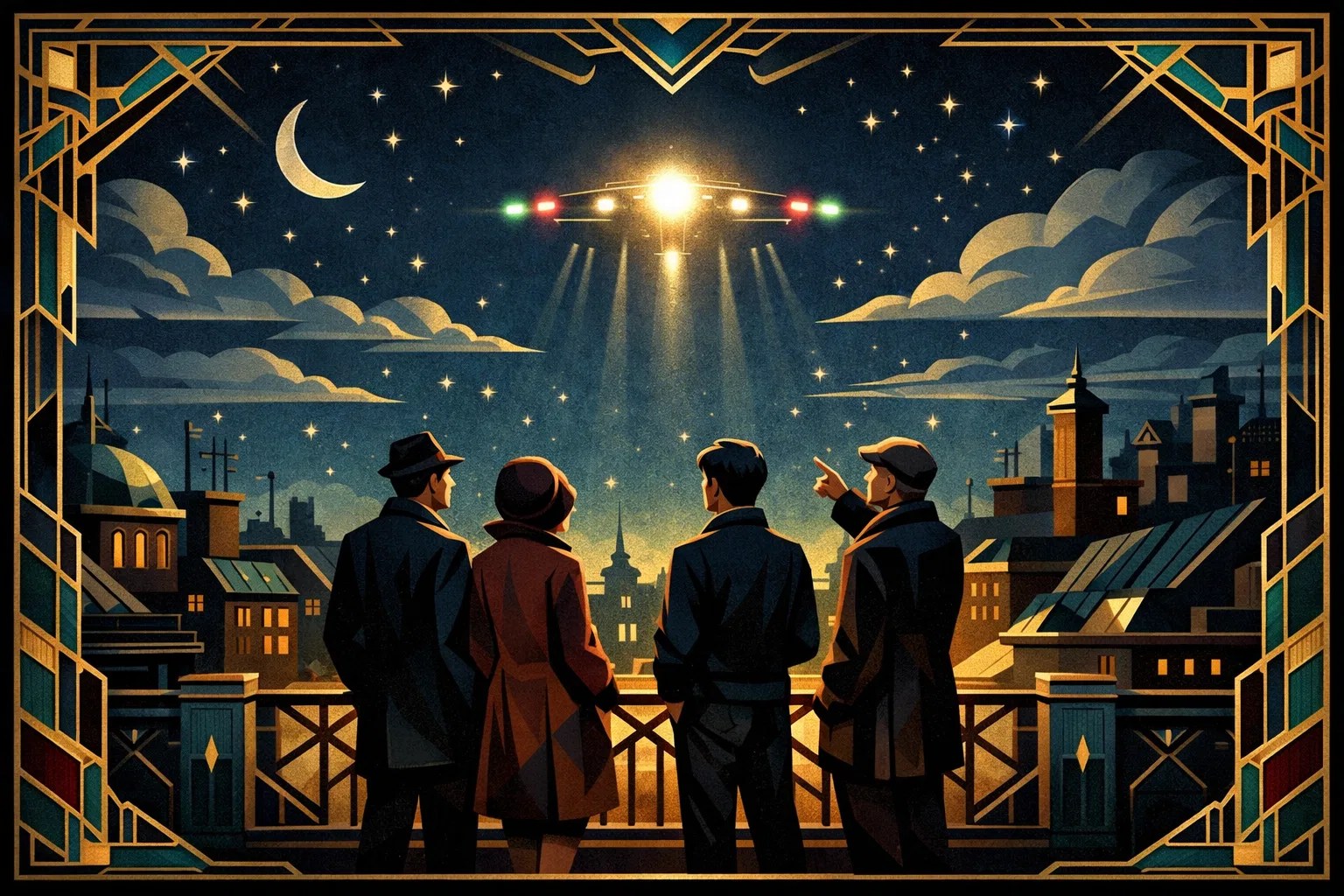
Distant aircraft are one of the most durable causes of UFO reports because they combine a real object, a real light and a misleading viewing geometry. A plane seen head-on may look motionless for several minutes; a landing light can outshine the red, green and white navigation lights that would normally give the game away; haze can erase the aircraft body; and a turn can make a steady light suddenly seem to accelerate, vanish or change direction. This is not a claim that every strange light is an aircraft. It is a specific mechanism: ordinary aircraft become convincing IFOs when distance, angle, lighting and expectation remove the cues people rely on to judge size, speed and identity.
The pattern is old enough to appear in official UFO-era records and current enough to matter in modern UAP analysis. The US Air Force’s Project Blue Book recorded 12,618 reports between 1947 and 1969, with 701 left unidentified, and the Air Force’s published conclusions did not find evidence that the unidentified residue represented extraterrestrial vehicles or technology beyond known science. [National Archives]archives.govNational Archives Project BLUE BOOKNational Archives Project BLUE BOOK In the aircraft-lights subset, the key question is usually not “could a plane have lights?” but “could this particular viewing angle make a plane look unlike a plane?”
Why planes can fool witnesses
A nearby aircraft is usually easy to recognise: you can see a fuselage, wings, engine noise, navigation lights and a path that makes sense. A distant aircraft often supplies only one or two of those clues. At night or dusk, a witness may see a bright point against a dark or hazy sky with no clear reference for range. Without distance, speed and size become guesses. A light that is five miles away and a light that is fifty miles away can look similar if the viewer has no landmarks, cloud layers or flight-track information to anchor the estimate.
This is why aircraft reports often contain sincere but misleading phrases such as “silent”, “hovering”, “huge”, “shot away” or “moved impossibly fast”. Sound may not carry clearly from a high or distant aircraft, especially in wind, traffic noise or urban background sound. A plane flying roughly towards the observer has little sideways movement across the field of view, so it may appear suspended in one place until it turns. A later turn can reveal side-on motion and make the object seem to “take off” suddenly, even though its speed has not changed.
Aviation safety material makes the same perceptual point from the opposite side: even trained pilots can misjudge lights at night. SKYbrary, an aviation safety knowledge base, notes that autokinesis can make a stationary light in the distance appear to move when watched against a dark background; it also warns that night approaches and poor visual cues distort judgements of position, distance and flight path. [Skybrary]skybrary.aeroVisual Illusions | SKYbrary Aviation SafetyVisual Illusions | SKYbrary Aviation Safety That matters for UFO reports because ground witnesses face an even harder version of the problem: they usually lack instruments, altitude information, radio calls and runway context.
The practical result is a common sighting sequence. A person notices a bright, silent light low in the sky. It seems fixed, or nearly fixed. Then it dims, splits into smaller lights, begins flashing, or moves away. The witness’s first interpretation — a hovering object — can feel confirmed by the minutes when the light barely moved. But the later change may simply be the aircraft turning, descending, changing landing-light angle, passing through haze, or revealing its navigation and anti-collision lights.
The aircraft light pattern that looks least like an aircraft
Aircraft lighting is designed for safety, not for making aircraft intuitive to distant observers. In US civil aviation rules, aircraft operating from sunset to sunrise must have lighted position lights, and aircraft equipped with anti-collision lights must generally use them unless the pilot decides that operating conditions make turning them off safer. [eCFR]ecfr.goveCFR:: 14 CFR 91.209 – Aircraft lights. (FAR 91.209)… In UK and European rules, aircraft at night similarly display anti-collision lights and, except for balloons, navigation lights intended to show the aircraft’s relative path. [Regulatory Library]regulatorylibrary.caa.co.uk00880 SERA3215 Lights to be displayed by aircraft00880 SERA3215 Lights to be displayed by aircraft
From the ground, however, those lights do not always read as a tidy “aircraft signature”. Position lights can be faint at range. Strobes may be hidden by angle, haze or cloud. Landing lights can dominate everything else. The FAA’s Aeronautical Information Publication says pilots are encouraged to use landing lights below 10,000 feet, day or night, especially within 10 miles of an airport, in reduced visibility, and in areas where birds may be expected. [Federal Aviation Administration]WikipediaFederal Aviation Administration That safety practice helps other pilots see the aircraft, but it also creates exactly the kind of intense single light that a ground observer may describe as a glowing orb.
This is especially important near airports, approach corridors and coastal or urban areas where aircraft may be descending with lights on long before the witness recognises the path. A plane on final approach can appear as a single white or yellow-white light for a surprisingly long time. If the wings are nearly level and the aircraft is aligned with the viewer, the red and green position lights may be too dim or too close together to separate. Only as the angle changes do the familiar blinking strobes and coloured lights become obvious.
The most misleading aircraft-light reports often share a few features:
- Low elevation near the horizon: haze, dust and thicker atmosphere dim the aircraft body while bright lights remain visible.
- Dusk or twilight: the sky is still bright enough to hide stars and aircraft structure, but dark enough for lights to stand out.
- Head-on motion: the aircraft’s true forward speed produces little apparent sideways motion.
- Approach or climb-out: landing lights, strobes and bank angles change rapidly as the aircraft lines up, turns or departs.
- No reliable range cue: without a known distance, a small close object and a large distant aircraft can be mentally swapped.
The important point is not that witnesses are careless. It is that the lighting system supplies partial information. Aircraft lights are excellent for collision avoidance; they are not a built-in identification label for someone several miles away on the ground.
Sunlight glints and approach lights
Some aircraft sightings happen before full darkness, when the confusing light is not a lamp but reflected sunlight. A polished fuselage, wing, canopy or high-altitude contrail can flare brightly while the rest of the aircraft remains invisible. Project Blue Book material explicitly noted that aircraft at high altitude and distance could appear in shapes ranging from discs to rockets because sunlight reflected from bright surfaces; it also noted that jet condensation trails could look fiery red or orange when reflecting sunlight. [ESD]esd.whs.milESDProject Blue BookESDProject Blue Book
This produces a different kind of “UFO” from the night-time landing-light case. Instead of a steady white point, the witness may see a bright metallic flash, a reddish streak, a cigar shape, or a glowing object that appears and disappears. The disappearance can feel dramatic, but the cause may be simple: the aircraft has changed angle, moved out of the sun-reflection geometry, or passed into a section of sky where haze and background brightness hide it.
Approach lights can be just as deceptive, but in a more patient way. A landing aircraft does not need to be close to seem bright. Powerful forward-facing lights can be visible from far away, and when the aircraft is travelling along a line close to the observer’s line of sight, the light may hold almost the same position against the background. The witness sees a “stationary” light; the pilot is actually covering miles.
Night visual-approach research shows why judging distance from lights alone is treacherous. SKYbrary notes that on clear nights lights can be seen from a long distance and distance is hard to judge without landmarks or electronic aids; in poor visibility, objects may appear farther away than they are. [Skybrary]skybrary.aeroNight Visual Approaches | SKYbrary Aviation SafetyNight Visual Approaches | SKYbrary Aviation Safety For a UFO witness, that same uncertainty can invert the story: a distant aircraft can be imagined as a nearby hovering object, or a nearby aircraft can be imagined as a huge object far away.
A useful test is whether the light eventually resolves into an aircraft pattern. Does it begin to show a red or green side light? Does a white strobe flash at intervals? Does it follow a plausible path towards or away from an airport? Does it align with known arrival routes? None of these checks is perfect, but together they often turn a strange light into an ordinary flight.
Afterburners, contrails and angle changes
Military jets add another layer because their exhaust, speed and manoeuvres can create reports that sound less like civil aviation. Project Blue Book’s explanatory material specifically identified afterburners as a source of UFO reports, noting that they can be visible from great distances when the aircraft itself cannot be seen. [ESD]esd.whs.milESDProject Blue BookESDProject Blue Book A distant afterburner glow may look like a fiery object, a fast-moving light, or a sudden flare in the sky. If the aircraft then changes heading, throttles back or passes behind haze, the light can seem to vanish abruptly.
Contrails can also mislead. At sunset, a high-altitude contrail may catch sunlight after the ground is already in shadow, turning orange, red or gold against a darker sky. Because the aircraft itself may be too small to see, the glowing trail can be read as an object. Wind shear and changing viewing angle can make the trail seem curved, broken or detached. This is not the same mechanism as a meteor or rocket plume, but to a casual viewer the visual vocabulary can overlap: streak, flame, glowing tail, sudden fade.
Angle change is the quietest but most common trick. A plane flying towards the viewer shows little lateral motion. A plane turning across the viewer’s line of sight suddenly shows much more. The aircraft has not accelerated in the way the witness’s brain may infer; the apparent motion across the background has changed. AARO’s 2024 information paper on forced perspective and parallax makes the broader point that, when range is uncertain, observers and electronic sensors can misinterpret an object’s true size, distance and speed; it specifically notes that parallax can make stationary objects appear to move and slow-moving objects appear very fast. [AARO]aaro.milEffect of Forced Perspective and Parallax View on UAP ObservationsEffect of Forced Perspective and Parallax View on UAP Observations
For aircraft sightings, this matters in both directions. A real fast aircraft can look stationary when its motion is mostly along the line of sight. A normal-speed aircraft can look suddenly fast when it turns across the line of sight. A distant aircraft can look close if its lights are bright and the body is hidden. These are not exotic errors; they are ordinary consequences of trying to reconstruct three-dimensional motion from a small light on a two-dimensional sky.
Why “silent” does not rule out an aircraft
Many aircraft-related UFO reports emphasise silence, and that detail deserves care. A loud jet overhead is easy to dismiss as a plane. A silent light feels stranger. But silence is not a reliable exclusion test unless the aircraft is demonstrably close.
Several ordinary factors weaken the sound cue. Distance reduces volume. Wind direction can carry sound away from the observer. Terrain, buildings, trees and traffic can mask engine noise. A high-altitude aircraft may be visible long before its sound would be noticeable, and a descending aircraft seen from ahead may not sound like the dramatic overhead pass a witness expects. Even when sound arrives, it may lag behind the visual position because sound travels far slower than light.
The perception problem is circular. If the witness assumes the light is nearby, silence seems impossible. If the light is actually far away, silence is expected. That is why distance estimation is the central issue. Without range, “silent” mostly means “no sound reached the witness clearly”, not “no aircraft was present”.
This is also why the strongest identifications use independent context: flight-tracking records, airport direction, weather, visibility, time stamps, video metadata and multiple witnesses from separated locations. NASA’s UAP study page frames the scientific challenge in similar terms, emphasising available data, better data collection and methods that can move observations from ambiguous reports towards testable explanations. [NASA Science]science.nasa.govScience UAPScience UAP For distant aircraft lights, the decisive data are often mundane: exact time, compass direction, elevation, nearby airports and whether the object followed an arrival or departure corridor.
How to check an aircraft-light explanation
The aircraft explanation becomes stronger when several details line up, not when someone merely says “it was probably a plane”. A careful check asks what the witness actually saw before assigning a label. The most useful observations are time, location, compass bearing, elevation above the horizon, duration, colour, flash pattern, direction of travel and whether the object changed appearance as it moved.
A practical aircraft-light check usually follows this path:
- Look for a head-on approach. A bright light that sits nearly still, then later reveals blinking lights or sideways movement, fits a common aircraft geometry.
- Check airport alignment. If the light appears along a known approach or departure path, especially below 10,000 feet or near an airport, landing-light use becomes more plausible.
- Separate lamps from reflected sunlight. A steady dusk glint that appears and disappears with angle may be reflection, not propulsion or self-luminosity.
- Treat speed estimates cautiously. Without range, a claim of impossible speed is weak. Apparent motion across the sky can change sharply when an aircraft turns.
- Use independent records. Flight trackers, air traffic context, weather and multiple viewing locations can confirm or weaken the aircraft hypothesis.
This method also protects against over-explaining. Some reports genuinely lack enough information. Others involve drones, satellites, balloons, planets, flares, birds or sensor artefacts rather than aircraft. A good IFO analysis does not force every light into the same box; it tests whether the aircraft mechanism fits the timing, direction, light behaviour and viewing conditions.
What aircraft lights teach about IFO reports
Aircraft lights are a useful IFO category because they show how a report can be honest, vivid and still wrong about the object’s nature. The witness may accurately describe a bright light, a period of apparent hovering, a sudden change in motion and no audible engine. The error enters when those perceptions are converted into distance, size, speed and intent.
That distinction is central to serious UFO analysis. “It was a plane” is not a satisfying explanation unless it explains the strange parts of the report. In the aircraft-lights mechanism, the strange parts often come from the same few causes: head-on motion, bright forward lights, haze or twilight, loss of body detail, poor distance cues, reflected sunlight, exhaust glow, contrails and angle changes. When those factors are present, ordinary aircraft can look silent, stationary, enormous, fiery, impossibly fast or unlike aircraft at all.
The best takeaway is not cynicism about witnesses. It is discipline about geometry. Before a distant light becomes evidence for something extraordinary, the ordinary three-dimensional scene has to be reconstructed: where the observer was, where the light was, how far away it might have been, what aircraft were in the area, and how the viewing angle changed. In many cases, that reconstruction turns a UFO back into an IFO: a real aircraft seen under conditions that made it briefly unrecognisable.
Amazon book picks
Further Reading
Books and field guides related to Why Ordinary Aircraft Look So Strange. Use these as the next step if you want deeper reading beyond the article.
The Report on Unidentified Flying Objects
Contains numerous aircraft explanation examples.
eBay marketplace picks
Marketplace Samples
Example marketplace items related to this page. Use the search link to explore similar finds on eBay.

Endnotes
-
Source: archives.gov
Title: National Archives Project BLUE BOOK
Link: https://www.archives.gov/research/military/air-force/ufos -
Source: af.mil
Title: Air Force
Link: https://www.af.mil/About-Us/Fact-Sheets/Display/Article/104590/unidentified-flying-objects-and-air-force-project-blue-book/Source snippet
Unidentified Flying Objects and Air Force Project Blue Book > Air Force > Fact Sheet Display...
-
Source: skybrary.aero
Title: Visual Illusions | SKYbrary Aviation Safety
Link: https://skybrary.aero/articles/visual-illusions -
Source: skybrary.aero
Title: Night Visual Approaches | SKYbrary Aviation Safety
Link: https://skybrary.aero/articles/night-visual-approaches -
Source: ecfr.gov
Link: https://www.ecfr.gov/current/title-14/chapter-I/subchapter-F/part-91/subpart-C/section-91.209Source snippet
eCFR:: 14 CFR 91.209 -- Aircraft lights. (FAR 91.209)...
-
Source: faa.gov
Link: https://www.faa.gov/air_traffic/publications/atpubs/aip_html/part2_enr_section_1.1.html -
Source: esd.whs.mil
Title: ESDProject Blue Book
Link: https://www.esd.whs.mil/Portals/54/Documents/FOID/Reading%20Room/UFOsandUAPs/proj_b1.pdf?ver=2017-05-22-113513-837 -
Source: aaro.mil
Title: Effect of Forced Perspective and Parallax View on UAP Observations
Link: https://www.aaro.mil/Portals/136/PDFs/Information%20Papers/AARO_Effect_of_Forced_Perspective_and_Parallax_View_on_UAP_Observations_2024.pdf -
Source: science.nasa.gov
Title: Science UAP
Link: https://science.nasa.gov/uap/ -
Source: faa.gov
Link: https://www.faa.gov/ -
Source: faa.gov
Link: https://www.faa.gov/sites/faa.gov/files/regulations_policies/handbooks_manuals/aviation/airplane_handbook/12_afh_ch11.pdf -
Source: faa.gov
Link: https://www.faa.gov/sites/faa.gov/files/Night_Ops_Ch13.pdf -
Source: aaro.mil
Link: https://www.aaro.mil/ -
Source: aaro.mil
Link: https://www.aaro.mil/UAP-Cases/Official-UAP-Imagery/ -
Source: aaro.mil
Link: https://www.aaro.mil/UAP-Cases/UAP-Case-Resolution-Reports/ -
Source: science.nasa.gov
Title: uap independent study team final report
Link: https://science.nasa.gov/wp-content/uploads/2023/09/uap-independent-study-team-final-report.pdf -
Source: skybrary.aero
Link: https://skybrary.aero/articles/federal-aviation-administration-faa -
Source: skybrary.aero
Link: https://skybrary.aero/sensory-illusions-skyclip -
Source: skybrary.aero
Link: https://skybrary.aero/bookshelf/understanding-visual-illusions-and-disorientation -
Source: skybrary.aero
Link: https://skybrary.aero/sites/default/files/bookshelf/3424.pdf -
Source: regulatorylibrary.caa.co.uk
Title: 00880 SERA3215 Lights to be displayed by aircraft
Link: https://regulatorylibrary.caa.co.uk/923-2012/Content/Regs/00880_SERA3215_Lights_to_be_displayed_by_aircraft.htm -
Source: Wikipedia
Title: Federal Aviation Administration
Link: https://en.wikipedia.org/wiki/Federal_Aviation_Administration -
Source: Wikipedia
Title: Project Blue Book
Link: https://en.wikipedia.org/wiki/Project_Blue_Book -
Source: Wikipedia
Title: Landing lights
Link: https://en.wikipedia.org/wiki/Landing_lights -
Source: facebook.com
Link: https://www.facebook.com/FAA/?locale=en_GB -
Source: epicflightacademy.com
Title: aircraft lights
Link: https://epicflightacademy.com/aircraft-lights/ -
Source: ukfsc.co.uk
Title: skybrary highlights
Link: https://www.ukfsc.co.uk/skybrary/skybrary-highlights/ -
Source: bahaistudies.net
Title: project blue book
Link: https://www.bahaistudies.net/asma/project_blue_book.pdf -
Source: play.google.com
Link: https://play.google.com/store/apps/details?hl=en_GB&id=com.gaiamobile.channel20
Additional References
-
Source: cia.gov
Link: https://www.cia.gov/readingroom/document/cia-rdp81r00560r000100010001-0 -
Source: govinfo.gov
Link: https://www.govinfo.gov/content/pkg/CHRG-89hhrg50066O/pdf/CHRG-89hhrg50066O.pdf -
Source: vedantu.com
Link: https://www.vedantu.com/maths/14-in-words -
Source: aui.edu
Link: https://aui.edu/aaro-releases-report-on-unidentified-anomalous-phenomena-uap/ -
Source: flywat.com
Link: https://flywat.com/pages/aircraft-lighting-regulations -
Source: facebook.com
Link: https://www.facebook.com/nsibofficial/posts/aircraft-lighting-ensures-safe-flight-operations-through-four-key-types-of-light/915547463938238/ -
Source: reddit.com
Link: https://www.reddit.com/r/askastronomy/comments/1os4a0p/any_idea_what_this_is/ -
Source: facebook.com
Link: https://www.facebook.com/groups/deafpilots/posts/1545660949225139/ -
Source: reddit.com
Link: https://www.reddit.com/r/UFOs/comments/1g3xs9k/can_someone_explain_to_me_what_this_is/ -
Source: facebook.com
Link: https://www.facebook.com/AVIO.KNOWLEDGE/posts/captured-a-stunning-parallax-effect-from-one-aircraft-to-another-in-flight-this-/1526781522821665/
Topic Tree