Within Birds
When the Bird Explanation Fails the Sensor Test
AARO rejected a bird explanation for the 2013 Puerto Rico case because expected wings or wing-beat signatures were not evident at reconstructed ranges.
On this page
- What a bird hypothesis would predict at the reconstructed range
- Why missing wings and pulsation mattered to the assessment
- What the case shows about limits of the orb like bird explanation
Page outline Jump by section
Introduction
The 2013 Puerto Rico UAP is an important counter-example to the idea that any rounded infrared target can safely be labelled a bird. In its March 2025 resolution of the Aguadilla incident, the US All-domain Anomaly Resolution Office (AARO) explicitly considered a marine-bird hypothesis and rejected it as unlikely. Its reason was not simply that the objects looked too round. AARO argued that its reconstruction placed them at ranges where real birds should still have betrayed their identity: either through visible anatomical features such as wings or through a repeating infrared pulsation associated with wing beats. Neither diagnostic signature was evident.[AARO]aaro.milPuerto Rico UAP Case ResolutionAARO Puerto Rico UAP Case Resolution…
That distinction matters. Infrared cameras can certainly turn sufficiently distant birds into indistinct blobs, and AARO has resolved other military infrared recordings as birds. But the Puerto Rico assessment shows that investigators cannot work backwards from “orb-like” appearance alone. The bird explanation has to survive tests involving range, resolution, movement and the expected temporal signature of flapping flight.[AARO]aaro.milUAP ImageryAARO UAP Imagery…
What a bird should have looked like at the reconstructed range
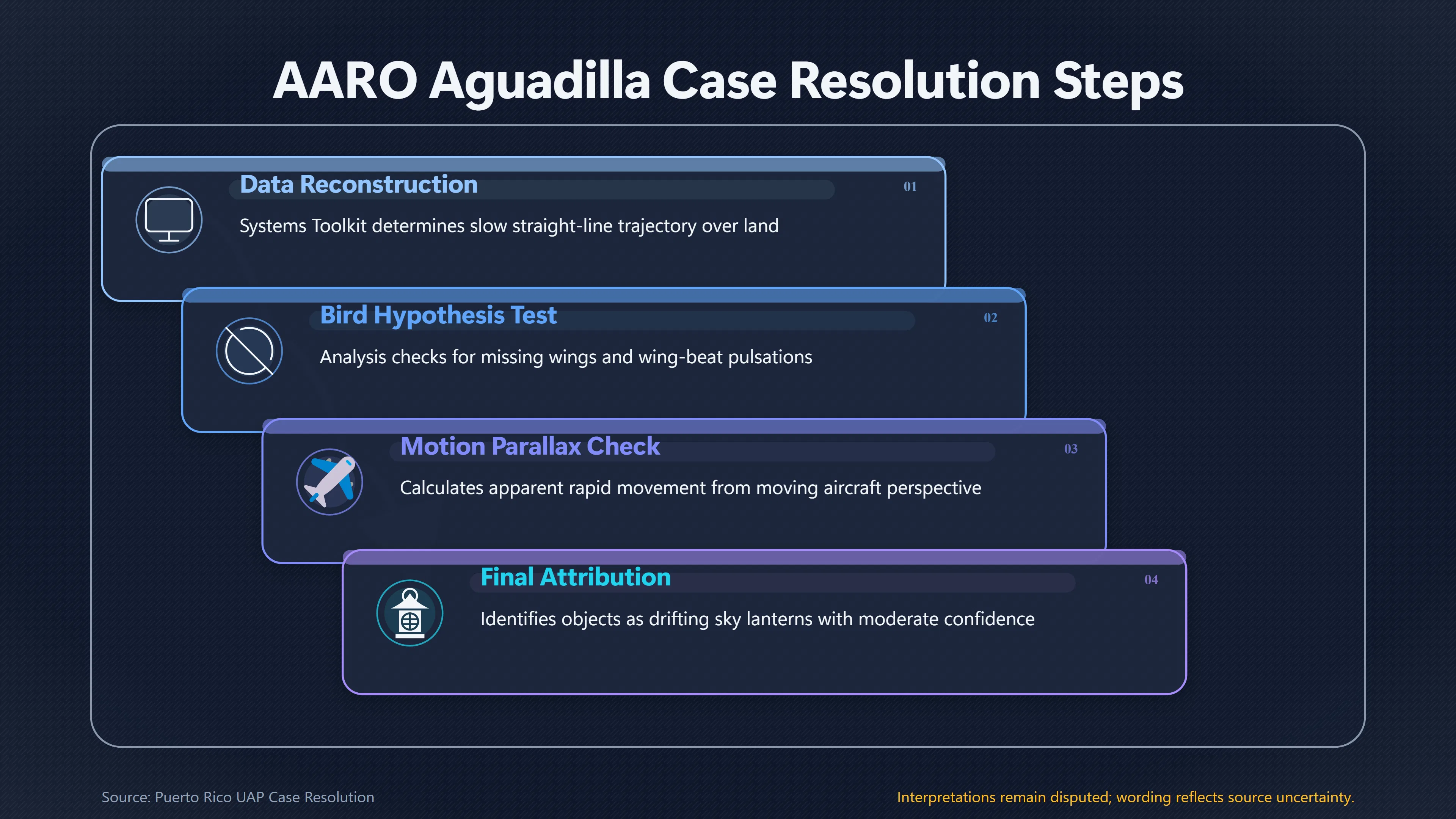
The Puerto Rico footage was recorded on 26 April 2013 by an infrared sensor aboard a US Customs and Border Protection aircraft near Rafael Hernández Airport at Aguadilla. AARO’s reconstruction radically changed the geometry implied by some earlier interpretations of the video. It concluded that there were two objects rather than one object dividing in two, and that they travelled over land rather than entering the Atlantic. The office placed their initial altitude at about 200 metres (656 feet) and reconstructed their motion at roughly 3.6 metres per second, or 8 mph, close to the recorded wind speed of 4.4 metres per second.[AARO]aaro.milPuerto Rico UAP Case ResolutionAARO Puerto Rico UAP Case Resolution…
That reconstructed geometry was crucial to the bird question. An AARO partner had proposed a substantially different scenario: two marine birds travelling at an estimated 35–130 mph at altitudes of 300–900 feet, descending towards the Atlantic. The partner itself noted that the poor data quality made identification difficult. AARO rejected that interpretation because its Systems Toolkit (STK) reconstruction instead indicated a slow, straight, wind-speed trajectory over land.[AARO]aaro.milPuerto Rico UAP Case ResolutionAARO Puerto Rico UAP Case Resolution…
More importantly for the imagery, AARO stated that birds seen through an infrared sensor at the distances involved in this encounter should retain identifiable features, including wings, or produce pulsation at the frequency of their wing beats.[AARO]aaro.milPuerto Rico UAP Case ResolutionAARO Puerto Rico UAP Case Resolution… This is a narrower and more useful claim than saying that infrared cameras always show bird anatomy. They plainly do not. AARO’s position was that these particular reconstructed viewing distances were not sufficient to explain away both the missing morphology and the missing wing-beat signature.
The report also estimated through pixel analysis that each Puerto Rico object was smaller than one metre across, although its shape remained indistinct. That combination is significant: AARO believed the imagery contained enough information to constrain the object’s approximate size while still not revealing the features it expected from a bird.[AARO]aaro.milPuerto Rico UAP Case ResolutionAARO Puerto Rico UAP Case Resolution…
There is an important qualification. The published report does not provide a detailed bird-resolution calculation showing, frame by frame, precisely how many pixels a particular species’ wings should occupy. Nor does it identify a candidate bird species and model its wingspan against the sensor’s instantaneous field of view. The public document therefore gives AARO’s conclusion about expected visibility rather than enough underlying calculation for an independent reader to reproduce that particular test completely. That limits how strongly the published bird rejection can be independently audited.
Why missing wings and pulsation mattered
The absence of an obvious bird silhouette would be weak evidence by itself. Infrared targets become progressively less recognisable as range increases, and AARO acknowledges that the Puerto Rico recording deteriorated during the encounter: the aircraft-to-object distance nearly tripled, while scattered clouds and changing thermal contrast also reduced sensor fidelity.[AARO]aaro.milPuerto Rico UAP Case ResolutionAARO Puerto Rico UAP Case Resolution…
AARO nevertheless treated the absence of avian signatures as meaningful because it expected two different kinds of evidence from birds.
The first was spatial: wings or other recognisable morphology. The second was temporal: periodic variation in the infrared return corresponding to wing beats. These are partly independent clues. A bird might be too poorly resolved for individual feathers or a clean silhouette while still producing a rhythmic signal as its projected area and thermal presentation change through successive wing strokes.
AARO’s treatment of another military infrared case demonstrates that this is not merely a theoretical criterion inserted into the Puerto Rico report. In case PR-016, recorded in Europe in 2023, AARO concluded with high confidence that the objects were almost certainly birds. Among its reasons were morphological similarities to other known bird imagery, relative positioning consistent with energy-saving group flight and a pulsating infrared return at a frequency consistent with wing beats.[AARO]aaro.milUAP ImageryAARO UAP Imagery…
That comparison provides a useful control case. In PR-016, pulsation helped turn ambiguous infrared objects into identifiable birds. In Puerto Rico, AARO specifically cited the absence of such expected pulsation, alongside the absence of identifiable wings, against the marine-bird interpretation.[AARO]aaro.milPuerto Rico UAP Case ResolutionAARO Puerto Rico UAP Case Resolution…
The logic is therefore stronger than “birds have wings, and no wings are visible”. It is closer to a prediction test:
- If the targets were birds at the reconstructed distances, AARO expected some morphological or wing-beat evidence.
- The footage did not provide the expected evidence.
- The reconstructed trajectory was also slow, straight and close to wind speed rather than matching the faster marine-bird trajectory proposed by the partner.
- AARO therefore regarded birds as less consistent with the complete sensor-and-trajectory model than a passive airborne explanation.[AARO]aaro.milPuerto Rico UAP Case ResolutionAARO Puerto Rico UAP Case Resolution…
This is also why simply pointing out that distant birds can look like featureless infrared orbs does not settle this case. That general observation is true, but the relevant question is whether the Puerto Rico objects were distant enough, small enough and poorly resolved enough for the expected bird signatures to disappear. AARO’s answer was no.
Why AARO preferred sky lanterns instead
Rejecting birds did not lead AARO to classify the objects as anomalous technology. Instead, the office assessed with moderate confidence that they were a pair of sky lanterns, while reaching the stronger, high-confidence conclusion that they displayed no anomalous performance or transmedium capability.[AARO]aaro.milPuerto Rico UAP Case ResolutionAARO Puerto Rico UAP Case Resolution…
Several reconstructed properties moved the case towards passive airborne objects. AARO calculated a straight-line speed of about 8 mph, close to the measured 9.8 mph wind. It attributed the striking impression of rapid motion to motion parallax — the apparent movement created by viewing a comparatively slow object from a moving aircraft through a magnified sensor.[AARO]aaro.milPuerto Rico UAP Case ResolutionAARO Puerto Rico UAP Case Resolution…
The apparent splitting was likewise reinterpreted. AARO identified occasions within the first minute when two targets could already be distinguished. As the aircraft climbed, its viewing angle changed from relatively side-on to more top-down, making the separation between the two objects increasingly obvious. The office therefore concluded that the video showed two nearby objects throughout rather than one object physically dividing.[AARO]aaro.milPuerto Rico UAP Case ResolutionAARO Puerto Rico UAP Case Resolution…
Those findings fit the sky-lantern hypothesis better than the marine-bird proposal because passive lanterns would naturally drift with the wind. AARO also reported checking with local hospitality businesses and finding that releasing sky lanterns during celebrations was common in the area. It noted that such lanterns are generally under a metre across and can produce a flickering, weakening thermal signature as their fuel is consumed — characteristics it regarded as consistent with the footage.[AARO]aaro.milPuerto Rico UAP Case ResolutionAARO Puerto Rico UAP Case Resolution…
Even here, AARO stopped short of certainty. It described the attribution as only moderate confidence, explicitly saying that the poor video quality prevented categorical identification.[AARO]aaro.milPuerto Rico UAP Case ResolutionAARO Puerto Rico UAP Case Resolution… That distinction is easy to lose in summaries of the case: AARO was highly confident that the extraordinary-looking behaviour was an artefact of geometry and sensor effects, but less confident about exactly what the two ordinary objects were.
Sensor artefacts did not automatically rescue the bird hypothesis
One potentially confusing feature of AARO’s analysis is that the office repeatedly emphasised limitations of the infrared imagery. If sensor degradation could erase the targets against the background, why could it not also erase their wings?
The answer lies in when and how AARO invoked those limitations. The report says that the aircraft-to-target range nearly tripled during the observation, that scattered clouds at about 3,000 feet could reduce thermal contrast, and that the encounter occurred roughly 94 minutes after sunset, within a period when thermal crossover could make objects and their background harder for an infrared system to distinguish. AARO used these factors primarily to explain the objects’ intermittent disappearance and the illusion that they entered the sea.[AARO]aaro.milPuerto Rico UAP Case ResolutionAARO Puerto Rico UAP Case Resolution…
AARO did not regard those limitations as severe enough to make every interpretation equally plausible. It said the sensor data were sufficiently detailed to resolve the case’s anomalous-performance question with high confidence, while separately acknowledging that image quality reduced confidence in the precise identification.[AARO]aaro.milPuerto Rico UAP Case ResolutionAARO Puerto Rico UAP Case Resolution…
This creates a useful hierarchy of claims. The office considered the geometry and trajectory relatively well constrained; exact object identity was less certain. Within that second question, it still judged birds inconsistent with the signatures expected at the reconstructed ranges. The fact that later frames became poorer does not, in AARO’s analysis, mean that the entire recording was always below the threshold at which avian characteristics could have appeared.

The bird rejection is useful, but not a universal sensor rule
The Puerto Rico case is especially instructive because it puts a limit on a perfectly legitimate UAP explanation. Birds really can become tiny, rounded or otherwise ambiguous targets in military infrared imagery. AARO’s own PR-016 bird resolution demonstrates that military sensors record objects that initially require interpretation rather than presenting unmistakable wildlife photographs.[AARO]aaro.milUAP ImageryAARO UAP Imagery…
But “birds can look like orbs” is a mechanism, not an identification. Applying it responsibly requires checking whether the geometry predicts that a bird should actually be unresolved. If reconstructed range and sensor performance imply that wings ought to remain detectable, their persistent absence counts against the hypothesis. If spatial detail is marginal but the recording is long enough to reveal rhythmic wing-beat modulation, the temporal signal becomes another test.
Puerto Rico also illustrates why the apparent behaviour of an infrared blob should not be analysed independently of the camera platform. A target that appears to race across the landscape may actually be drifting slowly while the aircraft moves around it. A target that seems to divide may be two closely spaced objects becoming separately resolved as viewing geometry changes. And an object that seems to disappear against water may simply have lost sufficient thermal contrast for the sensor to distinguish it. AARO invoked all three effects in reconstructing Aguadilla.[AARO]aaro.milPuerto Rico UAP Case ResolutionAARO Puerto Rico UAP Case Resolution…
The resulting lesson is narrower than either extreme in the UAP debate. The Puerto Rico footage does not show that rounded infrared targets cannot be birds; other AARO cases demonstrate that they can. Nor did rejecting birds leave the Aguadilla objects unexplained. AARO instead found that the bird hypothesis failed predictions it believed the sensor data should satisfy and judged slow-moving sky lanterns a better fit, albeit only with moderate confidence.[AARO]aaro.milPuerto Rico UAP Case ResolutionAARO Puerto Rico UAP Case Resolution…
For assessing supposed “orbs” on military sensors, that is the important precedent: shape alone is not enough to identify a bird, but shape alone is not enough to exclude one either. The useful evidence comes from asking what a bird should look and behave like at the reconstructed range — and then checking whether those predicted signatures are actually present.
Amazon book picks
Further Reading
Books and field guides related to When the Bird Explanation Fails the Sensor Test. Use these as the next step if you want deeper reading beyond the article.
The UFO Handbook: A Guide to Investigating, Evaluating, and R...
An explanation of the usual reasons for confusing IFOs (identified flying objects) with UFOs and a survey of the tools used to investigat...
The UFO Experience: A Scientific Inquiry
The author belives that a number of UFO siting are still to be explained.
Infrared Thermal Imaging: Fundamentals, Research and Applicat...
This richly illustrated hands-on guide is designed for researchers, teachers and practitioners. The huge selection of examples taken from...
eBay marketplace picks
Marketplace Samples
Live-tested eBay searches with available results related to this page.
Selected fromUFO poster oneBay.co.uk.

Current eBay listing
VINTAGE UFO FLYING SAUCERS COMIC ADVERTISING A2 POSTER PRINT



Current eBay listing
I Want To Believe UFO Poster Giclée Fine Art Heavyweight Print
Endnotes
1.
Source: aaro.mil
Title: Puerto Rico UAP Case Resolution
Link:https://www.aaro.mil/Portals/136/PDFs/case_resolution_reports/AARO_Puerto_Rico_UAP_Case_Resolution.pdf
Source snippet
AARO Puerto Rico UAP Case Resolution...
2.
Source: aaro.mil
Title: UAP Imagery
Link:https://www.aaro.mil/UAP-Cases/Official-UAP-Imagery/4/
Source snippet
AARO UAP Imagery...
3.
Source: aaro.mil
Link:https://www.aaro.mil/Next-AARO-Home-redesign/Next-Parent/Next-AARO-UAP-Imagery-Acc-Table/
Source snippet
Next - AARO UAP Imagery Acc Table...
4.
Source: dvidshub.net
Link:https://www.dvidshub.net/video/944204/puerto-rico-objects
Source snippet
Video - Puerto Rico Objects...
5.
Source: aaro.mil
Link:https://www.aaro.mil/Portals/136/PDFs/SASC_AARO_Open_Hearing_Case_Slides_19Nov2024.pdf?ver=Hec1SwKwP-4zSRJwIEIlJw%3D%3D
Source snippet
AARO Open Hearing Case Slides: Senate Armed Services Subcommittee on Emerging Threats and Capabilities...
Additional References
6.
Source: youtube.com
Link:https://www.youtube.com/watch?v=mvsU4p0Gsas
Source snippet
The Proof Is Out There: 5 Mysteries That Will Stun You | History...
7.
Source: youtube.com
Title: Limina Inaugural Symposium Day 3
Link:https://www.youtube.com/watch?v=BahEq46t3Uo
Source snippet
Breaking Down UAP Footage with the Head of The Pentagon's UAP Taskforce, Dr. Jon Kosloski...
8.
Source: youtube.com
Title: UFO FILES: FOIA VIDEO RELEASE of the ‘Aguadilla UAP’ in Puerto Rico
Link:https://www.youtube.com/watch?v=cuSZDrBDgb8
Source snippet
Limina Inaugural Symposium Day 3 - Mick West...
9.
Source: youtube.com
Title: The Proof Is Out There: 5 Mysteries That Will Stun You | History
Link:https://www.youtube.com/watch?v=C_q8A4khkeE
Source snippet
UAP & SETI: Evolving Paradigms | Robert Powell...
10.
Source: youtube.com
Title: UAP & SETI: Evolving Paradigms | Robert Powell
Link:https://www.youtube.com/watch?v=cUCU1u47LQk