Within Mirages
Can a Distant Aircraft Appear Somewhere Else?
A distant aircraft near the horizon can appear displaced or deformed when its light crosses a strong refractive layer under the right geometry.
On this page
- How aircraft lights can enter a strongly refracting layer
- Why displacement can outlast recognition of the aircraft
- What evidence is needed before calling a sighting a mirage
Page outline Jump by section
Introduction
Yes. Under the right conditions, the lights of a distant aircraft can reach an observer along a strongly curved optical path through a temperature inversion, so that the aircraft appears displaced from its true direction. The effect is most plausible when the aircraft is low in the observer’s sky and its light meets a strong, horizontally extensive refracting layer at a very shallow angle. A superior mirage can raise the apparent image; stronger or more complicated refractive structure can also stretch, compress, duplicate or destabilise it. The World Meteorological Organization notes that mirages can shift distant objects substantially in angle and can even make objects normally hidden below the horizon visible.[International Cloud Atlas]cloudatlas.wmo.intInternational Cloud Atlas Mirage | International Cloud AtlasInternational Cloud Atlas Mirage | International Cloud Atlas
For UFO or UAP identification, however, the important word is can. An inversion by itself does not establish that an unexplained aircraft-like light was a mirage. The aircraft’s real position, the observer’s position, the viewing angle and the vertical structure of the atmosphere must fit the optical geometry.[NCAS Files]files.ncas.orgFiles Condon Report, Sec VI, Chapter 4: Optical MirageNCAS FilesCondon Report, Sec VI, Chapter 4: Optical Mirage…
How aircraft lights enter a strongly refracting layer
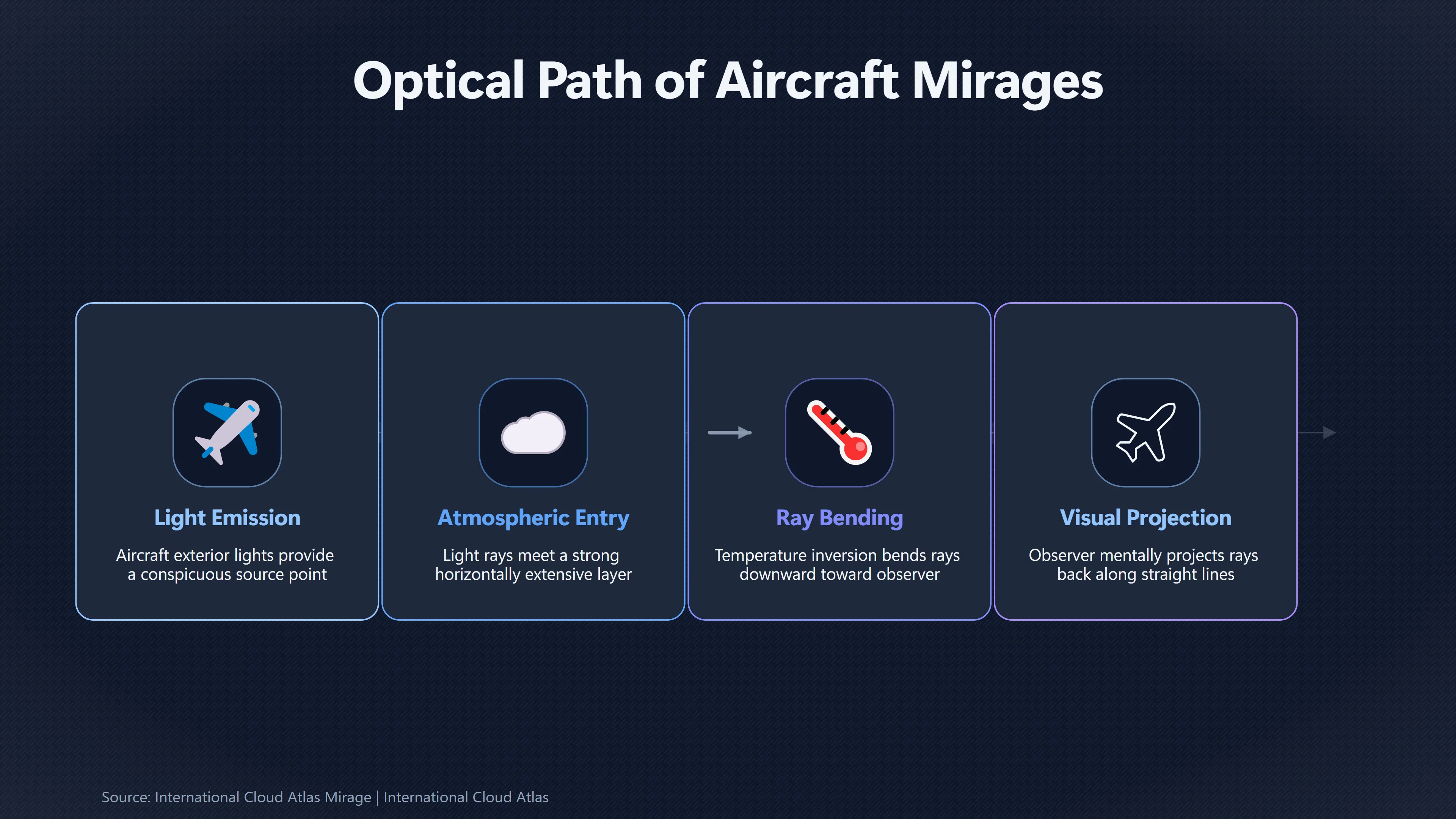
A temperature inversion is a layer in which temperature increases with height, reversing the more usual tendency for air to become colder aloft. Such layers commonly place warmer, less dense air above colder, denser air. Because the refractive index of air varies with its density, a sufficiently strong vertical gradient can bend nearly horizontal light rays downwards. An observer receiving those rays projects them mentally backwards along a straight line and therefore places the source in a direction different from its true one.[Met Office]weather.metoffice.gov.ukMet Office What is a temperature inversion?Met OfficeWhat is a temperature inversion? - Met Office…
This is the optical basis of a superior mirage. The World Meteorological Organization describes mirages as images of distant objects that can be single or multiple, upright or inverted, enlarged or reduced; their apparent angle above the horizon can differ markedly from the object’s real angle. Under exceptional conditions, refraction can even bring something geometrically below the horizon into view.[International Cloud Atlas]cloudatlas.wmo.intInternational Cloud Atlas Mirage | International Cloud AtlasInternational Cloud Atlas Mirage | International Cloud Atlas
Aircraft provide plausible sources because their exterior lights can remain conspicuous after the aeroplane itself has become impossible to resolve. The US Federal Aviation Administration describes landing lights as a means of making aircraft visible to other pilots at night and encourages their use below 10,000 feet, particularly near airports. Its current flying handbook also warns that aircraft lights can blend with stars or city lights at night.[Federal Aviation Administration]faa.govFederal Aviation Administration ENR 1.1: General RulesFederal Aviation Administration ENR 1.1: General Rules
The crucial restriction is geometry. The Condon UFO study’s technical chapter on optical mirages concluded that even a large temperature gradient is not sufficient: the refracting layer must also be illuminated at grazing incidence. In practical terms, light from the aircraft must travel almost along the layer rather than cutting steeply through it. That makes a distant aircraft close to the apparent horizon much more credible as a mirage source than one high overhead.[NCAS Files]files.ncas.orgFiles Condon Report, Sec VI, Chapter 4: Optical MirageNCAS FilesCondon Report, Sec VI, Chapter 4: Optical Mirage…
A useful mental model is therefore not an inversion acting as a giant mirror that can relocate any aeroplane anywhere in the sky. It is a narrow optical arrangement involving the source, observer and refractive layer. A slight change in aircraft altitude, observer height, range or atmospheric structure can move the ray path out of the favourable region and make the effect weaken or disappear.
Why the displaced light may stop looking like an aircraft
At great distance, an observer may not actually be seeing a recognisable aeroplane. They may principally see one or several bright points produced by its landing, navigation or anti-collision lights. This distinction matters because a small angular displacement can have a large effect on interpretation when there is no visible fuselage, horizon reference or reliable estimate of range.
Distance itself creates ambiguity. During the 2024 wave of reports about unidentified night-time objects in the United States, aviation specialists interviewed by the Associated Press emphasised how little information a bare light provides: a bright point can be surprisingly difficult to place at the correct range, while ordinary aircraft carry navigation, anti-collision and powerful landing lights.[AP News]apnews.comAP News Is that a drone or a plane?Experts help explain the differencesDecember 16, 2024 — Distinguishing drones from planes and helicopters can be challenging from a dista…
Refraction can remove still more of the familiar context. Instead of seeing an aircraft at the position expected from its actual flight path, the witness may receive a displaced image above it. The Condon study estimated, for the simplified mirage boundary it analysed, a maximum separation of roughly one degree between the true light source and its refracted image. That is not a universal limit for every atmospheric-optical configuration — the WMO records larger apparent displacements for mirages generally — but it illustrates how an ordinary light can be separated noticeably from its physical source.[NCAS Files]files.ncas.orgFiles Condon Report, Sec VI, Chapter 4: Optical MirageNCAS FilesCondon Report, Sec VI, Chapter 4: Optical Mirage…
Complex refractive structures can do more than shift a point uniformly. Where an atmospheric duct develops within a strong inversion, different ray paths can produce erect and inverted images and substantial vertical deformation. SKYbrary, an aviation-safety reference, stresses that a temperature inversion alone is not sufficient for the elaborate Fata Morgana form: the necessary ducting structure must also exist.[Skybrary]skybrary.aeroFata Morgana | SKYbrary Aviation SafetyFata Morgana | SKYbrary Aviation Safety…
For an unresolved aircraft light, such distortion need not look like the spectacular photographs of miraged ships often used to illustrate the phenomenon. The source may contain too little visible detail for the observer to recognise an inverted aeroplane. Instead, the perceptible result might simply be an unusually positioned light, an elongated glow, separated points or an image whose apparent elevation changes as the ray paths and source geometry evolve.
This helps explain a particular identification trap. The aircraft itself continues along an ordinary trajectory, but the visible image is controlled both by that trajectory and by propagation through the refractive layer. Changes in the aircraft’s heading or altitude, or small changes in the layer, can therefore alter the apparent light without requiring the physical aircraft to perform the same apparent manoeuvre.
A UFO-era example shows both the possibility and the limits
One of the more instructive historical discussions appears in the Condon study’s analysis of a 19 September 1957 incident involving a B-47 aircraft over the Louisiana–Texas region. Investigators considered whether a bright unexplained light could have been a combined radio-optical mirage of another aircraft flying at great distance just below a thin inversion layer. The proposed source would have needed to occupy a rather particular geometrical position relative to the B-47 and the inversion.[NCAS Files]files.ncas.orgFiles Condon Report, Sec III, Chapter 5: Optical & Radar AnalysisNCAS FilesCondon Report, Sec III, Chapter 5: Optical & Radar Analysis…
The investigators did not present that explanation as established fact. They identified several requirements and unresolved problems and ultimately concluded that no tenable solution could be reached from the available information. Among their objections was that parts of the reported geometry would have involved too large a grazing angle for an ordinary mirage.[NCAS Files]files.ncas.orgFiles Condon Report, Sec III, Chapter 5: Optical & Radar AnalysisNCAS FilesCondon Report, Sec III, Chapter 5: Optical & Radar Analysis…
That failed or incomplete identification is useful precisely because it demonstrates how aircraft-mirage hypotheses should be handled. Atmospheric refraction is physically real, and a distant aircraft can in principle provide the source. But a plausible-sounding combination of “aircraft plus inversion” is not enough. The proposed optical path has to survive comparison with the actual bearings, elevations, distances and atmospheric profile.
The broader Condon optical analysis reached much the same methodological point. Strong inversions extending for tens of kilometres can occur and can favour mirage formation when visibility is also good, but the detailed meteorological measurements needed to reconstruct a particular sighting were often unavailable.[NCAS Files]files.ncas.orgFiles Condon Report, Sec VI, Chapter 4: Optical MirageNCAS FilesCondon Report, Sec VI, Chapter 4: Optical Mirage…
Why displacement can outlast recognition of the aircraft
A particularly misleading configuration occurs when the source remains bright while almost every normal aircraft cue has disappeared. A distant aeroplane approaching more or less towards the observer may present powerful forward-facing lighting while showing little obvious angular motion. At night, without visible terrain or a clearly resolved aircraft body, distance and altitude become difficult to judge independently.
A refracted image can then remain visible even though its connection with the aeroplane is no longer apparent. In extreme superior-mirage conditions, the atmosphere can bend light from objects that would otherwise lie below the geometric horizon. The Hong Kong Observatory illustrates the same principle for distant objects generally: if downward ray curvature approaches the Earth’s curvature, something physically below the horizon can appear displaced above it.[Hong Kong Observatory]weather.gov.hkHong Kong Observatory Mirage|Hong Kong Observatory(HKO)|Observatory's BlogHong Kong Observatory Mirage|Hong Kong Observatory(HKO)|Observatory's Blog
That does not imply that ordinary airliners routinely appear from hundreds of kilometres away as hovering UFOs. The more extreme the proposed displacement, the more demanding the required atmospheric structure becomes. Strong optical ducting must persist over the relevant path, visibility must permit the light to survive the journey, and the aircraft and observer must remain suitably positioned relative to the refractive layer. SKYbrary explicitly distinguishes an ordinary temperature inversion from the stronger ducting conditions required for elaborate Fata Morgana effects.[Skybrary]skybrary.aeroFata Morgana | SKYbrary Aviation SafetyFata Morgana | SKYbrary Aviation Safety…
The practical result is a narrow but credible category of sightings: a low-elevation light whose apparent position or shape does not correspond cleanly to the aircraft that generated it. That is substantially more defensible than treating atmospheric refraction as a general explanation for erratic lights anywhere in the sky.

What evidence is needed before calling a sighting a mirage
A serious aircraft-mirage identification should begin with the source rather than with the weather. If an aircraft is proposed, its flight path should place it on approximately the correct azimuth at the relevant time, and preferably at a range and altitude that put its light close to the suspected refracting layer. Flight-tracking records, air-traffic-control information or reliable contemporaneous aircraft observations can therefore be decisive.
The atmospheric evidence then has to establish more than the existence of “an inversion”. A useful reconstruction needs, as far as records permit:
- the observer’s position and viewing height;
- the reported azimuth and elevation of the light, preferably at several times;
- a candidate aircraft’s position, altitude, heading and movement;
- the height, thickness and strength of the inversion or other steep temperature gradient;
- evidence that the layer extended far enough along the line of sight;
- sufficiently good visibility for a distant optical source to remain detectable;
- and a ray geometry shallow enough for strong anomalous refraction to be credible.
These requirements follow directly from the physics. The Condon analysis found that mirage formation depends jointly on abnormal temperature gradients and grazing illumination, while the WMO definition makes clear that the observable consequence is a displaced or distorted image rather than merely the presence of an inversion.[NCAS Files]files.ncas.orgFiles Condon Report, Sec VI, Chapter 4: Optical MirageNCAS FilesCondon Report, Sec VI, Chapter 4: Optical Mirage…
Timing provides another strong test. If the unexplained light moves in a way consistent with the candidate aircraft once refraction is considered, or disappears when the aircraft changes heading, altitude or leaves the favourable optical path, the case becomes stronger. Conversely, an aircraft on the wrong bearing, a sighting tens of degrees above the horizon, or a refracting layer that the relevant light path could not plausibly graze counts against the hypothesis.
Meteorological measurements also have limitations. A radiosonde may have been launched many kilometres away and hours before or after the observation. An inversion found in such data shows that refractive conditions existed somewhere in the regional atmosphere; it does not automatically reconstruct the small-scale structure along the witness’s exact line of sight. The Condon study specifically noted the difficulty of obtaining the necessary “hard” atmospheric data for the exact location and time of unusual optical observations.[NCAS Files]files.ncas.orgFiles Condon Report, Sec VI, Chapter 4: Optical MirageNCAS FilesCondon Report, Sec VI, Chapter 4: Optical Mirage…
When an aircraft-mirage explanation is convincing
The strongest cases are therefore tightly constrained ones: a bright unexplained light is reported close to the horizon; a real aircraft is independently established in roughly the appropriate direction; its altitude and range place its light near a strong inversion or duct; contemporaneous atmospheric measurements support unusually strong refraction; and ray-path modelling can reproduce approximately where the witness saw the image.
A weak explanation works backwards. It starts with an unidentified light, discovers that some form of temperature inversion existed over a broad region, and declares the sighting solved. That skips the very condition that makes aircraft mirages unusual: the source, observer and atmosphere have to line up closely.
Distant aircraft lights consequently belong among the legitimate but conditional causes of UFO and UAP reports. Atmospheric optics can physically relocate or distort the apparent image of a real aircraft, especially close to the horizon. But because inversions are much more common than spectacular aircraft mirages, the presence of an inversion should be treated as a reason to investigate the optical geometry — not as the identification itself.[wmo.int]cloudatlas.wmo.intInternational Cloud Atlas Mirage | International Cloud AtlasInternational Cloud Atlas Mirage | International Cloud Atlas
Amazon book picks
Further Reading
Books and field guides related to Can a Distant Aircraft Appear Somewhere Else?. Use these as the next step if you want deeper reading beyond the article.
Color and Light in Nature
We live in a world of optical marvels - from the commonplace but beautiful rainbow, to the rare and eerie superior mirage. But how many o...
Light and Color in the Outdoors
All of science springs from the observation of nature. In this classic book, the late Professor Minnaert accompanies the reader on a tour...

Rainbows, Halos, and Glories
First published 1980. Subjects: Halos (Meteorology), Meteorological optics, Rainbow, Rainbows.
Meteorology Today
METEOROLOGY TODAY has for many years been one of the most widely used and authoritative texts for the introductory meteorology course. Ea...
eBay marketplace picks
Marketplace Samples
Live-tested eBay searches with available results related to this page.
Selected fromUFO poster oneBay.co.uk.

Current eBay listing
VINTAGE UFO FLYING SAUCERS COMIC ADVERTISING A2 POSTER PRINT
Current eBay listing
I Want To Believe UFO Poster Giclée Fine Art Heavyweight Print

Endnotes
1.
Source: cloudatlas.wmo.int
Title: International Cloud Atlas Mirage | International Cloud Atlas
Link:https://cloudatlas.wmo.int/en/mirage.html
2.
Source: files.ncas.org
Title: Files Condon Report, Sec VI, Chapter 4: Optical Mirage
Link:https://files.ncas.org/condon/text/s6chap04.htm
Source snippet
NCAS FilesCondon Report, Sec VI, Chapter 4: Optical Mirage...
3.
Source: skybrary.aero
Title: Fata Morgana | SKYbrary Aviation Safety
Link:https://skybrary.aero/index.php/articles/fata-morgana
Source snippet
Fata Morgana | SKYbrary Aviation Safety...
4.
Source: files.ncas.org
Title: Files Condon Report, Sec III, Chapter 5: Optical & [Radar]({{ ‘radar/’ | relative_url }}) Analysis
Link:https://files.ncas.org/condon/text/s3chap05.htm
Source snippet
NCAS FilesCondon Report, Sec III, Chapter 5: Optical & Radar Analysis...
5.
Source: files.ncas.org
Link:https://files.ncas.org/condon/text/case35.htm
6.
Source: files.ncas.org
Link:https://files.ncas.org/condon/text/s3chap01.htm
7.
Source: files.ncas.org
Link:https://files.ncas.org/condon/text/case05.htm
8.
Source: files.ncas.org
Link:https://files.ncas.org/condon/text/s6chap02.htm
9.
Source: files.ncas.org
Link:https://files.ncas.org/condon/text/case09.htm
10.
Source: files.ncas.org
Link:https://files.ncas.org/condon/text/case02.htm
11.
Source: files.ncas.org
Link:https://files.ncas.org/condon/text/case12.htm
12.
Source: files.ncas.org
Link:https://files.ncas.org/condon/text/s4chap02.htm
13.
Source: files.ncas.org
Link:https://files.ncas.org/condon/text/case27.htm
14.
Source: files.ncas.org
Link:https://files.ncas.org/condon/text/case37.htm
15.
Source: files.ncas.org
Link:https://files.ncas.org/condon/text/s6chap05.htm
16.
Source: skybrary.aero
Link:https://skybrary.aero/index.php/articles/novaya-zemlya-effect
17.
Source: skybrary.aero
Link:https://skybrary.aero/index.php/articles/green-flash
18.
Source: skybrary.aero
Link:https://skybrary.aero/index.php/articles/paraselene
19.
Source: skybrary.aero
Link:https://skybrary.aero/index.php/articles/parhelion
20.
Source: skybrary.aero
Title: Misuse of Lasers
Link:https://skybrary.aero/index.php/articles/misuse-lasers-illumination-aircraft-and-atc-towers
21.
Source: skybrary.aero
Link:https://skybrary.aero/index.php/articles/visual-illusions
22.
Source: skybrary.aero
Link:https://skybrary.aero/index.php/articles/sun-pillar
23.
Source: skybrary.aero
Link:https://skybrary.aero/index.php/articles/somatogravic-and-somatogyral-illusions
24.
Source: skybrary.aero
Link:https://skybrary.aero/bookshelf/inadequate-visual-references-flight-pose-threat-spatial-disorientation
25.
Source: skybrary.aero
Link:https://skybrary.aero/index.php/articles/empty-field-myopia
26.
Source: skybrary.aero
Title: Vision (OGHFA BN) | SKYbrary Aviation Safety VISION (OGHFA BN) 1
Link:https://skybrary.aero/index.php/articles/vision-oghfa-bn
27.
Source: skybrary.aero
Link:https://skybrary.aero/index.php/articles/external-lights
28.
Source: skybrary.aero
Link:https://skybrary.aero/index.php/articles/visibility
29.
Source: skybrary.aero
Link:https://skybrary.aero/index.php/articles/medium-intensity-approach-light-system-runway-alignment-indicator-lights-malsr
30.
Source: skybrary.aero
Link:https://skybrary.aero/index.php/articles/approach-lighting
31.
Source: skybrary.aero
Link:https://skybrary.aero/index.php/articles/landing-distances
32.
Source: skybrary.aero
Link:https://skybrary.aero/index.php/articles/runway-lighting
33.
Source: skybrary.aero
Link:https://skybrary.aero/index.php/articles/laser-interference-aviation
34.
Source: skybrary.aero
Link:https://skybrary.aero/articles/transition-visual-flight-night-oghfa-se
35.
Source: skybrary.aero
Link:https://skybrary.aero/index.php/articles/taxiway-lighting
36.
Source: skybrary.aero
Title: glf3 biggin hill uk 2014
Link:https://skybrary.aero/accidents-and-incidents/glf3-biggin-hill-uk-2014
37.
Source: skybrary.aero
Link:https://skybrary.aero/index.php/articles/displaced-threshold
38.
Source: forecast.weather.gov
Link:https://forecast.weather.gov/glossary.php?word=s
39.
Source: forecast.weather.gov
Link:https://forecast.weather.gov/glossary.php?word=T
40.
Source: forecast.weather.gov
Link:https://forecast.weather.gov/glossary.php?letter=t
41.
Source: marine.weather.gov
Link:https://marine.weather.gov/glossary.php?word=VR
42.
Source: forecast.weather.gov
Link:https://forecast.weather.gov/glossary.php?word=n
43.
Source: weather.gov
Link:https://www.weather.gov/ggw/GlossaryM
44.
Source: forecast.weather.gov
Link:https://forecast.weather.gov/glossary.php?word=INVERSION
45.
Source: forecast.weather.gov
Link:https://forecast.weather.gov/glossary.php?word=a
46.
Source: forecast.weather.gov
Link:https://forecast.weather.gov/glossary.php?word=r
47.
Source: forecast.weather.gov
Link:https://forecast.weather.gov/glossary.php?word=MARINE+INVERSION
48.
Source: marine.weather.gov
Link:https://marine.weather.gov/glossary.php?word=r
49.
Source: forecast.weather.gov
Link:https://forecast.weather.gov/glossary.php?word=RADIATIONAL
50.
Source: files.ncas.org
Link:https://files.ncas.org/ufosymposium/baker.html
51.
Source: files.ncas.org
Title: appndx q
Link:https://files.ncas.org/condon/text/appndx-q.htm
52.
Source: weather.metoffice.gov.uk
Title: Met Office What is a temperature inversion?
Link:https://weather.metoffice.gov.uk/learn-about/weather/types-of-weather/temperature/temperature-inversion
Source snippet
Met OfficeWhat is a temperature inversion? - Met Office...
53.
Source: weather.gov.hk
Title: Hong Kong Observatory Mirage|Hong Kong Observatory(HKO)|Observatory’s Blog
Link:https://www.weather.gov.hk/en/Observatorys-Blog/104520/Mirage
54.
Source: faa.gov
Title: Federal Aviation Administration ENR 1.1: General Rules
Link:https://www.faa.gov/air_traffic/publications/atpubs/aip_html/part2_enr_section_1.1.html
55.
Source: faa.gov
Title: 12 afh ch11
Link:https://www.faa.gov/sites/faa.gov/files/regulations_policies/handbooks_manuals/aviation/airplane_handbook/12_afh_ch11.pdf
Source snippet
Federal Aviation AdministrationAirplane Flying Handbook (FAA-H-8083-3C)...
56.
Source: apnews.com
Title: AP News Is that a drone or a plane?
Link:https://apnews.com/article/57a0d051a2a94d21787089ceaf47b175
Source snippet
Experts help explain the differencesDecember 16, 2024 — Distinguishing drones from planes and [helicopters]({{ 'helicopters/' | relative_url }}) can be challenging from a dista...
Published: December 16, 2024
57.
Source: metoffice.gov.uk
Title: Deep Dive: High-pressure, dry air and meteor showers
Link:https://www.metoffice.gov.uk/blog/2026/met-office-deep-dive-for-april-22
58.
Source: metoffice.gov.uk
Title: Met Office Deep Dive: Has spring already sprung?
Link:https://www.metoffice.gov.uk/syndication/syndicated-articles/msn-news/2026/february/met-office-deep-dive-has-spring-already-sprung
59.
Source: faa.gov
Link:https://www.faa.gov/about/office_org/headquarters_offices/ato/service_units/techops/navservices/lsg/papi
60.
Source: faa.gov
Link:https://www.faa.gov/about/office_org/headquarters_offices/ato/service_units/techops/navservices/lsg/rvr
61.
Source: metoffice.gov.uk
Title: Met Office Deep Dive: A change on the way, but when?
Link:https://www.metoffice.gov.uk/blog/2025/met-office-deep-dive-a-change-on-the-way-but-when
62.
Source: faa.gov
Title: Navigation Programs
Link:https://www.faa.gov/about/office_org/headquarters_offices/ato/service_units/techops/navservices/lsg
63.
Source: faa.gov
Link:https://www.faa.gov/about/office_org/headquarters_offices/ato/service_units/techops/navservices/lsg/als
64.
Source: faa.gov
Link:https://www.faa.gov/about/office_org/headquarters_offices/ato/service_units/techops/navservices/lsg/reil
65.
Source: faa.gov
Link:https://www.faa.gov/air_traffic/publications/atpubs/AIM/aim0403.html
66.
Source: faa.gov
Title: Chapter 2. Aeronautical Lighting and Other Airport Visual Aids
Link:https://www.faa.gov/air_traffic/publications/atpubs/AIM/aim0201.html
67.
Source: media.bom.gov.au
Title: bom.gov.au Mirrors in the sky: Demystifying the legend of the Flying Dutchman
Link:https://media.bom.gov.au/social/blog/292/mirrors-in-the-sky-demystifying-the-legend-of-the-flying-dutchman
68.
Source: faa.gov
Link:https://www.faa.gov/air_traffic/publications/ATpubs/ATC/atc0304.html
69.
Source: faa.gov
Link:https://www.faa.gov/air_traffic/publications/atpubs/FSS/fss1001.htm
70.
Source: library.metoffice.gov.uk
Title: metoffice.gov.uk Noninverted images in inferior mirages
Link:https://library.metoffice.gov.uk/portal/Default/en-GB/RecordView/Index/150152
71.
Source: nuforc.org
Link:https://nuforc.org/sighting/?id=65416
72.
Source: govinfo.gov
Link:https://www.govinfo.gov/app/details/USREPORTS-528/USREPORTS-528-141/context
73.
Source: gi.alaska.edu
Title: fata morgana
Link:https://www.gi.alaska.edu/alaska-science-forum/fata-morgana
74.
Source: sciencedirect.com
Title: Atmospheric Refraction
Link:https://www.sciencedirect.com/topics/earth-and-planetary-sciences/atmospheric-refraction
75.
Source: faa.gov
Link:https://www.faa.gov/Air_traffic/publications/atpubs/aim_html/chap4_section_3.html
76.
Source: faa.gov
Link:https://www.faa.gov/Air_traffic/publications/atpubs/aim_html/chap2_section_1.html
77.
Source: faa.gov
Link:https://www.faa.gov/air_traffic/publications/atpubs/aip_html/chap2_section_2.html
78.
Source: faa.gov
Link:https://www.faa.gov/air_traffic/publications/atpubs/aip_html/chap2_section_1.html
79.
Source: faa.gov
Link:https://www.faa.gov/air_traffic/publications/atpubs/fs_html/chap9_section_1.html
80.
Source: faa.gov
Title: Chapter 3. Airport Traffic Control
Link:https://www.faa.gov/air_traffic/publications/atpubs/atc_html/chap3_section_4.html
81.
Source: faa.gov
Link:https://www.faa.gov/air_traffic/publications/atpubs/aip_html/part1_gen_section_1.7.html
82.
Source: faa.gov
Link:https://www.faa.gov/air_traffic/publications/atpubs/atc_html/chap7_section_5.html
83.
Source: faa.gov
Link:https://www.faa.gov/air_traffic/publications/atpubs/pcg_html/glossary-a.html
84.
Source: faa.gov
Link:https://www.faa.gov/air_traffic/publications/ATpubs/AIM_html/chap4_section_2.html
85.
Source: tarmacview.com
Link:https://www.tarmacview.com/glossary/horizon/
86.
Source: crystalinks.com
Title: Fata Morgana
Link:https://www.crystalinks.com/FataMorgana.html
87.
Source: aty.sdsu.edu
Link:https://aty.sdsu.edu/mirages/FM/lights.html
88.
Source: aty.sdsu.edu
Link:https://aty.sdsu.edu/mirages/bochoven/text.html
89.
Source: library.metoffice.gov.uk
Title: Record View
Link:https://library.metoffice.gov.uk/portal/Default/en-GB/RecordView/Index/471177
90.
Source: library.metoffice.gov.uk
Title: Record View
Link:https://library.metoffice.gov.uk/portal/Default/en-GB/RecordView/Index/458258
91.
Source: weather.metoffice.gov.uk
Title: russian heatwave
Link:https://weather.metoffice.gov.uk/learn-about/weather/case-studies/russian-heatwave
92.
Source: metoffice.gov.uk
Title: Aerodrome Weather Warnings
Link:https://www.metoffice.gov.uk/services/transport/aviation/regulated/training-resources-for-aviation/aerodrome-warnings
93.
Source: weather.metoffice.gov.uk
Title: metoffice.gov.uk Earth’s atmosphere
Link:https://weather.metoffice.gov.uk/climate/climate-explained/earths-atmosphere
94.
Source: weather.metoffice.gov.uk
Title: metoffice.gov.uk What are Lee Waves?
Link:https://weather.metoffice.gov.uk/learn-about/weather/types-of-weather/wind/lee-waves
95.
Source: library.metoffice.gov.uk
Title: Record View
Link:https://library.metoffice.gov.uk/portal/Default/en-GB/RecordView/Index/489292
96.
Source: scienceworld.wolfram.com
Link:https://scienceworld.wolfram.com/astronomy/Mirage.html
97.
Source: wiki.alsresume.com
Title: Landing lights
Link:https://wiki.alsresume.com/index.php/Landing_lights
98.
Source: spark.iop.org
Link:https://spark.iop.org/mirages
99.
Source: ebsco.com
Link:https://www.ebsco.com/research-starters/science/mirage
100.
Source: airporttech.tc.faa.gov
Title: retro reflective markers as taxiway visual aids
Link:https://www.airporttech.tc.faa.gov/Products/Airport-Safety-Papers-Publications/Airport-Safety-Detail/retro-reflective-markers-as-taxiway-visual-aids
Additional References
101.
Source: strangesounds.org
Title: Sky Misidentifications Explained
Link:https://strangesounds.org/sky-misidentifications-explained
Source snippet
Strange SoundsJuly 26, 2026 — SKY MISIDENTIFICATIONS EXPLAINED Sky misidentifications happen when ordinary atmospheric, [astronomical]({{ 'astronomical/' | relative_url }}), hum...
Published: July 26, 2026
102.
Source: archives.gov
Link:https://www.archives.gov/research/topics/uaps/moving-images-and-sound
103.
Source: usgs.gov
Link:https://www.usgs.gov/programs/earthquake-hazards/sonic-booms
104.
Source: text-message.blogs.archives.gov
Link:https://text-message.blogs.archives.gov/2017/07/05/see-something-say-something-ufo-reporting-requirements-office-of-military-government-for-bavaria-germany-may-1948/
Published: may 1948
105.
Source: cia.gov
Link:https://www.cia.gov/readingroom/document/cia-rdp71b00590r000100050018-2
106.
Source: visit.archives.gov
Title: gov50 Years Ago: Government Stops Investigating UFOs | National Archives Museum
Link:https://visit.archives.gov/whats-on/explore-exhibits/50-years-ago-government-stops-investigating-ufos
107.
Source: researchgate.net
Link:https://www.researchgate.net/publication/351601232_FUNDAMENTALS_OF_GEOMETRIC_AND_PHYSICAL_OPTICS_FOR_UNDERGRADUATES
108.
Source: researchgate.net
Link:https://www.researchgate.net/publication/273475827_Visible_and_invisible_mirages_comparing_inferior_mirages_in_the_visible_and_thermal_infrared
109.
Source: sciencedirect.com
Link:https://www.sciencedirect.com/science/article/abs/pii/S0273117723010463
110.
Source: sciencedirect.com
Link:https://www.sciencedirect.com/science/article/pii/S0273117723010463