Within UFO Identifications
How Reflections Put Phantom Lights in the Sky
Windows, lenses and other reflective surfaces can introduce lights that appear to occupy the distant sky instead of the foreground.
On this page
- Window and cockpit reflections
- Lens ghosts and internal optical reflections
- Simple tests for separating reflections from distant objects
Page outline Jump by section
Introduction
A light seen through a window is not necessarily outside the window. Glass, cockpit canopies and camera optics can all redirect a small fraction of nearby light into the observer’s line of sight, producing a bright spot, shape or duplicate image superimposed on the real sky. At night, when the background contains few depth cues, that reflected image can be remarkably easy to interpret as a distant airborne object.
This is a recognised source of identified UFO reports rather than a speculative catch-all explanation. The US All-domain Anomaly Resolution Office’s historical review of Project Blue Book records notes that some reports were resolved as reflections, alongside aircraft, astronomical objects, searchlights, birds and other ordinary causes. Aviation guidance likewise treats windshield reflections as a practical visibility problem, while camera manufacturers explicitly design lenses to suppress internally reflected “ghost” images.[aaro.mil]aaro.milAARO_Historical_Record_Repor…March 8, 2024 — 6 Mar 2024 — • Other UFO resolutions included stellar mirages, satellites, missiles, r…
The important question is therefore not simply, “Was there a light in the photograph?” It is whether the light was present in the distant scene at all.
Window and cockpit reflections can masquerade as sky objects
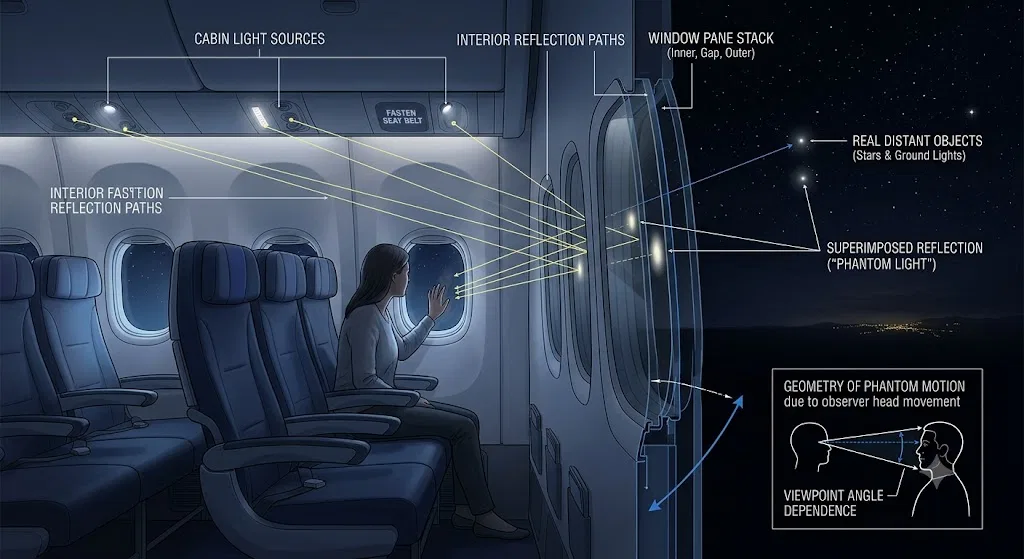
Ordinary glass both transmits and reflects light. Looking through a window therefore combines two scenes: the world beyond the glass and a weaker reflection of objects on the observer’s side. During daylight the transmitted exterior scene usually dominates. At night the balance can reverse. A dark sky supplies little illumination, while a dashboard, ceiling lamp, television, phone screen, instrument panel or illuminated object inside the room or vehicle can create a conspicuous reflection against it.
Aircraft crews encounter precisely this problem. The Federal Aviation Administration advises pilots to dim cockpit lighting at night because doing so eliminates or reduces reflections on windshields and windows; separate FAA medical guidance warns that light reflected from aircraft canopies and cockpit surfaces can produce glare that interferes with outside vision.[Federal Aviation Administration]faa.govFederal Aviation Administration Airplane Flying Handbook (3C) Chapter 11Darkness or low visibility increases pilot susceptibility to errorDimming the lights also eliminates reflections on the windshield and windows. After
That aviation context is particularly relevant to UFO and UAP reports because a cockpit offers almost ideal conditions for a misleading reflection: darkness outside, illuminated instruments inside and angled transparent surfaces directly in front of an observer scanning for distant traffic.
The same geometry occurs in cars, trains, houses and observation decks. A witness filming through a car side-window might unknowingly capture the reflection of a small illuminated control, seat-belt fitting or other bright interior feature. Heather Dixon of the British UFO Research Association described photographic investigations in which apparently unexplained objects proved to be mundane foreground effects, including a seat-belt buckle reflected in a car window.[The Guardian]theguardian.comThe Guardian Most UFOsThe Guardian Most UFOs
Several features make these reflections disproportionately convincing.
They are superimposed on the real landscape. The reflected light does not replace the distant view; it occupies the same visual field. A glowing patch can therefore appear to sit above hills, clouds or buildings even though the light that produced it is inside the room or vehicle.
Night-time depth information is weak. A point of light against a dark sky carries almost no inherent indication of size or range. Aviation authorities devote substantial attention to visual illusions at night because sparse visual references make distance, orientation and motion harder to judge reliably.[Federal Aviation Administration]faa.govpilot visionpilot vision
Moving observers make reflections seem to move. If a passenger shifts position, turns a camera or travels in a moving vehicle, the reflected image can slide across the glass relative to the landscape. The result can resemble an object pacing the vehicle, changing direction or accelerating across the sky. This motion is generated by changing viewing geometry rather than by an object travelling through distant air.
Multiple panes can multiply the effect. Modern windows often contain several glass surfaces. Each interface can return part of the light, so one source may produce displaced secondary reflections. Even ordinary double glazing is known to generate multiple visible reflections under suitable lighting.[Bramley Windows]bramleywindows.co.ukOpen source on bramleywindows.co.uk.
This last effect matters because a cluster of two or three similar lights may seem more difficult to dismiss than a single spot. In reality, repetition can be a clue that one source is being copied by several reflective surfaces.
Lens ghosts can create objects that existed only inside the camera
A different class of phantom appears after light has already entered the camera. Modern lenses contain several optical elements, each with surfaces capable of reflecting a small fraction of incoming light. Most light follows the intended path to the sensor, but some can bounce between optical surfaces before reaching it. The result may be flare, a coloured patch, a polygon, a bright orb or a secondary image often called a lens ghost.
Sony describes the underlying problem directly: although most light passes through optical glass, some reflects from lens surfaces and can produce flare or ghost images. Nikon similarly identifies ghosting as a reflection-related lens artefact and notes that lens hoods can reduce it by blocking stray light.[Sony]sony.comSony Alpha Lens Elements | Parts of a Camera Lens Although most of the light that falls on an optical glass transmits right through, someSonySony Alpha Lens Elements | Parts of a Camera LensAlthough most of the light that falls on an optical glass transmits right through, s…
These artefacts are not peculiar to cheap cameras. They are a routine optical-design problem. Zeiss describes a ghost as arising from double reflections between optical surfaces, while manufacturers apply anti-reflection coatings specifically to suppress such unwanted paths.[Lenspire]lenspire.zeiss.comtaking care of the unwanted lighttaking care of the unwanted light
Scientific imaging provides an especially clear demonstration that the phenomenon is physically real rather than a photographic rule of thumb. Astronomers studying deep images have measured unwanted out-of-focus images of bright stars produced by internal reflections between CCD detectors and other optical surfaces. Those ghosts changed in position, size and brightness depending on where the original star lay in the field.[arXiv]arxiv.orgarXiv Removing Internal Reflections from Deep Imaging DatasetsarXiv Removing Internal Reflections from Deep Imaging Datasets
That behaviour explains several characteristics sometimes regarded as unusual in UFO imagery.
A ghost may have no obvious visible connection to the bright source that created it. The Moon, Sun, street lamp or aircraft light responsible for the reflection can sit well away from the artefact or even just outside the crop.
It may also have a structured shape. Aperture geometry and the optical path can turn stray light into rings, discs, polygons or diffuse objects rather than a recognisable duplicate of the original source. Consequently, “it did not look like the lamp” is not strong evidence against a lens-reflection explanation.
Colour is not decisive either. Coatings, sensor response and different optical paths can give a ghost a different hue from the original light.
Most importantly, a photographic ghost is genuinely recorded in the image. Finding it in multiple video frames therefore does not prove that a corresponding object occupied the sky. The camera itself can generate a repeatable image feature.
Why a reflection can seem to perform impossible manoeuvres
Reflection cases become especially persuasive when witnesses describe motion: a light suddenly darting sideways, keeping pace with a vehicle or changing direction as the camera moves.
Such behaviour needs to be analysed in image coordinates rather than treated automatically as physical flight. A window reflection is tied to the relative positions of the light source, glass and observer. Move one part of that system and the apparent image moves. A lens ghost is similarly tied to the optical axis and the position of the bright source in or near the frame.
This creates a useful distinction between angular motion and real-world velocity. A spot sweeping rapidly across a photograph has undergone a large change in viewing angle, but its actual speed cannot be calculated without first establishing its distance. If the apparent object is an optical reflection centimetres from the camera rather than a craft kilometres away, translating that angular motion into an enormous airborne velocity is meaningless.
NASA’s Aviation Safety Reporting System has documented how relative viewing geometry and parallax can mislead pilots, particularly at night when few external references are available. Reflection adds another layer to that problem because the perceived object need not occupy the exterior scene at all.[Aviation Safety Reporting System]asrs.arc.nasa.govAviation Safety Reporting System CALLBACK 246Aviation Safety Reporting System CALLBACK 246
Camera movement supplies another warning sign. In recently published AARO report material, some UAP imagery explicitly notes that sensor motion can cause an area of contrast to move erratically across a display, illustrating why motion visible in a recording cannot simply be assigned to the observed feature without separating camera behaviour from scene behaviour.[AARO]aaro.milNext UAP Report DocumentsNext UAP Report Documents
Reflection analysis follows the same principle: before attributing spectacular motion to a distant object, investigators must determine what moved — the source, observer, window, lens, camera or actual external target.
Simple tests can separate reflections from distant objects
Reflection hypotheses are valuable because they are testable. A suspected phantom need not be dismissed merely because it “looks like a reflection”, nor accepted as distant merely because it looks object-like. Investigators can deliberately change the optical geometry.
A practical sequence is:
-
Change or extinguish nearby lights. Turn off dashboard lighting, cabin lamps, screens and room lights one at a time. If the supposed sky object disappears simultaneously, a reflection is strongly indicated. FAA advice to reduce cockpit lighting specifically to prevent windshield reflections rests on the same principle. Federal Aviation Administration
-
Change the viewing position. Move the head or camera sideways while keeping the exterior scene in view. Window reflections normally change position relative to distant landmarks because their geometry depends on the observer and glass. Reflections in windows are visibly sensitive to viewing angle; Canon’s photography guidance, for example, notes how moving sideways changes the balance between reflection and the scene beyond the glass. Canon Europe
-
Remove the window from the optical path. Open the window, step outside or photograph through an open door. Canon explicitly recommends opening a window or door when the aim is to avoid glass reflections. If the anomalous light vanishes while the exterior scene remains, the case is substantially narrowed. Canon Europe
- Look for a matching interior source. Search behind and beside the camera for lamps, illuminated buttons, displays, reflective fittings and phone screens. Their colour and shape need not perfectly match the phantom, particularly if several reflections or curved surfaces are involved.
- Compare naked-eye and camera-only visibility. An object repeatedly visible to an observer but absent when the camera is removed raises different questions from a spot seen only in recorded imagery. A feature that exists only through one camera configuration deserves immediate testing for flare, ghosting, dust, processing effects and other imaging artefacts.
-
Reframe the bright lights. With a suspected lens ghost, deliberately move a bright source around the frame. If the unexplained spot moves in a systematic relationship to that source, the optical explanation becomes much stronger. Scientific measurements of camera ghosts show that their position changes with the position of the source in the image field. arXiv
-
Change the optics. Try a different lens, remove an optional filter, alter zoom or shield stray light. Sony camera manuals specifically associate ghosting with excessive strong light entering the lens and recommend shielding it; Nikon likewise recommends controlling stray light to reduce ghost reflections. Sony
- Seek an independent exterior viewpoint. If another observer several metres away, preferably outside the original vehicle or building, sees the light at the same bearing against the stars or landscape, a local window reflection becomes much less plausible. Independent viewpoints are particularly useful because a reflection tied to one pane and one observer should not reproduce the geometry of a genuinely distant object for separated witnesses.
None of these tests alone proves every case. A real aircraft may disappear when a camera is moved; a reflection may coexist with a genuine exterior light; and incomplete recordings can prevent reconstruction. The value comes from combining tests and looking for a coherent optical pattern.
The strongest clue is dependence on the viewing system
Reflections occupy an unusual place among UFO and UAP explanations because the apparent object can look completely real while having no counterpart in the distant scene. The witness may accurately report seeing a light. The camera may accurately record it. The error arises only in locating where that light originated.
That makes dependence on the viewing system the central diagnostic question. Does the phenomenon change when an interior lamp is extinguished? Does it move when the observer changes position? Does opening the window remove it? Does changing the lens alter its shape? Does a bright source elsewhere in the frame move in a geometrically related way? Can an independent observer outside the glass see the same thing?
These questions are more informative than debating whether a photograph “looks artificial”. Lens ghosts can be sharply defined or diffuse, circular or polygonal, white or coloured. Window reflections can be faint enough to resemble distant navigation lights or complex enough to resemble luminous objects. Optical manufacturers devote substantial engineering effort to suppressing precisely these effects because internal reflections are an unavoidable consequence of real optical systems rather than rare camera malfunctions. Sony
For UFO/UAP investigation, the practical lesson is straightforward: whenever a sighting was made through glass or recorded near a strong light source, investigators should reconstruct the entire optical path before treating the apparent light as an object in the sky. A window, canopy or camera lens is not merely a transparent observer. Under the right conditions, it can create the thing being observed.
Amazon book picks
Further Reading
Books and field guides related to How Reflections Put Phantom Lights in the Sky. Use these as the next step if you want deeper reading beyond the article.
Optics
For courses in Optics A Contemporary Approach to Optics with Practical Applications and New Focused Pedagogy Hecht Optics balances theory...
Applied Photographic Optics
Selected by the American Library Association's 'Choice' magazine as "best technical book", the first edition of this book soon establishe...
Light and Color in the Outdoors
All of science springs from the observation of nature. In this classic book, the late Professor Minnaert accompanies the reader on a tour...
Understanding Exposure
Rating: 4.5/5 from 19 Google Books ratings
Provides detailed lessons on the elements of exposure and how each relates to depth of field, freezing and blurring action, and shooting...
eBay marketplace picks
Marketplace Samples
Live-tested eBay searches with available results related to this page.
Selected fromUFO poster oneBay.co.uk.

Current eBay listing
I Want To Believe UFO Poster Giclée Fine Art Heavyweight Print

Current eBay listing
VINTAGE UFO FLYING SAUCERS COMIC ADVERTISING A2 POSTER PRINT
Endnotes
1.
Source: aaro.mil
Link:https://www.aaro.mil/Portals/136/PDFs/AARO_Historical_Record_Report_Vol_1_2024.pdf
Source snippet
AARO_Historical_Record_Repor...March 8, 2024 — 6 Mar 2024 — • Other UFO resolutions included stellar [mirages]({{ 'mirages/' | relative_url }}), satellites, missiles, r...
Published: March 8, 2024
4.
Source: faa.gov
Title: Federal Aviation Administration Chapter 8
Link:https://www.faa.gov/air_traffic/publications/atpubs/aim_html/chap8_section_1.html
Source snippet
Medical Facts for PilotsExcessive illumination, especially from light reflected off the canopy, can produce glare, Pilots must ensure cur...
5.
Source: faa.gov
Title: pilot vision
Link:https://www.faa.gov/pilots/safety/pilotsafetybrochures/media/pilot_vision.pdf
6.
Source: faa.gov
Link:https://www.faa.gov/sites/faa.gov/files/regulations_policies/handbooks_manuals/aviation/phak/19_phak_ch17.pdf
7.
Source: lenspire.zeiss.com
Title: taking care of the unwanted light
Link:https://lenspire.zeiss.com/cine/en/article/taking-care-of-the-unwanted-light
8.
Source: sony.com
Link:https://www.sony.com/ng/electronics/camera-lenses/sel70200g
10.
Source: asrs.arc.nasa.gov
Title: Aviation Safety Reporting System CALLBACK 246
Link:https://asrs.arc.nasa.gov/publications/callback/cb_246.htm
11.
Source: aaro.mil
Title: Next UAP Report Documents
Link:https://www.aaro.mil/Next-AARO-Home-redesign/Next-Parent/Next-UAP-Report-Documents/
15.
Source: science.nasa.gov
Title: 03 behaviors
Link:https://science.nasa.gov/ems/03_behaviors/
16.
Source: apod.nasa.gov
Title: apod search
Link:https://apod.nasa.gov/cgi-bin/apod/apod_search?tquery=moon
17.
Source: apod.nasa.gov
Title: apod search
Link:https://apod.nasa.gov/cgi-bin/apod/apod_search?tquery=anticrepuscular
18.
Source: apod.nasa.gov
Title: archivepix Full
Link:https://apod.nasa.gov/apod/archivepixFull.html
19.
Source: ntrs.nasa.gov
Link:https://ntrs.nasa.gov/api/citations/19970005476/downloads/19970005476.pdf
20.
Source: ntrs.nasa.gov
Link:https://ntrs.nasa.gov/api/citations/19940021631/downloads/19940021631.pdf
21.
Source: science.nasa.gov
Title: midsummer sunrise gulf of saint lawrence 92622
Link:https://science.nasa.gov/earth/earth-observatory/midsummer-sunrise-gulf-of-saint-lawrence-92622/
22.
Source: asrs.arc.nasa.gov
Title: cb 193
Link:https://asrs.arc.nasa.gov/publications/callback/cb_193.htm
23.
Source: science.nasa.gov
Title: picturing earth eye of the beholder
Link:https://science.nasa.gov/earth/earth-observatory/picturing-earth-eye-of-the-beholder/
24.
Source: earth.gsfc.nasa.gov
Link:https://earth.gsfc.nasa.gov/sites/default/files/lab_climate/i3rcimagearchive.pdf
25.
Source: science.nasa.gov
Title: hubbles mirror flaw
Link:https://science.nasa.gov/mission/hubble/observatory/design/optics/hubbles-mirror-flaw/
26.
Source: apod.nasa.gov
Link:https://apod.nasa.gov/apod/archivepix.html
27.
Source: asrs.arc.nasa.gov
Title: cb 341
Link:https://asrs.arc.nasa.gov/publications/callback/cb_341.htm
28.
Source: asrs.arc.nasa.gov
Title: 35 Human Factors Terminal Control Area
Link:https://asrs.arc.nasa.gov/docs/rs/35_Human_Factors_Terminal_Control_Area.pdf
29.
Source: aaro.mil
Link:https://www.aaro.mil/UAP-Cases/Official-UAP-Imagery/
30.
Source: aaro.mil
Title: [Puerto Rico]({{ ‘puerto-rico/’ | relative_url }}) UAP Case Resolution
Link:https://www.aaro.mil/Portals/136/PDFs/case_resolution_reports/AARO_Puerto_Rico_UAP_Case_Resolution.pdf
31.
Source: aaro.mil
Link:https://www.aaro.mil/Portals/136/PDFs/FOIA/2022%20FOIAs/22-F-0863.pdf
32.
Source: aaro.mil
Title: UAP Records
Link:https://www.aaro.mil/UAP-Records/
33.
Source: canon-europe.com
Link:https://www.canon-europe.com/canon-club/lorenz-holder-reflection-photography-tips/
34.
Source: canon-europe.com
Link:https://www.canon-europe.com/get-inspired/tips-and-techniques/abstract-portrait-photography/
35.
Source: canon-europe.com
Link:https://www.canon-europe.com/get-inspired/stories/free-your-story/photo-contest/winners/
36.
Source: canon-europe.com
Link:https://www.canon-europe.com/pro/stories/l-series-rf-lens-gallery/
37.
Source: canon-europe.com
Link:https://www.canon-europe.com/view/travelling-light-megapixel-spad/
38.
Source: canon-europe.com
Link:https://www.canon-europe.com/pro/stories/cn-e20-50mm-t2.4-l-f-fp-first-shoot/
39.
Source: canon-europe.com
Link:https://www.canon-europe.com/pro/ambassadors/malachite-meadow/
40.
Source: faa.gov
Link:https://www.faa.gov/sites/faa.gov/files/Night_Ops_Ch13.pdf
41.
Source: faa.gov
Link:https://www.faa.gov/sites/faa.gov/files/2022-01/NovDec2015.pdf
42.
Source: faa.gov
Link:https://www.faa.gov/air_traffic/publications/atpubs/aim_html/chap7_section_6.html
43.
Source: faa.gov
Link:https://www.faa.gov/sites/faa.gov/files/about/office_org/headquarters_offices/avs/MP-086-20.pdf
44.
Source: faa.gov
Title: Intro Aviation Physiology
Link:https://www.faa.gov/sites/faa.gov/files/2022-11/Intro_Aviation_Physiology.pdf
45.
Source: faa.gov
Title: FA A Safety Briefing
Link:https://www.faa.gov/sites/faa.gov/files/JanFeb2025.pdf
46.
Source: faa.gov
Link:https://www.faa.gov/about/office_org/headquarters_offices/avs/offices/aam/cami/library/online_libraries/aerospace_medicine/media/77004299.pdf
47.
Source: faa.gov
Link:https://www.faa.gov/sites/faa.gov/files/about/office_org/headquarters_offices/avs/II.2.1_Vision.doc
48.
Source: faa.gov
Link:https://www.faa.gov/documentLibrary/media/Advisory_Circular/AC_90-89C.pdf
49.
Source: faa.gov
Title: A C 25-11B
Link:https://www.faa.gov/documentlibrary/media/advisory_circular/ac_25-11b.pdf
50.
Source: faa.gov
Title: Air France447 BEA
Link:https://www.faa.gov/sites/faa.gov/files/AirFrance447_BEA.pdf
51.
Source: faa.gov
Title: MMEL DA 2000EX Rev 5 Draft
Link:https://www.faa.gov/aircraft/draft_docs/mmel/MMEL_DA-2000EX_Rev_5_Draft.pdf
52.
Source: hf.tc.faa.gov
Link:https://hf.tc.faa.gov/people/nelson-brown/2008-all-strobe-approach-lighting-system/pb2008109781a.pdf
53.
Source: faa.gov
Link:https://www.faa.gov/documentLibrary/media/Advisory_Circular/AC_25-11A.pdf
54.
Source: faa.gov
Title: VNTSC Rpt DTO VNTSC FAA 91 7
Link:https://www.faa.gov/sites/faa.gov/files/2022-11/VNTSC%20Rpt%20DTO-VNTSC-FAA-91-7.pdf
55.
Source: sony.com
Link:https://www.sony.com/en-sn/electronics/camera-lenses/sel100400mc/specifications
56.
Source: sony.com
Link:https://www.sony.com/electronics/support/res/manuals/W000/W0003795M.pdf
57.
Source: sony.com
Link:https://www.sony.com/electronics/support/res/manuals/4420/44207451M.pdf
58.
Source: sony.com
Link:https://www.sony.com/electronics/support/res/manuals/3877/38776821M.pdf
59.
Source: sony.com
Link:https://www.sony.com/electronics/support/res/manuals/4159/41592411M.pdf
60.
Source: sony.com
Link:https://www.sony.com/electronics/support/articles/00032635
61.
Source: sony.com
Link:https://www.sony.com/electronics/support/res/manuals/4133/41334991M.pdf
62.
Source: theguardian.com
Title: The Guardian Most UFOs
Link:https://www.theguardian.com/commentisfree/2023/feb/16/ufo-chinese-spy-balloon-mystery
63.
Source: bramleywindows.co.uk
Link:https://bramleywindows.co.uk/product-care/visual-quality-of-double-glazing/
64.
Source: data.ntsb.gov
Link:https://data.ntsb.gov/carol-repgen/api/Aviation/ReportMain/GenerateNewestReport/98737/pdf
65.
Source: Wikipedia
Link:https://en.wikipedia.org/wiki/Aircraft
66.
Source: nationalcareers.service.gov.uk
Link:https://nationalcareers.service.gov.uk/job-profiles/airline-pilot
67.
Source: careers.ba.com
Link:https://careers.ba.com/pilots
Additional References
68.
Source: youtube.com
Link:https://www.youtube.com/watch?v=r847zbO0qVk
Source snippet
Camera Lens Flare and Ghosting: What You Need to Know for Better Photography | Round Glass Review...
69.
Source: youtube.com
Title: Why Your Lens Flares: A Practical Guide to Coatings and Reflection
Link:https://www.youtube.com/watch?v=arr0zRH5OVk
Source snippet
Lens flare camera UFO reflection ghosting What I mean by Glare (vs. Flare, vs. UFO)...
70.
Source: ntsb.gov
Link:https://www.ntsb.gov/about/Documents/SPC0503.pdf
71.
Source: youtube.com
Title: What I mean by Glare (vs. Flare, vs. UFO)
Link:https://www.youtube.com/watch?v=q3Oeaot9eX0
Source snippet
How to Design a Lens for HDR Cameras — Ghost Suppression, Flare Control, and Stray Light...
72.
Source: nikonusa.com
Link:https://www.nikonusa.com/p/af-s-nikkor-24-70mm-f28e-ed-vr/20052/overview?srsltid=AfmBOoquEYrLSqt4egmysSbOLp3Cz-a6ey_X6vnbeaIsaENGYEx4C4cP
73.
Source: nikonusa.com
Link:https://www.nikonusa.com/p/af-s-nikkor-500mm-f56e-pf-ed-vr/20082/overview?srsltid=AfmBOoqdVgO9li-nzWueet7yNhUHybNABpQhyPI6ZM73Cu7qpY6AE4yl
74.
Source: reddit.com
Link:https://www.reddit.com/r/blinkcameras/comments/13zzyrw/any_advice_to_reduce_the_reflection_once_it_goes/
75.
Source: balpa.org
Link:https://www.balpa.org/becoming-a-pilot/
76.
Source: lowes.com
Link:https://www.lowes.com/pl/windows/double-hung-windows/4294772367
77.
Source: facebook.com
Link:https://www.facebook.com/groups/dullmensclub/posts/2079938499329347/