Within Flares
Can a Tumbling Satellite Look Like It Is Maneuvering?
A rotating spacecraft can alternate between bright and dark surfaces, producing repeated flashes without changing course or speed.
On this page
- Why spacecraft rotation changes reflected brightness
- How repeating flash patterns can reveal tumbling
- Why bright faint cycles can be mistaken for active behavior
Page outline Jump by section
Introduction
A tumbling satellite can look far more active than it really is. As an uncontrolled spacecraft or spent rocket stage rotates, different panels, antennas, insulation surfaces and structural faces turn towards the Sun and the observer. Some orientations reflect very little light; others briefly send a concentrated reflection towards the ground. The result can be a moving point that repeatedly flashes, disappears and reappears even though its orbit remains essentially smooth.
That distinction matters in UFO and UAP observations because the eye naturally treats a bright reappearance as new information about motion. A sequence of separated flashes can seem to show an object surging, pausing or changing behaviour when the observer is actually seeing intermittent samples of one continuous trajectory. Regular or semi-regular flashing is sufficiently characteristic of rotating spacecraft that astronomers use precisely these brightness variations — their light curves — to measure the rotation of satellites and orbital debris.[Satellites Above]satobs.orgSatellites Above Tumbling SatellitesSatellites Above Tumbling Satellites
Why rotation changes reflected brightness
An uncontrolled satellite does not need a lamp, engine firing or change of speed to produce dramatic changes in apparent brightness. It only needs surfaces whose reflectivity varies with orientation.
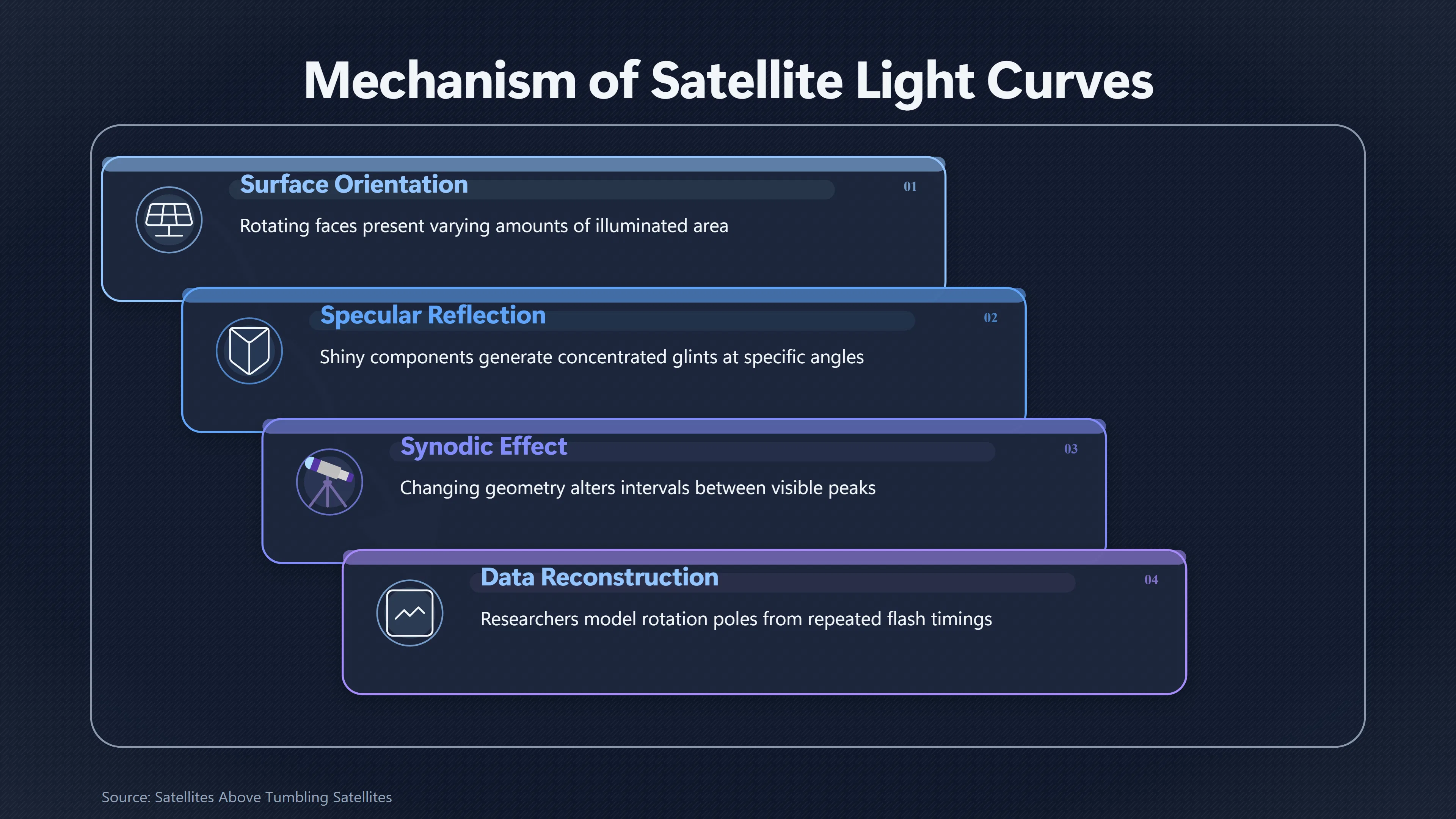
Two effects can operate together. First, a rotating object continually presents different amounts of illuminated surface area towards the observer, producing relatively smooth bright-faint cycles. Secondly, flat or shiny components can generate specular reflections: concentrated glints that occur when a reflecting face briefly reaches the correct Sun-satellite-observer angle. The Belgian Working Group for Satellites’ long-running observing material describes both effects and shows a measured light curve of a Zenit rocket stage in which smooth brightness variation is interrupted by sharp specular spikes.[Satellites Above]satobs.orgSatellites Above Tumbling SatellitesSatellites Above Tumbling Satellites
A complicated spacecraft can therefore produce a surprisingly complicated sequence:
faint → bright → invisible → weaker flash → invisible → brilliant flash → faint
without doing anything dynamically unusual. Different structural elements can generate different peaks during the same rotation. Solar panels, antenna structures or other asymmetrical components may introduce secondary flashes, while a simpler cylindrical rocket body can produce a much more regular pattern. Observers have documented secondary flashes appearing and disappearing during a single pass simply because the illumination geometry changes.[Satellites Above]satobs.orgSatellites Above Rotation and Flash PeriodSatellites Above Rotation and Flash Period
This behaviour is particularly relevant to dead or uncontrolled hardware. ESA notes that failed spacecraft including Envisat and Japan’s ADEOS-II were observed tumbling after control was lost, while launcher upper stages form another important population of rotating orbital debris. NASA’s Orbital Debris Program Office has accordingly used optical light curves to characterise the tumble motion of large upper stages.[European Space Agency]esa.intEuropean Space Agency ESAEuropean Space AgencyESA - Probing satellites’ mysterious death tumblingMay 28, 2014…
The spacecraft can be below naked-eye visibility between reflections. To a person watching casually, there may consequently be no obvious continuously moving satellite connecting one flash to the next. What is physically one rotating object following one orbit can perceptually become a succession of isolated lights.
Repeating flashes can reveal the tumble
The same repetition that makes a sighting look peculiar is also one of the strongest clues to its mundane mechanism. Astronomers measure a satellite’s brightness against time to create a light curve. If peaks recur at related intervals, their timing can reveal the object’s rotation.
This is not merely a qualitative rule of thumb. Photometric light curves are an established space-surveillance technique because brightness depends on an object’s shape, attitude, angular velocity and surface properties. ESA conference research describes photometry being used to characterise the dynamical rotation of defunct satellites, upper stages and fragmentation debris, while NASA studies have likewise analysed the periods contained in optical light curves of tumbling rocket bodies.[ESA Proceedings Database]conference.sdo.esoc.esa.intESA Proceedings DatabaseLight curves application to space debris characterization and classification | ESA Proceedings Database…
Envisat provides a particularly useful real-world example. The eight-tonne Earth-observation satellite failed in 2012 and became an uncontrolled object in low Earth orbit. Researchers analysing observations from 2013–15 used specular glints in 222 light curves to investigate its rotation pole and the gradual change in its rotation period. In other words, flashes that might look erratic to an unaided observer contained enough systematic information for researchers to reconstruct aspects of the dead satellite’s rotational behaviour.[ScienceDirect]sciencedirect.comRemote Sensing of the EnviSat and Cbers-2B satellites rotation around the centre of mass by photometry - ScienceDirectAugust…
The principle remains important in current research. A 2026 Advances in Space Research study describes estimating the attitude of a tumbling rocket body from a single pass of light-curve observations, modelling how its rotation and reflective properties produce the measured illumination pattern.[ScienceDirect]sciencedirect.comScienceDirect Attitude estimation of tumbling rocket body using light curve dataScienceDirect Attitude estimation of tumbling rocket body using light curve data
Repeating flashes are therefore not evidence that must first be explained by repeated propulsion events. They can be the optical fingerprint of rotation itself.
There is an important complication: flash period and rotation period are not always identical. A symmetrical tumbling body may present more than one reflective orientation during a single complete rotation. One rotation can therefore generate two or more conspicuous peaks. Conversely, some potentially reflective orientations may fail to send enough light towards a particular observer to be visible.[Satellites Above]satobs.orgSatellites Above Rotation and Flash PeriodSatellites Above Rotation and Flash Period
That is why a light flashing every three seconds does not automatically mean the spacecraft completes one rotation every three seconds. The repetition nevertheless provides a powerful diagnostic when several flashes can be timed and compared.
Why the rhythm can change during one pass
A tumbling satellite does not necessarily flash with metronomic precision from horizon to horizon. This is where an otherwise straightforward explanation can begin to look more like deliberate behaviour.
As the satellite moves along its orbit, the angle between the Sun, spacecraft and observer continuously changes. The spacecraft may maintain essentially the same rotational state, yet the orientation required to produce a reflection towards the observer shifts. Satellite observers call the resulting difference between intrinsic rotation and observed flash timing the synodic effect.[Satellites Above]satobs.orgSatellites Above A closer look at the synodic effectSatellites Above A closer look at the synodic effect
For relatively slow rotators, this can noticeably alter the intervals between visible peaks. The Satobs technical material notes that objects with longer rotation periods can show observed flash periods differing from their true rotation periods by several seconds; under extreme geometries the flashes can temporarily appear irregular. Secondary flashes can also emerge or disappear as individual surfaces enter or leave favourable reflection geometries.[Satellites Above]satobs.orgSatellites Above Rotation and Flash PeriodSatellites Above Rotation and Flash Period
This produces patterns that are easy to over-interpret:
- flashes may gradually become closer together or farther apart;
- alternating flashes can have very different brightness;
- a secondary pulse may suddenly appear between the main flashes;
- several flashes can disappear before the pattern resumes;
- the object can fade completely even though it is still travelling along the same orbit.
Even experienced satellite observers can find changing flash patterns confusing during a pass. Practical guidance for measuring tumbling satellites specifically warns that the flash pattern and apparent period can change because of the evolving Sun-object-observer geometry.[Satellites Above]satobs.orgSatellites Above Flash Period MeasurementsSatellites Above Flash Period Measurements
This is an important safeguard against an overly simple test such as “regular flashes mean satellite, irregular flashes mean something else”. A real rotating spacecraft can generate both regular and apparently irregular sequences during the same observation.
Why bright-faint cycles can look like manoeuvres
The crucial perceptual problem is that brightness and position become entangled when the object is invisible between flashes.
Imagine a satellite travelling smoothly across the sky but becoming visible only once every few seconds. Instead of seeing a continuous track, the observer receives a series of positions:
flash 1 → darkness → flash 2 → darkness → flash 3
The brain must infer what happened during each dark interval. If the flashes vary greatly in intensity, the brighter ones may appear more prominent or somehow closer. If one expected flash is too faint to detect, the next visible one can seem unexpectedly displaced. If secondary reflections appear between the main peaks, the apparent cadence of the object suddenly changes.
There is no corresponding requirement for the satellite to accelerate. The orbital trajectory and the brightness pattern are separate quantities: the former describes where the spacecraft is going, while the latter depends strongly on how its body is oriented relative to the Sun and observer.
Modern astronomical surveys demonstrate just how extreme that separation can become. Research using the Zwicky Transient Facility identified tens of thousands of individual satellite-glint events associated with hundreds of satellites. Individual reflections can last from roughly a tenth of a second down to millisecond scales and can have large brightness amplitudes. A rapidly rotating object can therefore be detectable chiefly as separated flashes rather than as an obvious continuous streak or steadily moving point.[arXiv]arxiv.orgarXiv Impact of satellite glints on the transient science on ZTF scalearXiv Impact of satellite glints on the transient science on ZTF scale
The phenomenon is not restricted to one orbital regime. The Zwicky work found glinting objects across orbital populations extending from low Earth orbit to geostationary altitudes. At great distance, where apparent angular motion is slow, intermittent flashes can be especially deceptive because successive events may occur within a comparatively small patch of sky.[arXiv]arxiv.orgarXiv Impact of satellite glints on the transient science on ZTF scalearXiv Impact of satellite glints on the transient science on ZTF scale
For UAP assessment, this makes the track between flashes more important than the drama of the flashes themselves. A genuine manoeuvre requires evidence that the object’s motion changed. A brightness change alone establishes only that the received light changed.
A real attitude change is different from an apparent one
There is a useful distinction between rotation, orbital motion and an actual change in rotational state.
A derelict spacecraft can tumble while its centre of mass continues along a predictable orbit. Over longer periods, however, the tumble itself can genuinely evolve. ESA lists atmospheric drag, solar radiation pressure, magnetic effects, impacts, outgassing, fuel leakage and other disturbances among the mechanisms capable of affecting the attitude of uncontrolled spacecraft.[European Space Agency]esa.intEuropean Space Agency ESAEuropean Space AgencyESA - Probing satellites’ mysterious death tumblingMay 28, 2014…
Long-term light-curve monitoring can detect such changes. NASA has reported dramatic changes in optical signatures among old tumbling rocket bodies, and a 2025 Acta Astronautica study used sequential light curves to investigate an unexpected acceleration in the tumbling motion of an SL-14 rocket body, considering a propulsion-system leak caused by mechanical failure as an explanation.[NASA Technical Reports Server]ntrs.nasa.govTechnical Reports Server Optical Measurements of Tumbling Rocket BodiesNASA Technical Reports ServerOptical Measurements of Tumbling Rocket Bodies - NASA Technical Reports Server (NTRS)…
That does not mean an observer watching a few flashes has witnessed the spacecraft firing thrusters. It illustrates almost the opposite point: researchers distinguish changes in rotation by comparing quantitative observations and modelling them over time. A momentary brightening is not, by itself, evidence of propulsion.
For a UFO or UAP report, the evidential question is therefore precise: did the object’s measured trajectory change, or did only its visibility change?
What separates tumbling from genuine course changes
A tumbling-satellite explanation becomes stronger when several features occur together: the object follows an otherwise smooth path; bright events recur with a recognisable cadence; individual flashes are white or sunlight-like rather than resembling navigation lights; and periods of apparent disappearance can be bridged by extrapolating the object’s earlier motion.
Repeated timing is especially valuable. Satellite observers traditionally time dozens of flashes rather than judging isolated events, because a longer sequence exposes periodic structure and reduces errors caused by individual missed or secondary flashes.[Satellites Above]satobs.orgSatellites Above Tumbling SatellitesSatellites Above Tumbling Satellites
Video can be more informative than eyewitness memory if background stars are visible. Frame-by-frame positions can test whether the flashes lie along a smooth trajectory even when the object disappears between them. Photometry goes further by converting subjective impressions such as “it suddenly powered up again” into a measurable brightness-versus-time sequence.
None of these features proves that every periodically flashing unidentified light is a tumbling satellite. Aircraft, rotating active spacecraft and other sources can also vary in brightness, while irregular debris may produce complicated signatures. The narrower point is that repeated bright-faint cycles do not require repeated changes in speed or direction. Rotation alone provides a well-observed mechanism capable of producing them.
The key diagnostic is motion, not brightness
The most useful way to interpret a suspected tumbling satellite is to separate two questions that an unaided observation tends to merge: where did the object move, and when did it become visible?
A spacecraft can move continuously while its brightness changes by several magnitudes or drops below the observer’s detection threshold. A rotating reflective surface can then restore visibility in a fraction of a second. If that cycle repeats, the resulting string of luminous points can look active, responsive or erratic despite arising from passive reflected sunlight. Large observational programmes treat these patterns not as anomalous propulsion signatures but as useful measurements of spacecraft rotation.[ESA Proceedings Database]conference.sdo.esoc.esa.intESA Proceedings DatabaseLight curves application to space debris characterization and classification | ESA Proceedings Database…
That makes tumbling satellites a particularly important subset of satellite flares that seem to appear from nowhere. A single flare can create the impression of sudden appearance. Tumbling adds something more deceptive: repetition. The light appears, vanishes and returns, sometimes with changing intervals and intensity, inviting the observer to interpret each flash as a new action.
The evidence from satellite photometry points to a simpler test. If the luminous events repeat while their positions remain compatible with one continuous orbital track, the apparent “behaviour” may belong to the spacecraft’s rotating surfaces rather than to its trajectory. In that situation, what looks like a sequence of manoeuvres is better understood as a sequence of glimpses of the same smoothly moving object.
Amazon book picks
Further Reading
Books and field guides related to Can a Tumbling Satellite Look Like It Is Maneuvering?. Use these as the next step if you want deeper reading beyond the article.
Satellite Orbits: Models, Methods and Applications
Satellite Orbits -Models, Methods, and Applications has been written as a compre hensive textbook that guides the reader through the theo...
Celestial Objects for Modern Telescopes
Based on field notes made by the author during his own career as an amateur astronomer, this unique guide covers both the traditional and...
Orbital Mechanics for Engineering Students
Orbital Mechanics for Engineering Students, Second Edition, provides an introduction to the basic concepts of space mechanics. These incl...
Fundamentals of Astrodynamics
Rating: 4.5/5 from 12 Google Books ratings
Teaching text developed by U.S. Air Force Academy and designed as a first course emphasizes the universal variable formulation. Develops...
eBay marketplace picks
Marketplace Samples
Live-tested eBay searches with available results related to this page.
Selected fromsatellite model oneBay.co.uk.
Endnotes
1.
Source: satobs.org
Title: Satellites Above Tumbling Satellites
Link:https://satobs.org/tumble/tumbleintro.html
2.
Source: conference.sdo.esoc.esa.int
Link:https://conference.sdo.esoc.esa.int/proceedings/sdc8/paper/168
Source snippet
ESA Proceedings DatabaseLight curves application to space debris characterization and classification | ESA Proceedings Database...
3.
Source: satobs.org
Title: Satellites Above Rotation and Flash Period
Link:https://satobs.org/tumble/rotandfp.html
4.
Source: satobs.org
Title: Satellites Above
Link:https://satobs.org/flash/102/node10.html
Source snippet
Introduction...
5.
Source: esa.int
Title: European Space Agency ESA
Link:https://www.esa.int/Space_Safety/Clean_Space/Probing_satellites_mysterious_death_tumbling
Source snippet
European Space AgencyESA - Probing satellites’ mysterious death tumblingMay 28, 2014...
Published: May 28, 2014
6.
Source: ntrs.nasa.gov
Link:https://ntrs.nasa.gov/citations/20120003597
Source snippet
NASA Technical Reports ServerLight Curve Observations of Upper Stages in the Low Earth Orbit Environment - NASA Technical Reports Server...
7.
Source: conference.sdo.esoc.esa.int
Link:https://conference.sdo.esoc.esa.int/proceedings/sdc8/paper/311
Source snippet
ESA Proceedings DatabaseClassification of Resident Space Objects by shape and spin motion using neural networks and photometric light cur...
8.
Source: ntrs.nasa.gov
Title: Technical Reports Server Optical Measurements of Tumbling Rocket Bodies
Link:https://ntrs.nasa.gov/citations/20120012414
Source snippet
NASA Technical Reports ServerOptical Measurements of Tumbling Rocket Bodies - NASA Technical Reports Server (NTRS)...
9.
Source: sciencedirect.com
Link:https://www.sciencedirect.com/science/article/abs/pii/S0273117716301594
Source snippet
Remote Sensing of the EnviSat and Cbers-2B satellites rotation around the centre of mass by photometry - ScienceDirectAugust...
10.
Source: sciencedirect.com
Link:https://www.sciencedirect.com/science/article/pii/S0273117716301594
Source snippet
Remote Sensing of the EnviSat and Cbers-2B satellites rotation around the centre of mass by photometry - ScienceDirect...
11.
Source: sciencedirect.com
Title: ScienceDirect Attitude estimation of tumbling rocket body using light curve data
Link:https://www.sciencedirect.com/science/article/abs/pii/S0273117726008604
12.
Source: satobs.org
Title: Satellites Above A closer look at the synodic effect
Link:https://www.satobs.org/flash/92/node7.html
13.
Source: satobs.org
Title: Satellites Above Flash Period Measurements
Link:https://www.satobs.org/tumble/flashpm.html
14.
Source: arxiv.org
Title: arXiv Impact of satellite glints on the transient science on ZTF scale
Link:https://arxiv.org/abs/2202.05719
15.
Source: arxiv.org
Title: arXiv The rate of satellite glints in ZTF and LSST sky surveys
Link:https://arxiv.org/abs/2310.17322
16.
Source: sciencedirect.com
Link:https://www.sciencedirect.com/science/article/pii/S009457652500219X
17.
Source: sciencedirect.com
Title: Complex attitude determination of H-2A rocket bodies assuming free precession
Link:https://www.sciencedirect.com/science/article/abs/pii/S0273117726009403
18.
Source: svs.gsfc.nasa.gov
Link:https://svs.gsfc.nasa.gov/5628
20.
Source: science.nasa.gov
Title: great balls of fire
Link:https://science.nasa.gov/earth/earth-observatory/great-balls-of-fire/
21.
Source: nasa.gov
Title: Sunglint on Atlantic Ocean
Link:https://www.nasa.gov/image-article/sunglint-on-atlantic-ocean/
22.
Source: fermi.gsfc.nasa.gov
Title: LAT caveats temporal
Link:https://fermi.gsfc.nasa.gov/ssc/data/analysis/LAT_caveats_temporal.html
23.
Source: sciencedirect.com
Link:https://www.sciencedirect.com/science/article/abs/pii/S1270963825003566
24.
Source: sciencedirect.com
Link:https://www.sciencedirect.com/science/article/pii/S0273117725001899
25.
Source: science.nasa.gov
Title: chapter6 4
Link:https://science.nasa.gov/learn/basics-of-space-flight/chapter6-4/
26.
Source: sciencedirect.com
Title: Light curve attitude estimation using particle swarm optimizers
Link:https://www.sciencedirect.com/science/article/pii/S0273117724009281
27.
Source: esa.int
Link:https://www.esa.int/ESA_Multimedia/Images/2024/04/Blowtorch_effect_of_satellite_[reentry
28.
Source: esa.int
Link:https://www.esa.int/ESA_Multimedia/Videos/2024/04/Simulating_tumbling_reaction_wheel_reentry
29.
Source: esa.int
Title: ES A Television
Link:https://www.esa.int/esatv/Videos/2024/04/Simulating_tumbling_reaction_wheel_reentry
30.
Source: esa.int
Link:https://www.esa.int/Space_Safety/Space_Debris/ERS-2_spotted_by_other_satellites_during_descent?rand=771654
31.
Source: sciencedirect.com
Link:https://www.sciencedirect.com/science/article/pii/S0019103523003949
32.
Source: esa.int
Link:https://www.esa.int/ESA_Multimedia/Images/2023/11/A_satellite_s_death_spiral
33.
Source: esa.int
Link:https://www.esa.int/Enabling_Support/Space_Engineering_Technology/Shaping_the_Future/Understanding_the_Tumbling_Motion_of_Space_Debris
34.
Source: ntrs.nasa.gov
Link:https://ntrs.nasa.gov/citations/20210016802
35.
Source: sciencedirect.com
Title: Analysis of Envisat’s rotation state using epoch method
Link:https://www.sciencedirect.com/science/article/abs/pii/S0273117720306360
36.
Source: sciencedirect.com
Link:https://www.sciencedirect.com/science/article/pii/S0273117719308749
37.
Source: sciencedirect.com
Link:https://www.sciencedirect.com/science/article/abs/pii/S0032063317304737
38.
Source: science.nasa.gov
Title: gov10 Things: Mysterious ‘Oumuamua
Link:https://science.nasa.gov/solar-system/comets/oumuamua/10-things-mysterious-oumuamua/?trk=public_post_comment-text
39.
Source: jpl.nasa.gov
Title: chasing oumuamua
Link:https://www.jpl.nasa.gov/news/chasing-oumuamua/
40.
Source: sciencedirect.com
Link:https://www.sciencedirect.com/science/article/abs/pii/S0273117718300784
41.
Source: sciencedirect.com
Link:https://www.sciencedirect.com/science/article/abs/pii/S027311771730786X
42.
Source: sciencedirect.com
Link:https://www.sciencedirect.com/science/article/pii/S027311771730786X
43.
Source: svs.gsfc.nasa.gov
Link:https://svs.gsfc.nasa.gov/12808/
45.
Source: sciencedirect.com
Link:https://www.sciencedirect.com/science/article/abs/pii/S0273117717307354
46.
Source: science.nasa.gov
Title: an icy trick of the light 90269
Link:https://science.nasa.gov/earth/earth-observatory/an-icy-trick-of-the-light-90269/
47.
Source: nasa.gov
Title: NAS A’s EPIC View Spots Flashes on Earth
Link:https://www.nasa.gov/science-research/earth-science/nasas-epic-view-spots-flashes-on-earth/
48.
Source: nasa.gov
Title: Long-Term Rotational Dynamics of Defunct Earth-Orbiting Satellites
Link:https://www.nasa.gov/?p=61376
49.
Source: nasa.gov
Title: NAS A’s SDO Takes a Spin
Link:https://www.nasa.gov/missions/sdo/nasas-sdo-takes-a-spin/
50.
Source: space.com
Title: Watching a Spacecraft Wreck Tumble Through Space | Space
Link:https://www.space.com/32671-watching-spacecraft-wreck-tumble-space.html
51.
Source: space.com
Title: JAX A Tracks Down the Silent, Damaged Hitomi Satellite | Space
Link:https://www.space.com/32408-japan-hitomi-satellite-tumbling-video-rescue-efforts.html
52.
Source: esa.int
Link:https://www.esa.int/ESA_Multimedia/Videos/2016/02/Sentinel-3A_tumbles
53.
Source: science.nasa.gov
Title: brightness rhythm of mars flyby comet is clue to rotation rate
Link:https://science.nasa.gov/resource/brightness-rhythm-of-mars-flyby-comet-is-clue-to-rotation-rate/
54.
Source: science.nasa.gov
Title: brightness rhythm of mars flyby comet is clue to rotation rate
Link:https://science.nasa.gov/photojournal/brightness-rhythm-of-mars-flyby-comet-is-clue-to-rotation-rate/
55.
Source: science.nasa.gov
Title: the science of sunglint 84333
Link:https://science.nasa.gov/earth/earth-observatory/the-science-of-sunglint-84333/
56.
Source: science.nasa.gov
Title: and the walls came tumbling down
Link:https://science.nasa.gov/photojournal/and-the-walls-came-tumbling-down/
57.
Source: ilrs.gsfc.nasa.gov
Title: ade2 support
Link:https://ilrs.gsfc.nasa.gov/missions/satellite_missions/past_missions/ade2_support.html
58.
Source: ntrs.nasa.gov
Link:https://ntrs.nasa.gov/citations/20120007406
59.
Source: apod.nasa.gov
Link:https://apod.nasa.gov/apod/ap120411.html
60.
Source: esa.int
Link:https://www.esa.int/Applications/Observing_the_Earth/Envisat/Envisat_in_its_new_home
61.
Source: science.nasa.gov
Title: dancing southern lights of saturn
Link:https://science.nasa.gov/photojournal/dancing-southern-lights-of-saturn/
62.
Source: science.nasa.gov
Title: dancing southern lights of saturn
Link:https://science.nasa.gov/resource/dancing-southern-lights-of-saturn/
63.
Source: satobs.org
Title: See Sat-L May-10: RE: Topex tumbling observation
Link:https://www.satobs.org/seesat/May-2010/0056.html
64.
Source: pds.nasa.gov
Title: view Profile.jsp
Link:https://pds.nasa.gov/ds-view/pds/viewProfile.jsp?dsid=EAR-L-MRO24M_PHOTGJON-2-EDR-LCROSS-V1.0
65.
Source: science.nasa.gov
Title: reflection of sunlight off titan lake
Link:https://science.nasa.gov/photojournal/reflection-of-sunlight-off-titan-lake/
66.
Source: science.nasa.gov
Title: reflection of sunlight off titan lake
Link:https://science.nasa.gov/resource/reflection-of-sunlight-off-titan-lake/
67.
Source: sciencedirect.com
Link:https://www.sciencedirect.com/science/article/pii/S0273117709001021
68.
Source: esa.int
Link:https://www.esa.int/Enabling_Support/Operations/Envisat_operations
69.
Source: science.nasa.gov
Link:https://science.nasa.gov/resource/iapetus/
70.
Source: satobs.org
Link:https://satobs.org/seesat/Jun-1998/0164.html
71.
Source: satobs.org
Link:https://www.satobs.org/seesat/Jan-1998/0090.html
72.
Source: ntrs.nasa.gov
Link:https://ntrs.nasa.gov/search.jsp?R=19880023107
73.
Source: ntrs.nasa.gov
Link:https://ntrs.nasa.gov/citations/19850036738
74.
Source: ntrs.nasa.gov
Link:https://ntrs.nasa.gov/citations/19750043828
75.
Source: conference.sdo.esoc.esa.int
Link:https://conference.sdo.esoc.esa.int/proceedings/sdc7/paper/482
76.
Source: conference.sdo.esoc.esa.int
Link:https://conference.sdo.esoc.esa.int/proceedings/sdc8/paper/97
77.
Source: conference.sdo.esoc.esa.int
Link:https://conference.sdo.esoc.esa.int/proceedings/neosst2/paper/66
78.
Source: conference.sdo.esoc.esa.int
Link:https://conference.sdo.esoc.esa.int/proceedings/neosst2/paper/33
79.
Source: conference.sdo.esoc.esa.int
Link:https://conference.sdo.esoc.esa.int/proceedings/sdc9/paper/265
80.
Source: conference.sdo.esoc.esa.int
Link:https://conference.sdo.esoc.esa.int/proceedings/sdc7/paper/477
81.
Source: nebula.esa.int
Link:https://nebula.esa.int/content/tumbling-motion-assessment-space-debris-objects
82.
Source: conference.sdo.esoc.esa.int
Link:https://conference.sdo.esoc.esa.int/proceedings/sdc7/paper/437
83.
Source: conference.sdo.esoc.esa.int
Link:https://conference.sdo.esoc.esa.int/proceedings/sdc7/paper/732
84.
Source: conference.sdo.esoc.esa.int
Link:https://conference.sdo.esoc.esa.int/proceedings/neosst2/paper/76
85.
Source: esa.int
Link:https://www.esa.int/Applications/Observing_the_Earth/What_is_Envisat
86.
Source: nebula.esa.int
Link:https://nebula.esa.int/content/investigation-active-detumbling-solutions-debris-removal
87.
Source: esa.int
Link:https://www.esa.int/Applications/Observing_the_Earth/Fast_facts
88.
Source: conference.sdo.esoc.esa.int
Link:https://conference.sdo.esoc.esa.int/proceedings/sdc7/paper/671
89.
Source: conference.sdo.esoc.esa.int
Link:https://conference.sdo.esoc.esa.int/proceedings/sdc9/paper/192
90.
Source: conference.sdo.esoc.esa.int
Link:https://conference.sdo.esoc.esa.int/proceedings/sdc9/paper/368
91.
Source: conference.sdo.esoc.esa.int
Link:https://conference.sdo.esoc.esa.int/proceedings/sdc9/paper/278
92.
Source: conference.sdo.esoc.esa.int
Link:https://conference.sdo.esoc.esa.int/proceedings/sdc7/paper/696
93.
Source: conference.sdo.esoc.esa.int
Link:https://conference.sdo.esoc.esa.int/proceedings/sdc7/paper/1061
94.
Source: conference.sdo.esoc.esa.int
Link:https://conference.sdo.esoc.esa.int/proceedings/sdc9/paper/301
95.
Source: conference.sdo.esoc.esa.int
Link:https://conference.sdo.esoc.esa.int/proceedings/sdc9/paper/216
96.
Source: conference.sdo.esoc.esa.int
Link:https://conference.sdo.esoc.esa.int/proceedings/sdc8/paper/116
97.
Source: nebula.esa.int
Link:https://nebula.esa.int/content/debris-attitude-motion-measurements-and-modelling
98.
Source: conference.sdo.esoc.esa.int
Link:https://conference.sdo.esoc.esa.int/proceedings/sdc9/paper/316
99.
Source: conference.sdo.esoc.esa.int
Link:https://conference.sdo.esoc.esa.int/proceedings/sdc9/paper/245
100.
Source: sciencedirect.com
Title: Database of photometric periods of artificial satellites
Link:https://www.sciencedirect.com/science/article/pii/S0273117797000057
101.
Source: sciencedirect.com
Link:https://www.sciencedirect.com/science/article/pii/S0094576526000391
102.
Source: sciencedirect.com
Title: GOE S spin state diversity and the implications for GEO debris mitigation
Link:https://www.sciencedirect.com/science/article/pii/S0094576519313815
103.
Source: sciencedirect.com
Link:https://www.sciencedirect.com/science/article/abs/pii/S0094576526000391
105.
Source: satobs.org
Link:https://www.satobs.org/flash/102/node11.html
106.
Source: w.satobs.org
Link:https://w.satobs.org/tumble/tumbleintro.html
108.
Source: satobs.org
Link:https://satobs.org/tumble/expresfpm.html
109.
Source: satobs.org
Link:https://satobs.org/observe.html
110.
Source: satobs.org
Link:https://www.satobs.org/flash/90/chapter2_5.html
111.
Source: satobs.org
Link:https://satobs.org/
112.
Source: epic.gsfc.nasa.gov
Link:https://epic.gsfc.nasa.gov/science/products/glint
113.
Source: ntrs.nasa.gov
Link:https://ntrs.nasa.gov/citations/20050031170
114.
Source: pauldmaley.com
Link:https://pauldmaley.com/bright/
115.
Source: twanight.org
Title: a tumbling satellite
Link:https://twanight.org/gallery/a-tumbling-satellite/
116.
Source: vimeo.com
Title: A Tumbling Satellite | Videos & Movies on Vimeo
Link:https://vimeo.com/37178525
117.
Source: nuforc.org
Link:https://nuforc.org/sighting/?id=4235
118.
Source: manos.lowell.edu
Link:https://manos.lowell.edu/overview/photometry
119.
Source: spacewatch.lpl.arizona.edu
Title: tumbling satellites
Link:https://spacewatch.lpl.arizona.edu/fmo-project/how-find/tutorial/tumbling-satellites
Additional References
120.
Source: youtube.com
Link:https://www.youtube.com/watch?v=lewotn8QMC4
Source snippet
Tumbling satellite flashing light curve UFO Oct 30 2014 0406 Satellite Flashing Near Betelgeuse...
121.
Source: nature.com
Link:https://www.nature.com/articles/s41467-024-50506-7
122.
Source: nature.com
Link:https://www.nature.com/articles/s41550
123.
Source: nature.com
Title: The tumbling rotational state of 1I/‘Oumuamua | Nature Astronomy
Link:https://www.nature.com/articles/s41550-018-0398-z
124.
Source: researchgate.net
Link:https://www.researchgate.net/publication/327534889_Attitude_Detection_of_Buccaneer_RMM_CubeSat_through_Experimental_and_Simulated_Light_Curves_in_combination_with_Telemetry_Data
125.
Source: researchgate.net
Link:https://www.researchgate.net/publication/385583192_Attitude_motion_classification_of_resident_space_objects_using_light_curve_spectral_analysis
126.
Source: researchgate.net
Link:https://www.researchgate.net/publication/372545481_Classification_of_Low_Earth_Orbit_LEO_Resident_Space_Objects%27_RSO_Light_Curves_Using_a_Support_Vector_Machine_SVM_and_Long_Short-Term_Memory_LSTM
127.
Source: researchgate.net
Link:https://www.researchgate.net/publication/349120506_Multi-Scale_Convolutional_Neural_Networks_for_Inference_of_Space_Object_Attitude_Status_from_Detrended_Geostationary_Light_Curves
128.
Source: researchgate.net
Link:https://www.researchgate.net/publication/367637574_Photometric_consistency_calibration_of_space_debris_based_on_numerical_simulation_and_laboratory_simulation
129.
Source: researchgate.net
Link:https://www.researchgate.net/publication/364119143_Recurrent_Neural_Network_Autoencoders_for_Spin_Stability_Classification_of_Irregularly_Sampled_Light_Curves