Within UFO Identifications
When the Camera Moves More Than the UFO
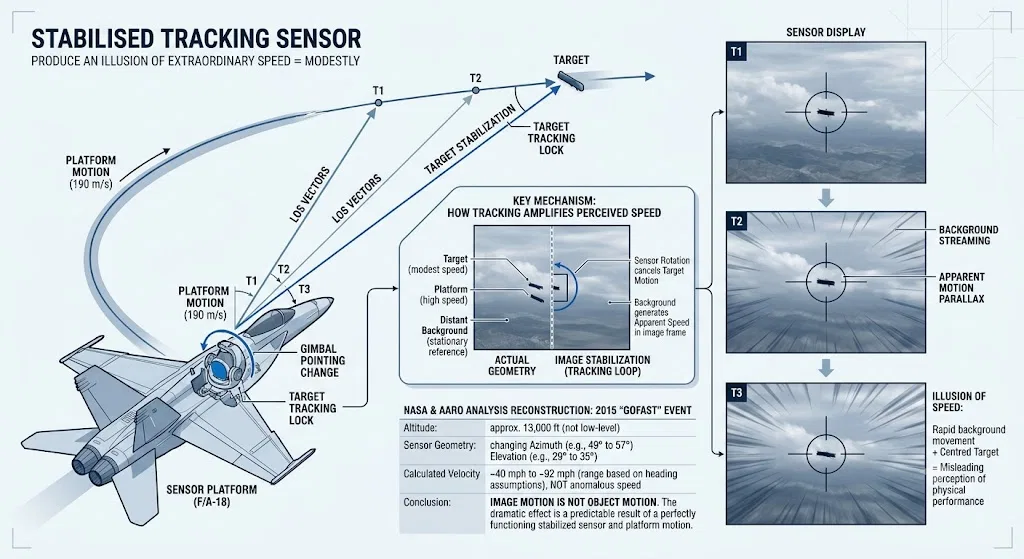
A moving sensor can keep a target centered while the background sweeps past, creating a powerful but misleading impression of speed.
On this page
- How stabilized tracking changes apparent motion
- Background motion and perceptual speed
- Recovering platform and gimbal movement
Page outline Jump by section
Introduction
A tracking camera can make a modestly moving object look extraordinarily fast. The reason is simple but visually powerful: once the camera locks on to a target and keeps it near the centre of the frame, the target ceases to provide the viewer with an obvious reference for the camera’s own movement. Instead, the landscape, ocean or cloud layer streams behind it. The resulting footage can resemble a chase shot of an object racing across the world even when much of the apparent motion is being generated by the aircraft carrying the sensor.
This is not merely a theoretical explanation for UFO or UAP imagery. NASA used the well-known 2015 “GoFast” recording as an example, calculating that the target was about 13,000 feet above the sea rather than just above the surface and noting that the rapid-looking background movement was substantially produced by the high-speed sensor platform and parallax. AARO, the US government’s UAP analysis office, later performed a more extensive reconstruction and likewise concluded with high confidence that the object displayed no anomalous speed.[NASA Science]science.nasa.govNASA Science…
The important lesson is not that every tracked UFO is slow. It is that image motion is not the same thing as object motion. To measure speed from a stabilised tracking video, investigators have to recover what the aircraft and camera were doing as well.
How tracking turns the world into the moving object
Imagine filming a balloon from a fast-moving aircraft. If the camera is fixed straight ahead, both balloon and background move across the image, and the observer can at least see that the viewpoint itself is changing. Now give the camera a steerable gimbal and tell its tracker to hold the balloon in the centre. The sensor continually rotates to cancel the balloon’s motion across the detector. The balloon therefore appears almost stationary on screen while everything behind it slides sideways.
That stabilisation is useful for surveillance: keeping a target centred allows an operator and tracking system to study it continuously. But it also changes the visual intuition of anyone later watching the clip. The eye naturally treats the stable central object as a reference point and the moving background as evidence that the object is travelling rapidly over that background. In reality, the camera may be doing much of the angular work.
The effect becomes stronger when three conditions occur together:
- The sensor platform is moving quickly. A fighter aircraft can shift its viewpoint by kilometres during a short recording.
- The target is much nearer than the background. The target and distant ground or ocean then change angular position at different rates, producing strong parallax.
- The camera is zoomed in and actively tracking. A narrow field of view magnifies background displacement while the tracking loop suppresses the most obvious clue that the camera is rotating.
AARO’s 2025 analysis of the 2013 Aguadilla, Puerto Rico, infrared recording provides a particularly clear official example. Investigators reconstructed objects drifting at about 3.6 metres per second, roughly 8 mph, close to the measured wind speed. Yet they appeared to travel rapidly through the scene. AARO attributed the impression to motion parallax produced by the aircraft’s movement, sensor zoom and changing geometry between aircraft, objects and background.[AARO]aaro.milPuerto Rico UAP Case ResolutionAARO Puerto Rico UAP Case Resolution…
This mechanism differs subtly from ordinary motion blur or a faulty camera. Nothing has to malfunction. A perfectly functioning stabilised sensor can produce a highly misleading impression of speed because it is doing exactly what it was designed to do: following the target while the observer moves.
Why a sweeping background feels like extraordinary speed
Motion parallax is familiar from everyday travel. From a train, nearby fence posts whip backwards while distant hills barely seem to move. The posts are not racing in the opposite direction; the apparent angular motion comes from the observer’s changing position. Airborne video adds another layer because the camera can rotate independently of the aircraft.
In a target-tracking recording, the visual relationship is effectively inverted. The sensor keeps the nearer target fixed while the distant background sweeps through the field of view. Without reliable knowledge of distance, the viewer may unconsciously assume that the target is close to the background — for example, a few metres above the sea — and therefore infer a tremendous linear speed from how quickly the sea texture passes behind it. If the target is actually thousands of feet above that surface, the same angular motion corresponds to a very different geometry.
“GoFast” demonstrates the problem unusually well. The infrared recording gives the immediate impression of a small object skimming over the Atlantic at great speed. NASA’s independent UAP study instead used the displayed range, camera elevation and aircraft altitude to estimate that the object was roughly 13,000 feet above sea level and about 4.2 miles in front of the ocean background along the viewing geometry. The panel estimated approximately 40 mph over one analysed interval, while acknowledging uncertainty because its calculation did not fully incorporate wind effects. Its central point was narrower and robust: the video did not require extraordinary velocity to explain what the viewer saw.[NASA Science]science.nasa.govNASA Science…
AARO revisited the case with a more elaborate treatment published in February 2025. It calculated an altitude near 13,000 feet and modelled a range of possible velocities because the aircraft’s absolute heading was unavailable. Depending on assumptions about heading and wind, AARO found an intrinsic speed range of roughly 5–92 mph after accounting for the wind, rather than the spectacular surface-skimming speed suggested by casual viewing. The office explicitly attributed the apparent high speed to motion parallax.[AARO]aaro.milGo Fast Case ResolutionAARO GoFast Case Resolution…
The contrast is useful because NASA and AARO did not produce identical single-number speed estimates. Their analyses used different assumptions and levels of detail. Yet both reached the more important geometrical conclusion: the dramatic appearance of the clip does not establish dramatic physical performance. The target’s apparent motion relative to the sea is inseparable from the movement and pointing direction of the jet-mounted camera.[NASA Science]science.nasa.govNASA Science…
There is also an instructive historical comparison. Years before AARO published its formal reconstruction, independent analysts examining “GoFast” had already argued that target lock was an important part of the visual illusion: by holding the small bright object near the image centre, the ATFLIR sensor made the ocean appear to rush beneath it. Those early reconstructions varied in assumptions and should not be treated as authoritative case resolutions, but the underlying geometrical argument anticipated the later NASA and AARO conclusion that platform motion and parallax had to be included before inferring extraordinary speed.[Metabunk]metabunk.orggo fast footage from tom delonges to the stars academy bird balloon.9569Metabunk"GO FAST" Footage from Tom DeLonge's To The Stars…9 Mar 2018 — The strangeness of the footage is largely a function of the abi…
Recovering what the aircraft and gimbal were actually doing
The remedy is to stop treating the video frame as a fixed window on the world. Investigators instead reconstruct the three-dimensional observation geometry. That means asking where the sensor platform was, how fast it was moving, where the camera was pointed and how those quantities changed from frame to frame.
For “GoFast”, AARO extracted several useful values displayed directly in the recording: target range, sensor azimuth, sensor elevation, aircraft altitude, aircraft speed and bank angle. During a selected 13-second interval, the displayed range fell from about 4.0 to 3.4 nautical miles while the sensor azimuth shifted from approximately 49° to 57° left and its elevation from roughly 29° to 35° downward. The F/A-18 was travelling at about 190 metres per second and banking by about 14°.[AARO]aaro.milGo Fast Case ResolutionAARO GoFast Case Resolution…
Those numbers transform the problem. Rather than asking “how fast does the object look against the ocean?”, analysts can construct a line of sight from the aircraft to the target at successive times. AARO represented that line of sight mathematically, rotated it according to the sensor’s azimuth and elevation, estimated the jet’s curved flight path from its speed and bank angle, and then calculated where the target had to be relative to the moving aircraft. The method produced a target altitude close to 13,000 feet at both analysed times.[AARO]aaro.milGo Fast Case ResolutionAARO GoFast Case Resolution…
The same principle was used in the Puerto Rico analysis. There, investigators combined the aircraft’s position with sensor elevation, azimuth and slant angle — the direct line-of-sight distance — to reconstruct both the viewing direction and the objects’ path. The resulting model placed the objects over land, moving approximately with the wind, even though the infrared imagery had been interpreted by some viewers as showing rapid flight and entry into the sea.[AARO]aaro.milPuerto Rico UAP Case ResolutionAARO Puerto Rico UAP Case Resolution…
For practical analysis, the most useful quantities are therefore not merely the target’s pixel coordinates. They include:
- Platform position and velocity. Without these, the observer’s contribution to relative motion is unknown.
- Platform attitude. Roll, pitch and heading determine how aircraft motion maps into sensor pointing.
- Gimbal azimuth and elevation. These show where the camera is looking relative to the aircraft.
- Target range or a defensible distance estimate. Angular velocity alone cannot yield physical speed without distance.
- Field of view or focal length. Zoom determines how angular displacement is represented on screen.
- Accurate timestamps. Positions and pointing angles must be compared over known intervals.
- Wind information where relevant. A balloon or other passive object may have substantial ground speed while possessing little speed relative to the surrounding air.
NASA has highlighted precisely this broader metadata problem in UAP investigations. Its independent study found that many recordings lack calibration information, sensor metadata and multiple independent measurements, making size and motion difficult or impossible to determine reliably. The report singled out “GoFast” as an instance in which sufficient information existed to show that apparent anomalous behaviour could largely be explained by sensor-platform motion.[NASA Science]science.nasa.govNASA Science…
What can and cannot be inferred from a centred target
A target remaining centred in a tracked video is almost no evidence that it is flying a smooth, straight path. It may simply mean the tracking system is doing a good job. Likewise, a rapidly moving landscape does not establish that the target is travelling rapidly over that landscape. Both observations describe image stabilisation, not necessarily the object’s true trajectory.
There are, however, useful clues inside such footage. Sudden changes in gimbal angle, zoom, aircraft bank or range can reveal how strongly the camera is compensating for platform motion. Background features can sometimes provide a reference against which camera rotation is reconstructed. If the target range is known, successive line-of-sight vectors can constrain its three-dimensional displacement. If the range is not known, analysts should normally produce a family of possible trajectories rather than a single confident speed.
This is why missing metadata matters so much. AARO’s “GoFast” analysis could not recover the F/A-18’s exact geographical position or compass heading, and the original video file and associated metadata were no longer available. Rather than claiming an exact trajectory, it modelled all possible aircraft headings and reported a range of target speeds. AARO also noted that the numerical values displayed in the footage were of limited precision.[AARO]aaro.milGo Fast Case ResolutionAARO GoFast Case Resolution…
That uncertainty is not a weakness unique to sceptical explanations. It is a constraint on every interpretation. If the aircraft heading, true range or sensor calibration is unknown, the same missing information that prevents investigators from proving a mundane trajectory also prevents them from securely calculating an extreme one. A visually spectacular clip cannot supply physical quantities that the recording never measured.
Multiple viewpoints can greatly improve matters. NASA’s study recommended collecting simultaneous observations and their metadata because triangulation can constrain an object’s location, velocity and size far more securely than a single moving camera can. A second geographically separated sensor can break the distance ambiguity that makes parallax so troublesome in monocular footage.[NASA Science]science.nasa.govNASA Science…
Tracking is a diagnostic, not a universal debunking rule
Camera tracking and parallax are powerful explanations only when the geometry supports them. Their presence in one case does not license dismissing another video simply because the target is centred. Analysts still have to demonstrate that plausible platform motion, target distance and camera pointing can reproduce the observed image.
The distinction is visible in AARO’s own public catalogue. The office now treats “GoFast” as a resolved performance question: the object itself remains unidentified, but AARO assesses that its speed was not anomalous. By contrast, the Navy’s “Gimbal” video is still listed by AARO as unresolved. That difference is important. A sensor-based explanation can remove one claimed anomaly — such as extraordinary speed — without necessarily identifying the underlying object, and it should not be transferred automatically to recordings whose geometry or evidence differs.[AARO]aaro.milUAP Case Resolution Reports Go Fast Case Resolution · GOFASTUAP Case Resolution ReportsGoFast Case Resolution · GOFAST - UAP Video. Eglin Case Resolution. A military pilot reported the object d…
The Puerto Rico case reinforces the same point from another direction. Reconstruction changed the interpretation of several apparently extraordinary features at once: high speed, the apparent path across the scene and the supposed transition into water. Yet those conclusions depended on integrating aircraft and sensor geometry rather than merely declaring the imagery an illusion.[AARO]aaro.milPuerto Rico UAP Case ResolutionAARO Puerto Rico UAP Case Resolution…
For UFO and UAP reports, this makes stabilised tracking an especially important source of IFOs — not because it fabricates objects, but because it can fabricate an intuitive story about their motion. The camera may have recorded a real bird, balloon, drone, aircraft or still-unidentified object perfectly accurately while presenting its movement in a deeply counter-intuitive reference frame.
The key test is whether the speed survives reconstruction
When a tracked UAP appears to race over terrain or water, the decisive question is not “How fast does it look?” It is “How fast is it after the observer’s movement and the gimbal’s pointing changes have been removed?”
“GoFast” is the clearest modern demonstration. A fighter-borne infrared camera held a small object near the centre while the ocean swept behind it, creating an immediate impression of extraordinary low-level speed. NASA and AARO independently found that the displayed geometry placed the object thousands of feet above the sea and that platform motion and parallax explained much of the dramatic appearance. AARO’s later, more detailed model found no anomalous performance even though it could not identify the object itself.[NASA Science]science.nasa.govNASA Science…
That is the broader analytical lesson. A target tracker is designed to suppress relative image motion between camera and target. In doing so, it can transfer the visible motion to the background and make an ordinary relative-motion problem look like extraordinary propulsion. Recovering the aircraft’s trajectory, gimbal angles, range and timing restores the missing reference frame — and only then does apparent speed become a physically meaningful speed.
Amazon book picks
Further Reading
Books and field guides related to When the Camera Moves More Than the UFO. Use these as the next step if you want deeper reading beyond the article.
Computer Vision: Algorithms and Applications
Computer Vision: Algorithms and Applications explores the variety of techniques used to analyze and interpret images. It also describes c...
Multiple View Geometry in Computer Vision
A basic problem in computer vision is to understand the structure of a real world scene given several images of it. Techniques for solvin...
An Invitation to 3-D Vision: From Images to Geometric Models
This book is intended to give students at the advanced undergraduate or introduc tory graduate level, and researchers in computer vision,...
The Geometry of Multiple Images
This book formalizes and analyzes the relations between multiple views of a scene from the perspective of various types of geometries. A...
eBay marketplace picks
Marketplace Samples
Live-tested eBay searches with available results related to this page.
Selected fromUFO collectible oneBay.co.uk.

Endnotes
1.
Source: science.nasa.gov
Link:https://science.nasa.gov/wp-content/uploads/2023/09/uap-independent-study-team-final-report.pdf?emrc=80696d
Source snippet
NASA Science...
2.
Source: aaro.mil
Title: [Go Fast]({{ ‘go-fast/’ | relative_url }}) Case Resolution
Link:https://www.aaro.mil/Portals/136/PDFs/case_resolution_reports/AARO_GoFast_Case_Resolution_Card_Methodology_Final.pdf
Source snippet
AARO GoFast Case Resolution...
3.
Source: aaro.mil
Title: Puerto Rico UAP Case Resolution
Link:https://www.aaro.mil/Portals/136/PDFs/case_resolution_reports/AARO_Puerto_Rico_UAP_Case_Resolution.pdf
Source snippet
AARO Puerto Rico UAP Case Resolution...
4.
Source: metabunk.org
Title: go fast footage from tom delonges to the stars academy bird balloon.9569
Link:https://www.metabunk.org/threads/go-fast-footage-from-tom-delonges-to-the-stars-academy-bird-balloon.9569/
Source snippet
Metabunk"GO FAST" Footage from Tom DeLonge's To The Stars...9 Mar 2018 — The strangeness of the footage is largely a function of the abi...
5.
Source: metabunk.org
Title: post 240166
Link:https://www.metabunk.org/threads/go-fast-footage-from-tom-delonges-to-the-stars-academy-bird-balloon.9569/post-240166
Source snippet
Metabunk"GO FAST" Footage from Tom DeLonge's To The Stars...9 Mar 2018 — Heading/turn rate: My analysis assumed constant heading because...
6.
Source: aaro.mil
Title: UAP Case Resolution Reports Go Fast Case Resolution · GOFAST
Link:https://www.aaro.mil/UAP-Cases/UAP-Case-Resolution-Reports/
Source snippet
UAP Case Resolution ReportsGoFast Case Resolution · GOFAST - UAP Video. Eglin Case Resolution. A military pilot reported the object d...
7.
Source: aaro.mil
Link:https://www.aaro.mil/UAP-Cases/Official-UAP-Imagery/
8.
Source: science.nasa.gov
Link:https://science.nasa.gov/uap/
9.
Source: science.gsfc.nasa.gov
Link:https://science.gsfc.nasa.gov/sci/bio/david.p.bennett
10.
Source: nasa.gov
Title: to release discuss unidentified anomalous phenomena report
Link:https://www.nasa.gov/news-release/nasa-to-release-discuss-unidentified-anomalous-phenomena-report/
11.
Source: science.nasa.gov
Link:https://science.nasa.gov/uap/faqs/
12.
Source: nasa.gov
Title: announces unidentified aerial phenomena study team members
Link:https://www.nasa.gov/general/nasa-announces-unidentified-aerial-phenomena-study-team-members/
13.
Source: science.nasa.gov
Link:https://science.nasa.gov/
14.
Source: nasa.gov
Title: update nasa shares uap independent study report names director
Link:https://www.nasa.gov/news-release/update-nasa-shares-uap-independent-study-report-names-director/
15.
Source: metabunk.org
Title: nasa panel analyzes go fast.13174
Link:https://www.metabunk.org/threads/nasa-panel-analyzes-go-fast.13174/
16.
Source: metabunk.org
Link:https://www.metabunk.org/threads/gofast-is-the-background-moving-relatively-to-the-movement-of-the-jet-or-the-camera-only.11812/
17.
Source: metabunk.org
Title: automated motion tracking in videos like gimbal and gofast.12299
Link:https://www.metabunk.org/threads/automated-motion-tracking-in-videos-like-gimbal-and-gofast.12299/
18.
Source: metabunk.org
Title: gimbal blender simulation with clouds.12209
Link:https://www.metabunk.org/threads/gimbal-blender-simulation-with-clouds.12209/
19.
Source: metabunk.org
Link:https://www.metabunk.org/threads/gimbal-video-simulating-the-atflir-tracking-and-gimbal-rotation.11391/
20.
Source: metabunk.org
Title: dow uap pr067 multiple spherical uap uso near sub.14898
Link:https://www.metabunk.org/threads/dow-uap-pr067-multiple-spherical-uap-uso-near-sub.14898/
21.
Source: metabunk.org
Title: UAP Hearing New Video
Link:https://www.metabunk.org/threads/uap-hearing-new-video-yemen-orb.14427/
22.
Source: metabunk.org
Title: ufos filmed from moving [helicopters]({{ ‘helicopters/’ | relative_url }}) and planes not so fast.10256
Link:https://www.metabunk.org/threads/ufos-filmed-from-moving-helicopters-and-planes-not-so-fast.10256/
23.
Source: metabunk.org
Title: middle east 2022 mq 9 observed apparent spherical uap via aaro.12932
Link:https://www.metabunk.org/threads/middle-east-2022-mq-9-observed-apparent-spherical-uap-via-aaro.12932/
24.
Source: aaro.mil
Link:https://www.aaro.mil/
25.
Source: aaro.mil
Title: AARO FY2025 Consolidated Annual Report on UAP
Link:https://www.aaro.mil/Portals/136/PDFs/FY25%20UAP%20Annual%20Report/AARO_FY2025_Consolidated_Annual_Report_on_UAP.pdf
26.
Source: aaro.mil
Link:https://www.aaro.mil/About/Leaders/
Additional References
27.
Source: youtube.com
Title: Raytheon ATFLIR expert discusses Navy gimbal UFO/UAP video with Mick West
Link:https://www.youtube.com/watch?v=FGHeu5GeR-0
Source snippet
Mick West GoFast camera tracking motion parallax Explained: "Go Fast" UFO Video - Not Low and Not Fast - Like a Balloon...
28.
Source: youtube.com
Title: Quantum physicists analyze pentagon US navy UFO video footage
Link:https://www.youtube.com/watch?v=cwACSrLEPeM
Source snippet
Raytheon ATFLIR expert discusses Navy gimbal UFO/UAP video with Mick West...
29.
Source: war.gov
Link:https://www.war.gov/ufo/
30.
Source: intelligence.gov
Link:https://www.intelligence.gov/publics-daily-brief/publics-daily-brief-articles/unidentified-aerial-phenomena-preliminary-intelligence-assessment
31.
Source: youtube.com
Title: The SHOCKING Math Error Behind Viral UFO Videos | Mick West
Link:https://www.youtube.com/watch?v=ypfbhfEXnBo
Source snippet
Quantum physicists analyze pentagon US navy UFO video footage...
32.
Source: researchgate.net
Link:https://www.researchgate.net/publication/335382837_Seeing_through_the_mist_an_evaluation_of_an_iteratively_designed_head-up_display_using_a_simulated_degraded_visual_environment_to_facilitate_rotary-wing_pilot_situation_awareness_and_workload
33.
Source: reddit.com
Link:https://www.reddit.com/r/UFOs/comments/166dk0u/according_to_aaros_new_website_the_flir_gimbal/
34.
Source: templatelab.com
Link:https://templatelab.com/uap-independent-study/
35.
Source: facebook.com
Link:https://www.facebook.com/StarTalk/videos/is-motion-parallax-the-reason-many-believe-this-to-be-a-uap-turns-out-we-can-cal/1000173309370538/
36.
Source: instagram.com
Link:https://www.instagram.com/reel/DI4yFHIi2Js/?hl=en