Within Planets
Why Venus Can Seem to Follow Your Car
Because a planet barely shifts as roadside scenery sweeps past, drivers can interpret its constant bearing as pursuit or synchronized movement.
On this page
- Parallax and the missing sideways shift
- Why turns and winding roads strengthen the illusion
- Foreground obstructions and repeated disappearances
Page outline Jump by section
Introduction
A bright planet can seem to follow a moving car even though it is hundreds of millions of kilometres away. The effect comes mainly from geometry and visual perception: roadside trees, buildings and signs sweep rapidly across the driver’s view, while the direction to an extremely distant object such as Venus changes by an imperceptibly small amount. The planet therefore keeps roughly the same bearing as the vehicle moves, creating the impression that the light is keeping pace.
This is an especially important source of misleading UFO or UAP reports because driving supplies abundant evidence that the observer is moving but almost no visible evidence that the planet is. A bend in the road can make the light apparently shift from ahead to the side; trees can repeatedly hide and reveal it; and changing foreground scenery can make a stationary celestial light seem to manoeuvre relative to the vehicle. Bright planets such as Venus and Jupiter are explicitly listed by the US All-domain Anomaly Resolution Office (AARO) among celestial objects commonly reported as UAP.[AARO]aaro.milAARO HomeWhat are some common objects/causes frequently reported as UAP?… Celestial objects: Bright planets like Venus and Jupiter…
Parallax and the missing sideways shift
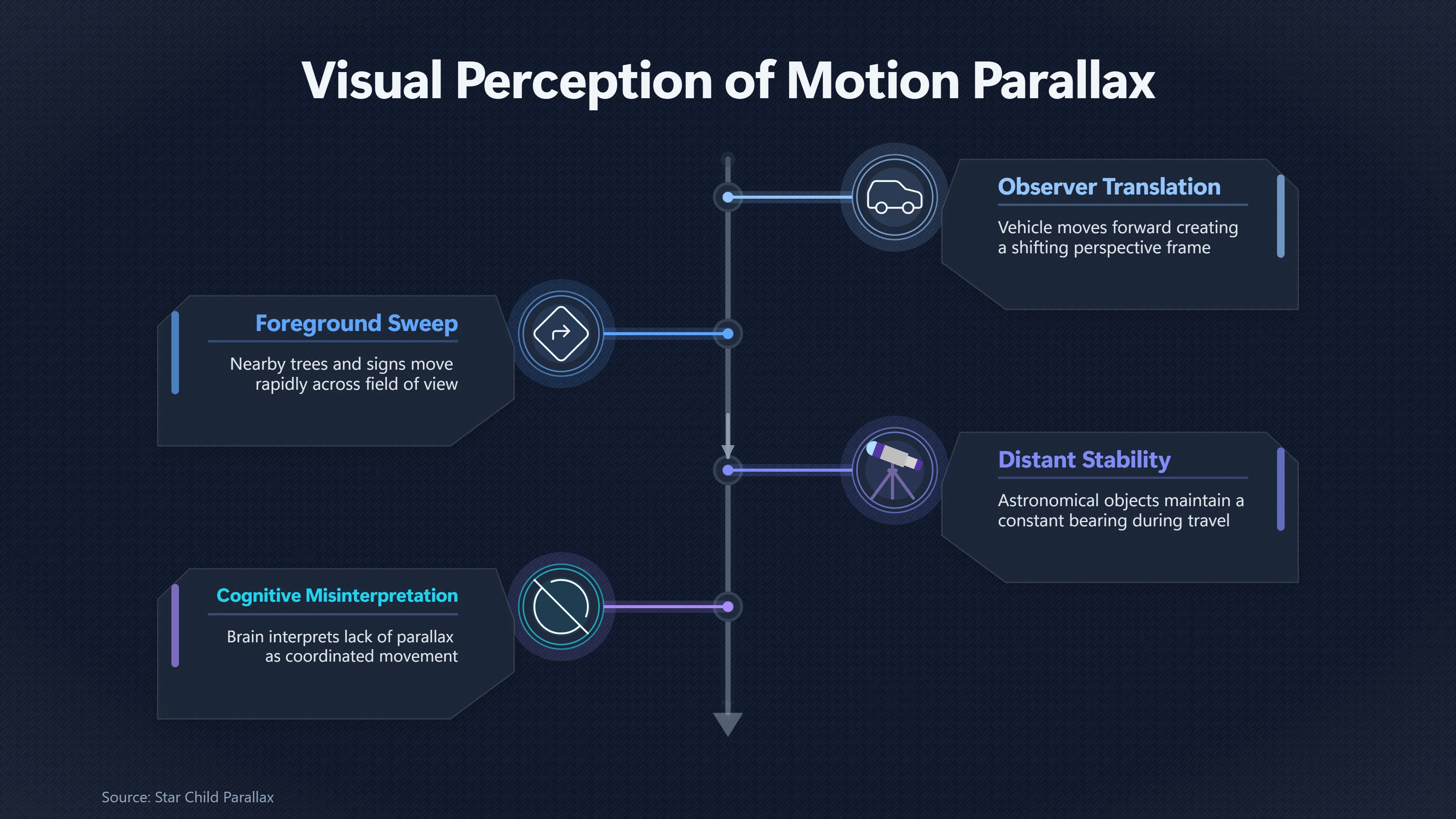
The basic mechanism is motion parallax. When an observer changes position, nearby and distant objects change direction by different amounts. A telegraph pole beside a road can race from the front of a passenger’s field of view to behind them in seconds. A distant hill moves much more slowly. An astronomical object changes its apparent direction least of all.
NASA illustrates the same geometry with ordinary parallax: change the viewing position and a nearby object appears to shift against a more distant background; the farther away the object is, the smaller that angular shift becomes. The principle is sufficiently precise that astronomers use parallax to measure stellar distances. Even Earth’s enormous orbital baseline produces only tiny apparent displacements for nearby stars.[nasa.gov]starchild.gsfc.nasa.govStar Child ParallaxStar Child Parallax
Research on human vision describes motion parallax more specifically as the different retinal motion produced by objects at different depths when the observer translates through the environment. It is a powerful depth cue precisely because nearer parts of a scene normally move across the visual field differently from farther ones.[PubMed Central (PMC)]pmc.ncbi.nlm.nih.govPub Med Central (PMC)The neural basis of depth perception from motion parallaxPubMed Central (PMC)The neural basis of depth perception from motion parallax - PMCJune 19, 2016…
A car makes this effect unusually obvious. Educational demonstrations of motion parallax use driving itself as an example: nearby objects move much farther across the field of view than distant objects as the vehicle proceeds along a road.[psych.hanover.edu]psych.hanover.eduMotion ParallaxMotion Parallax The familiar experience of the Moon seeming to follow a car is the same geometrical phenomenon at work on a more conspicuous object: a modest change in the observer’s terrestrial position hardly changes the line of sight to something at astronomical distance.[WIRED]wired.comwhy does the moon follow meWhy does the Moon follow me? | WIREDSeptember 27, 2010…
For Venus or Jupiter, the consequence can be counter-intuitive. The observer may travel several kilometres while the planet remains in almost the same direction. Everything that the driver knows to be stationary — trees, houses, hedges, lamp posts — is visibly sliding past. The one brilliant light that scarcely changes bearing can therefore look like the thing that is moving with the car.
This does not mean that parallax literally causes Venus to move across the sky alongside the vehicle. It means almost the opposite: the conspicuous absence of the amount of parallax expected from a nearby object can be misinterpreted as coordinated motion.
Why turns and winding roads strengthen the illusion
Straight-line travel can produce a simple impression of being followed, but bends make the experience more persuasive because the observer’s frame of reference keeps rotating.
Imagine Venus is low in a particular part of the sky. On one stretch of road it may appear ahead and slightly to the driver’s right. The road then bends towards it, putting the planet closer to the apparent direction of travel. Another bend may place it beside the vehicle. The planet has not performed those manoeuvres: the car has changed heading beneath a celestial line of sight that remains comparatively stable.
That distinction matters because rotation and translation do different things to the visual scene. Motion parallax arises from the observer’s translation, while turning changes the orientation of the observer and therefore where the same distant object falls within the forward or sideward view. Research on visual perception treats observer motion, retinal motion and eye movements as information that the visual system must combine to recover a stable three-dimensional world.[Royal Society Publishing]royalsocietypublishing.orgOpen source on royalsocietypublishing.org.
Inside a vehicle there is an additional psychological reference point: people naturally judge where an object is relative to the windscreen, road and direction of travel. A driver may therefore remember that a light “stayed ahead of us”, “came alongside” or “followed every turn”. Those descriptions can sound as though the light independently matched the vehicle’s course, even when a reconstruction shows that the vehicle’s own changing heading accounts for much of the apparent behaviour.
This is one reason that a reported pursuit should not, by itself, establish that a UFO was physically following a car. The stronger test is whether the light maintained the astronomical bearing expected for a planet when the witness’s changing road direction is reconstructed.
The distinction is also a useful caution against overly simple debunking. Not every light that appears to follow a vehicle is Venus, and not every complicated vehicle encounter can be explained merely by invoking parallax. A planetary identification needs to fit the date, time, observer location, viewing direction and elevation. AARO’s historical review notes that Venus, Jupiter and Mars were among objects historically reported as UFOs, but identifying a particular case still requires matching the candidate to the observation rather than assuming that any bright moving light was a planet.[AARO]aaro.milOpen source on aaro.mil.
Foreground obstructions and repeated disappearances
Trees, buildings, hills and roadside structures can make the following effect more dramatic rather than less. As a car moves, these nearby objects sweep rapidly across the line of sight and repeatedly cover and uncover a distant planet.
The result can look surprisingly active. A light may appear above a hedge, vanish behind trees, return through a gap, disappear behind a building and then reappear farther along the road. Because the foreground objects are changing so rapidly, it is easy to experience the sequence as the light itself darting in and out of view.
Occlusion is not a trivial visual detail. Experimental research shows that dynamic occlusion — surfaces revealing and concealing other surfaces as an observer moves — works together with motion parallax in human depth perception. The appearance and disappearance of visual information at boundaries can provide information about which surfaces are nearer or farther away.[PubMed Central (PMC)]pmc.ncbi.nlm.nih.govOpen source on nih.gov.
For a planet, however, ordinary terrestrial depth cues are extraordinarily mismatched. The trees have measurable parallax; the planet effectively does not. Trees visibly pass in front of it, proving that the light lies beyond them, but they provide little useful information about how much farther away it is. Once the observer interprets the bright point as an object somewhere in the local landscape or atmosphere, the visual system has no familiar size, shadow, surface detail or nearby companion object from which to recover its true astronomical distance.
This is why a sequence such as “it vanished behind the trees and then caught up with us” needs careful interpretation. If the disappearance coincides with foreground vegetation crossing the appropriate celestial direction, no motion by the light is required. The car itself transports the observer from one blocked sightline to the next.
Why a distant planet can look surprisingly close
The illusion depends partly on an ambiguity that disappears for most ordinary objects. A car has familiar dimensions. A house sits on the ground. An aircraft usually has recognisable navigation lights, an outline, motion against the sky or other distance cues. A bright unresolved planet offers very little of this information.
Human vision normally estimates three-dimensional layout by combining multiple cues, including motion parallax, binocular disparity, relative size and occlusion. Motion parallax itself provides powerful information when different parts of the visible environment lie at different depths.[PubMed Central (PMC)]pmc.ncbi.nlm.nih.govPub Med Central (PMC)The neural basis of depth perception from motion parallaxPubMed Central (PMC)The neural basis of depth perception from motion parallax - PMCJune 19, 2016… A lone point of light against a dark sky is a poor target for that normal process because there may be no usable neighbouring objects at comparable distance.
That leaves an important ambiguity: an unresolved bright point does not announce whether it is a modest light kilometres away or a planet at astronomical distance. If it is mentally placed in the nearer category, its behaviour becomes puzzling. A local object ought to change bearing noticeably as the car travels, yet the planet does not. The observer may resolve the contradiction not by revising the assumed distance, but by concluding that the object itself must be moving to maintain position.
The same geometry explains why distant mountains can seem to accompany a traveller and why the Moon famously appears to follow a car. The UFO-relevant difference is that Venus can look less obviously astronomical than the Moon. It is merely a brilliant point, so a witness who does not recognise it has fewer visual clues telling them that “following” is an effect of extreme distance rather than propulsion.
What a genuine planet match should predict
The moving-vehicle effect is valuable to investigators because it makes testable predictions. A planetary explanation should not require Venus or Jupiter to reproduce every apparent turn described by a witness. Instead, the planet should occupy approximately the celestial direction from which the reported light was seen while the vehicle’s position and heading account for the changing experience.
Several observations become particularly informative:
- Bearing matters more than perceived pursuit. If the witness travelled around bends but the reconstructed sightlines repeatedly point towards the planet’s calculated position, the apparent following behaviour is expected.
- Foreground interruptions should make geographical sense. Trees, hills or buildings capable of blocking that direction can explain repeated disappearances without requiring the object itself to switch off or accelerate.
- The lack of parallax is evidence of distance, not evidence of pursuit. A genuinely nearby stationary light should change direction substantially as the observer travels past it. A planet should not.
- Stopping the vehicle is a useful conceptual test. Once observer motion ceases, the rapid motion-parallax pattern of the roadside scene disappears. A planet will continue its ordinary slow celestial motion rather than displaying the supposed kilometre-for-kilometre pursuit implied while driving.
- Astronomical position provides an independent check. The strongest identification comes when calculated azimuth and elevation agree with the reported line of sight at the relevant times and locations, rather than from resemblance alone.
These tests follow directly from the geometry of parallax and from the established role of observer motion in visual depth perception. NASA’s explanations emphasise that apparent displacement decreases with distance, while experimental vision research shows that relative retinal motion produced by observer translation is itself an important source of perceived depth.[nasa.gov]starchild.gsfc.nasa.govStar Child ParallaxStar Child Parallax
The key clue is what did not move
Accounts of a light that “followed the car” can sound more extraordinary than accounts of a stationary light because pursuit implies purposeful movement. Yet for an astronomical object, persistent bearing is exactly what should be expected over ordinary driving distances.
The diagnostic question is therefore not simply, “Did the light appear to follow the vehicle?” It is: how much should its direction have changed if it had really been nearby? Roadside scenery provides dramatic motion parallax; distant terrain provides less; an astronomical body provides essentially none at the scale of a car journey. The resulting contrast can transform an ordinary planet into an apparently responsive object.
Turns can then change where that fixed celestial direction falls relative to the car, while trees and buildings can repeatedly erase and restore the light. Together, these effects can produce a remarkably coherent subjective impression: a luminous object that stays with the vehicle, shifts position as the road changes and repeatedly disappears before returning.
That pattern is therefore compatible with Venus or another bright planet, but it is not sufficient on its own to prove such an identification. The decisive evidence is geometrical: when the witness’s route, headings and obstructions are combined with the calculated position of the planet, the supposed pursuit should emerge from the observer’s movement rather than requiring corresponding motion by the light itself.
Amazon book picks
Further Reading
Books and field guides related to Why Venus Can Seem to Follow Your Car. Use these as the next step if you want deeper reading beyond the article.
Sensation and Perception
. Bruce Goldstein's SENSATION AND PERCEPTION, the best-seller which has helped over 150,000 students understand the ties between how we s...
NightWatch: A Practical Guide to Viewing the Universe
A practical guide to viewing the universe.
The UFO Handbook: A Guide to Investigating, Evaluating, and R...
An explanation of the usual reasons for confusing IFOs (identified flying objects) with UFOs and a survey of the tools used to investigat...
The Backyard Astronomer's Guide
Discusses the practical aspects of stargazing, including how to choose appropriate equipment, contending with light pollution, taking suc...
eBay marketplace picks
Marketplace Samples
Live-tested eBay searches with available results related to this page.
Selected fromVenus wall art oneBay.co.uk.
Endnotes
1.
Source: aaro.mil
Link:https://www.aaro.mil/
Source snippet
AARO HomeWhat are some common objects/causes frequently reported as UAP?... Celestial objects: Bright planets like Venus and Jupiter...
2.
Source: aaro.mil
Link:https://www.aaro.mil/FAQ/
Source snippet
AARO FAQWhat are some common objects/causes frequently reported as UAP?... Celestial objects: Bright planets like Venus and Jupiter...
3.
Source: starchild.gsfc.nasa.gov
Title: Star Child Parallax
Link:https://starchild.gsfc.nasa.gov/docs/StarChild/questions/parallax.html
4.
Source: imagine.gsfc.nasa.gov
Title: Imagine the Universe Description
Link:https://imagine.gsfc.nasa.gov/descriptions/parallax.html
5.
Source: science.nasa.gov
Title: Science Stellar Parallax
Link:https://science.nasa.gov/asset/hubble/stellar-parallax/
Source snippet
NASA ScienceStellar Parallax - NASA Science...
6.
Source: psych.hanover.edu
Title: Motion Parallax
Link:https://psych.hanover.edu/krantz/motionparallax/motionparallax.html
7.
Source: wired.com
Title: why does the moon follow me
Link:https://www.wired.com/2010/09/why-does-the-moon-follow-me/
Source snippet
Why does the Moon follow me? | WIREDSeptember 27, 2010...
Published: September 27, 2010
8.
Source: aaro.mil
Link:https://www.aaro.mil/Portals/136/PDFs/AARO_Historical_Record_Report_Vol_1_2024.pdf
9.
Source: science.nasa.gov
Title: hubble glossary
Link:https://science.nasa.gov/mission/hubble/multimedia/hubble-glossary/
10.
Source: aaro.mil
Link:https://www.aaro.mil/Next-AARO-Home-redesign/Next-Parent/Next-AARO-UAP-Imagery-Acc-Table/
11.
Source: aaro.mil
Link:https://www.aaro.mil/Next-AARO-Home-redesign/Next-Parent/Next-UAP-Report-Documents/poster/dividLink/
12.
Source: science.nasa.gov
Link:https://science.nasa.gov/universe/glossary/
13.
Source: science.nasa.gov
Title: venus resources
Link:https://science.nasa.gov/solar-system/resources/resource-packages/venus-resources/
14.
Source: change.org
Title: Petition · FREE (Flock resistance everyone everywhere)
Link:https://www.change.org/p/free-flock-resistance-everyone-everywhere
15.
Source: aaro.mil
Link:https://www.aaro.mil/Next-AARO-Home-redesign/Next-Parent/Presidential-UAP-Transparency-Initiative/
16.
Source: aaro.mil
Link:https://www.aaro.mil/Next-AARO-Home-redesign/Next-Parent/Presidential-UAP-Transparency-Initiative/dvpmoduleid/77396/
17.
Source: aaro.mil
Link:https://www.aaro.mil/Next-AARO-Home-redesign/Next-Parent/Presidential-UAP-Transparency-Initiative/videoid/1010269/dvpcc/false/
18.
Source: science.nasa.gov
Title: parker solar probe lines up for final venus flyby
Link:https://science.nasa.gov/blogs/parker-solar-probe/2024/09/06/parker-solar-probe-lines-up-for-final-venus-flyby/
19.
Source: svs.gsfc.nasa.gov
Link:https://svs.gsfc.nasa.gov//5320
20.
Source: aaro.mil
Link:https://www.aaro.mil/Next-AARO-Home-redesign/Next-Parent/Presidential-UAP-Transparency-Initiative/videoid/988673/dvpcc/false/
21.
Source: nasa.gov
Title: 60 Years Ago: Mariner 2 First to Explore Venus
Link:https://www.nasa.gov/history/60-years-ago-mariner-2-first-to-explore-venus/
22.
Source: nasa.gov
Title: NAS A’s DAVINCI Mission To Take the Plunge Through Massive Atmosphere of Venus
Link:https://www.nasa.gov/centers-and-facilities/goddard/nasas-davinci-mission-to-take-the-plunge-through-massive-atmosphere-of-venus/
23.
Source: aaro.mil
Link:https://www.aaro.mil/Next-AARO-Home-redesign/Next-Parent/Presidential-UAP-Transparency-Initiative/videoid/1010264/dvpcc/false/
24.
Source: imagine.gsfc.nasa.gov
Title: nearest star info
Link:https://imagine.gsfc.nasa.gov/features/cosmic/nearest_star_info.html
25.
Source: nasa.gov
Title: NAS A’s New Horizons Conducts the First Interstellar Parallax Experiment
Link:https://www.nasa.gov/solar-system/nasas-new-horizons-conducts-the-first-interstellar-parallax-experiment/
26.
Source: astrobiology.nasa.gov
Title: know thy star know thy planet
Link:https://astrobiology.nasa.gov/news/know-thy-star-know-thy-planet/
27.
Source: science.nasa.gov
Title: hubble stretches stellar tape measure 10 times farther into space
Link:https://science.nasa.gov/missions/hubble/hubble-stretches-stellar-tape-measure-10-times-farther-into-space/
28.
Source: pwg.gsfc.nasa.gov
Link:https://pwg.gsfc.nasa.gov/stargaze/Sparalax.htm
29.
Source: science.nasa.gov
Title: artists view of ancient star annotated
Link:https://science.nasa.gov/asset/hubble/artists-view-of-ancient-star-annotated/
30.
Source: wired.com
Title: ufo video fake tsirbas
Link:https://www.wired.com/2013/02/ufo-video-fake-tsirbas/
31.
Source: science.nasa.gov
Title: depth perception in space
Link:https://science.nasa.gov/resource/depth-perception-in-space/
32.
Source: science.nasa.gov
Title: venus cloud tops viewed by hubble
Link:https://science.nasa.gov/photojournal/venus-cloud-tops-viewed-by-hubble/
33.
Source: spacemath.gsfc.nasa.gov
Link:https://spacemath.gsfc.nasa.gov/transits/TRACEvenus.html
34.
Source: ufos.wiki
Title: Autokinetic effect
Link:https://ufos.wiki/investigation/autokinetic-effect/
35.
Source: ufos.wiki
Link:https://ufos.wiki/investigate/
36.
Source: scholars.lib.ntu.edu.tw
Link:https://scholars.lib.ntu.edu.tw/entities/publication/1991b342-1531-4f47-8248-4691994040ba
37.
Source: astronomy.swin.edu.au
Link:https://astronomy.swin.edu.au/cosmos/T/Trigonometric%2BParallax
38.
Source: everything.explained.today
Link:https://everything.explained.today/Identification_studies_of_UFOs/
39.
Source: everything.explained.today
Link:https://everything.explained.today/Project_Blue_Book/
40.
Source: aaro.mil
Title: AAR O UAP Trends All-domain Anomaly Resolution Office UAP REPORTING TRENDS
Link:https://www.aaro.mil/UAP-Cases/UAP-Reporting-Trends/
41.
Source: aaro.mil
Link:https://www.aaro.mil/Next-AARO-Home-redesign/Next-Parent/Next-AARO-UAP-Trends/
42.
Source: aaro.mil
Link:https://www.aaro.mil/UAP-Cases/Official-UAP-Imagery/4/
43.
Source: aaro.mil
Link:https://www.aaro.mil/UAP-Cases/Official-UAP-Imagery/ftag/MSF0951a18/
44.
Source: aaro.mil
Link:https://www.aaro.mil/Next-AARO-Home-redesign/Next-Parent/Next-AARO-UAP-Imagery-Fixed-Table/
45.
Source: aaro.mil
Link:https://www.aaro.mil/EFOIA-Reading-Room/
46.
Source: aaro.mil
Link:https://www.aaro.mil/Next-AARO-Home-redesign/Inactive-Parent/Next-UAP-Imagery-dup/
47.
Source: aaro.mil
Link:https://www.aaro.mil/Next-AARO-Home-redesign/Next-Parent/Next-UAP-Case-RR-Data-Table/
48.
Source: youtube.com
Title: Why is the moon following me?
Link:https://www.youtube.com/watch?v=UXpmM7BzTfI
Source snippet
Motion Parallax - sensation and perception...
49.
Source: youtube.com
Title: Motion Parallax
Link:https://www.youtube.com/watch?v=RxO3HMCjfQs
Source snippet
This video demonstrates motion parallax in visual perception, explaining why near objects move quickly while distant objects and celestia...
50.
Source: pmc.ncbi.nlm.nih.gov
Title: Pub Med Central (PMC)The neural basis of depth perception from motion parallax
Link:https://pmc.ncbi.nlm.nih.gov/articles/PMC4901450/
Source snippet
PubMed Central (PMC)The neural basis of depth perception from motion parallax - PMCJune 19, 2016...
Published: June 19, 2016
51.
Source: royalsocietypublishing.org
Title: The neural basis of depth perception from motion
Link:https://royalsocietypublishing.org/rstb/article/371/1697/20150256/22922/The-neural-basis-of-depth-perception-from-motion
Source snippet
Finally, depth from motion parallax has generally been studied during lateral translation of observers...
52.
Source: royalsocietypublishing.org
Link:https://royalsocietypublishing.org/rstb/article/371/1697/20150265/22896/A-moving-observer-in-a-three-dimensional-worldA
53.
Source: royalsocietypublishing.org
Title: Spatial constancy mechanisms in motor
Link:https://royalsocietypublishing.org/rstb/article/366/1564/476/21491/Spatial-constancy-mechanisms-in-motor
54.
Source: pmc.ncbi.nlm.nih.gov
Link:https://pmc.ncbi.nlm.nih.gov/articles/PMC4521857/
55.
Source: pubmed.ncbi.nlm.nih.gov
Title: Pub Med Relative distance cues contribute to scaling depth from motion parallax
Link:https://pubmed.ncbi.nlm.nih.gov/12049281/
56.
Source: esa.int
Title: European Space Agency ESA
Link:https://www.esa.int/Science_Exploration/Space_Science/Gaia/How_does_Gaia_study_the_Milky_Way
57.
Source: astro.com
Link:https://www.astro.com/astrowiki/en/Parallax
58.
Source: GOV.UK
Link:https://www.gov.uk/government/publications/undercover-policing-inquiry-tranche-1-interim-report/undercover-policing-inquiry-tranche-1-interim-report-accessible-version
59.
Source: weather.gov.hk
Link:https://www.weather.gov.hk/en/education/astronomy-and-time/astronomy/00405-apparent-motion-of-planets-explained.html
60.
Source: pmc.ncbi.nlm.nih.gov
Link:https://pmc.ncbi.nlm.nih.gov/articles/PMC8070410/
61.
Source: media.nationalarchives.gov.uk
Link:https://media.nationalarchives.gov.uk/index.php/ufo-files-national-archives/
62.
Source: pmc.ncbi.nlm.nih.gov
Link:https://pmc.ncbi.nlm.nih.gov/articles/PMC4990516/
63.
Source: pubmed.ncbi.nlm.nih.gov
Link:https://pubmed.ncbi.nlm.nih.gov/27618514/
64.
Source: pubmed.ncbi.nlm.nih.gov
Link:https://pubmed.ncbi.nlm.nih.gov/27269599/
65.
Source: pmc.ncbi.nlm.nih.gov
Link:https://pmc.ncbi.nlm.nih.gov/articles/PMC4302165/
66.
Source: pmc.ncbi.nlm.nih.gov
Link:https://pmc.ncbi.nlm.nih.gov/articles/PMC2422877/
67.
Source: pubmed.ncbi.nlm.nih.gov
Link:https://pubmed.ncbi.nlm.nih.gov/12954876/
68.
Source: pmc.ncbi.nlm.nih.gov
Link:https://pmc.ncbi.nlm.nih.gov/articles/PMC20395/
69.
Source: sciencedirect.com
Title: Motion Parallax
Link:https://www.sciencedirect.com/topics/computer-science/motion-parallax
70.
Source: royalsocietypublishing.org
Link:https://royalsocietypublishing.org/rstb/article-pdf/doi/10.1098/rstb.2015.0256/111747/rstb.2015.0256.pdf
71.
Source: royalsocietypublishing.org
Link:https://royalsocietypublishing.org/rspb/article-pdf/203/1153/405/171821/rspb.1979.0006.pdf
72.
Source: royalsocietypublishing.org
Link:https://royalsocietypublishing.org/rstb/article/378/1869/20210448/42672/Understanding-3D-vision-as-a-policy
73.
Source: royalsocietypublishing.org
Link:https://royalsocietypublishing.org/rstb/article/378/1869/20210464/42742/Familiar-size-affects-perception-differently-in
74.
Source: royalsocietypublishing.org
Title: The fine structure of honeybee head and body yaw
Link:https://royalsocietypublishing.org/rspb/article/277/1689/1899/73153/The-fine-structure-of-honeybee-head-and-body-yaw
75.
Source: royalsocietypublishing.org
Link:https://royalsocietypublishing.org/doi/pdf/10.1098/rstb.1997.0128
76.
Source: royalsocietypublishing.org
Title: Minimal theory of 3D vision new approach to visual
Link:https://royalsocietypublishing.org/rstb/article/378/1869/20210455/42765/Minimal-theory-of-3D-vision-new-approach-to-visual
77.
Source: astro.unl.edu
Link:https://astro.unl.edu/naap/distance/parallax.html
78.
Source: ultimatepopculture.fandom.com
Link:https://ultimatepopculture.fandom.com/wiki/Parallax
Additional References
79.
Source: cia.gov
Link:https://www.cia.gov/readingroom/document/cia-rdp81r00560r000100010002-9
80.
Source: nature.com
Title: Scene-relative object motion biases depth percepts | Scientific Reports
Link:https://www.nature.com/articles/s41598-022-23219-4
81.
Source: researchgate.net
Link:https://www.researchgate.net/publication/19929166_Dynamic_Occlusion_and_Motion_Parallax_in_Depth_Perception
82.
Source: researchgate.net
Link:https://www.researchgate.net/publication/260245012_Effects_of_motion_parallax_in_driving_simulators
83.
Source: researchgate.net
Link:https://www.researchgate.net/publication/252192490_The_1882_Transit_of_Venus_and_the_Popularisation_of_Astronomy_through_the_Pages_of_the_New_York_Times
84.
Source: researchgate.net
Link:https://www.researchgate.net/publication/319702400_COOK_GREEN_MASKELYNE_AND_THE_1769_TRANSIT_OF_VENUS_THE_LEGACY_OF_THE_TAHITIAN_OBSERVATIONS
85.
Source: en-academic.com
Link:https://en-academic.com/dic.nsf/enwiki/451935
86.
Source: countryhighpoints.com
Link:https://www.countryhighpoints.com/wp-content/uploads/2018/04/NorthAmericaHighpoints_TripReports.pdf
87.
Source: facebook.com
Link:https://www.facebook.com/groups/1592920787750818/posts/2429506447425577/
88.
Source: instagram.com
Link:https://www.instagram.com/reel/DSDweKUgcZX/