Within Blue Book
Why Huge Balloons Generated So Many UFOs
Large high-altitude balloons could reflect sunlight, drift with unseen winds and reach sizes or speeds that surprised observers on the ground.
On this page
- How large research balloons could appear
- Why sunlight and upper winds misled observers
- How launch records tested balloon explanations
Page outline Jump by section
Introduction
Research and weather balloons were among the most important ordinary objects behind early American UFO reports. The reason was not simply that witnesses mistook small meteorological balloons for something exotic. From the late 1940s onwards, new polyethylene research balloons such as the US Navy’s Skyhook vehicles could rise above 100,000 feet, expand to enormous dimensions and remain visible over great distances. From the ground, their unfamiliar size, changing shape, brilliant reflection of sunlight and movement on high-altitude winds could make them look unlike any balloon an observer expected to see.[Smithsonian Research Online]repository.si.eduSmithsonian Research Online The Invention and DevelopmentSmithsonian Research OnlineThe Invention and DevelopmentMarch 20, 2007…
Project Blue Book therefore treated balloons as a major identification category rather than a convenient catch-all explanation. In the 3,201 sightings statistically examined for Blue Book’s Special Report No. 14, 450 — 14 per cent — were classified as balloons. That does not mean every disputed UFO was a balloon, and Blue Book retained substantial numbers of unidentified reports. It does show why checking balloon launches and trajectories became a routine part of UFO investigation.[The Black Vault]theblackvault.comThe Black Vault Government UFO LiesThe Black VaultGovernment UFO Lies - The Black Vault Case FilesJanuary 17, 2024…
How huge research balloons could look like UFOs
The balloon technology appearing in the skies after the Second World War was markedly different from the small weather balloons familiar to many observers. The Smithsonian’s history of radiosonde technology records that the Office of Naval Research funded General Mills’ development of high-altitude plastic balloons and that the first Skyhook was flown in September 1947, reaching roughly 30 kilometres — about 100,000 feet.[Smithsonian Research Online]repository.si.eduSmithsonian Research Online The Invention and DevelopmentSmithsonian Research OnlineThe Invention and DevelopmentMarch 20, 2007…
Skyhook-class balloons were extraordinarily large. Some expanded to more than 30 metres in diameter at altitude. Their appearance also changed during ascent. Near the ground, the lifting gas occupied only the upper portion of the loose plastic envelope; as atmospheric pressure fell, the gas expanded until the envelope became much fuller, producing a large spherical or ovoid object high in the sky.[Designation Systems]designation-systems.netDesignation Systems WS-119L / WS-461LDesignation Systems WS-119L / WS-461L
That combination of altitude and size created an identification problem. An observer who could not determine the object’s distance had no dependable way to infer its true dimensions. A huge balloon tens of kilometres away might therefore be interpreted as a smaller object much closer to the observer. Without recognisable wings, engines or contrails, there was little in its silhouette to establish that it was an ordinary aircraft either.
The timing also mattered. Skyhook’s first flight came in September 1947, only months after “flying saucers” became a major American news story. The technology was therefore entering the sky at almost exactly the moment when civilians, pilots and military personnel had become particularly alert to unfamiliar airborne objects. Over the following decade, more than 1,500 Skyhook flights reportedly took place for Office of Naval Research and associated scientific work, providing repeated opportunities for unusual sightings.[Wikipedia]WikipediaSkyhook balloonSkyhook balloon
Research balloons were not all doing the same job. High-altitude platforms carried cosmic-ray detectors, photographic equipment and other scientific payloads. Later programmes also exploited similar balloon technology for military and intelligence purposes. The significance for UFO identification was straightforward: the object seen by a witness might genuinely be an unusual, enormous and technologically advanced airborne vehicle while still being a human-made balloon.[Global Security]globalsecurity.orgGlobal Security Project SkyhookGlobal SecurityProject SkyhookJuly 28, 2011…
Why sunlight and upper winds misled observers
A balloon’s appearance could become particularly strange around sunrise or sunset. A high-altitude balloon may remain in direct sunlight after the ground below has entered twilight. Against a darkening sky, its reflective envelope can consequently appear as an isolated brilliant object while familiar terrestrial reference points have become difficult to see.
Contemporary explanations explicitly recognised this effect. In 1951, physicist Urner Liddell, associated with the Navy’s balloon research, described Skyhook balloons roughly 100 feet across and capable of reaching about 19 miles in altitude. He argued that low-angle sunlight could illuminate their undersides and give them a saucer-like appearance. The account also noted that many reported discs had been observed near sunset.[Project 1947]project1947.comProject 1947PROJECT 1947 - UFO Reports and Documents from 1951…
Blue Book’s statistical work took illumination seriously rather than treating brightness as a trivial detail. Special Report No. 14 calculated the Sun’s position relative to witnesses and compared sightings by local solar time. Its analysis explicitly separated sunrise, sunset and night-time geometries, demonstrating that investigators considered illumination conditions potentially useful in distinguishing ordinary objects from unexplained reports.[Internet Archive]archive.orgInternet Archive Full text of "Project Blue Book Special Report #14Internet Archive Full text of "Project Blue Book Special Report #14
Motion was equally deceptive. A balloon has no engine, but that does not mean it is stationary. At altitude it is carried by winds that can differ greatly in speed and direction from conditions experienced by an observer on the ground. A person standing in calm air could therefore see an object travelling steadily across the sky without any visible propulsion and reasonably fail to associate its movement with the wind.
The opposite impression was possible too. At great range, even a moving balloon could appear almost motionless because its angular movement across the observer’s field of view was small. Blue Book’s statistical study distinguished reports ranging from apparently stationary objects to those assigned much higher apparent speeds. The underlying problem was that eyewitness speed estimates depended heavily on assumptions about range and size — quantities that were often unknown.[Internet Archive]archive.orgInternet Archive Full text of "Project Blue Book Special Report #14Internet Archive Full text of "Project Blue Book Special Report #14
These effects could reinforce one another. A very large balloon might be interpreted as a smaller, nearer object; that mistaken distance estimate could then distort the observer’s estimate of its speed. Sunlight could hide the translucent character of the envelope and turn it into a brilliant white or metallic-looking shape. Gradual changes in wind or viewing geometry could then appear to be deliberate changes of course.
This is why “balloon” should not be understood as synonymous with an obviously balloon-shaped object floating slowly overhead. The identification problem arose precisely because, under some conditions, the observer did not see the visual cues normally associated with a balloon.
How launch records tested balloon explanations
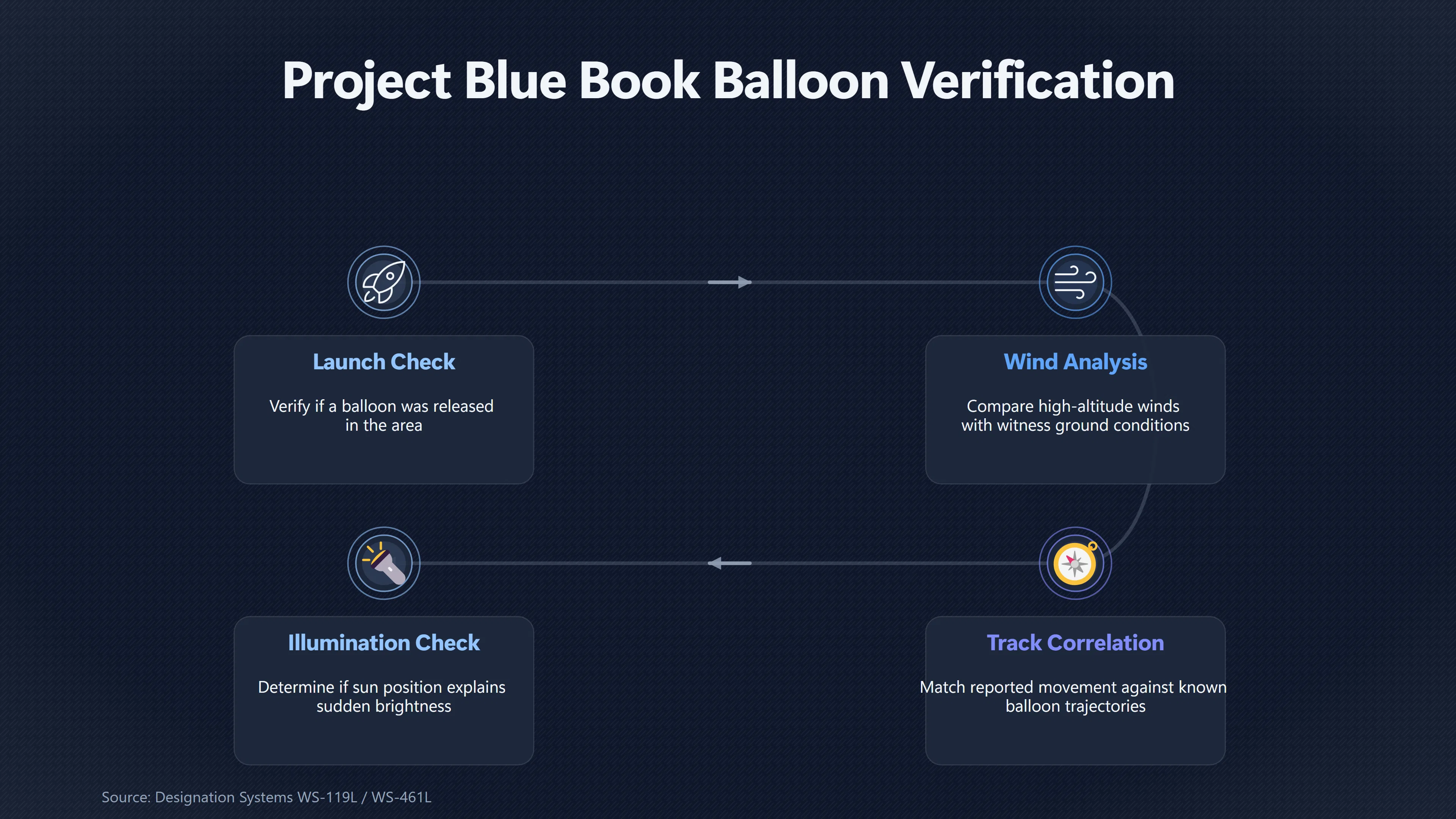
Blue Book’s strongest balloon identifications were not supposed to rest on resemblance alone. Investigators could compare the time and location of a UFO report with actual balloon activity and meteorological information.
Edward J. Ruppelt, who headed Project Blue Book during its formative period, described a continuous flow of information used to eliminate conventional explanations. Blue Book received position reports for large Skyhook flights and could obtain details about other research balloons and regularly launched weather balloons. Aircraft movements and astronomical information were checked through comparable channels. Ruppelt wrote that the project had learnt early that roughly 60 per cent of reports involved balloons, aircraft or astronomical bodies seen under unusual conditions, making rapid correlation with those sources central to its working method.[Project Gutenberg]gutenberg.orgOpen source on gutenberg.org.
The procedure was later formalised in Air Force Regulation 200-2. Its investigative guidance specifically instructed personnel to consult military and civilian weather forecasters for the tracks of balloons released in the area, noting that such balloons were often responsible for sightings. The same regulation called for information on winds aloft, aircraft traffic, astronomical objects and experimental aerospace activity.[Cufon]cufon.orgafr200 2Reporting…
A credible balloon identification therefore depended on several questions fitting together:
- Was a balloon actually aloft? Launch and tracking information could establish whether a weather or research balloon was in a plausible area.
- Could the winds carry it towards the sighting location? Winds aloft mattered more than the breeze experienced by witnesses at ground level.
- Did its track fit the reported movement? Direction and timing could be compared with the witness account.
- Did illumination fit? The Sun’s position could help explain why a balloon suddenly became bright, changed appearance or apparently disappeared.
- Did the object’s behaviour resemble a drifting lighter-than-air vehicle? Smooth movement with the wind strengthened the identification; motion incompatible with the calculated balloon track weakened it.
This method is more significant than the label attached to any individual Blue Book file. It transformed “probably a balloon” from a visual guess into a hypothesis that could, at least in principle, be tested against independent records.
What the Blue Book numbers actually establish
The historical statistics require careful wording. It is easy to turn “balloons explained many UFO reports” into the much stronger claim that balloons explained essentially all of them. Blue Book’s own data do not support that conclusion.
Special Report No. 14 analysed 3,201 sightings from the project’s earlier files. Its published categorisation assigned 450, or 14 per cent, to balloons. Astronomical explanations and aircraft accounted for still larger shares, while hundreds of reports remained unidentified or lacked sufficient information.[The Black Vault]theblackvault.comThe Black Vault Government UFO LiesThe Black VaultGovernment UFO Lies - The Black Vault Case FilesJanuary 17, 2024…
The report also distinguished between individual reports and what it called “object sightings”. Several people could report the same phenomenon, so analysts attempted to group related observations rather than automatically treating every witness statement as evidence of a separate object. The report acknowledged that this consolidation involved judgement and adopted a conservative approach when deciding whether several sightings represented the same phenomenon.[Internet Archive]archive.orgInternet Archive Full text of "Project Blue Book Special Report #14Internet Archive Full text of "Project Blue Book Special Report #14
That distinction is important when discussing claims that research balloons were “behind thousands” of flying-saucer reports. Contemporary balloon researchers sometimes made sweeping claims. Liddell was reported in 1951 as saying that roughly 2,000 flying-saucer reports had been examined and that the reliable observations could be attributed to cosmic-ray balloons. That was an argument made by a prominent participant in balloon research, not the eventual statistical conclusion of Project Blue Book. Blue Book’s later case-by-case data were considerably more cautious.[Project 1947]project1947.comProject 1947PROJECT 1947 - UFO Reports and Documents from 1951…
The defensible conclusion is narrower but still striking: balloon programmes generated enough confusing observations to become one of the Air Force’s principal recurring UFO explanations. In Special Report No. 14 alone, hundreds of sightings were placed specifically in that category, and Ruppelt’s account shows that balloon tracking became part of Blue Book’s routine investigative infrastructure.[The Black Vault]theblackvault.comThe Black Vault Government UFO LiesThe Black VaultGovernment UFO Lies - The Black Vault Case FilesJanuary 17, 2024…
Secrecy made some balloon sightings harder to solve
There was another complication that ordinary weather data could not always fix: some balloon programmes were connected with classified national-security work.
Project Mogul is the clearest example. The programme operated from 1947 to 1949 and sought ways to detect Soviet nuclear testing using high-altitude balloon-borne sensors. The Pentagon’s All-domain Anomaly Resolution Office now describes a crashed Mogul balloon as the assessed source of the material that later became central to Roswell UFO claims.[AARO]aaro.milUnclassified Final DSD AARO Historical ReportUnclassified Final DSD AARO Historical Report…
The broader lesson is not that every unexplained Blue Book report concealed a classified balloon. Rather, secrecy could remove exactly the information investigators and witnesses needed for identification. An observer might accurately report an enormous unfamiliar object, yet know nothing about the programme responsible for putting it there. Public descriptions such as “weather balloon” could also sound implausible when the actual vehicle was much larger or carried unusual equipment.
That creates an important distinction in the history of identified flying objects. A witness could be wrong about an extraterrestrial interpretation while being entirely right that the thing overhead was extraordinary by everyday standards. Some research balloons really were enormous experimental vehicles operating at remarkable altitudes, carrying sophisticated scientific or intelligence equipment and following trajectories that civilians could neither predict nor easily explain.
Balloons remain a useful identification test
The balloon problem did not disappear with Project Blue Book. Modern UAP investigation still encounters the same basic combination of ambiguous shape, uncertain range and wind-driven motion. The Pentagon’s All-domain Anomaly Resolution Office, for example, has published several military videos it assesses with high confidence as balloons because their morphology and movement are consistent with lighter-than-air objects drifting with the prevailing wind.[AARO]aaro.milUAP ImageryUAP Imagery
Its current statistics make the continuity especially clear. Among AARO cases listed as resolved through 15 June 2026, balloons account for 460 cases, or 50.7 per cent of closed-case resolution outcomes. The dataset and sensors are different from Blue Book’s, so those percentages should not be directly compared with the 1950s figures. What persists is the investigative principle: objects whose distance, dimensions and surrounding airflow are initially unknown can appear far more anomalous than they prove to be once independent environmental and tracking data are added.[AARO]aaro.milUAP TrendsUAP Trends
Project Blue Book’s experience with research balloons therefore offers a particularly concrete lesson about UFO reports. The witness need not be dishonest, careless or even especially mistaken about what was visible. A genuinely enormous object can be high overhead; sunlight can make it shine like metal; stratospheric winds can carry it in a direction that seems unrelated to conditions on the ground; and lack of distance cues can make its apparent size and speed almost impossible to judge. The decisive evidence often comes afterwards, when observation time, position, winds aloft and balloon-launch records are brought together.
Amazon book picks
Further Reading
Books and field guides related to Why Huge Balloons Generated So Many UFOs. Use these as the next step if you want deeper reading beyond the article.
The UFO Experience: A Scientific Inquiry
Cited by the New York Review of Books as "the best brief for visitation," this classic study presents an analysis of UFO reports and conc...
UFOs and Government: A Historical Inquiry
Governments around the world have had to deal with the UFO phenomenon for a good part of a century. How and why they did so is the subjec...
The Report on Unidentified Flying Objects
Edward J. Ruppelt's "The Report on Unidentified Flying Objects" serves as a pivotal text in the study of UFO phenomena, blending personal...
The Pre-Astronauts: Manned Ballooning on the Threshold of Space
Back in the 1950s and early 1960s, before liquid-fuel rockets had launched us full-sail onto what John Kennedy would call the "new ocean"...
eBay marketplace picks
Marketplace Samples
Live-tested eBay searches with available results related to this page.
Selected fromUFO poster oneBay.co.uk.


Current eBay listing
I Want To Believe UFO Poster Giclée Fine Art Heavyweight Print

Current eBay listing
VINTAGE UFO FLYING SAUCERS COMIC ADVERTISING A2 POSTER PRINT
Endnotes
1.
Source: designation-systems.net
Title: Designation Systems WS-119L / WS-461L
Link:https://www.designation-systems.net/dusrm/app4/ws-119l.html
2.
Source: gutenberg.org
Link:https://www.gutenberg.org/cache/epub/17346/pg17346-images.html
3.
Source: Wikipedia
Title: Skyhook balloon
Link:https://en.wikipedia.org/wiki/Skyhook_balloon
4.
Source: aaro.mil
Title: Unclassified Final DSD AARO Historical Report
Link:https://www.aaro.mil/Portals/136/PDFs/AARO_Historical_Record_Report_Vol_1_2024.pdf?emci=622cd777-b774-f011-8dc9-6045bda9d96b&emdi=ea000000-0000-0000-0000-000000000001&sourceid=1070813
Source snippet
Unclassified Final DSD AARO Historical Report...
5.
Source: project1947.com
Link:https://www.project1947.com/fig/1951a.htm
Source snippet
Project 1947PROJECT 1947 - UFO Reports and Documents from 1951...
6.
Source: archive.org
Title: Internet Archive Full text of “Project [Blue Book Special]({{ ‘report-14/’ | relative_url }}) Report #14”
Link:https://archive.org/stream/ProjectBlueBookSpecialReport14/pbbsr14_djvu.txt
7.
Source: cufon.org
Title: afr200 2
Link:https://www.cufon.org/cufon/afr200-2.htm
Source snippet
Reporting...
8.
Source: aaro.mil
Title: UAP Imagery
Link:https://www.aaro.mil/UAP-Cases/Official-UAP-Imagery/4/
9.
Source: aaro.mil
Title: UAP Trends
Link:https://www.aaro.mil/UAP-Cases/UAP-Reporting-Trends/
10.
Source: aaro.mil
Link:https://www.aaro.mil/Next-AARO-Home-redesign/Next-Parent/Next-AARO-UAP-Imagery-Acc-Table/
11.
Source: aaro.mil
Link:https://www.aaro.mil/Next-AARO-Home-redesign/Next-Parent/Next-UAP-Report-Documents/
12.
Source: gutenberg.org
Link:https://www.gutenberg.org/cache/epub/66639/pg66639-images.html
13.
Source: history.navy.mil
Link:https://www.history.navy.mil/browse-by-topic/communities/naval-aviation/1960-1969.html
14.
Source: project1947.com
Title: kb uasgov
Link:https://www.project1947.com/kbcat/kb_uasgov.htm
15.
Source: history.com
Title: u s air force closes the book on ufos 45 years ago
Link:https://www.history.com/articles/u-s-air-force-closes-the-book-on-ufos-45-years-ago
16.
Source: history.com
Title: Project Blue Book
Link:https://www.history.com/articles/project-blue-book
17.
Source: cufon.org
Title: bb 1661
Link:https://www.cufon.org/cufon/wash_nat/bb_1661.htm
18.
Source: cufon.org
Link:https://cufon.org/cufon/taf_1.htm
19.
Source: cufon.org
Link:https://cufon.org/cufon/4602smpl5.htm
20.
Source: cufon.org
Link:https://www.cufon.org/cufon/cufon-v.htm
21.
Source: aaro.mil
Link:https://www.aaro.mil/Next-AARO-Home-redesign/Next-Parent/Next-AARO-UAP-Trends/
22.
Source: aaro.mil
Link:https://www.aaro.mil/Next-AARO-Home-redesign/Next-Parent/Next-UAP-Case-RR-Data-Table/
23.
Source: aaro.mil
Link:https://www.aaro.mil/Next-AARO-Home-redesign/Next-Parent/AARO-UAP-Case-Resolution-DT/
24.
Source: aaro.mil
Link:https://www.aaro.mil/Next-AARO-Home-redesign/Bruce-working/Next-AARO-UAP-Trends-Charts/
25.
Source: aaro.mil
Link:https://www.aaro.mil/
26.
Source: aaro.mil
Link:https://www.aaro.mil/Resources/Historical-Record-Reports/Volume-II/
27.
Source: aaro.mil
Link:https://www.aaro.mil/Next-AARO-Home-redesign/Next-Parent/Next-AARO-UAP-Imagery-Fixed-Table/
28.
Source: aaro.mil
Title: AAR O UAP Trends All-domain Anomaly Resolution Office UAP REPORTING TRENDS
Link:https://www.aaro.mil/UAP-Cases/UAP-Reporting-Trends/quot/
29.
Source: aaro.mil
Link:https://www.aaro.mil/Next-AARO-Home-redesign/Inactive-Parent/Next-AARO-UAP-DT-Records/
30.
Source: aaro.mil
Link:https://www.aaro.mil/UAP-Cases/Official-UAP-Imagery/ftag/MSF0951a18/
31.
Source: aaro.mil
Link:https://www.aaro.mil/Next-AARO-Home-redesign/Next-Parent/Next-Submit-a-Report-dup/
32.
Source: aaro.mil
Link:https://www.aaro.mil/Next-AARO-Home-redesign/Next-Parent/Next-AARO-Congressional-Press-Products/
33.
Source: aaro.mil
Title: Congressional Press Products
Link:https://www.aaro.mil/Congressional-Press-Products/
34.
Source: aaro.mil
Title: Congressional Tab DT
Link:https://www.aaro.mil/Next-AARO-Home-redesign/Next-Parent/AARO-Congressional-Tab-DT/
35.
Source: project1947.com
Link:https://project1947.com/fig/1952a.htm
36.
Source: project1947.com
Link:https://www.project1947.com/fig/lockufo53.htm
37.
Source: project1947.com
Link:https://www.project1947.com/47cats/usnavydraft1.htm
38.
Source: everything.explained.today
Link:https://everything.explained.today/Identification_studies_of_UFOs/
39.
Source: everything.explained.today
Link:https://everything.explained.today/General_Mills/
40.
Source: gutenberg.org
Link:https://www.gutenberg.org/files/66639/66639-h/66639-h.htm
42.
Source: project1947.com
Link:https://www.project1947.com/fig/look7152.htm
43.
Source: project1947.com
Link:https://www.project1947.com/1947/opcharlie.html
44.
Source: repository.si.edu
Title: Smithsonian Research Online The Invention and Development
Link:https://repository.si.edu/server/api/core/bitstreams/9c7cace5-7093-49fe-9f56-1456930a4618/content
Source snippet
Smithsonian Research OnlineThe Invention and DevelopmentMarch 20, 2007...
Published: March 20, 2007
45.
Source: theblackvault.com
Title: The Black Vault Government UFO Lies
Link:https://www.theblackvault.com/casefiles/government-ufo-lies/
Source snippet
The Black VaultGovernment UFO Lies - The Black Vault Case FilesJanuary 17, 2024...
Published: January 17, 2024
46.
Source: globalsecurity.org
Title: Global Security Project Skyhook
Link:https://www.globalsecurity.org/intell/systems/skyhook.htm
Source snippet
Global SecurityProject SkyhookJuly 28, 2011...
Published: July 28, 2011
47.
Source: en.ikwipedia.org
Title: Project Blue Book
Link:https://en.ikwipedia.org/wiki/Project_Blue_Book
48.
Source: wikidisc.org
Title: Project Blue Book | Wiki Disc
Link:https://www.wikidisc.org/wiki/Project_Blue_Book
49.
Source: archives.gov
Title: Project BLUE BOOK
Link:https://www.archives.gov/research/military/air-force/ufos
50.
Source: theblackvault.com
Title: Project Blue Book Special Report #14 –
Link:https://www.theblackvault.com/documentarchive/project-blue-book-special-report-14-may-5-1955/
51.
Source: creativespirits.net
Title: Project Blue Book | Creativespirits.net
Link:https://www.creativespirits.net/project-blue-book/
52.
Source: abcnews.go.com
Link:https://abcnews.go.com/Technology/Primetime/story?id=528712&page=1
53.
Source: sgp.fas.org
Link:https://sgp.fas.org/othergov/roswell.html
54.
Source: phatsoheff.tripod.com
Link:https://phatsoheff.tripod.com/ufo.html
55.
Source: military-history.fandom.com
Title: Project Blue Book
Link:https://military-history.fandom.com/wiki/Project_Blue_Book
56.
Source: ultimatepopculture.fandom.com
Title: General Mills
Link:https://ultimatepopculture.fandom.com/wiki/General_Mills
57.
Source: cufos.org
Title: Project Blue Book
Link:https://cufos.org/resources/project-blue-book/
58.
Source: books.google.com
Title: Project Blue Book Special Report 14
Link:https://books.google.com/books/about/Project_Blue_Book_Special_Report_14.html?id=D1oVAwAAQBAJ
59.
Source: wikizero.net
Title: Project Blue Book
Link:https://www.wikizero.net/wiki/en/Project_Blue_Book
60.
Source: si.edu
Link:https://www.si.edu/object/siris_sil_97883
61.
Source: si.edu
Link:https://www.si.edu/object/archives/sova-nasm
62.
Source: si.edu
Link:https://www.si.edu/object/gondola-raven%3Anasm_A19950178000
63.
Source: ufotransparency.com
Link:https://ufotransparency.com/takeaways/all
64.
Source: internationalflyingsaucerbureau.com
Title: Project Blue Book
Link:https://www.internationalflyingsaucerbureau.com/project-blue-book/
65.
Source: si.edu
Link:https://www.si.edu/object/siris_sil_259088
Additional References
66.
Source: ufotransparency.com
Title: decade 1970s project blue book special report 14 1955 pbbsr14
Link:https://ufotransparency.com/files/decade-1970s-project-blue-book-special-report-14-1955-pbbsr14
Source snippet
UFO TransparencyProject Blue Book Special Report 14, 1955, U.S. Air Force / Battelle Memorial Institute · 1976 · UFO Transparency...
67.
Source: cia.gov
Link:https://www.cia.gov/readingroom/document/cia-rdp81r00560r000100070028-5
68.
Source: archives.gov
Link:https://www.archives.gov/research/catalog/catalog-bulk-downloads/uap-bulk-download
69.
Source: cia.gov
Link:https://www.cia.gov/readingroom/document/cia-rdp78-03642a001300040030-0
70.
Source: archives.gov
Link:https://www.archives.gov/news/articles/project-blue-book-50th-anniversary
71.
Source: cia.gov
Link:https://www.cia.gov/readingroom/document/cia-rdp78-03642a001300040015-7
72.
Source: archives.gov
Link:https://www.archives.gov/research/topics/uaps/textual-and-microfilm
73.
Source: visit.archives.gov
Title: gov50 Years Ago: Government Stops Investigating UFOs | National Archives Museum
Link:https://visit.archives.gov/whats-on/explore-exhibits/50-years-ago-government-stops-investigating-ufos
74.
Source: internationalskeptics.com
Link:https://internationalskeptics.com/forums/threads/a-critical-examination-of-randis-encyclopedia-entry-on-ufos.130336/page-2
75.
Source: ouchaku.github.io
Link:https://ouchaku.github.io/ds/en/blog/2025/06/12/roswell