Within Reconstruction
Why the First UFO Notes Matter Most
Writing down time, direction and sequence immediately can preserve reconstruction clues before later discussion changes how the event is remembered.
On this page
- Which details should be recorded immediately
- How later discussion can alter remembered sequence
- Why first estimates improve reconstruction
Page outline Jump by section
Introduction
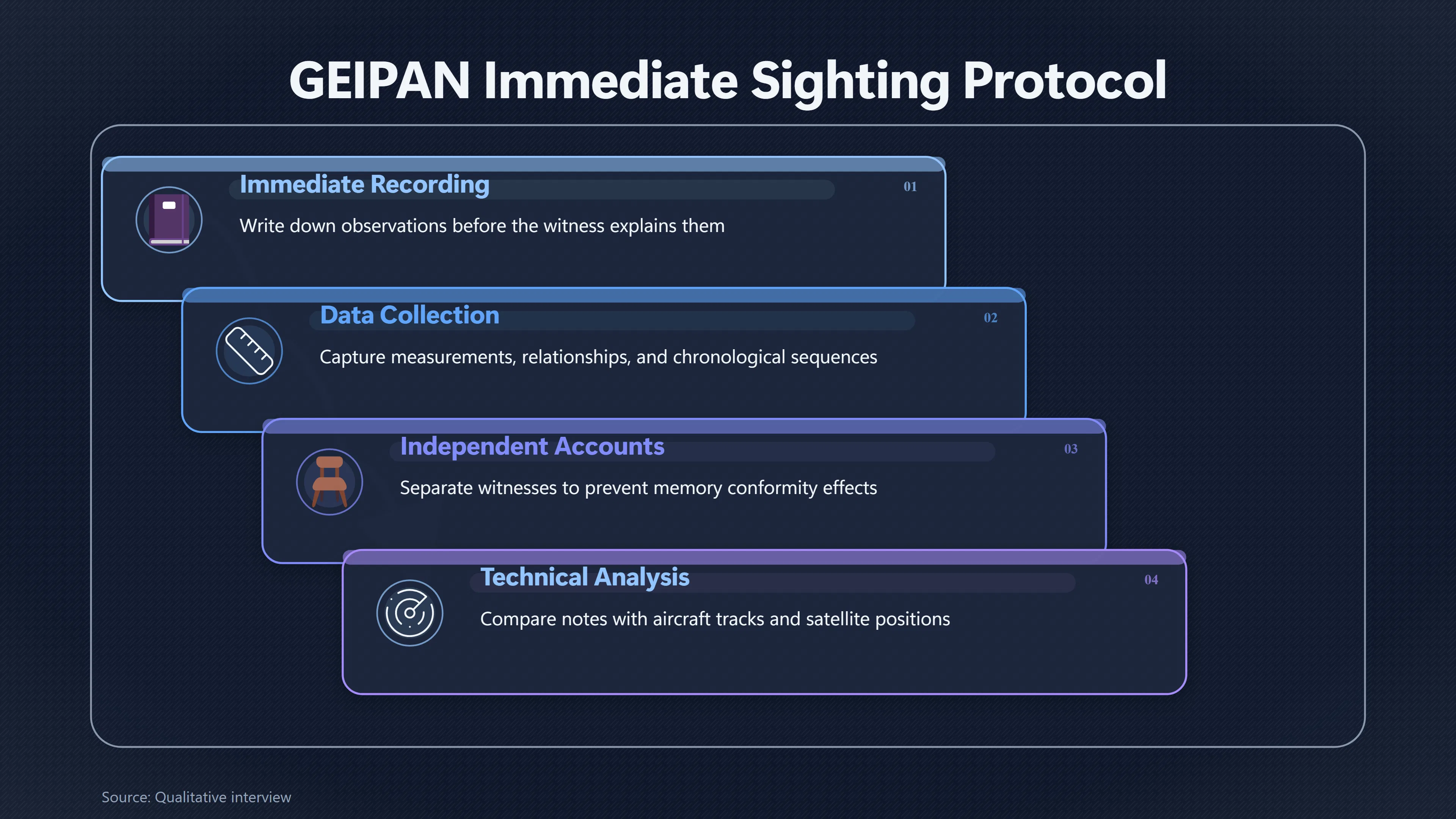
The first useful record of a UFO or UAP sighting is often the one made before the witness has had time to explain it. France’s official GEIPAN investigation service explicitly advises people who have seen a strange aerial phenomenon to write down their observation immediately. That advice has a practical purpose: investigators later need times, directions, durations, changes and sequences that can be compared with aircraft tracks, satellite positions, weather and viewing geometry.[Geipan]geipan.frOpen source on geipan.fr.
Memory research supports the same principle. Early, structured recall can preserve more correct information for later interviews, while subsequent conversations, reports and questions can introduce details that were not part of the original observation. The aim is therefore not to produce a polished UFO story. It is to preserve a dated snapshot of what the witness remembers before reconstruction by investigators — and reinterpretation by the witness — begins.[nih.gov]nih.govOpen source on nih.gov.
Which details should be recorded immediately?
A first note is most valuable when it captures measurements, relationships and sequence rather than conclusions. “Bright light moving left to right for about 20 seconds” gives an investigator more to work with than “advanced craft travelling at tremendous speed”. The second description contains an interpretation; the first contains observations that can potentially be tested.
GEIPAN places direct testimony at the centre of its investigative method and uses a technical questionnaire to obtain the information needed to open an investigation. Sketches, photographs, videos and other records can supplement that testimony. Its classifications also distinguish cases that remain unidentified because information is inadequate from those that remain unidentified after investigation, showing why the quantity and reliability of the original data matter.[Geipan]geipan.frOpen source on geipan.fr.
Immediately after a sighting, the highest-value notes include:
- Exact date and clock time. Record when the observation began and ended, including whether the time came from a phone or watch or is only an estimate.
- Duration. Write down the estimated number of seconds or minutes separately from the start and finish times.
- Observer position. Record the street, road, building, viewpoint or coordinates if readily available, plus whether the observer was standing still or moving.
- Direction. Note where the phenomenon first appeared and where it went: for example, west to east. A compass bearing from a phone can be useful if taken at the scene.
- Height above the horizon. A rough angular estimate is more useful than phrases such as “high in the sky”. Nearby fixed objects — a roofline, tree, mast or hill — can provide reference points.
- Apparent movement. Record whether it was stationary, drifting, travelling steadily, changing direction or apparently accelerating. Avoid converting apparent motion into kilometres per hour without knowing the distance.
- Sequence. Write what happened first, second and third: appeared above a roof, brightened, moved right, separated into two lights, disappeared behind cloud, for example.
- Appearance and changes. Record colour, brightness, apparent shape and number of lights, especially when any of those changed during the sighting.
- Viewing conditions. Note cloud, haze, rain, darkness, glare and obstructions, and whether the phenomenon was viewed through glass, binoculars or a camera.
- Other witnesses. Record who else saw the event, but ideally let each person write an independent account before comparing descriptions.
Precision should not be manufactured. Evidence-based witness guidance from the College of Policing notes that people can become less accurate when pressed to give greater specificity than their memory supports. “About 30 seconds” or “roughly south-east” can therefore be better evidence than an exact-looking number produced only because someone felt obliged to provide one.[College of Policing]police.ukOpen source on police.uk.
A sketch can be particularly useful because it records relationships that prose handles badly. Mark the horizon, observer position, prominent landmarks, the phenomenon’s first and last positions and arrows showing its apparent path. Research on eyewitness retrieval has found benefits from structured early accounts and, in some contexts, sketch-based reinstatement of the scene.[PubMed]nih.govOpen source on nih.gov.
How later discussion can alter remembered sequence
The danger is not simply that witnesses “forget”. Human memory is reconstructive: information encountered after an event can become difficult to distinguish from information actually perceived during it. That matters particularly for UFO sightings because witnesses naturally want to discuss an unusual experience, search online for similar reports or compare what they saw with photographs and videos.
The evidence for this effect extends well beyond UAP research. The College of Policing reviewed 16 studies of co-witness discussion and reported that 14 found witnesses significantly more likely to report information they had not directly observed after exposure to other witnesses’ accounts. Its guidance consequently recommends separating witnesses when initial accounts are taken and warning them that subsequent information can affect recollection.[College of Policing]police.ukOpen source on police.uk.
Experimental research demonstrates the same “memory conformity” problem. In one influential study, pairs watched slightly different versions of an event and then discussed what they had seen. Seventy-one per cent of witnesses in the discussion condition subsequently recalled at least one item that they had acquired from the other witness rather than seen themselves. A later replication programme involving 486 participants across ten countries again found that people often reported details supplied by their co-witness.[Aberdeen Research Portal]elsevierpure.comOpen source on elsevierpure.com.
For a UFO investigation, the consequence can be subtle. Suppose two people initially remember three lights. One says after discussion that they formed a perfect triangle; the other then recognises that description as fitting what they remember. After repeated conversation, both may sincerely describe a precise triangular formation. Investigators then face a difficult question: are there two independent observations of that geometry, or one observation followed by information transfer?
That is why the independence of first accounts matters almost as much as their detail. Separate notes written before discussion preserve differences as well as agreements. Those differences are not necessarily defects. One witness may have had a clearer view of the object’s left side; another may have noticed its disappearance. If their descriptions converge only later, investigators need to know that too.
The same caution applies to online searches and media coverage. College of Policing guidance recommends establishing where a witness’s information came from because people can confuse personally observed details with things learned afterwards. It advises witnesses to distinguish what they actually saw and heard from what others subsequently told them.[College of Policing]police.ukOpen source on police.uk.
Why first estimates improve reconstruction
Immediate notes become especially valuable when investigators try to convert a visual impression into geometry. UFO reports frequently contain claims of extraordinary speed, sudden acceleration or unusual trajectories, but apparent movement alone does not reveal an object’s physical speed. The observer’s own movement, unknown object distance, viewing angle and parallax can produce very different physical explanations for the same appearance.
AARO’s reconstruction of the 2013 Puerto Rico UAP illustrates the point. Infrared footage appeared to show an object travelling rapidly, splitting into two and entering the sea. By reconstructing the observing aircraft’s movement and sensor viewing geometry, investigators concluded that two objects had remained airborne and travelled approximately with the wind; changing viewing angles and motion parallax accounted for much of the extraordinary appearance.[AARO]aaro.milOpen source on aaro.mil.
Its analysis of the “GoFast” video similarly depended on quantitative inputs such as sensor pointing angles, range and assumptions about aircraft and wind motion. AARO calculated an altitude of roughly 13,000 feet and showed how parallax could make the object’s apparent motion look substantially faster than its actual movement.[AARO]aaro.milOpen source on aaro.mil.
Those cases involve sensor data rather than ordinary handwritten witness notes, but they demonstrate why apparently mundane details matter. If an investigator knows that a witness was travelling north in a car, saw a light 20 degrees above the western horizon and watched it remain almost fixed relative to a particular building for 40 seconds, those facts constrain possible explanations. If the surviving account merely says that “a UFO followed the car at incredible speed”, much of the geometry needed to test that impression has disappeared.
Timing can be equally decisive. A sufficiently accurate timestamp allows a sighting to be compared with external records that have their own clocks. A discrepancy of several minutes may determine whether a particular aircraft, satellite or astronomical object was actually in the relevant part of the sky. The first note therefore functions less as proof of what the object was than as a set of coordinates for asking the right questions later.
Early recall is useful, but it is not automatically correct
Writing something down immediately does not turn it into objective fact. A witness can misjudge direction, duration, angular size or sequence while an event is happening. Attention may have been divided, visibility poor or the sighting extremely brief. An immediate account preserves an early memory; it does not guarantee that the perception itself was accurate.
Research nevertheless indicates a real advantage to obtaining that account promptly. Experiments with the Self-Administered Interview, a structured eyewitness-recall technique, found that participants completing an early account later recalled more correct details than controls. A study specifically examining recall timing concluded that initial recall should occur within 24 hours and found benefits to later memory lasting for at least a month.[University of Portsmouth]port.ac.ukOpen source on port.ac.uk.
Other experiments found that early structured recall made participants less vulnerable to misleading information introduced later. That finding is particularly relevant to unusual aerial sightings, where witnesses may encounter explanations, drawings, social-media posts and other people’s accounts almost immediately after the event.[University of Portsmouth]port.ac.ukOpen source on port.ac.uk.
The practical lesson is therefore narrower than “trust the first account”. Investigators should preserve the first account as a baseline. Later interviews can add detail, correct obvious mistakes and explore ambiguities, but they can then be compared with a record created closer to the event. Changes become visible instead of silently replacing the earlier version.
The best first note separates observation from interpretation
One simple habit can substantially improve the usefulness of a UFO report: distinguish what was perceived from what the witness thinks it might mean.
A note might say: “One white point remained above the same chimney for approximately 40 seconds; it then moved slowly right and faded.” The witness can separately add: “At the time I thought it was hovering.” The first sentence gives investigators observable relationships to test. The second preserves the witness’s contemporaneous interpretation without allowing that interpretation to overwrite the raw description.
The same distinction should be maintained when uncertainty exists. “I think there were three lights, possibly four” is useful evidence because it records uncertainty honestly. Replacing it later with “there were definitely four lights” creates false precision unless some independent evidence resolves the question. Evidence-based witness guidance similarly favours accounts in the witness’s own words and open questioning, rather than forcing answers towards an investigator’s preferred level of specificity.[College of Policing]police.ukOpen source on police.uk.
For UFO reconstruction, then, the ideal first record is neither dramatic nor exhaustive. It is early, independent, chronological and candid about uncertainty. Write the time, place, direction, duration and sequence; sketch the path against fixed landmarks; preserve original photographs or video; distinguish observation from inference; and record the account before comparing it with anyone else’s. Those modest details may later provide the difference between a sighting that can be tested against the surrounding sky and one that remains unidentified largely because the information needed to reconstruct it was never preserved. GEIPAN’s own system explicitly recognises this distinction by separating cases that remain unidentified because data are lacking from those that remain unexplained after investigation.[Geipan]geipan.frOpen source on geipan.fr.
Amazon book picks
Further Reading
Books and field guides related to Why the First UFO Notes Matter Most. Use these as the next step if you want deeper reading beyond the article.
The UFO Experience: A Scientific Inquiry
Cited by the New York Review of Books as "the best brief for visitation," this classic study presents an analysis of UFO reports and conc...
The Seven Sins of Memory: How the Mind Forgets and Remembers
Rating: 3.5/5 from 5 Google Books ratings
A New York Times Notable Book: A psychologist's "gripping and thought-provoking" look at how and why our brains sometimes fail us (Steven...
Eyewitness Testimony
By shedding light on the many factors that can intervene and create inaccurate testimony, Elizabeth Loftus illustrates how memory can be...
Remember: The Science of Memory and the Art of Forgetting
NEW YORK TIMES BESTSELLER • A fascinating exploration of the intricacies of how we remember, why we forget, and what we can do to protect...
eBay marketplace picks
Marketplace Samples
Live-tested eBay searches with available results related to this page.
Selected fromUFO poster oneBay.co.uk.

Current eBay listing
I Want To Believe UFO Poster Giclée Fine Art Heavyweight Print


Current eBay listing
VINTAGE UFO FLYING SAUCERS COMIC ADVERTISING A2 POSTER PRINT

Endnotes
1.
Source: aaro.mil
Link:https://www.aaro.mil/Portals/136/PDFs/case_resolution_reports/AARO_Puerto_Rico_UAP_Case_Resolution.pdf
2.
Source: geipan.fr
Link:https://www.geipan.fr/en/what-did-i-see/step-1
3.
Source: aaro.mil
Link:https://www.aaro.mil/UAP-Records/
Additional References
4.
Source: youtube.com
Title: Qualitative interview
Link:https://www.youtube.com/watch?v=eU5o6Ikr6Jg
Source snippet
A-Level Psychology (AQA): The Cognitive Interview...
5.
Source: youtube.com
Title: Scott Fraser: The problem with eyewitness testimony
Link:https://www.youtube.com/watch?v=buhMdC7MO0U
Source snippet
Qualitative interview - the cognitive interviewing method...
6.
Source: youtube.com
Title: A-Level Psychology (AQA): The Cognitive Interview
Link:https://www.youtube.com/watch?v=loWZUaBmhQQ
Source snippet
Eyewitness accounts: Why they're so unreliable...
7.
Source: youtube.com
Title: Understanding witness memory
Link:https://www.youtube.com/watch?v=-VUwf82cXFk
Source snippet
Scott Fraser: The problem with eyewitness testimony...
8.
Source: youtube.com
Title: Eyewitness accounts: Why they’re so unreliable
Link:https://www.youtube.com/watch?v=EC3AQcDPtyI