Within Blue Book
When Satellites Became a New UFO Source
As more objects entered orbit, satellites became a major new source of unfamiliar moving lights and forced investigators to use tracking records.
On this page
- Why satellite reports increased in the 1960 s
- How orbital lights differed from older explanations
- How tracking systems supported identifications
Page outline Jump by section
Introduction
Artificial satellites changed Project Blue Book’s identification problem because, from late 1957 onwards, observers could see a genuinely new class of human-made object moving through the night sky. Before Sputnik, a steadily travelling point of light was more likely to be tested against aircraft, balloons, meteors or astronomical objects. During the 1960s, investigators increasingly had to ask another question: was the reported UFO actually an object in Earth orbit?
The change became especially noticeable after the launch of large, reflective satellites such as NASA’s Echo 1 in 1960. Echo could be seen easily with the naked eye, while expanding American satellite-tracking networks supplied orbital information that could be compared with a sighting’s time, location and direction.[NASA]nasa.govDawn of the Space AgeDawn of the Space Age - NASAJanuary 8, 2026…
That combination — more visible spacecraft overhead and better records of where they should be — effectively added orbital objects to Blue Book’s routine identification toolkit. It also demonstrated an important principle in UFO investigation: the population of plausible explanations changes when technology changes.
Why satellite reports increased in the 1960s
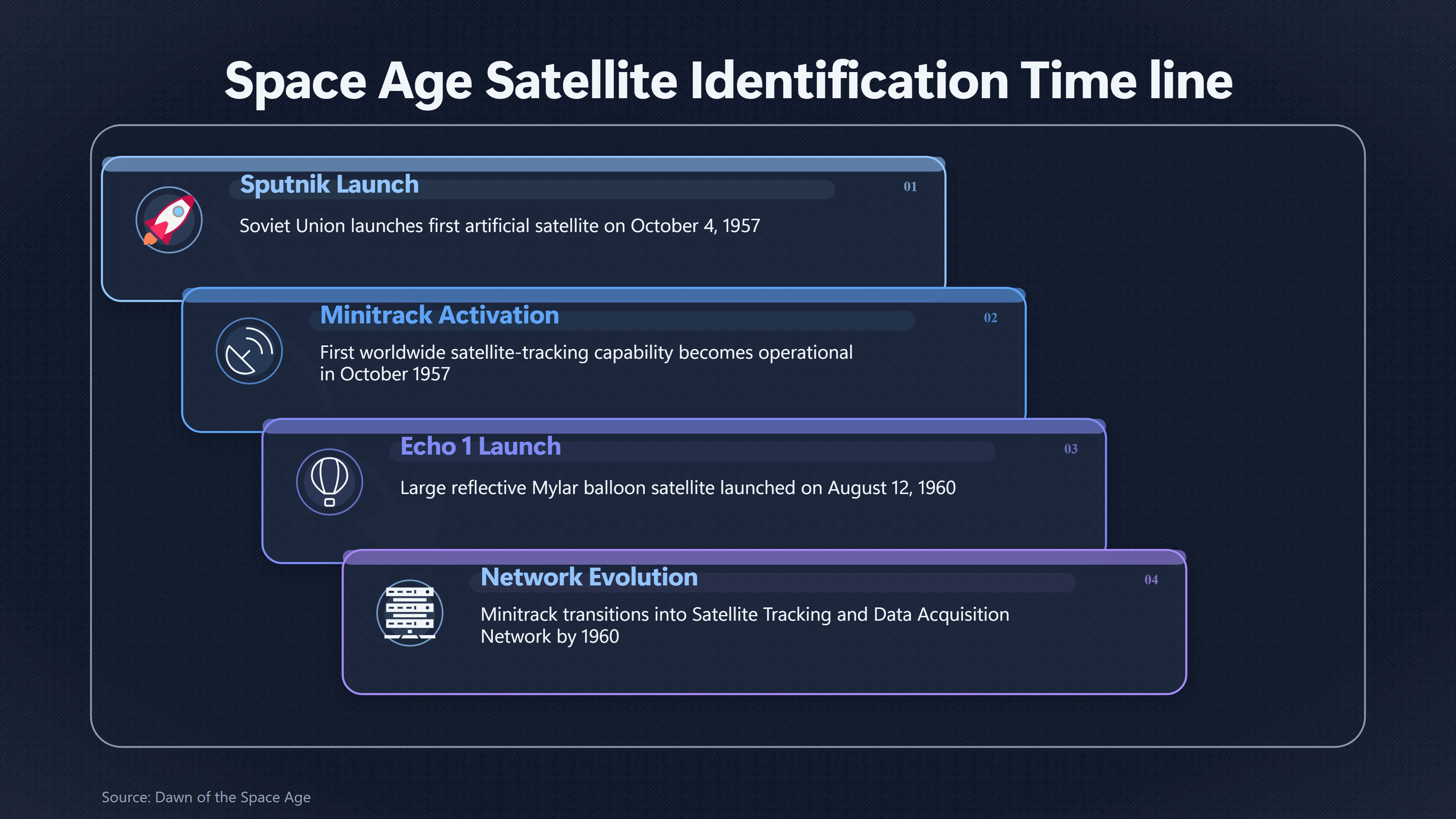
The decisive dividing line was 4 October 1957, when the Soviet Union launched Sputnik 1, the world’s first artificial satellite. It orbited Earth roughly every 98 minutes. Interestingly, NASA notes that much of what people visually observed during the Sputnik episode was actually the more reflective rocket core that had also reached orbit rather than the small satellite itself.[NASA]nasa.govDawn of the Space AgeDawn of the Space Age - NASAJanuary 8, 2026…
That distinction matters for UFO history. The Space Age did not merely introduce spacecraft as an abstract possibility; it introduced new visible objects whose identity could be difficult for an observer on the ground to determine. A person did not need to mistake a satellite for an elaborate structured craft. A simple unexplained point of light travelling steadily across an otherwise dark sky was enough to generate a report.
The effect became much stronger with Echo 1, launched on 12 August 1960. Echo was an unusual satellite: essentially a 30-metre aluminium-coated Mylar balloon designed to reflect radio signals. Its enormous reflective surface made it conspicuous from the ground. NASA says Echo generated considerable public interest because it was visible to the naked eye, while a contemporary history describes people around the world watching it cross the sky according to a predictable schedule.[si.edu]si.eduOpen source on si.edu.
Echo therefore produced almost ideal conditions for misidentification. It looked like a bright celestial point, yet unlike a star or planet it travelled across the sky. It was extremely distant, so an observer had little visual information from which to judge its size or altitude. And although its orbital motion was predictable to specialists with the appropriate data, that information was not necessarily available to someone who happened to look upwards.
A retrospective study of UFO reports submitted by ships to Blue Book found a particularly striking concentration during this period. It identified 93 shipboard reports classified as satellites, with 57 originating from the US Navy and 23 from the US Coast Guard. In that dataset, satellite identifications represented 51 per cent of the Navy cases and 47 per cent of Coast Guard cases. The study characterises 1960–65 as a period when Blue Book received unusually large numbers of satellite reports.[NICAP]nicap.orgBlue Book UFO Reports at Sea by ShipsBlue Book UFO Reports at Sea by ShipsMarch 18, 2003…
Those figures concern a specialised maritime subset rather than Blue Book’s entire archive, so they should not be generalised to all UFO reports. They nevertheless show how dramatically orbital objects could alter the explanation mix within particular reporting environments. Sailors with broad horizons and long periods of night observation were especially well placed to notice unfamiliar moving lights.
How orbital lights differed from older explanations
Satellites overlapped visually with several explanations Blue Book already knew well, but they did not behave exactly like them.
A bright planet or star could appear anomalous because atmospheric conditions, observer motion or the lack of visual reference points made it seem to move. Aircraft could become little more than isolated lights at long range. Meteors could cross large sections of sky rapidly. Balloons could drift in unexpected directions. A satellite added another pattern: a distant, usually silent point of light making a comparatively smooth passage across the celestial background.
Echo made that pattern unusually obvious. A historical account of the programme describes the satellite as a naked-eye object orbiting roughly 1,000 miles above Earth at about 15,000 miles per hour. From the ground, however, that extraordinary orbital speed did not necessarily look like the violent acceleration people associated with aircraft or meteors. It could instead appear as a bright ‘star’ steadily changing position.[American Spacecraft]american-spacecraft.orgAmerican SpacecraftThis New Ocean: From Development into Qualification: Flight Tests (July - December 1960)…
That created an identification problem based less on appearance than on trajectory and timing. A witness could accurately report seeing a light without possessing enough information to recognise what it was. The investigators’ task was therefore to determine whether an artificial satellite occupied the right portion of sky at the right time.
A Blue Book case from Chicago on 10 October 1962 illustrates the process particularly clearly. A civilian watched an illuminated, star-like object travel west to east for about 15 minutes and wondered whether it might be Echo. The surviving record says Echo data were not available for Chicago itself, but investigators established that Echo was over Toronto nine minutes after the reported observation and judged that it probably would have been visible from Chicago. The case was evaluated as Echo I.[govweird]govweird.comchicago il october 1962Project Blue Book: Chicago, Illinois, October 1962 · govweirdOctober 10, 1962…
Another February 1962 report came from a US Navy ship off Luzon in the Philippines. The crew described a bright white object that slowly descended towards the horizon during a roughly seven-minute observation. Blue Book’s record correlated the observation with Echo I, again converting what had entered the reporting system as an unidentified object into an orbital identification.[govweird]govweird.com16 32n 119 31 e luzon philippines february 1962 2899631216 32n 119 31 e luzon philippines february 1962 28996312
The importance of these examples is methodological. Satellites gave Blue Book an explanation that could sometimes be checked independently rather than inferred simply from resemblance. A report saying ‘bright light moving through the sky’ might fit several possibilities. A satellite whose calculated orbit put it above the observer at approximately the reported time was a substantially more specific match.
Tracking records became part of UFO identification
The Space Age did not merely create more things to misidentify. It simultaneously created infrastructure for identifying them.
The United States had been developing the Minitrack satellite-tracking system before Sputnik. NASA records that the network became operational in October 1957 and formed the first US worldwide satellite-tracking capability. Its ground stations detected satellite radio transmissions and measured their positions; after NASA’s creation in 1958, the agency inherited the network.[NASA]nasa.govHistory of the NetworksHistory of the Networks - NASA…
By the early 1960s, this capability was developing into the Satellite Tracking and Data Acquisition Network. NASA describes that evolution as a response to increasingly demanding spacecraft operations, while its technical history characterises Minitrack as the first worldwide satellite-tracking capability and dates its transition into the newer network to roughly 1960–66.[NASA Technical Reports Server]ntrs.nasa.govOpen source on nasa.gov.
For Blue Book, such systems offered something fundamentally useful: external comparison data. Instead of evaluating every moving light purely from witness testimony, investigators could ask whether a known Earth satellite matched the observation.
Surviving accounts show that this could involve more than consulting a printed list. One Blue Book case discussed in a contemporary published review records investigators checking the University of Alaska Geophysical Institute’s Minitrack facilities and the North American Air Defense Command’s Space Detection and Tracking System, or SPADATS, for possible Earth-satellite activity. The nearest identified satellite was reportedly travelling in the wrong direction, so the orbital hypothesis did not provide a satisfactory identification in that instance.[CiteSeerX]citeseerx.ist.psu.eduCite Seer XThe Official Guide To UFOsCite Seer XThe Official Guide To UFOs
That negative result is as revealing as a successful match. Satellite checking was not simply a label that automatically explained any moving nocturnal light. Direction, time and expected position could rule a candidate out as well as rule it in. The usefulness of orbital records lay precisely in making the satellite hypothesis more testable.
Echo became Blue Book’s recognisable satellite explanation
No spacecraft illustrates the change better than Echo.
Its great visibility meant that Echo repeatedly appeared in UFO discussions during the 1960s. A Navy report later discussed by Blue Book consultant J. Allen Hynek concerned an object travelling south-east for approximately 15 minutes; the Air Force identified it as Echo I.[UFO Magazine Archive]ufomagazines.comUFO Magazine Archive PLAYBOY — HMH Publishing Company | UFO Magazine ArchiveUFO Magazine Archive PLAYBOY — HMH Publishing Company | UFO Magazine Archive
Even people deeply familiar with spaceflight could momentarily be puzzled by an orbital light. A particularly memorable 1964 episode involved science-fiction writer Arthur C. Clarke and film director Stanley Kubrick while they were working on 2001: A Space Odyssey. A surviving Blue Book record concerns their sighting of a bright object over New York; the case was ultimately associated with Echo I.[The UFO Database]theufodatabase.comThe UFO Database Kubrick Clarke UFO incidentThe UFO Database Kubrick Clarke UFO incident
The anecdote is useful not because famous witnesses make a report more reliable, but because it shows how unintuitive satellite appearances could still be during the early Space Age. Knowing that satellites existed was not the same thing as immediately recognising one under real observing conditions.
Echo 2, launched in January 1964, reinforced the phenomenon. Like its predecessor, it was a huge reflective balloon satellite; cases from 1965 were subsequently evaluated against Echo 2 passages. A later review of Blue Book files, for example, agrees with the project’s satellite identification of a January 1965 Pacific observation as Echo 2.[Astronomy UFO]astronomyufo.comAstronomy UFOShedding some light on UFOlogy and UFOsAstronomy UFOShedding some light on UFOlogy and UFOs
Satellite explanations were therefore not a vague catch-all comparable to saying that something was ‘probably astronomical’. Named spacecraft could sometimes be proposed, and their expected movements checked against reported observations.

Satellite matches still depended on good sighting data
The new capability had an important limitation: orbital correlation only worked when the UFO report contained sufficiently precise information.
Investigators needed an accurate date and time, a reasonably precise observing location and useful information about the object’s direction and path. Without those details, even perfect knowledge of satellite orbits could not establish whether a particular spacecraft had been visible.
That problem appears directly in later reviews of Blue Book cases. One 1965 report from Irving, New York, was explained by Blue Book as involving satellites and stars, but a subsequent reviewer considered the information inadequate because dates were missing. Without a date, a claimed satellite correlation cannot be properly reconstructed.[Astronomy UFO]astronomyufo.comAstronomy UFOShedding some light on UFOlogy and UFOsAstronomy UFOShedding some light on UFOlogy and UFOs
The Chicago Echo case reveals the opposite situation. Its 15-minute observation, direction of movement and timing could be compared with known Echo information, allowing investigators to construct a plausible orbital match.[govweird]govweird.comchicago il october 1962Project Blue Book: Chicago, Illinois, October 1962 · govweirdOctober 10, 1962…
This is why satellites fit naturally into Blue Book’s wider distinction between identified, insufficient-data and unidentified reports. A satellite was not an explanation merely because a light moved steadily. The strongest identification occurred when witness information and independent tracking data converged.
The broader Blue Book archive makes the same distinction important. The Air Force eventually recorded 12,618 reports from the programme’s historical period, leaving 701 classified as unidentified. The existence of a growing catalogue of satellites therefore did not eliminate the unidentified category; it expanded the set of ordinary explanations investigators had to test before placing a report there.[Secrets Declassified]secretsdeclassified.af.milOpen source on af.mil.
Satellites changed what an ‘ordinary’ UFO could be
The satellite era altered Blue Book’s work in two linked ways. First, it created unfamiliar sights. Second, it created increasingly precise data with which those sights could be checked.
That makes satellites different from merely adding another item to a list of conventional explanations. They demonstrate that UFO identification is historically contingent. Before October 1957, an artificial Earth satellite could not plausibly explain a contemporary sighting because none existed. Within only a few years, reflective spacecraft such as Echo were sufficiently conspicuous that satellite correlations had become a routine part of interpreting some reports.
The same period also changed the evidential standard available to investigators. Early UFO explanations frequently depended heavily on descriptions — whether something looked like an aircraft, behaved like a balloon or resembled a meteor. Satellite tracking introduced a more data-driven comparison: an investigator could test whether a known object was predicted to cross a particular observer’s sky.
That did not make every Blue Book satellite identification correct. Some correlations were approximate, some reports lacked the information necessary for a firm match, and contemporary critics challenged particular Air Force explanations. The crucial historical shift is narrower and better supported: by the 1960s, artificial satellites had become both a significant new source of UFO reports and a class of objects whose predicted movements could often be checked against them.[nicap.org]nicap.orgBlue Book UFO Reports at Sea by ShipsBlue Book UFO Reports at Sea by ShipsMarch 18, 2003…
Within Project Blue Book’s identified categories, satellites therefore capture the transition from the pre-Space-Age sky to a technologically crowded one. A mysterious moving light no longer had to be an aircraft, balloon, meteor or misperceived star. It might be something genuinely travelling through space — but something entirely human-made, already catalogued and following a calculable orbit.
Amazon book picks
Further Reading
Books and field guides related to When Satellites Became a New UFO Source. Use these as the next step if you want deeper reading beyond the article.
The UFO Experience: A Scientific Inquiry
Cited by the New York Review of Books as "the best brief for visitation," this classic study presents an analysis of UFO reports and conc...
UFOs and Government: A Historical Inquiry
Governments around the world have had to deal with the UFO phenomenon for a good part of a century. How and why they did so is the subjec...
The Report on Unidentified Flying Objects
Edward J. Ruppelt's "The Report on Unidentified Flying Objects" serves as a pivotal text in the study of UFO phenomena, blending personal...
eBay marketplace picks
Marketplace Samples
Live-tested eBay searches with available results related to this page.
Selected fromsatellite model oneBay.co.uk.
Endnotes
1.
Source: nasa.gov
Title: Dawn of the Space Age
Link:https://www.nasa.gov/history/dawn-of-the-space-age/
Source snippet
Dawn of the Space Age - NASAJanuary 8, 2026...
Published: January 8, 2026
2.
Source: nasa.gov
Title: Echo, NASA’s First Communications Satellite
Link:https://www.nasa.gov/image-article/echo-nasas-first-communications-satellite/
Source snippet
Echo, NASA's First Communications Satellite - NASA...
3.
Source: nasa.gov
Title: History of the Networks
Link:https://www.nasa.gov/communicating-with-missions/history-of-the-networks/
Source snippet
History of the Networks - NASA...
4.
Source: nasa.gov
Title: 65 Years Ago: Sputnik Ushers in the Space Age
Link:https://www.nasa.gov/history/65-years-ago-sputnik-ushers-in-the-space-age/
Source snippet
65 Years Ago: Sputnik Ushers in the Space Age - NASA...
5.
Source: ntrs.nasa.gov
Title: Technical Reports Server
Link:https://ntrs.nasa.gov/api/citations/19660004987/downloads/19660004987.pdf
Source snippet
SATELLITE COMMUNICATIONS: 1958 through lg64/'...
6.
Source: nicap.org
Title: Blue Book UFO Reports at Sea by Ships
Link:https://www.nicap.org/uso/bbpdf.pdf
Source snippet
Blue Book UFO Reports at Sea by ShipsMarch 18, 2003...
Published: March 18, 2003
7.
Source: american-spacecraft.org
Link:https://www.american-spacecraft.org/documents/sp-4201/chapter-9.html
Source snippet
American SpacecraftThis New Ocean: From Development into Qualification: Flight Tests (July - December 1960)...
Published: December 1960
8.
Source: govweird.com
Title: chicago il october 1962
Link:https://www.govweird.com/topics/ufo/project-blue-book/chicago-il-october-1962
Source snippet
Project Blue Book: Chicago, Illinois, October 1962 · govweirdOctober 10, 1962...
Published: october 1962
9.
Source: govweird.com
Title: 16 32n 119 31 e luzon philippines february 1962 28996312
Link:https://www.govweird.com/topics/ufo/project-blue-book/16-32n-119-31-e-luzon-philippines-february-1962-28996312
Published: february 1962
10.
Source: nasa.gov
Title: october 1957 minitrack declared operational
Link:https://www.nasa.gov/image-article/october-1957-minitrack-declared-operational/
Published: october 1957
11.
Source: nasa.gov
Title: Chapter 9
Link:https://www.nasa.gov/history/sputnik/chapter9.html
12.
Source: ntrs.nasa.gov
Link:https://ntrs.nasa.gov/citations/19810063720
13.
Source: nasa.gov
Title: About Exploration and Space Communications
Link:https://www.nasa.gov/goddard/esc/about/
14.
Source: astronomyufo.com
Title: Astronomy UFOShedding some light on UFOlogy and UFOs
Link:https://www.astronomyufo.com/UFO/SUNlite14_2.pdf
15.
Source: science.nasa.gov
Title: messier 64
Link:https://science.nasa.gov/mission/hubble/science/explore-the-night-sky/hubble-messier-catalog/messier-64/?linkId=921759651
16.
Source: history.navy.mil
Title: mil U-2s, UFOs, and Operation Blue Book
Link:https://www.history.navy.mil/research/library/online-reading-room/title-list-alphabetically/u/u2s-ufos-and-operation-blue-book.html
17.
Source: nasa.gov
Title: Sputnik, Explorer, and the Dawn of the Space Age
Link:https://www.nasa.gov/gallery/dawn-of-the-space-age/
18.
Source: science.nasa.gov
Title: messier 31
Link:https://science.nasa.gov/mission/hubble/science/explore-the-night-sky/hubble-messier-catalog/messier-31/
19.
Source: science.nasa.gov
Title: messier 92
Link:https://science.nasa.gov/mission/hubble/science/explore-the-night-sky/hubble-messier-catalog/messier-92/
20.
Source: science.nasa.gov
Title: caldwell 27
Link:https://science.nasa.gov/mission/hubble/science/explore-the-night-sky/hubble-caldwell-catalog/caldwell-27/
21.
Source: science.nasa.gov
Link:https://science.nasa.gov/skywatching/faq/
22.
Source: apod.nasa.gov
Link:https://apod.nasa.gov/apod/ap210625.html
23.
Source: history.navy.mil
Title: mil From the Sea to the Stars
Link:https://www.history.navy.mil/research/library/online-reading-room/title-list-alphabetically/f/from-sea-stars.html
24.
Source: imagine.gsfc.nasa.gov
Title: night sky
Link:https://imagine.gsfc.nasa.gov/ask_astro/night_sky.html
25.
Source: history.com
Title: j allen hynek ufos project blue book
Link:https://www.history.com/articles/j-allen-hynek-ufos-project-blue-book
26.
Source: history.com
Title: ufo encounter florida desvergers scoutmaster burned
Link:https://www.history.com/articles/ufo-encounter-florida-desvergers-scoutmaster-burned
27.
Source: history.com
Title: ufo chiles whitted soviet spycraft air force coverup
Link:https://www.history.com/articles/ufo-chiles-whitted-soviet-spycraft-air-force-coverup
28.
Source: science.nasa.gov
Title: light echo expanding from exploded star
Link:https://science.nasa.gov/asset/hubble/light-echo-expanding-from-exploded-star/
29.
Source: nasa.gov
Title: First Pass of Echo 1 Satellite Over the Goldstone Tracking Station
Link:https://www.nasa.gov/image-article/first-pass-of-echo-1-satellite-over-goldstone-tracking-station/
30.
Source: jpl.nasa.gov
Title: pia21114 goldstone tracking the echo satelloon
Link:https://www.jpl.nasa.gov/images/pia21114-goldstone-tracking-the-echo-satelloon/
31.
Source: science.nasa.gov
Title: goldstone tracking the echo satelloon
Link:https://science.nasa.gov/photojournal/goldstone-tracking-the-echo-satelloon/
32.
Source: jpl.nasa.gov
Title: no balloons for jpls birthday just a satelloon
Link:https://www.jpl.nasa.gov/news/no-balloons-for-jpls-birthday-just-a-satelloon/
33.
Source: space.com
Title: The Truth Is Out There: CIA Publishes UFO Investigation Tips | Space
Link:https://www.space.com/31809-cia-ufo-investigation-tips.html
34.
Source: nicap.org
Title: NC P Paper
Link:https://www.nicap.org/ncp/ncp-ridge12.htm
35.
Source: nasa.gov
Title: 50 Years of Communications in Space
Link:https://www.nasa.gov/image-article/50-years-of-communications-space/
36.
Source: history.com
Title: Project Blue Book
Link:https://www.history.com/articles/project-blue-book
37.
Source: science.nasa.gov
Title: stars and a stripe in celestial [fireworks]({{ ‘fireworks/’ | relative_url }})
Link:https://science.nasa.gov/missions/hubble/stars-and-a-stripe-in-celestial-fireworks/
38.
Source: science.nasa.gov
Title: sn 1006 supernova remnant hubble
Link:https://science.nasa.gov/asset/hubble/sn-1006-supernova-remnant-hubble/
39.
Source: nasa.gov
Title: [Distance]({{ ‘distance/’ | relative_url }}) to Dark Bodies
Link:https://www.nasa.gov/image-article/distance-dark-bodies/
40.
Source: nicap.org
Link:https://www.nicap.org/babylon/missile_incidents.htm
41.
Source: science.nasa.gov
Title: spitzer makes invisible visible
Link:https://science.nasa.gov/photojournal/spitzer-makes-invisible-visible/
42.
Source: science.nasa.gov
Title: light echo illuminates dust around supergiant star v838 monocerotis v838 mon
Link:https://science.nasa.gov/asset/hubble/light-echo-illuminates-dust-around-supergiant-star-v838-monocerotis-v838-mon
43.
Source: science.nasa.gov
Title: hubble identifies what may be the most luminous star known
Link:https://science.nasa.gov/missions/hubble/hubble-identifies-what-may-be-the-most-luminous-star-known/
44.
Source: science.nasa.gov
Title: hubble surveys the homes of quasars
Link:https://science.nasa.gov/missions/hubble/hubble-surveys-the-homes-of-quasars/
45.
Source: jpl.nasa.gov
Title: astronomers find bright light source to be an illusion
Link:https://www.jpl.nasa.gov/news/astronomers-find-bright-light-source-to-be-an-illusion/
46.
Source: ntrs.nasa.gov
Link:https://ntrs.nasa.gov/citations/19780003607
47.
Source: ntrs.nasa.gov
Link:https://ntrs.nasa.gov/citations/19700023612
48.
Source: nasa.gov
Link:https://www.nasa.gov/history/sputnik/chap13.html
49.
Source: nasa.gov
Link:https://www.nasa.gov/history/sputnik/loi.html
50.
Source: nasa.gov
Title: Image Article
Link:https://www.nasa.gov/page/3094/?post_type=image-article
51.
Source: nicap.org
Link:https://www.nicap.org/bluebook/unknowns.htm
52.
Source: nicap.org
Link:https://www.nicap.org/reports/opposition_flap_1965.htm
53.
Source: govweird.com
Link:https://www.govweird.com/topics/ufo/project-blue-book/year/1960
54.
Source: govweird.com
Title: norton ct october 1962
Link:https://www.govweird.com/topics/ufo/project-blue-book/norton-ct-october-1962
Published: october 1962
55.
Source: govweird.com
Title: salina ks september 1960
Link:https://www.govweird.com/topics/ufo/project-blue-book/salina-ks-september-1960
Published: september 1960
56.
Source: govweird.com
Title: hokkaido japan february 1958 28977049
Link:https://www.govweird.com/topics/ufo/project-blue-book/hokkaido-japan-february-1958-28977049
Published: february 1958
57.
Source: govweird.com
Title: 60 14n 13 36w atlantic october 1962 28999600
Link:https://www.govweird.com/topics/ufo/project-blue-book/60-14n-13-36w-atlantic-october-1962-28999600
Published: october 1962
58.
Source: govweird.com
Title: 65 20n 28 50w atlantic october 1962 28999592
Link:https://www.govweird.com/topics/ufo/project-blue-book/65-20n-28-50w-atlantic-october-1962-28999592
Published: october 1962
59.
Source: ntrs.nasa.gov
Link:https://ntrs.nasa.gov/citations/19980227766
60.
Source: govweird.com
Title: japan december 1960 28990735
Link:https://www.govweird.com/topics/ufo/project-blue-book/japan-december-1960-28990735
Published: december 1960
61.
Source: ntrs.nasa.gov
Link:https://ntrs.nasa.gov/citations/19630039939
62.
Source: youtube.com
Title: SPUTNIK 1: The First Traveler
Link:https://www.youtube.com/watch?v=LVszEiaG0aY
Source snippet
Project Blue Book...
63.
Source: youtube.com
Title: Project Blue Book
Link:https://www.youtube.com/watch?v=jjinS2lZAsY
Source snippet
How the US Air Force investigated UFOs...
64.
Source: si.edu
Link:https://www.si.edu/object/communications-satellite-echo-1%3Anasm_A20030090000
65.
Source: citeseerx.ist.psu.edu
Title: Cite Seer XThe Official Guide To UFOs
Link:https://citeseerx.ist.psu.edu/document?doi=347980df9b4d2f12837f0c0d65e30b09f131e420&repid=rep1&type=pdf
66.
Source: ufomagazines.com
Title: UFO Magazine Archive PLAYBOY — HMH Publishing Company | UFO Magazine Archive
Link:https://www.ufomagazines.com/playboy-1967-12-00-playboy-hynek/
67.
Source: theufodatabase.com
Title: The UFO Database Kubrick Clarke UFO incident
Link:https://theufodatabase.com/docs/kubrick-and-clarke-sighting-project-blue-book-record-card
68.
Source: theufodatabase.com
Title: The UFO Database NASA Echo II satellite | The UFO Database
Link:https://theufodatabase.com/photos/echo-2-satellite
69.
Source: secretsdeclassified.af.mil
Link:https://www.secretsdeclassified.af.mil/Fact-Sheets/Display/Article/459832/project-blue-book/
70.
Source: en.ikwipedia.org
Title: Project Blue Book
Link:https://en.ikwipedia.org/wiki/Project_Blue_Book
71.
Source: archives.gov
Title: Project BLUE BOOK
Link:https://www.archives.gov/research/military/air-force/ufos
72.
Source: media.nationalarchives.gov.uk
Title: nationalarchives.gov.uk The Cold War and UFOs | The National Archives
Link:https://media.nationalarchives.gov.uk/index.php/cold-war-ufos/
73.
Source: media.nationalarchives.gov.uk
Link:https://media.nationalarchives.gov.uk/index.php/ufo-files-national-archives/
74.
Source: ufomagazines.com
Title: SU Nlite — SUNlite (Tim Printy) | UFO Magazine Archive
Link:https://www.ufomagazines.com/sunlite-tim-printy-sunlite-vol-05-no-06/
75.
Source: fold3.com
Link:https://www.fold3.com/document/11448232
76.
Source: slideshare.net
Title: J. Allen Hynek
Link:https://www.slideshare.net/slideshow/j-allen-hynek-the-ufo-experience-a-scientific-inquiry-1972/6915084
77.
Source: ufomagazines.com
Title: NOTIZIARI O UFO — Notiziario UFO (CUN) | UFO Magazine Archive
Link:https://www.ufomagazines.com/notiziario-ufo-cun-notiziario-ufo-1970-09-10-no-5/
78.
Source: si.edu
Link:https://www.si.edu/object/siris_sil_16876
79.
Source: si.edu
Link:https://www.si.edu/object/siris_sil_95477
80.
Source: si.edu
Link:https://www.si.edu/object/siris_sil_97883
81.
Source: airandspace.si.edu
Link:https://airandspace.si.edu/collection-objects/communications-satellite-echo-1/nasm_A20030090000
82.
Source: si.edu
Link:https://www.si.edu/object/propulsion-unit-communications-satellite-echo-1%3Anasm_A19791315002
83.
Source: si.edu
Link:https://www.si.edu/object/nasm_A19731560000
84.
Source: scribd.com
Link:https://www.scribd.com/document/32768128/Project-Blue-Book
85.
Source: secretsdeclassified.af.mil
Title: Fact Sheets
Link:https://www.secretsdeclassified.af.mil/Fact-Sheets/
86.
Source: secretsdeclassified.af.mil
Link:https://www.secretsdeclassified.af.mil/Historical-Documents/Unidentified-Flying-Objects/
87.
Source: nationalarchives.gov.uk
Title: UF O reports
Link:https://www.nationalarchives.gov.uk/explore-the-collection/explore-by-time-period/postwar/ufo-reports/
88.
Source: ufomagazines.com
Link:https://www.ufomagazines.com/sunlite-tim-printy-sunlite-vol-15-no-02/
89.
Source: ufomagazines.com
Link:https://www.ufomagazines.com/bufora-1964-1981-bufora-journal-vols1-to-10-bufora-journal-volume-01-no-02-autumn-1964/
90.
Source: ufomagazines.com
Link:https://www.ufomagazines.com/ufo-navigator-mikhail-gershtein-ufo-navigator-no-066-2003/
91.
Source: hamradioworks.org
Title: ECH O 1
Link:https://www.hamradioworks.org/echo-1.html
92.
Source: cufos.org
Title: Project Blue Book
Link:https://cufos.org/resources/project-blue-book/
93.
Source: hangar1publishing.com
Title: project blue book
Link:https://hangar1publishing.com/blogs/ufos-uaps-and-aliens/project-blue-book
94.
Source: internationalflyingsaucerbureau.com
Title: Project Blue Book
Link:https://www.internationalflyingsaucerbureau.com/project-blue-book/
95.
Source: wikizero.net
Title: Project Blue Book
Link:https://www.wikizero.net/wiki/en/Project_Blue_Book
96.
Source: origins.osu.edu
Title: project blue book
Link:https://origins.osu.edu/watch/project-blue-book
97.
Source: satyori.com
Title: project blue book
Link:https://satyori.com/suppressed-history/project-blue-book/
98.
Source: flickr.com
Link:https://www.flickr.com/photos/nasacommons/9464633943
99.
Source: si.edu
Link:https://www.si.edu/object/siris_sil_259088
Additional References
100.
Source: nature.com
Link:https://www.nature.com/articles/s41598-023-49527-x
101.
Source: archives.gov
Link:https://www.archives.gov/research/catalog/catalog-bulk-downloads/uap-bulk-download
102.
Source: archives.gov
Link:https://www.archives.gov/news/articles/project-blue-book-50th-anniversary
103.
Source: archives.gov
Link:https://www.archives.gov/research/topics/uaps/photographs
104.
Source: archives.gov
Link:https://www.archives.gov/research/topics/uaps/rg-collections
105.
Source: archives.gov
Link:https://www.archives.gov/research/topics/uaps/textual-and-microfilm
106.
Source: visit.archives.gov
Title: gov50 Years Ago: Government Stops Investigating UFOs | National Archives Museum
Link:https://visit.archives.gov/whats-on/explore-exhibits/50-years-ago-government-stops-investigating-ufos
107.
Source: youtube.com
Title: Echo-1: NASA’s Giant Space Balloon That Changed Communication
Link:https://www.youtube.com/watch?v=_Mvj_t4vKBk
Source snippet
Echo 1 Launched Communications Revolution...
108.
Source: en-academic.com
Link:https://en-academic.com/dic.nsf/enwiki/7365722/
109.
Source: aaro.mil
Link:https://www.aaro.mil/FAQ/