Within Birds
Why Can a Bird Look Like an Orb?
A bird near a sensor's resolution limit can lose its wings and tail while remaining a clear infrared target.
On this page
- Angular size and the loss of recognizable anatomy
- How optical blur spreads a tiny target across pixels
- Why detection can remain strong after identification fails
Page outline Jump by section
Introduction
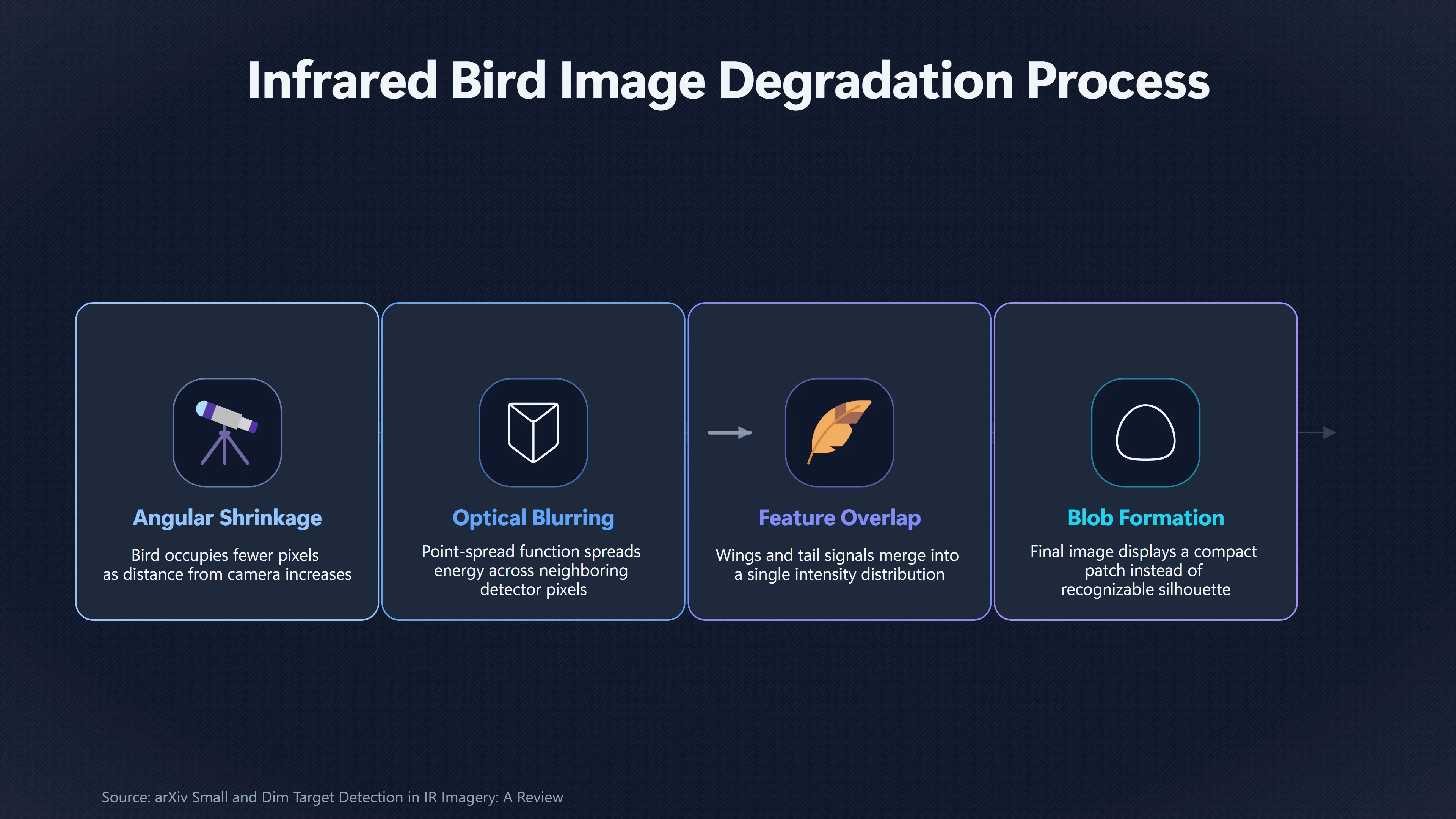
A distant bird can look like a round infrared “orb” for a straightforward reason: the sensor may still detect the bird after it has lost the spatial resolution needed to depict wings, tail and body separately. As range increases, the bird’s angular size shrinks until its anatomy spans only a few detector pixels. At that point, optics blur the bird’s infrared signal across neighbouring pixels, sampling reduces fine structure further, and the surviving image becomes a compact bright or dark patch rather than a recognisable silhouette.
This distinction matters when interpreting military infrared footage. A clear, persistent infrared target is not necessarily a clearly imaged object. Infrared engineering explicitly distinguishes detection — establishing that a target is present — from the much more demanding tasks of recognition and identification. Research on infrared small targets consequently deals with objects whose signals remain detectable even though shape information has largely disappeared.[spiedigitallibrary.org]spiedigitallibrary.orgOpen source on spiedigitallibrary.org.
Angular size makes the bird’s anatomy disappear
What determines whether wings can be seen is not simply the bird’s physical size but its angular size: the angle it occupies from the camera’s viewpoint. For a target much farther away than its own dimensions, angular size is approximately its physical dimension divided by its distance. Double the distance and the same bird spans roughly half as much angle; increase the range tenfold and it spans about one-tenth as much.
The camera then has to divide that increasingly small angular target among a finite number of detector elements. Suppose, purely as an illustration, that a bird’s one-metre wingspan covers ten pixels at one range. At five times that distance it would cover only about two pixels under otherwise identical imaging conditions. Thin structures such as wing tips and a narrow tail can fall below useful sampling even sooner than the larger torso.
That is why long-range infrared imaging literature describes small targets as occupying only a few pixels and lacking usable information about shape and dimensions. Work specifically on sub-pixel and small-target imaging notes that long-range targets are difficult to characterise precisely because detailed spatial features such as shape and size are no longer captured reliably.[optica.org]opg.optica.orgOptica Publishing GroupSub-pixel target fine spatial feature extraction method…by C Zhang · 2024 · Cited by 3 — In long-range imaging…
There is therefore no contradiction in saying, “the sensor clearly sees something, but you cannot see that it is a bird”. Those are two different imaging thresholds.
The principle is familiar in military electro-optical and infrared engineering through the Johnson criteria, a family of methods for estimating the image detail needed for different visual tasks. Detection requires substantially less spatial information than recognition or identification; SPIE’s treatment notes that, under the basic Johnson framework, recognition and identification ranges are considerably shorter than detection range. Real performance also varies with target contrast, atmospheric conditions, background clutter and processing.[SPIE Digital Library]proceedings.spiedigitallibrary.orgImplementation of the Johnson criteria for infrared images is the probabilities of a discrimination technique. The inputs to the model.Re…
For a bird, that gap is crucial. The thermal signature can cross the detection threshold while its wings have already crossed below the identification threshold.
Optical blur turns a tiny bird into a blob
Pixels are only part of the story. Even before the detector samples an image, the camera’s optics impose their own resolution limit.
An ideal point in the scene is not reproduced as an infinitely small point in the image. An optical system spreads its energy into a finite point-spread function, or PSF. With an ideal circular aperture, diffraction produces the familiar Airy pattern: a bright central region surrounded by progressively weaker rings. More generally, focus, aberrations, atmospheric effects, platform motion and other imperfections contribute to the blur produced by a real imaging system. The practical result is that sufficiently small features cease to be represented independently.[sciencedirect.com]sciencedirect.comScienceDirect Airy DiskScienceDirect Airy Disk
This has a particularly intuitive consequence for an unresolved bird. At close range, imagine the camera receiving distinct spatial information from the left wing, body, right wing and tail. At greater range those features move closer together in the image. Eventually their blurred responses overlap so strongly that the detector cannot preserve them as separate structures.
The camera then records something closer to one compact intensity distribution.
Infrared small-target research documents this effect directly. One study notes that because of atmospheric turbulence and the optical system’s PSF, even a nominally single-pixel infrared target can acquire a blob-like morphology affecting an area of roughly 3 × 3 pixels. Other work describes infrared small targets as having energy distributed according to the PSF across only a few pixels.[MDPI]mdpi.comNew Results on Small and Dim Infrared Target DetectionNew Results on Small and Dim Infrared Target Detection
This helps explain why “round” should not automatically be read as a measurement of the object’s physical outline. Near the resolution limit, the displayed outline is increasingly a picture of how the imaging system responds to a tiny source, rather than a faithful map of the source’s edges.
A useful analogy is a distant star. A star is vastly too small in angular terms for a conventional telescope to photograph its actual disc, yet it appears as a small spot because the optical system spreads the unresolved source into a finite pattern.[Swinburne Astronomy]astronomy.swin.edu.auSwinburne Astronomy Airy Disk | COSMOSSwinburne Astronomy Airy Disk | COSMOS A distant bird is obviously not a point source in the physical sense, but once its relevant dimensions approach the camera’s resolving limit, the same general imaging principle applies: the recorded spot can tell you where the target is and how strong its signal is without faithfully preserving its shape.
Why the body survives when the wings do not
Loss of detail does not necessarily happen uniformly across the bird. A recognisable silhouette contains structures of very different spatial scales. The central body is comparatively broad and compact; wing tips, legs, necks or tails may be much narrower. As the image shrinks, those thin structures are the easiest to lose.
The bird therefore does not have to go directly from a detailed silhouette to complete invisibility. There is an intermediate regime in which the strongest central signal remains while the features that make the target recognisably avian no longer survive as separate image structures.
Optical blur reinforces this process. Energy from adjacent parts of the animal is spread and mixed by the PSF. Detector sampling then converts that already blurred distribution into discrete pixel values. If a wing’s distinctive width or separation from the body is smaller than the system can resolve, increasing display magnification afterwards does not recreate the missing anatomical information. It mainly enlarges the existing pixels or interpolates between them.
That is an important distinction when viewing cropped military video. A blob occupying dozens of pixels on a computer screen may have occupied only a tiny number of independent resolution elements in the original sensor data. Display size is not the same thing as resolved target detail.
Infrared small-target algorithms are built around precisely this problem. Rather than expecting detailed contours, they often search for compact local intensity anomalies — small regions that differ sufficiently from their surroundings to constitute a target. Research in the field describes targets of only a few pixels, sometimes with little distinctive feature information available for conventional object recognition.[arXiv]arxiv.orgarXiv Small and Dim Target Detection in IR Imagery: A ReviewarXiv Small and Dim Target Detection in IR Imagery: A Review

Detection can remain strong after identification fails
Birds provide a particularly good example of the gap between seeing a target and knowing what it is because they can present a useful infrared contrast against the sky.
A 2026 Ornithology study offers a real-world demonstration outside the UAP debate. Researchers at Cape May, New Jersey, used thermal imaging to locate nocturnally migrating birds. Thermal optics were effective at finding their heat signatures in darkness, but the team then illuminated approaching birds and used high-resolution digital photography to establish their identities. The authors describe thermal imaging as a means of detecting endothermic — warm-blooded — animals in complete darkness and note that increasing distance made detailed identification progressively harder.[OUP Academic]academic.oup.comOpen source on oup.com.
The experimental workflow itself is revealing: thermal detection first, detailed identification second.
The researchers used thermal optics to find flying targets and waited until they were sufficiently close before illumination and photography — generally under 300 metres for large waterbirds and under 150 metres for small songbirds in their setup. Their high-resolution photographic equipment then supplied the visual detail required for species-level identification.[OUP Academic]academic.oup.comOpen source on oup.com.
This does not mean that every military infrared dot is a bird, nor that thermal cameras are incapable of resolving birds. It demonstrates the narrower and more important point: a genuine bird can produce a readily detectable infrared target at a stage where identification from the thermal image alone is substantially more difficult. Cornell’s summary of the same work likewise describes observers first locating an approaching bird by its bright heat signature before illuminating and photographing it.[Birds, Cornell Lab of Ornithology]birds.cornell.eduOpen source on cornell.edu.
That makes absence of an obvious bird silhouette much weaker evidence than it might initially seem. Whether wings should be visible depends on range, bird size, field of view, focal length, detector sampling, optical quality, focus, atmospheric propagation, target-background contrast and processing — not simply on whether the object looks large after the video has been enlarged for viewing.
Why “orb” is a description, not an identification
Once the target approaches the system’s resolution limit, apparently meaningful geometry becomes unreliable. A compact bird can appear roughly circular, oval or irregular depending on its sub-pixel position, the PSF, viewing angle, instantaneous wing position and image processing.
This is why infrared engineering commonly treats very small distant objects as point-like or small targets rather than attempting to infer detailed physical geometry from their displayed perimeter. The target’s position and contrast may be meaningful while its apparent edge is largely an imaging product. Studies of infrared small-target detection explicitly describe such targets as occupying only a few pixels, while PSF effects distribute their signal beyond the dimensions that a simplistic pixel-count interpretation would suggest.[MDPI]mdpi.comNew Results on Small and Dim Infrared Target DetectionNew Results on Small and Dim Infrared Target Detection
A round infrared blob therefore does not establish a round physical object. But the reverse is equally important: roundness alone does not establish that the target is a bird. The imaging mechanism explains why a bird can lose its bird-like shape; it cannot identify every unresolved blob.
That qualification is supported by AARO’s own case work. In its 2025 analysis of the 2013 Puerto Rico infrared footage, AARO considered and rejected a marine-bird interpretation. Its reconstruction indicated that, at the distances it calculated for that particular encounter, birds should still have retained identifiable features such as wings or produced a pulsation associated with wing beats. AARO instead assessed with moderate confidence that the two objects were sky lanterns.[AARO]aaro.milPuerto Rico UAP Case ResolutionPuerto Rico UAP Case Resolution
That case supplies an important boundary condition. “Distant targets become blobs” is an imaging principle, not a universal excuse for featureless footage. If the independently established range, optics and target dimensions imply that wings should have been resolved, their absence becomes evidence against the bird hypothesis.
Conversely, when angular size is genuinely near the sensor’s resolving limit, demanding a textbook bird silhouette is unreasonable.
What an infrared orb actually tells us
For military-sensor UAP analysis, the useful question is therefore not “Does this blob look like a bird?” but “Was the imaging system capable of showing bird anatomy at the target’s probable range?”
That requires information beyond the enlarged video frame: approximate range, sensor field of view or focal length, detector resolution, optical performance and an estimate of plausible target size. Only then is it possible to estimate how many useful resolution elements should span the bird and whether wings or a tail ought to survive.
AARO’s published cases illustrate why this sensor-aware approach matters. Its official UAP imagery catalogue notes, for example, that distant commercial aircraft in the Western United States case appeared only as small dots because of their considerable distance from the infrared sensor. In the Puerto Rico analysis, AARO likewise states that sensor fidelity degrades with increasing target distance, particularly for small objects; the aircraft-to-target distance nearly tripled during that encounter and image quality diminished.[AARO]aaro.milUAP ImageryUAP Imagery
The same physics applies when the candidate target is avian. As a bird recedes, there is a range in which identity disappears before detectability does. Its wings and tail cease to supply separately resolvable structure; the optical response blends what remains; the detector samples that response into a handful of pixels; and the surviving infrared contrast becomes a small, often rounded patch.
That is the core mechanism behind birds that become apparent “orbs” on military infrared sensors. The orb need not be spherical at all. At the resolution limit, its shape can be less a portrait of the bird than a portrait of the camera’s inability to resolve it.
Amazon book picks
Further Reading
Books and field guides related to Why Can a Bird Look Like an Orb?. Use these as the next step if you want deeper reading beyond the article.
Infrared Thermal Imaging: Fundamentals, Research and Applicat...
This richly illustrated hands-on guide is designed for researchers, teachers and practitioners. The huge selection of examples taken from...
Optical Design Fundamentals for Infrared Systems
The practical, popular 1995 tutorial has been thoroughly revised and updated, reflecting developments in technology and applications duri...
Passive Infrared Detection: Theory and Applications
Familiarization with the infrared world Thermal imaging systems extend human perception beyond the visible spectrum. Since their principl...
eBay marketplace picks
Marketplace Samples
Live-tested eBay searches with available results related to this page.
Selected fromUFO poster oneBay.co.uk.


Current eBay listing
VINTAGE UFO FLYING SAUCERS COMIC ADVERTISING A2 POSTER PRINT

Current eBay listing
I Want To Believe UFO Poster Giclée Fine Art Heavyweight Print

Endnotes
1.
Source: mdpi.com
Link:https://www.mdpi.com/2076-3417/14/19/8798
Source snippet
It finds use in aerospace...Read more...
2.
Source: opg.optica.org
Link:https://opg.optica.org/abstract.cfm?uri=oe-32-10-16761
Source snippet
Optica Publishing GroupSub-pixel target fine spatial feature extraction method...by C Zhang · 2024 · Cited by 3 — In long-range imaging...
3.
Source: arxiv.org
Title: arXiv Small and Dim Target Detection in IR Imagery: A Review
Link:https://arxiv.org/abs/2311.16346
4.
Source: sciencedirect.com
Title: ScienceDirect Airy Disk
Link:https://www.sciencedirect.com/topics/engineering/airy-disk
5.
Source: arxiv.org
Title: arXiv A modern description of Rayleigh’s criterion
Link:https://arxiv.org/abs/1801.02917
6.
Source: mdpi.com
Title: New Results on Small and Dim Infrared Target Detection
Link:https://www.mdpi.com/1424-8220/21/22/7746
7.
Source: mdpi.com
Link:https://www.mdpi.com/1424-8220/26/6/1980
8.
Source: arxiv.org
Link:https://arxiv.org/abs/2411.13260
9.
Source: academic.oup.com
Link:https://academic.oup.com/auk/article/143/2/1/8506565
10.
Source: birds.cornell.edu
Link:https://www.birds.cornell.edu/home/new-tech-to-id-night-migrating-birds/
11.
Source: aaro.mil
Title: Puerto Rico UAP Case Resolution
Link:https://www.aaro.mil/Portals/136/PDFs/case_resolution_reports/AARO_Puerto_Rico_UAP_Case_Resolution.pdf
12.
Source: aaro.mil
Title: UAP Imagery
Link:https://www.aaro.mil/UAP-Cases/Official-UAP-Imagery/
13.
Source: mdpi.com
Title: I R-SAM2: Target Enhancement with SAM2 for Infrared Small Target Detection
Link:https://www.mdpi.com/2072-4292/18/12/1891
14.
Source: aaro.mil
Link:https://www.aaro.mil/Next-AARO-Home-redesign/Next-Parent/Next-AARO-UAP-Imagery-Acc-Table/
15.
Source: aaro.mil
Link:https://www.aaro.mil/Next-AARO-Home-redesign/Next-Parent/Next-UAP-Report-Documents/poster/dividLink/
16.
Source: academic.oup.com
Link:https://academic.oup.com/auk
17.
Source: mdpi.com
Link:https://www.mdpi.com/2072-4292/18/5/804
18.
Source: academic.oup.com
Link:https://academic.oup.com/auk/article/143/2/1/8506565?searchresult=1
19.
Source: academic.oup.com
Link:https://academic.oup.com/auk/article-abstract/143/2/1/8506565
20.
Source: aaro.mil
Link:https://www.aaro.mil/Next-AARO-Home-redesign/Next-Parent/Presidential-UAP-Transparency-Initiative/
21.
Source: academic.oup.com
Link:https://academic.oup.com/auk/issue/143/1
22.
Source: mdpi.com
Link:https://www.mdpi.com/2072-4292/17/14/2502
23.
Source: mdpi.com
Link:https://www.mdpi.com/2072-4292/17/13/2268
24.
Source: mdpi.com
Link:https://www.mdpi.com/2072-4292/17/11/1921
25.
Source: sciencedirect.com
Link:https://www.sciencedirect.com/science/article/pii/S0925231225003121
26.
Source: mdpi.com
Link:https://www.mdpi.com/2076-3417/15/9/4797
27.
Source: mdpi.com
Link:https://www.mdpi.com/1424-8220/25/3/814
28.
Source: mdpi.com
Link:https://www.mdpi.com/2072-4292/16/22/4160
29.
Source: mdpi.com
Link:https://www.mdpi.com/2072-4292/15/23/5539
30.
Source: mdpi.com
Link:https://www.mdpi.com/2072-4292/15/22/5424
31.
Source: mdpi.com
Link:https://www.mdpi.com/2624-6120/4/2/18
32.
Source: aaro.mil
Link:https://www.aaro.mil/Next-AARO-Home-redesign/Next-Parent/Presidential-UAP-Transparency-Initiative/videoid/988673/dvpcc/false/
33.
Source: aaro.mil
Link:https://www.aaro.mil/Next-AARO-Home-redesign/Next-Parent/Presidential-UAP-Transparency-Initiative/videoid/1006060/dvpcc/false/
34.
Source: aaro.mil
Link:https://www.aaro.mil/Next-AARO-Home-redesign/Next-Parent/Presidential-UAP-Transparency-Initiative/videoid/1006056/dvpcc/false/
35.
Source: mdpi.com
Link:https://www.mdpi.com/2079-9292/11/6/933
36.
Source: mdpi.com
Link:https://www.mdpi.com/1424-8220/21/17/5700
37.
Source: opg.optica.org
Link:https://opg.optica.org/ao/abstract.cfm?origin=search&uri=ao
38.
Source: opg.optica.org
Title: upcoming pdf.cfm
Link:https://opg.optica.org/ao/upcoming_pdf.cfm?id=427782
39.
Source: opg.optica.org
Link:https://opg.optica.org/ao/abstract.cfm?uri=ao
40.
Source: opg.optica.org
Title: upcoming pdf.cfm
Link:https://opg.optica.org/ao/upcoming_pdf.cfm?id=386417
41.
Source: opg.optica.org
Link:https://opg.optica.org/ao/abstract.cfm?uri=ao
42.
Source: academic.oup.com
Link:https://academic.oup.com/auk/article/doi/10.1093/auk/ukz051/5565028
43.
Source: mdpi.com
Title: Thermal Imager Range: Predictions, Expectations, and Reality
Link:https://www.mdpi.com/1424-8220/19/15/3313
44.
Source: opg.optica.org
Link:https://opg.optica.org/ao/abstract.cfm?uri=ao
45.
Source: opg.optica.org
Link:https://opg.optica.org/ao/abstract.cfm?uri=ao
46.
Source: opg.optica.org
Link:https://opg.optica.org/abstract.cfm?uri=ao
47.
Source: opg.optica.org
Link:https://opg.optica.org/ao/abstract.cfm?uri=ao
48.
Source: opg.optica.org
Link:https://opg.optica.org/ao/abstract.cfm?uri=ao-52-7-c72
49.
Source: opg.optica.org
Link:https://opg.optica.org/abstract.cfm?uri=isa-2012-ITu1C.2
50.
Source: opg.optica.org
Link:https://opg.optica.org/aop/abstract.cfm?uri=ISA-2012-ITu1C.2
51.
Source: academic.oup.com
Link:https://academic.oup.com/auk/article/122/1/319/5562431
52.
Source: opg.optica.org
Link:https://opg.optica.org/ao/abstract.cfm?uri=ao
53.
Source: aaro.mil
Link:https://www.aaro.mil/UAP-Cases/Official-UAP-Imagery/ftag/MSF0951a18/
54.
Source: aaro.mil
Link:https://www.aaro.mil/UAP-Cases/Official-UAP-Imagery/4/
55.
Source: aaro.mil
Link:https://www.aaro.mil/Next-AARO-Home-redesign/Inactive-Parent/Next-UAP-Imagery-dup/
56.
Source: aaro.mil
Link:https://www.aaro.mil/Next-AARO-Home-redesign/Next-Parent/AARO-UAP-Case-Resolution-DT/
57.
Source: aaro.mil
Link:https://www.aaro.mil/Next-AARO-Home-redesign/Next-Parent/Next-AARO-UAP-Imagery-Fixed-Table/
58.
Source: aaro.mil
Title: Next UAP Case RR Data Table
Link:https://www.aaro.mil/Next-AARO-Home-redesign/Next-Parent/Next-UAP-Case-RR-Data-Table/
59.
Source: aaro.mil
Title: AAR O UAP Trends All-domain Anomaly Resolution Office UAP REPORTING TRENDS
Link:https://www.aaro.mil/UAP-Cases/UAP-Reporting-Trends/
60.
Source: aaro.mil
Link:https://www.aaro.mil/Next-AARO-Home-redesign/Next-Parent/Next-AARO-UAP-Trends/
61.
Source: aaro.mil
Link:https://www.aaro.mil/
62.
Source: academic.oup.com
Link:https://academic.oup.com/auk/issue
63.
Source: academic.oup.com
Title: highly cited
Link:https://academic.oup.com/auk/pages/highly_cited
64.
Source: academic.oup.com
Link:https://academic.oup.com/aosjournals
65.
Source: academic.oup.com
Title: advance articles
Link:https://academic.oup.com/auk/advance-articles
66.
Source: academic.oup.com
Link:https://academic.oup.com/auk/advance-article-pdf/doi/10.1093/ornithology/ukaf074/67235377/ukaf074.pdf
67.
Source: academic.oup.com
Link:https://academic.oup.com/auk/article/142/2/ukaf002/7951360
68.
Source: academic.oup.com
Link:https://academic.oup.com/auk/advance-article-abstract/doi/10.1093/ornithology/ukaf074/8506565
69.
Source: academic.oup.com
Link:https://academic.oup.com/condor/article/127/1/duae062/7863690
70.
Source: academic.oup.com
Link:https://academic.oup.com/auk/article/141/1/ukad055/7529095
71.
Source: academic.oup.com
Link:https://academic.oup.com/beheco/article-pdf/27/4/1122/21722956/arw021.pdf
72.
Source: opg.optica.org
Link:https://opg.optica.org/abstract.cfm?uri=ao
73.
Source: opg.optica.org
Title: upcoming pdf.cfm
Link:https://opg.optica.org/ao/upcoming_pdf.cfm?id=206609
74.
Source: sciencedirect.com
Title: Infrared small target segmentation networks: A survey
Link:https://www.sciencedirect.com/science/article/pii/S0031320323004867
75.
Source: sciencedirect.com
Link:https://www.sciencedirect.com/science/article/pii/S0006320718309054
76.
Source: sciencedirect.com
Title: Angular Resolution
Link:https://www.sciencedirect.com/topics/engineering/angular-resolution
77.
Source: sciencedirect.com
Link:https://www.sciencedirect.com/science/article/pii/S1350449516300160
78.
Source: sciencedirect.com
Link:https://www.sciencedirect.com/science/article/pii/1350449595001298
79.
Source: sciencedirect.com
Link:https://www.sciencedirect.com/science/article/abs/pii/S1350449516301086
80.
Source: sciencedirect.com
Title: Focal Plane
Link:https://www.sciencedirect.com/topics/engineering/focal-plane
81.
Source: mdpi.com
Link:https://www.mdpi.com/2079-9292/12/22/4701
82.
Source: mdpi.com
Link:https://www.mdpi.com/2072-4292/18/14/2349
83.
Source: mdpi.com
Link:https://www.mdpi.com/2072-4292/17/20/3457
84.
Source: mdpi.com
Link:https://www.mdpi.com/2304-6732/13/8/748
85.
Source: birds.cornell.edu
Title: news releases archive
Link:https://www.birds.cornell.edu/home/news/news-releases-archive/
86.
Source: spiedigitallibrary.org
Link:https://www.spiedigitallibrary.org/ebook/Download?isFullBook=False&urlid=10.1117%2F3.2588947.ch19
87.
Source: proceedings.spiedigitallibrary.org
Link:https://proceedings.spiedigitallibrary.org/journalIssue/Download?downloadType=journal+article&isResultClick=True&urlId=10.1117%2F1.1531637
Source snippet
Implementation of the Johnson criteria for infrared images is the probabilities of a discrimination technique. The inputs to the model.Re...
88.
Source: astronomicaltelescopes.spiedigitallibrary.org
Title: In this way we can
Link:https://astronomicaltelescopes.spiedigitallibrary.org/proceedings/Download?downloadType=proceedings+article&isResultClick=True&urlId=10.1117%2F12.2303975
Source snippet
SPIE Digital LibraryEvaluating the performance of an IR imaging system: A tutorialThe Johnson Criteria uses the limiting resolution of th...
89.
Source: astronomy.swin.edu.au
Title: Swinburne Astronomy Airy Disk | COSMOS
Link:https://astronomy.swin.edu.au/cosmos/A/Airy%2Bdisk
90.
Source: astronomy.swinburne.edu.au
Link:https://astronomy.swinburne.edu.au/cosmos/R/Rayleigh%2BCriterion
91.
Source: spiedigitallibrary.org
Link:https://www.spiedigitallibrary.org/proceedings/Download?urlId=10.1117%2F12.2311868
92.
Source: proceedings.spiedigitallibrary.org
Link:https://proceedings.spiedigitallibrary.org/proceedings/Download?urlId=10.1117%2F12.2028703
93.
Source: spiedigitallibrary.org
Link:https://www.spiedigitallibrary.org/conference-proceedings-of-spie/12533/1253313/Detection-range-performance-analysis-and-verification-of-the-long-wavelength/10.1117/12.2670189.full
94.
Source: astronomicaltelescopes.spiedigitallibrary.org
Link:https://astronomicaltelescopes.spiedigitallibrary.org/proceedings/Download?downloadType=proceedings+article&isResultClick=True&urlId=10.1117%2F12.2017644
95.
Source: ebooks.spiedigitallibrary.org
Link:https://ebooks.spiedigitallibrary.org/conference-proceedings-of-spie/9684/96842H/Performance-evaluation-and-verification-of-infrared-imaging-system-based-on/10.1117/12.2242493.full
96.
Source: spiedigitallibrary.org
Link:https://www.spiedigitallibrary.org/conference-proceedings-of-spie/3701/1/Night-vision-modeling-historical-perspective/10.1117/12.352982.pdf
97.
Source: journals.spiedigitallibrary.org
Link:https://journals.spiedigitallibrary.org/proceedings/Download?downloadType=proceedings+article&isResultClick=True&urlId=10.1117%2F12.2178146
Additional References
98.
Source: ieeexplore.ieee.org
Link:https://ieeexplore.ieee.org/iel7/4609443/9314330/09261944.pdf
Source snippet
IEEE XploreInfrared Small Target Detection Utilizing the Enhanced Closest-...performance, the target usually occupies only a few pixels and...
99.
Source: nature.com
Link:https://www.nature.com/articles/s41467-023-43046-z
100.
Source: nature.com
Link:https://www.nature.com/nature-index/topics/l4/infrared-small-target-detection-algorithms
101.
Source: nature.com
Link:https://www.nature.com/articles/s41598-018-35880-9
102.
Source: youtube.com
Title: Mick West: UFOs DEBUNKED! Brian Keating’s INTO THE IMPOSSIBLE Podcast (#154)
Link:https://www.youtube.com/watch?v=HJtTgIKDUZw
Source snippet
Limina Inaugural Symposium Day 3 - Mick West...
103.
Source: tethys.pnnl.gov
Title: automatic identification bird targets [radar]({{ ‘radar/’ | relative_url }}) patterns produced wing flapping
Link:https://tethys.pnnl.gov/publications/automatic-identification-bird-targets-radar-patterns-produced-wing-flapping
104.
Source: youtube.com
Title: Limina Inaugural Symposium Day 3
Link:https://www.youtube.com/watch?v=BahEq46t3Uo
Source snippet
The SHOCKING Math Error Behind Viral UFO Videos | Mick West...
105.
Source: flir.com
Link:https://www.flir.com/en-gb/products/tg268/
106.
Source: physandbox.com
Link:https://physandbox.com/optics/airy-disk-resolution
107.
Source: videophysics.com
Link:https://videophysics.com/airy-disk