Within Compression
When Compression Erases a UFO's Real Shape
When a target spans only a few pixels, compression can erase the structural clues needed to tell an aircraft, bird, balloon or drone apart.
On this page
- Why tiny targets depend on fragile pixel details
- How quantisation removes wings, tails and gaps
- When shape claims become too weak to trust
Page outline Jump by section
Introduction
When a distant UFO or UAP occupies only a few pixels, its apparent shape can be much less informative than it looks. Wings, tailplanes, gaps between nearby objects and other identifying features may each be represented by only a tiny brightness difference. Lossy video compression is designed to discard or approximate precisely this sort of fine information when it needs to reduce the data rate. Research on compressed infrared imagery confirms that tiny and small targets are more vulnerable to compression than larger objects.[CVF Open Access]openaccess.thecvf.comCVF Open AccessCVPR 2022 Open Access Repository…
The result is important for UAP analysis: compression can preserve enough signal to show that something is present while no longer preserving enough structure to establish what that something looks like. An aircraft may become an oblong dot; two close features may merge; a narrow wing or tail may vanish. Enlarging the surviving pixels does not restore the information that was discarded. In such footage, a seemingly simple geometric silhouette can therefore be evidence of lost detail rather than evidence that the real object had a simple geometric shape.
Why tiny targets depend on fragile pixels
A large, well-resolved aircraft has considerable redundancy. Its fuselage, wings and tail occupy many pixels, so modest image degradation can occur without destroying the overall aircraft-like appearance. A very distant aircraft has no such margin. If its entire image is perhaps only several pixels across, a wing tip or tail may occupy a fraction of the target’s already limited signal.
This is a recognised problem well beyond UAP investigation. Research into tiny flying-object detection describes very-low-resolution targets as having little and unreliable visual information, with MPEG compression artefacts adding another difficulty. Work on detecting birds and unmanned aircraft in 4K video specifically identifies low target resolution and compression artefacts as part of the same practical problem: there may simply be too little stable appearance information in an individual frame to classify the object reliably.[arXiv]arxiv.orgFinding a Needle in a Haystack: Tiny Flying Object Detection in 4K Videos using a Joint Detection-and-Tracking ApproachMay 18, 2021…
Infrared imagery is particularly relevant because many prominent military UAP videos come from infrared sensors. A 2022 CVPR Workshops study tested lossy compression on thermal imagery and divided targets by apparent area into tiny, small, medium and large categories. The researchers found that tiny and small objects were more sensitive to compression than medium and large ones, with the greatest deterioration under stronger compression. Importantly, compression could damage machine-detection performance even when the compressed images still appeared visually acceptable.[CVF Open Access]openaccess.thecvf.comCVF Open AccessCVPR 2022 Open Access Repository…
That last point matters for human interpretation too. A video can look perfectly watchable while no longer being suitable for fine morphological claims. “The picture looks clear” and “the target’s shape is faithfully preserved” are different propositions.
The All-domain Anomaly Resolution Office (AARO) provides a useful real-world example. In its Western United States case, infrared objects initially reported as UAP were assessed as commercial aircraft travelling along established air corridors, in some cases as far as 300 nautical miles from the observing platform. AARO describes the targets as oblong dots or lights, and its public imagery page says the aircraft appeared simply as small dots because of their great distance. Identification came from positional analysis and air-traffic data rather than from recognising wings or fuselages in the displayed shapes.[AARO]aaro.milCase Resolution of Western United States Uap 508 02262024UNCLASSIFIEDFebruary 11, 2026…
This illustrates the central limitation. Once an aircraft is reduced to a dot, asking whether the dot itself “looks like an aircraft” sets an impossible standard. The distinctive aircraft structure may no longer exist in the recorded representation.
How quantisation removes wings, tails and gaps
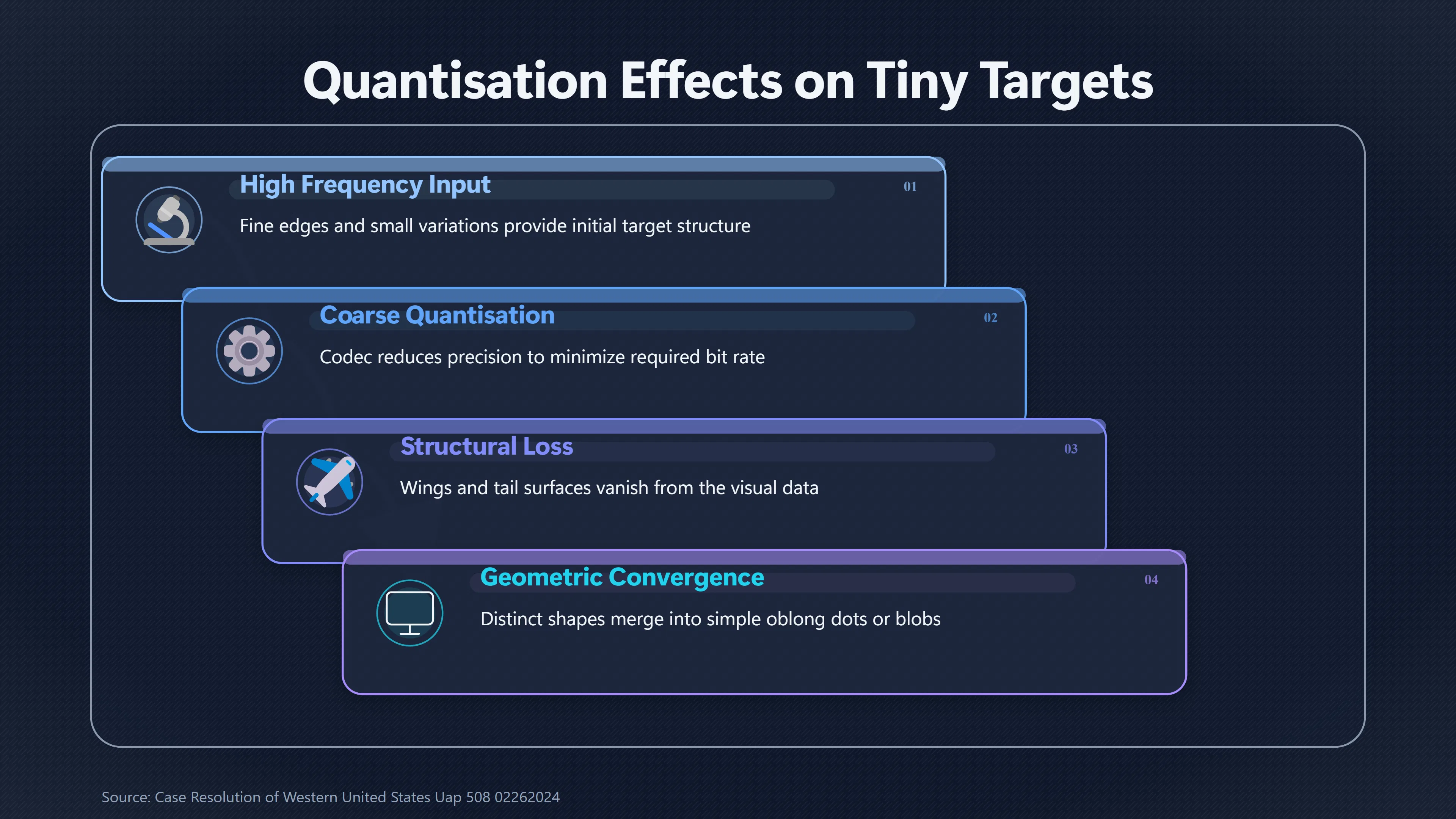
Lossy compression does not normally decide explicitly to “remove the wing”. Instead, codecs represent image information in ways that allow less visually important detail to be stored less precisely. A crucial step is quantisation: transformed image information is represented with reduced precision so that the video requires fewer bits.
Fine edges and small variations rely heavily on higher spatial-frequency information. Coarse quantisation can suppress that information. Technical literature on block-based compression links coarse quantisation to visible discontinuities, while descriptions of ringing artefacts explain that excessive quantisation of high-frequency transform information can distort boundaries around image features.[PubMed]pubmed.ncbi.nlm.nih.govPub Med Removing the blocking artifacts of block-based DCT compressed imagesRemoving the blocking artifacts of block-based DCT compressed images - PubMed…
For a tiny aerial target, that mathematical operation can have an unusually large morphological effect. Consider a simplified aircraft image only a few pixels wide. Its bright central pixels may represent the fuselage, while one-pixel or sub-pixel changes at either side carry what remains of the wings. If compression retains the strong central contrast but suppresses those weaker variations, the reconstructed target can become a compact oval or blob.
Several related losses can occur:
- Thin structures disappear. Wings, tail surfaces, rotors or antenna-like protrusions may depend on weak edge information that does not survive quantisation.
- Small gaps close. Two separated bright regions can blur together, making separate objects or structural components appear continuous.
- Different shapes converge. A distant bird, aircraft, balloon or drone can end up represented by similarly simple clusters of pixels once their distinctive fine structure has been lost.
- Edges become codec-dependent. Blocking, ringing and reconstruction errors can influence the boundary of a target whose real boundary is barely resolved in the first place.[PubMed]pubmed.ncbi.nlm.nih.govPub Med Removing the blocking artifacts of block-based DCT compressed imagesRemoving the blocking artifacts of block-based DCT compressed images - PubMed…
NIST research on MPEG compression describes “mosquito noise”, a time-dependent impairment in which high-frequency spatial detail around crisp edges is intermittently distorted. Because the effect varies over time, a tiny target’s apparent boundary can fluctuate even when its physical shape is unchanged.[NIST]nist.govMosquito Noise in MPEG-compressed Video: Test Patterns and Metrics | NISTMosquito Noise in MPEG-compressed Video: Test Patterns and Metrics | NIST…
This is why compression at the few-pixel scale is not equivalent to putting an ordinary photograph slightly out of focus. If the target’s identity is encoded in only a handful of small spatial differences, removing those differences can change the category of shape that an observer thinks they see.

A dot can still be an aircraft
The temptation to infer physical shape from a tiny target is understandable. A magnified frame may show what looks like a clean sphere, oval, capsule or polygon. But digital enlargement merely makes the existing samples larger. It cannot reveal wings or gaps that the sensor never resolved or the encoder subsequently discarded.
AARO’s Western United States resolution demonstrates why external evidence can become more informative than silhouette inspection at these scales. The objects were reported as lights and appeared as dots in the infrared imagery, yet their positions correlated strongly with specific commercial aircraft on different routes. AARO also concluded that apparent changes in their shapes resulted from sensor vibration and autofocus.[AARO]aaro.milCase Resolution of Western United States Uap 508 02262024UNCLASSIFIEDFebruary 11, 2026…
AARO’s South Asia material supplies an even more direct warning about trusting fine structure in compressed UAP video. An MQ-9 infrared recording showed an object accompanied by what appeared to be an atmospheric wake. AARO’s 2025 mission brief says post-event analysis attributed the visible trail to a camera-software artefact: the video-compression process overlaid frames and attempted to resolve differences in the infrared grey gradient, introducing a trail-like feature. Morphology and air-traffic information indicated that the target was probably a commercial airliner.[AARO]aaro.milMission BriefAARO Mission BriefJune 20, 2025…
The fuller AARO Atmospheric Wakes resolution likewise reports that one investigated object was identified with high confidence as a specific Airbus A380 using commercial flight data, with photogrammetry producing a size estimate close to that aircraft. Scientific and technical partners separately concluded that the apparent wakes were sensor artefacts rather than anomalous propulsion effects.[AARO]aaro.milCase Resolution of 'Atmospheric WakesCase Resolution of 'Atmospheric Wakes'February 26, 2024…
These cases do not imply that every featureless UAP is an aeroplane. They demonstrate a narrower and more useful principle: failure to see aircraft structure in a tiny compressed image is not strong evidence that aircraft structure was absent from the real object.
When shape claims become too weak to trust
There is no universal pixel count below which all shape analysis becomes impossible. Reliability depends on contrast, optics, sensor resolution, focus, atmospheric conditions, motion, exposure, compression settings and whether useful information persists across multiple frames. But the evidential burden should rise rapidly as the target becomes smaller.
A useful distinction is between detection and identification. Detection may require only a persistent contrast difference: there is a target here. Identification requires considerably richer information: the target has a particular structure, proportions and distinguishing features. Compression can leave the first conclusion intact while destroying the basis for the second. The thermal-imagery compression experiments are consistent with this distinction: smaller targets suffer disproportionately because they begin with fewer useful features to spare.[CVF Open Access]openaccess.thecvf.comCVF Open AccessCVPR 2022 Open Access Repository…
Shape claims become particularly fragile when the supposed feature is only one or two displayed pixels wide, appears only after heavy enlargement, changes from frame to frame, aligns with compression blocks or ringing, or disappears under a different zoom or sensor setting. In those circumstances, labels such as “sphere”, “disc”, “cube” or “wingless craft” can imply more certainty than the data contain.
Repeated re-encoding makes the problem harder still. A recording may pass from an original sensor stream to an operational recording system, an exported clip, a presentation file, a social-media upload and finally a screenshot. Each lossy stage can simplify already marginal structure. The final enlarged image may have hundreds of thousands of screen pixels, yet all of them ultimately derive from a target that occupied only a tiny number of informative samples in the earlier recording.
The safest question is therefore not simply, “What shape does the enlarged object resemble?” It is: Was the source imagery capable of preserving the structural feature being claimed? If a proposed wing, tail, separation or contour lies near the resolution and compression limits of the recording, absence of that feature carries little diagnostic weight.
What survives when the silhouette does not
Loss of trustworthy shape does not make a UAP recording useless. It changes which evidence deserves the most weight. Multi-frame motion, angular position, sensor geometry, range estimates, simultaneous radar information, air-traffic records and higher-resolution observations can remain informative even when the target’s silhouette cannot support identification.
The AARO cases show this distinction clearly. Western US aircraft were resolved largely through positional and air-traffic correlations despite appearing as distant dots. In the atmospheric-wake investigation, longer-focal-length footage, full-motion analysis, photogrammetry and flight information supplied evidence that a single compressed frame could not.[AARO]aaro.milUAP ImageryUAP Imagery…
That is the practical lesson for tiny UFO imagery. Compression does not necessarily make an object disappear. More deceptively, it can leave behind a convincing-looking simplified version of the object. The central blob survives while the weak identifying structure does not. At that point, “featureless”, “round” or “wingless” may describe the compressed image accurately without describing the physical object accurately at all.
For UAP identification, the missing pixels are therefore as important as the visible ones. Once compression has erased the structural clues separating an aircraft, bird, balloon or drone from a generic luminous or dark blob, the apparent silhouette should be treated as weak evidence and identification should shift towards information that survived the imaging chain.
Amazon book picks
Further Reading
Books and field guides related to When Compression Erases a UFO's Real Shape. Use these as the next step if you want deeper reading beyond the article.
Digital Image Processing
This is the eBook of the printed book and may not include any media, website access codes, or print supplements that may come packaged wi...
Fundamentals of Digital Image Processing
Two-Dimensional Systems and Mathematical Preliminaries - Image Perception - Image Sampling and Quantization - Image Transforms - Image Re...
H.264 and MPEG-4 Video Compression: Video Coding for Next-gen...
Following on from the successful MPEG-2 standard, MPEG-4 Visual is enabling a new wave of multimedia applications from Internet video str...
Digital Video and HD: Algorithms and Interfaces
& Quot;Digital Video and HDTV Algorithms and Interfaces covers the theory and engineering of digital video systems in a manner that is eq...
eBay marketplace picks
Marketplace Samples
Live-tested eBay searches with available results related to this page.
Selected fromUFO poster oneBay.co.uk.



Current eBay listing
VINTAGE UFO FLYING SAUCERS COMIC ADVERTISING A2 POSTER PRINT

Current eBay listing
I Want To Believe UFO Poster Giclée Fine Art Heavyweight Print
Endnotes
1.
Source: arxiv.org
Link:https://arxiv.org/abs/2105.08253
Source snippet
Finding a Needle in a Haystack: Tiny Flying Object Detection in 4K Videos using a Joint Detection-and-Tracking ApproachMay 18, 2021...
Published: May 18, 2021
2.
Source: aaro.mil
Title: Case Resolution of Western United States Uap 508 02262024
Link:https://www.aaro.mil/Portals/136/PDFs/case_resolution_reports/Case_Resolution_of%20_Western_United_States_Uap_508-02262024.pdf
Source snippet
UNCLASSIFIEDFebruary 11, 2026...
Published: February 11, 2026
3.
Source: aaro.mil
Title: UAP Imagery
Link:https://www.aaro.mil/Next-AARO-Home-redesign/Inactive-Parent/Next-UAP-Imagery-dup/
Source snippet
UAP Imagery...
4.
Source: nist.gov
Title: Mosquito Noise in MPEG-compressed Video: Test Patterns and Metrics | NIST
Link:https://www.nist.gov/publications/mosquito-noise-mpeg-compressed-video-test-patterns-and-metrics
Source snippet
Mosquito Noise in MPEG-compressed Video: Test Patterns and Metrics | NIST...
5.
Source: aaro.mil
Title: Mission Brief
Link:https://www.aaro.mil/Portals/136/PDFs/AARO_Mission_Brief_2025.pdf
Source snippet
AARO Mission BriefJune 20, 2025...
Published: June 20, 2025
6.
Source: aaro.mil
Title: Case Resolution of ‘Atmospheric Wakes’
Link:https://www.aaro.mil/Portals/136/PDFs/case_resolution_reports/Case_Resolution_of_Atmospheric_Wakes_508-02262024.pdf?ver=S7tqVvXUSxHY9LR1W7Mchw%3D%3D
Source snippet
Case Resolution of 'Atmospheric Wakes'February 26, 2024...
Published: February 26, 2024
7.
Source: aaro.mil
Title: Case Resolution of ‘Atmospheric Wakes’
Link:https://www.aaro.mil/Portals/136/PDFs/case_resolution_reports/Case_Resolution_of_Atmospheric_Wakes_508-02262024.pdf
8.
Source: aaro.mil
Link:https://www.aaro.mil/Next-AARO-Home-redesign/Next-Parent/Next-AARO-UAP-Imagery-Acc-Table/
9.
Source: aaro.mil
Link:https://www.aaro.mil/Next-AARO-Home-redesign/Next-Parent/Next-UAP-Report-Documents/poster/dividLink/
10.
Source: aaro.mil
Link:https://www.aaro.mil/Next-AARO-Home-redesign/Next-Parent/Presidential-UAP-Transparency-Initiative/
11.
Source: nist.gov
Title: what quantization
Link:https://www.nist.gov/video/what-quantization
12.
Source: aaro.mil
Link:https://www.aaro.mil/Next-AARO-Home-redesign/Next-Parent/Presidential-UAP-Transparency-Initiative/videoid/1006078/dvpcc/false/
13.
Source: aaro.mil
Link:https://www.aaro.mil/Next-AARO-Home-redesign/Next-Parent/Presidential-UAP-Transparency-Initiative/videoid/1007720/dvpcc/false/
14.
Source: aaro.mil
Link:https://www.aaro.mil/Next-AARO-Home-redesign/Next-Parent/Presidential-UAP-Transparency-Initiative/videoid/1010276/dvpcc/false/
15.
Source: aaro.mil
Link:https://www.aaro.mil/Next-AARO-Home-redesign/Next-Parent/Presidential-UAP-Transparency-Initiative/videoid/1007740/dvpcc/false/
16.
Source: aaro.mil
Link:https://www.aaro.mil/Next-AARO-Home-redesign/Next-Parent/Presidential-UAP-Transparency-Initiative/videoid/1007707/dvpcc/false/
17.
Source: aaro.mil
Link:https://www.aaro.mil/Next-AARO-Home-redesign/Next-Parent/Presidential-UAP-Transparency-Initiative/videoid/1006083/dvpcc/false/
18.
Source: aaro.mil
Link:https://www.aaro.mil/Next-AARO-Home-redesign/Next-Parent/Presidential-UAP-Transparency-Initiative/videoid/1006104/dvpmoduleid/77396/
19.
Source: nist.gov
Title: vqips processing
Link:https://www.nist.gov/ctl/pscr/vqips-processing
20.
Source: nist.gov
Link:https://www.nist.gov/publications/pixel-interlacing-based-video-transmission-low-complexity-intra-frame-error-concealment
21.
Source: nist.gov
Title: efficient motion vector interpolation error concealment h264avc
Link:https://www.nist.gov/publications/efficient-motion-vector-interpolation-error-concealment-h264avc
22.
Source: nist.gov
Title: wsq problem two thumb captures large platen live scan devices
Link:https://www.nist.gov/publications/wsq-problem-two-thumb-captures-large-platen-live-scan-devices
23.
Source: nist.gov
Title: video signal error concealment
Link:https://www.nist.gov/ctl/smart-connected-systems-division/video-signal-error-concealment
24.
Source: nist.gov
Title: image compression and deblurring
Link:https://www.nist.gov/publications/image-compression-and-deblurring
25.
Source: nist.gov
Title: perceptual effects noise digital video compression
Link:https://www.nist.gov/publications/perceptual-effects-noise-digital-video-compression
26.
Source: nist.gov
Title: mosquito noise mpeg compressed video test patterns and metrics 0
Link:https://www.nist.gov/publications/mosquito-noise-mpeg-compressed-video-test-patterns-and-metrics-0
27.
Source: nist.gov
Link:https://www.nist.gov/publications/toward-developing-unit-measure-and-scale-digital-video-quality-ieee-broadcast
28.
Source: nist.gov
Link:https://www.nist.gov/publications/multi-priority-video-transmission-third-generation-wireless-communication-systems
29.
Source: nist.gov
Title: simulation graded video impairment weighted summation validation methodology
Link:https://www.nist.gov/publications/simulation-graded-video-impairment-weighted-summation-validation-methodology
30.
Source: nist.gov
Title: visibility thresholds compression induced image blocking measurement and models
Link:https://www.nist.gov/publications/visibility-thresholds-compression-induced-image-blocking-measurement-and-models
31.
Source: nist.gov
Title: perceptual effects noise digital video compression 0
Link:https://www.nist.gov/publications/perceptual-effects-noise-digital-video-compression-0
32.
Source: aaro.mil
Link:https://www.aaro.mil/UAP-Cases/Official-UAP-Imagery/4/
33.
Source: aaro.mil
Link:https://www.aaro.mil/Next-AARO-Home-redesign/Next-Parent/Next-AARO-UAP-Imagery-Fixed-Table/
34.
Source: aaro.mil
Link:https://www.aaro.mil/UAP-Cases/Official-UAP-Imagery/ftag/MSF0951a18/
35.
Source: aaro.mil
Link:https://www.aaro.mil/Next-AARO-Home-redesign/Next-Parent/AARO-UAP-Case-Resolution-DT/
36.
Source: aaro.mil
Link:https://www.aaro.mil/Next-AARO-Home-redesign/Next-Parent/Next-UAP-Case-RR-Data-Table/
37.
Source: aaro.mil
Title: AAR O UAP Trends All-domain Anomaly Resolution Office UAP REPORTING TRENDS
Link:https://www.aaro.mil/UAP-Cases/UAP-Reporting-Trends/
38.
Source: aaro.mil
Link:https://www.aaro.mil/Next-AARO-Home-redesign/Next-Parent/Next-AARO-UAP-Trends/
39.
Source: aaro.mil
Link:https://www.aaro.mil/Next-AARO-Home-redesign/Bruce-working/Next-AARO-UAP-Trends-Charts/
40.
Source: aaro.mil
Title: AAR O UAP Trends All-domain Anomaly Resolution Office UAP REPORTING TRENDS
Link:https://www.aaro.mil/UAP-Cases/UAP-Reporting-Trends/quot/
41.
Source: aaro.mil
Link:https://www.aaro.mil/
42.
Source: openaccess.thecvf.com
Link:https://openaccess.thecvf.com/content/CVPR2022W/PBVS/html/Bhowmik_Lost_in_Compression_The_Impact_of_Lossy_Image_Compression_on_CVPRW_2022_paper.html
Source snippet
CVF Open AccessCVPR 2022 Open Access Repository...
43.
Source: pubmed.ncbi.nlm.nih.gov
Title: Pub Med Removing the blocking artifacts of block-based DCT compressed images
Link:https://pubmed.ncbi.nlm.nih.gov/18237958/
Source snippet
Removing the blocking artifacts of block-based DCT compressed images - PubMed...
44.
Source: pmc.ncbi.nlm.nih.gov
Link:https://pmc.ncbi.nlm.nih.gov/articles/PMC10205570/
45.
Source: pmc.ncbi.nlm.nih.gov
Link:https://pmc.ncbi.nlm.nih.gov/articles/PMC8840351/
46.
Source: pmc.ncbi.nlm.nih.gov
Link:https://pmc.ncbi.nlm.nih.gov/articles/PMC8621198/
47.
Source: pubmed.ncbi.nlm.nih.gov
Link:https://pubmed.ncbi.nlm.nih.gov/34460579/
48.
Source: pmc.ncbi.nlm.nih.gov
Link:https://pmc.ncbi.nlm.nih.gov/articles/PMC6387049/
49.
Source: pubmed.ncbi.nlm.nih.gov
Link:https://pubmed.ncbi.nlm.nih.gov/26435032/
50.
Source: openaccess.thecvf.com
Title: Yu Compressive Quantization for ICCV 2017 paper
Link:https://openaccess.thecvf.com/content_iccv_2017/html/Yu_Compressive_Quantization_for_ICCV_2017_paper.html
51.
Source: openaccess.thecvf.com
Link:https://openaccess.thecvf.com/content/CVPR2026W/SVC/html/Shinde_Subtle-Aware_Mixed-Precision_Quantization_for_Efficient_Change_Detection_CVPRW_2026_paper.html
52.
Source: openaccess.thecvf.com
Title: Chen AQD Towards Accurate Quantized Object Detection CVPR 2021 paper
Link:https://openaccess.thecvf.com/content/CVPR2021/html/Chen_AQD_Towards_Accurate_Quantized_Object_Detection_CVPR_2021_paper.html
53.
Source: openaccess.thecvf.com
Link:https://openaccess.thecvf.com/content/CVPR2026/html/Duan_CHAL_Causal-guided_Hierarchical_Anomaly-aware_Learning_for_Moving_Infrared_Small_Target_CVPR_2026_paper.html
54.
Source: openaccess.thecvf.com
Link:https://openaccess.thecvf.com/content/CVPR2026/html/Yan_Target-Aware_Invertible_Encoder_with_Reconstruction_Guidance_for_Infrared_Small_Target_CVPR_2026_paper.html
55.
Source: openaccess.thecvf.com
Link:https://openaccess.thecvf.com/content/CVPR2025/html/Fan_MANTA_A_Large-Scale_Multi-View_and_Visual-Text_Anomaly_Detection_Dataset_for_CVPR_2025_paper.html
56.
Source: openaccess.thecvf.com
Title: Sun SET Spectral Enhancement for Tiny Object Detection CVPR 2025 paper
Link:https://openaccess.thecvf.com/content/CVPR2025/html/Sun_SET_Spectral_Enhancement_for_Tiny_Object_Detection_CVPR_2025_paper.html
57.
Source: openaccess.thecvf.com
Link:https://openaccess.thecvf.com/content/CVPR2022/html/Xu_Interactive_Segmentation_and_Visualization_for_Tiny_Objects_in_Multi-Megapixel_Images_CVPR_2022_paper.html
58.
Source: pubmed.ncbi.nlm.nih.gov
Link:https://pubmed.ncbi.nlm.nih.gov/24043387/
59.
Source: mpeg.chiariglione.org
Link:https://mpeg.chiariglione.org/standards/mpeg-1/video.html
60.
Source: mpeg.chiariglione.org
Link:https://mpeg.chiariglione.org/standards/mpeg-4/video.html
61.
Source: ouci.dntb.gov.ua
Link:https://ouci.dntb.gov.ua/en/works/73NdBmR9/
Additional References
62.
Source: nature.com
Link:https://www.nature.com/articles/s41598-026-35301-2
63.
Source: youtube.com
Title: How are Images Compressed? [46MB ↘↘ 4.07MB] JPEG In Depth
Link:https://www.youtube.com/watch?v=Kv1Hiv3ox8I
Source snippet
Mick West video compression artifacts UFO UAP Chandelier UFO Analysis...
64.
Source: eetimes.com
Title: EE Times How video compression works
Link:https://www.eetimes.com/how-video-compression-works/
Source snippet
EE TimesHow video compression works - EE Times...
65.
Source: researchgate.net
Link:https://www.researchgate.net/publication/3307981_A_postprocessing_method_for_reducing_quantization_effects_in_low_bit-rate_moving_picture_coding
66.
Source: researchgate.net
Link:https://www.researchgate.net/publication/403226694_Beyond_Signal-to-Clutter_Ratio_A_Multi-Factor_Detectability_Framework_for_Infrared_Dim_Small_Targets
67.
Source: researchgate.net
Link:https://www.researchgate.net/publication/3307923_Blocking_artifacts_reduction_in_image_compression_with_block_boundary_discontinuity_criterion
68.
Source: researchgate.net
Link:https://www.researchgate.net/publication/401329763_Exploring_the_JPEG_Algorithm_Impacts_of_Modifications_in_the_Quantization_and_Transform_Stages
69.
Source: researchgate.net
Link:https://www.researchgate.net/publication/358299879_First_Gradually_Then_Suddenly_Understanding_the_Impact_of_Image_Compression_on_Object_Detection_Using_Deep_Learning
70.
Source: researchgate.net
Link:https://www.researchgate.net/publication/383119894_Infra-YOLO_Efficient_Neural_Network_Structure_with_Model_Compression_for_Real-Time_Infrared_Small_Object_Detection
71.
Source: researchgate.net
Link:https://www.researchgate.net/publication/4672903_Luminance-model-based_DCT_quantization_for_color_image_compression