Within Birds
When Invisible Wings Still Leave a Signal
Unresolved wings may disappear from individual frames yet still produce rhythmic brightness changes consistent with flapping flight.
On this page
- How flapping changes an unresolved infrared return
- What wing beat frequency can reveal about a target
- Why flicker supports but does not prove a bird identification
Page outline Jump by section
Introduction
A distant bird can lose its recognisable wings in infrared video without losing every trace of wing motion. When the animal is too small in the image for the wings to appear as separate structures, flapping can still alter the total infrared signal recorded from the unresolved target. The result may be a compact dot or “orb” whose brightness repeatedly rises and falls — an infrared flicker carrying temporal information that individual frames no longer preserve spatially.
This is not merely a theoretical possibility. In its 2023 European case PR-016, the US All-domain Anomaly Resolution Office (AARO) assessed a group of infrared objects as almost certainly birds, citing, among other clues, a “pulsating infrared return at a frequency consistent with wing beats”.[AARO]aaro.milUAP ImageryAARO UAP Imagery… Thermal-wildlife research likewise treats wing-beat frequency and rhythm as potentially useful information when shape alone is inadequate for identifying distant flying animals.[ScienceDirect]sciencedirect.comScienceDirect Classification of birds and bats using flight tracksClassification of birds and bats using flight tracks - ScienceDirect…
How flapping changes an unresolved infrared return
The important distinction is between seeing a wing and detecting what the wing does to the signal. A thermal camera can fail at the first while retaining enough information for the second.
Research on offshore bird and bat monitoring illustrates the problem directly. In thermal imagery, small structures such as a bird’s neck, beak, wings and tail can fall below the dimensions of an individual resolution cell except at relatively close range. The target then ceases to offer a dependable anatomical outline. Yet the same research identifies wing-beat frequency as information that may still be extracted from thermal video and used alongside flight behaviour for classification.[ScienceDirect]sciencedirect.comTwo-dimensional thermal video analysis of offshore bird and bat flight - ScienceDirect…
That apparent contradiction makes sense because a pixel does not have to contain an identifiable wing to be affected by one. As the wings move through a stroke, several properties of the unresolved image can change: the projected area presented towards the sensor, the distribution of warmer and cooler parts inside the resolution cells, the target’s apparent extent, and therefore the intensity assigned to the small cluster of pixels representing the bird. Successive frames may consequently resemble:
bright dot → weaker dot → bright dot → weaker dot
rather than:
bird with wings up → bird with wings down → bird with wings up.
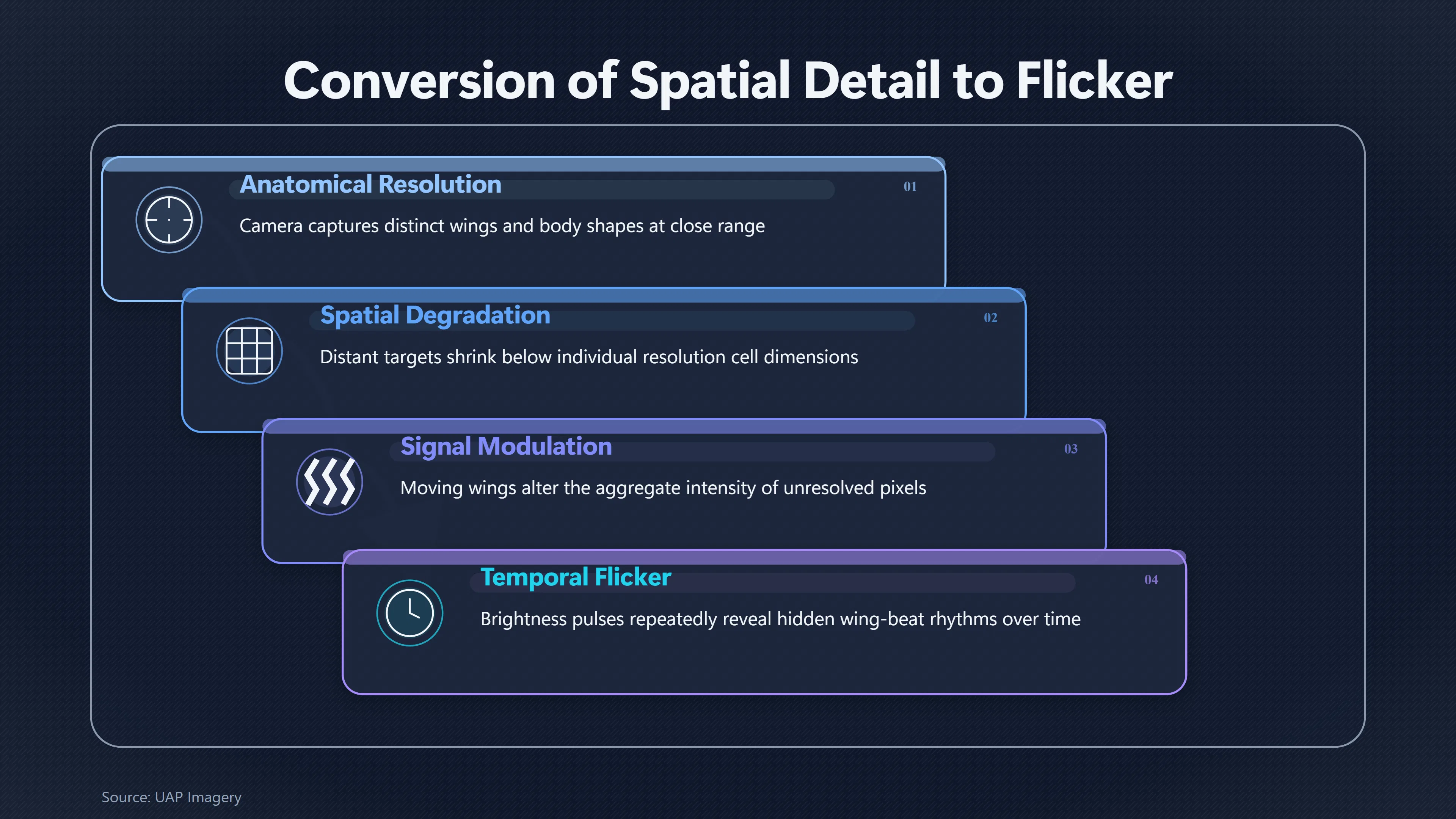
In other words, spatial detail has been converted into a time-varying signal. A comparable principle is well established in radar ornithology. Radar echoes from birds fluctuate with the wing-beat cycle even when the instrument is not forming an ordinary photographic image of the wings. Reviews of migration radar describe echo fluctuations correlated with wing beats, while experimental micro-Doppler studies record periodic “flashes” associated with avian wing motion.[Nature]nature.comThe Use of Radar in the Study of Animal Migration | Learn Science at ScitableThe Use of Radar in the Study of Animal Migration | Learn Science at Scitable…
Radar and infrared imaging measure different physical quantities, so the two signatures should not be treated as identical. Radar micro-Doppler measures velocity-related changes in reflected radio waves; an infrared video’s brightness pulsation is an image-intensity phenomenon. The useful analogy is narrower: periodic motion can remain measurable after the moving anatomical structure itself has become difficult or impossible to resolve.
This is precisely what makes flicker interesting in an infrared UAP clip. Examining a sharp still frame may reveal nothing more than a featureless blob. Examining the blob’s intensity through time can reveal structure that the still image hides.
What wing-beat frequency can reveal
The most useful question is not simply whether a target flickers, but whether the fluctuations have the rate and rhythm expected from biological flight.
Bird wing-beat frequencies occupy biologically constrained ranges and vary with size, morphology and flight style. Measurements across birds show a broad relationship between body mass and wing-beat frequency: larger birds generally beat their wings more slowly. Radar and cine-camera research covering more than 150 western Palaearctic bird species also found characteristic differences between taxonomic groups and flight styles, including birds that alternate flapping with pauses.[The Company of Biologists]journals.biologists.comThe Company of BiologistsScaling of wingbeat frequency with body mass in bats and limits to maximum bat size | Journal of Experimental Bi…
For some familiar seabird-sized targets, the frequencies are comfortably measurable in conventional video. A thermal-video study notes that gulls and other seabirds typically flap at around 5 beats per second or less, while puffins can reach roughly 9 beats per second. At a 30-frame-per-second recording rate, those frequencies fall below the 15-Hz Nyquist limit — the theoretical highest frequency that can be sampled unambiguously at that frame rate.[ScienceDirect]sciencedirect.comTwo-dimensional thermal video analysis of offshore bird and bat flight - ScienceDirect…
Controlled radar measurements give a sense of the same timescale. Experiments with several bird species measured wing-beat frequencies around 4–6 Hz and found periodic signatures associated with those beats. A northern hawk owl produced a signal of approximately 6 Hz in one flight, while another measurement was about 4 Hz; strong wing-beat signatures were also obtained from a tawny eagle.[PubMed Central (PMC)]pmc.ncbi.nlm.nih.govPubMed Central (PMC)Radar micro-Doppler signatures of drones and birds at K-band and W-band - PMC… These are radar measurements rather than infrared brightness measurements, but they establish the biologically plausible cadence that analysts can compare with periodic changes in imagery.
The rhythm can reveal more than a single frequency. Birds do not necessarily flap continuously. Some alternate powered strokes with glides or pauses; flock members need not flap in phase; and changes in speed or manoeuvring can alter the cadence. Radar studies have long used combinations of flapping and pause intervals to distinguish broad flight styles, while newer work has detected wing-beat modulation from entire bird formations.[Nature]nature.comThe Use of Radar in the Study of Animal Migration | Learn Science at ScitableThe Use of Radar in the Study of Animal Migration | Learn Science at Scitable…
For infrared analysis, that means a useful signature might consist of a few rapid pulses followed by a quieter interval rather than a perfectly regular metronome. Conversely, expecting every bird-like target to blink continuously at one fixed rate would oversimplify real avian flight.
The AARO case where the pulsation mattered
AARO’s PR-016 case provides an unusually direct connection between this mechanism and military UAP imagery. The 25-second recording came from an infrared sensor aboard a US military platform in Europe in 2023. AARO assessed the objects as almost certainly birds, assigning a probability above 95 per cent.[AARO]aaro.milUAP ImageryAARO UAP Imagery…
Crucially, the assessment did not depend simply on somebody deciding that small infrared dots “looked like birds”. AARO identified several mutually supporting features. The objects were morphologically consistent with other bird imagery, maintained relative positions in a way compatible with energy-conserving group flight, and displayed a pulsating infrared return at a frequency consistent with wing beats.[AARO]aaro.milUAP ImageryAARO UAP Imagery…
That combination shows why temporal evidence can be more informative than an isolated screenshot. A still taken from the sequence may contain little obvious avian anatomy. The full-motion video adds another dimension: the target’s brightness behaviour through time. If that behaviour repeatedly changes on an avian wing-beat timescale while the objects simultaneously behave like a flock, the bird hypothesis becomes substantially stronger.
AARO has also resolved other military infrared recordings as migratory birds using different combinations of evidence. Its PR-002 Africa 2024 assessment relied on morphological consistency and flight behaviour corresponding to known migration routes, with an external US Intelligence Community partner concurring.[AARO]aaro.milUAP ImageryAARO UAP Imagery… The contrast is useful: wing flicker is one possible discriminator, not a mandatory feature that must be visible in every bird recording.

Why the wings can vanish before the rhythm does
The survival of a rhythmic signal is easiest to understand by separating two kinds of information.
Spatial information answers: What shape does the target have right now? Resolving a narrow wing requires enough image detail to distinguish it from the body and surrounding background.
Temporal information asks: Does the measured target change repeatedly over time? That can require much less spatial resolution because an analyst can measure variations in the same unresolved pixel cluster across many frames.
Thermal-wildlife studies have explicitly recognised this trade-off. Researchers studying offshore fauna concluded that taxonomic classification based on shape requires relatively close observations, but that flight pattern and wing-beat frequency provide additional information for identifying groups. A related study achieved an average classification accuracy of 82 per cent among bats, swallows, gulls and terns using flight-track characteristics alone and concluded that adding distance and wing-beat frequency should improve classification.[ScienceDirect]sciencedirect.comTwo-dimensional thermal video analysis of offshore bird and bat flight - ScienceDirect…
There is an intuitive parallel in ordinary astronomy: a distant source can be too small to resolve spatially yet still vary measurably in brightness. The sensor cannot tell where within the unresolved source the variation originates, but it can measure that variation happened. With a distant flying bird, flapping supplies a natural repeating mechanism capable of modulating the small infrared target.
The practical consequence for UAP analysis is important. “I cannot see wings” and “there is no evidence of wing motion” are not equivalent statements. Once the target is unresolved, the evidence may have moved from the shape domain into the time domain.
Frame rate can preserve, distort or hide the flicker
A wing-beat signal is not automatically reproduced faithfully by a video system. Sampling matters.
A camera recording at 30 frames per second takes 30 discrete measurements each second. A bird flapping five times per second gives the system roughly six frames per wing-beat cycle, potentially enough to expose a repeating pattern. The thermal-wildlife literature therefore notes that common seabird frequencies of roughly 5 Hz or below, and even puffin frequencies approaching 9 Hz, are in principle measurable at 30 fps.[ScienceDirect]sciencedirect.comTwo-dimensional thermal video analysis of offshore bird and bat flight - ScienceDirect…
But that is only the theoretical sampling limit. Whether the pulsation is actually recoverable also depends on target distance, wingspan, camera resolution and viewing angle. The same thermal-video study specifically identifies these factors as constraints on recovering wing-beat information.[ScienceDirect]sciencedirect.comTwo-dimensional thermal video analysis of offshore bird and bat flight - ScienceDirect…
Low signal-to-noise ratio can further bury the modulation. Compression, stabilisation, contrast adjustment and other processing may change how subtle frame-to-frame variations appear in the final distributed clip. A short sequence can also be misleading if it catches only a glide or pause between bursts of flapping.
Sampling creates another problem: aliasing. When periodic motion approaches the temporal limits of a recording system, the apparent motion can differ from the true motion. At particularly unfortunate relationships between wing-beat rate and frame rate, successive frames may repeatedly sample similar phases of the stroke. The wing motion can then appear slower, irregular or nearly stationary. This is why a video’s apparent lack of obvious flapping cannot automatically be converted into a biological claim that no flapping occurred.
The most defensible analysis therefore works from the original, highest-quality full-motion imagery where possible and treats the measured frequency as one observation with uncertainty, rather than reading too much into a compressed online copy.
Why flicker supports but does not prove a bird identification
A periodic infrared pulse is evidence, not a species label.
Other mechanisms can produce repeating intensity changes. A rotating or oscillating object can periodically change its projected area or infrared reflectance. Sensor processing may introduce or exaggerate temporal variations. A distant target crossing uneven background contrast can fluctuate for reasons unrelated to its own motion. Atmospheric effects and compression can add still more apparent variability.
Even among biological targets, wing-beat frequency is not uniquely identifying. Thermal-video researchers have therefore proposed using it alongside other properties rather than as a standalone classifier. Radar research reaches much the same conclusion from a different sensing modality: wing motion supplies valuable classification features, but analysts normally combine those features with target velocity, flight behaviour, signal structure and other characteristics.[ScienceDirect]sciencedirect.comScienceDirect Classification of birds and bats using flight tracksClassification of birds and bats using flight tracks - ScienceDirect…
There is also substantial natural variation. Wing-beat rate depends on body size and morphology, but an individual bird can change its flight mode. Different species occupy overlapping frequency ranges, and birds may glide, soar or use intermittent flapping. The broader lesson from infrared biological sensing is that a measured wing-beat frequency is most powerful as one element of a multi-feature identification rather than a fingerprint by itself. Even infrared wing-beat systems developed for insects encounter extensive frequency overlap between species and require additional parameters for reliable identification.[Nature]nature.comOpen source on nature.com.
A convincing bird interpretation of an unresolved military infrared target therefore becomes progressively stronger when several observations agree: the target’s brightness varies at a plausible wing-beat rate; the modulation persists or recurs over multiple cycles; the movement resembles powered or intermittent avian flight; multiple targets behave like a flock; their speed and route are plausible for birds; and no independent evidence requires a less ordinary explanation.
PR-016 is instructive precisely because AARO reported such a convergence rather than relying on the flicker alone.[AARO]aaro.milUAP ImageryAARO UAP Imagery…
What an infrared “orb” may still be telling us
When a distant bird becomes a nearly featureless infrared point, information has not necessarily disappeared all at once. Anatomical information can fail first: no recognisable wing, tail or beak remains. Coarser temporal information can survive longer because each wing stroke still changes the aggregate signal reaching the detector.
That makes wing-beat flicker a particularly useful clue in the wider problem of birds appearing as orbs on military sensors. The diagnostically important feature may not be visible around the dot but encoded through time inside it.
The strongest interpretation is therefore neither “a featureless infrared orb cannot be a bird because it has no visible wings” nor “anything that flickers must be a bird”. The evidence-based middle position is more useful: an unresolved target whose infrared return oscillates at a biologically plausible cadence has retained a potential signature of flapping flight, and that signature becomes persuasive when independent features — flight path, grouping, morphology, speed and environmental context — point in the same direction. AARO’s PR-016 assessment demonstrates that this kind of temporal clue is already being used in the analysis of real military UAP footage.[DVIDS]dvidshub.netVideo - PR-016, Resolved as Birds, Europe 2023…
Amazon book picks
Further Reading
Books and field guides related to When Invisible Wings Still Leave a Signal. Use these as the next step if you want deeper reading beyond the article.
Infrared Thermal Imaging: Fundamentals, Research and Applicat...
This richly illustrated hands-on guide is designed for researchers, teachers and practitioners. The huge selection of examples taken from...
Hawks at a Distance: Identification of Migrant Raptors
The ultimate field manual for identifying distant raptors The ultimate must-have guide for identifying migrant raptors, Hawks at a Distan...
Passive Infrared Detection: Theory and Applications
Familiarization with the infrared world Thermal imaging systems extend human perception beyond the visible spectrum. Since their principl...
eBay marketplace picks
Marketplace Samples
Live-tested eBay searches with available results related to this page.
Selected fromUFO poster oneBay.co.uk.

Current eBay listing
I Want To Believe UFO Poster Giclée Fine Art Heavyweight Print


Current eBay listing
VINTAGE UFO FLYING SAUCERS COMIC ADVERTISING A2 POSTER PRINT

Endnotes
1.
Source: aaro.mil
Title: UAP Imagery
Link:https://www.aaro.mil/UAP-Cases/Official-UAP-Imagery/ftag/MSF0951a18/
Source snippet
AARO UAP Imagery...
2.
Source: sciencedirect.com
Title: ScienceDirect Classification of birds and bats using flight tracks
Link:https://www.sciencedirect.com/science/article/pii/S1574954115000692
Source snippet
Classification of birds and bats using flight tracks - ScienceDirect...
3.
Source: sciencedirect.com
Link:https://www.sciencedirect.com/science/article/pii/S1574954115001478
Source snippet
Two-dimensional thermal video analysis of offshore bird and bat flight - ScienceDirect...
4.
Source: nature.com
Title: The Use of Radar in the Study of Animal Migration | Learn Science at Scitable
Link:https://www.nature.com/scitable/knowledge/library/the-use-of-radar-in-the-study-84825627/
Source snippet
The Use of Radar in the Study of Animal Migration | Learn Science at Scitable...
5.
Source: journals.biologists.com
Link:https://journals.biologists.com/jeb/article/215/5/711/11225/Scaling-of-wingbeat-frequency-with-body-mass-in
Source snippet
The Company of BiologistsScaling of wingbeat frequency with body mass in bats and limits to maximum bat size | Journal of Experimental Bi...
6.
Source: nature.com
Link:https://www.nature.com/articles/s41598-018-35880-9
7.
Source: aaro.mil
Link:https://www.aaro.mil/Next-AARO-Home-redesign/Next-Parent/Next-AARO-UAP-Imagery-Acc-Table/
8.
Source: aaro.mil
Title: UAP Imagery
Link:https://www.aaro.mil/Next-AARO-Home-redesign/Inactive-Parent/Next-UAP-Imagery-dup/
9.
Source: nature.com
Link:https://www.nature.com/articles/s41598-021-89644-z
10.
Source: aaro.mil
Link:https://www.aaro.mil/Next-AARO-Home-redesign/Next-Parent/Presidential-UAP-Transparency-Initiative/videoid/988673/dvpcc/false/
11.
Source: sciencedirect.com
Link:https://www.sciencedirect.com/science/article/pii/S0894177719313974
12.
Source: sciencedirect.com
Link:https://www.sciencedirect.com/science/article/abs/pii/S0894177719313974
13.
Source: nature.com
Link:https://www.nature.com/articles/s41598-017-01616-4
14.
Source: journals.biologists.com
Link:https://journals.biologists.com/jeb/article/212/22/3633/19050/Adjustments-of-wingbeat-frequency-and-air-speed-to
15.
Source: journals.biologists.com
Title: Biomechanics of bird flight
Link:https://journals.biologists.com/jeb/article/210/18/3135/17027/Biomechanics-of-bird-flight
16.
Source: journals.biologists.com
Title: Energetic influence on gull flight strategy
Link:https://journals.biologists.com/jeb/article/209/18/3489/16100/Energetic-influence-on-gull-flight-strategy
17.
Source: journals.biologists.com
Title: Scaling bat wingbeat frequency and amplitude
Link:https://journals.biologists.com/jeb/article/205/17/2615/9081/Scaling-bat-wingbeat-frequency-and-amplitude
18.
Source: journals.biologists.com
Title: Wingbeat frequency of barn swallows and house
Link:https://journals.biologists.com/jeb/article/205/16/2461/9131/Wingbeat-frequency-of-barn-swallows-and-house
19.
Source: journals.biologists.com
Title: Wingbeat Frequency of Birds in Steady Cruising
Link:https://journals.biologists.com/jeb/article/199/7/1613/7344/Wingbeat-Frequency-of-Birds-in-Steady-Cruising
20.
Source: journals.biologists.com
Link:https://journals.biologists.com/jeb/article/150/1/171/5695/Predicting-Wingbeat-Frequency-and-Wavelength-of
21.
Source: sciencedirect.com
Title: Wing-beat frequencies, wing-areas and masses of flying insects and hummingbirds
Link:https://www.sciencedirect.com/science/article/pii/0022519383903946
22.
Source: sciencedirect.com
Title: Mosquito vector monitoring system based on optical wingbeat classification
Link:https://www.sciencedirect.com/science/article/pii/S0168169915002471
23.
Source: sciencedirect.com
Title: Infrared Signature
Link:https://www.sciencedirect.com/topics/earth-and-planetary-sciences/infrared-signature
24.
Source: sciencedirect.com
Title: Classification of bird species from video using appearance and motion features
Link:https://www.sciencedirect.com/science/article/abs/pii/S1574954118300566
25.
Source: sciencedirect.com
Link:https://www.sciencedirect.com/science/article/pii/S1290072916306901
26.
Source: sciencedirect.com
Title: Slender Delta Wing
Link:https://www.sciencedirect.com/topics/engineering/slender-delta-wing
27.
Source: aaro.mil
Link:https://www.aaro.mil/UAP-Cases/Official-UAP-Imagery/4/
28.
Source: aaro.mil
Link:https://www.aaro.mil/Next-AARO-Home-redesign/Next-Parent/Next-AARO-UAP-Imagery-Fixed-Table/
29.
Source: aaro.mil
Link:https://www.aaro.mil/FAQ/
30.
Source: dvidshub.net
Link:https://www.dvidshub.net/video/988673/pr-016-resolved-birds-europe-2023
Source snippet
Video - PR-016, Resolved as Birds, Europe 2023...
31.
Source: pmc.ncbi.nlm.nih.gov
Link:https://pmc.ncbi.nlm.nih.gov/articles/PMC6255807/
Source snippet
PubMed Central (PMC)Radar micro-Doppler signatures of [drones]({{ 'drones/' | relative_url }}) and birds at K-band and W-band - PMC...
32.
Source: pmc.ncbi.nlm.nih.gov
Link:https://pmc.ncbi.nlm.nih.gov/articles/PMC12899695/
33.
Source: dvidshub.net
Title: DVID S
Link:https://www.dvidshub.net/video/955936/2013-[puerto-rico
34.
Source: dvidshub.net
Title: DVID S
Link:https://www.dvidshub.net/video/973048/pr-002-resolved-migratory-birds-africa-2024
35.
Source: pmc.ncbi.nlm.nih.gov
Link:https://pmc.ncbi.nlm.nih.gov/articles/PMC8150018/
36.
Source: pmc.ncbi.nlm.nih.gov
Link:https://pmc.ncbi.nlm.nih.gov/articles/PMC8113239/
37.
Source: pmc.ncbi.nlm.nih.gov
Link:https://pmc.ncbi.nlm.nih.gov/articles/PMC6548498/
38.
Source: pmc.ncbi.nlm.nih.gov
Link:https://pmc.ncbi.nlm.nih.gov/articles/PMC6525094/
39.
Source: pmc.ncbi.nlm.nih.gov
Link:https://pmc.ncbi.nlm.nih.gov/articles/PMC5750011/
40.
Source: pmc.ncbi.nlm.nih.gov
Link:https://pmc.ncbi.nlm.nih.gov/articles/PMC5496556/
41.
Source: pmc.ncbi.nlm.nih.gov
Link:https://pmc.ncbi.nlm.nih.gov/articles/PMC5431090/
42.
Source: pmc.ncbi.nlm.nih.gov
Link:https://pmc.ncbi.nlm.nih.gov/articles/PMC5522517/
43.
Source: pmc.ncbi.nlm.nih.gov
Link:https://pmc.ncbi.nlm.nih.gov/articles/PMC5042028/
44.
Source: pmc.ncbi.nlm.nih.gov
Link:https://pmc.ncbi.nlm.nih.gov/articles/PMC4614784/
45.
Source: pmc.ncbi.nlm.nih.gov
Link:https://pmc.ncbi.nlm.nih.gov/articles/PMC3826235/
46.
Source: pubmed.ncbi.nlm.nih.gov
Link:https://pubmed.ncbi.nlm.nih.gov/22323193/
47.
Source: pmc.ncbi.nlm.nih.gov
Link:https://pmc.ncbi.nlm.nih.gov/articles/PMC2978710/
48.
Source: pmc.ncbi.nlm.nih.gov
Link:https://pmc.ncbi.nlm.nih.gov/articles/PMC3024816/
49.
Source: pubmed.ncbi.nlm.nih.gov
Link:https://pubmed.ncbi.nlm.nih.gov/18505711/
50.
Source: pmc.ncbi.nlm.nih.gov
Link:https://pmc.ncbi.nlm.nih.gov/articles/PMC2607429/
51.
Source: pubmed.ncbi.nlm.nih.gov
Link:https://pubmed.ncbi.nlm.nih.gov/17171355/
52.
Source: pubmed.ncbi.nlm.nih.gov
Link:https://pubmed.ncbi.nlm.nih.gov/9319516/
53.
Source: uapufo.org
Link:https://uapufo.org/entities/aaro
54.
Source: t.co
Link:https://t.co/4M3L5Trglk
Additional References
55.
Source: pnnl.gov
Title: Two-dimensional thermal video analysis of offshore bird and bat flight
Link:https://www.pnnl.gov/sites/default/files/media/file/Two-dimensional%20thermal%20video%20analysis%20of%20offshore%20bird%20and%20bat%20flight.pdf
Source snippet
Two-dimensional thermal video analysis of offshore bird and bat flight...
56.
Source: youtube.com
Link:https://www.youtube.com/watch?v=OaW9eUkhcP0
Source snippet
Breakdown of the Pentagon UFO videos with Mick West...
57.
Source: arxiv.org
Link:https://arxiv.org/abs/2309.15415
58.
Source: youtube.com
Link:https://www.youtube.com/watch?v=pFF3Wo1LyTo
Source snippet
BrainChip Demonstration of the Company's Always-On Radar-Based Edge Classification...
59.
Source: youtube.com
Title: UAP FILES
Link:https://www.youtube.com/watch?v=JckDOdfreSc
Source snippet
Visual Evidence from 3 Cases over Africa (2022-2024)...
60.
Source: youtube.com
Title: UAP FILES
Link:https://www.youtube.com/watch?v=rhP8VdCIz9A
Source snippet
Micro Doppler based target classification, SIH 2024...
61.
Source: tethys.pnnl.gov
Title: adjustments wingbeat frequency air speed air density free flying migratory birds
Link:https://tethys.pnnl.gov/publications/adjustments-wingbeat-frequency-air-speed-air-density-free-flying-migratory-birds
62.
Source: tethys.pnnl.gov
Title: wingbeat frequency birds steady cruising flight new data improved predictions
Link:https://tethys.pnnl.gov/publications/wingbeat-frequency-birds-steady-cruising-flight-new-data-improved-predictions
63.
Source: researchgate.net
Link:https://www.researchgate.net/publication/47812944_Flight_Modes_in_Migrating_European_Bee-Eaters_Heart_Rate_May_Indicate_Low_Metabolic_Rate_during_Soaring_and_Gliding
64.
Source: researchgate.net
Link:https://www.researchgate.net/publication/357233636_Influencing_Activity_of_Bats_by_Dimly_Lighting_Wind_Turbine_Surfaces_with_Ultraviolet_Light?_tp=eyJjb250ZXh0Ijp7InBhZ2UiOiJzY2llbnRpZmljQ29udHJpYnV0aW9ucyIsInByZXZpb3VzUGFnZSI6bnVsbCwic3ViUGFnZSI6bnVsbH19