Within UFO Identifications
Why Approaching Aircraft Can Seem to Hover
An aircraft flying almost directly toward an observer can remain visually fixed while bright landing lights hide its body.
On this page
- The geometry of head on approaches
- How landing lights erase aircraft shape
- Flight data checks that resolve ambiguous sightings
Page outline Jump by section
Introduction
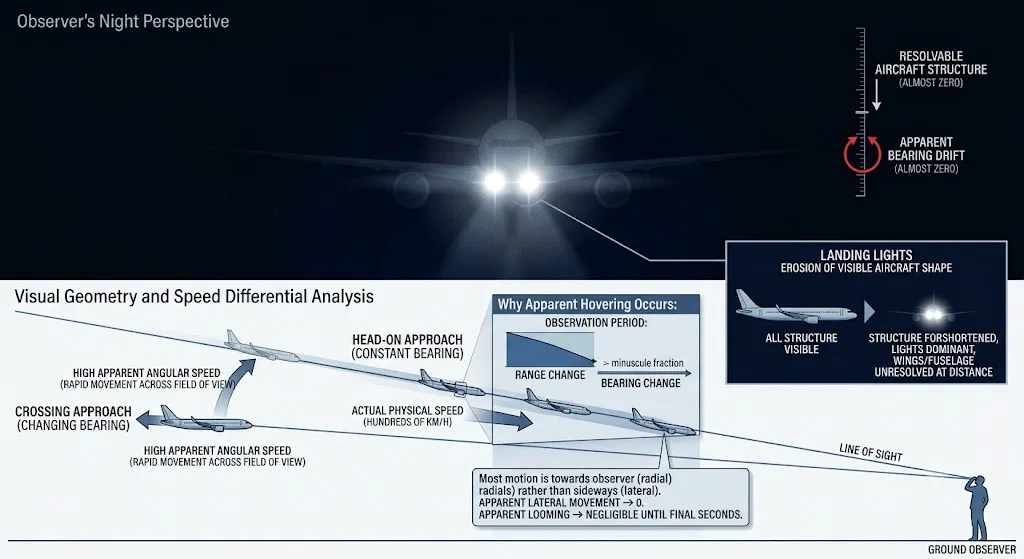
An aircraft can appear to hover even while travelling towards an observer at hundreds of kilometres per hour. The key is viewing geometry. When an aeroplane is flying almost directly along the observer’s line of sight, most of its motion is towards the observer rather than sideways across the sky. Its bearing therefore changes very little. At night, powerful forward-facing landing lights may be conspicuous long before the aircraft’s wings and fuselage are distinguishable, leaving what looks like a stationary point or cluster of bright lights.
This is not merely a theoretical explanation for UFO or UAP reports. Aviation safety literature treats an aircraft that remains at nearly constant bearing as a particularly important visual problem, because a collision-course aircraft can appear almost stationary in the visual field. Modern UAP investigations can test the same geometry against radar and flight-tracking data, sometimes converting an apparently anomalous light into an ordinary aircraft seen from an unusually deceptive angle.[skybrary.aero]skybrary.aerocollision course will usually appear to be a stationary object…Read more…
The geometry of a head-on approach
People are very good at noticing objects moving sideways across their field of view. A distant aircraft crossing from left to right therefore advertises its movement clearly. An aircraft coming almost directly towards the observer does something quite different: its distance changes rapidly while its angular position — where it appears against the sky — may barely change.
Aviation collision research provides an unusually clear demonstration of the principle. UK military aviation guidance states that two aircraft travelling on a collision course at constant speeds maintain a constant relative bearing, so each presents a substantially static image to the other. A UK service inquiry likewise warned pilots that an aircraft on a collision course can remain stationary in the field of view and consequently be harder to detect.[GOV.UK]assets.publishing.service.gov.uk6: Aviation MedicineTwo aircraft on a collision course, each flying at an independent constant speed, will maintain a constant bearing re…
For a person standing on the ground, an arriving aircraft does not have to be aimed precisely at the observer for a similar effect to occur. It need only have a small sideways component of motion relative to its distance. Imagine an airliner many kilometres away descending towards a runway whose extended approach path passes somewhere near the observer. During a short observation, its range may decrease substantially while its bearing moves by only a small fraction of the sky. Without nearby visual references, that small angular drift can be difficult to notice.
This produces an important distinction between physical speed and apparent angular speed. A fast aircraft can have very low apparent angular movement when approaching nearly head-on. Conversely, a slower object passing nearby can sweep quickly across the observer’s view. Apparent movement alone therefore gives a poor estimate of an unknown object’s actual speed unless its range and trajectory are also known. The same relationship is important enough in aviation that researchers studying collision avoidance deliberately use “stationary” approaching-aircraft imagery: a 2021 vision dataset, for example, contains more than 55,000 images of a fixed-wing aircraft approaching a stationary camera on collision-course geometry.[arXiv]arxiv.orgA Dataset of Stationary, Fixed-wing Aircraft on a Collision Course for Vision-Based Sense and AvoidDecember 6, 2021…
The effect does not remain perfect indefinitely. As the aircraft gets much closer, its angular size increases — a visual cue known as looming — and small departures from the observer’s line of sight become increasingly obvious. Human and machine-vision research identifies angular expansion as an important cue to an approaching object. Yet that expansion can be surprisingly subtle at first. In an Australian Transport Safety Bureau analysis of an aircraft collision, there was little change in the target aircraft’s apparent angular size until roughly the final 10–12 seconds before impact.[JOV]jov.arvojournals.orgVisual processing of the impending collision of a looming objectby JJ Yan · 2011 · Cited by 63 — Cues such as tau, angular size, rate…
For a UFO witness there is normally no collision, of course. The practical point is perceptual: “It stayed in exactly the same place for several minutes” does not establish that the object was physically hovering. What the witness directly knows is that its bearing changed little enough to look stationary.
How landing lights can erase the aircraft shape
The illusion becomes particularly convincing around dusk or at night, because an approaching aeroplane may first be perceived not as an aeroplane but simply as light.
Aircraft carry several kinds of external lighting. Position lights help indicate orientation, anti-collision lights improve conspicuity, and landing lights illuminate the area ahead while also making an aircraft easier for others to see. FAA pilot guidance specifically notes that landing lights provide a means for aeroplanes to be seen at night, while current FAA operational guidance describes anti-collision systems using bright red or white beacons or strobes.[ATSB]atsb.gov.auFAA H 8083 3B Chapter 10FAA H 8083 3B Chapter 10
From a favourable head-on angle, the forward-facing lights can therefore become the dominant visible feature. The observer may be able to see the lights at a range where the much dimmer fuselage and wings are still difficult to separate from the dark sky. Reduced depth cues at night compound the problem: Transport Canada notes that darkness reduces depth perception and makes distance judgements involving lights difficult.[Transport Canada]tc.canada.caTransport Canada Hazards Associated with Flying at NightTransport Canada Hazards Associated with Flying at Night
What the witness may consequently see is not the familiar side profile of an airliner but something much less informative:
- one intense white light, if separate lamps merge at the available angular resolution;
- two or more closely spaced lights with no obvious structure connecting them;
- a bright central glow accompanied intermittently by strobes;
- a light that appears fixed for some time and then suddenly develops obvious sideways movement;
- an apparently hovering object that eventually resolves into an aircraft as it turns, passes the observer or gets close enough for its outline and navigation lights to become recognisable.
The last transition can seem especially strange. The aircraft has not suddenly begun moving. Rather, its geometry has changed. A turn onto or away from the original line of sight converts radial motion into visible lateral motion. Features that were foreshortened during the head-on view also become easier to recognise.
This is one reason a description such as “bright light, no visible wings, apparently stationary” is not by itself strong evidence against an aircraft explanation. AARO, the US All-domain Anomaly Resolution Office, explicitly lists conventional commercial and military aircraft viewed from unusual angles or in difficult visibility among recurring causes of UAP reports.[AARO]aaro.milOpen source on aaro.mil.
It is also worth separating this effect from a different night-time illusion sometimes discussed in aviation: autokinesis, in which an actually stationary point of light can appear to move when viewed against a featureless dark background. The approaching-aircraft mechanism discussed here does not require false perceived motion. The aircraft really is moving rapidly; the deceptive feature is that most of that movement occurs along the observer’s line of sight rather than across it.
Why the illusion can last longer than expected
Observers sometimes reject an aircraft explanation because the object appeared motionless for what felt like too long. Duration alone is not decisive.
Commercial aircraft routinely spend extended periods aligned with arrival routes before landing. An observer positioned near the extension of such a route can therefore occupy approximately the same bearing from the aircraft for a substantial part of its approach. Small heading corrections may cause only slight drift when the aircraft is distant.
Distance also matters because humans do not directly perceive the range of an isolated light in the sky. If an observer assumes the light is nearby, its lack of apparent movement can suggest a genuinely hovering object. If it is actually a large aircraft much farther away, the same angular behaviour has an ordinary geometric explanation. Night conditions make this scale ambiguity worse because familiar size, surface detail, shadows and intervening landscape features may all be absent.[Transport Canada]tc.canada.caTransport Canada Hazards Associated with Flying at NightTransport Canada Hazards Associated with Flying at Night
The apparent brightness can be misleading for the same reason. A bright light is easily interpreted as something powerful and nearby, but without knowing the lamp intensity or atmospheric conditions, brightness does not provide a reliable standalone range measurement.
A useful warning comes from aviation safety itself: the constant-bearing geometry is dangerous precisely because an approaching aircraft need not look dramatically approaching. Safety studies have repeatedly examined the difficulty pilots have visually acquiring traffic on or near a collision course. NASA-related research cited median visual-acquisition distances of roughly one nautical mile for unalerted pilots in one body of testing, illustrating how difficult aircraft can be to recognise even when the consequences of missing them are serious.[NASA Technical Reports Server]ntrs.nasa.govOpen source on nasa.gov.

Flight-data checks can resolve the ambiguity
The strongest test of an “apparently hovering aircraft” explanation is not resemblance. It is reconstruction.
A useful investigation starts with four basic pieces of information: the observer’s location, the observation time, the direction of sight and the approximate elevation above the horizon. Once those are reasonably constrained, investigators can compare the reported direction with aircraft trajectories around the same time.
This has become much more practical because many aircraft broadcast Automatic Dependent Surveillance–Broadcast (ADS-B) information. According to the FAA, ADS-B Out typically transmits an aircraft’s GPS-derived location, altitude, ground speed and other information once per second. Such records allow an investigator to reconstruct whether a candidate aircraft was descending towards the observer’s bearing, crossing the line of sight or travelling somewhere incompatible with the sighting.[Federal Aviation Administration]faa.govins outsins outs
Public flight-tracking systems can also combine several surveillance sources. Flightradar24, for example, describes using ADS-B as its principal GPS-based technology while supplementing it with multilateration and other tracking methods; the OpenSky Network maintains live and historical aircraft-position datasets used in aviation research.[Flightradar24]flightradar24.comOpen source on flightradar24.com.
A particularly relevant UAP example comes from AARO’s investigation of the Western United States case. Witnessed objects appeared as small lights moving at a relatively constant pace. Analysis of the full-motion imagery together with commercial flight information found that the objects corresponded to three commercial aircraft at great distances from the sensor; radar tracks aligned with their observed positions. The detailed case report placed the aircraft as far as approximately 300 nautical miles away.[AARO]aaro.milUAP ImageryAARO to assess that the objects were three separate commercial aircraft flying at a great distance from the infrared sensor…
That case is not identical to a ground witness watching a head-on landing light, but it demonstrates the decisive evidential principle: objects that look structureless or anomalous in imagery can be tested against independently recorded aircraft trajectories rather than identified only by visual impression.
What a useful reconstruction should test
A good aircraft hypothesis should explain several observations at once.
Bearing: Did the candidate aircraft occupy approximately the reported direction? A flight that was tens of degrees away is not rescued merely because it was airborne at the right time.
Elevation: Given its altitude and distance, would it have appeared at roughly the reported height above the horizon?
Angular movement: Did its reconstructed track produce little sideways motion during the period in which the witness described it as hovering?
Timing: Does the aircraft subsequently turn or pass in a way that matches the moment when the object reportedly began to move, dim, separate into several lights or reveal an aircraft shape?
Lighting and orientation: Was the observer looking approximately towards the aircraft’s nose, where forward-facing landing or recognition lights could dominate the view?
The most persuasive identification is therefore geometric rather than cosmetic. “It looked like an aircraft light” is weaker than demonstrating that a real aircraft was occupying the correct line of sight and that its recorded movement reproduces the apparent hovering.
Why flight trackers are strong evidence but not perfect records
A failure to find an aircraft on a consumer tracking website does not automatically rule aircraft out. Coverage depends on the surveillance technology, receiver network and whether the aircraft is broadcasting data that the service can use. FAA ADS-B requirements apply to specified airspace and operations rather than every aircraft everywhere, and public tracking networks combine data from different sources with differing coverage.[Federal Aviation Administration]faa.govOpen source on faa.gov.
Tracking data can also contain errors. ADS-B depends on an aircraft’s navigation source, while GPS interference can corrupt displayed positions under some circumstances. Flightradar24 has documented cases in which GPS spoofing produced erroneous aircraft locations and explains that multilateration can provide an independent position source only where sufficient receivers are available.[Flightradar24]flightradar24.comHow Flightradar24 uses MLAT to counter GPS jammingHow Flightradar24 uses MLAT to counter GPS jamming
Accordingly, a robust investigation should prefer multiple mutually consistent clues: flight data, radar where available, airport arrival routes, photographs or video with known orientation, accurate timestamps and the witness’s original account. Absence from one public tracker is much weaker evidence than a positive track whose time, bearing, altitude and movement all fit the observation.
When the aircraft explanation is compelling — and when it is not
The approaching-aircraft mechanism is strongest when several distinctive features occur together: a bright light at night or twilight, little apparent lateral movement, a viewing direction near an airport or established traffic flow, gradual brightening or growing apparent size, and eventual development into recognisable aircraft movement or lighting. Aviation research establishes the underlying constant-bearing geometry independently of UFO investigations, while modern surveillance records provide a way to test individual cases.[GOV.UK]assets.publishing.service.gov.uk6: Aviation MedicineTwo aircraft on a collision course, each flying at an independent constant speed, will maintain a constant bearing re…
It should not, however, be used as a universal explanation for every stationary light. A candidate aircraft must actually fit the observation. A well-documented object remaining at a fixed position while reliable range measurements show no approach, for example, would require another explanation. The same is true when precise flight or radar records exclude aircraft from the relevant volume of sky.
The practical lesson for UFO/UAP assessment is narrower and more useful: visual hovering does not necessarily mean physical hovering. When an aircraft approaches almost along the observer’s line of sight, high real speed can coexist with extremely low apparent angular speed. At night, forward-facing lights can remain conspicuous while aircraft structure is unresolved. The resulting sight — an intense, seemingly stationary light that eventually “starts moving” and becomes an aeroplane — follows directly from ordinary flight geometry and the limitations of visual range and motion perception.
Amazon book picks
Further Reading
Books and field guides related to Why Approaching Aircraft Can Seem to Hover. Use these as the next step if you want deeper reading beyond the article.
The Pilot's Handbook of Aeronautical Knowledge
Pilot's Handbook of Aeronautical Knowledge, an official Federal Aviation Administration (FAA) Handbook; provides basic knowledge that is...
Human Factors in Aviation
Fully updated and expanded, the second edition of Human Factors in Aviation serves the needs of the widespread aviation community - stude...
Principles of Flight for Pilots
Organised and written as an accessible study guide for student pilots wishing to take commercial ground examinations to obtain ATPL or CP...
Visual Perception
First Published in 2001. Routledge is an imprint of Taylor & Francis, an informa company.
eBay marketplace picks
Marketplace Samples
Live-tested eBay searches with available results related to this page.
Selected fromaircraft wall art oneBay.co.uk.

Endnotes
1.
Source: skybrary.aero
Link:https://skybrary.aero/sites/default/files/bookshelf/259.pdf
Source snippet
collision course will usually appear to be a stationary object...Read more...
2.
Source: assets.publishing.service.gov.uk
Link:https://assets.publishing.service.gov.uk/media/5e18b047ed915d3b0d1b767b/Volume_06_Aviation_Medicine.pdf
Source snippet
6: Aviation MedicineTwo aircraft on a collision course, each flying at an independent constant speed, will maintain a constant bearing re...
3.
Source: aaro.mil
Link:https://www.aaro.mil/UAP-Cases/Official-UAP-Imagery/
Source snippet
UAP ImageryAARO to assess that the objects were three separate commercial aircraft flying at a great distance from the infrared sensor...
4.
Source: assets.publishing.service.gov.uk
Link:https://assets.publishing.service.gov.uk/media/5a74e587e5274a59fa715d0b/Tornado_ZD743_ZD812_Part_1_4_1.pdf
Source snippet
Inquiry into accident involving XV(R) Sqn Tornado...Look hard below and above the horizon and remember that an ac on a collision course...
5.
Source: arxiv.org
Link:https://arxiv.org/abs/2112.02735
Source snippet
A Dataset of Stationary, Fixed-wing Aircraft on a Collision Course for Vision-Based Sense and AvoidDecember 6, 2021...
Published: December 6, 2021
6.
Source: jov.arvojournals.org
Link:https://jov.arvojournals.org/article.aspx?articleid=2121255
Source snippet
Visual processing of the impending collision of a looming objectby JJ Yan · 2011 · Cited by 63 — Cues such as tau, angular size, rate...
7.
Source: atsb.gov.au
Link:https://www.atsb.gov.au/investigations/2022-001
8.
Source: atsb.gov.au
Title: FAA H 8083 3B Chapter 10
Link:https://www.atsb.gov.au/sites/default/files/2024-05/FAA-H-8083-3B%20Chapter%2010.pdf
9.
Source: faa.gov
Link:https://www.faa.gov/air_traffic/publications/atpubs/aim_html/chap4_section_3.html
10.
Source: tc.canada.ca
Title: Transport Canada Hazards Associated with Flying at Night
Link:https://tc.canada.ca/en/aviation/publications/system-safety-summer-briefing-kit-tp-14112/hazards-associated-flying-night-powerpoint-presentation
11.
Source: aaro.mil
Link:https://www.aaro.mil/FAQ/
12.
Source: ntrs.nasa.gov
Link:https://ntrs.nasa.gov/api/citations/20080017109/downloads/20080017109.pdf
13.
Source: faa.gov
Title: ins outs
Link:https://www.faa.gov/air_traffic/technology/equipadsb/capabilities/ins_outs
14.
Source: faa.gov
Title: Federal Aviation Administration Automatic Dependent Surveillance
Link:https://www.faa.gov/about/office_org/headquarters_offices/avs/offices/afx/afs/afs400/afs410/ads-b
15.
Source: flightradar24.com
Link:https://www.flightradar24.com/how-it-works
16.
Source: opensky-network.org
Link:https://opensky-network.org/data
17.
Source: aaro.mil
Link:https://www.aaro.mil/Portals/136/PDFs/case_resolution_reports/Case_Resolution_of_Western_United_States_Uap_508-02262024.pdf
18.
Source: faa.gov
Link:https://www.faa.gov/air_traffic/technology/equipadsb/resources/faq
19.
Source: flightradar24.com
Title: How Flightradar24 uses MLAT to counter GPS jamming
Link:https://www.flightradar24.com/blog/aviation-explainer-series/how-flightradar24-uses-mlat-to-counter-gps-jamming/
20.
Source: faa.gov
Title: Federal Aviation Administration AC 20-165B
Link:https://www.faa.gov/documentlibrary/media/advisory_circular/ac_20-165b.pdf
21.
Source: flightradar24.com
Title: passenger partially sucked out of ryanair malta air 737
Link:https://www.flightradar24.com/blog/flight-tracking-news/major-incident/passenger-partially-sucked-out-of-ryanair-malta-air-737/
22.
Source: faa.gov
Title: pilot handbook 1
Link:https://www.faa.gov/sites/faa.gov/files/pilot_handbook_1.pdf
23.
Source: faa.gov
Link:https://www.faa.gov/media/13821
24.
Source: faa.gov
Link:https://www.faa.gov/sites/faa.gov/files/regulations_policies/handbooks_manuals/aviation/faa-h-8083-21.pdf
25.
Source: faa.gov
Link:https://www.faa.gov/sites/faa.gov/files/regulations_policies/handbooks_manuals/aviation/FAA-H-8083-11.pdf
26.
Source: faa.gov
Link:https://www.faa.gov/sites/faa.gov/files/Night_Ops_Ch13.pdf
27.
Source: faa.gov
Title: AIM Chg 1 dtd 8 7 25
Link:https://www.faa.gov/air_traffic/publications/media/AIM_Chg_1_dtd_8-7-25.pdf
28.
Source: faa.gov
Link:https://www.faa.gov/air_traffic/publications/atpubs/aip_html/part2_enr_section_1.1.html
29.
Source: faa.gov
Link:https://www.faa.gov/air_traffic/publications/atpubs/aim_html/chap_2.html
30.
Source: faa.gov
Link:https://www.faa.gov/sites/faa.gov/files/aim_basic_dtd_4-20-23.pdf
31.
Source: faa.gov
Title: AIM Chg 3 dtd 7 9 26
Link:https://www.faa.gov/AIR_TRAFFIC/PUBLICATIONS/media/AIM_Chg_3_dtd_7-9-26.pdf
32.
Source: faa.gov
Link:https://www.faa.gov/air_traffic/publications/atpubs/pcg_html/glossary-a.html
33.
Source: faa.gov
Title: 2019 11 07 ACS WG Interim Recommendation Report Powered Lift Handbook
Link:https://www.faa.gov/regulations_policies/rulemaking/committees/documents/media/2019-11-07%20ACS%20WG%20Interim%20Recommendation%20Report%20-%20Powered-Lift%20Handbook.pdf
34.
Source: faa.gov
Title: Letts 2017 Legal Interpretation
Link:https://www.faa.gov/about/office_org/headquarters_offices/agc/practice_areas/regulations/interpretations/Data/interps/2017/Letts_2017_Legal_Interpretation.pdf
35.
Source: faa.gov
Title: Chapter 3. Airport Traffic Control
Link:https://www.faa.gov/air_traffic/publications/atpubs/atc_html/chap3_section_4.html
36.
Source: faa.gov
Title: glossary c
Link:https://www.faa.gov/air_traffic/publications/atpubs/pcg_html/glossary-c.html
37.
Source: faa.gov
Link:https://www.faa.gov/air_traffic/publications/atpubs/aim_html/chap1_section_1.html
38.
Source: faa.gov
Title: aim basic chg 1 1 30 20
Link:https://www.faa.gov/air_traffic/publications/media/aim_basic_chg_1_1-30-20.pdf
39.
Source: faa.gov
Link:https://www.faa.gov/air_traffic/publications/atpubs/aim_html/chap2_section_1.html
40.
Source: faa.gov
Link:https://www.faa.gov/air_traffic/technology/rwsl
41.
Source: faa.gov
Link:https://www.faa.gov/air_traffic/publications/atpubs/aip_html/part1_gen_section_1.7.html
42.
Source: faa.gov
Title: Runway Status Lights Pilot Reference Guide
Link:https://www.faa.gov/air_traffic/technology/rwsl/pet
43.
Source: faa.gov
Link:https://www.faa.gov/air_traffic/publications/atpubs/AIM/aim0504.html
44.
Source: faa.gov
Title: AIM Change 1
Link:https://www.faa.gov/air_traffic/publications/media/AIM_Change_1.pdf
45.
Source: faa.gov
Link:https://www.faa.gov/documentLibrary/media/Advisory_Circular/AC_90-48E.pdf
46.
Source: faa.gov
Title: AIM Chg2 dtd 1 22 26
Link:https://www.faa.gov/air_traffic/publications/media/AIM_Chg2_dtd_1-22-26.pdf
47.
Source: faa.gov
Title: aim basic chgs1 2 9 13 18
Link:https://www.faa.gov/air_traffic/publications/media/aim_basic_chgs1_2_9-13-18.pdf
48.
Source: faa.gov
Link:https://www.faa.gov/air_traffic/publications/atpubs/aim/Index-Basic.html
49.
Source: faa.gov
Title: aim chg 1 1 30 20
Link:https://www.faa.gov/air_traffic/publications/media/aim_chg_1_1-30-20.pdf
50.
Source: faa.gov
Link:https://www.faa.gov/air_traffic/publications/atpubs/aim_html/chap2_section_2.html
51.
Source: faa.gov
Link:https://www.faa.gov/air_traffic/publications/atpubs/aim_html/chap2_section_3.html
52.
Source: faa.gov
Title: glossary v
Link:https://www.faa.gov/air_traffic/publications/atpubs/pcg_html/glossary-v.html
53.
Source: faa.gov
Link:https://www.faa.gov/documentLibrary/media/Advisory_Circular/150_5340_30g.pdf
54.
Source: hf.tc.faa.gov
Link:https://hf.tc.faa.gov/people/nelson-brown/2008-all-strobe-approach-lighting-system/pb2008109781a.pdf
55.
Source: faa.gov
Link:https://www.faa.gov/documentlibrary/media/advisory_circular/ac120-29a.pdf
56.
Source: faa.gov
Title: Human Factors Evaluation of Commercial Aviation, Low Intensity, Iteration 2
Link:https://www.faa.gov/sites/faa.gov/files/Human%20Factors%20Evaluation%20of%20Commercial%20Aviation%2C%20Low%20Intensity%2C%20Iteration%202%20.pdf
57.
Source: faa.gov
Title: AC.70 1B Outdoor.Laser.Operations
Link:https://www.faa.gov/documentlibrary/media/advisory_circular/AC.70-1B_Outdoor.Laser.Operations.pdf
58.
Source: faa.gov
Link:https://www.faa.gov/documentLibrary/media/Advisory_Circular/150_5340_30e_part1.pdf
59.
Source: faa.gov
Link:https://www.faa.gov/documentlibrary/media/advisory_circular/150_5340_30d.pdf
60.
Source: faa.gov
Title: FAA Order 6850.2B
Link:https://www.faa.gov/documentLibrary/media/Order/FAA_Order_6850.2B.pdf
61.
Source: faa.gov
Link:https://www.faa.gov/documentlibrary/media/advisory_circular/150_5340_30f.pdf
62.
Source: faa.gov
Link:https://www.faa.gov/documentlibrary/media/advisory_circular/ac_20-167a.pdf
63.
Source: faa.gov
Title: A C 20-165
Link:https://www.faa.gov/documentLibrary/media/Advisory_Circular/AC%2020-165.pdf
64.
Source: faa.gov
Link:https://www.faa.gov/sites/faa.gov/files/air_traffic/technology/adsb/quicklinks/ADS-B_In_Strategy.pdf
65.
Source: faa.gov
Link:https://www.faa.gov/documentLibrary/media/Advisory_Circular/AC_20-172B.pdf
66.
Source: faa.gov
Link:https://www.faa.gov/air_traffic/technology/equipadsb/capabilities/benefits
67.
Source: faa.gov
Link:https://www.faa.gov/documentLibrary/media/Advisory_Circular/AC_90-114C.pdf
68.
Source: faa.gov
Title: A C 20-172
Link:https://www.faa.gov/documentLibrary/media/Advisory_Circular/AC%2020-172.pdf
69.
Source: skybrary.aero
Title: National Transportation Safety Board Aviation Accident
Link:https://skybrary.aero/sites/default/files/bookshelf/3888.pdf
70.
Source: skybrary.aero
Link:https://skybrary.aero/sites/default/files/bookshelf/36043.pdf
71.
Source: skybrary.aero
Link:https://skybrary.aero/articles/right-way
72.
Source: skybrary.aero
Link:https://skybrary.aero/sites/default/files/bookshelf/3358.pdf
73.
Source: skybrary.aero
Link:https://skybrary.aero/articles/heading-track-and-radial
74.
Source: skybrary.aero
Link:https://skybrary.aero/sites/default/files/bookshelf/3708.pdf
75.
Source: skybrary.aero
Link:https://skybrary.aero/sites/default/files/bookshelf/33312.pdf
76.
Source: skybrary.aero
Link:https://skybrary.aero/sites/default/files/bookshelf/3677.pdf
77.
Source: skybrary.aero
Link:https://skybrary.aero/sites/default/files/bookshelf/3903.pdf
78.
Source: skybrary.aero
Link:https://skybrary.aero/articles/night-visual-approaches
79.
Source: aaro.mil
Link:https://www.aaro.mil/
80.
Source: aaro.mil
Link:https://www.aaro.mil/UAP-Cases/UAP-Case-Resolution-Reports/
81.
Source: aaro.mil
Link:https://www.aaro.mil/UAP-Cases/UAP-Reporting-Trends/
82.
Source: aaro.mil
Link:https://www.aaro.mil/Portals/136/PDFs/AARO_Mission_Brief_2025.pdf
83.
Source: aaro.mil
Title: AARO Trends 1996 2024 508
Link:https://www.aaro.mil/Portals/136/Images/UAP%20Reporting%20Trends/AARO_Trends_1996_2024_508.pdf
84.
Source: aaro.mil
Title: all-domain anomaly
Link:https://www.aaro.mil/Portals/136/PDFs/SASC_AARO_Open_Hearing_Case_Slides_19Nov2024.pdf
85.
Source: aaro.mil
Title: Next UAP Report Documents
Link:https://www.aaro.mil/Next-AARO-Home-redesign/Next-Parent/Next-UAP-Report-Documents/
86.
Source: aaro.mil
Title: UNCLASSIFIED FY23 Consolidated Annual Report on UAP Oct 25 2023 1236
Link:https://www.aaro.mil/Portals/136/PDFs/UNCLASSIFIED-FY23_Consolidated_Annual_Report_on_UAP-Oct_25_2023_1236.pdf
87.
Source: aaro.mil
Title: [Puerto Rico]({{ ‘puerto-rico/’ | relative_url }}) UAP Case Resolution
Link:https://www.aaro.mil/Portals/136/PDFs/case_resolution_reports/AARO_Puerto_Rico_UAP_Case_Resolution.pdf
88.
Source: aaro.mil
Title: AARO FY2025 Consolidated Annual Report on UAP
Link:https://www.aaro.mil/Portals/136/PDFs/FY25%20UAP%20Annual%20Report/AARO_FY2025_Consolidated_Annual_Report_on_UAP.pdf
89.
Source: aaro.mil
Title: AARO Historical Record Report Vol 1 2024
Link:https://www.aaro.mil/Portals/136/PDFs/AARO_Historical_Record_Report_Vol_1_2024.pdf
90.
Source: opensky-network.org
Link:https://opensky-network.org/data/scientific
91.
Source: opensky-network.org
Link:https://opensky-network.org/about/publications
92.
Source: opensky-network.org
Link:https://opensky-network.org/files/publications/dasc2015.pdf
93.
Source: opensky-network.org
Title: Open Sky AD S-B / Historical Database
Link:https://opensky-network.org/
94.
Source: opensky-network.org
Link:https://opensky-network.org/files/publications/cps-spc15.pdf
95.
Source: opensky-network.org
Link:https://opensky-network.org/files/publications/commag2014.pdf
96.
Source: symposium.opensky-network.org
Link:https://symposium.opensky-network.org/2020/
97.
Source: opensky-network.org
Link:https://opensky-network.org/files/publications/cpss15.pdf
98.
Source: workshop.opensky-network.org
Link:https://workshop.opensky-network.org/2018/
99.
Source: ntrs.nasa.gov
Title: Object Detection System Functional de LERD
Link:https://ntrs.nasa.gov/api/citations/20250005652/downloads/Object%20Detection%20System%20Functional_de-LERD.pdf
100.
Source: ntrs.nasa.gov
Link:https://ntrs.nasa.gov/api/citations/19690017889/downloads/19690017889.pdf
101.
Source: ntrs.nasa.gov
Link:https://ntrs.nasa.gov/api/citations/19840008109/downloads/19840008109.pdf
102.
Source: ntrs.nasa.gov
Link:https://ntrs.nasa.gov/api/citations/19690003830/downloads/19690003830.pdf
103.
Source: ntrs.nasa.gov
Link:https://ntrs.nasa.gov/api/citations/19890008666/downloads/19890008666.pdf?attachment=true
104.
Source: human-factors.arc.nasa.gov
Title: Wickens NASAHPM 04 01
Link:https://human-factors.arc.nasa.gov/ihi/hcsl/publications/Wickens_NASAHPM_04_01.pdf
105.
Source: ntrs.nasa.gov
Link:https://ntrs.nasa.gov/api/citations/19740026332/downloads/19740026332.pdf
106.
Source: ntrs.nasa.gov
Link:https://ntrs.nasa.gov/api/citations/19910012789/downloads/19910012789.pdf
107.
Source: ntrs.nasa.gov
Link:https://ntrs.nasa.gov/api/citations/19790013897/downloads/19790013897.pdf
108.
Source: assets.publishing.service.gov.uk
Title: AAIB Bulletin 1 2025
Link:https://assets.publishing.service.gov.uk/media/677e51208ef66f3f5ea397af/AAIB_Bulletin_1-2025.pdf
109.
Source: assets.publishing.service.gov.uk
Title: AAIB Bulletin 3 2026
Link:https://assets.publishing.service.gov.uk/media/69b28fb359f6a126771258c0/AAIB_Bulletin_3-2026.pdf
110.
Source: assets.publishing.service.gov.uk
Title: AAIB Bulletin 11 2019 Hi res
Link:https://assets.publishing.service.gov.uk/media/5f68a3d6d3bf7f7232e7e72e/AAIB_Bulletin_11-2019_Hi_res.pdf
111.
Source: assets.publishing.service.gov.uk
Title: AAIB Bulletin 12 2019 hi res
Link:https://assets.publishing.service.gov.uk/media/5f69d373d3bf7f7235427e70/AAIB_Bulletin_12-2019_hi_res.pdf
112.
Source: assets.publishing.service.gov.uk
Title: AAIB Bulletin 4 2015 v2
Link:https://assets.publishing.service.gov.uk/media/5a7ffabf40f0b62302690c8b/AAIB_Bulletin_4-2015_v2.pdf
113.
Source: assets.publishing.service.gov.uk
Title: publishing.service.gov.uk Volume 8: Aircraft Operations
Link:https://assets.publishing.service.gov.uk/media/5e18b091ed915d3b13ed3073/Volume_08_Aircraft_Operations.pdf
114.
Source: assets.publishing.service.gov.uk
Link:https://assets.publishing.service.gov.uk/media/58b9247740f0b67ec80000fc/AAR_1-2017_G-BXFI.pdf
115.
Source: assets.publishing.service.gov.uk
Title: Bulletin 11 2018 Hi Res
Link:https://assets.publishing.service.gov.uk/media/5f687a288fa8f5106d156464/Bulletin_11-2018_Hi_Res.pdf
116.
Source: flightradar24.com
Title: how we track flights with ads b
Link:https://www.flightradar24.com/blog/inside-flightradar24/how-we-track-flights-with-ads-b/
117.
Source: flightradar24.com
Title: from plane to screen how raw data becomes flightradar24
Link:https://www.flightradar24.com/blog/inside-flightradar24/from-plane-to-screen-how-raw-data-becomes-flightradar24/
118.
Source: flightradar24.com
Title: expanding uat flight tracking
Link:https://www.flightradar24.com/blog/inside-flightradar24/expanding-uat-flight-tracking/
119.
Source: flightradar24.com
Title: how the flightradar24 receiver application process works
Link:https://www.flightradar24.com/blog/inside-flightradar24/how-the-flightradar24-receiver-application-process-works/
120.
Source: flightradar24.com
Link:https://www.flightradar24.com/about_android.php
121.
Source: flightradar24.com
Link:https://www.flightradar24.com/glossary
122.
Source: flightradar24.com
Title: airport history by date
Link:https://www.flightradar24.com/blog/inside-flightradar24/airport-history-by-date/
123.
Source: flightradar24.com
Title: Apply for a free ADS-B receiver
Link:https://www.flightradar24.com/apply-for-receiver
124.
Source: Wikipedia
Link:https://fr.wikipedia.org/wiki/Constant
125.
Source: Wikipedia
Link:https://en.wikipedia.org/wiki/Constant
126.
Source: Wikipedia
Link:https://en.wikipedia.org/wiki/Aircraft
127.
Source: dictionary.cambridge.org
Link:https://dictionary.cambridge.org/dictionary/english/constant
128.
Source: encyclo.nl
Link:https://www.encyclo.nl/begrip/constant
Additional References
129.
Source: youtube.com
Title: Plane appears to pause mid-air in optical illusion
Link:https://www.youtube.com/watch?v=zuq_s3jtBeM
Source snippet
Airplane hovering illusion [parallax]({{ 'parallax/' | relative_url }}) 3 Ways your BRAIN Tricks You into Thinking AIRPLANES HOVER...
130.
Source: youtube.com
Title: Explained: “Go Fast” UFO Video
Link:https://www.youtube.com/watch?v=PLyEO0jNt6M
Source snippet
Plane appears to pause mid-air in optical illusion...
131.
Source: youtube.com
Title: 3 Ways your BRAIN Tricks You into Thinking AIRPLANES HOVER!
Link:https://www.youtube.com/watch?v=3osSwf7dgUI
Source snippet
Why Planes Appear Stuck in Midair – The Parallax Effect Explained...
132.
Source: researchgate.net
Link:https://www.researchgate.net/publication/23233342_Visual_Misperception_in_Aviation_Glide_Path_Performance_in_a_Black_Hole_Environment
133.
Source: researchgate.net
Link:https://www.researchgate.net/publication/51720206_Visual_processing_of_the_impending_collision_of_a_looming_object_Time_to_collision_revisited
134.
Source: merriam-webster.com
Link:https://www.merriam-webster.com/dictionary/constant
135.
Source: merriam-webster.com
Link:https://www.merriam-webster.com/thesaurus/constant
136.
Source: collinsdictionary.com
Link:https://www.collinsdictionary.com/dictionary/english/constant
137.
Source: constantcontact.com
Link:https://www.constantcontact.com/
138.
Source: en.wiktionary.org
Link:https://en.wiktionary.org/wiki/constant