Within Searchlights
Why Searchlight Spots Can Move Impossibly Fast
A moving beam can send a bright cloud spot racing, reversing or turning far faster than any physical object could.
On this page
- How a beam creates a moving cloud spot
- Why small angle changes produce huge apparent motion
- How cloud height and shape alter the illusion
Page outline Jump by section
Introduction
A searchlight spot on cloud can appear to perform manoeuvres that would be extraordinary for a physical aircraft: crossing a large part of the sky in seconds, accelerating sharply, reversing almost instantaneously or seeming to jump between positions. The key is that the bright patch is not an object travelling across the cloud. It is the changing intersection between a directed beam and a distant, irregular cloud surface.
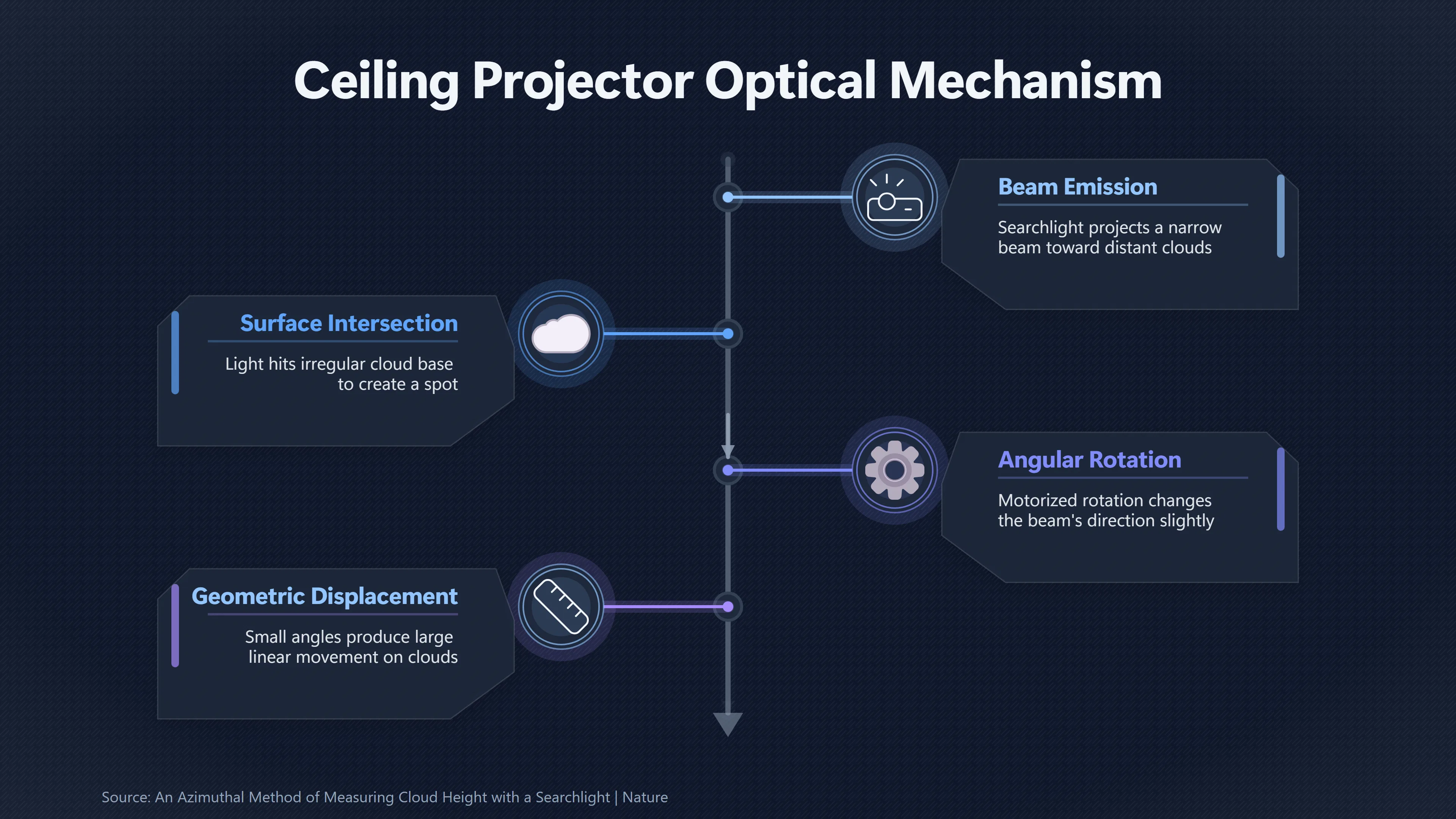
That distinction removes the apparent performance problem. Meteorologists historically used essentially the same phenomenon deliberately: a narrow searchlight or ceiling projector produced a visible spot on a cloud base whose position could be measured geometrically to determine cloud height.[ametsoc.org]glossary.ametsoc.orgGlossary of Meteorologycloud-height indicatorGlossary of Meteorology… When the projector is rotated rather than held still, modest angular movement at ground level can translate into very large displacement of that intersection point. In UFO/UAP reports, this geometry can therefore produce apparent speeds and turns that no material craft needs to have made.
How a beam creates a moving cloud spot
A useful starting point is the old meteorological ceiling light, also called a ceiling projector. The American Meteorological Society describes it as a searchlight that projects a narrow beam vertically onto a cloud base. An observer at a known horizontal distance measures the angle to the illuminated patch and derives the cloud height by triangulation.[Glossary of Meteorology]glossary.ametsoc.orgGlossary of Meteorologyceiling lightGlossary of Meteorology…
This is important because it establishes experimentally, rather than merely hypothetically, that a cloud can function as a distant projection surface. W. E. Knowles Middleton’s 1939 treatment of the ceiling projector explicitly analysed both the geometry and the apparent brightness of such a light spot under different atmospheric conditions.[Optica Publishing Group]opg.optica.orgPublishing Group On the Theory of the Ceiling Projector</span>Optica Publishing GroupOn the Theory of the Ceiling Projector*…</span></span> In 1947, British meteorologist E. G. Bilham described the standard night-time technique in *Nature: direct a searchlight towards the cloud, observe the resulting spot from a known baseline and calculate the cloud-base height trigonometrically.[Nature]nature.comAn Azimuthal Method of Measuring Cloud Height with a Searchlight | NatureAn Azimuthal Method of Measuring Cloud Height with a Searchlight | Nature…
Modern ceilometers usually work differently, sending laser pulses upwards and timing the backscattered return. The underlying optical fact remains useful: clouds contain enough droplets to return measurable light towards the ground. The University of Reading’s atmospheric observatory notes that its ceilometer detects backscatter not only from clouds but also from haze, mist, precipitation and other material in the atmosphere.[Met Reading]met.reading.ac.ukMet Reading Dept of Meteorology Home PageMet ReadingDept of Meteorology Home Page - University of Reading…
Now rotate the source. Instead of one fixed illuminated patch, successive beam directions strike successive parts of the cloud. Human vision naturally interprets those rapidly changing illuminated positions as one luminous thing moving through the sky.
That distinction is central to UFO identification. Skeptical Inquirer gives precisely this example when explaining that a reported UFO need not actually be either flying or an object: a bright disc can instead be the effect of a searchlight playing on low cloud.[Skeptical Inquirer]skepticalinquirer.orgSkeptical Inquirer UFO Identification Process | Skeptical InquirerSkeptical Inquirer UFO Identification Process | Skeptical Inquirer US government UFO records likewise treated searchlights as a conventional category of explanation: the US National Archives’ account of Project Blue Book includes searchlights among the human-created phenomena responsible for identified reports, while the CIA’s summary of Blue Book methodology lists searchlights among the possibilities investigators considered.[Pieces of History]prologue.blogs.archives.govPieces of History UFOs: Natural Explanations – Pieces of HistoryPieces of HistoryUFOs: Natural Explanations – Pieces of HistoryApril 16, 2018…
Why small angle changes produce huge apparent motion
The surprising motion follows from elementary geometry. Imagine, initially, that the cloud is a flat screen. If a searchlight is a perpendicular distance D from that surface and its beam is displaced through an angle θ, the intersection point is displaced roughly according to:
x = D tan θ
That is the same tangent relationship used in classical cloud-height measurements. Bilham’s meteorological formulation gives the corresponding relationship between a known baseline, the elevation angle of the illuminated spot and the height of the cloud.[Nature]nature.comAn Azimuthal Method of Measuring Cloud Height with a Searchlight | NatureAn Azimuthal Method of Measuring Cloud Height with a Searchlight | Nature…
For a moving beam, differentiating the simple flat-screen relationship gives:
v = Dω sec²θ
where ω is the angular rate at which the beam direction changes. This standard spotlight geometry is also used in physics problems involving a rotating beam sweeping along a distant wall.[Sathee]sathee.iitk.ac.inOpen source on iitk.ac.in.
The important point for an eyewitness is not the equation itself but what it means: apparent linear speed increases with distance.
Consider a simplified example. If a cloud base is 1,000 metres away and the beam direction changes by only 10 degrees in one second, a small-angle estimate already gives an intersection displacement of roughly 175 metres. At a 2,000-metre distance, the same angular movement corresponds to roughly 350 metres. Nothing at the cloud has been mechanically accelerated to those speeds. The projector has merely changed where it is pointing.
The effect becomes still more nonlinear when the beam approaches a grazing angle to the projected surface, because the tangent relationship steepens. A nearly constant rotation rate at the searchlight therefore does not necessarily produce constant linear movement of the spot. The patch can appear to accelerate dramatically even though the projector’s motor has not accelerated at all.
This helps explain why reported motion can sound aerodynamically implausible. A witness may describe a light as moving slowly, suddenly accelerating and then vanishing towards the horizon. If it is an illuminated intersection rather than a craft, the inferred velocity is the wrong physical quantity: the observer is assigning object-like motion to a moving optical pattern.
The principle was recognised early in public discussion of flying-saucer reports. In 1952, Time described astronomer Donald Menzel’s point that a searchlight spot on high cloud could be swept at apparent speeds of thousands of miles per hour and could change direction abruptly because it was non-material.[TIME]time.coman astronomers explanation those flying saucersAn Astronomer's Explanation: THOSE FLYING SAUCERSJune 9, 1952… The precise speed in any real observation depends on the beam’s angular motion and cloud geometry, but the underlying distinction remains sound.
A reversal need not mean anything reversed course
The same geometry makes sudden changes of direction much less mysterious than they appear.
A motorised searchlight can simply reverse its rotation or oscillate between programmed limits. At the cloud, the illuminated point consequently retraces its route. There is no momentum to overcome because the previous bright patch does not have to stop and fly backwards. One region of cloud ceases to be strongly illuminated while another becomes illuminated.
That permits changes of apparent direction far sharper than an aircraft could make. A physical vehicle travelling rapidly eastward must decelerate before travelling westward. A projected spot has no such constraint. Its apparent position follows the beam direction.
Several beams make the effect even less object-like physically while potentially making it more object-like perceptually. Two searchlights can sweep towards one another, overlap and then separate. If the observer interprets the luminous patches as persistent objects rather than independently illuminated portions of cloud, the pattern may appear to involve lights approaching one another, merging, dividing or changing formation.
This is why extraordinary apparent acceleration is not, by itself, evidence that an extraordinary acceleration actually occurred. The first question is whether the observed feature had independent physical substance at all. Historical UFO investigation explicitly included searchlights among ordinary causes, while identification literature continues to cite searchlights playing on clouds as examples of apparent UFOs.[Pieces of History]prologue.blogs.archives.govPieces of History UFOs: Natural Explanations – Pieces of HistoryPieces of HistoryUFOs: Natural Explanations – Pieces of HistoryApril 16, 2018…

How cloud height and shape alter the illusion
The simple flat-cloud model explains the basic amplification, but real clouds make the apparent motion more complicated.
A cloud base is not a rigid horizontal ceiling. It can slope, undulate and contain areas at different heights. The searchlight therefore intersects a three-dimensional scattering surface whose distance and orientation vary along the beam’s sweep. Even with perfectly smooth rotation of the projector, the resulting spot need not move smoothly.
The consequences follow directly from the same triangulation geometry used by meteorological ceiling projectors. Because the position of the spot depends jointly on beam angle and cloud height, a change in cloud-base distance changes the mapping between projector movement and apparent displacement. Meteorological cloud-height instruments exploit precisely this dependence to infer altitude from the illuminated intersection.[Glossary of Meteorology]glossary.ametsoc.orgGlossary of Meteorologycloud-height indicatorGlossary of Meteorology…
An irregular cloud layer can therefore produce several misleading effects:
- Apparent acceleration: the beam encounters a part of the cloud whose geometry makes a small angular change correspond to a larger displacement.
- Apparent slowing: another section presents the opposite geometry, compressing the visible movement.
- Sudden disappearance: the beam leaves an optically thick region and enters a gap, very thin cloud or an area too faint to return a conspicuous patch.
- Apparent reappearance elsewhere: as the sweep continues, the beam encounters another sufficiently reflective portion of cloud, creating a new bright patch separated from the previous one.
- Changing size or shape: the beam strikes differently oriented or differently structured portions of cloud, changing the illuminated footprint visible to the observer.
Cloud thickness matters as well as cloud height. Historical descriptions of ceiling-projector operation note that with thin cloud the light can penetrate into the layer rather than producing a perfectly defined surface spot.[Wikipedia]WikipediaOpen source on wikipedia.org. Modern lidar observations likewise demonstrate that atmospheric backscatter varies through haze, fog, precipitation and cloud layers rather than behaving like reflection from a solid screen.[Met Reading]met.reading.ac.ukMet Reading Dept of Meteorology Home PageMet ReadingDept of Meteorology Home Page - University of Reading…
Consequently, the apparent target can deform while it moves. A circular-looking patch may stretch, blur, brighten or fade as the beam traverses cloud with different local structure. Those changes can make a regular mechanical sweep look much less regular when viewed only at its distant endpoint.
The spot’s speed is not an aircraft speed
The most important interpretive distinction is between the motion of matter and the motion of an illuminated location.
Suppose a searchlight illuminates point A on a cloud and, a fraction of a second later, illuminates point B hundreds of metres away. No object has travelled from A to B. Different rays emitted in different directions have illuminated different cloud droplets. The apparent travelling spot is a sequence of illuminated locations.
There is therefore no meaningful aircraft-style acceleration limit for the pattern. In sufficiently extreme geometries, projected spots on very distant surfaces can even have intersection speeds exceeding the speed of light without violating relativity, because no material body, signal or causal influence is travelling laterally from one illuminated point to the next. The cloud-searchlight situation normally involves far smaller distances, but it rests on the same geometrical principle: the apparent transverse speed of the intersection is not the physical propagation speed of an object.
This also explains an otherwise puzzling feature of some reports: extreme speed combined with silence. If the visible phenomenon is only an illuminated cloud patch, there is no vehicle at that apparent location to produce engine noise, sonic effects or aerodynamic behaviour. The observation may still be accurately described — a bright patch really did cross the cloud rapidly — while the inferred moving object never existed.
That distinction is why searchlight geometry belongs among established identification mechanisms for UFO/UAP reports rather than serving merely as a vague resemblance. Project Blue Book explicitly included searchlights among identifiable causes, and meteorological instruments provide direct technical evidence that narrow projected beams can form conspicuous spots on cloud bases.[archives.gov]prologue.blogs.archives.govPieces of History UFOs: Natural Explanations – Pieces of HistoryPieces of HistoryUFOs: Natural Explanations – Pieces of HistoryApril 16, 2018…
What the motion itself can reveal
Paradoxically, movement that seems too agile for an aircraft can provide a clue that the phenomenon is projected light.
A searchlight explanation becomes geometrically stronger when a luminous feature remains associated with cloud, follows repeated arcs or sweeps, changes direction without a plausible turning radius, vanishes at cloud boundaries, or appears to accelerate as its angular position changes. These characteristics are not individually diagnostic, but together they are consistent with an intersection point controlled from a remote projector rather than a self-propelled object occupying the apparent location.
Repeated motion is especially informative. A mechanical lighting installation may run a programmed cycle, causing a spot to revisit approximately the same areas of cloud at regular intervals. Because the cloud itself is moving and changing, successive sweeps need not look identical. The underlying beam programme can remain regular while its visible endpoint drifts, stretches or intermittently disappears.
This is also why estimating an object’s speed from angular movement alone can be misleading. To convert angular motion into linear velocity, the observer needs a reliable distance. With a cloud projection, the assumed distance to an airborne craft may be fictitious; the actual relevant distance is from the projector to the illuminated part of the cloud. The historical ceiling-projector method demonstrates exactly how strongly the observed angular position of a cloud spot is tied to that geometry.[Nature]nature.comAn Azimuthal Method of Measuring Cloud Height with a Searchlight | NatureAn Azimuthal Method of Measuring Cloud Height with a Searchlight | Nature…
The apparent impossibility is therefore the useful clue. A luminous “object” that seems to execute instantaneous turns or enormous accelerations need not represent an object capable of impossible flight. When a narrow beam is sweeping a distant cloud layer, the sky is acting as a projection surface, and what races across it is geometry made visible.
Amazon book picks
Further Reading
Books and field guides related to Why Searchlight Spots Can Move Impossibly Fast. Use these as the next step if you want deeper reading beyond the article.
Optics
For courses in Optics A Contemporary Approach to Optics with Practical Applications and New Focused Pedagogy Hecht Optics balances theory...

Light and Color in the Outdoors
First published 1993. Subjects: Color, Light, Popular works, Science: General Issues, Photographic equipment & techniques.
Color and Light in Nature
We live in a world of optical marvels - from the commonplace but beautiful rainbow, to the rare and eerie superior mirage. But how many o...
Seeing the Light: Optics in Nature, Photography, Color, Visio...
The clearest and most complete non-mathematical study of light available—with updated material and a new chapter on digital photography....
eBay marketplace picks
Marketplace Samples
Live-tested eBay searches with available results related to this page.
Selected fromUFO poster oneBay.co.uk.



Current eBay listing
I Want To Believe UFO Poster Giclée Fine Art Heavyweight Print

Current eBay listing
VINTAGE UFO FLYING SAUCERS COMIC ADVERTISING A2 POSTER PRINT
Endnotes
1.
Source: nature.com
Title: An Azimuthal Method of Measuring Cloud Height with a Searchlight | Nature
Link:https://www.nature.com/articles/159677b0
Source snippet
An Azimuthal Method of Measuring Cloud Height with a Searchlight | Nature...
2.
Source: opg.optica.org
Title: Publishing Group On the Theory of the Ceiling Projector*
Link:https://opg.optica.org/josa/abstract.cfm?uri=josa
Source snippet
Optica Publishing GroupOn the Theory of the Ceiling Projector*...
3.
Source: prologue.blogs.archives.gov
Title: Pieces of History UFOs: Natural Explanations – Pieces of History
Link:https://prologue.blogs.archives.gov/2018/04/16/ufos-natural-explanations/
Source snippet
Pieces of HistoryUFOs: Natural Explanations – Pieces of HistoryApril 16, 2018...
Published: April 16, 2018
4.
Source: cia.gov
Title: How To Investigate a Flying Saucer
Link:https://www.cia.gov/stories/story/how-to-investigate-a-flying-saucer/
Source snippet
How To Investigate a Flying Saucer - CIA...
5.
Source: time.com
Title: an astronomers explanation those flying saucers
Link:https://time.com/archive/6608795/an-astronomers-explanation-those-flying-saucers/
Source snippet
An Astronomer's Explanation: THOSE FLYING SAUCERSJune 9, 1952...
Published: June 9, 1952
6.
Source: Wikipedia
Link:https://en.wikipedia.org/wiki/Ceilometer
7.
Source: archives.gov
Title: Project BLUE BOOK
Link:https://www.archives.gov/foia/ufos.html
8.
Source: searchlight.vc
Title: Moving de dark cloud
Link:https://www.searchlight.vc/uncategorized/2016/01/15/moving-de-dark-cloud/
9.
Source: history.com
Title: Project Blue Book
Link:https://www.history.com/articles/project-blue-book
10.
Source: history.com
Title: of UFOs
Link:https://www.history.com/articles/history-of-ufos
11.
Source: opg.optica.org
Link:https://opg.optica.org/josaa/abstract.cfm?uri=josaa
12.
Source: opg.optica.org
Link:https://opg.optica.org/abstract.cfm?uri=josa
13.
Source: ufos.wiki
Title: Crown flash
Link:https://ufos.wiki/investigation/crown-flash/
14.
Source: opg.optica.org
Link:https://opg.optica.org/abstract.cfm?uri=josa
15.
Source: opg.optica.org
Link:https://opg.optica.org/josa/abstract.cfm?uri=josa
16.
Source: glossary.ametsoc.org
Title: Glossary of Meteorologycloud-height indicator
Link:https://glossary.ametsoc.org/wiki/cloud-height-indicator/
Source snippet
Glossary of Meteorology...
17.
Source: glossary.ametsoc.org
Title: Glossary of Meteorologyceiling light
Link:https://glossary.ametsoc.org/wiki/ceiling-light/
Source snippet
Glossary of Meteorology...
18.
Source: met.reading.ac.uk
Title: Met Reading Dept of Meteorology Home Page
Link:https://www.met.reading.ac.uk/observatorymain/ceilometer.html
Source snippet
Met ReadingDept of Meteorology Home Page - University of Reading...
19.
Source: skepticalinquirer.org
Title: Skeptical Inquirer UFO Identification Process | Skeptical Inquirer
Link:https://skepticalinquirer.org/2018/11/ufo-identification-process/
20.
Source: sathee.iitk.ac.in
Link:https://sathee.iitk.ac.in/jee-pyq-chapterwise/physics/kinematics/kinematics_ques_55/
21.
Source: weather-atlas.com
Title: Ceilometer | Weather Atlas
Link:https://www.weather-atlas.com/g/ceilometer
22.
Source: cma.gov.cn
Title: Cloud Observation
Link:https://www.cma.gov.cn/en2014/20150311/20170310/2017031008/201703/t20170317_400693.html
23.
Source: cufos.org
Title: Project Blue Book
Link:https://cufos.org/resources/project-blue-book/
24.
Source: glossary.ametsoc.org
Link:https://glossary.ametsoc.org/wiki/ceilometer/
25.
Source: www2.anac.gov.br
Link:https://www2.anac.gov.br/anacpedia/ing_por/tr4373.htm
26.
Source: www2.anac.gov.br
Link:https://www2.anac.gov.br/anacpedia/ing-por/tr4373.htm
27.
Source: researchcentre.army.gov.au
Title: army.gov.au [Radar]({{ ‘radar/’ | relative_url }}) and Field Gunnery | Australian Army Research Centre (AARC)
Link:https://researchcentre.army.gov.au/library/australian-army-journal-aaj/number-1-july-1948/radar-and-field-gunnery
Additional References
28.
Source: youtube.com
Link:https://www.youtube.com/watch?v=0_Y9tYksutA
Source snippet
Visualize the Mixing Layer Height with Ceilometers and BL-VIEW Software...
29.
Source: researchgate.net
Link:https://www.researchgate.net/publication/322710400_Research_on_improving_the_precision_of_1064nm_fiber_Doppler_lidar_in_detecting_rotating_targets
30.
Source: researchgate.net
Link:https://www.researchgate.net/publication/327489018_Optimization_of_a_fast_rotating_target_to_produce_kHz_X-ray_pulses_from_laser-plasma_interaction?_tp=eyJjb250ZXh0Ijp7InBhZ2UiOiJzY2llbnRpZmljQ29udHJpYnV0aW9ucyIsInByZXZpb3VzUGFnZSI6bnVsbCwic3ViUGFnZSI6bnVsbH19
31.
Source: sarthaks.com
Link:https://www.sarthaks.com/1537334/light-rotates-horizontal-plane-with-constant-angular-velocity-light-move-along-wall-disatn
32.
Source: sarthaks.com
Link:https://www.sarthaks.com/1537334/spot-light-rotates-horizontal-plane-with-constant-angular-velocity-spot-light-along-disatn
33.
Source: tardigrade.in
Link:https://tardigrade.in/question/a-spot-of-light-s-rotates-in-a-horizontal-plane-with-a-constant-jtmusxtp
34.
Source: vedantu.com
Link:https://www.vedantu.com/question-answer/a-spot-of-light-s-rotates-in-a-horizontal-plane-class-11-physics-cbse-5f8829348a0a932d9e621f98
35.
Source: brainly.in
Link:https://brainly.in/question/884832
36.
Source: studylib.net
Link:https://studylib.net/doc/25531099/pilot-s-handbook-of-aeronautical-knowledge—aeromedical-
37.
Source: docsity.com
Link:https://www.docsity.com/en/docs/aeromedical-training-for-flight-personnel-questions-and-answers/12242733/