Within Reentry
How Skylab Turned Into a Fleet of Lights
Skylab's breakup showed how one enormous spacecraft can become several prominent lights and then a long procession of smaller fragments.
On this page
- What observers saw as Skylab crossed Western Australia
- How a single structure became separated luminous objects
- What Skylab teaches investigators about apparent formations
Page outline Jump by section
Introduction
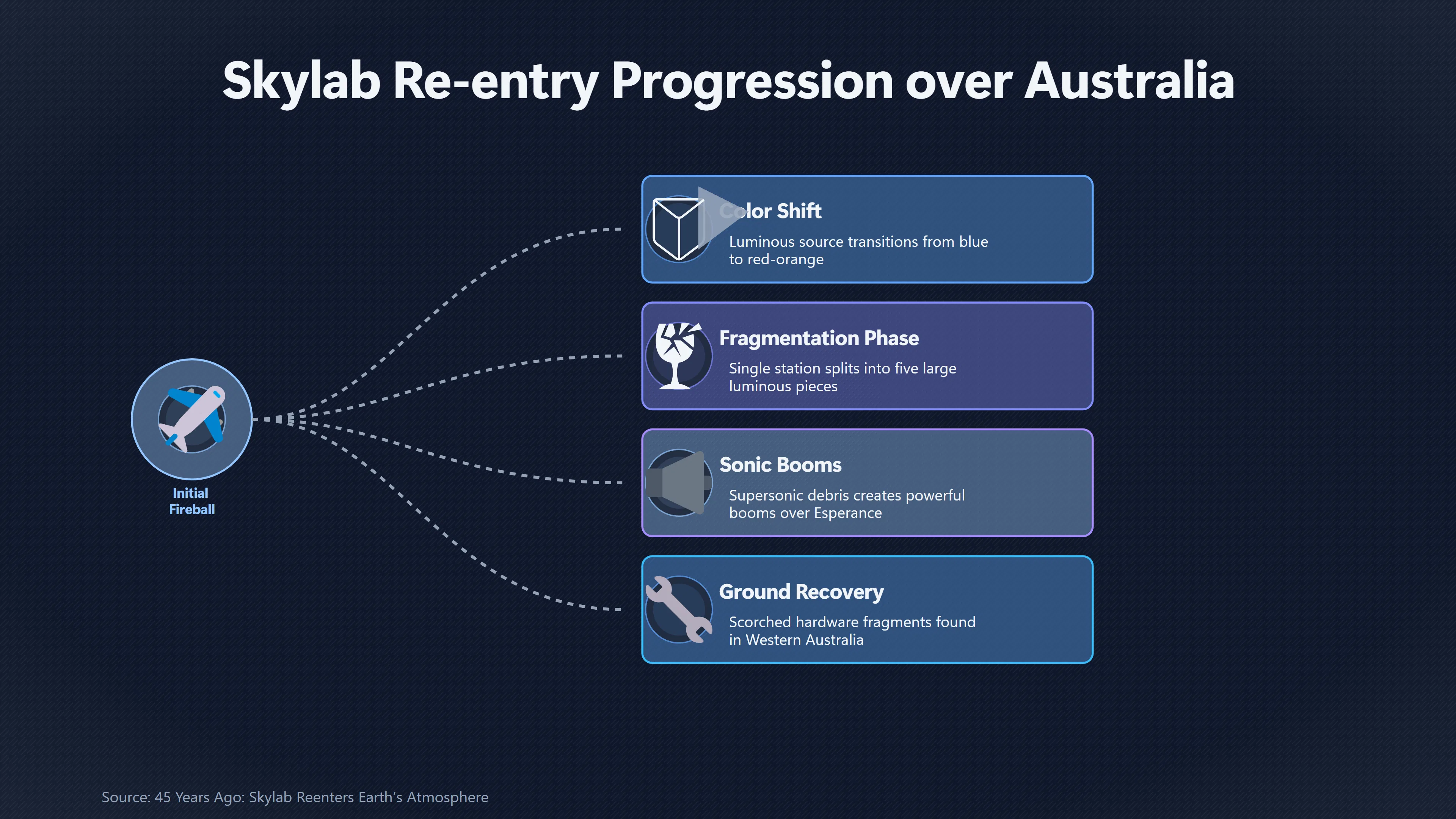
Skylab’s final minutes are a particularly useful case for understanding how a single re-entering spacecraft can appear to become a fleet of separate objects. On 11 July 1979 — already 12 July in Western Australia — the 77-tonne American space station descended across the Indian Ocean towards Australia. An aircraft crew first saw a blue fireball; about 45 seconds later it had changed to red-orange and split into five conspicuous pieces. Farther along the track, observers in Western Australia saw flaming fragments, while sonic booms shook communities below.[NASA Technical Reports Server]ntrs.nasa.govNASA Technical Reports ServerNASA/TP-1999-208856December 2, 2002…
The importance for UFO or UAP investigation is not that witnesses mistook Skylab itself for something mysterious: its re-entry was internationally anticipated. It is that the event provides a documented demonstration of the underlying visual mechanism. One enormous artificial object entered the atmosphere, progressively broke apart and presented observers with several bright, jointly moving objects followed by a much larger population of debris. A formation of lights in the sky did not require a formation of vehicles.
What observers saw over Western Australia
Skylab had already begun coming apart before the most dramatic Australian sightings. NASA’s later historical reconstruction says tracking from Bermuda still showed the station’s large solar array attached to the orbital workshop. By the time Skylab passed the Ascension Island tracking station in the South Atlantic, at an altitude of about 66 miles (106 kilometres), the solar array was beginning to detach and the workshop was visibly heating. After Ascension lost contact, the disintegrating station continued across the Indian Ocean without further tracking coverage.[NASA]nasa.gov45 Years Ago: Skylab Reenters Earth’s Atmosphere45 Years Ago: Skylab Reenters Earth’s Atmosphere - NASA…
A NASA technical history preserves an unusually vivid observation from this otherwise poorly monitored interval. The crew of an aircraft flying at about 8,500 metres over the Indian Ocean saw Skylab as a blue fireball against the predawn sky. After roughly 45 seconds it changed to red-orange and separated into five large pieces. Early risers in south-western Australia subsequently saw flaming pieces crossing the sky.[NASA Technical Reports Server]ntrs.nasa.govNASA Technical Reports ServerNASA/TP-1999-208856December 2, 2002…
That sequence matters. It shows that Skylab did not simply produce one bright streak and disappear. There was an observable transition from one luminous source to several prominent luminous sources. Those sources were still travelling along the parent spacecraft’s general flight path, so an observer seeing only the later phase could encounter several bright objects moving together without having witnessed the original object from which they came.
Accounts from the Esperance region add the human-scale impression of the display. Brendan Freeman, who had been waiting for the predicted re-entry, recalled being startled by sonic booms before going outside and watching a “fiery apparition” race through the sky; he compared the sight to an exceptional fireworks display. Merv Andre, then president of the Esperance Shire, remembered about six powerful sonic booms, strong enough to rattle doors and windows.[ABC News]abc.net.auABC News Skylab anniversaryABC NewsSkylab anniversary - Behind The NewsJuly 12, 2019…
Another eyewitness, Stan Thornton, later described a “bunch of brightly colored lights” followed by large sonic booms, saying that the sky became brilliantly illuminated. Thornton subsequently recovered a hot, scorched fragment near his home.[WIRED]wired.comthe day the skylab fellThe Day the Sky(lab) Fell | WIREDMarch 22, 2001…
The observations therefore fit together in a revealing progression: a brilliant fireball over the Indian Ocean, separation into several large luminous pieces, numerous flaming objects continuing towards Western Australia, and finally physical debris on the ground. What appeared overhead as multiple lights was demonstrably the changing visible expression of one spacecraft breaking up.
How one spacecraft became many luminous objects
Skylab was unusually large for an uncontrolled re-entry. NASA describes it as the heaviest single object placed into orbit at the time, with a launch mass of about 170,000 pounds. By July 1979 controllers could influence its attitude and therefore its drag, but they could not perform the kind of precisely targeted powered deorbit expected for a modern large space station.[NASA]nasa.gov50 Years Ago: The Launch of Skylab, America’s First Space Station50 Years Ago: The Launch of Skylab, America’s First Space Station - NASAMay 14, 2023…
On its 34,981st orbit, controllers commanded Skylab into a slow tumble. The intention was to improve the odds that breakup and surviving debris would occur over ocean rather than a heavily populated region. The station nevertheless remained intact farther along its trajectory than expected. NASA’s modern reconstruction states that it finally broke apart at an altitude of about 10 miles, lower than anticipated, shifting surviving debris farther east towards Western Australia.[NASA]nasa.gov40 Years Ago: Skylab Reenters Earth’s Atmosphere40 Years Ago: Skylab Reenters Earth’s Atmosphere - NASAJuly 11, 2019…
The visible multiplication of objects follows naturally from that physical breakup. Skylab was not a homogeneous block. It was a large assembled structure containing tanks, structural members, machinery and other components with different masses, shapes and resistance to heating. As connections failed, large sections could separate first; those sections could then shed or break into additional pieces.
NASA’s re-entry modelling illustrates why such fragmentation produces an extended procession rather than a compact pile of debris. Analyses of Skylab’s possible debris footprint treated impact distance as dependent on properties such as a fragment’s ballistic coefficient — broadly, how effectively its mass carries it forward against atmospheric drag. Pieces with different aerodynamic properties therefore decelerate and fall differently after separation.[NASA Technical Reports Server]ntrs.nasa.govNASA Technical Reports ServerMonte Carlo analysis of satellite debris footprint dispersion - NASA Technical Reports Server (NTRS)January…
For a distant observer, however, those physical separations may initially be modest compared with the viewing distance. The fragments retain substantial forward motion inherited from the parent spacecraft. They can consequently appear as several lights following similar directions across the sky, even while the debris cloud is steadily stretching along its trajectory.
This is the central visual lesson of Skylab: fragmentation creates multiplicity before it necessarily creates obvious disorder. The pieces do not have to scatter randomly in every direction. Their shared origin gives them shared motion, while aerodynamic differences gradually spread them out.
The ground trail confirms what happened overhead
The debris recovered after the event makes Skylab unusually valuable as an evidential case. The luminous procession was not merely interpreted as fragmentation after the fact; numerous fragments of the original spacecraft were physically recovered along its path.
NASA’s 1980 reactivation mission report concluded that the debris dispersion area extended from the south-eastern Indian Ocean across sparsely populated Western Australia.[NASA Technical Reports Server]ntrs.nasa.govTechnical Reports Server Skylab reactivation mission reportTechnical Reports Server Skylab reactivation mission report NASA’s later reconstruction gives the documented footprint a length of about 2,450 miles (3,940 kilometres), while an earlier NASA technical history described the Australian portion as more than 1,000 kilometres long and nearly 200 kilometres wide. Differences between such figures reflect what portion or definition of the debris footprint is being discussed, but both make the essential point: fragmentation distributed pieces over an enormous distance along the flight path.[NASA]nasa.gov45 Years Ago: Skylab Reenters Earth’s Atmosphere45 Years Ago: Skylab Reenters Earth’s Atmosphere - NASA…
The National Archives of Australia records wreckage being examined at Esperance, Coolgardie, Kalgoorlie, Rawlinna and Balladonia. Australian authorities reported no injuries or significant damage, although sonic booms from the supersonic debris alarmed residents.[NAA]naa.gov.auNAASkylab country: collaborating to salvage a space station | naa.gov.auNAASkylab country: collaborating to salvage a space station | naa.gov.au
Some sizeable components survived. The Esperance Museum accumulated a substantial collection, while an oxygen tank was discovered much later on a Western Australian property. The continuing recovery of recognisable spacecraft hardware reinforces the connection between the lights seen in the sky and the fragmented structure that produced them.[NAA]naa.gov.auNAASkylab country: collaborating to salvage a space station | naa.gov.auNAASkylab country: collaborating to salvage a space station | naa.gov.au
There is also an important distinction between the visible fragmentation train and the eventual debris footprint. Not every luminous piece survived to the surface, and pieces that did survive continued to separate aerodynamically as they descended. A witness’s apparent “fleet” therefore represents only a temporary optical snapshot of a debris cloud whose components were continually changing brightness, spacing and speed.
Why the display could look organised
A group of lights moving on related paths can invite an interpretation very different from “one object disintegrating”. Human observers normally infer structure from coordinated motion: lights that keep roughly the same direction and speed may appear to belong together, whether as separate vehicles travelling in formation or as illuminated points on a much larger unseen object.
Skylab demonstrates why that inference can fail during re-entry. Its prominent fragments had three characteristics capable of creating an impression of organisation.
First, they shared almost the same original trajectory. Atmospheric breakup did not erase the station’s enormous orbital momentum, so separated pieces continued generally downrange rather than instantly flying apart in unrelated directions.
Second, breakup was progressive. The aircraft observation records an initial fireball becoming five large pieces, while Australian observers later encountered numerous flaming fragments. That evolution means different witnesses along the ground track could see quite different apparent configurations from the same event.[NASA Technical Reports Server]ntrs.nasa.govNASA Technical Reports ServerNASA/TP-1999-208856December 2, 2002…
Third, the pieces were physically different. Some structures could remain luminous longer than others, while smaller or less robust material disappeared sooner. The visible pattern could therefore reorganise itself as individual lights brightened, faded or fragmented.
That last point is especially important in UAP analysis. A witness need not be wrong about seeing several distinct lights. The mistake can occur at the next interpretive step: assuming that several distinct lights imply several independently controlled objects, or that lights preserving a rough geometric relationship must be attached to a single intact craft.
Skylab provides a documented alternative. Several lights really can be several physical objects while simultaneously being the remains of one original object.
What Skylab teaches investigators about apparent formations
For investigators examining reports of structured or formation-like objects, Skylab suggests that the most diagnostic clues may lie in the behaviour of the whole event rather than the apparent shape seen at one instant.
A report becomes more compatible with re-entry fragmentation when multiple lights travel together in one dominant direction, smaller lights appear or peel away, individual components flare or fade independently, and the entire display progresses steadily across a long stretch of sky. Reports of delayed booms can add supporting evidence because supersonic debris may be seen before its shock waves reach the observer. Skylab produced exactly this combination of bright fragments and powerful sonic booms in Western Australia.[ABC News]abc.net.auABC News Skylab anniversaryABC NewsSkylab anniversary - Behind The NewsJuly 12, 2019…
The timing and ground track are even stronger tests. Skylab’s Australian sightings occurred beneath a known orbital re-entry whose trajectory was being monitored internationally, and recovered debris established where the fragments ultimately went. The physical evidence removes the ambiguity that usually surrounds an isolated eyewitness report.
There is nevertheless a limit to what the case proves. Skylab does not establish that every report of several coordinated lights is a re-entry, nor that every claimed structured UAP can be reduced to fragmentation. Its value is narrower and stronger: it demonstrates experimentally, through a historically documented event with tracking, eyewitnesses and recovered hardware, that one large spacecraft can generate a visually convincing procession of multiple luminous objects.
That makes Skylab a useful comparison case whenever a supposed formation has the characteristic temporal signature of atmospheric re-entry. Instead of asking only, “What shape did the lights make?”, investigators should also ask whether the formation evolved — whether one light became several, fragments appeared behind larger objects, brightness varied independently and the whole procession continued smoothly along a common track.
Skylab shows why those questions matter. Over the Indian Ocean it began as a single enormous spacecraft. During its luminous descent it became a handful of major fiery objects. By the time its remains reached Western Australia, it had become a debris field stretching across a substantial portion of the continent.[nasa.gov]ntrs.nasa.govNASA Technical Reports ServerNASA/TP-1999-208856December 2, 2002…
The apparent fleet was real in one sense: observers genuinely were looking at multiple separate objects. What they were not looking at was a fleet of separate craft. They were watching one spacecraft turn into many.
Amazon book picks
Further Reading
Books and field guides related to How Skylab Turned Into a Fleet of Lights. Use these as the next step if you want deeper reading beyond the article.
Homesteading Space: The Skylab Story
As the United States and the Soviet Union went from exploring space to living in it, a space station was conceived as the logical success...
Failure Is Not an Option
Rating: 4.5/5 from 12 Google Books ratings
This New York Times bestselling memoir of a veteran NASA flight director tells riveting stories from the early days of the Mercury progra...
Space Debris: Models and Risk Analysis
In Space Debris Models and Risk Analysis the authors will provide the reader with a comprehensive background to understand the various so...
eBay marketplace picks
Marketplace Samples
Live-tested eBay searches with available results related to this page.
Selected fromSkylab mission patch oneBay.co.uk.
Endnotes
1.
Source: ntrs.nasa.gov
Link:https://ntrs.nasa.gov/api/citations/19990041784/downloads/19990041784.pdf
Source snippet
NASA Technical Reports ServerNASA/TP-1999-208856December 2, 2002...
Published: December 2, 2002
2.
Source: nasa.gov
Title: 45 Years Ago: Skylab Reenters Earth’s Atmosphere
Link:https://www.nasa.gov/history/45-years-ago-skylab-reenters-earths-atmosphere/
Source snippet
45 Years Ago: Skylab Reenters Earth’s Atmosphere - NASA...
3.
Source: wired.com
Title: the day the skylab fell
Link:https://www.wired.com/2001/03/the-day-the-skylab-fell/
Source snippet
The Day the Sky(lab) Fell | WIREDMarch 22, 2001...
Published: March 22, 2001
4.
Source: nasa.gov
Title: 50 Years Ago: The Launch of Skylab, America’s First Space Station
Link:https://www.nasa.gov/history/50-years-ago-the-launch-of-skylab-americas-first-space-station/
Source snippet
50 Years Ago: The Launch of Skylab, America’s First Space Station - NASAMay 14, 2023...
Published: May 14, 2023
5.
Source: ntrs.nasa.gov
Link:https://ntrs.nasa.gov/citations/19790052554
Source snippet
NASA Technical Reports ServerSkylab orbit decay update and the eleventh hour contingency plan - NASA Technical Reports Server (NTRS)...
6.
Source: nasa.gov
Title: 40 Years Ago: Skylab Reenters Earth’s Atmosphere
Link:https://www.nasa.gov/history/40-years-ago-skylab-reenters-earths-atmosphere/
Source snippet
40 Years Ago: Skylab Reenters Earth’s Atmosphere - NASAJuly 11, 2019...
Published: July 11, 2019
7.
Source: ntrs.nasa.gov
Link:https://ntrs.nasa.gov/citations/19790061297
Source snippet
NASA Technical Reports ServerMonte Carlo analysis of satellite debris footprint dispersion - NASA Technical Reports Server (NTRS)January...
8.
Source: ntrs.nasa.gov
Title: Technical Reports Server Skylab reactivation mission report
Link:https://ntrs.nasa.gov/citations/19800012907
9.
Source: naa.gov.au
Title: NAASkylab country: collaborating to salvage a space station | naa.gov.au
Link:https://www.naa.gov.au/blog/skylab-country-collaborating-salvage-space-station
10.
Source: nasa.gov
Link:https://www.nasa.gov/mission/skylab/
11.
Source: nasa.gov
Title: 50 Years Ago: Skylab 4 Astronauts Return From Record-Breaking Spaceflight
Link:https://www.nasa.gov/history/50-years-ago-skylab-4-astronauts-return-from-record-breaking-spaceflight/
12.
Source: ntrs.nasa.gov
Link:https://ntrs.nasa.gov/archive/nasa/casi.ntrs.nasa.gov/20190033904.pdf
13.
Source: ntrs.nasa.gov
Link:https://ntrs.nasa.gov/citations/20190033493
14.
Source: ntrs.nasa.gov
Link:https://ntrs.nasa.gov/citations/20190033904
15.
Source: nasa.gov
Title: Repeat Performance: Apollo 12 Achieves Second Moon Landing
Link:https://www.nasa.gov/centers-and-facilities/kennedy/repeat-performance-apollo-12-achieves-second-moon-landing/
16.
Source: space.com
Title: Crashing Chinese Space Station Will Go Down Shooting — Fireballs | Space
Link:https://www.space.com/40142-crashing-chinese-space-station-fireballs.html
17.
Source: ntrs.nasa.gov
Link:https://ntrs.nasa.gov/citations/20160012385
18.
Source: nasa.gov
Title: Remembering Skylab: America’s First Space Station
Link:https://www.nasa.gov/humans-in-space/40th-anniversary-of-skylab/
19.
Source: wired.com
Title: 0711skylab [reentry]({{ ‘reentry/’ | relative_url }}) space junk
Link:https://www.wired.com/2011/07/0711skylab-reentry-space-junk/
20.
Source: wired.com
Title: gallery nasa 50 vehicles
Link:https://www.wired.com/2008/08/gallery-nasa-50-vehicles/
21.
Source: wired.com
Title: dayintech 0711 2
Link:https://www.wired.com/2008/07/dayintech-0711-2/
22.
Source: ntrs.nasa.gov
Link:https://ntrs.nasa.gov/citations/20130012635
23.
Source: nasa.gov
Title: Part I
Link:https://www.nasa.gov/humans-in-space/part-i-the-history-of-skylab/
24.
Source: ntrs.nasa.gov
Link:https://ntrs.nasa.gov/citations/19930015503
25.
Source: ntrs.nasa.gov
Link:https://ntrs.nasa.gov/citations/19930063598
26.
Source: ntrs.nasa.gov
Link:https://ntrs.nasa.gov/citations/19870034564
27.
Source: ntrs.nasa.gov
Link:https://ntrs.nasa.gov/archive/nasa/casi.ntrs.nasa.gov/19800012907.pdf
28.
Source: ntrs.nasa.gov
Link:https://ntrs.nasa.gov/search.jsp?R=19790063233
29.
Source: ntrs.nasa.gov
Link:https://ntrs.nasa.gov/citations/19720013169
30.
Source: starchild.gsfc.nasa.gov
Link:https://starchild.gsfc.nasa.gov/docs/StarChild/space_level2/skylab.html
31.
Source: space.com
Title: 21092 skylab space station debris photos
Link:https://www.space.com/21092-skylab-space-station-debris-photos.html
32.
Source: time.com
Title: skylabs fiery fall
Link:https://time.com/archive/6854470/skylabs-fiery-fall/
33.
Source: history.com
Link:https://www.history.com/articles/the-day-skylab-crashed-to-earth-facts-about-the-first-u-s-space-stations-re-entry
34.
Source: youtube.com
Link:https://www.youtube.com/watch?v=5IJ-xd-UGHw
Source snippet
OTD in Space – July 11: Abandoned Skylab Returns to Earth...
35.
Source: abc.net.au
Title: ABC News Skylab anniversary
Link:https://www.abc.net.au/btn/newsbreak/skylab-anniversary/11303220
Source snippet
ABC NewsSkylab anniversary - Behind The NewsJuly 12, 2019...
Published: July 12, 2019
36.
Source: abc.net.au
Link:https://www.abc.net.au/news/2019-07-12/four-decades-on-from-skylabs-descent-from-space/11249626
Source snippet
ABC NewsA space station crash landed over Esperance 40 years ago, setting in motion unusual events - ABC News...
37.
Source: visit.museum.wa.gov.au
Title: ss rodondo 1894
Link:https://visit.museum.wa.gov.au/ss-rodondo-1894
38.
Source: abc.net.au
Title: Witnesses stunned as small meteor lights up sky over parts of Western Australia
Link:https://www.abc.net.au/news/2025-05-11/small-meteor-lights-up-wa-sky/105279490
39.
Source: visit.museum.wa.gov.au
Link:https://visit.museum.wa.gov.au/about/media/western-australian-museum-and-university-new-south-wales-entomologists-discover
40.
Source: spectrum.ieee.org
Link:https://spectrum.ieee.org/skylab
41.
Source: abc.net.au
Title: Space station Skylab’s big impact on Esperance
Link:https://www.abc.net.au/radio/programs/storystream/space-station-skylabs-big-impact-on-esperance/13972738
42.
Source: abc.net.au
Title: Space station Skylab’s big impact on Esperance
Link:https://www.abc.net.au/listen/programs/storystream/space-station-skylabs-big-impact-on-esperance/13972738
43.
Source: abc.net.au
Link:https://www.abc.net.au/news/2021-05-10/luna-park-ghost-train-fire-witnesses-demand-government-inquiry/100128264
44.
Source: abc.net.au
Title: The untold stories of Luna Park’s Ghost Train fire
Link:https://www.abc.net.au/news/2021-03-24/the-untold-stories-about-luna-parks-ghost-train-fire/13259246
45.
Source: abc.net.au
Title: Accident or arson? The mystery of Sydney’s Luna Park Ghost Train fire
Link:https://www.abc.net.au/news/2021-03-16/sydney-luna-park-ghost-train-fire-accident-or-arson/13180028
46.
Source: abc.net.au
Title: Back in the Day: Skylab crashes in Esperance
Link:https://www.abc.net.au/listen/programs/wa-drive/back-in-the-day%3A-skylab-crashes-in-esperance/12341790
47.
Source: abc.net.au
Link:https://www.abc.net.au/news/2020-05-31/nasa-skylab-fell-to-earth-esperance-retrofocus/12282468
48.
Source: insightobservatory.com
Link:https://www.insightobservatory.com/2018/04/look-up-in-sky-its-bird-its-plane.html
49.
Source: museum.wa.gov.au
Link:https://museum.wa.gov.au/online-collections/content/H2016.217
50.
Source: museum.wa.gov.au
Link:https://museum.wa.gov.au/online-collections/content/H2016.166
51.
Source: naa.gov.au
Title: Malcolm Fraser: timeline | naa.gov.au
Link:https://www.naa.gov.au/explore-collection/australias-prime-ministers/malcolm-fraser/timeline
52.
Source: museum.wa.gov.au
Title: History Department | WA Museum Collections
Link:https://museum.wa.gov.au/online-collections/users/History-Department?page=1&qt-user_content=1
53.
Source: abc.net.au
Title: Fireball that lit up the night sky in Australia’s south-east, Russian space junk
Link:https://www.abc.net.au/radio/programs/pm/fireball-that-lit-up-the-night-sky-in-australias/5591340
54.
Source: abc.net.au
Title: Esperance ‘will never forget’ Skylab crash
Link:https://www.abc.net.au/news/2009-07-13/esperance-will-never-forget-skylab-crash/1351410
55.
Source: purl.slwa.wa.gov.au
Title: slwa b3133271 1
Link:https://purl.slwa.wa.gov.au/slwa_b3133271_1
56.
Source: purl.slwa.wa.gov.au
Title: slwa b2459574 2
Link:https://purl.slwa.wa.gov.au/slwa_b2459574_2
57.
Source: naa.gov.au
Link:https://www.naa.gov.au/students-and-teachers/student-research-portal/learning-resource-themes/first-australians/history/jabiluka-uranium-project-letter-about-environmental-impact-statement
58.
Source: naa.gov.au
Title: Jabiluka Uranium Project – final environmental impact statement | naa.gov.au
Link:https://www.naa.gov.au/students-and-teachers/student-research-portal/learning-resource-themes/first-australians/history/jabiluka-uranium-project-final-environmental-impact-statement
59.
Source: purl.slwa.wa.gov.au
Title: slwa b2459562 2
Link:https://purl.slwa.wa.gov.au/slwa_b2459562_2
60.
Source: purl.slwa.wa.gov.au
Title: slwa b2459562 3
Link:https://purl.slwa.wa.gov.au/slwa_b2459562_3
61.
Source: purl.slwa.wa.gov.au
Title: slwa b2459547 1
Link:https://purl.slwa.wa.gov.au/slwa_b2459547_1
62.
Source: purl.slwa.wa.gov.au
Title: slwa b2851747 5
Link:https://purl.slwa.wa.gov.au/slwa_b2851747_5
63.
Source: purl.slwa.wa.gov.au
Title: slwa b3133172 2
Link:https://purl.slwa.wa.gov.au/slwa_b3133172_2
64.
Source: naa.gov.au
Link:https://www.naa.gov.au/search?page=18&search_api_fulltext=aboriginal+people
65.
Source: naa.gov.au
Link:https://www.naa.gov.au/help-your-research/international-movement-records
66.
Source: naa.gov.au
Link:https://www.naa.gov.au/explore-collection/immigration-and-citizenship/passenger-arrival-records
67.
Source: naa.gov.au
Link:https://www.naa.gov.au/explore-collection/intelligence-and-security/history-australian-intelligence-and-security
68.
Source: naa.gov.au
Link:https://www.naa.gov.au/
69.
Source: naa.gov.au
Link:https://www.naa.gov.au/explore-collection/australias-prime-ministers/malcolm-fraser/during-office
70.
Source: naa.gov.au
Link:https://www.naa.gov.au/blog/50th-anniversary-cyclone-tracy/recovery-and-rebuilding
71.
Source: naa.gov.au
Link:https://www.naa.gov.au/help-your-research/fact-sheets/torrens-island-quarantine-station-south-australia
72.
Source: esperance.wa.gov.au
Link:https://www.esperance.wa.gov.au/esperance-museum/skylab
73.
Source: purl.slwa.wa.gov.au
Link:https://purl.slwa.wa.gov.au/slwa_b2449449
74.
Source: purl.slwa.wa.gov.au
Link:https://purl.slwa.wa.gov.au/slwa_b2449449_1
75.
Source: slwa.wa.gov.au
Link:https://slwa.wa.gov.au/dead_reckoning/other_material/oral_history
76.
Source: exhibitions.slwa.wa.gov.au
Link:https://exhibitions.slwa.wa.gov.au/s/migration/item/537
77.
Source: purl.slwa.wa.gov.au
Title: slwa.wa.gov.au Aerial views of Fremantle, Perth and Scarborough
Link:https://purl.slwa.wa.gov.au/slwa_b2836558_8
78.
Source: nasa.fandom.com
Link:https://nasa.fandom.com/wiki/Skylab
79.
Source: archives.act.gov.au
Title: act.gov.au Previous find of the month
Link:https://www.archives.act.gov.au/find_of_the_month/2009/july/previous_find_of_the_month
80.
Source: museum.wa.gov.au
Title: swan sfg nl james
Link:https://museum.wa.gov.au/welcomewalls/names/swan-sfg-nl-james
81.
Source: museum.wa.gov.au
Link:https://museum.wa.gov.au/maritime-archaeology-db/taxonomy/term/492
82.
Source: museum.wa.gov.au
Title: robinson harold bertha
Link:https://museum.wa.gov.au/welcomewalls/names/robinson-harold-bertha
83.
Source: museum.wa.gov.au
Link:https://museum.wa.gov.au/welcomewalls/names/brunsden-frederick-ernest
84.
Source: museum.wa.gov.au
Link:https://museum.wa.gov.au/maritime-archaeology-db/wrecks/search?page=10
85.
Source: visit.museum.wa.gov.au
Link:https://visit.museum.wa.gov.au/goldfields/eastern-goldfields-miners-memorial
86.
Source: museum.wa.gov.au
Title: id 338
Link:https://museum.wa.gov.au/maritime-archaeology-db/wrecks/id-338
87.
Source: Wikipedia
Link:https://en.wikipedia.org/wiki/Skylab
Additional References
88.
Source: youtube.com
Link:https://www.youtube.com/watch?v=zoVXuKQ__0s
Source snippet
Everyone Knew It Was Falling. No One Could Reach It. | The Postmortem...
89.
Source: livescience.com
Link:https://www.livescience.com/author/elizabeth-howell/page/9
90.
Source: davidreneke.com
Link:https://www.davidreneke.com/
91.
Source: spacepieces.au
Link:https://spacepieces.au/exposure/behind-the-discovery-of-skylab
92.
Source: facebook.com
Link:https://www.facebook.com/FriendsOfNASA/posts/earth-atmospheric-entry-of-mysterious-object-observed-international-space-statio/1290805396493235/
93.
Source: scribd.com
Link:https://www.scribd.com/document/200327387/Fire-From-the-Sky
94.
Source: honeysucklecreek.net
Link:https://www.honeysucklecreek.net/other_stations/carnarvon/GT5.html
95.
Source: spaceacademy.net.au
Link:https://www.spaceacademy.net.au/watch/debris/reentryhaz.htm
96.
Source: guinnessworldrecords.com
Link:https://www.guinnessworldrecords.com/world-records/689457-largest-piece-of-orbital-debris-to-make-an-uncontrolled-re-entry
97.
Source: scribd.com
Link:https://www.scribd.com/document/49338965/Skylab-4-Voice-Dump-Transcription-12-of-13