Within Drones
Why a Hovering Light Can Suddenly Race Away
A drone flying toward an observer can look stationary until a sideways turn makes its motion suddenly obvious.
On this page
- How head on flight suppresses apparent sideways motion
- Why a course change can mimic sudden acceleration
- What observations can distinguish geometry from extreme speed
Page outline Jump by section
Introduction
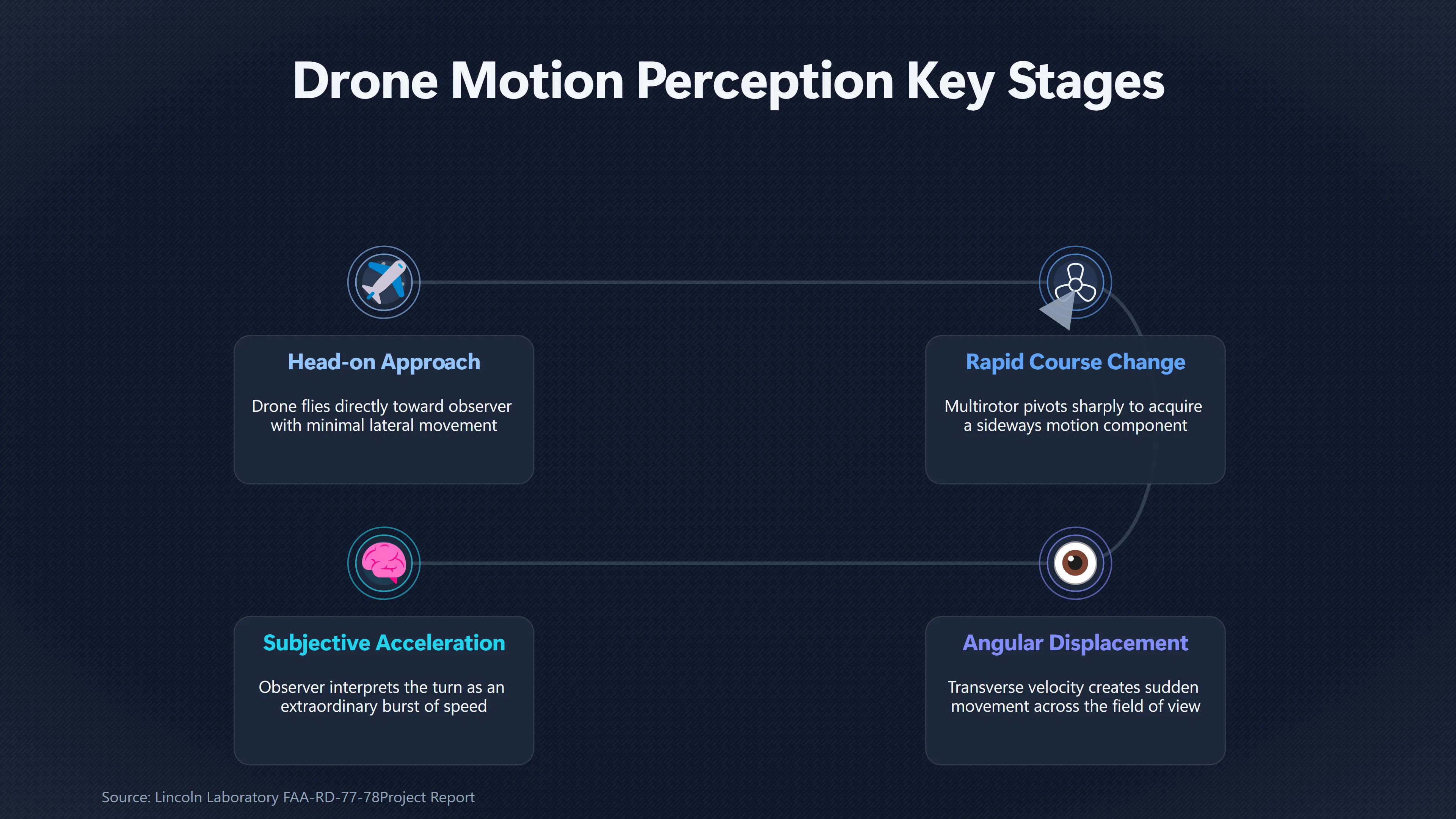
A drone does not have to hover and then perform an extraordinary burst of acceleration to create that impression. If it is flying almost directly towards or away from an observer, much of its velocity lies along the observer’s line of sight. Its bearing therefore changes very little, so a distant point of light can appear nearly stationary. When the drone turns and acquires a substantial sideways component of motion, its position suddenly begins changing against the sky. To the eye, the transition can look like “hovering, then shooting away”, even when the aircraft’s speed changed only modestly.
This is a particularly important trap in UFO/UAP reports because an unresolved light supplies poor information about distance, size and heading. Aviation guidance recognises the underlying geometry: an approaching aircraft on a nearly constant bearing can show little lateral or vertical apparent motion.[Federal Aviation Administration]faa.govFederal Aviation Administration Chapter 8. Medical Facts for PilotsFederal Aviation Administration Chapter 8. Medical Facts for Pilots A manoeuvrable multirotor can then make the illusion more convincing by changing direction rapidly.
How head-on flight hides motion
When watching an aircraft, the most obvious visual cue to movement is usually angular motion: how quickly its direction from the observer changes across the field of view. Physical speed and angular speed are not the same thing.
Imagine a drone travelling at constant speed. If it crosses from left to right, almost all of that movement is transverse to the observer’s line of sight, so its bearing changes continuously. Its motion is obvious. Turn the same flight path until the drone is coming almost straight towards the observer and the situation changes. The drone may cover tens or hundreds of metres while remaining in nearly the same direction in the sky.
This principle is familiar enough in aviation to be a safety concern. The US Federal Aviation Administration warns pilots that an aircraft showing no relative motion — remaining in one part of the visual field without appreciable lateral or vertical movement — may be on a collision course.[Federal Aviation Administration]faa.govFederal Aviation Administration Chapter 8. Medical Facts for PilotsFederal Aviation Administration Chapter 8. Medical Facts for Pilots An MIT Lincoln Laboratory analysis likewise describes the constant-bearing geometry of two aircraft on a collision course: as their range decreases, the angle at which one sees the other can remain constant.[MIT Lincoln Laboratory]ll.mit.eduLincoln Laboratory FAA-RD-77-78Project ReportMIT Lincoln LaboratoryFAA-RD-77-78Project Report…
The same geometry does not require a literal collision course to matter in a drone sighting. A drone merely has to be travelling sufficiently close to the observer’s viewing direction for its sideways angular displacement to be small. A slightly off-axis approach will drift slowly rather than remain perfectly fixed.
For a recognisable daytime aircraft, other clues may reveal what is happening: its silhouette gets larger, its orientation becomes clearer, or changing perspective reveals the approach. A small drone seen mainly as a light is much harder to judge. US night-flight rules illustrate just how conspicuous the light can be compared with the aircraft carrying it: Part 107 operations at night require suitable anti-collision lighting visible for at least three statute miles.[Federal Aviation Administration]faa.govFederal Aviation Administration Chapter 11. Unmanned Aircraft Systems (UASFederal Aviation Administration Chapter 11. Unmanned Aircraft Systems (UAS At sufficient distance, a witness can therefore detect the light while being unable to resolve the drone’s body or see its changing apparent size clearly.
Visual-perception research adds another complication. Absolute distance and speed cannot always be recovered reliably from retinal motion alone; different combinations of object size, distance and velocity can generate similar visual information.[CNS NYU]cns.nyu.eduCNS NYUPerception Lecture Notes: Visual Motion PerceptionCNS NYUPerception Lecture Notes: Visual Motion Perception A lone light against a dark or featureless sky strips away many of the contextual cues that would normally help resolve those ambiguities.
Why a turn can look like sudden acceleration
The striking part occurs when the drone changes course.
Suppose a drone has been flying towards an observer at 15 metres per second. From the observer’s viewpoint, its transverse velocity may initially be close to zero, so the light hardly moves across the sky. If the drone then turns through roughly 90 degrees while maintaining approximately the same overall speed, much of that 15 metres per second becomes transverse motion.
The observer consequently sees a rapid change from almost no angular movement to conspicuous angular movement. Subjectively, that can be interpreted as the object accelerating from a hover.
But those are different descriptions of what happened:
Apparent interpretation:
stationary → enormous acceleration → rapid departure.
Possible physical trajectory:
ordinary forward flight → rapid change of heading → ordinary sideways flight.
A multirotor makes this explanation more plausible than it would be for many conventional aeroplanes because multicopters genuinely are capable of sharp course changes, stops and reversals. Drone specialists interviewed by the Associated Press have noted that multicopters can stop abruptly, pivot sharply and reverse direction, while also stressing how difficult it is to identify a distant aircraft from little more than a light at night.[AP News]apnews.comAP News Is that a drone or a plane?Experts help explain the differencesDecember 16, 2024 — Distinguishing drones from planes and helicopters can be challenging from a dista…
Research platforms demonstrate how agile the underlying technology can be without invoking anything exotic. In experimental work on aggressive quadrotor control, researchers reported complex three-dimensional trajectories reaching 12.9 metres per second and accelerations of up to 2.1g.[arXiv]arxiv.orgAccurate Tracking of Aggressive Quadrotor Trajectories using Incremental Nonlinear Dynamic Inversion and Differential FlatnessSeptem… Those figures should not be treated as specifications for every consumer drone, but they establish the relevant point: a multicopter can change its velocity vector quickly enough for the geometry of a sighting to change abruptly.
The perceived jump in performance can therefore be greater than the actual one. The drone may indeed turn hard, but the observer is comparing two very different projections of its motion: first mostly along the line of sight, then largely across it.
Why distance can exaggerate the “shooting away” effect
Once the light starts crossing the observer’s field of view, estimating its actual speed introduces a second problem: range.
A witness can observe that a light has moved through a certain angle, but converting that angular displacement into metres requires knowing how far away it is. If the assumed distance is much too large, the inferred physical speed will also be much too large.
That matters especially for unresolved night lights. As one drone specialist told the Associated Press during the 2024 US drone-sighting wave, a distant light can provide remarkably little information about how far away the object actually is.[AP News]apnews.comAP News Is that a drone or a plane?Experts help explain the differencesDecember 16, 2024 — Distinguishing drones from planes and helicopters can be challenging from a dista… A small nearby object and a larger, more distant one can produce confusingly similar visual impressions, while visual-motion research explicitly recognises the trade-off between distance and speed in retinal information.[CNS NYU]cns.nyu.eduCNS NYUPerception Lecture Notes: Visual Motion PerceptionCNS NYUPerception Lecture Notes: Visual Motion Perception
Official UAP investigations provide concrete examples of why apparent motion should not automatically be translated into extraordinary physical velocity. In its Puerto Rico UAP analysis, the US All-domain Anomaly Resolution Office (AARO) reconstructed objects that appeared to move rapidly and concluded that they were travelling at roughly 3.6 metres per second, with the apparent high speed attributable to motion parallax involving the observing aircraft, sensor geometry and relative positions.[AARO]aaro.milPuerto Rico UAP Case ResolutionAARO Puerto Rico UAP Case ResolutionMarch 19, 2025…
The well-known Navy “Go Fast” video provides another cautionary example, although it involves a moving sensor platform rather than the specific stationary-observer drone geometry considered here. AARO reconstructed possible trajectories from the available video and concluded with high confidence that the object did not demonstrate anomalous speed. Its detailed analysis stresses that recovering physical velocity requires information about sensor direction, aircraft motion, object altitude and geometry rather than simply judging how rapidly an object crosses the image.[AARO]aaro.milGo Fast Case Resolution Card Methodology FinalUNCLASSIFIEDMay 10, 2026…
These cases are not evidence that any particular “hover then shoot away” report was a drone. They demonstrate the narrower analytical point: apparent angular speed is not, by itself, a measurement of physical speed.
What would distinguish geometry from extreme speed?
The key question is whether the object actually underwent an enormous change in velocity or merely underwent an ordinary course change that made previously hidden motion visible. A single eyewitness impression often cannot settle that question, but several observations can make the distinction much clearer.
Track the bearing before the apparent departure. If the light supposedly “hovered” while steadily changing in brightness or apparent size, that can be consistent with motion towards or away from the observer. A stable bearing is not proof of hovering. Aviation’s constant-bearing collision geometry is a useful warning against making that assumption.[Federal Aviation Administration]faa.govFederal Aviation Administration Chapter 8. Medical Facts for PilotsFederal Aviation Administration Chapter 8. Medical Facts for Pilots
Look for sideways drift before the turn. Even a nearly head-on trajectory may have a small transverse component. Stable video containing fixed stars, buildings, poles or other reference points can reveal gradual angular motion that was difficult to notice by eye.
Establish range independently. This is crucial. Radar, stereoscopic observations from separated locations, reliable telemetry or another independent distance measurement can transform an ambiguous angular observation into a useful physical-speed estimate. Without range, statements such as “it crossed a kilometre in a second” may merely encode an assumed distance rather than a measured one. NASA’s UAP study has emphasised the need for calibrated observations, multiple measurements and thorough sensor metadata precisely because sparse sightings often lack the information required for firm conclusions.[NASA]nasa.govUPDATE: NASA Shares UAP Independent Study Report; Names DirectorUPDATE: NASA Shares UAP Independent Study Report; Names Director
Preserve the original recording and metadata. Stabilised or cropped clips can make apparent motion harder to interpret because they conceal camera movement and field of view. AARO’s “Go Fast” methodology illustrates the importance — and difficulty — of reconstructing trajectories when original georeferenced position and heading data are unavailable.[AARO]aaro.milGo Fast Case Resolution Card Methodology FinalUNCLASSIFIEDMay 10, 2026…
Compare angular motion with a plausible drone trajectory. A sequence of near-constant bearing followed by increasing lateral angular speed is qualitatively what line-of-sight geometry predicts when an approaching or departing aircraft turns across the observer’s view. Conversely, independently measured range showing a genuinely enormous displacement over a very short interval would count against this explanation.
A dramatic departure is not automatically a dramatic acceleration
The main analytical risk is treating what happened in the observer’s field of view as though it directly described what happened to the aircraft’s velocity.
For a drone travelling nearly along the line of sight, substantial physical movement can produce little apparent sideways movement. Once the drone turns, the transverse component becomes visible and its angular motion can rise abruptly. Multirotor agility can sharpen that transition, while uncertain distance can magnify the speed subsequently attributed to it.
That combination is enough to produce a compelling UFO-like sequence: a light apparently hangs motionless, then seems to race away.
It is a plausible explanation, not an automatic diagnosis. A report backed by independent range, calibrated imagery or multiple synchronised viewpoints could demonstrate that an object really did accelerate dramatically. But where the evidence consists mainly of an unresolved light, uncertain distance and an eyewitness impression of “hovering followed by impossible speed”, line-of-sight geometry has to be tested before extraordinary acceleration is inferred.
Amazon book picks
Further Reading
Books and field guides related to Why a Hovering Light Can Suddenly Race Away. Use these as the next step if you want deeper reading beyond the article.
Small Unmanned Aircraft: Theory and Practice
Includes bibliographical references (p. [291]-298) and index.
The Pilot's Handbook of Aeronautical Knowledge
Pilot's Handbook of Aeronautical Knowledge, an official Federal Aviation Administration (FAA) Handbook; provides basic knowledge that is...
Human Factors in Aviation
Fully updated and expanded, the second edition of Human Factors in Aviation serves the needs of the widespread aviation community - stude...
Visual Perception
First Published in 2001. Routledge is an imprint of Taylor & Francis, an informa company.
eBay marketplace picks
Marketplace Samples
Live-tested eBay searches with available results related to this page.
Selected fromUFO poster oneBay.co.uk.



Current eBay listing
I Want To Believe UFO Poster Giclée Fine Art Heavyweight Print

Current eBay listing
VINTAGE UFO FLYING SAUCERS COMIC ADVERTISING A2 POSTER PRINT
Endnotes
1.
Source: ll.mit.edu
Title: Lincoln Laboratory FAA-RD-77-78Project Report
Link:https://www.ll.mit.edu/sites/default/files/publication/doc/2018-12/Harman_1977_ATC-76_WW-15318.pdf
Source snippet
MIT Lincoln LaboratoryFAA-RD-77-78Project Report...
2.
Source: cns.nyu.edu
Title: CNS NYUPerception Lecture Notes: Visual Motion Perception
Link:https://www.cns.nyu.edu/~david/courses/perception/lecturenotes/motion/motion.html
3.
Source: cns.nyu.edu
Title: CNS NYUPerception Lecture Notes: Depth, Size, and Shape
Link:https://www.cns.nyu.edu/~msl/courses/0022X/lecturenotes/depth/depth-size.html
4.
Source: arxiv.org
Link:https://arxiv.org/abs/1809.04048
Source snippet
Accurate Tracking of Aggressive Quadrotor Trajectories using Incremental Nonlinear Dynamic Inversion and Differential FlatnessSeptem...
5.
Source: aaro.mil
Title: Puerto Rico UAP Case Resolution
Link:https://www.aaro.mil/Portals/136/PDFs/case_resolution_reports/AARO_Puerto_Rico_UAP_Case_Resolution.pdf
Source snippet
AARO Puerto Rico UAP Case ResolutionMarch 19, 2025...
Published: March 19, 2025
6.
Source: aaro.mil
Title: Go Fast Case Resolution Card Methodology Final
Link:https://www.aaro.mil/Portals/136/PDFs/case_resolution_reports/AARO_GoFast_Case_Resolution_Card_Methodology_Final.pdf?ver=qXvjrruO_0MgtnTsfYnCEQ%3D%3D
Source snippet
UNCLASSIFIEDMay 10, 2026...
Published: May 10, 2026
7.
Source: aaro.mil
Title: Go Fast Case Resolution
Link:https://www.aaro.mil/Portals/136/PDFs/case_resolution_reports/AARO_GoFast_Case_Resolution_Card_Methodology_Final.pdf
8.
Source: nasa.gov
Title: UPDATE: NASA Shares UAP Independent Study Report; Names Director
Link:https://www.nasa.gov/news-release/update-nasa-shares-uap-independent-study-report-names-director/
9.
Source: science.gsfc.nasa.gov
Title: stella data
Link:https://science.gsfc.nasa.gov/stella/about/stella-data/
10.
Source: aaro.mil
Link:https://www.aaro.mil/Next-AARO-Home-redesign/Next-Parent/Next-AARO-UAP-Imagery-Acc-Table/
11.
Source: aaro.mil
Link:https://www.aaro.mil/Next-AARO-Home-redesign/Next-Parent/Next-UAP-Report-Documents/poster/dividLink/
12.
Source: science.nasa.gov
Link:https://science.nasa.gov/uap/faqs/
13.
Source: science.nasa.gov
Link:https://science.nasa.gov/uap/
14.
Source: aaro.mil
Link:https://www.aaro.mil/Next-AARO-Home-redesign/Next-Parent/Presidential-UAP-Transparency-Initiative/dvpmoduleid/77396/
15.
Source: science.nasa.gov
Title: hubble constant and tension
Link:https://science.nasa.gov/mission/hubble/science/science-behind-the-discoveries/hubble-constant-and-tension/
16.
Source: jpl.nasa.gov
Title: exploring the mystery of our expanding universe
Link:https://www.jpl.nasa.gov/edu/resources/teachable-moment/exploring-the-mystery-of-our-expanding-universe/
17.
Source: nasa.gov
Title: NAS A to Release, Discuss Unidentified Anomalous Phenomena Report
Link:https://www.nasa.gov/news-release/nasa-to-release-discuss-unidentified-anomalous-phenomena-report/
18.
Source: science.nasa.gov
Title: the moon illusion why does the moon look so big sometimes
Link:https://science.nasa.gov/solar-system/moon/the-moon-illusion-why-does-the-moon-look-so-big-sometimes/
19.
Source: nasa.gov
Title: NAS A Announces Unidentified Aerial Phenomena Study Team Members
Link:https://www.nasa.gov/general/nasa-announces-unidentified-aerial-phenomena-study-team-members/
20.
Source: aaro.mil
Link:https://www.aaro.mil/Next-AARO-Home-redesign/Next-Parent/Presidential-UAP-Transparency-Initiative/videoid/1010264/dvpcc/false/
21.
Source: aaro.mil
Link:https://www.aaro.mil/Next-AARO-Home-redesign/Next-Parent/Presidential-UAP-Transparency-Initiative/videoid/1007707/dvpcc/false/
22.
Source: podaac.jpl.nasa.gov
Title: SPURS2 XBAND
Link:https://podaac.jpl.nasa.gov/dataset/SPURS2_XBAND
23.
Source: podaac.jpl.nasa.gov
Title: SPURS2 SEAGLIDER
Link:https://podaac.jpl.nasa.gov/dataset/SPURS2_SEAGLIDER
24.
Source: podaac.jpl.nasa.gov
Title: SPURS2 SAILDRONE
Link:https://podaac.jpl.nasa.gov/dataset/SPURS2_SAILDRONE
25.
Source: science.nasa.gov
Title: what is cosmological redshift
Link:https://science.nasa.gov/asset/webb/what-is-cosmological-redshift/
26.
Source: nasa.gov
Title: Our Solar System’s First Known Interstellar Object Gets Unexpected Speed Boost
Link:https://www.nasa.gov/news-release/our-solar-systems-first-known-interstellar-object-gets-unexpected-speed-boost/
27.
Source: nasa.gov
Title: Solar System’s First Interstellar Visitor Dazzles Scientists
Link:https://www.nasa.gov/missions/solar-systems-first-interstellar-visitor-dazzles-scientists/
28.
Source: nasa.gov
Title: Small Asteroid or Comet ‘Visits’ from Beyond the Solar System
Link:https://www.nasa.gov/solar-system/small-asteroid-or-comet-visits-from-beyond-the-solar-system/
29.
Source: ntrs.nasa.gov
Link:https://ntrs.nasa.gov/citations/20170005859
30.
Source: ntrs.nasa.gov
Link:https://ntrs.nasa.gov/citations/20170003878
31.
Source: apod.nasa.gov
Link:https://apod.nasa.gov/apod/ap111018.html
32.
Source: podaac.jpl.nasa.gov
Title: ASCATA L2 25km
Link:https://podaac.jpl.nasa.gov/dataset/ASCATA-L2-25km
33.
Source: pds.nasa.gov
Title: view Profile.jsp
Link:https://pds.nasa.gov/ds-view/pds/viewProfile.jsp?dsid=ULY-D-UDDS-5-DUST-V3.1
34.
Source: science.gsfc.nasa.gov
Title: indigo usera
Link:https://science.gsfc.nasa.gov/attic/indigo/indigo_usera.html
35.
Source: cns.nyu.edu
Link:https://www.cns.nyu.edu/~david/courses/perception/lecturenotes/motion/motion-12-7-2004.html
36.
Source: cns.nyu.edu
Title: motion 5 1999
Link:https://www.cns.nyu.edu/~david/courses/perception/lecturenotes/motion/motion-5-1999.html
37.
Source: ntrs.nasa.gov
Link:https://ntrs.nasa.gov/citations/19970010712
38.
Source: ntrs.nasa.gov
Link:https://ntrs.nasa.gov/citations/20050000268
39.
Source: ntrs.nasa.gov
Link:https://ntrs.nasa.gov/search.jsp?R=19920041688
40.
Source: ntrs.nasa.gov
Link:https://ntrs.nasa.gov/search.jsp?R=19910068997
41.
Source: ntrs.nasa.gov
Link:https://ntrs.nasa.gov/citations/19880009710
42.
Source: ntrs.nasa.gov
Link:https://ntrs.nasa.gov/citations/19880055706
43.
Source: ntrs.nasa.gov
Link:https://ntrs.nasa.gov/citations/19800011510
44.
Source: ntrs.nasa.gov
Link:https://ntrs.nasa.gov/citations/19770033407
45.
Source: aaro.mil
Link:https://www.aaro.mil/FAQ/
46.
Source: aaro.mil
Link:https://www.aaro.mil/
47.
Source: aaro.mil
Link:https://www.aaro.mil/Next-AARO-Home-redesign/Inactive-Parent/FAQ-Datatable/
48.
Source: aaro.mil
Link:https://www.aaro.mil/UAP-Cases/Official-UAP-Imagery/ftag/MSF0951a18/
49.
Source: aaro.mil
Link:https://www.aaro.mil/UAP-Cases/Official-UAP-Imagery/4/
50.
Source: aaro.mil
Link:https://www.aaro.mil/Next-AARO-Home-redesign/Next-Parent/Next-UAP-Case-RR-Data-Table/
51.
Source: aaro.mil
Title: AAR O UAP Trends All-domain Anomaly Resolution Office UAP REPORTING TRENDS
Link:https://www.aaro.mil/UAP-Cases/UAP-Reporting-Trends/
52.
Source: aaro.mil
Link:https://www.aaro.mil/Next-AARO-Home-redesign/Next-Parent/AARO-UAP-Case-Resolution-DT/
53.
Source: aaro.mil
Link:https://www.aaro.mil/Next-AARO-Home-redesign/Next-Parent/Next-AARO-UAP-Imagery-Fixed-Table/
54.
Source: aaro.mil
Link:https://www.aaro.mil/Next-AARO-Home-redesign/Inactive-Parent/Next-UAP-Imagery-dup/
55.
Source: aaro.mil
Link:https://www.aaro.mil/Next-AARO-Home-redesign/Next-Parent/AARO-UAP-Case-DT/
56.
Source: cns.nyu.edu
Title: depth size
Link:https://www.cns.nyu.edu/~david/courses/perception/lecturenotes/depth/depth-size.html
57.
Source: cns.nyu.edu
Title: depth size 11 30 2004
Link:https://www.cns.nyu.edu/~david/courses/perception/lecturenotes/depth/depth-size-11-30-2004.html
58.
Source: cns.nyu.edu
Title: outline motion
Link:https://www.cns.nyu.edu/~david/courses/perception/outlines/outline-motion.html
59.
Source: www1.grc.nasa.gov
Title: side forces
Link:https://www1.grc.nasa.gov/beginners-guide-to-aeronautics/side-forces/
60.
Source: eclipse2017.nasa.gov
Title: exploring angular diameter
Link:https://eclipse2017.nasa.gov/exploring-angular-diameter
61.
Source: apod.nasa.gov
Title: nslens effects
Link:https://apod.nasa.gov/htmltest/gifcity/nslens_effects.html
62.
Source: faa.gov
Title: Federal Aviation Administration Chapter 8. Medical Facts for Pilots
Link:https://www.faa.gov/Air_traffic/publications/atpubs/aim_html/chap8_section_1.html
63.
Source: faa.gov
Title: Federal Aviation Administration Chapter 11. Unmanned Aircraft Systems (UAS)
Link:https://www.faa.gov/air_traffic/publications/atpubs/aim_html/chap11_section_8.html
64.
Source: apnews.com
Title: AP News Is that a drone or a plane?
Link:https://apnews.com/article/57a0d051a2a94d21787089ceaf47b175
Source snippet
Experts help explain the differencesDecember 16, 2024 — Distinguishing [drones]({{ 'drones/' | relative_url }}) from planes and helicopters can be challenging from a dista...
Published: December 16, 2024
65.
Source: faa.gov
Title: Aviation Handbooks & Manuals | Federal Aviation Administration
Link:https://www.faa.gov/regulations_policies/handbooks_manuals/aviation
66.
Source: faa.gov
Link:https://www.faa.gov/newsroom/small-unmanned-aircraft-systems-uas-regulations-part-107
67.
Source: faa.gov
Title: There’s More to VLOS Than Meets the Eye | Federal Aviation Administration
Link:https://www.faa.gov/blog/clearedfortakeoff/theres-more-vlos-meets-eye
68.
Source: faa.gov
Title: faa h 8083 28b aviation weather handbook
Link:https://www.faa.gov/regulationspolicies/handbooksmanuals/aviation/faa-h-8083-28b-aviation-weather-handbook
69.
Source: faa.gov
Title: Part 107 Airspace Authorizations | Federal Aviation Administration
Link:https://www.faa.gov/uas/commercial_operators/part_107_airspace_authorizations
70.
Source: faa.gov
Title: UA S Traffic Management (UTM) Field Test | Federal Aviation Administration
Link:https://www.faa.gov/uas/research_development/traffic_management/field_test
71.
Source: faa.gov
Title: Handbooks & Manuals | Federal Aviation Administration
Link:https://www.faa.gov/regulations_policies/handbooks_manuals
72.
Source: faa.gov
Title: Chapter 1
Link:https://www.faa.gov/regulationspolicies/handbooksmanuals/aviation/phak/chapter-1-introduction-flying
73.
Source: faa.gov
Title: Airplane Flying Handbook | Federal Aviation Administration
Link:https://www.faa.gov/regulations_policies/handbooks_manuals/aviation/airplane_handbook
74.
Source: academy.faa.gov
Link:https://academy.faa.gov/catalog/CPNT/Details/9340
75.
Source: faa.gov
Title: pilots handbook aeronautical knowledge faa h 8083 25b
Link:https://www.faa.gov/aviation/phak/pilots-handbook-aeronautical-knowledge-faa-h-8083-25b
76.
Source: faa.gov
Title: Chapter 8. Medical Facts for Pilots
Link:https://www.faa.gov/air_traffic/publications/atpubs/aim/aim0801.html
77.
Source: bhxb.buaa.edu.cn
Title: buaa.edu.cn Target observability criteria from bearing-rate-only measurements
Link:https://bhxb.buaa.edu.cn/bhzk/en/article/Y2011/I5/534
78.
Source: academy.faa.gov
Link:https://academy.faa.gov/catalog/CPNT/Details?id=9346
79.
Source: faa.gov
Link:https://www.faa.gov/Air_traffic/publications/atpubs/aim_html/chap3_section_1.html
80.
Source: faa.gov
Link:https://www.faa.gov/faq/there-standard-3-mile-visibility-requirement-twilight-operations-terms-lighting-colors
81.
Source: faa.gov
Title: EN R 1.15: Medical Facts for Pilots7.. JUDGMENT ASPECTS OF COLLISION AVOIDANCE 1
Link:https://www.faa.gov/air_traffic/publications/atpubs/aip_html/part2_enr_section_1.15.html
82.
Source: faa.gov
Link:https://www.faa.gov/faq/beyond-visual-line-sight-bvlos-operations-are-anti-collision-lights-required
83.
Source: faa.gov
Link:https://www.faa.gov/air_traffic/publications/atpubs/atc_html/chap1_section_2.html
84.
Source: faa.gov
Link:https://www.faa.gov/air_traffic/publications/atpubs/aip_html/chap11_section_4.html
85.
Source: faa.gov
Link:https://www.faa.gov/air_traffic/publications/atpubs/atc_html/chap7_section_2.html
86.
Source: faa.gov
Link:https://www.faa.gov/air_traffic/publications/atpubs/aip_html/part2_enr_section_1.1.html
87.
Source: bhxb.buaa.edu.cn
Link:https://bhxb.buaa.edu.cn/bhzk/article/id/11957
88.
Source: astronomy.swin.edu.au
Link:https://astronomy.swin.edu.au/cosmos/%2A/Velocity
89.
Source: astronomy.swin.edu.au
Link:https://astronomy.swin.edu.au/cosmos/%2A/Transverse%2Bvelocity
90.
Source: astronomy.swin.edu.au
Link:https://astronomy.swin.edu.au/cosmos/p/Proper%2Bmotion
91.
Source: astronomy.swinburne.edu.au
Link:https://astronomy.swinburne.edu.au/cosmos/A/Angular%2BVelocity
92.
Source: mathworks.com
Link:https://www.mathworks.com/help/uav/ref/multirotor.html
93.
Source: w3.phys.nthu.edu.tw
Link:https://w3.phys.nthu.edu.tw/~hkchang/ga1/ch07-01.htm
Additional References
94.
Source: youtube.com
Title: UFO Videos Explained: Mick West’s Expert Analysis
Link:https://www.youtube.com/watch?v=-_4QF__92q0
Source snippet
This selection of videos explains how motion parallax, line-of-sight perspective shifts, and camera geometry create the illusion of hover...
95.
Source: youtube.com
Link:https://www.youtube.com/watch?v=wFaBB4cMHUU
Source snippet
The SHOCKING Math Error Behind Viral UFO Videos | Mick West...
96.
Source: nature.com
Link:https://www.nature.com/articles/37359
97.
Source: youtube.com
Title: The SHOCKING Math Error Behind Viral UFO Videos | Mick West
Link:https://www.youtube.com/watch?v=ypfbhfEXnBo
Source snippet
The "Windfarm UFO" - analyzed, 3D-recreated and debunked...
98.
Source: youtube.com
Title: The Truth Behind Famous UFO Sightings
Link:https://www.youtube.com/watch?v=q0Gv9TWY774
Source snippet
Charlie Kirk Conspiracies, Missile Vs. Mystery Orb, & UFO Cults EXPOSED | Mick West...
99.
Source: youtube.com
Title: The “Windfarm UFO”
Link:https://www.youtube.com/watch?v=xkgTajUDORs
Source snippet
UFO Videos Explained: Mick West's Expert Analysis...
100.
Source: metabunk.org
Link:https://www.metabunk.org/threads/go-fast-footage-from-tom-delonges-to-the-stars-academy-bird-balloon.9569/page-14
101.
Source: researchgate.net
Link:https://www.researchgate.net/publication/235190081_Necessary_and_Sufficient_Observability_Conditions_for_Bearings-Only_Target_Motion_Analysis
102.
Source: researchgate.net
Link:https://www.researchgate.net/publication/258339423_Vision-Based_Estimation_of_Airborne_Target_Pseudobearing_Rate_using_Hidden_Markov_Model_Filters
103.
Source: visualexpert.com
Link:https://www.visualexpert.com/Resources/crashcourse.html