Within Then vs Now
Why Starlink Created a New UFO Look
Dense satellite constellations introduced lines, clusters and bright flares that earlier UFO investigators never had to consider.
On this page
- Why newly launched satellites appear in trains
- How reflected sunlight produces bright flares
- Why constellation checks now matter in UFO identification
Page outline Jump by section
Introduction
Starlink changed the visual vocabulary of UFO and UAP reports. Before large commercial satellite constellations, investigators certainly had to consider satellites, and bright satellite flares were already known. What did not exist in the Project Blue Book era was a system routinely placing dozens of similar spacecraft into low Earth orbit together, followed by thousands of operational satellites capable of producing repeated reflections across the same part of the sky.
The result is two particularly modern-looking phenomena. Newly deployed Starlink satellites can form a conspicuous train: a procession of lights following the same path. Once dispersed into operational orbits, individual satellites can produce brief flares or glints when their surfaces reflect sunlight towards an observer. Multiple flares can appear, disappear and recur in a restricted area of sky, sometimes creating the impression of manoeuvring lights or luminous objects flying in formation. The US All-domain Anomaly Resolution Office (AARO) now treats both satellite trains and flares as specific UAP-identification problems.[AARO]aaro.milCorrelations of Starlink Satellite Flaring with UAP ObservationsCorrelations of Starlink Satellite Flaring with UAP Observations…
Why newly launched satellites appear in trains
The distinctive Starlink train is a consequence of how the constellation is deployed. SpaceX’s first major Starlink deployment in May 2019 placed 60 satellites into low Earth orbit in a single launch, immediately demonstrating a sight that earlier generations of UFO investigators simply could not have encountered.[World Economic Forum]weforum.orgWorld Economic ForumWatch the launch of Space X's first Starlink satellites | World Economic ForumMay 24, 2019…
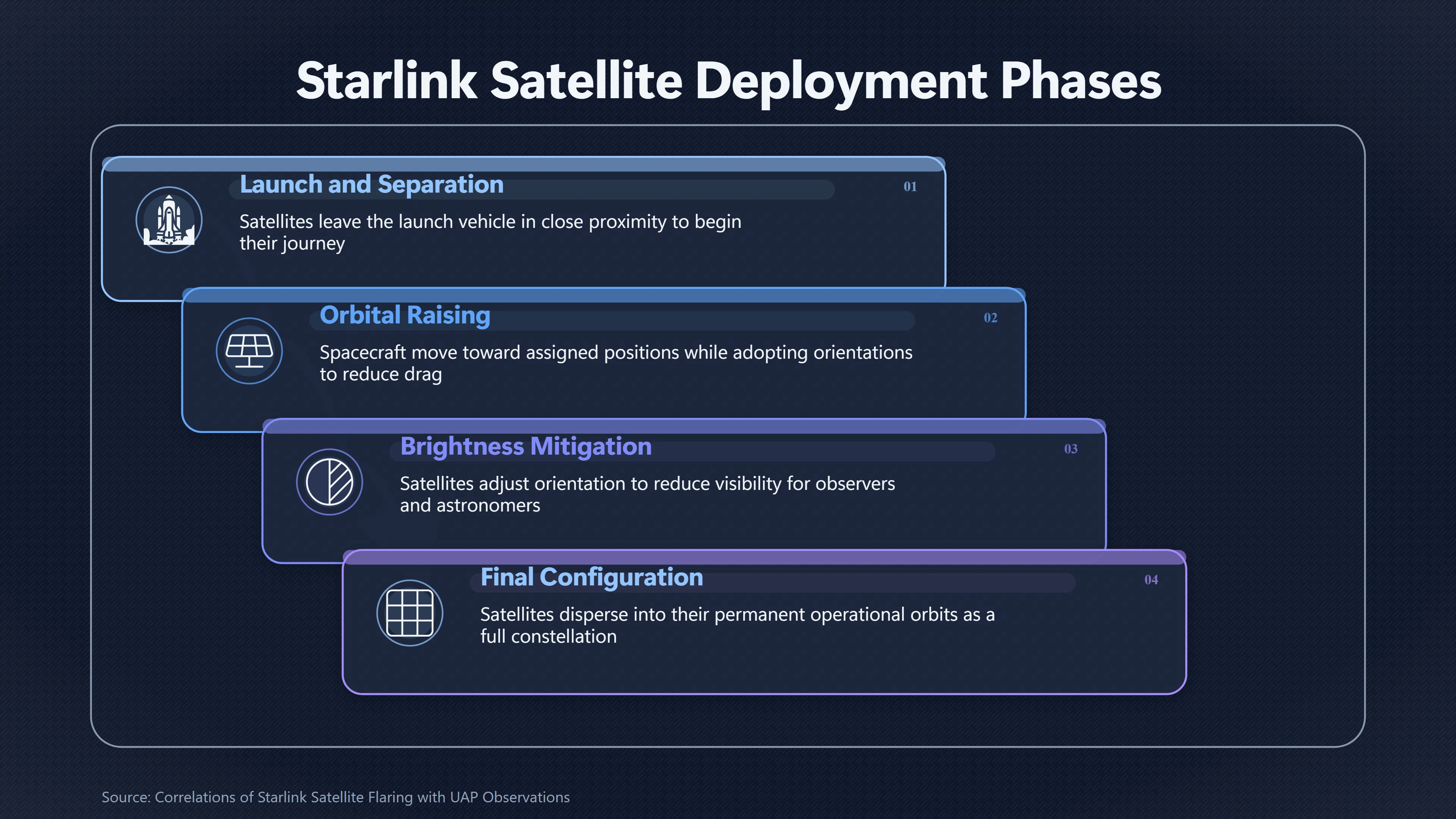
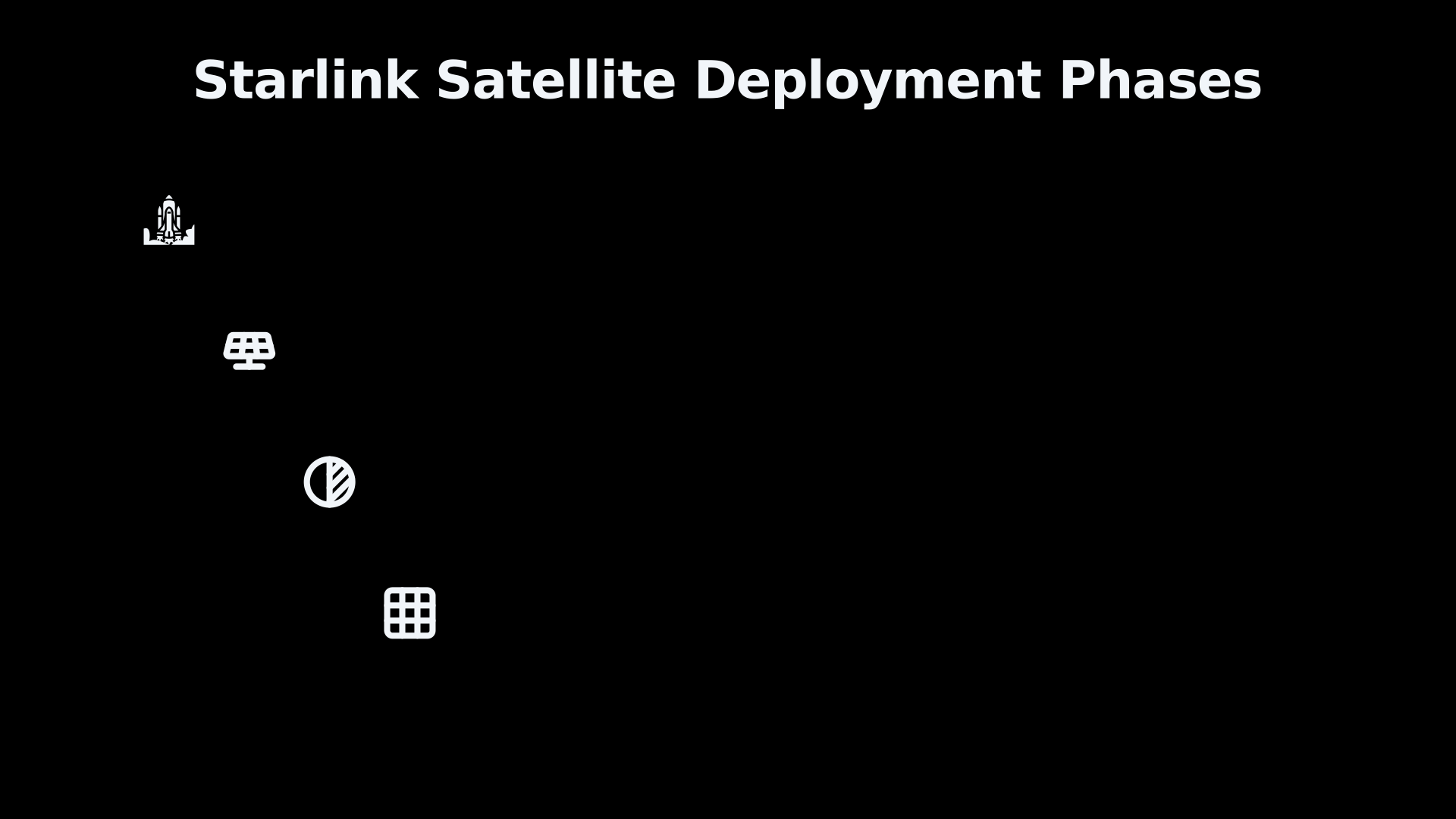
After deployment, the satellites do not instantly occupy widely separated operational positions. They separate from the launch vehicle relatively close together and then gradually move towards their assigned orbital locations. AARO describes three relevant phases: launch and separation, orbital raising, and the final operational configuration. During orbital raising, the satellites adopt an orientation intended to reduce atmospheric drag, with their solar panels positioned in a way that can make the group conspicuous when illuminated by the Sun.[AARO]aaro.milCorrelations of Starlink Satellite Flaring with UAP ObservationsCorrelations of Starlink Satellite Flaring with UAP Observations…
From the ground, this can produce the famous line or “string of pearls”: numerous points of light travelling across the sky one behind another. The configuration is temporary. AARO notes that immediately after launch and for several days afterwards, the spacecraft can form a distinctive bright line before becoming less conspicuous as they ascend and disperse.[AARO]aaro.milCorrelations of Starlink Satellite Flaring with UAP ObservationsCorrelations of Starlink Satellite Flaring with UAP Observations…
That pattern matters to UFO identification because it violates many people’s intuitive picture of what a satellite should look like. A single steadily moving point is easy to recognise once someone has learnt to spot satellites. Twenty, thirty or more apparently coordinated lights following one another can instead resemble a formation, a procession of aircraft or a much larger object marked by multiple lights.
The phenomenon has also evolved as Starlink hardware and operating procedures have changed. Photometric research on Starlink V2 Mini satellites during orbital raising found a large brightness difference associated with a change in spacecraft orientation at roughly 357 kilometres altitude. Below that threshold the observed mean apparent magnitude was 2.68, compared with 6.46 above it; after correcting for distance, the researchers estimated that the mitigation reduced brightness by about 93 per cent. The important point for UFO investigation is that a satellite’s visibility cannot be inferred merely from the fact that it belongs to Starlink: its altitude, generation and operating orientation matter too.[arXiv]arxiv.orgarXiv The Brightness of Starlink Mini Satellites During Orbit-RaisingThe Brightness of Starlink Mini Satellites During Orbit-RaisingMay 20, 2024…
How reflected sunlight creates bright flares
The train is only the most recognisable Starlink signature. A more deceptive form appears after the satellites have spread into their operational constellation.
Satellites generally do not look bright because they are shining lights towards the ground. They are visible primarily because they reflect sunlight. Two kinds of reflection are especially important. Diffuse reflection scatters incoming light across many directions, allowing a satellite to resemble a relatively steady moving star. Specular reflection is more mirror-like: light is concentrated into a much narrower direction. If the Sun, satellite surface and observer happen to align correctly, the observer can receive an intense but short-lived flash.[AARO]aaro.milCorrelations of Starlink Satellite Flaring with UAP ObservationsCorrelations of Starlink Satellite Flaring with UAP Observations…
Satellite flares themselves are older than Starlink. The Iridium communications constellation became famous for predictable flares in the 1990s and 2000s. What Starlink altered was the scale and geometry of the problem. AARO says Starlink’s design and operation have produced a significant increase in sightings of satellite flares, while the sheer number of spacecraft means that several satellites can produce reflections within the same restricted region of sky.[AARO]aaro.milCorrelations of Starlink Satellite Flaring with UAP ObservationsCorrelations of Starlink Satellite Flaring with UAP Observations…
Starlink spacecraft contain surfaces with quite different reflective properties. AARO describes flat antenna arrays and mirrored panels on the Earth-facing satellite bus, while research into satellite brightness has shown that apparent magnitude varies strongly with the relative positions of the observer, spacecraft and Sun. Measurements of Starlink brightness have documented both strong directional scattering and brief brightness surges.[AARO]aaro.milCorrelations of Starlink Satellite Flaring with UAP ObservationsCorrelations of Starlink Satellite Flaring with UAP Observations…
Under favourable geometry, these reflections can become strikingly bright. Research by Anthony Mallama and Richard Cole found that Starlink spacecraft can undergo extreme specular flaring, and applied their model to an event reported as UAP by commercial pilots. A related account in Sky & Telescope reported observed Starlink flares reaching magnitude −2, while the reconstructed pilot sighting was approximately magnitude −4 — around the brightness of Venus.[arXiv]arxiv.orgarXiv Extreme Flaring of Starlink SatellitesExtreme Flaring of Starlink SatellitesMay 21, 2024…
Brightness mitigation does not eliminate the identification problem. Different generations of Starlink have used measures including sunshades, reflective treatments and altered orientations to reduce their effect on astronomy. Measurements indicate that these measures can substantially reduce average brightness, but they do not prevent every favourable geometry from producing a conspicuous reflection.[arXiv]arxiv.orgarXiv Assessment of Brightness Mitigation Practices for Starlink SatellitesAssessment of Brightness Mitigation Practices for Starlink SatellitesSeptember 25, 2023…
Why flares can look like manoeuvring UFOs
This is where Starlink most clearly changed the character of satellite-related UFO reports. A train looks unusual but behaves fairly intuitively once recognised: the lights follow one another along an orbital track. Multiple operational satellites flaring in succession can create a much stranger visual impression.
AARO explains that operational Starlink satellites can produce very bright reflections inside a comparatively small region it calls the flare window. Several satellites travelling on different orbital tracks may flare within that window at roughly the same time. To an observer who cannot see the much dimmer satellites before and after their individual flares, the visible scene consists mainly of lights that suddenly materialise, brighten, move for a short interval and disappear.[AARO]aaro.milCorrelations of Starlink Satellite Flaring with UAP ObservationsCorrelations of Starlink Satellite Flaring with UAP Observations…
That distinction is crucial. The eye is not necessarily following one continuously visible object. It may instead be seeing a sequence of separate satellites becoming visible only when each crosses favourable reflection geometry. AARO notes that simultaneous or successive flares can therefore appear like glowing orbs that vanish and reappear, spinning lights or points tracing apparent geometric shapes such as triangles.[AARO]aaro.milCorrelations of Starlink Satellite Flaring with UAP ObservationsCorrelations of Starlink Satellite Flaring with UAP Observations…
The illusion becomes particularly persuasive when the observer mentally groups separate flashes into a single event. One satellite brightens here, another appears slightly displaced, a third brightens elsewhere, and the first fades. Without orbital information, the sequence can be interpreted as one light changing direction or several lights circling one another. The underlying satellites, however, can continue travelling along ordinary orbital trajectories.
Amateur astronomical observations independently demonstrate this clustering effect. Sky & Telescope reported groups of operational Starlink satellites repeatedly flaring within a moving region of sky. Satellite observers found that the flare zone itself shifts during the night according to the Sun-satellite-observer geometry.[Sky & Telescope]skyandtelescope.orgOpen source on skyandtelescope.org.
This makes “I know what a Starlink train looks like, and this was not one” an insufficient exclusion test. A Starlink train and operational Starlink flares are different appearances produced at different stages of the satellites’ lives. Recognising the familiar procession of recently launched satellites does not necessarily prepare an observer for isolated or clustered glints from spacecraft that have already dispersed.

Airline pilots exposed a particularly convincing version
High-altitude aircraft provide one of the clearest demonstrations of why Starlink has complicated modern UAP identification. Pilots are experienced observers of aircraft and atmospheric lights, but they also have a different horizon from people standing on the ground. From cruising altitude they can see farther over Earth’s curvature, potentially remaining within favourable satellite-reflection geometry for longer.
AARO specifically notes that satellite trains and flares are visible from aircraft and that an airborne observer has a greater line of sight to the horizon. A pilot flying east-to-west after sunset towards the Sun’s direction, or west-to-east before sunrise, can remain within the relevant reflection geometry for an extended period.[AARO]aaro.milCorrelations of Starlink Satellite Flaring with UAP ObservationsCorrelations of Starlink Satellite Flaring with UAP Observations…
A particularly useful case occurred over the Pacific on 10 August 2022. Five pilots aboard two commercial aircraft reported unusual bright objects and obtained photographs and video. Researchers subsequently combined the aircraft’s Automatic Dependent Surveillance–Broadcast (ADS-B) flight data with orbital information for a Starlink group launched that same day. Their reconstruction identified the apparent UAP as a closely spaced Starlink train seen under unusual illumination conditions.[arXiv]arxiv.orgOpen source on arxiv.org.
The episode is valuable because it goes beyond simply saying that satellites were somewhere overhead. The investigators could reconstruct the aircraft position, satellite positions and viewing geometry and compare them with the photographs. The elongated light in one pilot image matched the closely spaced satellite group; brightness measurements indicated an apparent magnitude of roughly −4.[Sky & Telescope]skyandtelescope.orgSky & Telescope Starlink Flares Can Fool Anyone — Even Airline PilotsSky & TelescopeStarlink Flares Can Fool Anyone — Even Airline Pilots - Sky & Telescope…
Reports by pilots of apparently recurring or circling lights have sometimes acquired the informal label “racetrack” UAP. Not every report with that description should automatically be declared Starlink, but the flare mechanism shows how a succession of independently moving satellites can generate something much less intuitive than the familiar straight satellite train. That is precisely why an orbital check is necessary rather than identification by visual resemblance alone.
Why constellation checks now matter in UFO identification
The practical change for investigators is straightforward: satellite deconfliction has become a routine part of serious UFO analysis. Seeing that Starlink was generally “visible that night” is not enough, but neither is dismissing satellites because the witness did not see a textbook Starlink train.
A useful Starlink test needs several pieces of information: the observer’s location, an accurate date and time, viewing direction and elevation, and orbital data for candidate satellites. For flare cases, the position of the Sun below the horizon also matters because reflection geometry determines where a bright glint can occur. AARO’s own procedure therefore works from the observer’s latitude and longitude, date, time, solar altitude and azimuth, and expected satellite elevation.[AARO]aaro.milCorrelations of Starlink Satellite Flaring with UAP ObservationsCorrelations of Starlink Satellite Flaring with UAP Observations…
AARO tested this approach in Nebraska in March 2024. Its personnel calculated when and where the expected Starlink flare window should appear, then photographed actual flares. The measured directions and elevations fell within the predicted ranges. This is important methodologically: the satellite explanation is capable of producing a prediction about where the lights should be, rather than merely being attached to a sighting afterwards.[AARO]aaro.milCorrelations of Starlink Satellite Flaring with UAP ObservationsCorrelations of Starlink Satellite Flaring with UAP Observations…
Orbital catalogues make much more detailed reconstruction possible.[CelesTrak's supplemental orbital data]celestrak.orgOpen source on celestrak.org. include Starlink information derived from SpaceX ephemeris data, including launch-specific pre-deployment and post-deployment sets. Such information allows investigators to ask the relevant question: not merely whether satellites existed in the region, but whether particular spacecraft occupied positions consistent with the witness’s line of sight at the reported time.[CelesTrak]celestrak.orgOpen source on celestrak.org.
That distinction prevents “Starlink” from becoming a catch-all explanation. A credible identification should reproduce important features of the observation — timing, direction, angular position and movement — and, for a proposed flare, should make sense under the illumination geometry. If those elements do not agree, the existence of thousands of Starlink satellites does not by itself resolve the case.
The new satellite signature
Starlink therefore represents more than an increase in the number of satellites. It created combinations of appearance and frequency that changed what a satellite-generated UFO report can look like.
A satellite report can now involve a long procession of regularly spaced lights after a launch; an extremely bright isolated point that appears and fades rapidly; or several lights repeatedly emerging in the same region of sky as different satellites enter favourable reflection geometry. AARO’s December 2024 paper explicitly concluded that both diffuse and specular sunlight reflection from satellites can explain some UAP reports and distinguished the closely grouped satellite train from the short-lived satellite flare.[AARO]aaro.milCorrelations of Starlink Satellite Flaring with UAP ObservationsCorrelations of Starlink Satellite Flaring with UAP Observations
The scale is also historically important. When AARO prepared its analysis in late 2024, it counted more than 6,700 Starlink satellites in orbit. By late July 2026, published tracking figures put the constellation at more than 10,800 spacecraft.[AARO]aaro.milCorrelations of Starlink Satellite Flaring with UAP ObservationsCorrelations of Starlink Satellite Flaring with UAP Observations… The identification problem introduced in 2019 has therefore become a persistent feature of the modern sky rather than an occasional curiosity.
This is the central contrast with the Blue Book era. Earlier investigators knew that artificial satellites and reflected sunlight could produce unusual observations, but they did not inhabit a sky filled with thousands of nearly related spacecraft distributed through a commercial mega-constellation, nor did they encounter freshly deployed batches producing lines of dozens of moving lights. Modern UFO investigation has consequently acquired a new first-line question: where were the satellite constellations, and how were they illuminated?
That question does not explain every unidentified light. It does something more useful: it identifies a large, modern and testable source of reports whose appearance can be far stranger than the word “satellite” suggests.
Amazon book picks
Further Reading
Books and field guides related to Why Starlink Created a New UFO Look. Use these as the next step if you want deeper reading beyond the article.
NightWatch: A Practical Guide to Viewing the Universe
A practical guide to viewing the universe.
The Backyard Astronomer's Guide
Discusses the practical aspects of stargazing, including how to choose appropriate equipment, contending with light pollution, taking suc...
Turn Left at Orion
With over 100,000 copies sold since first publication, this is one of the most popular astronomy books of all time. It is a unique guideb...
Fundamentals of Astrodynamics
Rating: 4.5/5 from 12 Google Books ratings
Teaching text developed by U.S. Air Force Academy and designed as a first course emphasizes the universal variable formulation. Develops...
eBay marketplace picks
Marketplace Samples
Live-tested eBay searches with available results related to this page.
Selected fromStarlink satellite model oneBay.co.uk.
References
Endnotes
1.
Source: aaro.mil
Title: Correlations of Starlink Satellite Flaring with UAP Observations
Link:https://www.aaro.mil/Portals/136/PDFs/Information%20Papers/AARO_Satellite_Flaring_Paper.pdf
Source snippet
Correlations of Starlink Satellite Flaring with UAP Observations...
2.
Source: arxiv.org
Title: arXiv The Brightness of Starlink Mini Satellites During Orbit-Raising
Link:https://arxiv.org/abs/2405.12007
Source snippet
The Brightness of Starlink Mini Satellites During Orbit-RaisingMay 20, 2024...
Published: May 20, 2024
3.
Source: arxiv.org
Title: arXiv Satellite Optical Brightness
Link:https://arxiv.org/abs/2305.11123
4.
Source: arxiv.org
Link:https://arxiv.org/abs/2111.09735
5.
Source: arxiv.org
Title: arXiv Extreme Flaring of Starlink Satellites
Link:https://arxiv.org/abs/2405.13091
Source snippet
Extreme Flaring of Starlink SatellitesMay 21, 2024...
Published: May 21, 2024
6.
Source: arxiv.org
Title: arXiv Assessment of Brightness Mitigation Practices for Starlink Satellites
Link:https://arxiv.org/abs/2309.14152
Source snippet
Assessment of Brightness Mitigation Practices for Starlink SatellitesSeptember 25, 2023...
Published: September 25, 2023
7.
Source: arxiv.org
Title: arXiv Simulated impact on LSST data of Starlink V1.5 and V2 satellites
Link:https://arxiv.org/abs/2506.19092
8.
Source: arxiv.org
Link:https://arxiv.org/abs/2403.08155
9.
Source: celestrak.org
Link:https://celestrak.org/NORAD/elements/supplemental/
10.
Source: aaro.mil
Title: Correlations of Starlink Satellite Flaring with UAP Observations
Link:https://www.aaro.mil/Portals/136/PDFs/Information%20Papers/AARO_Satellite_Flaring_Paper_508_FINAL_04222025.pdf
11.
Source: celestrak.org
Title: Celes Trak: Current Supplemental GP Element Sets
Link:https://celestrak.org/NORAD/elements/supplemental/?FORMAT=csv
13.
Source: celestrak.org
Title: Celes Trak: Current Supplemental GP Element Sets
Link:https://www.celestrak.org/NORAD/elements/supplemental/index.php?FORMAT=kvn
14.
Source: celestrak.org
Title: Celes Trak: Current Supplemental GP Element Sets
Link:https://celestrak.org/NORAD/elements/supplemental/index.php?FORMAT=2le
16.
Source: celestrak.org
Title: Celes Trak: Current Supplemental GP Element Sets
Link:https://www.celestrak.org/NORAD/elements/supplemental/index.php?FORMAT=json-pretty
17.
Source: celestrak.org
Title: Celes Trak: Current Supplemental GP Element Sets
Link:https://www.celestrak.org/NORAD/elements/supplemental/index.php?FORMAT=csv
18.
Source: celestrak.org
Title: Celes Trak: Current Supplemental GP Element Sets
Link:https://celestrak.org/NORAD/elements/supplemental/index.php?FORMAT=xml
20.
Source: celestrak.org
Title: Celes Trak: Current Supplemental GP Element Sets
Link:https://www.celestrak.org/NORAD/elements/supplemental/index.php?FORMAT=json
21.
Source: spacex.com
Title: Space X
Link:https://www.spacex.com/[launches
22.
Source: spacex.com
Title: Space X
Link:https://www.spacex.com/launches/sl
23.
Source: spacex.com
Title: Space X
Link:https://www.spacex.com/launches/sl
24.
Source: spacex.com
Title: Space X
Link:https://www.spacex.com/launches/sl
25.
Source: starlink.com
Link:https://starlink.com/mh/updates
26.
Source: starlink.com
Link:https://starlink.com/bd/updates
27.
Source: spacex.com
Title: Space X
Link:https://www.spacex.com/launches/sl
28.
Source: celestrak.org
Title: Celes Trak: Current Supplemental GP Element Sets
Link:https://celestrak.org/NORAD/elements/supplemental/index.php?FORMAT=tle
29.
Source: aaro.mil
Link:https://www.aaro.mil/Next-AARO-Home-redesign/Next-Parent/Next-UAP-Report-Documents/
30.
Source: aaro.mil
Link:https://www.aaro.mil/Next-AARO-Home-redesign/Next-Parent/Next-AARO-UAP-Imagery-Acc-Table/
31.
Source: aaro.mil
Link:https://www.aaro.mil/Next-AARO-Home-redesign/Next-Parent/Next-UAP-Report-Documents/poster/
32.
Source: spacex.com
Title: Space X
Link:https://www.spacex.com/launches/sl
33.
Source: spacex.com
Title: Space X
Link:https://www.spacex.com/launches/sl
34.
Source: spacex.com
Title: Space X
Link:https://www.spacex.com/launches/sl
35.
Source: spacex.com
Title: Space X
Link:https://www.spacex.com/launches/sl
36.
Source: spacex.com
Title: Space X
Link:https://www.spacex.com/launches/sl
37.
Source: spacex.com
Title: Space X
Link:https://www.spacex.com/launches/sl
38.
Source: spacex.com
Title: Space X
Link:https://www.spacex.com/launches/sl
39.
Source: starlink.com
Link:https://starlink.com/si/updates
40.
Source: spacex.com
Title: Space X
Link:https://www.spacex.com/launches/sl-28
41.
Source: spacex.com
Title: Space X
Link:https://www.spacex.com/launches/sl-21
42.
Source: spacex.com
Title: Space X
Link:https://www.spacex.com/launches/sl-17
43.
Source: spacex.com
Title: Space X
Link:https://www.spacex.com/launches/sl-16
44.
Source: aaro.mil
Link:https://www.aaro.mil/Next-AARO-Home-redesign/Inactive-Parent/Next-AARO-UAP-DT-Records/
45.
Source: aaro.mil
Link:https://www.aaro.mil/
46.
Source: aaro.mil
Link:https://www.aaro.mil/FAQ/
47.
Source: aaro.mil
Title: UAP Records
Link:https://www.aaro.mil/UAP-Records/
48.
Source: aaro.mil
Link:https://www.aaro.mil/Resources/Historical-Record-Reports/Volume-II/
49.
Source: aaro.mil
Title: AAR O UAP Trends All-domain Anomaly Resolution Office UAP REPORTING TRENDS
Link:https://www.aaro.mil/UAP-Cases/UAP-Reporting-Trends/
50.
Source: aaro.mil
Link:https://www.aaro.mil/Next-AARO-Home-redesign/Next-Parent/Next-AARO-UAP-Trends/
51.
Source: aaro.mil
Link:https://www.aaro.mil/UAP-Cases/Official-UAP-Imagery/4/
52.
Source: aaro.mil
Link:https://www.aaro.mil/Next-AARO-Home-redesign/Next-Parent/Next-AARO-UAP-Imagery-Fixed-Table/
53.
Source: aaro.mil
Link:https://www.aaro.mil/Next-AARO-Home-redesign/Inactive-Parent/AARO-Records-Tabs/
54.
Source: aaro.mil
Link:https://www.aaro.mil/UAP-Records/-1/
55.
Source: starlink.com
Title: Obstructions Explained
Link:https://starlink.com/as/support/article/d79d6c7f-b871-78fb-8083-a11f41b45eeb
56.
Source: docs.space-safety.starlink.com
Link:https://docs.space-safety.starlink.com/docs/tutorial-basics/stargaze/
57.
Source: space-safety.starlink.com
Title: constellation altitudes
Link:https://space-safety.starlink.com/docs/space-safety-articles/constellation_altitudes/
58.
Source: starlink.com
Link:https://starlink.com/sl/updates
59.
Source: starlink.com
Link:https://starlink.com/ml/updates
60.
Source: starlink.com
Link:https://starlink.com/bb/updates/stargaze
61.
Source: starlink.com
Link:https://starlink.com/to/updates/stargaze
62.
Source: starlink.com
Link:https://starlink.com/do/updates
63.
Source: starlink.com
Link:https://starlink.com/gb/emergency-response
64.
Source: starlink.com
Link:https://starlink.com/space-safety
65.
Source: weforum.org
Link:https://www.weforum.org/agenda/2019/05/first-satellites-for-musks-starlink-internet-venture-launched-into-orbit
Source snippet
World Economic ForumWatch the launch of Space X's first Starlink satellites | World Economic ForumMay 24, 2019...
Published: May 24, 2019
66.
Source: skyandtelescope.org
Title: Sky & Telescope Starlink Flares Can Fool Anyone — Even Airline Pilots
Link:https://skyandtelescope.org/astronomy-news/starlink-flares-can-fool-anyone-even-airline-pilots/
Source snippet
Sky & TelescopeStarlink Flares Can Fool Anyone — Even Airline Pilots - Sky & Telescope...
67.
Source: skyandtelescope.org
Link:https://skyandtelescope.org/astronomy-news/freaky-starlink-cluster-flares-glimmer-in-the-dead-of-night-comet-lemmon-bright/
68.
Source: skyandtelescope.org
Title: Satellite or Meteor? Dissecting Light Trails in Your Sky Photos
Link:https://skyandtelescope.org/astronomy-news/satellite-or-meteor-dissecting-light-trails-in-your-sky-photos/
69.
Source: iauarchive.eso.org
Title: satellite constellations
Link:https://iauarchive.eso.org/public/themes/satellite-constellations/
70.
Source: skyandtelescope.org
Link:https://skyandtelescope.org/astronomy-news/page/31/
71.
Source: skyandtelescope.org
Link:https://skyandtelescope.org/astronomy-news/page/33/
72.
Source: skyandtelescope.org
Link:https://skyandtelescope.org/astronomy-news/astronomy-and-society/page/2/
73.
Source: skyandtelescope.org
Link:https://skyandtelescope.org/author/tmallamaskyandtelescope-com/
74.
Source: skyandtelescope.org
Link:https://skyandtelescope.org/astronomy-news/page/28/?c=y&id=123828866
Additional References
75.
Source: space.com
Link:https://www.space.com/spacex-starlink-satellites.html
Source snippet
However, concerns have arisen about Starlink’s environmental and astronomical impact. Astronomers are troubled by the satellites’ brightn...
76.
Source: arstechnica.com
Title: Ars Technica Space X launches Starlink mission, deploys 60 satellites [Updated]
Link:https://arstechnica.com/science/2019/05/spacex-returns-its-[falcon-9
Source snippet
Ars TechnicaSpaceX launches Starlink mission, deploys 60 satellites [Updated] - Ars Technica...
77.
Source: youtube.com
Title: Line of lights in the sky: Starlink satellite train seen over south-central Pa
Link:https://www.youtube.com/watch?v=hZ0qZ5T9bCg
Source snippet
Train of Satellites in the Sky over California | Looks like UFOs | SpaceX Starlink Train 2023...
78.
Source: youtube.com
Link:https://www.youtube.com/watch?v=cldNfJHdZws
Source snippet
Still not aliens - Starlink satellites pass over Ohio Thursday night...
79.
Source: youtube.com
Title: Strange lights in Night Sky? It was Space X Starlink, not UFOs
Link:https://www.youtube.com/watch?v=obmBcb0kQ3Y
Source snippet
Line of lights in the sky: Starlink satellite train seen over south-central Pa...
80.
Source: faa.gov
Link:https://www.faa.gov/air_traffic/publications/atpubs/aip_html/part2_enr_section_1.12.html
81.
Source: faa.gov
Link:https://www.faa.gov/newsroom/faa-proposes-175000-fine-against-spacex-not-submitting-required-pre-launch-data
82.
Source: thedebrief.org
Link:https://thedebrief.org/any-idea-what-they-are-american-pilots-report-multiple-encounters-with-unusual-racetrack-uap-in-recent-weeks/
83.
Source: theblackvault.com
Link:https://www.theblackvault.com/documentarchive/aaro-releases-document-and-video-explaining-satellite-flares-as-a-uap-misidentification-source/
84.
Source: ufopress.com
Link:https://www.ufopress.com/articles/aaro-releases-four-information-papers-on-uap-classification-satellite-flaring-se/