Within Helicopters
When a Searchlight Hides the Helicopter Behind It
A powerful landing light or searchlight can dominate the view so completely that the helicopter behind it becomes difficult to recognize.
On this page
- Why bright white lights overpower weaker visual cues
- How haze and mist enlarge the apparent glow
- When navigation colors remain useful for identification
Page outline Jump by section
Introduction
A helicopter searchlight can become more visible than the helicopter carrying it. At night, the fuselage, tail and rotor may contribute very little contrast against a dark sky, while a landing light or steerable searchlight remains an intense point source. Some airborne searchlights are extraordinarily powerful: Spectrolab, for example, rates an enhanced version of its helicopter-mounted SX-16 Nightsun at a nominal 50 million candlepower.[Spectrolab]spectrolab.comIllumination Systems Searchlights —- Products — SX 16 Nightsun IFCO EnhancedIllumination Systems Searchlights —- Products — SX 16 Nightsun IFCO Enhanced…
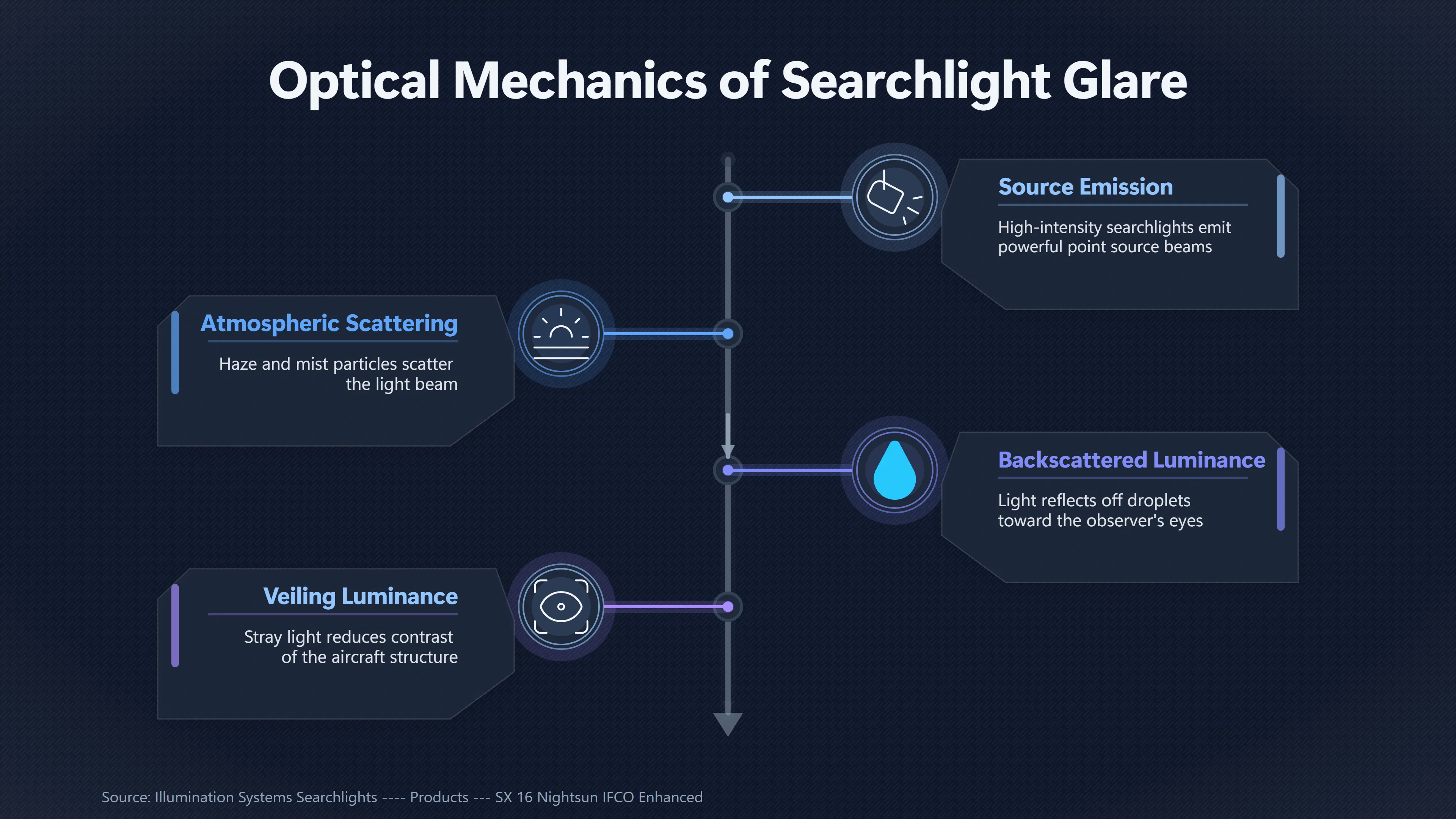
The important UFO/UAP-reporting mechanism is therefore not simply that a helicopter “has bright lights”. It is that the brightest light can suppress the weaker visual information needed to recognise the aircraft’s shape. Glare reduces contrast around a bright source; haze, mist and other particles can scatter the beam and enlarge its luminous appearance; and viewing angle determines whether the smaller red and green navigation lights remain detectable. A witness can consequently see an impressive white glow without seeing an equally convincing helicopter attached to it.[faa.gov]faa.govOpen source on faa.gov.
Why the white light can overwhelm the aircraft
The brightness difference can be enormous. US certification rules for normal-category rotorcraft require forward red and green position lights to produce minimum intensities ranging from 5 to 40 candela depending on viewing angle, with the rear white position light specified at 20 candela over its principal horizontal sector. Those figures describe lights intended primarily to communicate an aircraft’s presence and orientation.[Legal Information Institute]law.cornell.eduLegal Information Institute14 CFR § 27.1391 - Minimum intensities in the horizontal plane of forward and rear position lights. | Electron… A specialist searchlight is a very different instrument. The SX-16 Nightsun Enhanced is rated at a nominal 50 million candlepower and can be focused between wider and narrower beam settings.[Spectrolab]spectrolab.comIllumination Systems Searchlights —- Products — SX 16 Nightsun EnhancedIllumination Systems Searchlights —- Products — SX 16 Nightsun Enhanced…
Those figures should not be treated as a simple prediction of what a particular witness will see: beam direction, distance, atmospheric attenuation and the geometry of each lamp matter. They do, however, demonstrate the extreme difference in scale that is possible between an aircraft’s identification lights and a high-intensity searchlight. A helicopter pointed towards an observer can therefore present a dominant white source while much weaker lights, reflected illumination from the airframe and the dark structure itself become comparatively inconspicuous.
This has a well-understood visual counterpart: disability glare. The International Commission on Illumination describes the relevant effect in terms of “veiling luminance”, stray light superimposed on the retinal image that reduces contrast.[CIE]cie.co.atcie collection glare 2002CIE Collection on Glare 2002 | CIEJanuary 1, 2002… An assessment published through the US National Academies likewise explains that disability glare reduces retinal-image contrast and that scattered light can originate not only inside the eye but from airborne particles and transparent surfaces such as windows or spectacles.[NCBI]ncbi.nlm.nih.govNCBITESTS OF VISUAL FUNCTIONSVisual Impairments: - NCBI Bookshelf…
For a UFO/UAP witness, the practical consequence is straightforward. Recognising a helicopter depends on comparatively low-contrast details: the fuselage extending away from the light, the tail boom, landing gear, rotor disc or other structure. Put a sufficiently bright source close to those details in the visual field and their contrast becomes harder to detect. The light does not literally erase the helicopter; it makes the information needed to recognise it much less accessible.
Aviation authorities take bright-light interference seriously for exactly this reason. The US Federal Aviation Administration defines glare as a temporary disruption of vision while a bright source is in the visual field and distinguishes it from persistent effects such as flash blindness and afterimages.[Federal Aviation Administration]faa.govOpen source on faa.gov. An FAA aerospace-medicine study of night-flight accidents and incidents similarly notes that eyes adapted to low illumination can suffer temporary impairment from bright sources through glare, flash blindness and afterimages.[Federal Aviation Administration]faa.govOpen source on faa.gov.
This does not mean an ordinary observer looking at a helicopter searchlight necessarily experiences hazardous glare of the sort studied in pilots. Rather, the same underlying contrast problem works in the direction needed for misidentification: an intense light is unusually easy to detect while the darker structure beside it is unusually difficult.
Haze and mist can turn a point into a glow
A perfectly clear atmosphere gives the observer the best chance of separating the searchlight from the aircraft behind it. Haze, mist and fog complicate the view because suspended particles scatter light. Night-time imaging research specifically treats artificial lights in haze as a combination of illumination, atmospheric scattering and attenuation; bright sources can therefore produce conspicuous local illumination while contrast elsewhere in the scene deteriorates.[arXiv]arxiv.orgarXiv Nighttime Haze Removal with Illumination CorrectionarXiv Nighttime Haze Removal with Illumination Correction
Research on visibility in fog illustrates the mechanism particularly clearly. Experiments and modelling of vehicle lighting show that stronger forward illumination can create substantial backscattered luminance as light is scattered by fog towards the observer. In one published study, increasing the forward source intensity from 30,000 to 100,000 candela substantially increased calculated backscatter across the tested fog conditions.[PubMed Central (PMC)]pmc.ncbi.nlm.nih.govPubMed Central (PMC)Impacts of Fog Characteristics, Forward Illumination, and Warning Beacon Intensity Distribution on Roadway Hazard Vis… The geometry of a helicopter searchlight is different from a vehicle headlamp, so those numerical results cannot simply be transferred to an airborne sighting. The useful point is the established optical mechanism: intense artificial illumination in suspended droplets can generate additional luminous foreground or beam scatter rather than merely illuminating the intended target.
That helps explain several otherwise puzzling appearances. A helicopter’s searchlight may look larger than the lamp itself; a narrow source may acquire a halo; and under suitable geometry part of the beam may become visible as a luminous cone or streak. Meanwhile, atmospheric attenuation works against the already weak visual signal from the dark airframe. The result can be an apparent bright “object” whose visible dimensions are governed more by scattered light and glare than by the physical dimensions of the helicopter.
There is also a camera version of the problem. Low-light imaging already struggles with poor signal-to-noise ratios and reduced object-recognition performance, while research into glare in vision systems shows that bright sources and saturated pixels can degrade object detection and recognition.[arXiv]arxiv.orgarXiv Dark Vision: A Benchmark for Low-light Image/Video PerceptionarXiv Dark Vision: A Benchmark for Low-light Image/Video Perception A phone video that records a large white blob with little visible structure is therefore weak evidence that the real source itself was a featureless luminous object. The recording system may preserve the brightest signal while losing precisely the low-contrast detail that would reveal the aircraft.
Searchlights are built to dominate a dark scene
The intensity is not an accidental side effect. Helicopter searchlights are designed to place useful illumination on terrain or objects from an aircraft operating in darkness. Spectrolab’s SX-16 family, for example, allows the beam to be driven from wide to narrow focus, while its enhanced reflector is specified to increase the searchlight’s output to roughly 50 million candlepower.[Spectrolab]spectrolab.comIllumination Systems Searchlights —- Products — SX 16 Nightsun IFCO EnhancedIllumination Systems Searchlights —- Products — SX 16 Nightsun IFCO Enhanced…
European aviation rules also show why a strong forward or downward-facing light on a helicopter is not intrinsically anomalous. Current European Union Aviation Safety Agency rules require rotorcraft operated at night to carry an anti-collision system, navigation or position lights and a landing light. Guidance for helicopters says that the landing light should be trainable at least vertically, or supplemented by fixed lights giving a wide spread of illumination.[EASA]easa.europa.euEASAEasy Access Rules for Air OperationsEASAEasy Access Rules for Air Operations
That distinction matters when interpreting eyewitness language. A report of a “brilliant white object”, “single huge light” or “ball of light” does not establish that the observed object’s physical outline matched the visible luminous area. In this viewing situation, the lamp is the high-contrast object. The helicopter is effectively the low-contrast background structure carrying it.
Changes in beam direction can make the effect more confusing. A steerable searchlight that swings towards an observer can brighten dramatically without the aircraft itself accelerating towards them. If the beam subsequently turns away, the brilliant white source can fade abruptly even though the helicopter remains nearby. The SX-16’s steerable and variable-focus design demonstrates that such changes in beam presentation are normal capabilities of airborne searchlighting equipment.[Spectrolab]spectrolab.comIllumination Systems Searchlights —- Products — SX 16 Nightsun IFCO EnhancedIllumination Systems Searchlights —- Products — SX 16 Nightsun IFCO Enhanced…
That is particularly relevant to reports in which an apparently brilliant object “dimmed”, “switched off” or suddenly became much less conspicuous. Such behaviour does not prove a searchlight explanation, but it is compatible with one and should be distinguished from an actual disappearance of the aircraft.
When navigation colours remain useful
A searchlight does not make the helicopter’s other lights irrelevant. In favourable geometry, those weaker lights may provide the best surviving clue to what is behind the white glare.
Helicopter position-light arrangements are deliberately directional. US rotorcraft standards specify a red forward position light on the left, a green one on the right, and a white rear light mounted as far aft as practicable.[Legal Information Institute]law.cornell.eduOpen source on cornell.edu. European night-operation rules likewise require navigation or position lights alongside anti-collision and landing lights.[EASA]easa.europa.euEASAEasy Access Rules for Air OperationsEASAEasy Access Rules for Air Operations
Consequently, small coloured lights beside a dominant white source deserve attention rather than dismissal as incidental details. A persistent red light on one side and green on the other is strongly compatible with conventional aircraft lighting. Seeing only one colour does not rule an aircraft out, because the lights have defined fields of coverage rather than equal visibility in every direction. US intensity standards explicitly vary with angle from the rotorcraft’s longitudinal axis.[Legal Information Institute]law.cornell.eduLegal Information Institute14 CFR § 27.1391 - Minimum intensities in the horizontal plane of forward and rear position lights. | Electron…
The searchlight itself can make those clues harder to notice. When the white source occupies nearly the same line of sight, glare reduces contrast and the observer’s attention is naturally drawn towards the brightest feature. As the helicopter turns, however, the searchlight may point away while a red, green or white position light becomes easier to distinguish. That transition—from apparently structureless white brilliance to recognisable aviation colours—is much more informative than a single still image taken at maximum glare.
The same principle applies to video analysis. Rather than enlarging one saturated frame and trying to infer a craft’s outline from the white blob, it is more useful to examine the entire sequence for moments when the dominant light weakens, changes direction or passes behind an obstruction. Those moments can expose smaller coloured lights or portions of the airframe that were invisible during peak illumination.

What makes the helicopter explanation stronger
A bright light alone is not enough to identify a helicopter, and searchlight glare should not become a catch-all explanation for every luminous UFO/UAP report. The mechanism becomes substantially more persuasive when several independent observations fit together.
The strongest combination is a brilliant white source accompanied intermittently by correctly positioned red, green or rearward white aviation lights; a beam that can be seen illuminating terrain, buildings, cloud or haze; slow movement or hovering compatible with helicopter operations; and a luminous appearance that changes sharply as the aircraft changes orientation. Regulations and equipment specifications establish that helicopters can carry exactly this combination of position, anti-collision, landing and steerable high-intensity lighting.[europa.eu]easa.europa.euEASAEasy Access Rules for Air OperationsEASAEasy Access Rules for Air Operations
Atmospheric conditions add another useful clue. If haze or mist is present and the white source develops a conspicuous halo or visible beam while surrounding structure disappears, established scattering and glare mechanisms predict that contrast should deteriorate in precisely that direction.[nih.gov]ncbi.nlm.nih.govNCBITESTS OF VISUAL FUNCTIONSVisual Impairments: - NCBI Bookshelf…
Conversely, a searchlight explanation is weaker where high-quality imagery clearly resolves a solid object’s outline independently of the light, where accurately measured motion is incompatible with a helicopter, or where the proposed helicopter cannot be reconciled with other reliable evidence. The useful lesson is narrower: failure to see a helicopter-shaped silhouette beside an intense airborne light is not, by itself, good evidence that no helicopter was present.
The key identification lesson
The most misleading feature of a helicopter searchlight is that visibility does not belong equally to every part of the aircraft. A powerful lamp may remain conspicuous after the fuselage, rotor and tail have dropped below useful visual contrast. Human vision then receives an unusually strong signal telling it that something bright is there, but comparatively little information telling it what is carrying the light. Disability glare can further reduce nearby contrast, while haze and mist can enlarge the apparent luminous region through scattering.[CIE]cie.co.atcie collection glare 2002CIE Collection on Glare 2002 | CIEJanuary 1, 2002…
For UFO/UAP assessment, the shape of the glow should therefore not automatically be treated as the shape of the object. The more diagnostic evidence often lies at its edges and in its changes over time: a faint red or green navigation light, a beam sweeping across the ground, a halo that grows in mist, or a sudden reduction in brilliance when the searchlight turns away. Helicopter lighting standards and real searchlight specifications show that a conventional aircraft can produce an extreme imbalance between a dazzling white source and the much less visible machine behind it.[cornell.edu]law.cornell.eduOpen source on cornell.edu.
Amazon book picks
Further Reading
Books and field guides related to When a Searchlight Hides the Helicopter Behind It. Use these as the next step if you want deeper reading beyond the article.
UFOs Explained
Analyzing several UFO cases, the author exposes the myth of extraterrestrial visitors to earth.
The UFO Handbook: A Guide to Investigating, Evaluating, and R...
An explanation of the usual reasons for confusing IFOs (identified flying objects) with UFOs and a survey of the tools used to investigat...
The Report on Unidentified Flying Objects
Edward J. Ruppelt's "The Report on Unidentified Flying Objects" serves as a pivotal text in the study of UFO phenomena, blending personal...
Human Factors in Aviation
Fully updated and expanded, the second edition of Human Factors in Aviation serves the needs of the widespread aviation community - stude...
eBay marketplace picks
Marketplace Samples
Live-tested eBay searches with available results related to this page.
Selected fromhelicopter model oneBay.co.uk.
Endnotes
1.
Source: spectrolab.com
Title: Illumination Systems Searchlights —- Products — SX 16 Nightsun IFCO Enhanced
Link:https://www.spectrolab.com/searchlights/products/prod_sx16_ns_ifco_enh.html
Source snippet
Illumination Systems Searchlights ---- Products --- SX 16 Nightsun IFCO Enhanced...
2.
Source: spectrolab.com
Title: Illumination Systems Searchlights —- Products — SX 16 Nightsun Enhanced
Link:https://www.spectrolab.com/searchlights/products/prod_sx16_ns_enh.html
Source snippet
Illumination Systems Searchlights ---- Products --- SX 16 Nightsun Enhanced...
3.
Source: faa.gov
Link:https://www.faa.gov/aircraft/safety/report/laserinfo/report_incident
4.
Source: faa.gov
Link:https://www.faa.gov/data_research/research/med_humanfacs/oamtechreports/2000s/2006/200628
5.
Source: arxiv.org
Title: arXiv Nighttime Haze Removal with Illumination Correction
Link:https://arxiv.org/abs/1606.01460
6.
Source: arxiv.org
Title: arXiv Dark Vision: A Benchmark for Low-light Image/Video Perception
Link:https://arxiv.org/abs/2301.06269
7.
Source: arxiv.org
Title: arXiv How to deal with glare for improved perception of Autonomous Vehicles
Link:https://arxiv.org/abs/2404.10992
8.
Source: spectrolab.com
Link:https://www.spectrolab.com/illumination.html
9.
Source: easa.europa.eu
Title: EASAEasy Access Rules for Air Operations
Link:https://www.easa.europa.eu/en/document-library/easy-access-rules/online-publications/easy-access-rules-air-operations?erules-id=ERULES-1963177438-13224
10.
Source: easa.europa.eu
Title: EASAEasy Access Rules for Air Operations
Link:https://www.easa.europa.eu/en/document-library/easy-access-rules/online-publications/easy-access-rules-air-operations?erules-id=ERULES-1963177438-18537
11.
Source: faa.gov
Title: Aviation Handbooks & Manuals | Federal Aviation Administration
Link:https://www.faa.gov/regulations_policies/handbooks_manuals/aviation
12.
Source: faa.gov
Title: Pilot’s Handbook of Aeronautical Knowledge | Federal Aviation Administration
Link:https://www.faa.gov/regulations_policies/handbooks_manuals/aviation/phak
13.
Source: faa.gov
Title: Handbooks & Manuals | Federal Aviation Administration
Link:https://www.faa.gov/regulations_policies/handbooks_manuals
14.
Source: faa.gov
Title: Helicopter Flying Handbook | Federal Aviation Administration
Link:https://www.faa.gov/regulations_policies/handbooks_manuals/aviation/helicopter_flying_handbook
15.
Source: faa.gov
Title: Airplane Flying Handbook | Federal Aviation Administration
Link:https://www.faa.gov/regulations_policies/handbooks_manuals/aviation/airplane_handbook
16.
Source: faa.gov
Title: pilots handbook aeronautical knowledge faa h 8083 25b
Link:https://www.faa.gov/aviation/phak/pilots-handbook-aeronautical-knowledge-faa-h-8083-25b
17.
Source: faa.gov
Title: Chapter 8. Medical Facts for Pilots
Link:https://www.faa.gov/air_traffic/publications/atpubs/aim/aim0801.html
18.
Source: faa.gov
Title: Chapter 2. Aeronautical Lighting and Other Airport Visual Aids
Link:https://www.faa.gov/air_traffic/publications/atpubs/AIM/aim0201.html
19.
Source: faa.gov
Link:https://www.faa.gov/air_traffic/publications/atpubs/aim/aim1002.html
20.
Source: faa.gov
Title: Chapter 10. Helicopter Operations
Link:https://www.faa.gov/air_traffic/publications/atpubs/aim/aim1001.html
21.
Source: faa.gov
Link:https://www.faa.gov/Air_traffic/publications/atpubs/aim_html/chap8_section_1.html
22.
Source: faa.gov
Link:https://www.faa.gov/Air_traffic/publications/atpubs/aim_html/chap2_section_1.html
23.
Source: faa.gov
Link:https://www.faa.gov/air_traffic/publications/atpubs/aip_html/part2_enr_section_5.3.html
24.
Source: faa.gov
Link:https://www.faa.gov/air_traffic/publications/atpubs/aip_html/chap2_section_1.html
25.
Source: faa.gov
Link:https://www.faa.gov/air_traffic/publications/atpubs/aip_html/chap2_section_2.html
26.
Source: faa.gov
Link:https://www.faa.gov/Air_traffic/Publications/atpubs/aip_html/part3_ad_section_1.1.html
27.
Source: faa.gov
Link:https://www.faa.gov/Air_traffic/publications/atpubs/aim_html/chap7_section_6.html
28.
Source: faa.gov
Link:https://www.faa.gov/air_traffic/publications/atpubs/aip_html/part2_enr_section_1.15.html
29.
Source: faa.gov
Link:https://www.faa.gov/air_traffic/publications/atpubs/aim_html/chap_10.html
30.
Source: faa.gov
Link:https://www.faa.gov/air_traffic/publications/atpubs/aip_html/part3_ad_1.1.html
31.
Source: faa.gov
Link:https://www.faa.gov/air_traffic/publications/atpubs/aip_html/chap7_section_6.html
32.
Source: faa.gov
Link:https://www.faa.gov/air_traffic/publications/atpubs/aip_html/chap10_section_2.html
33.
Source: faa.gov
Link:https://www.faa.gov/Air_traffic/publications/atpubs/aim_html/chap4_section_3.html
34.
Source: faa.gov
Link:https://www.faa.gov/air_traffic/publications/atpubs/aip_html/part2_enr_section_1.1.html
35.
Source: faa.gov
Link:https://www.faa.gov/air_traffic/publications/atpubs/aip_html/part1_gen_section_1.7.html
36.
Source: spectrolab.com
Link:https://www.spectrolab.com/searchlights/products/products.html
37.
Source: spectrolab.com
Link:https://www.spectrolab.com/searchlights/customer_service/aboutus.html
38.
Source: spectrolab.com
Link:https://www.spectrolab.com/searchlights/products/prod_sx16_ns.html
39.
Source: spectrolab.com
Link:https://www.spectrolab.com/searchlights/products/prod_nightsunxp_IRLED.html
40.
Source: spectrolab.com
Link:https://www.spectrolab.com/searchlights/index.html
41.
Source: spectrolab.com
Link:https://www.spectrolab.com/illumination-bulletin.html
42.
Source: spectrolab.com
Link:https://www.spectrolab.com/searchlights/products/prod_nightsunxp.html
43.
Source: spectrolab.com
Link:https://www.spectrolab.com/company.html
44.
Source: spectrolab.com
Link:https://www.spectrolab.com/searchlights/customer_service/bulletins.html
45.
Source: youtube.com
Title: Spectrolab SX-16 Nightsun 40 Million Candle Power
Link:https://www.youtube.com/watch?v=SVdCOs66C-U
Source snippet
Spectrolab SX-16 Nightsun Searchlight...
46.
Source: youtube.com
Title: Spectrolab SX-16 Nightsun Searchlight
Link:https://www.youtube.com/watch?v=7teHTBpoOEA
Source snippet
Helicopter Searchlight Downtown Toronto...
47.
Source: youtube.com
Title: Helicopter Searchlight Downtown Toronto
Link:https://www.youtube.com/watch?v=8xmqEIESOBc
Source snippet
Airborne - TrakkaBeam® - TLX High Intensity Searchlight...
48.
Source: youtube.com
Link:https://www.youtube.com/watch?v=cltosaae6W8
Source snippet
Police [Helicopter Hovering]({{ 'hovering-lights/' | relative_url }}) with Spotlight on at Night...
49.
Source: ncbi.nlm.nih.gov
Title: NCBITESTS OF VISUAL FUNCTIONS
Link:https://www.ncbi.nlm.nih.gov/books/NBK207559/
Source snippet
Visual Impairments: - NCBI Bookshelf...
50.
Source: pmc.ncbi.nlm.nih.gov
Link:https://pmc.ncbi.nlm.nih.gov/articles/PMC4893454/
Source snippet
PubMed Central (PMC)Impacts of Fog Characteristics, Forward Illumination, and Warning Beacon Intensity Distribution on Roadway Hazard Vis...
51.
Source: law.cornell.edu
Link:https://www.law.cornell.edu/cfr/text/14/27.1391
Source snippet
Legal Information Institute14 CFR § 27.1391 - Minimum intensities in the horizontal plane of forward and rear position lights. | Electron...
52.
Source: cie.co.at
Title: cie collection glare 2002
Link:https://cie.co.at/publications/cie-collection-glare-2002
Source snippet
CIE Collection on Glare 2002 | CIEJanuary 1, 2002...
Published: January 1, 2002
53.
Source: cie.co.at
Title: CIE17-22-105 | CIE
Link:https://cie.co.at/eilvterm/17
54.
Source: law.cornell.edu
Link:https://www.law.cornell.edu/cfr/text/14/29.1385
55.
Source: nuforc.org
Link:https://nuforc.org/sighting/?id=198295
56.
Source: easa.europa.eu
Title: eu Easy Access Rules for Air Operations
Link:https://www.easa.europa.eu/en/document-library/easy-access-rules/online-publications/easy-access-rules-air-operations?erules-id=ERULES-1963177438-14156
57.
Source: easa.europa.eu
Title: eu Easy Access Rules for Air Operations
Link:https://www.easa.europa.eu/en/document-library/easy-access-rules/online-publications/easy-access-rules-air-operations?erules-id=ERULES-1963177438-13048
58.
Source: easa.europa.eu
Title: eu Easy Access Rules for Air Operations
Link:https://www.easa.europa.eu/en/document-library/easy-access-rules/online-publications/easy-access-rules-air-operations?erules-id=ERULES-1963177438-13401
59.
Source: easa.europa.eu
Title: eu Easy Access Rules for Large Rotorcraft (CS-29)
Link:https://www.easa.europa.eu/en/document-library/easy-access-rules/online-publications/easy-access-rules-large-rotorcraft-cs-29-12?erules-id=ERULES-1963177438-5683
60.
Source: GOV.UK
Title: www.gov.uk New Search and Rescue base for HM Coastguard’s rescue helicopter
Link:https://www.gov.uk/government/news/new-search-and-rescue-base-for-hm-coastguards-rescue-helicopter
61.
Source: easa.europa.eu
Title: easy access rules aircrew
Link:https://www.easa.europa.eu/en/document-library/easy-access-rules/online-publications/easy-access-rules-aircrew?erules-id=ERULES-1963177438-10644
62.
Source: pmc.ncbi.nlm.nih.gov
Link:https://pmc.ncbi.nlm.nih.gov/articles/PMC12947085/
63.
Source: metoffice.gov.uk
Title: Mist, fog, and haze: What’s the difference?
Link:https://www.metoffice.gov.uk/blog/2025/whats-the-difference-between-mist-fog-and-haze
64.
Source: nuforc.org
Link:https://nuforc.org/sighting/?id=189744
65.
Source: easa.europa.eu
Title: easy access rules large rotorcraft cs 29 0
Link:https://www.easa.europa.eu/en/document-library/easy-access-rules/online-publications/easy-access-rules-large-rotorcraft-cs-29-0?page=40
66.
Source: easa.europa.eu
Title: eu Easy Access Rules for Air Operations
Link:https://www.easa.europa.eu/en/document-library/easy-access-rules/online-publications/easy-access-rules-air-operations?kw=Take-off&page=32
67.
Source: pmc.ncbi.nlm.nih.gov
Link:https://pmc.ncbi.nlm.nih.gov/articles/PMC9981761/
68.
Source: easa.europa.eu
Title: eu Easy Access Rules for Small Rotorcraft (CS-27)
Link:https://www.easa.europa.eu/en/document-library/easy-access-rules/online-publications/easy-access-rules-small-rotorcraft-cs-27?page=40
69.
Source: easa.europa.eu
Title: eu Easy Access Rules for Small Rotorcraft (CS-27)
Link:https://www.easa.europa.eu/da/document-library/easy-access-rules/online-publications/easy-access-rules-small-rotorcraft-cs-27-0?page=40
70.
Source: eur-lex.europa.eu
Title: eu EU R-Lex
Link:https://eur-lex.europa.eu/eli/reg/2012/965/2023-02-22/eng
71.
Source: pmc.ncbi.nlm.nih.gov
Link:https://pmc.ncbi.nlm.nih.gov/articles/PMC9508687/
72.
Source: london.gov.uk
Title: Police Helicopters
Link:https://www.london.gov.uk/who-we-are/what-london-assembly-does/questions-mayor/find-an-answer/police-helicopters-4
73.
Source: london.gov.uk
Title: helicopters 1 0
Link:https://www.london.gov.uk/who-we-are/what-london-assembly-does/questions-mayor/find-an-answer/helicopters
74.
Source: london.gov.uk
Title: Police helicopters
Link:https://www.london.gov.uk/who-we-are/what-london-assembly-does/questions-mayor/find-an-answer/police-helicopters-3
75.
Source: london.gov.uk
Title: Helicopter deployments
Link:https://www.london.gov.uk/who-we-are/what-london-assembly-does/questions-mayor/find-an-answer/helicopter-deployments
76.
Source: GOV.UK
Title: www.gov.uk U K Second-Generation Search and Rescue Aviation programme (UKSAR2G)
Link:https://www.gov.uk/government/collections/uk-second-generation-search-and-rescue-aviation-programme-uksar2g
77.
Source: cie.co.at
Link:https://cie.co.at/eilvterm/17
78.
Source: cie.co.at
Link:https://cie.co.at/eilvterm/17
79.
Source: london.gov.uk
Title: Police helicopters
Link:https://www.london.gov.uk/who-we-are/what-london-assembly-does/questions-mayor/find-an-answer/police-helicopters-2
80.
Source: london.gov.uk
Title: Police Helicopter Use (1)
Link:https://www.london.gov.uk/who-we-are/what-london-assembly-does/questions-mayor/find-an-answer/police-helicopter-use-1
81.
Source: policeconduct.gov.uk
Link:https://www.policeconduct.gov.uk/our-work/learning/national-recommendations-and-recommendations-made-metropolitan-police-service-and
82.
Source: london.gov.uk
Title: Helicopters (1)
Link:https://www.london.gov.uk/who-we-are/what-london-assembly-does/questions-mayor/find-an-answer/helicopters-1
83.
Source: GOV.UK
Link:https://www.gov.uk/government/news/second-generation-uk-search-and-rescue-aviation-programme-uksar2g
84.
Source: london.gov.uk
Title: [Drones]({{ ‘drones/’ | relative_url }}) | Talk London
Link:https://www.london.gov.uk/talk-london/transport/drones?page=2%2C0
85.
Source: london.gov.uk
Title: Drones | Talk London
Link:https://www.london.gov.uk/talk-london/comment/20423
86.
Source: london.gov.uk
Title: Police helicopters
Link:https://www.london.gov.uk/who-we-are/what-london-assembly-does/questions-mayor/find-an-answer/police-helicopters-1
87.
Source: ad.easa.europa.eu
Title: eu EAS A Safety Publications Tool
Link:https://ad.easa.europa.eu/ad/2019-04
88.
Source: GOV.UK
Title: regulatory article ra 3535 helicopter landing site lights
Link:https://www.gov.uk/government/publications/regulatory-article-ra-3535-helicopter-landing-site-lights
89.
Source: pmc.ncbi.nlm.nih.gov
Link:https://pmc.ncbi.nlm.nih.gov/articles/PMC6010579/
90.
Source: pubmed.ncbi.nlm.nih.gov
Link:https://pubmed.ncbi.nlm.nih.gov/28271538/
91.
Source: pmc.ncbi.nlm.nih.gov
Link:https://pmc.ncbi.nlm.nih.gov/articles/PMC4844042/
92.
Source: GOV.UK
Link:https://www.gov.uk/government/news/uk-transport-minister-opens-new-7-million-search-and-rescue-base-at-prestwick-airport
93.
Source: pubmed.ncbi.nlm.nih.gov
Link:https://pubmed.ncbi.nlm.nih.gov/26637966/
94.
Source: GOV.UK
Title: aerospatiale sa 341g gazelle ha lfb 8 march 2011
Link:https://www.gov.uk/aaib-reports/aerospatiale-sa-341g-gazelle-ha-lfb-8-march-2011
Published: march 2011
95.
Source: GOV.UK
Title: agusta a109s g iooz 8 december 2013
Link:https://www.gov.uk/aaib-reports/agusta-a109s-g-iooz-8-december-2013
Published: december 2013
96.
Source: GOV.UK
Title: www.gov.uk[Withdrawn] Coastguard search and rescue helicopter programme
Link:https://www.gov.uk/government/news/coastguard-search-and-rescue-helicopter-programme
97.
Source: candlepowerforums.com
Title: Helicopter Searchlights | Candle Power Forums
Link:https://www.candlepowerforums.com/threads/helicopter-searchlights.378902/
98.
Source: GOV.UK
Title: www.gov.uk Government welcomes £1 billion Agusta Westland helicopter deal
Link:https://www.gov.uk/government/news/government-welcomes-1-billion-agustawestland-helicopter-deal
99.
Source: nuforc.org
Link:https://nuforc.org/sighting/?id=93303
100.
Source: GOV.UK
Title: www.gov.uk3D technology helps helicopters land on sand
Link:https://www.gov.uk/government/news/3d-technology-helps-helicopters-land-on-sand
101.
Source: pmc.ncbi.nlm.nih.gov
Link:https://pmc.ncbi.nlm.nih.gov/articles/PMC3972772/
102.
Source: nuforc.org
Link:https://nuforc.org/sighting/?id=72446
103.
Source: pubmed.ncbi.nlm.nih.gov
Link:https://pubmed.ncbi.nlm.nih.gov/20168561/
104.
Source: law.cornell.edu
Link:https://www.law.cornell.edu/cfr/text/14/29.1322
105.
Source: law.cornell.edu
Link:https://www.law.cornell.edu/cfr/text/14/27.1322
106.
Source: pubmed.ncbi.nlm.nih.gov
Link:https://pubmed.ncbi.nlm.nih.gov/7500206/
107.
Source: pubmed.ncbi.nlm.nih.gov
Link:https://pubmed.ncbi.nlm.nih.gov/17662931/
108.
Source: pubmed.ncbi.nlm.nih.gov
Link:https://pubmed.ncbi.nlm.nih.gov/8302535/
109.
Source: pubmed.ncbi.nlm.nih.gov
Link:https://pubmed.ncbi.nlm.nih.gov/22445628/
110.
Source: pubmed.ncbi.nlm.nih.gov
Link:https://pubmed.ncbi.nlm.nih.gov/25751837/
111.
Source: law.cornell.edu
Link:https://www.law.cornell.edu/cfr/text/14/23.2530
112.
Source: law.cornell.edu
Link:https://www.law.cornell.edu/cfr/text/14/29.1401
113.
Source: law.cornell.edu
Link:https://www.law.cornell.edu/cfr/text/14/27.1385
114.
Source: law.cornell.edu
Link:https://www.law.cornell.edu/cfr/text/14/29.1389
115.
Source: law.cornell.edu
Link:https://www.law.cornell.edu/cfr/text/14/27.1389
116.
Source: law.cornell.edu
Title: edu14 CFR Part 27
Link:https://www.law.cornell.edu/cfr/text/14/part-27/subpart-F
117.
Source: cie.co.at
Link:https://cie.co.at/eilvterm/17
118.
Source: cie.co.at
Link:https://cie.co.at/publications/discomfort-caused-glare-luminaires-non-uniform-source-luminance
119.
Source: cie.co.at
Link:https://cie.co.at/eilvterm/17
120.
Source: cie.co.at
Title: example luminance measurement setup ugr
Link:https://cie.co.at/publications/example-luminance-measurement-setup-ugr
121.
Source: cie.co.at
Link:https://cie.co.at/eilvterm/17
122.
Source: cie.co.at
Link:https://cie.co.at/eilvterm/17
123.
Source: cie.co.at
Title: glare and uniformity road lighting installations
Link:https://cie.co.at/publications/glare-and-uniformity-road-lighting-installations
124.
Source: cie.co.at
Link:https://cie.co.at/e-ilv
125.
Source: herts-pcc.gov.uk
Link:https://www.herts-pcc.gov.uk/new-archive/2022/november-2022/police-helicopter-a-vital-resource-for-hertfordshire/
126.
Source: trid.trb.org
Link:https://trid.trb.org/View/798555
127.
Source: atsb.gov.au
Link:https://www.atsb.gov.au/news/2022/night-vision-goggles
128.
Source: atsb.gov.au
Link:https://www.atsb.gov.au/node?page=911
129.
Source: law.cornell.edu
Link:https://www.law.cornell.edu/cfr/text/14/25.1385
130.
Source: law.cornell.edu
Link:https://www.law.cornell.edu/cfr/text/14/25.1397
131.
Source: law.cornell.edu
Link:https://www.law.cornell.edu/cfr/text/14/29.1397
132.
Source: law.cornell.edu
Link:https://www.law.cornell.edu/cfr/text/14/27.1401
133.
Source: law.cornell.edu
Link:https://www.law.cornell.edu/cfr/text/14/27.1397
134.
Source: law.cornell.edu
Link:https://www.law.cornell.edu/cfr/text/14/27.1387
135.
Source: law.cornell.edu
Title: edu14 CFR § 31.65
Link:https://www.law.cornell.edu/cfr/text/14/31.65
Additional References
136.
Source: transportation.gov
Link:https://www.transportation.gov/regulations/federal-register-documents/2012-5621
137.
Source: ntsb.gov
Link:https://www.ntsb.gov/Advocacy/mwl/Pages/mwl3_2015.aspx
138.
Source: nhtsa.gov
Link:https://www.nhtsa.gov/human-factors/human-factors-program-areas
139.
Source: ntsb.gov
Link:https://www.ntsb.gov/news/Testimony/Pages/Homendy20250327.aspx
140.
Source: ntsb.gov
Link:https://www.ntsb.gov/advocacy/safety-alerts/Pages/safetyalerts.aspx
141.
Source: highways.fhwa.dot.gov
Link:https://highways.fhwa.dot.gov/safety/other/visibility/fhwa-lighting-handbook-august-2012/3-vision-and-fundamental-concepts
142.
Source: highways.fhwa.dot.gov
Link:https://highways.fhwa.dot.gov/safety/other/visibility/fhwa-lighting-handbook-august-2012/5-considerations-concerning-lighting
143.
Source: ntsb.gov
Link:https://www.ntsb.gov/news/press-releases/Pages/NR20250311.aspx
144.
Source: nasa.gov
Title: Characterizing the Visual Experience of Astronauts at the Lunar South Pole
Link:https://www.nasa.gov/centers-and-facilities/nesc/characterizing-the-visual-experience-of-astronauts-at-the-lunar-south-pole/
145.
Source: faraim.org
Link:https://www.faraim.org/faa/aim/chapter-10/section-10-2-2.html