Within Aircraft
Why an Approaching Aircraft May Not Look Closer
An approaching aircraft may show surprisingly little increase in apparent size until late in the encounter, weakening a key cue that it is coming closer.
On this page
- What looming reveals about an approaching object
- Why angular expansion can remain subtle at long range
- What collision research shows about late visual growth
Page outline Jump by section
Introduction
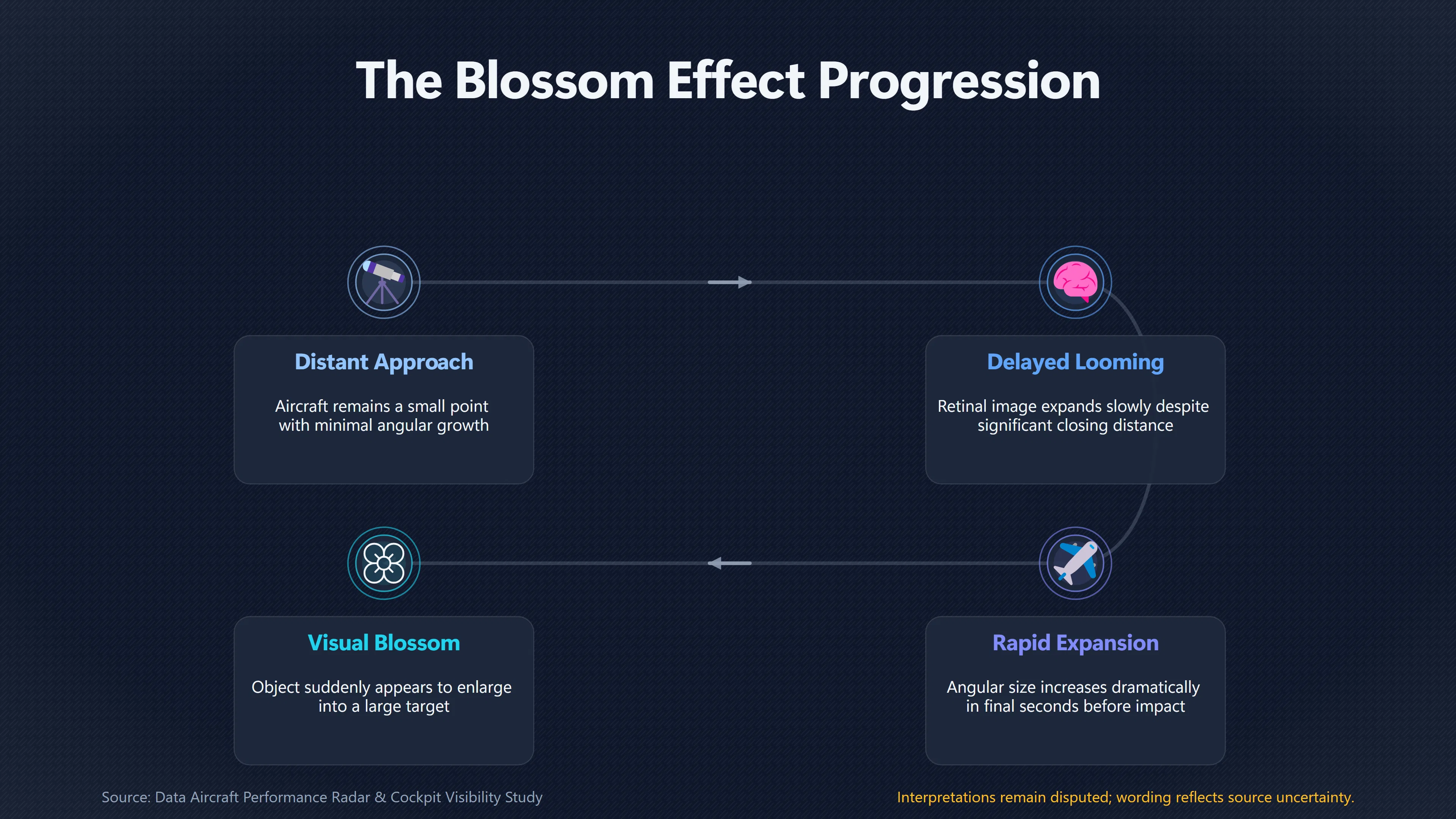
An aircraft can be closing rapidly without looking much closer. The reason is delayed looming: at long range, an approaching aircraft’s image may expand so slowly on the retina that the change is difficult to notice. Only later, when the remaining distance has become much smaller, does its apparent size begin to increase dramatically.
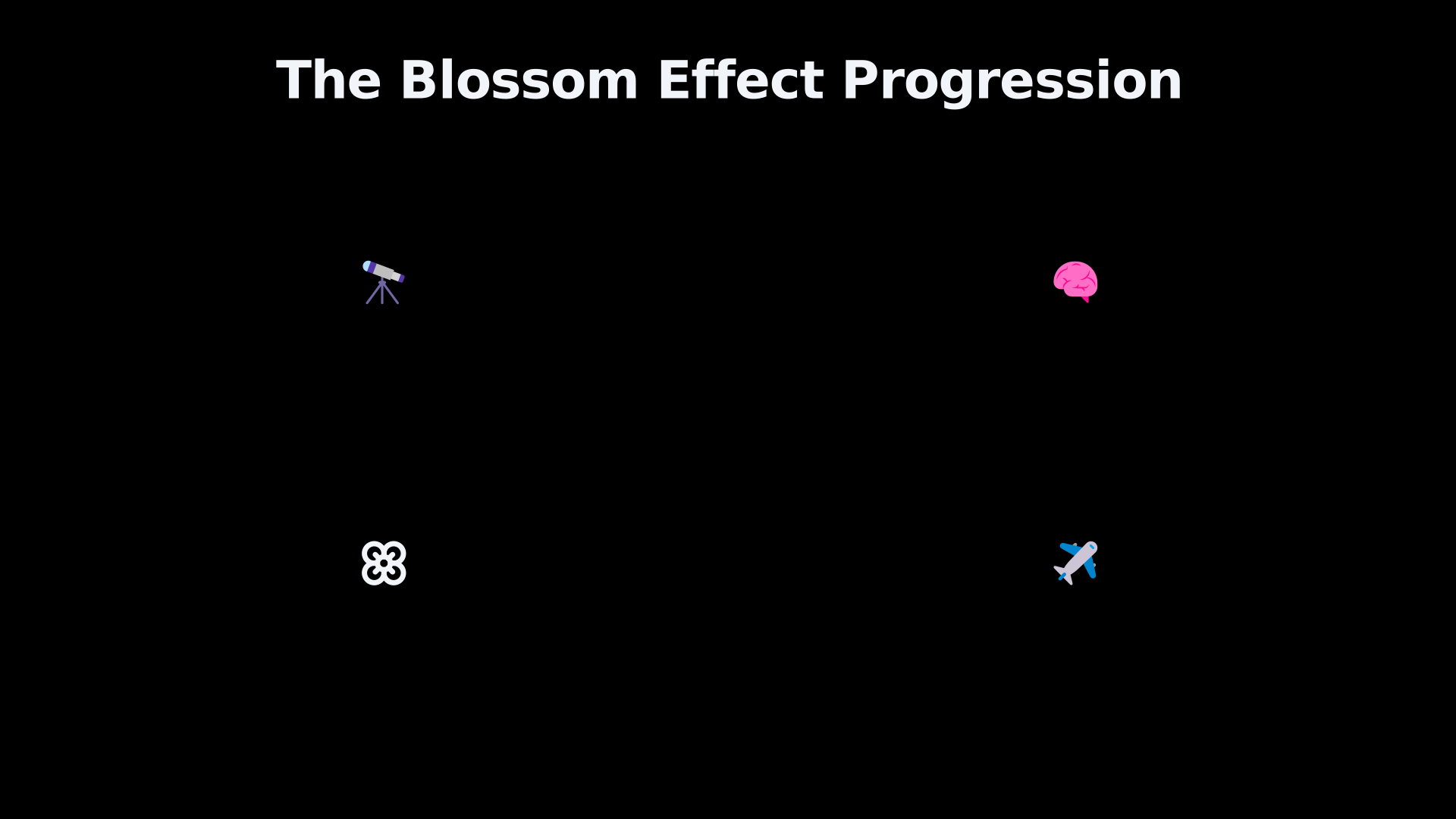
This matters when assessing reports of aircraft that seemed to hover or remain at a fixed distance. A witness may reasonably expect a fast-approaching aeroplane to become steadily and obviously larger. In reality, perspective produces a strongly non-linear pattern: little apparent growth for much of the approach, followed by rapid expansion near the end. Aviation investigators have measured precisely this pattern in collision reconstructions, where aircraft travelling towards one another remained visually small until only seconds before impact.[atsb.gov.au]atsb.gov.auar Mangalore Airport, Victoria on 19 February 2020 | ATSBJune 22, 2022…
Delayed looming therefore weakens an important intuitive distance cue. It does not prove that any particular UFO or UAP report was an aircraft, but it explains why “it did not seem to be getting closer” is not, by itself, strong evidence that a light was actually hovering.
What looming reveals about an approaching object
Looming is the optical expansion produced when an object approaches an observer. As its distance decreases, the angle occupied by the object in the observer’s visual field increases. For a directly approaching object, that expanding retinal image supplies information about the approach even when the object has almost no sideways movement across the sky. Research on visual perception describes looming as an important cue to impending contact, and the rate of optical expansion can provide information related to the remaining time to collision.[nih.gov]pubmed.ncbi.nlm.nih.govPub Med Threat modulates perception of looming visual stimuliThreat modulates perception of looming visual stimuli - PubMedOctober 9, 2012…
The important point is that this expansion is not linear with distance or time. Consider a simplified aircraft of fixed width W at distance D. Its angular width is approximately determined by:
θ=2arctan(2DW)
At distances much greater than the aircraft’s width, this is approximately W/D. Halving the range therefore roughly doubles the angular size.
That sounds as though approaching motion ought to be obvious, but the absolute changes can initially be tiny. A 40-metre-wide aircraft viewed head-on from 20 kilometres away spans only about 0.11°. At 15 kilometres it is roughly 0.15°. The aircraft has travelled five kilometres closer, yet its apparent width has increased by only around four hundredths of a degree. At five kilometres it spans roughly 0.46°, and at one kilometre about 2.3°. The same physical approach consequently becomes far more visually dramatic towards the end.
This accelerating expansion is intrinsic to perspective. Reviews of looming and time-to-contact perception describe an approaching object’s retinal image as expanding increasingly quickly as the distance falls.[PubMed Central (PMC)]pmc.ncbi.nlm.nih.govPub Med Central (PMC)Mechanisms of Visuomotor InterceptionPubMed Central (PMC)Mechanisms of Visuomotor Interception - PMCApril 22, 2026…
For a distant aircraft, therefore, there can be a substantial difference between closing distance and visible evidence of closing distance. Thousands of metres may disappear while the target remains little more than a point.
Why angular expansion can remain subtle at long range
Aircraft provide a particularly difficult looming target because their physical dimensions are modest compared with the distances over which they are first visible. A large aeroplane may be tens of metres across while still being several or tens of kilometres away. Its angular dimensions can therefore remain extremely small even while its actual range changes substantially.
A major Australian Transport Safety Bureau (ATSB) reconstruction illustrates the scale of the problem. The study supported the investigation of the 2020 mid-air collision between two aircraft near Mangalore, Victoria. Their average closing speed during the final 260 seconds was about 244 knots. Yet the ATSB’s geometrical reconstruction found little change in their relative apparent size until the final 10–12 seconds.[ATSB]atsb.gov.auar Mangalore Airport, Victoria on 19 February 2020 | ATSBJune 22, 2022…
The ATSB estimated that one target aircraft would have subtended only about 0.39° around 12.5 seconds before collision. Its apparent size then increased to about 1° five seconds before impact and approximately 7.5° during the final second. In other words, the conspicuous visual growth was heavily concentrated towards the end of the encounter rather than being spread evenly across the approach.[ATSB]atsb.gov.auar Mangalore Airport, Victoria on 19 February 2020 | ATSBJune 22, 2022…
That distinction is crucial for interpreting an observation from the ground. If an aircraft is approaching roughly along the observer’s line of sight, two normally useful signs of movement may be weak simultaneously:
- its bearing changes little, so it does not obviously travel across the sky;
- its angular size initially changes little, so it does not obviously seem to come closer.
A distant aircraft can consequently look surprisingly static even though its range is falling continuously. If it is seen primarily as landing lights rather than as a clearly resolved fuselage and wings, judging small changes in physical extent may be harder still: the observer is effectively watching a bright point rather than measuring the outline of a known-size object.
This is why aviation training material sometimes describes the late expansion of a collision-course aircraft as the “blossom effect”. US Federal Aviation Administration educational material explains that a distant collision-course aircraft can appear motionless and fail to show obvious growth for a considerable period before suddenly expanding into a much larger target. The Aircraft Owners and Pilots Association similarly describes the conflict aircraft as a small, nearly stationary speck until the late “blossom”.[FAASafety]faasafety.govLearning Center Library ContentsLearning Center Library Contents - FAA - FAASTeam - FAASafety.gov…
The word “suddenly” should not be interpreted literally as an instantaneous physical change. The aeroplane has been expanding optically throughout the approach. What changes is the visibility and salience of that expansion: an initially minute increase eventually accelerates into something that the observer cannot miss.

What collision research shows about late visual growth
Mid-air collision investigations are useful here because they provide unusually well-constrained examples. Investigators can reconstruct aircraft positions, speeds and viewing geometry, then calculate how large each aircraft should have appeared in the other’s field of view.
A US National Transportation Safety Board (NTSB) performance and visibility study provides another striking example. Its reconstruction concluded that each aircraft remained less than about 0.5° across until roughly five seconds before collision, after which apparent size increased very rapidly — explicitly described in the study as the “blossom” effect.[NTSB Data]data.ntsb.govData Aircraft Performance Radar & Cockpit Visibility StudyNTSB DataAircraft Performance Radar & Cockpit Visibility Study…
These are extreme collision geometries rather than ordinary UFO observations, but that is precisely what makes them useful demonstrations of the mechanism. They show that high closing speed does not guarantee conspicuous visual growth at long range. The physics can allow an aircraft to cover substantial distance while remaining a very small angular target.
Research into the wider limitations of visual collision avoidance reaches the same general conclusion. A study analysing 159 US civil-aviation mid-air collisions noted that an unobstructed converging aircraft can remain small, relatively motionless and inconspicuous until shortly before impact. Its modelling also found that successful visual detection and avoidance became progressively less likely as closing speeds increased.[PubMed]pubmed.ncbi.nlm.nih.govMidair collisions: limitations of the see-and-avoid concept in civil aviation - PubMed…
Australia’s long-running research into “see and avoid” likewise emphasises that the problem persists even in good visibility. Its foundational study followed fatal collisions that had occurred despite apparently favourable visual conditions, concluding that unaided visual collision avoidance has serious physical and perceptual limitations.[ATSB]atsb.gov.aulimitations see and avoid principlelimitations see and avoid principle
That safety problem is significant enough that aviation increasingly supplements eyesight with electronic information. The UK Civil Aviation Authority describes electronic conspicuity systems such as ADS-B as a way of adding an electronic means of detecting nearby traffic to the traditional “see and avoid” principle. In 2026, EASA and EUROCONTROL likewise published electronic-conspicuity use cases aimed at improving awareness of nearby aircraft.[caa.co.uk]caa.co.ukOpen source on caa.co.uk.
Why this matters for a seemingly hovering aircraft
Delayed looming does not mean that every apparently stationary aircraft will remain visually unchanged until it is nearby. The strength of the effect depends on aircraft size, speed, trajectory, viewing distance, contrast, illumination and how carefully the observer watches it. Nor should numerical thresholds from cockpit collision studies be treated as universal limits for witnesses on the ground. The ATSB itself stresses that there is no single angular size at which an object becomes perceptible: background, relative motion, position in the visual field and human factors all matter.[ATSB]atsb.gov.auar Mangalore Airport, Victoria on 19 February 2020 | ATSBJune 22, 2022…
What the evidence does undermine is a common intuitive inference:
“If the aircraft had really been approaching me, I would have seen it getting steadily bigger.”
That expectation is unreliable. For an aircraft far down the line of sight, the early increase in angular size can be very small. As the aircraft closes, the growth accelerates; eventually it may seem to enlarge much more rapidly. Aviation’s “blossom effect” is the safety-critical version of precisely this phenomenon.[aopa.org]aopa.orgThe ScanThe Scan - AOPA…
For UFO or UAP analysis, the distinction is between what a witness observed and what that observation establishes physically. “It looked the same size for several minutes” may be a useful description of the experience, but unless the object’s actual dimensions and distance were independently known, it does not demonstrate constant range. A distant aircraft may have been closing throughout that period while producing too little angular expansion for the change to be obvious.
This mechanism becomes especially relevant when an apparently hovering light later resolves into an aircraft, becomes suddenly larger, reveals navigation or landing lights, passes overhead, or begins to show obvious sideways movement. Those developments need not imply that a previously stationary object abruptly started moving. They can instead mark the point at which an already approaching aircraft became close enough for looming — previously weak — to become visually unmistakable.
Amazon book picks
Further Reading
Books and field guides related to Why an Approaching Aircraft May Not Look Closer. Use these as the next step if you want deeper reading beyond the article.
The Ecological Approach to Visual Perception
This book, first published in 1979, is about how we see: the environment around us (its surfaces, their layout, and their colors and text...
Sensation and Perception
. Bruce Goldstein's SENSATION AND PERCEPTION, the best-seller which has helped over 150,000 students understand the ties between how we s...
Vision Science: Photons to Phenomenology
This textbook on vision reflects the integrated computational approach of modern research scientists, combining psychological, computatio...
Human Factors in Aviation
Fully updated and expanded, the second edition of Human Factors in Aviation serves the needs of the widespread aviation community - stude...
eBay marketplace picks
Marketplace Samples
Live-tested eBay searches with available results related to this page.
Selected fromaircraft print oneBay.co.uk.

Endnotes
1.
Source: atsb.gov.au
Link:https://www.atsb.gov.au/investigations/2022-001
Source snippet
ar Mangalore Airport, Victoria on 19 February 2020 | ATSBJune 22, 2022...
Published: June 22, 2022
2.
Source: data.ntsb.gov
Title: Data Aircraft Performance [Radar]({{ ‘radar/’ | relative_url }}) & Cockpit Visibility Study
Link:https://data.ntsb.gov/Docket/Document/docBLOB?FileExtension=.PDF&FileName=Aircraft+Performance+Radar+%26+Cockpit+Visibility+Study-Master.PDF&ID=40445948
Source snippet
NTSB DataAircraft Performance Radar & Cockpit Visibility Study...
3.
Source: faasafety.gov
Title: Learning Center Library Contents
Link:https://www.faasafety.gov/gslac/alc/libview_printerfriendly.aspx?id=6851
Source snippet
Learning Center Library Contents - FAA - FAASTeam - FAASafety.gov...
4.
Source: aopa.org
Title: The Scan
Link:https://www.aopa.org/training-and-safety/online-learning/safety-spotlights/collision-avoidance/the-scan
Source snippet
The Scan - AOPA...
5.
Source: atsb.gov.au
Title: limitations see and avoid principle
Link:https://www.atsb.gov.au/publications/research-and-analysis-report/2022/aviation/limitations-see-and-avoid-principle
6.
Source: atsb.gov.au
Title: ATSBSee and Avoid | ATSB
Link:https://www.atsb.gov.au/publications/2009/see-and-avoid
7.
Source: eurocontrol.int
Title: Electronic Conspicuity Air-to-Air Use Case | EUROCONTROL
Link:https://www.eurocontrol.int/publication/electronic-conspicuity-air-air-use-case
8.
Source: eurocontrol.int
Title: and easa release electronic conspicuity use cases safer shared airspace
Link:https://www.eurocontrol.int/news/eurocontrol-and-easa-release-electronic-conspicuity-use-cases-safer-shared-airspace
9.
Source: aopa.org
Title: Collision Avoidance Made Easy
Link:https://www.aopa.org/news-and-media/all-news/1998/april/flight-training-magazine/collision-avoidance-made-easy
10.
Source: aopa.org
Title: Operations at Nontowered Airports
Link:https://www.aopa.org/news-and-media/all-news/1998/april/flight-training-magazine/operations-at-nontowered-airports
11.
Source: faasafety.gov
Link:https://www.faasafety.gov/gslac/alc/libview_chapter.aspx?chapter=Limitations+of+the+Eye&id=6851
12.
Source: pubmed.ncbi.nlm.nih.gov
Link:https://pubmed.ncbi.nlm.nih.gov/15828635/
Source snippet
Midair collisions: limitations of the see-and-avoid concept in civil aviation - PubMed...
13.
Source: pubmed.ncbi.nlm.nih.gov
Title: Pub Med Threat modulates perception of looming visual stimuli
Link:https://pubmed.ncbi.nlm.nih.gov/23058796/
Source snippet
Threat modulates perception of looming visual stimuli - PubMedOctober 9, 2012...
Published: October 9, 2012
14.
Source: pmc.ncbi.nlm.nih.gov
Link:https://pmc.ncbi.nlm.nih.gov/articles/PMC3420976/
Source snippet
PubMed Central (PMC)Unifying Time to Contact Estimation and Collision Avoidance across Species - PMC...
15.
Source: pubmed.ncbi.nlm.nih.gov
Link:https://pubmed.ncbi.nlm.nih.gov/22003252/
Source snippet
Visual processing of the impending collision of a looming object: time to collision revisited - PubMed...
16.
Source: pmc.ncbi.nlm.nih.gov
Title: Pub Med Central (PMC)Mechanisms of Visuomotor Interception
Link:https://pmc.ncbi.nlm.nih.gov/articles/PMC13205071/
Source snippet
PubMed Central (PMC)Mechanisms of Visuomotor Interception - PMCApril 22, 2026...
Published: April 22, 2026
17.
Source: caa.co.uk
Link:https://www.caa.co.uk/general-aviation/aircraft-ownership-and-maintenance/electronic-conspicuity-devices/
18.
Source: atsb.gov.au
Link:https://www.atsb.gov.au/taxonomy/term/368
19.
Source: pmc.ncbi.nlm.nih.gov
Link:https://pmc.ncbi.nlm.nih.gov/articles/PMC13253847/
20.
Source: atsb.gov.au
Link:https://www.atsb.gov.au/taxonomy/term/381
21.
Source: atsb.gov.au
Link:https://www.atsb.gov.au/taxonomy/term/391
22.
Source: atsb.gov.au
Link:https://www.atsb.gov.au/node?page=63
23.
Source: atsb.gov.au
Link:https://www.atsb.gov.au/investigations/2023-001
24.
Source: atsb.gov.au
Link:https://www.atsb.gov.au/safety-issues/AO-2023-001-SI-06
25.
Source: atsb.gov.au
Link:https://www.atsb.gov.au/taxonomy/term/343?page=1
26.
Source: GOV.UK
Title: www.gov.uk30 years of investigating Serious Incidents – the AAIB’s perspective
Link:https://www.gov.uk/government/publications/investigating-serious-incidents/30-years-of-investigating-serious-incidents-the-aaibs-perspective
27.
Source: GOV.UK
Title: air accident monthly bulletin august 2024
Link:https://www.gov.uk/government/publications/air-accident-monthly-bulletin-august-2024
Published: august 2024
28.
Source: atsb.gov.au
Link:https://www.atsb.gov.au/publications/investigation_reports/2025/report/ao
29.
Source: pmc.ncbi.nlm.nih.gov
Link:https://pmc.ncbi.nlm.nih.gov/articles/PMC11126809/
30.
Source: atsb.gov.au
Link:https://www.atsb.gov.au/investigations/ao
31.
Source: atsb.gov.au
Link:https://www.atsb.gov.au/node?page=94
32.
Source: pmc.ncbi.nlm.nih.gov
Link:https://pmc.ncbi.nlm.nih.gov/articles/PMC10491236/
33.
Source: pubmed.ncbi.nlm.nih.gov
Link:https://pubmed.ncbi.nlm.nih.gov/38248596/
34.
Source: pmc.ncbi.nlm.nih.gov
Link:https://pmc.ncbi.nlm.nih.gov/articles/PMC11154257/
35.
Source: caa.co.uk
Link:https://www.caa.co.uk/newsroom/news/new-study-on-electronic-conspicuity-published-by-aviation-regulator/
36.
Source: pmc.ncbi.nlm.nih.gov
Link:https://pmc.ncbi.nlm.nih.gov/articles/PMC10607331/
37.
Source: pmc.ncbi.nlm.nih.gov
Link:https://pmc.ncbi.nlm.nih.gov/articles/PMC10595048/
38.
Source: GOV.UK
Title: www.gov.uk AAI B Record-only UAS investigations reviewed: April
Link:https://www.gov.uk/government/publications/aaib-record-only-uas-investigations-reviewed-april-may-2023/aaib-record-only-uas-investigations-reviewed-april-may-2023
39.
Source: GOV.UK
Title: air accident monthly bulletin july 2023
Link:https://www.gov.uk/government/publications/air-accident-monthly-bulletin-july-2023
Published: july 2023
40.
Source: atsb.gov.au
Link:https://www.atsb.gov.au/investigations/ao
41.
Source: pmc.ncbi.nlm.nih.gov
Link:https://pmc.ncbi.nlm.nih.gov/articles/PMC9098083/
42.
Source: atsb.gov.au
Link:https://www.atsb.gov.au/investigations/ro
43.
Source: GOV.UK
Title: www.gov.uk AAI B investigation to Tecnam P92-EM Echo, G-WHEN
Link:https://www.gov.uk/aaib-reports/aaib-investigation-to-tecnam-p92-em-echo-g-when/
44.
Source: GOV.UK
Title: air accident monthly bulletin november 2020
Link:https://www.gov.uk/government/publications/air-accident-monthly-bulletin-november-2020
Published: november 2020
45.
Source: GOV.UK
Title: air accident monthly bulletin may 2020
Link:https://www.gov.uk/government/publications/air-accident-monthly-bulletin-may-2020
Published: may 2020
46.
Source: GOV.UK
Title: www.gov.uk AAI B Report: Jabiru UL-450, collision with stationary glider
Link:https://www.gov.uk/government/news/aaib-report-jabiru-ul-450-collision-with-stationary-glider
47.
Source: atsb.gov.au
Link:https://www.atsb.gov.au/investigations/ao
48.
Source: pubmed.ncbi.nlm.nih.gov
Link:https://pubmed.ncbi.nlm.nih.gov/29929099/
49.
Source: trid.trb.org
Link:https://trid.trb.org/View/1522789
50.
Source: atsb.gov.au
Link:https://www.atsb.gov.au/investigations/ao
51.
Source: atsb.gov.au
Link:https://www.atsb.gov.au/investigations/ao
52.
Source: pubmed.ncbi.nlm.nih.gov
Link:https://pubmed.ncbi.nlm.nih.gov/27994567/
53.
Source: pmc.ncbi.nlm.nih.gov
Link:https://pmc.ncbi.nlm.nih.gov/articles/PMC5133426/
54.
Source: pubmed.ncbi.nlm.nih.gov
Link:https://pubmed.ncbi.nlm.nih.gov/28180166/
55.
Source: GOV.UK
Title: air accident monthly bulletin september 2016
Link:https://www.gov.uk/government/publications/air-accident-monthly-bulletin-september-2016
Published: september 2016
56.
Source: pmc.ncbi.nlm.nih.gov
Link:https://pmc.ncbi.nlm.nih.gov/articles/4746292/
57.
Source: researchportal.ukhsa.gov.uk
Title: blue laser induced retinal injury in a commercial pilot at 1300 f 2
Link:https://researchportal.ukhsa.gov.uk/en/publications/blue-laser-induced-retinal-injury-in-a-commercial-pilot-at-1300-f-2/
58.
Source: pmc.ncbi.nlm.nih.gov
Link:https://pmc.ncbi.nlm.nih.gov/articles/PMC4658432/
59.
Source: GOV.UK
Title: 8 2010 g eyes and g bolz 17 august 2008
Link:https://www.gov.uk/aaib-reports/8-2010-g-eyes-and-g-bolz-17-august-2008/
Published: august 2008
60.
Source: GOV.UK
Title: 6 2010 g byut and g byvn 11 february 2009
Link:https://www.gov.uk/aaib-reports/6-2010-g-byut-and-g-byvn-11-february-2009
Published: february 2009
61.
Source: GOV.UK
Title: robinson r22 beta g lids and hybred 44xlr g mtjp 6 july 2004
Link:https://www.gov.uk/aaib-reports/robinson-r22-beta-g-lids-and-hybred-44xlr-g-mtjp-6-july-2004
Published: july 2004
62.
Source: pmc.ncbi.nlm.nih.gov
Link:https://pmc.ncbi.nlm.nih.gov/articles/PMC3916774/
63.
Source: pmc.ncbi.nlm.nih.gov
Link:https://pmc.ncbi.nlm.nih.gov/articles/PMC3903602/
64.
Source: pmc.ncbi.nlm.nih.gov
Link:https://pmc.ncbi.nlm.nih.gov/articles/PMC3710190/
65.
Source: pmc.ncbi.nlm.nih.gov
Link:https://pmc.ncbi.nlm.nih.gov/articles/PMC3390210/
66.
Source: atsb.gov.au
Title: Breakdown of separation
Link:https://www.atsb.gov.au/investigations/ao
67.
Source: atsb.gov.au
Title: staying clear other aircraft uncontrolled
Link:https://www.atsb.gov.au/publications/educational-fact-sheet/2022/aviation/staying-clear-other-aircraft-uncontrolled
68.
Source: pmc.ncbi.nlm.nih.gov
Link:https://pmc.ncbi.nlm.nih.gov/articles/PMC3743412/
69.
Source: niassembly.gov.uk
Title: Report on the Dogs (Amendment) Bill
Link:https://www.niassembly.gov.uk/assembly-business/committees/2011-2016/agriculture-and-rural-development/archive/archive-committee-reports/session-2010-2011/report-on-the-dogs-amendment-bill/
70.
Source: pmc.ncbi.nlm.nih.gov
Link:https://pmc.ncbi.nlm.nih.gov/articles/PMC3081747/
71.
Source: niassembly.gov.uk
Title: Report on its Inquiry into Consideration of European Issues
Link:https://www.niassembly.gov.uk/assembly-business/committees/2007-2011/office-of-the-first-minister-and-deputy-first-minister2/archive-committee-reports/session-2009-2010/report-on-its-inquiry-into-consideration-of-european-issues/
72.
Source: indianamilitary.org
Title: Mid-Air Collision
Link:https://www.indianamilitary.org/Bakalar%20AFB/Publications/MidAirCollison.htm
73.
Source: pubmed.ncbi.nlm.nih.gov
Link:https://pubmed.ncbi.nlm.nih.gov/16634669/
74.
Source: trid.trb.org
Link:https://trid.trb.org/View/815454
75.
Source: pmc.ncbi.nlm.nih.gov
Link:https://pmc.ncbi.nlm.nih.gov/articles/PMC6762430/
76.
Source: atsb.gov.au
Link:https://www.atsb.gov.au/investigations/199902550
77.
Source: atsb.gov.au
Title: limit see avoid
Link:https://www.atsb.gov.au/publications/1991/limit_see_avoid
78.
Source: pmc.ncbi.nlm.nih.gov
Link:https://pmc.ncbi.nlm.nih.gov/articles/PMC13285341/
79.
Source: pubmed.ncbi.nlm.nih.gov
Link:https://pubmed.ncbi.nlm.nih.gov/8440984/
80.
Source: atsb.gov.au
Link:https://www.atsb.gov.au/media/news-items/2025/lake-macquarie-runway-near-collision-highlights-importance-effective-radio-communications-and-effective-visual-scan-non-towered-aerodromes
81.
Source: atsb.gov.au
Link:https://www.atsb.gov.au/news/2025/study-demonstrates-visibility-issues-midair-collision
82.
Source: atsb.gov.au
Link:https://www.atsb.gov.au/node?page=80
83.
Source: atsb.gov.au
Link:https://www.atsb.gov.au/taxonomy/term/372
84.
Source: atsb.gov.au
Link:https://www.atsb.gov.au/news/2022/visibility-study
85.
Source: atsb.gov.au
Link:https://www.atsb.gov.au/taxonomy/term/322
86.
Source: atsb.gov.au
Link:https://www.atsb.gov.au/media/news-items/2025/ads-b-rebate-program
87.
Source: skybrary.aero
Link:https://skybrary.aero/index.php/articles/collision-avoidance
Additional References
88.
Source: youtube.com
Title: Pilot Vision & Physiological Factors
Link:https://www.youtube.com/watch?v=SzEPhfCJkRU
Source snippet
3 ways your brain tricks you into thinking airplanes hover 3 Ways your BRAIN Tricks You into Thinking AIRPLANES HOVER...
89.
Source: nature.com
Link:https://www.nature.com/articles/s41467-026-73345-0
90.
Source: science.gov
Link:https://www.science.gov/topicpages/c/control%2Bflow%2Bseparation.html
91.
Source: science.gov
Link:https://www.science.gov/topicpages/c/counter%2Brotating%2Bvortex.html
92.
Source: youtube.com
Title: 3 Ways your BRAIN Tricks You into Thinking AIRPLANES HOVER!
Link:https://www.youtube.com/watch?v=3osSwf7dgUI
Source snippet
The GEOMETRY Problem That Killed Seven People And Two Aircraft...
93.
Source: youtube.com
Title: Visual Scanning and Collision Avoidance Explained
Link:https://www.youtube.com/watch?v=l4CdoBrkblk
Source snippet
Pilot Vision & Physiological Factors - AeroGuard Flight Training Center...
94.
Source: researchgate.net
Link:https://www.researchgate.net/publication/267327287_Acquisition_orthorectification_and_object-based_classification_of_Unmanned_Aerial_Vehicle_UAV_imagery_for_rangeland_monitoring
95.
Source: researchgate.net
Link:https://www.researchgate.net/publication/247502765_An_Information-Centered_Analysis_of_the_Tunnel-in-the-Sky_Display_Part_3_The_Interception_of_Curved_Trajectories
96.
Source: researchgate.net
Link:https://www.researchgate.net/publication/262885251_Computation_of_object_approach_by_a_system_of_visual_motion-sensitive_neurons_in_the_crab_Neohelice
97.
Source: researchgate.net
Link:https://www.researchgate.net/publication/345685632_Feed-forward_inhibition_conveys_time-varying_stimulus_information_in_a_collision_detection_circuit