Within UFO Identifications
How Parallax Makes Slow Objects Look Fast
Camera or observer motion can make a slow or stationary object appear to race across the background when its true distance is unknown.
On this page
- Relative motion between observer and target
- Why unknown range breaks speed estimates
- Reconstructing motion from geometry
Page outline Jump by section
Introduction
Parallax can make an ordinary object appear to cross the landscape at an extraordinary speed even when the object itself is drifting slowly or is nearly stationary. The effect becomes especially misleading when the observer is moving rapidly — for example in a fighter aircraft — and the object’s distance is uncertain. What the camera records is then a changing line of sight, not the object’s speed directly.
This distinction matters in UFO and UAP analysis because apparent speed is often one of the features that makes a sighting seem technologically impossible. Yet speed cannot be recovered reliably from angular motion alone unless investigators also know, or can constrain, the object’s range and the observer’s own motion. AARO explicitly identifies motion parallax as a recurring explanation for reports of implausibly high UAP speeds, while NASA’s analysis of the well-known “GoFast” footage reached the same basic conclusion: much of the drama in the image comes from the moving sensor platform rather than extreme target performance.[AARO]aaro.milEffect of Forced Perspective and Parallax View on UAP ObservationsEffect of Forced Perspective and Parallax View on UAP Observations…
How a slow object can appear to race across the background
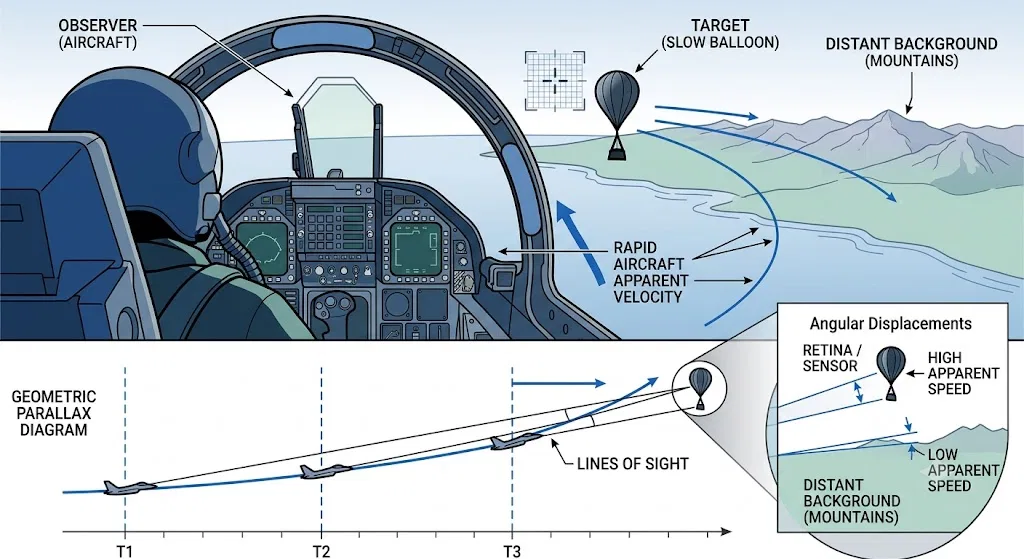
Motion parallax is easiest to understand from a moving car or train. Nearby objects seem to sweep backwards rapidly, while distant hills barely shift. Nothing unusual is happening to the objects; the changing viewpoint of the observer creates different apparent motions at different distances.
The same geometry applies to an airborne camera. As an aircraft moves, a nearby object is continuously projected against different parts of the much more distant ground or sea. AARO illustrates this with a stationary object suspended above a river: as the observer passes it, the object appears successively against one bank, the river and the opposite bank. The apparent movement is produced by the observer’s changing viewpoint. AARO notes that faster observer motion makes the perceived target motion more dramatic, so a stationary or slow-moving object can appear very fast.[AARO]aaro.milEffect of Forced Perspective and Parallax View on UAP ObservationsEffect of Forced Perspective and Parallax View on UAP Observations…
This is particularly powerful in military footage because the observing aircraft may be travelling at hundreds of kilometres per hour while the camera keeps the target locked near the centre of the frame. The object therefore looks comparatively stable while the terrain or ocean sweeps behind it. Human perception naturally tends to assign that background movement to the target.
The visual impression can become stronger when the sensor uses a narrow field of view. AARO’s public guidance says that motion parallax is enhanced when the observer is moving rapidly relative to the target, when the target is comparatively close to the observer, or when the sensor is viewing through a small field of view.[AARO]aaro.milAARO FAQ… stationary or slow moving? Optical phenomena, such as motion parallax, can explain how a stationary or slow-moving object…
Why unknown range breaks speed estimates
A video can show how quickly an object moves across the image in angular terms — degrees per second, or pixels per frame — without revealing how fast it is travelling through three-dimensional space. The missing quantity is usually distance.
Consider two objects that both shift by one degree across the observer’s view in one second. If one is 500 metres away and the other is 50 kilometres away, they must cover radically different physical distances to produce the same angular displacement. Treating angular motion as physical speed without establishing range can therefore produce errors of orders of magnitude.
This is closely connected to the familiar size-distance ambiguity. A featureless object in the sky may be small and nearby or large and distant while subtending the same angle at the camera. AARO warns that unknown objects without familiar structural cues — such as wings, windows or propellers — are particularly vulnerable to incorrect estimates of both distance and size. Those errors then propagate directly into estimates of speed.[AARO]aaro.milEffect of Forced Perspective and Parallax View on UAP ObservationsEffect of Forced Perspective and Parallax View on UAP Observations…
For airborne sensors, the observer’s own movement adds another layer. The measured change in viewing angle may reflect:
- movement of the target;
- movement of the aircraft;
- aircraft turning or banking;
- movement of the camera line of sight;
- or some combination of all four.
A speed calculation that neglects the observer’s trajectory can therefore attribute relative motion to the wrong participant.
NASA’s UAP study emphasised this broader problem. It found that existing UAP observations often lack sensor metadata, calibration information and the measurements needed to characterise size and motion conclusively. It specifically cited “GoFast” as an example in which apparent anomalous behaviour could be explained by motion of the sensor platform.[NASA Science]science.nasa.govNASA Science…
“GoFast”: the clearest modern parallax example
The 2015 US Navy “GoFast” video is unusually useful because enough information is visible on the sensor display to reconstruct at least part of the encounter. The footage gives the strong visual impression of a small object skimming just above the Atlantic at very high speed. NASA described precisely that impression, but its geometric analysis placed the object at roughly 13,000 feet rather than near the ocean surface.[NASA Science]science.nasa.govNASA Science…
Using the displayed range, bearing and aircraft information, NASA reconstructed a 22-second interval and estimated that the object travelled about 390 metres during that period, corresponding to roughly 40 mph. NASA cautioned that the calculation neglected wind effects on the aircraft and therefore carried uncertainty, but concluded that the object did not need an extraordinary velocity to produce the observed video.[NASA Science]science.nasa.govNASA Science…
AARO subsequently conducted a more extensive analysis. Its February 2025 case resolution likewise placed the object at about 13,000 feet and assessed with high confidence that it had not demonstrated anomalous speed. Because the exact aircraft heading was unavailable, AARO modelled the full range of possible headings rather than claiming a single target velocity.[AARO]aaro.milGo Fast Case ResolutionAARO GoFast Case Resolution…
The resulting speed range depended on the object’s direction relative to the wind. AARO calculated ground-relative speeds of approximately 72 to 161 mph, but after removing the contribution from winds at the target altitude, it estimated an intrinsic speed ranging from about 5 to 92 mph. In none of its simulations did the object travel against the prevailing wind.[AARO]aaro.milGo Fast Case ResolutionAARO GoFast Case Resolution…
The important point is not that investigators know exactly what the GoFast object was; AARO said it could not definitively identify it. The important point is that the dramatic apparent motion did not require dramatic actual motion. AARO explicitly attributed the impression of very high speed to motion parallax.[AARO]aaro.milGo Fast Case ResolutionAARO GoFast Case Resolution…
The case also demonstrates why a visual label such as “fast” is not itself a measurement. During the segment AARO analysed, the F/A-18 was travelling at about 190 metres per second, roughly 425 mph, while the range to the target changed from about 4.0 to 3.4 nautical miles. The aircraft’s own rapid displacement was therefore a major component of the changing viewing geometry.[AARO]aaro.milGo Fast Case ResolutionAARO GoFast Case Resolution…
The Puerto Rico case shows the same mechanism in a different setting
A separate UAP video recorded in 2013 near Aguadilla, Puerto Rico, appeared to show an object moving rapidly across the landscape, splitting into two and eventually entering the sea. AARO’s later reconstruction found a much less exotic trajectory.
Using the aircraft position and infrared sensor look angle, investigators reconstructed the target path and concluded that the footage depicted two nearby objects moving in a straight line at approximately wind speed. AARO assessed with high confidence that they never entered the water and with moderate confidence that they were sky lanterns.[AARO]aaro.milUAP Case Resolution ReportsAARO UAP Case Resolution Reports…
Parallax was central to the apparent speed. The aircraft moved while the sensor tracked the objects, causing their projected position against the terrain to change rapidly. AARO’s case presentation stated that the perception of high speed was attributable to motion parallax, while trajectory reconstruction showed the objects moving in a straight line at wind speed.[Armed Services Committee]armed-services.senate.govArmed Services CommitteeAARO Open Hearing Case SlidesNovember 20, 2024 — 10 Oct 2024 — The perception of high speed was attributed to mot…
The case is useful because it demonstrates that parallax does not merely affect featureless videos over open ocean. Even when buildings, roads or coastlines are visible, those background references can be misleading if the target is at a different distance from the camera than the viewer assumes. Apparent traversal of terrain is not necessarily physical traversal of that terrain.
Reconstructing motion from geometry
The remedy for parallax is not subjective interpretation but geometry. Investigators try to reconstruct the observer, target and viewing direction in three dimensions and ask whether an ordinary trajectory can reproduce the recorded angular motion.
A rigorous reconstruction typically needs several kinds of information:
- Observer position over time. The aircraft, drone or camera location establishes the moving baseline from which the target was viewed.
- Observer velocity and heading. These determine how rapidly the viewpoint changed.
- Camera azimuth and elevation. These define the line of sight from the sensor towards the target.
- Range or a defensible range constraint. Without this, angular motion cannot be converted uniquely into physical displacement.
- Accurate timing. Positions at different moments must be compared over known intervals.
- Camera field of view and zoom state. These are needed to interpret apparent image motion correctly.
AARO’s GoFast methodology provides a concrete example. Investigators used sensor azimuth, elevation, displayed target range, aircraft altitude, aircraft velocity and frame timing. Because the aircraft’s absolute heading and location were missing, they evaluated the entire set of possible aircraft headings rather than pretending the missing information did not matter.[AARO]aaro.milGo Fast Case ResolutionAARO GoFast Case Resolution…
The reconstruction begins with a line-of-sight vector from the aircraft. That vector is rotated according to the camera angles and extended to the measured range, giving a target position relative to the aircraft. Repeating the calculation at later times gives successive target positions. Once the aircraft’s own displacement is accounted for, investigators can estimate how far the target itself actually moved.[AARO]aaro.milGo Fast Case ResolutionAARO GoFast Case Resolution…
This is why raw footage can be less informative than it looks. A moving dot against a detailed background may feel intuitively measurable, but without enough information about the geometry, multiple three-dimensional trajectories can generate very similar two-dimensional video.

Why two viewpoints are much better than one
Parallax is both a source of error and, when measured deliberately, a way to determine distance. Two separated observers viewing the same target provide a baseline for triangulation. If their positions and viewing angles are known accurately, the intersection of their lines of sight can constrain the target’s location and therefore its true speed.
NASA’s UAP study highlighted the value of simultaneous observations from multiple calibrated sensors. It noted that near-simultaneous observations from different locations could be combined to triangulate an object’s position and estimate its velocity and size.[NASA Science]science.nasa.govNASA Science…
This changes the evidential quality of a case substantially. A single moving camera generally measures line-of-sight direction and perhaps range imperfectly. Two independent viewpoints can break the size-distance and motion-distance ambiguities that make apparent speed so deceptive.
Radar can serve a similar purpose when it produces reliable range and velocity measurements. NASA noted that properly calibrated radar systems can help test claims of rapid acceleration or other extreme motion through measurable Doppler signatures.[NASA Science]science.nasa.govNASA Science…
What parallax can and cannot explain
Parallax should not be treated as a universal explanation for every fast-moving UFO report. AARO itself stresses that no single mechanism accounts for all UAP cases. A parallax explanation is strongest when a fast observer is present, target distance is poorly perceived, background motion is prominent and a geometric reconstruction shows that modest target motion reproduces the footage.[AARO]aaro.milEffect of Forced Perspective and Parallax View on UAP ObservationsEffect of Forced Perspective and Parallax View on UAP Observations…
Conversely, the explanation becomes weaker when independent measurements establish the target’s distance and velocity directly. If several separated sensors triangulate the same object, calibrated radar measures its range rate, and the results all agree on extreme acceleration, simple motion parallax cannot erase those measurements.
That distinction is crucial. Parallax is not an argument that “objects only look fast”. It is a warning that apparent angular speed is not the same quantity as true physical speed.
The practical question for any apparently high-speed UAP is therefore not simply “How fast does it look?” but “What measurement fixes its distance, and has the observer’s own motion been removed?” Until those questions are answered, spectacular apparent velocity may be evidence of unusual geometry rather than unusual propulsion.
Amazon book picks
Further Reading
Books and field guides related to How Parallax Makes Slow Objects Look Fast. Use these as the next step if you want deeper reading beyond the article.
Sensation and Perception
. Bruce Goldstein's SENSATION AND PERCEPTION, the best-seller which has helped over 150,000 students understand the ties between how we s...
Optics
For courses in Optics A Contemporary Approach to Optics with Practical Applications and New Focused Pedagogy Hecht Optics balances theory...
Fundamentals of Astrodynamics
Rating: 4.5/5 from 12 Google Books ratings
Teaching text developed by U.S. Air Force Academy and designed as a first course emphasizes the universal variable formulation. Develops...
The UFO Experience: A Scientific Inquiry
Cited by the New York Review of Books as "the best brief for visitation," this classic study presents an analysis of UFO reports and conc...
eBay marketplace picks
Marketplace Samples
Live-tested eBay searches with available results related to this page.
Selected fromUFO poster oneBay.co.uk.

Current eBay listing
VINTAGE UFO FLYING SAUCERS COMIC ADVERTISING A2 POSTER PRINT



Current eBay listing
I Want To Believe UFO Poster Giclée Fine Art Heavyweight Print
Endnotes
1.
Source: aaro.mil
Title: Effect of Forced Perspective and Parallax View on UAP Observations
Link:https://www.aaro.mil/Portals/136/PDFs/Information%20Papers/AARO_Effect_of_Forced_Perspective_and_Parallax_View_on_UAP_Observations_2024.pdf
Source snippet
Effect of Forced Perspective and Parallax View on UAP Observations...
2.
Source: science.nasa.gov
Link:https://science.nasa.gov/wp-content/uploads/2023/09/uap-independent-study-team-final-report.pdf
Source snippet
NASA Science...
3.
Source: aaro.mil
Link:https://www.aaro.mil/FAQ/
Source snippet
AARO FAQ... stationary or slow moving? Optical phenomena, such as motion parallax, can explain how a stationary or slow-moving object...
4.
Source: aaro.mil
Title: [Go Fast]({{ ‘go-fast/’ | relative_url }}) Case Resolution
Link:https://www.aaro.mil/Portals/136/PDFs/case_resolution_reports/AARO_GoFast_Case_Resolution_Card_Methodology_Final.pdf
Source snippet
AARO GoFast Case Resolution...
5.
Source: aaro.mil
Title: UAP Case Resolution Reports
Link:https://www.aaro.mil/UAP-Cases/UAP-Case-Resolution-Reports/
Source snippet
AARO UAP Case Resolution Reports...
6.
Source: aaro.mil
Title: Puerto Rico UAP Case Resolution
Link:https://www.aaro.mil/Portals/136/PDFs/case_resolution_reports/AARO_Puerto_Rico_UAP_Case_Resolution.pdf
Source snippet
AARO Puerto Rico UAP Case Resolution...
7.
Source: aaro.mil
Title: AARO Historical Record Report Vol 1 2024
Link:https://www.aaro.mil/Portals/136/PDFs/AARO_Historical_Record_Report_Vol_1_2024.pdf
8.
Source: aaro.mil
Title: UAP Records
Link:https://www.aaro.mil/UAP-Records/
9.
Source: aaro.mil
Link:https://www.aaro.mil/UAP-Cases/Official-UAP-Imagery/
10.
Source: science.nasa.gov
Link:https://science.nasa.gov/uap/faqs/
11.
Source: science.gsfc.nasa.gov
Link:https://science.gsfc.nasa.gov/sci/bio/david.p.bennett
12.
Source: human-factors.arc.nasa.gov
Title: sid09 jbm reprint
Link:https://human-factors.arc.nasa.gov/publications/sid09_jbm_reprint.pdf
13.
Source: ntrs.nasa.gov
Link:https://ntrs.nasa.gov/api/citations/19980019496/downloads/19980019496.pdf
14.
Source: armed-services.senate.gov
Link:https://www.armed-services.senate.gov/download/aaro-slides-112124
Source snippet
Armed Services CommitteeAARO Open Hearing Case SlidesNovember 20, 2024 — 10 Oct 2024 — The perception of high speed was attributed to mot...
Published: November 20, 2024
15.
Source: armed-services.senate.gov
Link:https://www.armed-services.senate.gov/download/aaro-case-slides-112024
Source snippet
The perception of high speed was attributed to motion parallax. AARO, in coordination with IC assesses with...
16.
Source: uapcompany.com
Link:https://www.uapcompany.com/about
17.
Source: sciencedirect.com
Title: Motion Parallax
Link:https://www.sciencedirect.com/topics/computer-science/motion-parallax
18.
Source: Wikipedia
Link:https://en.wikipedia.org/wiki/Parallax
Additional References
19.
Source: youtube.com
Title: The SHOCKING Math Error Behind Viral UFO Videos | Mick West
Link:https://www.youtube.com/watch?v=ypfbhfEXnBo
Source snippet
Pentagon claims to debunk famous 'GOFAST' UFO radar video, but still has not ID'd mysterious object...
20.
Source: youtube.com
Link:https://www.youtube.com/watch?v=fh3znHctOkA
Source snippet
Pentagon UAP Videos: What the Cameras Really Show...
21.
Source: war.gov
Link:https://www.war.gov/ufo/
22.
Source: energy.gov
Link:https://www.energy.gov/nnsa/uapufo-resources-and-documents
23.
Source: intelligence.gov
Link:https://www.intelligence.gov/publics-daily-brief/publics-daily-brief-articles/unidentified-aerial-phenomena-preliminary-intelligence-assessment
24.
Source: youtube.com
Title: Quantum physicists analyze pentagon US navy UFO video footage
Link:https://www.youtube.com/watch?v=cwACSrLEPeM
Source snippet
Breakdown of the Pentagon UFO videos with Mick West...
25.
Source: youtube.com
Title: Pentagon UAP Videos: What the Cameras Really Show
Link:https://www.youtube.com/watch?v=9vD5DOZCPrc
Source snippet
Quantum physicists analyze pentagon US navy UFO video footage...
26.
Source: reddit.com
Link:https://www.reddit.com/r/UFOs/comments/1gv8xak/aaro_has_resolved_the_go_fast_uap/
27.
Source: facebook.com
Link:https://www.facebook.com/newshour/posts/boston-university-space-physicist-joshua-semeter-was-part-of-an-independent-pane/1143879570940621/
28.
Source: disclosure.org
Link:https://disclosure.org/