Within UFO Identifications
Why UFO Size Is Impossible Without Distance
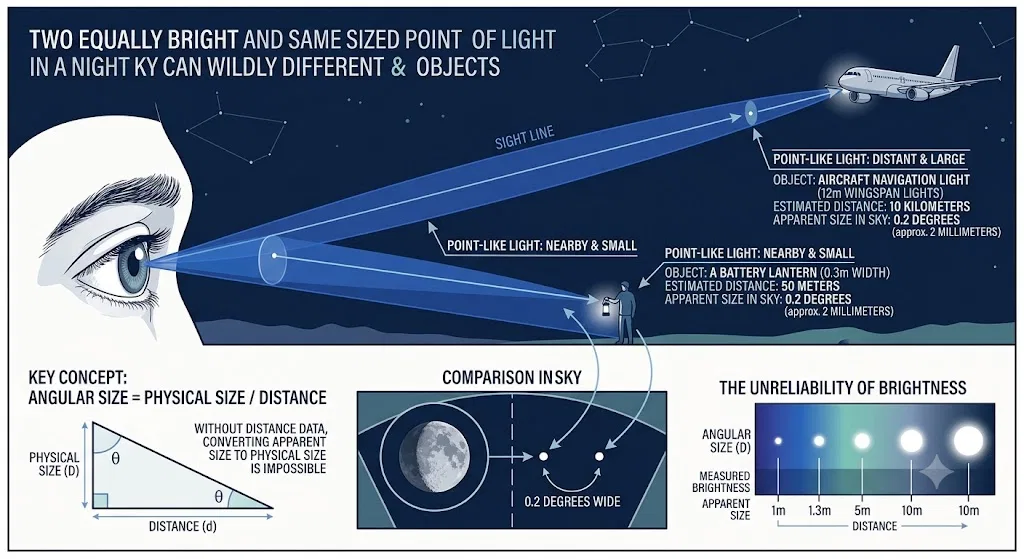
Without range information, observers cannot reliably tell whether a light is a small nearby object or a large distant one.
On this page
- Angular size versus physical size
- Why night scenes remove depth cues
- What range data can settle
Page outline Jump by section
Introduction
A UFO or UAP can look enormous without providing any reliable evidence that it actually is enormous. The reason is simple: an observer usually sees an angle, not a physical width. A small nearby object and a much larger distant object can occupy exactly the same apparent size in the sky. Until the distance is known independently, converting that apparent size into metres is underdetermined. This is a basic geometric problem rather than a peculiarity of UFO reports.[Imaging the Universe]itu.physics.uiowa.eduImaging the UniverseSmall Angle Formula | Imaging the UniverseThe equation reads, 'Theta equals big D (physical size) over little d (dist…
The problem becomes especially severe at night, when a sighting may consist of little more than one or several lights against a dark background. Familiar objects, surface texture and other depth cues disappear, leaving the witness with fewer ways to judge range. Aviation guidance explicitly warns that darkness and sparse visual references can distort perceptions of distance and position.[Federal Aviation Administration]faa.govDarkness or low visibility increases pilotFederal Aviation AdministrationAirplane Flying Handbook (3C) Chapter 11September 24, 2021 — Night Illusions Visual illusions are especial…
For UFO investigation, this means that statements such as “it was the size of a football pitch” are not measurements unless there is also credible range information. NASA and the US All-domain Anomaly Resolution Office (AARO) repeatedly identify missing distance, calibration and sensor metadata as barriers to determining UAP size, motion and nature.[NASA Science]science.nasa.govNASA Science…
Angular size is not physical size
What the eye or camera directly records is angular size: the angle an object spans across the observer’s field of view. For relatively small angles, the relationship is approximately:
physical size ≈ distance × angular size in radians[itu.physics.uiowa.edu]itu.physics.uiowa.eduImaging the UniverseSmall Angle Formula | Imaging the UniverseThe equation reads, 'Theta equals big D (physical size) over little d (dist…
That equation contains two unknown quantities if the range is missing. Measuring the angle alone therefore does not yield a unique physical size. Astronomy uses precisely the same geometry when relating the apparent dimensions of distant objects to their actual dimensions.[Imaging the Universe]itu.physics.uiowa.eduImaging the UniverseSmall Angle Formula | Imaging the UniverseThe equation reads, 'Theta equals big D (physical size) over little d (dist…
Consider two hypothetical objects that both appear about 0.57 degrees wide. One could be roughly 1 metre across at 100 metres; another could be roughly 10 metres across at 1 kilometre. Their apparent width is essentially the same because both size and distance have increased by the same factor. A witness who mistakes the first object’s range for the second’s would inflate the inferred physical size by roughly tenfold.
This ambiguity cuts both ways. An apparently huge UFO need not be large; conversely, an object assumed to be nearby might in fact be larger and farther away. The defensible observation is normally the apparent angle — for example, “roughly half a degree wide” — rather than a linear estimate such as “30 metres across”, unless the observer has an independent basis for the distance.
Human vision normally hides this geometrical ambiguity remarkably well. The brain combines angular size with information such as binocular disparity, perspective, motion parallax, familiar size and environmental context to form judgements about distance and scale. Research on size and distance perception shows that perceived size and perceived distance are closely linked, although the exact relationship is more complicated than a single simple perceptual rule.[PubMed Central (PMC)]pmc.ncbi.nlm.nih.govPub Med Central (PMC)A Binocular Information Source for Size PerceptionPub Med Central (PMC)A Binocular Information Source for Size Perception
A UFO report becomes troublesome when those supporting cues are absent or misleading. If the sighting consists of an unfamiliar point or blob in an otherwise empty sky, the observer may have no known-size reference against which to calibrate it. A bright “disc” several millimetres across in an image may represent the optical spread of a point-like light rather than the outline of a structure, making physical-size claims still less secure unless the imaging system is characterised.
Why darkness strips away range cues
Night sightings are particularly vulnerable because darkness removes much of the visual scenery that ordinarily anchors depth. FAA guidance notes that low-light conditions diminish vision and increase susceptibility to visual illusion. It also warns that ground lights can become difficult to distinguish from stars or other lights when terrain and horizon references disappear.[Federal Aviation Administration]faa.govDarkness or low visibility increases pilotFederal Aviation AdministrationAirplane Flying Handbook (3C) Chapter 11September 24, 2021 — Night Illusions Visual illusions are especial…
A lone airborne light may therefore supply almost none of the information needed to decide whether it is nearby or distant. There may be no visible fuselage, no intervening terrain, no shadows, no surface texture and no recognisable object of known dimensions at the same range. Even highly experienced pilots are not exempt from this basic limitation: aviation guidance treats night visual illusions as a normal human-factors problem and recommends checking visual impressions against instruments.[Federal Aviation Administration]faa.govFederal Aviation Administration Pilot Vision brochure_englishFederal Aviation Administration Pilot Vision brochure_english
Brightness is an unreliable substitute for range. A witness may intuitively interpret a very bright light as close, large or powerful, but apparent brightness depends on the source’s intrinsic output, beam direction, atmospheric transmission, exposure settings and other factors as well as distance. Without knowing the light source, brightness does not supply a trustworthy scale.
The same issue affects apparent spacing between several lights. If three lights form a triangle in the sky, their angular separation can be measured, but that does not reveal whether they are lamps attached to one large structure, separate objects at different distances, or unrelated lights that merely line up from the observer’s viewpoint. Establishing physical dimensions requires demonstrating that the lights share a common range and geometry.
Movement can add another misleading cue. Motion parallax means that relative movement across the observer’s field of view depends strongly on distance and on the observer’s own motion. A nearby slow object can sweep dramatically against a distant background, while a distant fast object may show comparatively little angular displacement. AARO explicitly cites this effect in its analysis of the 2015 “Go Fast” UAP video.[AARO]aaro.milGo Fast Case ResolutionGo Fast Case Resolution
The “Go Fast” case shows what range changes
The Navy’s “Go Fast” infrared video is useful because it demonstrates the difference between an initial visual impression and an estimate constrained by range data. The footage appeared to show an object moving rapidly close to the Atlantic Ocean. However, the sensor display contained target range, viewing angles, aircraft altitude and aircraft speed — enough information to reconstruct much of the geometry.[AARO]aaro.milGo Fast Case ResolutionGo Fast Case Resolution
AARO’s February 2025 case analysis assessed the object at about 13,000 feet altitude rather than immediately above the sea and concluded with high confidence that it did not display anomalous speed. The office attributed much of the rapid apparent motion to motion parallax as the F/A-18 moved relative to the target. AARO did not identify the object itself conclusively.[AARO]aaro.milGo Fast Case ResolutionGo Fast Case Resolution
The important point for size estimation is more subtle. Even after determining target range, AARO said the video resolution was too poor to determine a definitive size. Pixel analysis by an intelligence-community partner suggested an object about one metre or less across, but AARO treated that as an indication rather than an exact measurement.[AARO]aaro.milGo Fast Case ResolutionGo Fast Case Resolution
This illustrates a useful hierarchy. Angular imagery without range is insufficient for physical size. Range plus imagery is much better, but image resolution and calibration still determine how precisely size can be measured. Distance is therefore necessary in many cases, but it is not always sufficient by itself.
NASA used the same “Go Fast” material in its 2023 independent UAP study to demonstrate how range, viewing angles and aircraft motion can turn an apparently extraordinary trajectory into a more conventional one. NASA calculated an altitude of roughly 13,000 feet and emphasised that additional data would still be needed for a firmer conclusion about the object’s nature.[NASA Science]science.nasa.govNASA Science…

A known object in the same scene can supply scale
Investigators do not always need a direct laser or radar range reading. Sometimes the image itself contains enough geometry to establish scale — provided there is a genuinely comparable reference object whose dimensions and position are known.
AARO’s investigation of the 2013 Aguadilla, Puerto Rico, infrared footage provides an example. Its reconstruction used aircraft and sensor geometry to reassess a sequence that appeared to show an object travelling rapidly, splitting and entering the water. AARO concluded that the footage depicted two objects travelling near one another and assessed them as most likely sky lanterns.[AARO]aaro.milUAP ImageryUAP Imagery
For size, AARO used pixel analysis involving comparison with objects of known dimensions and estimated each target at under one metre. That figure was meaningful because the analysis was not merely converting an unidentified blob’s apparent width directly into metres; it incorporated reference information capable of establishing scale.[AARO]aaro.milPuerto Rico UAP Case ResolutionPuerto Rico UAP Case Resolution
The principle matters more than the particular case. A photograph containing an aircraft, building or other object does not automatically solve the scale problem. The reference is useful only if its dimensions and geometric relationship to the unknown object are known. A lamp post in the foreground, for example, cannot establish the size of a light kilometres behind it merely because both appear in the same frame.
What range data can actually settle
A useful UFO size estimate requires evidence that constrains where the object was in three-dimensional space. Different forms of evidence can do this with different precision.
Direct sensor range. Radar, laser ranging or other calibrated systems may provide a direct line-of-sight distance. When that can be matched accurately to optical imagery, the object’s angular extent can be converted into physical dimensions.
Triangulation from separated observers. Two or more simultaneous observations from known locations can constrain a target’s position through intersecting sight lines. NASA’s UAP study specifically proposed combining near-simultaneous observations and metadata so that an object’s location, velocity and size could be estimated.[NASA Science]science.nasa.govNASA Science…
Motion parallax with known observer motion. If a camera platform’s position and movement are precisely recorded, changes in viewing angle over time can help solve for target distance. This principle underlies many forms of photogrammetry and was central to the reconstruction of cases such as “Go Fast”.[AARO]aaro.milGo Fast Case ResolutionGo Fast Case Resolution
Geolocation against known terrain or structures. If an object crosses features whose coordinates and dimensions are known, its trajectory and range may sometimes be reconstructed. AARO notes that full-motion-video analysis works particularly well for objects associated with the ground because the sensor’s position and pointing direction can be used to calculate the ground intersection. Airborne targets are harder because they are not fixed to that known surface.[AARO]aaro.milGo Fast Case ResolutionGo Fast Case Resolution
Correlated radar or flight-tracking data. Matching an unknown light with a known aircraft track can resolve both identity and approximate range. AARO reports that several “Western U.S. Objects” seen as small infrared dots were identified as distant commercial aircraft after video analysis was combined with commercial flight data.[AARO]aaro.milUAP ImageryUAP Imagery
These methods share one feature: they introduce information independent of the object’s apparent image size. That breaks the size-distance ambiguity.
What investigators should record
For a naked-eye sighting, the most useful immediate description separates what was actually observed from what was inferred. “The light appeared one-quarter the width of the Moon” preserves an angular comparison. “The craft was 50 metres wide” usually embeds an unstated range assumption.
A stronger record therefore captures the observation geometry: exact observer position, precise time, direction and elevation angle, duration, apparent angular size, movement against stars or landmarks, and any contemporaneous photographs or video. For cameras, focal length, zoom state, field of view, stabilisation, cropping and original uncropped files matter because they determine how image pixels relate to viewing angle. NASA has stressed that missing sensor calibration, metadata and multiple measurements routinely prevent conclusive characterisation of UAP size and motion.[NASA Science]science.nasa.govNASA Science…
If several witnesses observed the event from different places, their original positions and timings are particularly valuable. Independent sight lines can turn an otherwise ambiguous report into a solvable geometry problem. Simply collecting several descriptions from people standing together does much less to establish range because their lines of sight are nearly identical.
Likewise, later recollections such as “it seemed just above the trees” should not automatically be treated as measured altitude. Unless the object actually passed behind or in front of a feature whose location is known, apparent proximity to a treeline may merely reflect two things lining up in the observer’s visual field.
Why unresolved size claims should stay unresolved
The absence of distance data does not prove that a UFO was small, ordinary or misidentified. It means something narrower but crucial: its physical size cannot be established from angular appearance alone. The appropriate conclusion is uncertainty, not a substitute guess.
That distinction is central to modern UAP analysis. NASA’s independent study found that many existing observations lack the calibrated data and metadata required to determine size, motion or nature conclusively. AARO’s historical review likewise identifies missing information about altitude, speed and size as a longstanding obstacle to UFO investigations.[NASA Science]science.nasa.govNASA Science…
Recent AARO reporting shows that the problem persists. Its FY2025 annual report states that nearly a quarter of the analysed reports lacked enough information even to reach a conclusion about morphological characteristics, while some cases described potentially remarkable performance without accompanying technical data capable of validating it.[AARO]aaro.milAARO FY2025 Consolidated Annual Report on UAPAARO FY2025 Consolidated Annual Report on UAP
For assessing an individual UFO report, the practical rule is therefore straightforward: first establish range, then discuss physical scale. Until that first step is supported by radar, triangulation, calibrated sensor geometry or another independent constraint, a light described as “huge” remains a large appearance, not a measured large object.

Amazon book picks
Further Reading
Books and field guides related to Why UFO Size Is Impossible Without Distance. Use these as the next step if you want deeper reading beyond the article.
The UFO Experience: A Scientific Inquiry
Cited by the New York Review of Books as "the best brief for visitation," this classic study presents an analysis of UFO reports and conc...
UFOs: Generals, Pilots, and Government Officials Go on the Re...
NEW YORK TIMES BESTSELLER • Impeccably researched, this riveting journalistic investigation separates fact from fiction, and documents th...
Optics
For courses in Optics A Contemporary Approach to Optics with Practical Applications and New Focused Pedagogy Hecht Optics balances theory...
Sensation and Perception
. Bruce Goldstein's SENSATION AND PERCEPTION, the best-seller which has helped over 150,000 students understand the ties between how we s...
eBay marketplace picks
Marketplace Samples
Live-tested eBay searches with available results related to this page.
Selected fromUFO model oneBay.co.uk.


Endnotes
1.
Source: faa.gov
Title: Darkness or low visibility increases pilot
Link:https://www.faa.gov/sites/faa.gov/files/regulations_policies/handbooks_manuals/aviation/airplane_handbook/12_afh_ch11.pdf
Source snippet
Federal Aviation AdministrationAirplane Flying Handbook (3C) Chapter 11September 24, 2021 — Night Illusions Visual illusions are especial...
Published: September 24, 2021
2.
Source: science.nasa.gov
Link:https://science.nasa.gov/wp-content/uploads/2023/09/uap-independent-study-team-final-report.pdf
Source snippet
NASA Science...
3.
Source: aaro.mil
Title: AARO Historical Record Report Vol 1 2024
Link:https://www.aaro.mil/Portals/136/PDFs/AARO_Historical_Record_Report_Vol_1_2024.pdf
Source snippet
AARO_Historical_Record_Repor...6 Mar 2024 — The lack of actionable, researchable data—specifically the lack of speed, altitude, and s...
4.
Source: faa.gov
Link:https://www.faa.gov/pilots/safety/pilotsafetybrochures/media/spatiald_visillus.pdf
5.
Source: faa.gov
Title: Federal Aviation Administration Pilot Vision brochure_english
Link:https://www.faa.gov/pilots/safety/pilotsafetybrochures/Pilot_Vision_brochure_english.pdf
6.
Source: aaro.mil
Title: Go Fast Case Resolution
Link:https://www.aaro.mil/Portals/136/PDFs/case_resolution_reports/AARO_GoFast_Case_Resolution_Card_Methodology_Final.pdf
7.
Source: aaro.mil
Title: UAP Imagery
Link:https://www.aaro.mil/UAP-Cases/Official-UAP-Imagery/
8.
Source: aaro.mil
Title: Puerto Rico UAP Case Resolution
Link:https://www.aaro.mil/Portals/136/PDFs/case_resolution_reports/AARO_Puerto_Rico_UAP_Case_Resolution.pdf
9.
Source: aaro.mil
Title: AARO FY2025 Consolidated Annual Report on UAP
Link:https://www.aaro.mil/Portals/136/PDFs/FY25%20UAP%20Annual%20Report/AARO_FY2025_Consolidated_Annual_Report_on_UAP.pdf
10.
Source: science.nasa.gov
Link:https://science.nasa.gov/uap/
11.
Source: faa.gov
Link:https://www.faa.gov/
12.
Source: faa.gov
Title: pilot handbook 1
Link:https://www.faa.gov/sites/faa.gov/files/pilot_handbook_1.pdf
13.
Source: faa.gov
Link:https://www.faa.gov/sites/faa.gov/files/regulations_policies/handbooks_manuals/aviation/faa-h-8083-21.pdf
14.
Source: faa.gov
Link:https://www.faa.gov/sites/faa.gov/files/data_research/research/med_humanfacs/oamtechreports/AM78-15.pdf
15.
Source: faa.gov
Link:https://www.faa.gov/sites/faa.gov/files/data_research/research/med_humanfacs/oamtechreports/AM82-06.pdf
16.
Source: faa.gov
Link:https://www.faa.gov/sites/faa.gov/files/data_research/research/med_humanfacs/oamtechreports/AM77-12.pdf
17.
Source: faa.gov
Link:https://www.faa.gov/sites/faa.gov/files/2022-01/NovDec2020.pdf
18.
Source: faa.gov
Title: PHA K Table of Contents Chapter 1
Link:https://www.faa.gov/sites/faa.gov/files/regulations_policies/handbooks_manuals/aviation/phak/02_phak_toc.pdf
19.
Source: faa.gov
Link:https://www.faa.gov/sites/faa.gov/files/regulations_policies/handbooks_manuals/aviation/airplane_handbook/06_afh_ch5.pdf
20.
Source: faa.gov
Link:https://www.faa.gov/documentLibrary/media/Advisory_Circular/Editorial_Update_AC_107-2A.pdf
21.
Source: faa.gov
Link:https://www.faa.gov/sites/faa.gov/files/regulations_policies/handbooks_manuals/aviation/instrument_procedures_handbook/FAA-H-8083-16B.pdf
22.
Source: faa.gov
Link:https://www.faa.gov/sites/faa.gov/files/training_testing/training/wake/04SEC2.PDF
23.
Source: faa.gov
Link:https://www.faa.gov/documentlibrary/media/advisory_circular/150_5300_18b.pdf
24.
Source: faa.gov
Link:https://www.faa.gov/sites/faa.gov/files/about/office_org/headquarters_offices/avs/SD_UAV-EV1.pdf
25.
Source: faa.gov
Title: Intro Aviation Physiology
Link:https://www.faa.gov/sites/faa.gov/files/2022-11/Intro_Aviation_Physiology.pdf
26.
Source: itu.physics.uiowa.edu
Link:https://itu.physics.uiowa.edu/glossary/small-angle-formula
Source snippet
Imaging the UniverseSmall Angle Formula | Imaging the UniverseThe equation reads, 'Theta equals big D (physical size) over little d (dist...
27.
Source: pmc.ncbi.nlm.nih.gov
Title: Pub Med Central (PMC)A Binocular Information Source for Size Perception
Link:https://pmc.ncbi.nlm.nih.gov/articles/PMC5723144/
28.
Source: pubmed.ncbi.nlm.nih.gov
Link:https://pubmed.ncbi.nlm.nih.gov/17131650/
29.
Source: skybrary.aero
Link:https://skybrary.aero/articles/visual-illusions
30.
Source: skybrary.aero
Link:https://skybrary.aero/articles/federal-aviation-administration-faa
31.
Source: pubmed.ncbi.nlm.nih.gov
Link:https://pubmed.ncbi.nlm.nih.gov/6535981/
32.
Source: pubmed.ncbi.nlm.nih.gov
Link:https://pubmed.ncbi.nlm.nih.gov/1620566/
33.
Source: pubmed.ncbi.nlm.nih.gov
Link:https://pubmed.ncbi.nlm.nih.gov/26868887/
34.
Source: pubmed.ncbi.nlm.nih.gov
Link:https://pubmed.ncbi.nlm.nih.gov/2216472/
35.
Source: pubmed.ncbi.nlm.nih.gov
Link:https://pubmed.ncbi.nlm.nih.gov/23751007/
36.
Source: pubmed.ncbi.nlm.nih.gov
Link:https://pubmed.ncbi.nlm.nih.gov/2972800/
37.
Source: pubmed.ncbi.nlm.nih.gov
Link:https://pubmed.ncbi.nlm.nih.gov/9259645/
38.
Source: pubmed.ncbi.nlm.nih.gov
Link:https://pubmed.ncbi.nlm.nih.gov/27210039/
39.
Source: pmc.ncbi.nlm.nih.gov
Link:https://pmc.ncbi.nlm.nih.gov/articles/PMC9874321/
40.
Source: pubmed.ncbi.nlm.nih.gov
Link:https://pubmed.ncbi.nlm.nih.gov/16355744/
41.
Source: pmc.ncbi.nlm.nih.gov
Link:https://pmc.ncbi.nlm.nih.gov/articles/PMC3876294/
42.
Source: pubmed.ncbi.nlm.nih.gov
Link:https://pubmed.ncbi.nlm.nih.gov/42252381/
43.
Source: pubmed.ncbi.nlm.nih.gov
Link:https://pubmed.ncbi.nlm.nih.gov/31735889/
44.
Source: pubmed.ncbi.nlm.nih.gov
Link:https://pubmed.ncbi.nlm.nih.gov/9090148/
45.
Source: pubmed.ncbi.nlm.nih.gov
Link:https://pubmed.ncbi.nlm.nih.gov/29988581/
46.
Source: pubmed.ncbi.nlm.nih.gov
Link:https://pubmed.ncbi.nlm.nih.gov/29225765/
47.
Source: pubmed.ncbi.nlm.nih.gov
Link:https://pubmed.ncbi.nlm.nih.gov/20198365/
48.
Source: pubmed.ncbi.nlm.nih.gov
Link:https://pubmed.ncbi.nlm.nih.gov/12972392/
49.
Source: Wikipedia
Title: Federal Aviation Administration
Link:https://en.wikipedia.org/wiki/Federal_Aviation_Administration
50.
Source: web.williams.edu
Link:https://web.williams.edu/Astronomy/Course-Pages/330/images/distances.pdf
51.
Source: youtube.com
Link:https://www.youtube.com/user/FAAnews
52.
Source: youtube.com
Link:https://www.youtube.com/watch?v=XE-tkMD5N0M
53.
Source: sciencedirect.com
Title: Angular Size
Link:https://www.sciencedirect.com/topics/engineering/angular-size
54.
Source: aty.sdsu.edu
Link:https://aty.sdsu.edu/explain/atmos_refr/angles.html
55.
Source: facebook.com
Link:https://www.facebook.com/FAA/?locale=en_GB
Additional References
56.
Source: skybrary.aero
Link:https://skybrary.aero/articles/night-visual-approaches
Source snippet
Night Visual Approaches | SKYbrary Aviation SafetyOn a clear night, lights can be seen from a long distance and it is quite diffi...
57.
Source: lco.global
Link:https://lco.global/spacebook/sky/using-angles-describe-positions-and-apparent-sizes-objects/
Source snippet
An angle is the opening between two lines that meet at a point.Read more...
58.
Source: youtube.com
Title: Pentagon UFO Footage Looks Impossible. Here’s the Catch
Link:https://www.youtube.com/watch?v=a3rZqkAvPVQ
Source snippet
Breakdown of the Pentagon UFO videos with Mick West...
59.
Source: youtube.com
Title: Navy UFO Videos
Link:https://www.youtube.com/watch?v=qsEjV8DdSbs
Source snippet
PSW 2513 Unidentified Anomalous Phenomena | Joshua Semeter...
60.
Source: researchgate.net
Link:https://www.researchgate.net/publication/375671690_Analysis_of_Pilot_Distance_Estimation_in_Different_Lighting_and_Visibility_Conditions
61.
Source: researchgate.net
Link:https://www.researchgate.net/publication/395858774_Toward_a_Reliability_Scale_for_Assessing_Reports_of_Unidentified_Anomalous_Phenomena_UAP
62.
Source: researchgate.net
Link:https://www.researchgate.net/publication/400385806_Physiology_in_Aviation_Hearing_Vision_Spatial_Disorientation_and_Visual_Illusions
63.
Source: facebook.com
Link:https://www.facebook.com/groups/728877225402752/posts/1305043741119428/
64.
Source: medium.com
Link:https://medium.com/%40kyeq1/activity
65.
Source: 1728.org
Link:https://www.1728.org/angsize.htm