Within Secret Aircraft
The Flying Saucer That Could Barely Fly
The saucer-shaped Avrocar looked extraordinary, but its poor flight performance rules it out for distant high-altitude or high-speed sightings.
On this page
- Why the Avrocar looked like a classic UFO
- What its real flight tests showed
- Why appearance alone cannot identify a historical sighting
Page outline Jump by section
Introduction
The Avro Canada VZ-9AV Avrocar is almost irresistible in discussions of secret aircraft and historical UFO reports: it was classified, military-funded and quite literally shaped like the popular image of a flying saucer. Yet those same facts can give it explanatory power that its actual performance does not deserve. The surviving test record shows a vehicle that could hover close to the ground but became unstable as it climbed and achieved only about 30–35 mph in flight testing. It never came remotely close to the high-altitude, high-speed aircraft once envisaged by its designers.[Air Force Museum]nationalmuseum.af.milOpen source on af.mil.
That distinction matters when assessing UFO reports. The Avrocar demonstrates that secret saucer-shaped aircraft really did exist. It does not provide a credible explanation for reports requiring a disc to fly rapidly across the sky, operate at substantial altitude or perform sustained high-speed manoeuvres. In this case, appearance is striking evidence of resemblance, but the measured flight envelope is strong evidence against identification.
Why the Avrocar looked like a classic UFO
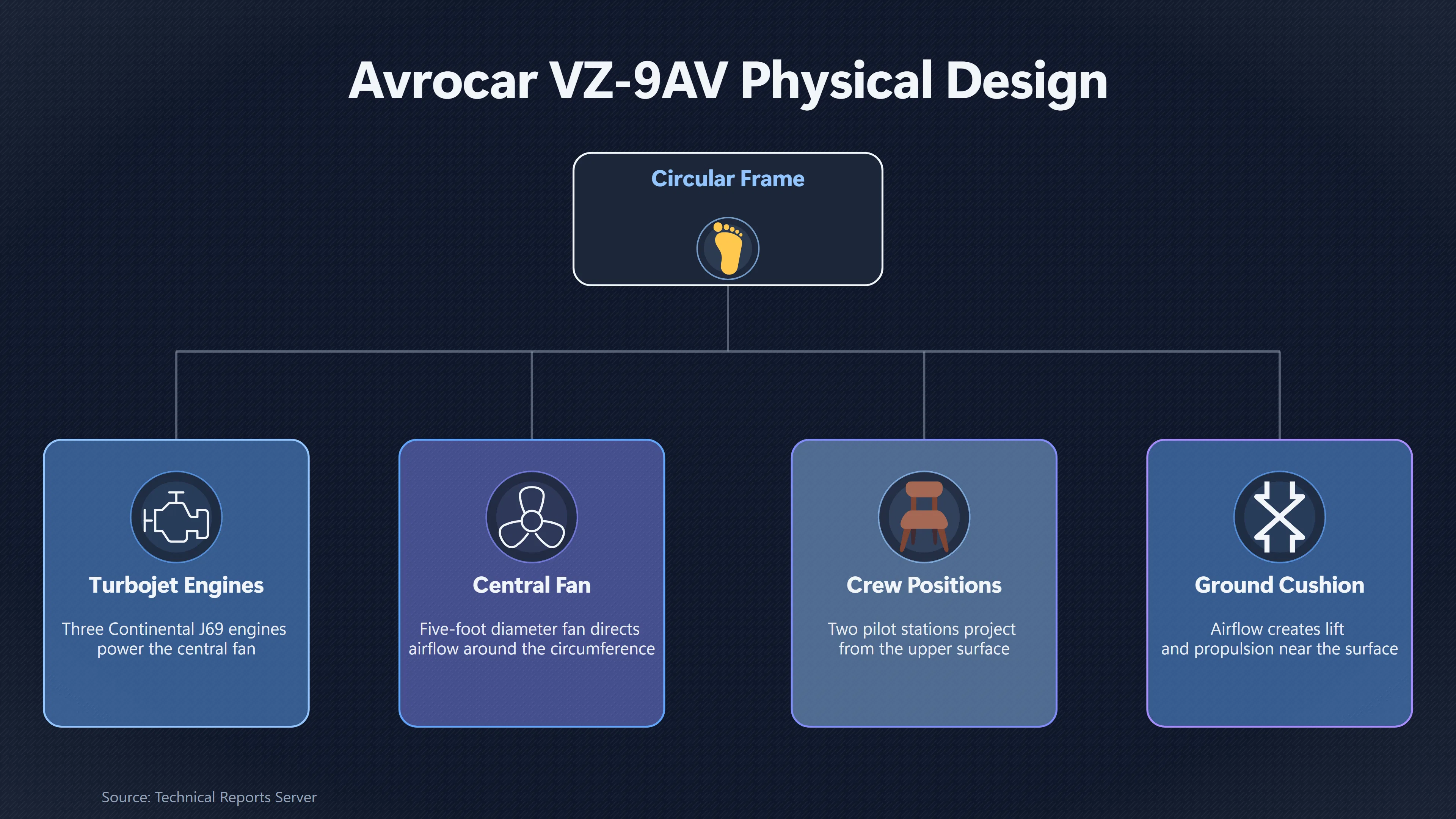
Seen in photographs, the Avrocar seems almost designed to encourage retrospective UFO theories. It was an 18-foot-diameter circular aircraft, less than five feet high, with two crew positions projecting from its upper surface. Three Continental J69 turbojets powered a central five-foot-diameter fan, with airflow directed around the circumference to provide lift, propulsion and control.[Air Force Museum]nationalmuseum.af.milOpen source on af.mil.
The concept was much more ambitious than the machine that ultimately flew. The US Army wanted a comparatively low-flying tactical vehicle, while the US Air Force was interested in a vertical-take-off aircraft that might remain below radar coverage and then accelerate to supersonic speed. Avro hoped the circular-wing concept could accommodate both sets of requirements.[Air Force Museum]nationalmuseum.af.milOpen source on af.mil.
That history creates an important trap. Planned performance is easily confused with demonstrated performance. Contemporary ambitions, design studies and later accounts can make the Avro programme sound like evidence that the United States possessed an operational supersonic flying saucer. In reality, even preliminary model testing indicated that the Avrocar’s air cushion became unstable only a few feet above the ground and that the vehicle would not achieve the Air Force’s supersonic objective.[Air Force Museum]nationalmuseum.af.milOpen source on af.mil.
The aircraft nevertheless remained worth investigating as a lower-performance vehicle. That is why photographs of an authentic military flying saucer coexist with test results showing something much less spectacular. They document an experimental programme, not proof that its most ambitious performance predictions were achieved.
What its real flight tests showed
NASA Ames participated in full-scale wind-tunnel and flight evaluation of the Avrocar. NASA engineer Woodrow L. Cook’s later technical review describes the Ames work as an investigation of why the system failed to deliver the performance and control anticipated by its manufacturer.[NASA Technical Reports Server]ntrs.nasa.govTechnical Reports ServerNASA Technical Reports ServerSummary of Lift and Lift/Cruise Fan Powered Lift Concept Technology - NASA Technical Reports Server (NTRS)… The original Avro continuation-test documentation from May 1961 is also preserved in the Bernard Lindenbaum Vertical Flight Research Collection at Wright State University, providing an archival trail for the programme’s full-scale wind-tunnel work.[Wright State University]wright.libraryhost.com1 Contract# AF33(600)-42163 AVRO, 1961 May | Wright State University…
The results expose a fundamental mismatch between the Avrocar and a high-speed UFO.
NASA flight-test memoirs report that the aircraft benefited from a ground-cushion or “fountain” effect at very low height, but above approximately three feet it became dynamically unstable in pitch and roll. The oscillating behaviour became known as “hubcapping”. The problem was not simply an inexperienced pilot having difficulty with an unconventional aircraft: separated airflow beneath the vehicle, reflected flow from the ground, control coupling and large trim changes with increasing forward speed were inherent aerodynamic problems. The craft also lacked inherent directional stability and damping, demanding continual pilot control close to the surface.[Wikimedia Commons]upload.wikimedia.orgWikimedia CommonsCover: Pilot and flight-test engineer compare notes on wing of a Republic P-47 Thunderbolt…
Propulsion compounded the difficulty. NASA’s account attributes the disappointing fan thrust partly to airflow problems at the compressor inlet and substantial internal duct losses. These reduced not only lift and forward thrust but also the control forces needed to manage the vehicle.[Wikimedia Commons]upload.wikimedia.orgWikimedia CommonsCover: Pilot and flight-test engineer compare notes on wing of a Republic P-47 Thunderbolt…
The result was extraordinary only in comparison with what had been promised. An Ames pilot flight-tested the VZ-9AV to its performance limits in Canada in 1960. NASA’s historical account says that although unofficial expectations had reached roughly 300 mph and 30,000 feet, the vehicle barely achieved 30 mph and three feet. The National Museum of the United States Air Force gives a maximum speed of 35 mph and likewise records uncontrollable pitch-and-roll behaviour when the Avrocar rose more than about three feet.[Wikimedia Commons]upload.wikimedia.orgWikimedia CommonsCover: Pilot and flight-test engineer compare notes on wing of a Republic P-47 Thunderbolt…
The exact figures vary slightly according to how particular tests are described, but that small difference is irrelevant to the UFO question. Whether the best figure is expressed as roughly 30 or 35 mph, the Avrocar was a very-low-altitude, low-speed experimental vehicle, not an aircraft capable of the hundreds or thousands of miles per hour sometimes inferred in spectacular UFO reports.
Nor was there a hidden successful high-speed phase behind the disappointing free-flight tests. NASA Ames conducted full-scale testing in its 40-by-80-foot wind tunnel specifically to examine aerodynamic forces, stability, control and propulsion behaviour during transition towards cruise flight. NASA’s retrospective assessment was that these tests revealed serious deficiencies too complex to solve with the technology available.[Wikimedia Commons]upload.wikimedia.orgWikimedia CommonsCover: Pilot and flight-test engineer compare notes on wing of a Republic P-47 Thunderbolt… The Air Force museum similarly states that the Ames tests demonstrated insufficient high-speed control and aerodynamic instability.[Air Force Museum]nationalmuseum.af.milOpen source on af.mil.
The Avrocar’s basic aerodynamic efficiency was poor as well. NASA’s memoir gives the disc a best cruise lift-to-drag ratio of about 3.5, compared with roughly 10 for conventional-wing aircraft of the period. Even improved modern controls, the account concluded, would not remove fundamental difficulties such as large trim changes and recirculation of hot gases near the ground. NASA characterised the vehicle in practical terms as a low-performance ground-effect machine.[Wikimedia Commons]upload.wikimedia.orgWikimedia CommonsCover: Pilot and flight-test engineer compare notes on wing of a Republic P-47 Thunderbolt…
There was another observational clue that works against some UFO identifications: noise. With three turbojets driving a high-speed fan, this was not a silent craft. NASA’s Ames account records a pilot’s memorable description of it as a “3,000-horsepower siren” and says it could be heard well before it could be seen.[Wikimedia Commons]upload.wikimedia.orgWikimedia CommonsCover: Pilot and flight-test engineer compare notes on wing of a Republic P-47 Thunderbolt… A historical report describing a silent disc moving rapidly overhead would therefore require more than a visual resemblance before the Avrocar became a convincing candidate.
Why appearance alone cannot identify a historical sighting
The useful question is not “Did the military build a flying saucer?” It plainly did. The useful question is whether the known aircraft could have produced the particular observation being investigated.
For an Avrocar explanation to work, the report should be compatible with the vehicle’s demonstrated characteristics. A low-level sighting near a relevant test location and period, involving a relatively slow disc-shaped object accompanied by substantial engine and fan noise, is at least worth comparing with Avrocar activity. A report describing a disc thousands of feet overhead, rapidly crossing a large part of the sky, overtaking conventional aircraft or accelerating away at extraordinary speed is a different proposition. Assigning that report to the Avrocar would require capabilities contradicted by its documented tests.[Air Force Museum]nationalmuseum.af.milOpen source on af.mil.
This provides a useful discipline for evaluating claims that secret aircraft caused historical UFO reports:
- Shape is only one matching characteristic. A circular outline can establish visual similarity without establishing identity.
- Altitude must match. The Avrocar’s instability outside its ground cushion makes substantial-altitude reports especially difficult to reconcile with it.
- Speed must match. A machine tested at roughly 30–35 mph cannot explain a genuinely observed high-speed event merely because designers once hoped for several hundred miles per hour or more.
- Sound matters. Reports emphasising an unusually quiet or silent object fit poorly with a vehicle powered by three turbojets and a large fan.
- Date and location matter. An identification requires the aircraft to have been operating where and when the sighting occurred, not simply to have existed somewhere within the same broad Cold War era.
The qualification “genuinely observed high-speed event” is important. UFO witnesses usually do not know an unidentified object’s true size or distance, which means apparent angular motion cannot automatically be converted into a reliable physical speed. Some reports described as “high speed” may therefore have much more ordinary explanations. But uncertainty in a witness’s speed estimate does not supply the Avrocar with capabilities it never demonstrated. A proposed identification still has to fit the available evidence.
The secret-aircraft lesson is narrower than it first appears
The Avrocar belongs in the history of UFOs precisely because it prevents two opposite mistakes.
One mistake is assuming that reports of unconventional aircraft must have been imaginary because no military engineer would seriously build something resembling a flying saucer. The Avrocar disproves that assumption spectacularly. It was a real, secret military programme, and NASA photographs show the full-scale vehicle undergoing aerodynamic testing at Ames.[NASA]nasa.govAmes AeronauticsAmes Aeronautics - NASAMarch 27, 2023…
The opposite mistake is treating the existence of such a programme as sufficient to explain sightings that merely resemble it. That approach substitutes technological possibility for case evidence. The Avrocar’s ambitious design goals were not operational capabilities, and its eventual cancellation in 1961 followed extensive evidence that its stability, control and performance shortcomings prevented it from becoming the high-performance aircraft originally imagined.[Air Force Museum]nationalmuseum.af.milOpen source on af.mil.
That makes the Avrocar unusually instructive within the broader question of secret aircraft behind historical UFO reports. With genuinely successful classified aircraft, secrecy can hide capabilities that witnesses actually encountered. With the Avrocar, declassification and technical history do almost the reverse: they reveal just how limited the aircraft really was.
The saucer shape survives because it is visually unforgettable. The flight-test numbers are less famous, but they carry much greater evidential weight. For historical UFO cases involving sustained high altitude or extreme speed, the documented VZ-9AV is therefore not a hidden solution. It is a cautionary example of why matching an unidentified object to a secret aircraft requires matching performance as well as appearance.

Amazon book picks
Further Reading
Books and field guides related to The Flying Saucer That Could Barely Fly. Use these as the next step if you want deeper reading beyond the article.
Skunk Works: A Personal Memoir of My Years at Lockheed
The former head of Lockheed's SKUNK WORKS reveals the amazing story of the secret aircraft that changed the course of history - from the...
Area 51: An Uncensored History of America's Top Secret Milita...
The explosive, untold story of the Cold War's biggest secret from the bestselling author of NUCLEAR WAR: A SCENARIO 'An extraordinary boo...
The UFO Experience: A Scientific Inquiry
The author belives that a number of UFO siting are still to be explained.
The UFO Handbook: A Guide to Investigating, Evaluating, and R...
An explanation of the usual reasons for confusing IFOs (identified flying objects) with UFOs and a survey of the tools used to investigat...
eBay marketplace picks
Marketplace Samples
Live-tested eBay searches with available results related to this page.
Selected fromflying saucer model oneBay.co.uk.
Endnotes
1.
Source: upload.wikimedia.org
Link:https://upload.wikimedia.org/wikipedia/commons/5/52/Memoirs_of_an_Aeronautical_Engineer-_Flight_Tests_at_Ames_Research_Center%2C_1940-1970-_NASA_Monographs_in_Aerospace_History%2C_No._26%282002%29.pdf
Source snippet
Wikimedia CommonsCover: Pilot and flight-test engineer compare notes on wing of a Republic P-47 Thunderbolt...
2.
Source: ntrs.nasa.gov
Title: Technical Reports Server
Link:https://ntrs.nasa.gov/citations/19940019016
Source snippet
NASA Technical Reports ServerSummary of Lift and Lift/Cruise Fan Powered Lift Concept Technology - NASA Technical Reports Server (NTRS)...
3.
Source: ntrs.nasa.gov
Title: Technical Reports Server NASA
Link:https://ntrs.nasa.gov/api/citations/19940019016/downloads/19940019016.pdf?attachment=true
Source snippet
Contractor Report 177619 Summary of Lift and...
4.
Source: nasa.gov
Title: Ames Aeronautics
Link:https://www.nasa.gov/gallery/ames-aeronautics/
Source snippet
Ames Aeronautics - NASAMarch 27, 2023...
Published: March 27, 2023
5.
Source: nasa.gov
Title: Ames Research Center Capabilities and Facilities
Link:https://www.nasa.gov/ames-partnerships/ames-capabilities-facilities/
Source snippet
July 22, 2026 — Image: NASA Ames Research Center aerial from the NFAC 80-by-120-foot wind tunnel inlet vanes N221B with Power Substat...
Published: July 22, 2026
6.
Source: commons.wikimedia.org
Title: Category:Avro Canada VZ 9AV in 40 by 80 Foot Wind Tunnel
Link:https://commons.wikimedia.org/wiki/Category%3AAvro_Canada_VZ-9AV_in_40-_by_80-Foot_Wind_Tunnel
7.
Source: nasa.gov
Title: NAS A Ames Unitary Plan Wind Tunnel
Link:https://www.nasa.gov/nasa-ames-unitary-plan-wind-tunnel/
8.
Source: nasa.gov
Title: naca ames 1955 inspection
Link:https://www.nasa.gov/naca-ames-1955-inspection/
9.
Source: commons.wikimedia.org
Title: File:Avro Canada VZ 9AV Avrocar 6.jpg
Link:https://commons.wikimedia.org/wiki/File%3AAvro_Canada_VZ-9AV_Avrocar_6.jpg
10.
Source: commons.wikimedia.org
Title: File:Avro Canada VZ 9AV Avrocar 5.jpg
Link:https://commons.wikimedia.org/wiki/File%3AAvro_Canada_VZ-9AV_Avrocar_5.jpg
11.
Source: commons.wikimedia.org
Title: File:Avro Canada VZ 9AV Avrocar 8.jpg
Link:https://commons.wikimedia.org/wiki/File%3AAvro_Canada_VZ-9AV_Avrocar_8.jpg
12.
Source: commons.wikimedia.org
Title: File:Avro Canada VZ 9AV Avrocar 3.jpg
Link:https://commons.wikimedia.org/wiki/File%3AAvro_Canada_VZ-9AV_Avrocar_3.jpg
13.
Source: commons.wikimedia.org
Title: File:Avro Canada VZ 9AV Avrocar 2 (53993437252).jpg
Link:https://commons.wikimedia.org/wiki/File%3AAvro_Canada_VZ-9AV_Avrocar_2_%2853993437252%29.jpg
14.
Source: nasa.gov
Title: Ames Contributions to Orion
Link:https://www.nasa.gov/ames-contributions-to-orion/
15.
Source: nas.nasa.gov
Link:https://www.nas.nasa.gov/pubs/ams/2022/04-28-22.html
16.
Source: nasa.gov
Title: Testing on the Ground Before You Fly: Wind Tunnels at NASA Ames
Link:https://www.nasa.gov/centers-and-facilities/ames/testing-on-the-ground-before-you-fly-wind-tunnels-at-nasa-ames/
17.
Source: nasa.gov
Title: X-29 Advanced Technology Demonstrator Aircraft
Link:https://www.nasa.gov/aeronautics/nasa-aircraft/x-29-demonstrator/
18.
Source: commons.wikimedia.org
Title: File:It’s not science fiction It’s what we do every day DVIDS765481.jpg
Link:https://commons.wikimedia.org/wiki/File%3AIt%27s_not_science_fiction_-_It%27s_what_we_do_every_day_DVIDS765481.jpg
19.
Source: commons.wikimedia.org
Title: File:NASM Avro VZ9V 1. (1984).jpg
Link:https://commons.wikimedia.org/wiki/File%3ANASM_Avro_VZ9V-1._%281984%29.jpg
20.
Source: commonresearchmodel.larc.nasa.gov
Title: ames 11 ft wind tunnel
Link:https://commonresearchmodel.larc.nasa.gov/home-2/high-speed-crm/experimental-approach/facilities/ames-11-ft-wind-tunnel/
21.
Source: rotorcraft.arc.nasa.gov
Link:https://rotorcraft.arc.nasa.gov/Research/Programs/s76.html
22.
Source: commonresearchmodel.larc.nasa.gov
Title: ames 11 ft wind tunnel
Link:https://commonresearchmodel.larc.nasa.gov/home-2/high-speed-crm/experimental-approach/test-conditions/ames-11-ft-wind-tunnel/
23.
Source: transportation.army.mil
Link:https://transportation.army.mil/history/studies/flying_saucer.html?curius=3527
24.
Source: commons.wikimedia.org
Title: File:AVROCAR Test in the NASA Ames 40x80 foot Wind Tunnel (A 27749).jpg
Link:https://commons.wikimedia.org/wiki/File%3AAVROCAR_Test_in_the_NASA_Ames_40x80foot_Wind_Tunnel%28A-27749%29.jpg
25.
Source: commons.wikimedia.org
Title: File:Avrocar Test in Ames 40x80 Foot Wind Tunnel (A 27748).jpg
Link:https://commons.wikimedia.org/wiki/File%3AAvrocar_Test_in_Ames_40x80Foot_Wind_Tunnel%28A-27748%29.jpg
26.
Source: commons.wikimedia.org
Title: File:AVROCAR tested in the NASA Ames 40x80ft Wind Tunnel (ARC 1961 A 27748).jpg
Link:https://commons.wikimedia.org/wiki/File%3AAVROCAR_tested_in_the_NASA_Ames_40x80ft_Wind_Tunnel_%28ARC-1961-A-27748%29.jpg
27.
Source: youtube.com
Title: The Story of the Air Force’s SECRET FLYING SAUCER
Link:https://www.youtube.com/watch?v=KCGkPIl6zZI
Source snippet
Avrocar - The Real Flying Saucer...
28.
Source: youtube.com
Link:https://www.youtube.com/watch?v=CqufOYs1-q0
Source snippet
The Story of America's Flying Saucer 1950s...
29.
Source: nationalmuseum.af.mil
Link:https://www.nationalmuseum.af.mil/Visit/Museum-Exhibits/Fact-Sheets/Display/Article/195801/avro-canada-vz-9av-avrocar/fbclid/avro-canada-vz-9av-avrocar/
30.
Source: nationalmuseum.af.mil
Link:https://www.nationalmuseum.af.mil/Visit/Museum-Exhibits/Fact-Sheets/Display/Article/195801/AFmuseum/avro-canada-vz-9av-avrocar/
31.
Source: wright.libraryhost.com
Link:https://wright.libraryhost.com/repositories/2/archival_objects/203767
Source snippet
1 Contract# AF33(600)-42163 AVRO, 1961 May | Wright State University...
32.
Source: planehistoria.com
Title: V Z-9AV Avrocar
Link:https://planehistoria.com/vz-9av/
33.
Source: theblackvault.com
Link:https://www.theblackvault.com/documentarchive/avrocar/
34.
Source: af.mil
Title: Declassified document shows ‘real’ flying saucer > Air Force > Article Display
Link:https://www.af.mil/News/Article-Display/Article/110252/declassified-document-shows-real-flying-saucer/Article/110252/declassified-document-shows-real-flying-saucer/
35.
Source: af.mil
Title: Declassified document shows ‘real’ flying saucer > Air Force > Article Display
Link:https://www.af.mil/News/Article-Display/Article/110252/declassified-document-shows-real-flying-saucer/
36.
Source: 1000aircraftphotos.com
Title: Avro Canada VZ-9AV Avrocar
Link:https://1000aircraftphotos.com/Contributions/CoffmanBill/8701.htm
37.
Source: doczz.net
Title: Bernard Lindenbaum Vertical Flight Research Collection
Link:https://doczz.net/doc/2935013/bernard-lindenbaum-vertical-flight-research-collection
38.
Source: nationalmuseum.af.mil
Title: mil Photos
Link:https://www.nationalmuseum.af.mil/Upcoming/Photos/igsearch/avrocar/
39.
Source: nationalmuseum.af.mil
Title: mil Photos
Link:https://www.nationalmuseum.af.mil/Upcoming/Photos/igpage/98/igsort/Title/
40.
Source: nationalmuseum.af.mil
Title: mil Photos
Link:https://www.nationalmuseum.af.mil/Upcoming/Photos/igpage/10/igsort/Title/?igcategory=Museum+Aircraft&igtag=National+Museum+of+the+United+States+Air+Force
41.
Source: nationalmuseum.af.mil
Title: mil Photos
Link:https://www.nationalmuseum.af.mil/Upcoming/Photos/igpage/38/igsort/Title/igtag/Historic/?igcategory=Museum+Aircraft
42.
Source: nationalmuseum.af.mil
Title: mil Photos
Link:https://www.nationalmuseum.af.mil/Upcoming/Photos/igpage/10/igtag/History/?igcategory=Museum+Aircraft
43.
Source: nationalmuseum.af.mil
Title: mil Photos
Link:https://www.nationalmuseum.af.mil/Upcoming/Photos/?igsearch=b-2+stealth+bomber
44.
Source: nationalmuseum.af.mil
Title: mil Photos
Link:https://www.nationalmuseum.af.mil/Upcoming/Photos/igpage/11/igsort/Title/igtag/fighter/?igcategory=Museum+Aircraft
45.
Source: nationalmuseum.af.mil
Title: mil Photos
Link:https://www.nationalmuseum.af.mil/Upcoming/Photos/igcategory/Exhibits/igpage/16/?igtag=Museum+Aircraft
46.
Source: nationalmuseum.af.mil
Title: mil Photos
Link:https://www.nationalmuseum.af.mil/Upcoming/Photos/igpage/21/igsort/Title/igtag/cargo/?igcategory=Museum+Aircraft
47.
Source: nationalmuseum.af.mil
Title: mil Photos
Link:https://www.nationalmuseum.af.mil/Upcoming/Photos/igpage/7/?igsearch=WWII+fighter+plane
48.
Source: nationalmuseum.af.mil
Title: mil Photos
Link:https://www.nationalmuseum.af.mil/Upcoming/Photos/igpage/11/igsort/Title/?igcategory=RC+Air+Show&igtag=Museum+Aircraft
49.
Source: af.mil
Link:https://www.af.mil/News/Photos/tabid/129/igphoto/2000644715/Default.aspx
50.
Source: nationalmuseum.af.mil
Title: mil Photos
Link:https://www.nationalmuseum.af.mil/Upcoming/Photos/?igcategory=Museum+Buildings&igpage=78&igtag=aircraft
51.
Source: nationalmuseum.af.mil
Title: mil Photos
Link:https://www.nationalmuseum.af.mil/Upcoming/Photos/igcategory/Education/igpage/90/igtag/aircraft/
52.
Source: nationalmuseum.af.mil
Title: mil Photos
Link:https://www.nationalmuseum.af.mil/Upcoming/Photos/?igcategory=Restoration&igpage=35&igsort=Title&igtag=Historic
Additional References
53.
Source: migflug.com
Title: The Avrocar: When the Pentagon Built a Flying Saucer
Link:https://migflug.com/jetflights/avrocar-vz-9-pentagon-flying-saucer-coanda-vtol-cancelled-1961/
Source snippet
May 20, 2026 — THE AVROCAR: WHEN THE PENTAGON BUILT A FLYING SAUCER by Connor Kerr | May 20, 2026 | History & Legends, Military Aviation...
Published: May 20, 2026
54.
Source: youtube.com
Link:https://www.youtube.com/watch?v=V0XVnN9iyNE
Source snippet
Avrocar VZ-9AV flying saucer documentary Avrocar: The Story of America's Flying Saucer 1950s...
55.
Source: science.gov
Link:https://www.science.gov/topicpages/o/open-jet%2Bwind%2Btunnel
56.
Source: science.gov
Link:https://www.science.gov/topicpages/w/waste%2Bdecontamination%2Bkrypton
57.
Source: science.gov
Link:https://www.science.gov/topicpages/w/wind%2Btunnel%2Btest
58.
Source: researchgate.net
Link:https://www.researchgate.net/publication/317056911_History_of_Aviation-A_Short_Review
59.
Source: researchgate.net
Link:https://www.researchgate.net/publication/282791431_The_Aviation_History
60.
Source: mdpi.com
Link:https://www.mdpi.com/2226-4310/13/4/325
61.
Source: bookcurl.com
Link:https://bookcurl.com/collections/aerospace-and-aviation-technology?filter.v.availability=1
62.
Source: flugzeug-lexikon.de
Link:https://www.flugzeug-lexikon.de/US_Air_Force/Testflugzeuge/Avro_Canada_VZ-9AV_Avrocar/avro_canada_vz-9av_avrocar.html