Within UFO Identifications
How Haze Makes Aircraft Lose Their Shape
Haze can erase an aircraft's wings and fuselage while allowing bright landing or navigation lights to remain visible.
On this page
- Why contrast disappears before bright lights do
- Head on aircraft in poor visibility
- Weather and flight records that restore context
Page outline Jump by section
Introduction
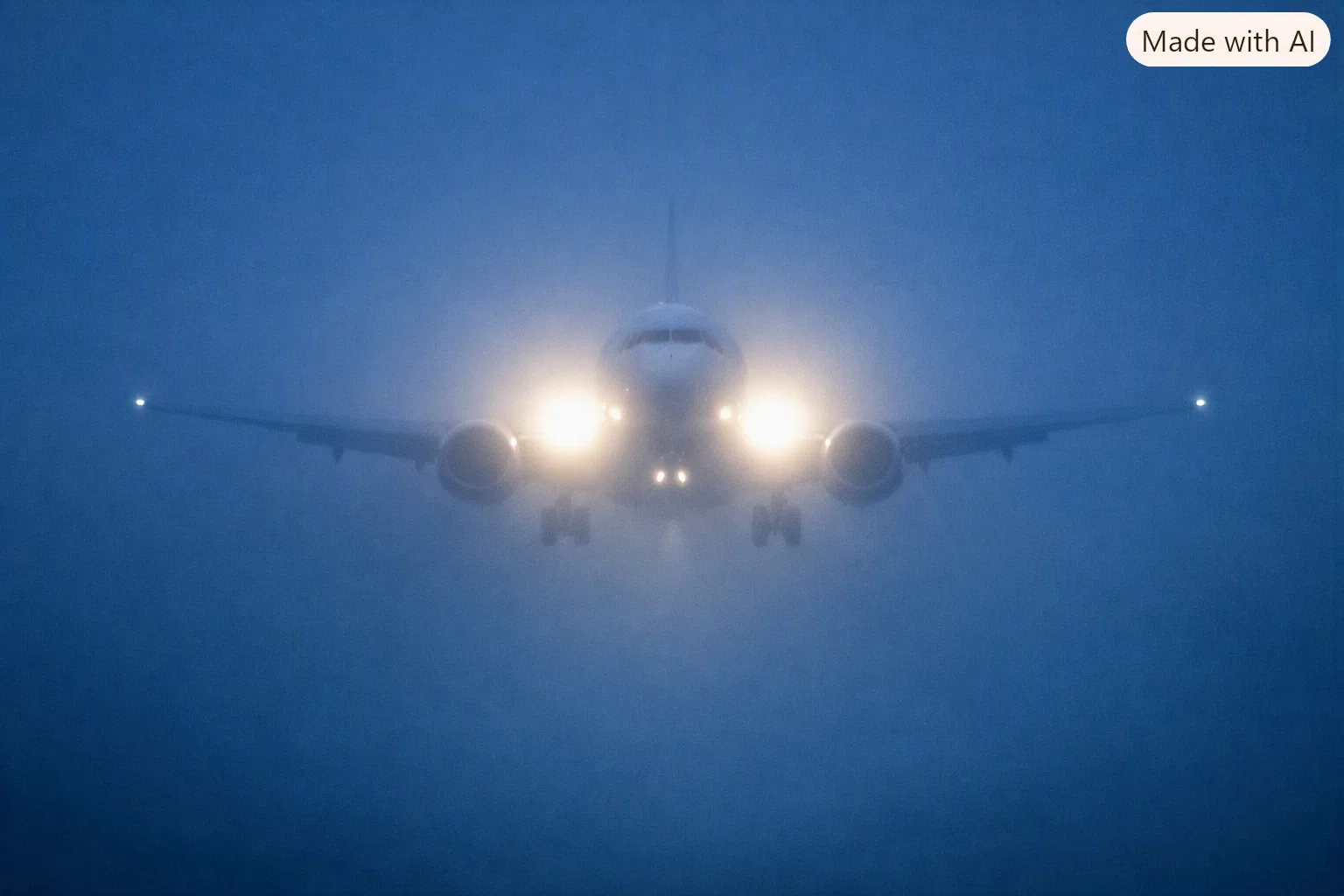
Haze can make an ordinary aircraft look like little more than a bright, apparently shapeless light. The reason is not that the aircraft itself becomes optically invisible while its lamps remain untouched; rather, haze removes low-contrast visual information more quickly than it removes the detectability of a concentrated light source. Wings, tail and fuselage depend on small brightness differences between the aircraft and the surrounding sky. Landing lights, meanwhile, are deliberately intense and aimed so that other people can see the aircraft, especially during approach and in reduced visibility.[US EPA]epa.govUS EPAIntroduction to VisibilityUS EPAIntroduction to Visibility
This distinction is important when assessing some UFO or UAP reports. A witness may accurately report seeing a luminous object with no discernible wings, tail or fuselage even though the source is a conventional aircraft. The most revealing clues often come not from the light itself, but from its direction, slow change in position, proximity to an airport and the weather and flight records for the exact time of observation.
Why contrast disappears before bright lights do
Seeing the shape of an aircraft requires the eye to distinguish its surfaces and edges from the background. Haze interferes with that process in two connected ways: it scatters and absorbs some of the light travelling from the aircraft to the observer, while also scattering other ambient light into the observer’s line of sight. The US Environmental Protection Agency’s visibility guide describes atmospheric extinction as the loss of image-forming light through scattering and absorption. It also emphasises that visibility is a perceptual problem involving the contrast between an object and its surroundings, not simply whether photons from the object reach the observer.[US EPA]epa.govUS EPAIntroduction to VisibilityUS EPAIntroduction to Visibility
That matters particularly for an aeroplane viewed against a bright or hazy sky. A grey fuselage or wing may differ only modestly in brightness from the illuminated atmosphere behind it. As distance through the haze increases, those differences are progressively washed out. Fine structural details disappear first, then larger outlines become difficult to separate, until the aircraft may no longer have a recognisable silhouette. Research on hazy imaging describes the same underlying process: atmospheric scattering reduces scene contrast and adds an obscuring component of scattered light, which is why computer-vision systems require specialised “dehazing” methods to recover distant edges and textures.[arXiv]arxiv.orgarXiv Haze Visibility Enhancement: A Survey and Quantitative BenchmarkingHaze Visibility Enhancement: A Survey and Quantitative BenchmarkingJuly 21, 2016…
A bright aircraft lamp is a different visual target. It is a compact source producing far more luminance than the adjacent portions of the aircraft. Haze attenuates that light too, but the source can remain above the eye’s detection threshold after the subtler contrast defining the airframe has fallen below it. Civil-aviation definitions themselves acknowledge this difference: ICAO material distinguishes between the distance at which a dark object can be recognised against a bright background and the distance at which a roughly 1,000-candela light can be identified against an unlit background, noting that these distances are not the same even in air with the same extinction.[ICAO]icao.intInternational Civil Aviation Organization SAM/AIM/16-WP/…August 8, 2023 — 26 Jan 2023 — the greatest distance at which lights in t…
The result can therefore seem paradoxical without being so: the aircraft’s shape has not vanished in a physical sense; the information needed to perceive that shape has fallen below useful contrast while its strongest lights remain detectable.
There can also be a glow around the surviving light. Night-time haze scatters light from bright point sources into neighbouring directions, producing halos or diffuse glare. Modern image-processing research treats this glow as a characteristic problem of night scenes in haze because it can obscure edges and enlarge the apparent luminous area around a source.[arXiv]arxiv.orgEnhancing Visibility in Nighttime Haze Images Using Guided APSF and Gradient Adaptive ConvolutionAugust 3, 2023… A distant landing light can consequently look less like a neat lamp fixed to an aeroplane and more like a self-contained luminous blob.
Head-on aircraft can look especially puzzling
The effect becomes strongest when an aircraft is approaching almost directly towards the observer. In that geometry, several of the clues that normally disclose an aeroplane are weakened at the same time.
The fuselage is seen largely end-on rather than broadside, so its angular size is comparatively small. The wings extend sideways, but at long range their apparent width may still be tiny, particularly once haze has degraded their edge contrast. At the same time, forward-facing landing or recognition lights may be pointed approximately towards the witness.
This is not an accidental use of aircraft lighting. FAA guidance says landing lights help other pilots see aeroplanes and recommends their use near airports and during reduced visibility. The FAA Airplane Flying Handbook specifically notes that landing lights provide a means by which aircraft can be seen by others and are useful both by day and night in degraded visibility.[Federal Aviation Administration]faa.govFederal Aviation Administration Airplane Flying Handbook (3C) Chapter 11Federal Aviation Administration Airplane Flying Handbook (3C) Chapter 11 Federal rules for commercial night operations also require position lights, an anti-collision light and landing lights, while aircraft certification standards specify the distribution and intensity of external lighting.[eCFR]ecfr.gov121.323 Instruments and equipment for operations at night.Position lights. (b) An anti-collision light. (c) Two landing lights, There…
A head-on aeroplane can therefore present an unusually misleading combination: an intense white source near the centre, perhaps accompanied intermittently by anti-collision flashes, but little or no visible airframe.
Its motion may add to the mystery. An aircraft coming roughly along the observer’s line of sight can remain at nearly the same bearing for some time. Instead of racing sideways across the sky, it may appear to hang in one location while slowly increasing in brightness or apparent size. Constant or nearly constant bearing is a familiar aviation geometry; FAA research into aircraft conspicuity has explicitly discussed the fact that another aircraft on a threatening relative path can appear fixed in the visual field.[Federal Aviation Administration]faa.govOpen source on faa.gov.
For a ground observer without a reliable distance estimate, that absence of sideways movement can be interpreted as hovering. If the aircraft then turns onto another heading, the light may suddenly move sideways, diminish sharply or break into several coloured or flashing lights. What looks like a change in the object’s behaviour can simply be a change in viewing angle.
Position lights can sometimes expose the transition. Standard aeroplane lighting places red on the left wing, green on the right and white towards the rear; the FAA notes that these colours help observers infer an aircraft’s direction of travel.[Federal Aviation Administration]faa.govFederal Aviation Administration Airplane Flying Handbook (3C) Chapter 11Federal Aviation Administration Airplane Flying Handbook (3C) Chapter 11 At long range in haze, however, the weaker coloured lights may be difficult to distinguish while the forward landing light dominates. Only after the aircraft gets closer or turns broadside may the familiar red-green configuration become evident.
Haze need not be thick enough to look like fog
A common mistake is to assume that an aircraft could lose its visible outline only in obviously dense fog. Haze can be much subtler.
Meteorologically, haze is an obscuration caused by very small suspended particles. The US National Weather Service defines it as sufficiently numerous fine particles that reduce visibility, while the UK Met Office uses the code HZ for haze in aviation weather reports.[National Weather Service]weather.govNational Weather Service AVIATION WEATHER OBSERVATIONS for SupplementaryNational Weather Service AVIATION WEATHER OBSERVATIONS for Supplementary It can occur when the ground and nearby buildings still seem reasonably clear, because the optical penalty accumulates with the length of the sight path.
A nearby tree may be viewed through a few hundred metres of hazy air; an aircraft near the horizon may be viewed through many kilometres. Even moderate atmospheric extinction therefore has far more opportunity to erase contrast from the distant aircraft. A long, shallow line of sight through the lower atmosphere can be particularly unfavourable because it remains within the aerosol-rich boundary layer for much of its path.
Lighting conditions also alter the outcome. During daytime or twilight, a bright sky provides a high background against which the aircraft’s relatively dark surfaces must be detected. Near dusk, an aircraft’s lights may already be prominent while enough residual sky glow remains to weaken its silhouette. After dark, the airframe may receive so little illumination that its outline becomes intrinsically hard to see even before haze is considered. The FAA warns more generally that night flying can reduce visual cues so severely that lights become dominant features of a scene and may be confused with other lights.[Federal Aviation Administration]faa.govOpen source on faa.gov.
Haze is therefore best understood as an amplifier of an existing identification problem. Distance, darkness, twilight and head-on geometry already reduce the information available about an aircraft’s shape; aerosol scattering can remove what remains.

Weather and flight records can restore the missing context
A witness description such as “a bright stationary light with no visible wings” contains too little information by itself to establish what was present. The most useful test is to reconstruct the viewing geometry.
The first check is the weather around the observation. METAR reports — routine aviation weather observations — include visibility and present-weather information. The Aviation Weather Center lists visibility among the standard METAR fields, and both US and UK decoding guidance identify HZ as the code for haze.[Aviation Weather Center]aviationweather.govOpen source on aviationweather.gov. A report of reduced visibility, haze, smoke or mist near the sightline would not prove that an aircraft caused a particular observation, but it would establish exactly the sort of conditions in which aircraft shape and contrast can deteriorate.
The second check is whether aircraft traffic matches the time and direction. Automatic Dependent Surveillance–Broadcast, or ADS-B, allows equipped aircraft to transmit GPS-derived position, altitude, ground speed and other information, generally once per second. FAA documentation describes the system as providing substantially more precise and frequent positional information than traditional rotating radar.[Federal Aviation Administration]faa.govFederal Aviation Administration Automatic Dependent SurveillanceFederal Aviation Administration Automatic Dependent Surveillance Historical flight-tracking data based on ADS-B can therefore be useful in reconstructing whether an aircraft was approaching a nearby runway along the witness’s line of sight.
Several details make a match particularly persuasive:
- the aircraft was on an arrival or departure path aligned with the reported azimuth;
- the sighting occurred at the same time as the recorded flight;
- the aircraft’s track initially pointed towards the observer, explaining little apparent lateral movement;
- the light changed direction or disappeared at approximately the time the aircraft turned;
- the nearest aviation weather observation recorded haze or reduced visibility; and[skybrary.aero]skybrary.aeroSource details in endnotes.
- the reported duration is compatible with the time an approaching aircraft would have occupied that part of the sky.
No single item is decisive. ADS-B coverage is not universal, some aircraft can be absent from public tracking services, weather observations are taken at particular locations rather than along every possible sightline, and eyewitness bearings and times can be approximate. The reconstruction becomes stronger when several independent elements agree.
What this explanation can and cannot establish
“Haze made it an aircraft” should not be used as a catch-all explanation for every unresolved light. Haze explains a specific perceptual pattern: an ordinary aircraft whose low-contrast airframe is difficult or impossible to distinguish while one or more high-intensity lights remain visible. It works best when the observation occurs near an air route or airport, in reduced visibility, with a slowly changing or head-on geometry and with flight records that place an aircraft where the witness was looking.
It is weaker when the reported object is sharply resolved at close range, when independent data exclude ordinary aircraft from the relevant location, or when the claimed motion cannot plausibly be reproduced by changing aircraft geometry and observer perspective. Those cases require other explanations or may remain unresolved.
Within UFO and UAP investigations, the useful lesson is narrower but important: “I could see a light but no aircraft” is not evidence that no aircraft was there. Visibility science predicts that the silhouette and the light can have very different detection ranges, and aviation practice deliberately equips aircraft with lights intended to remain conspicuous when the rest of the machine is hard to see.[ICAO]icao.intInternational Civil Aviation Organization SAM/AIM/16-WP/…August 8, 2023 — 26 Jan 2023 — the greatest distance at which lights in t… Reconstructing the weather, bearing and flight traffic can often put back the context that haze removed from the original view.
Amazon book picks
Further Reading
Books and field guides related to How Haze Makes Aircraft Lose Their Shape. Use these as the next step if you want deeper reading beyond the article.
Light and Color in the Outdoors
All of science springs from the observation of nature. In this classic book, the late Professor Minnaert accompanies the reader on a tour...
Sensation and Perception
. Bruce Goldstein's SENSATION AND PERCEPTION, the best-seller which has helped over 150,000 students understand the ties between how we s...
Human Factors in Aviation
Since the 1950s, a number of specialized books dealing with human factors has been published, but very little in aviation. Human Factors...
The UFO Handbook: A Guide to Investigating, Evaluating, and R...
An explanation of the usual reasons for confusing IFOs (identified flying objects) with UFOs and a survey of the tools used to investigat...
eBay marketplace picks
Marketplace Samples
Live-tested eBay searches with available results related to this page.
Selected fromaircraft wall art oneBay.co.uk.


Endnotes
1.
Source: epa.gov
Title: US EPAIntroduction to Visibility
Link:https://www.epa.gov/sites/default/files/2016-07/documents/introvis.pdf
2.
Source: faa.gov
Title: Federal Aviation Administration Airplane Flying Handbook (3C) Chapter 11
Link:https://www.faa.gov/sites/faa.gov/files/regulations_policies/handbooks_manuals/aviation/airplane_handbook/12_afh_ch11.pdf
3.
Source: arxiv.org
Title: arXiv Haze Visibility Enhancement: A Survey and Quantitative Benchmarking
Link:https://arxiv.org/abs/1607.06235
Source snippet
Haze Visibility Enhancement: A Survey and Quantitative BenchmarkingJuly 21, 2016...
Published: July 21, 2016
4.
Source: arxiv.org
Link:https://arxiv.org/abs/1505.05286
5.
Source: icao.int
Link:https://www.icao.int/sites/default/files/sp-files/SAM/Documents/2023-RLA06901-SAMAIM16/SAMAIM16_WP12_Proposl%20of%20amendment%20to%20ICAO%20Annex%203%20-%20Creation%20of%20PANS-MET%20-%20Impact%20on%20AIS%20AIM%20wApnd%20A.pdf
Source snippet
International Civil Aviation Organization SAM/AIM/16-WP/...August 8, 2023 — 26 Jan 2023 — the greatest distance at which lights in t...
Published: August 8, 2023
6.
Source: arxiv.org
Link:https://arxiv.org/abs/2308.01738
Source snippet
Enhancing Visibility in Nighttime Haze Images Using Guided APSF and Gradient Adaptive ConvolutionAugust 3, 2023...
Published: August 3, 2023
7.
Source: ecfr.gov
Link:https://www.ecfr.gov/current/title-14/chapter-I/subchapter-G/part-121/subpart-K/section-121.323
Source snippet
121.323 Instruments and equipment for operations at night.Position lights. (b) An anti-collision light. (c) Two landing lights, There...
8.
Source: ecfr.gov
Title: e CFR14 CFR Part 25 Subpart F
Link:https://www.ecfr.gov/current/title-14/chapter-I/subchapter-C/part-25/subpart-F/subject-group-ECFR0cb7970b9d1fd5f
9.
Source: faa.gov
Link:https://www.faa.gov/sites/faa.gov/files/data_research/research/med_humanfacs/oamtechreports/AM70-09.pdf
10.
Source: weather.gov
Title: National Weather Service AVIATION WEATHER OBSERVATIONS for Supplementary
Link:https://www.weather.gov/media/surface/WSOH8.pdf
11.
Source: faa.gov
Link:https://www.faa.gov/air_traffic/publications/atpubs/aim_html/chap8_section_1.html
12.
Source: faa.gov
Title: Federal Aviation Administration Automatic Dependent Surveillance
Link:https://www.faa.gov/about/office_org/headquarters_offices/avs/offices/afx/afs/afs400/afs410/ads-b
13.
Source: faa.gov
Title: ins outs
Link:https://www.faa.gov/air_traffic/technology/equipadsb/capabilities/ins_outs
14.
Source: airporttech.tc.faa.gov
Title: Download Handler.ashx
Link:https://www.airporttech.tc.faa.gov/DesktopModules/FlexNews/DownloadHandler.ashx?f=S10101-Bullough.pdf&id=26fc8f52-70f8-4c68-a56c-121201945879
15.
Source: faa.gov
Link:https://www.faa.gov/air_traffic/publications/atpubs/aim_html/chap7_section_1.html
16.
Source: faa.gov
Link:https://www.faa.gov/air_traffic/publications/media/aim.pdf
17.
Source: faa.gov
Link:https://www.faa.gov/air_traffic/publications/atpubs/aip_html/part2_enr_section_1.1.html
18.
Source: faa.gov
Title: AIM Chg2 dtd 1 22 26
Link:https://www.faa.gov/air_traffic/publications/media/AIM_Chg2_dtd_1-22-26.pdf
19.
Source: faa.gov
Title: AIM Chg 1 dtd 10 5 23
Link:https://www.faa.gov/air_traffic/publications/media/AIM_Chg_1_dtd_10-5-23.pdf
20.
Source: faa.gov
Link:https://www.faa.gov/air_traffic/publications/atpubs/pcg_html/glossary-a.html
21.
Source: faa.gov
Link:https://www.faa.gov/air_traffic/publications/atpubs/ATC/PCG/A.HTM
22.
Source: faa.gov
Link:https://www.faa.gov/air_traffic/publications/atpubs/aip_html/part1_gen_section_1.7.html
23.
Source: faa.gov
Link:https://www.faa.gov/documentLibrary/media/Advisory_Circular/Editorial_Update_AC_107-2A.pdf
24.
Source: faa.gov
Link:https://www.faa.gov/sites/faa.gov/files/2022-01/NovDec2020.pdf
25.
Source: faa.gov
Link:https://www.faa.gov/sites/faa.gov/files/about/office_org/headquarters_offices/avs/Final%2520Report%2520FA8650-04-C-6457.pdf
26.
Source: faa.gov
Title: 2019 11 07 ACS WG Interim Recommendation Report Powered Lift Handbook
Link:https://www.faa.gov/regulations_policies/rulemaking/committees/documents/media/2019-11-07%20ACS%20WG%20Interim%20Recommendation%20Report%20-%20Powered-Lift%20Handbook.pdf
27.
Source: faa.gov
Link:https://www.faa.gov/lessons_learned/rotorcraft/accidents/N828AC
28.
Source: faa.gov
Link:https://www.faa.gov/sites/faa.gov/files/Human%20Factors%20Evaluation%20of%20Commercial%20Aviation%2C%20Low%20Intensity%2C%20Iteration%202%20%28CALI-2%29%20Laser%20Eye%20Protection_0.pdf
29.
Source: faa.gov
Link:https://www.faa.gov/data_research/research/med_humanfacs/oamtechreports/media/AM63-30pt01.pdf
30.
Source: faa.gov
Link:https://www.faa.gov/sites/faa.gov/files/regulations_policies/handbooks_manuals/aviation/faa-h-8083-21.pdf
31.
Source: faa.gov
Title: AIM Chg 1 dtd 8 7 25
Link:https://www.faa.gov/air_traffic/publications/media/AIM_Chg_1_dtd_8-7-25.pdf
32.
Source: adsbperformance.faa.gov
Link:https://adsbperformance.faa.gov/PAPRRequest.aspx
33.
Source: faa.gov
Link:https://www.faa.gov/air_traffic/technology/equipadsb/privacy
34.
Source: faa.gov
Link:https://www.faa.gov/air_traffic/technology/adsb/faq
35.
Source: faa.gov
Link:https://www.faa.gov/air_traffic/technology/equipadsb/capabilities/benefits
36.
Source: faa.gov
Title: vehicle transmitter maps
Link:https://www.faa.gov/air_traffic/technology/adsb/vehicle_transmitter_maps
37.
Source: faa.gov
Title: AD S-B In Pilot Applications
Link:https://www.faa.gov/air_traffic/technology/adsb/pilot
38.
Source: faa.gov
Title: know adsb system
Link:https://www.faa.gov/air_traffic/technology/equipadsb/installation/know_adsb_system
39.
Source: faa.gov
Link:https://www.faa.gov/air_traffic/technology/equipadsb/research/airspace
40.
Source: ecfr.gov
Title: 14 CFR Part 27 Subpart F
Link:https://www.ecfr.gov/current/title-14/chapter-I/subchapter-C/part-27/subpart-F/subject-group-ECFRe40ba920ef38b09
41.
Source: ecfr.gov
Title: 14 CFR Part 29 Subpart F
Link:https://www.ecfr.gov/current/title-14/chapter-I/subchapter-C/part-29/subpart-F/subject-group-ECFR7862ec040679935
42.
Source: ecfr.gov
Title: subpart F
Link:https://www.ecfr.gov/current/title-14/chapter-I/subchapter-C/part-27/subpart-F?toc=1
43.
Source: ecfr.gov
Link:https://www.ecfr.gov/current/title-14/chapter-I/subchapter-C/part-25/subpart-F
44.
Source: ecfr.gov
Link:https://www.ecfr.gov/current/title-14/chapter-I/subchapter-C/part-23/subpart-F
45.
Source: ecfr.gov
Title: subpart F
Link:https://www.ecfr.gov/current/title-14/chapter-I/subchapter-C/part-29/subpart-F?toc=1
46.
Source: ecfr.gov
Link:https://www.ecfr.gov/current/title-14/chapter-I/subchapter-C/part-27/subpart-F
47.
Source: ecfr.gov
Title: subpart F
Link:https://www.ecfr.gov/current/title-14/chapter-I/subchapter-C/part-25/subpart-F?toc=1
48.
Source: icao.int
Title: EUR Doc 013 6th Edition November 2023
Link:https://www.icao.int/sites/default/files/EURNAT/Documents/EUR%20and%20Nat%20Docs/EUR%20Documents/EUR%20Documents/013%20-%20EUR%20Guidance%20Material%20on%20AWO%20at%20Aerodromes/EUR-Doc-013-6th-Edition-November-2023.pdf
Published: November 2023
49.
Source: icao.int
Title: WP 09 Performance Based Aerodrome Operating Minima Secretariat
Link:https://www.icao.int/sites/default/files/APAC/Meetings/2024/2024%20PBNICG-11/3-Working%20Papers/WP-09-Performance-Based-Aerodrome-Operating-Minima-Secretariat.pdf
50.
Source: icao.int
Title: WP08 AI4 Report of AP ADOTF 5
Link:https://www.icao.int/sites/default/files/APAC/Meetings/2024/2024%20AOP-SG-8/3-Working%20Papers/WP08-AI4-Report-of-AP-ADOTF-5.pdf
51.
Source: icao.int
Link:https://www.icao.int/sites/default/files/SAM/eDocuments/Guia%20QMS%20MET-Eng.pdf
52.
Source: icao.int
Title: WP09 AI 3.1 Outcomes of AOP SG 8 for APANPIRG 35
Link:https://www.icao.int/sites/default/files/APAC/Meetings/2024/2024%20APANPIRG-35/3-Working%20Papers/WP09-AI-3.1-Outcomes-of-AOP-SG-8-for-APANPIRG-35.pdf
53.
Source: icao.int
Link:https://www.icao.int/sites/default/files/sp-files/SAM/Documents/2017-SAMAIM10/SAMAIM10_Item6_WP12_AMDT_ANX15.pdf
54.
Source: icao.int
Link:https://www.icao.int/sites/default/files/sp-files/SAM/Documents/2010/ASTERIX/07%20%20DOC4444.pdf
55.
Source: forecast.weather.gov
Link:https://forecast.weather.gov/glossary.php?word=fog
56.
Source: forecast.weather.gov
Link:https://forecast.weather.gov/glossary.php?word=D
57.
Source: weather.gov
Link:https://www.weather.gov/mlb/fog_threat
58.
Source: forecast.weather.gov
Link:https://forecast.weather.gov/glossary.php?word=R
59.
Source: weather.gov
Link:https://www.weather.gov/ggw/GlossaryR
60.
Source: forecast.weather.gov
Link:https://forecast.weather.gov/glossary.php?word=LI
61.
Source: forecast.weather.gov
Link:https://forecast.weather.gov/glossary.php?word=C
62.
Source: weather.gov
Link:https://www.weather.gov/zse/AviationDiscussions
63.
Source: weather.gov
Link:https://www.weather.gov/zse/ZSEStationInfo?id=KBNA¬ab=
64.
Source: weather.gov
Title: metar decode key
Link:https://www.weather.gov/media/wrh/mesowest/metar_decode_key.pdf
65.
Source: weather.gov
Title: NW S Little Rock, AR
Link:https://www.weather.gov/lzk/metar.htm
66.
Source: weather.gov
Link:https://www.weather.gov/source/zhu/ZHU_Training_Page/Weather_Keys/AIRMETs/AIRMET.htm
67.
Source: weather.gov
Link:https://www.weather.gov/media/surface/SFCTraining.pdf
68.
Source: weather.gov
Link:https://www.weather.gov/media/asos/aum-toc.pdf
69.
Source: weather.gov
Link:https://www.weather.gov/media/aviation/afp/Aviation%20Brochure%20Huntsville.pdf
70.
Source: weather.gov
Link:https://www.weather.gov/media/directives/010_pdfs_archived/pd01008013e.pdf
71.
Source: forecast.weather.gov
Link:https://forecast.weather.gov/product.php?format=CI&glossary=0&issuedby=BOU&product=SYN&site=NWS&version=20
72.
Source: weather.gov
Title: NW S OTX Aviation Dashboard
Link:https://www.weather.gov/otx/avndashboard
73.
Source: nepis.epa.gov
Title: Zy PURL.cgi
Link:https://nepis.epa.gov/Exe/ZyPURL.cgi?Dockey=P1003OJ9.TXT
74.
Source: nepis.epa.gov
Title: Zy PURL.cgi
Link:https://nepis.epa.gov/Exe/ZyPURL.cgi?Dockey=2000D60A.TXT
75.
Source: nepis.epa.gov
Title: Zy PURL.cgi
Link:https://nepis.epa.gov/Exe/ZyPURL.cgi?Dockey=9101143E.TXT
76.
Source: nepis.epa.gov
Title: Zy PURL.cgi
Link:https://nepis.epa.gov/Exe/ZyPURL.cgi?Dockey=P100FLUX.TXT
77.
Source: nepis.epa.gov
Title: Zy PURL.cgi
Link:https://nepis.epa.gov/Exe/ZyPURL.cgi?Dockey=2000HCJ4.TXT
78.
Source: nepis.epa.gov
Title: Zy PURL.cgi
Link:https://nepis.epa.gov/Exe/ZyPURL.cgi?Dockey=20008N4R.TXT
79.
Source: nepis.epa.gov
Title: Zy PURL.cgi
Link:https://nepis.epa.gov/Exe/ZyPURL.cgi?Dockey=P100AUMY.TXT
80.
Source: nepis.epa.gov
Title: Zy PURL.cgi
Link:https://nepis.epa.gov/Exe/ZyPURL.cgi?Dockey=2000B511.TXT
81.
Source: nepis.epa.gov
Title: Zy PURL.cgi
Link:https://nepis.epa.gov/Exe/ZyPURL.cgi?Dockey=P100M2WM.TXT
82.
Source: metoffice.gov.uk
Link:https://www.metoffice.gov.uk/services/transport/aviation/regulated/training-resources-for-aviation/abbreviations
83.
Source: aviationweather.gov
Link:https://aviationweather.gov/help/data/
84.
Source: docs.mavis.metoffice.gov.uk
Title: How to decode a METAR
Link:https://docs.mavis.metoffice.gov.uk/guidance/metar-decode/
85.
Source: Wikipedia
Link:https://en.wikipedia.org/wiki/Haze
86.
Source: aviationweather.gov
Link:https://aviationweather.gov/gfa/help/
87.
Source: aviationweather.gov
Link:https://aviationweather.gov/viewer/help/
88.
Source: testbed.aviationweather.gov
Link:https://testbed.aviationweather.gov/viewer/help/
89.
Source: vocabulary.com
Link:https://www.vocabulary.com/dictionary/haze
90.
Source: dictionary.cambridge.org
Link:https://dictionary.cambridge.org/us/dictionary/english/haze
Additional References
91.
Source: youtube.com
Title: How Runway Illusions affect pilot’s perception
Link:https://www.youtube.com/watch?v=Zmux_WJ3Bcc
Source snippet
Atmospheric visual illusions pilot spatial disorientation haze contrast Spatial Disorientation Explained: Deadly Flight Illusions Every P...
92.
Source: flightsafety.org
Link:https://flightsafety.org/wp-content/uploads/2016/12/293-BIG-v6-WEB-FINAL.pdf
93.
Source: skybrary.aero
Link:https://skybrary.aero/sites/default/files/bookshelf/3568.pdf
94.
Source: flightsafety.org
Link:https://flightsafety.org/fsd/fsd_mar-apr02.pdf
95.
Source: facebook.com
Link:https://www.facebook.com/Kernow.Weather.Team/posts/fog-mist-and-haze-all-affect-visibility-which-is-an-important-part-of-forecasts-/704326998389666/
96.
Source: merriam-webster.com
Link:https://www.merriam-webster.com/dictionary/haze
97.
Source: instagram.com
Link:https://www.instagram.com/haze.brand/?hl=en
98.
Source: instagram.com
Link:https://www.instagram.com/drink.haze/?hl=en
99.
Source: haze420.com
Link:https://haze420.com/
100.
Source: techscience.com
Link:https://www.techscience.com/iasc/v36n2/51164/html