Within Haze
Why Aircraft Shapes Vanish Before Their Lights
A distant aircraft can lose its visible wings and fuselage while its intense landing lights remain easy to detect through haze.
On this page
- How haze removes low contrast aircraft detail
- Why concentrated landing lights remain detectable
- When a featureless light can still be an aircraft
Page outline Jump by section
Introduction
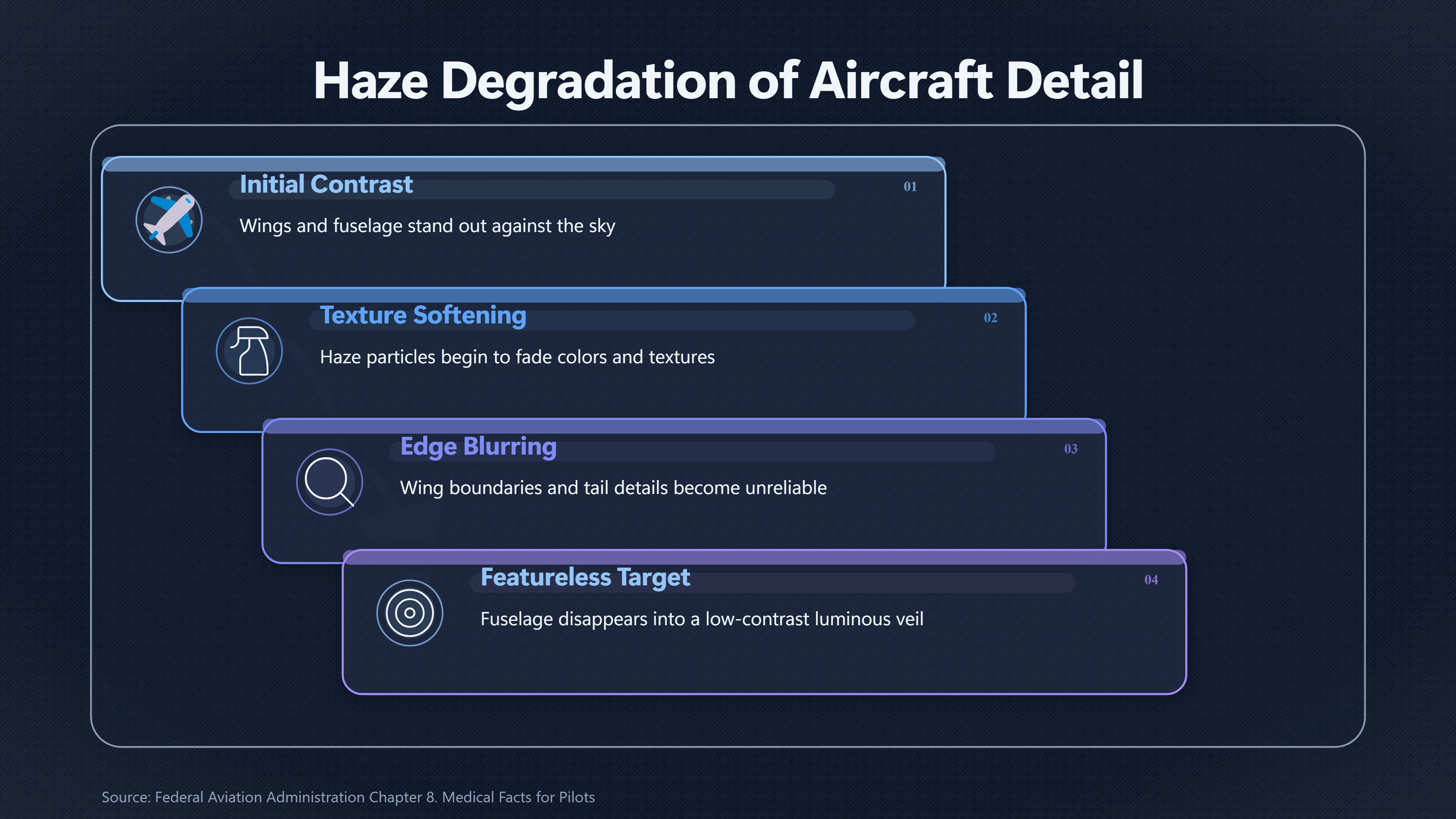
A distant aircraft can become visually “featureless” in haze while its landing lights remain strikingly obvious. This is not an optical contradiction. The aircraft’s wings, tail and fuselage are seen mainly because their brightness differs from the surrounding sky; haze progressively destroys that contrast information. A landing light is a compact, high-intensity source whose only task, from the observer’s point of view, is to remain bright enough to be detected. Those two visual thresholds can be reached at very different distances.
The distinction is well established in aviation visibility science. ICAO’s aeronautical definition of visibility explicitly treats recognising a dark object against a bright background and identifying a roughly 1,000-candela light against an unlit background as separate visual tasks.[ICAO]icao.intOpen source on icao.int. The result has direct relevance to some UFO and UAP reports: “I could see a brilliant light but no wings or fuselage” does not, by itself, rule out an aircraft.
How haze removes low-contrast aircraft detail
Haze consists of small particles suspended in the atmosphere. Depending on their composition and size, these particles scatter and absorb visible light. The US National Park Service describes the perceptual consequences plainly: haze softens textures, fades colours and obscures distant features.[National Park Service]nps.govNational Park Service How We Measure VisibilityNational Park ServiceHow We Measure Visibility - Air (U.S. National Park Service)August 7, 2025… The US Environmental Protection Agency likewise describes haze as reducing the clarity and colour of what people see, with the effect often becoming stronger in humid conditions.[US EPA]epa.govOpen source on epa.gov.
For an aircraft observer, scattering has two important consequences. First, some of the light carrying information from the aircraft towards the observer is scattered out of that path. Second, atmospheric light is scattered into the same line of sight. The second effect matters enormously because it places a luminous veil over the distant target.
The classic aviation treatment of this problem is remarkably explicit. A National Bureau of Standards monograph prepared with FAA sponsorship, Visual Range: Concepts, Instrumental Determination, and Aviation Applications, explains that an object against the sky can be seen only while its apparent contrast with the background remains above a minimum threshold. It identifies scattering by air molecules and aerosols between target and observer as the mechanism reducing that apparent contrast.[NIST]nist.govOpen source on nist.gov.
This means that visibility is not equivalent to transparency in the everyday sense. An atmosphere can transmit plenty of light while transmitting too little contrast to preserve a useful aircraft silhouette.
Consider a grey airliner against a pale sky. The fuselage may initially be slightly darker than its background, while its wing edges provide narrow boundaries that define the familiar aircraft shape. With increasing distance through haze, the luminance difference between those surfaces and the sky becomes progressively smaller. Fine structural information becomes unreliable first. The tail becomes difficult to distinguish; wing edges soften; eventually even the main fuselage may no longer form a recognisable outline.
This is not merely theoretical. An Australian aviation study on visual acquisition describes contrast as a major determinant of aircraft detectability and explains that haze or fog reduces contrast because particles scatter light. Crucially, it notes that atmospheric scattering both removes light from the observer’s line of sight and introduces background light into the apparent image of the aircraft. The study further notes that contrast can be greatly reduced even at distances shorter than the nominal visibility distance.[Skybrary]skybrary.aeroOpen source on skybrary.aero.
That last point prevents a common misunderstanding. A weather report giving visibility of several miles does not mean every aircraft within that radius should have a sharply identifiable silhouette.
The Met Office explains why. Traditional human visibility observations required a distant reference object not merely to be visible, but to be identifiable against its background. Modern sensors instead determine meteorological optical range, defined as the atmospheric path over which a beam’s luminous flux falls to 5 per cent of its original value. The Met Office stresses that this instrumental quantity is approximately equivalent to, but not identical with, the contrast visibility of a distant object.[Met Office]weather.metoffice.gov.ukMet Office How we measure visibilityMet OfficeHow we measure visibility - Met Office…
An aircraft can therefore be well inside the reported meteorological visibility and still present a surprisingly poor visual target.
Seeing something is easier than recognising an aircraft
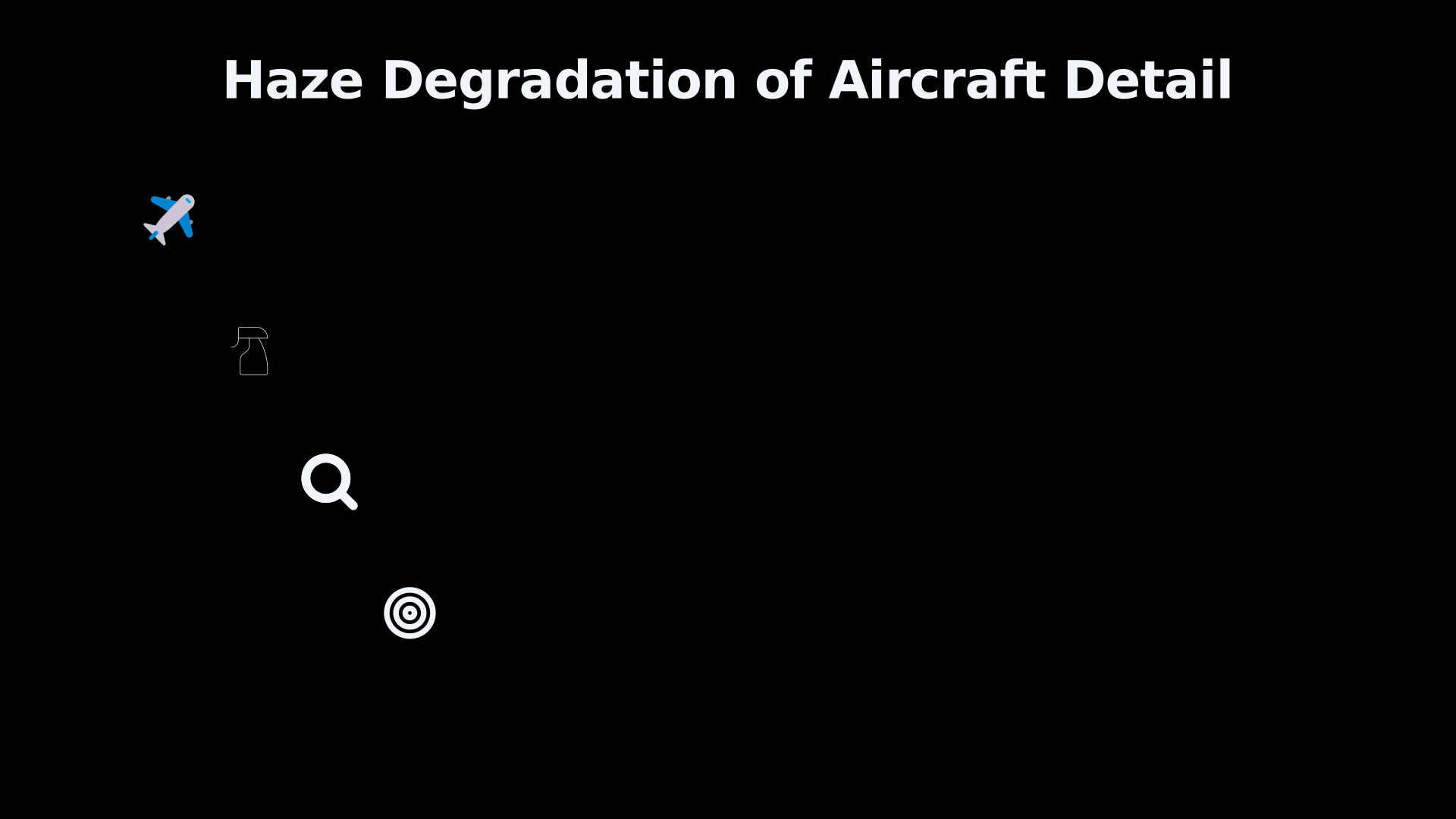
Another key distinction is between detection, recognition and identification.
FAA human-factors material defines detection as knowing that something is present without necessarily recognising or identifying it. Recognition means discriminating its general class — for example, recognising something as a particular class of aircraft — while identification requires still more specific visual information.[FAA Home Flightservice]hf.faa.govHome Flightservice FAAFAA Home FlightserviceFAA - Human Factors Division | Visibility Tool - help…
These stages explain how an observer can sincerely report an unidentified luminous object without having experienced anything physically unusual.
At long range, the observer might first detect a bright point. To recognise it as an aircraft, however, the visual system needs additional information: an airframe outline, separated navigation lights, characteristic motion, engine sound, or some combination of these cues. Haze can selectively eliminate several of those clues while leaving the strongest light plainly detectable.
Aviation accident investigations demonstrate how demanding visual aircraft acquisition can be even without extreme weather. In a 2025 Australian Transport Safety Bureau account of a runway near-collision, investigators highlighted small angular target size, low contrast against complex backgrounds and minimal relative movement as factors reducing the pilots’ ability to see one another.[ATSB]atsb.gov.auOpen source on atsb.gov.au. A separate ATSB analysis of a fatal mid-air collision found that meteorological factors, closing geometry and cockpit shielding all restricted opportunities for visual acquisition; the study specifically modelled aircraft contrast against changing backgrounds.[ATSB]atsb.gov.auOpen source on atsb.gov.au.
Those investigations concern aviation safety rather than UAP reports, but the visual principle transfers directly: an aircraft’s physical presence does not guarantee that a human observer will recover enough information to recognise its shape.
Why concentrated landing lights remain detectable
The landing light is playing by different visual rules.
The wing and fuselage are extended targets. Seeing them depends on preserving enough luminance contrast across their surfaces and boundaries. A distant landing light behaves much more like a point source. It need not reveal its physical dimensions to be noticed; it only needs to deliver enough illumination to the observer to exceed the relevant detection threshold.
This distinction has deep roots in visibility science. The NBS/FAA visual-range monograph treats the visual range of objects separately from the visual range of lights. For point sources, it describes the classical Allard relationship, in which illumination received from a source depends on its luminous intensity, distance and atmospheric extinction.[GovInfo]govinfo.govOpen source on govinfo.gov. In other words, haze certainly attenuates a landing light, but that does not imply that the light becomes undetectable at exactly the distance where the aircraft’s low-contrast outline becomes unrecognisable.
ICAO’s operational definition makes the distinction unusually concrete. Visibility for aeronautical purposes considers both the distance at which a suitably sized black object can be seen and recognised against a bright background and the distance at which lights around 1,000 candelas can be seen and identified against an unlit background.[ICAO]icao.intOpen source on icao.int. European aviation rules reproduce essentially the same two-part definition.[Eur-Lex]europa.euOpen source on europa.eu.
The Netherlands’ Royal Meteorological Institute has explained the underlying distinction in: daytime object visibility depends on luminance contrast between target and background, whereas night-time visibility involving a luminous source is governed by a different threshold problem.[KNMI]knmi.nlOpen source on knmi.nl.
That is almost exactly the distinction relevant to the “light without an aircraft” observation.
The aircraft body might be represented visually by only a slight brightness decrement against a bright hazy sky. Once haze reduces that difference below the observer’s useful contrast threshold, its shape disappears. The landing light can simultaneously remain many times brighter than the immediate background and therefore remain easy to detect.
The atmosphere has attenuated both signals. It has simply pushed the weaker recognition signal below threshold first.
Landing lights are deliberately used to make aircraft conspicuous
There is also a practical reason landing lights frequently dominate the appearance of aircraft in precisely the circumstances where their outlines are difficult to see: aviation authorities encourage their use for conspicuity.
The FAA’s Aeronautical Information Manual describes its voluntary “Operation Lights On” programme as a way to enhance see-and-avoid safety. Pilots are encouraged to use landing lights during take-off and below 10,000 feet, day or night, especially within ten miles of an airport and in reduced visibility.[Federal Aviation Administration]faa.govFederal Aviation Administration Chapter 4. Air Traffic ControlFederal Aviation Administration Chapter 4. Air Traffic Control
FAA guidance for some helicopter operations is even more explicit, recommending landing lights to enhance aircraft identification during take-offs and landings, in congested traffic areas and during reduced visibility.[Federal Aviation Administration]faa.govOpen source on faa.gov.
This produces a useful irony for UAP identification. The very atmospheric conditions that make an aircraft’s body difficult to recognise are among the conditions in which its high-intensity lights may deliberately be used to make it easier to notice.
The intended outcome is successful detection. It does not follow that the observer will simultaneously obtain a clear silhouette.
Experimental work supports the importance of light intensity. NASA research on the conspicuity of aviation target lights found that correct detections increased and reaction times decreased as target intensity increased. The experiment examined point-source lights against a star background while observers also dealt with a simulated cockpit task.[NASA Technical Reports Server]ntrs.nasa.govOpen source on nasa.gov. Earlier NASA/FAA work also investigated how runway-light intensity, fog density and ambient luminance affected visual range through fog, demonstrating that the detectability of lights under obscuration depends on both source and atmospheric conditions rather than on a single generic “visibility” distance.[NASA Technical Reports Server]nasa.govOpen source on nasa.gov.

Haze can turn the surviving lamp into a glowing blob
The effect does not necessarily stop when the aircraft outline disappears. Haze can also alter the appearance of the surviving bright light.
Night-time hazy scenes pose a recognised imaging problem because artificial light sources generate non-uniform illumination and glow through atmospheric scattering. Research into night-time dehazing specifically identifies intense glow and scattered light around luminous sources as features that obscure edges and textures.[arXiv]arxiv.orgOpen source on arxiv.org. Other work has treated glow removal and haze removal as related but distinguishable image-processing problems because bright artificial sources can create conspicuous luminous regions in hazy scenes.[arXiv]arxiv.orgarXiv Night Time Haze and Glow Removal using Deep Dilated Convolutional NetworkarXiv Night Time Haze and Glow Removal using Deep Dilated Convolutional Network
For an aircraft observer, this can change the perceptual character of a landing light. Rather than appearing as a sharply bounded bulb mounted somewhere on a visible machine, it can look like a fuzzy white spot or luminous patch with no obvious structure around it.
That distinction is important in reports describing an apparent “orb”. The apparent diameter of a glow is not necessarily the physical diameter of its source, and the visible luminous boundary need not correspond to the boundary of an object. Atmospheric scattering can spread light around the unresolved source while simultaneously reducing the contrast of the aircraft carrying it.
The two effects reinforce each other: the airframe becomes less distinct while the light becomes more visually dominant.
Distance makes the contrast loss more damaging
Haze is only part of the mechanism. Distance also shrinks an aircraft’s angular size.
As an aircraft moves farther away, its wingspan occupies a progressively smaller angle in the observer’s visual field. Features that were once separated become increasingly difficult to resolve. Atmospheric contrast loss is therefore attacking a target whose useful spatial information is already declining with distance.
FAA-derived aviation vision guidance summarised by SKYbrary identifies object size, ambient illumination, contrast, viewing time and atmospheric clarity as important determinants of visibility. It also notes that identification of dim objects at night suffers from poor detail resolution and that haze, smoke, fog and similar phenomena can obscure visual references.[Skybrary]skybrary.aeroOpen source on skybrary.aero.
The practical consequence is that “large aircraft” does not necessarily mean “obviously aircraft-shaped”. An airliner can be physically enormous yet occupy a small angular extent when several miles away. Its landing lights do not have to be spatially resolved as lamps to be detected. Its wings and tail, by contrast, must contribute sufficient resolved contrast if the observer is to reconstruct an aeroplane-shaped object.
This also explains why binoculars, a telephoto lens or simply a substantial reduction in range can suddenly make the aircraft “appear”. Nothing has emerged from behind the light. The observer has crossed back into a regime where the airframe’s angular dimensions and contrast are sufficient for recognition.
NASA’s work on enhanced vision provides an instructive technological parallel. Systems designed for rain, snow, fog and haze use image enhancement partly because conventional visible imagery in poor visibility becomes low in contrast and loses useful information. NASA has specifically reported using enhancement methods to improve low-contrast imagery acquired in poor visibility.[NASA Technical Reports Server]nasa.govOpen source on nasa.gov.
A head-on aircraft can look almost stationary
The most deceptive geometry occurs when the aircraft is approaching roughly towards the observer.
In that situation, the forward-facing landing lights can be presented strongly towards the viewer, while much of the aircraft’s velocity is along the observer’s line of sight rather than across it. Consequently, its angular motion across the sky can be small. A bright source that is actually travelling rapidly can appear to remain in approximately the same patch of sky for an appreciable interval.
The same geometry makes visual collision avoidance difficult in aviation. ATSB investigations identify small angular size and minimal relative angular movement as factors that can impede visual acquisition.[ATSB]atsb.gov.auOpen source on atsb.gov.au.
Combine that geometry with haze and the perceptual result can be striking: the observer sees one bright, slowly moving or apparently stationary light; cannot resolve wings, tail or fuselage; may not initially distinguish navigation lights; and therefore lacks several of the cues normally used to categorise something as an aeroplane.
The appearance may then change abruptly when the aircraft turns.
A modest change in heading can move the observer away from the strongest part of the forward lighting geometry. The brilliant white light may diminish rapidly, while lateral movement suddenly becomes obvious and red, green or flashing aircraft lights become easier to separate. What seemed to be a hovering luminous object can therefore “transform” into an ordinary aircraft without any unusual manoeuvre having occurred.
What would strengthen an aircraft explanation?
The haze mechanism is useful precisely because it makes predictions. It should not be used as a blanket explanation for every unexplained light.
A conventional aircraft becomes a stronger explanation when several observations coincide: reduced visibility or documented haze; a sightline towards an airport approach or departure corridor; a powerful white light initially dominating the observation; little apparent transverse motion followed by clearer sideways movement; substantial brightness change when the object alters heading; or later emergence of a recognisable aircraft silhouette or navigation-light pattern.
Weather records matter because “it looked hazy” is less useful than establishing the actual atmospheric conditions. The FAA classifies haze as an obstruction to visibility in aviation weather reporting, alongside phenomena such as fog, smoke and dust.[Federal Aviation Administration]faa.govOpen source on faa.gov. The Australian Transport Safety Bureau likewise lists haze among atmospheric conditions capable of reducing the visual references available to pilots.[ATSB]atsb.gov.auOpen source on atsb.gov.au.
Flight-path information can then test the geometry. If an aircraft was approaching almost directly towards the observer at the reported time, a slowly changing bearing and prominent forward light become expected rather than anomalous. If it subsequently turned and the light weakened while the object acquired obvious lateral movement, that is especially consistent with an aircraft interpretation.
Conversely, the explanation weakens if reliable data show excellent atmospheric clarity, no plausible aircraft traffic, motion incompatible with conventional flight, or observations from multiple viewpoints that establish properties the haze-and-light mechanism cannot reproduce.
The point is not that haze proves an unidentified light was an aircraft. It is that absence of a visible aircraft outline cannot fairly be used as evidence against an aircraft until atmospheric contrast and viewing geometry have been considered.
Why “I saw the light clearly” is not a contradiction
Perhaps the most persistent misconception is that a clearly visible landing light proves the atmosphere must also have been clear enough to reveal the aircraft.
Aviation visibility science says otherwise.
Object recognition and light detection have different thresholds. The NBS/FAA visual-range literature separately models extended-object contrast and point-source illumination.[NIST]nist.govOpen source on nist.gov. ICAO’s definition of visibility explicitly preserves the distinction between recognising a dark object and identifying a luminous source.[ICAO]icao.intOpen source on icao.int. Modern meteorological practice similarly distinguishes instrumental atmospheric transmission from the human recognition of distant objects.[Met Office]weather.metoffice.gov.ukMet Office How we measure visibilityMet OfficeHow we measure visibility - Met Office…
That makes the apparently paradoxical observation physically ordinary:
the atmosphere can be clear enough to transmit a conspicuous landing light yet hazy enough to erase the contrast that reveals the aircraft carrying it.
For UFO and UAP assessment, this is a small but important diagnostic principle. A witness need not be inattentive, dishonest or “seeing things” to report a brilliant featureless light where an aircraft actually was. The observation itself may be substantially correct. What haze removes is not the aeroplane, but the low-contrast visual information required to recognise it as one.
Amazon book picks
Further Reading
Books and field guides related to Why Aircraft Shapes Vanish Before Their Lights. Use these as the next step if you want deeper reading beyond the article.
Sensation and Perception
. Bruce Goldstein's SENSATION AND PERCEPTION, the best-seller which has helped over 150,000 students understand the ties between how we s...
Light and Color in the Outdoors
All of science springs from the observation of nature. In this classic book, the late Professor Minnaert accompanies the reader on a tour...
Human Factors in Aviation
Since the 1950s, a number of specialized books dealing with human factors has been published, but very little in aviation. Human Factors...
The Nature of Light & Colour in the Open Air
Explains such natural phenomena as rainbows, mirages, iridescent clouds, and halos for the scientist and the artist
eBay marketplace picks
Marketplace Samples
Live-tested eBay searches with available results related to this page.
Selected fromaircraft wall art oneBay.co.uk.

Endnotes
1.
Source: faa.gov
Title: Federal Aviation Administration Chapter 8. Medical Facts for Pilots
Link:https://www.faa.gov/Air_traffic/publications/atpubs/aim_html/chap8_section_1.html
2.
Source: faa.gov
Title: Federal Aviation Administration Chapter 4. Air Traffic Control
Link:https://www.faa.gov/Air_traffic/publications/atpubs/aim_html/chap4_section_3.html
3.
Source: arxiv.org
Title: arXiv Haze Visibility Enhancement: A Survey and Quantitative Benchmarking
Link:https://arxiv.org/abs/1607.06235
Source snippet
Haze Visibility Enhancement: A Survey and Quantitative BenchmarkingJuly 21, 2016...
Published: July 21, 2016
4.
Source: arxiv.org
Link:https://arxiv.org/abs/1505.05286
5.
Source: hf.faa.gov
Title: Home Flightservice FAA
Link:https://www.hf.faa.gov/visibility/help.aspx
Source snippet
FAA Home FlightserviceFAA - Human Factors Division | Visibility Tool - help...
6.
Source: arxiv.org
Title: arXiv Human Contrast Threshold and [Astronomical]({{ ‘astronomical/’ | relative_url }}) Visibility
Link:https://arxiv.org/abs/1405.4209
Source snippet
Human Contrast Threshold and Astronomical VisibilityMay 16, 2014...
Published: May 16, 2014
7.
Source: icao.int
Link:https://www.icao.int/safety/meteorology/amofsg/amofsg%20meeting%20material/amofsg.10.sn.011.5.en.pdf
8.
Source: faa.gov
Title: Federal Aviation Administration ENR 1.1: General Rules
Link:https://www.faa.gov/air_traffic/publications/atpubs/aip_html/part2_enr_section_1.1.html
9.
Source: ntrs.nasa.gov
Link:https://ntrs.nasa.gov/citations/19750023659
10.
Source: arxiv.org
Title: arXiv Night Time Haze and Glow Removal using Deep Dilated Convolutional Network
Link:https://arxiv.org/abs/1902.00855
11.
Source: arxiv.org
Link:https://arxiv.org/abs/2603.29507
12.
Source: faa.gov
Title: All Information for Operators (In FOs) | Federal Aviation Administration
Link:https://www.faa.gov/other_visit/aviation_industry/airline_operators/airline_safety/info/all_infos
13.
Source: epa.gov
Title: basic information about visibility
Link:https://www.epa.gov/visibility/basic-information-about-visibility
14.
Source: airporttech.tc.faa.gov
Title: lighted x runway closure markerflight testing
Link:https://www.airporttech.tc.faa.gov/Products/Airport-Safety-Papers-Publications/Airport-Safety-Detail/lighted-x-runway-closure-markerflight-testing
15.
Source: nasa.gov
Title: NAS A Advances Precision Landing Technology with Field Test at Kennedy
Link:https://www.nasa.gov/centers-and-facilities/johnson/nasa-advances-precision-landing-technology-with-field-test-at-kennedy/
16.
Source: faa.gov
Title: Runway Status Lights | Federal Aviation Administration
Link:https://www.faa.gov/air_traffic/technology/rwsl
17.
Source: faa.gov
Link:https://www.faa.gov/about/office_org/headquarters_offices/ato/service_units/techops/navservices/lsg/als
18.
Source: ntrs.nasa.gov
Link:https://ntrs.nasa.gov/citations/20220014873
19.
Source: faa.gov
Title: Aerospace Medicine Technical Reports | Federal Aviation Administration
Link:https://www.faa.gov/dataresearch/research/medhumanfacs/oamtechreports/aerospace-medicine-technical-reports-1
20.
Source: faa.gov
Link:https://www.faa.gov/headquartersoffices/avs/investigation-lighting-schemes-improve-suas-conspicuity
21.
Source: nasa.gov
Title: Flash Lidar: Shining New Light on Landing Sites
Link:https://www.nasa.gov/centers-and-facilities/langley/flash-lidar-shining-new-light-on-landing-sites/
22.
Source: nasa.gov
Title: NAS A Technology Enables Precision Landing Without a Pilot
Link:https://www.nasa.gov/centers-and-facilities/johnson/nasa-technology-enables-precision-landing-without-a-pilot/
23.
Source: nasa.gov
Title: Laser-based Sensor Tests Moon Landing Technology at Langley Air Force Base
Link:https://www.nasa.gov/centers-and-facilities/langley/laser-based-sensor-tests-moon-landing-technology-at-langley-air-force-base/
24.
Source: hf.tc.faa.gov
Title: 2019 general aviation pilot situation
Link:https://hf.tc.faa.gov/publications/2019-general-aviation-pilot-situation/
25.
Source: faa.gov
Link:https://www.faa.gov/lessonslearned/smallairplane/accidents/N952DB
26.
Source: airporttech.tc.faa.gov
Title: effective intensity of multiple pulse flashing signal lights
Link:https://www.airporttech.tc.faa.gov/Products/Airport-Safety-Papers-Publications/Airport-Safety-Detail/effective-intensity-of-multiple-pulse-flashing-signal-lights
27.
Source: 19january2017snapshot.epa.gov
Title: visibility basic information
Link:https://19january2017snapshot.epa.gov/visibility/visibility-basic-information_.html
28.
Source: faa.gov
Title: Chapter 8. Medical Facts for Pilots
Link:https://www.faa.gov/air_traffic/publications/atpubs/aim/aim0801.html
29.
Source: faa.gov
Title: Chapter 7. Safety of Flight
Link:https://www.faa.gov/air_traffic/publications/atpubs/aim/aim0701.html
30.
Source: faa.gov
Title: Chapter 2. Aeronautical Lighting and Other Airport Visual Aids
Link:https://www.faa.gov/air_traffic/publications/atpubs/AIM/aim0201.html
31.
Source: faa.gov
Link:https://www.faa.gov/air_traffic/publications/atpubs/AIM/aim0403.html
32.
Source: faa.gov
Title: Aerospace Medicine Technical Reports | Federal Aviation Administration
Link:https://www.faa.gov/data_research/research/med_humanfacs/oamtechreports/2010s/2014/201409
33.
Source: faa.gov
Title: document ID
Link:https://www.faa.gov/regulations_policies/advisory_circulars/index.cfm/go/document.information/documentID/215227
34.
Source: faa.gov
Link:https://www.faa.gov/airports/resources/advisory_circulars/index.cfm/go/document.current/documentNumber/150
35.
Source: hf.tc.faa.gov
Title: 2010 moving toward an air traffic control display standard
Link:https://hf.tc.faa.gov/publications/2010-moving-toward-an-air-traffic-control-display-standard/
36.
Source: nist.gov
Title: effective intensity flashing lights
Link:https://www.nist.gov/pml/sensor-science/optical-radiation/effective-intensity-flashing-lights
37.
Source: airporttech.tc.faa.gov
Title: l 853 cylindrical runway and taxiway retro reflective markers study 1
Link:https://www.airporttech.tc.faa.gov/Products/Airport-Safety-Papers-Publications/Airport-Safety-Detail/l-853-cylindrical-runway-and-taxiway-retro-reflective-markers-study-1
38.
Source: nepis.epa.gov
Title: Zy PURL.cgi
Link:https://nepis.epa.gov/Exe/ZyPURL.cgi?Dockey=00002RY5.TXT
39.
Source: ntrs.nasa.gov
Link:https://ntrs.nasa.gov/citations/20250005806
40.
Source: nepis.epa.gov
Title: Zy PURL.cgi
Link:https://nepis.epa.gov/Exe/ZyPURL.cgi?Dockey=20008N4R.TXT
41.
Source: faa.gov
Title: A C 20-30B
Link:https://www.faa.gov/airports/resources/advisory_circulars/index.cfm/go/document.information/documentNumber/20-30B
42.
Source: nepis.epa.gov
Title: Zy PURL.cgi
Link:https://nepis.epa.gov/Exe/ZyPURL.cgi?Dockey=9101H7KT.TXT
43.
Source: nepis.epa.gov
Title: Zy PURL.cgi
Link:https://nepis.epa.gov/Exe/ZyPURL.cgi?Dockey=9100ZHLQ.TXT
44.
Source: nepis.epa.gov
Title: Zy PURL.cgi
Link:https://nepis.epa.gov/Exe/ZyPURL.cgi?Dockey=9101143E.TXT
45.
Source: nepis.epa.gov
Title: Zy PURL.cgi
Link:https://nepis.epa.gov/Exe/ZyPURL.cgi?Dockey=2000XB0L.TXT
46.
Source: ntrs.nasa.gov
Link:https://ntrs.nasa.gov/citations/19760005639
47.
Source: nepis.epa.gov
Title: Zy PURL.cgi
Link:https://nepis.epa.gov/Exe/ZyPURL.cgi?Dockey=9101JYKT.TXT
48.
Source: ntrs.nasa.gov
Link:https://ntrs.nasa.gov/citations/19720017022
49.
Source: faa.gov
Link:https://www.faa.gov/air_traffic/publications/atpubs/aim_html/chap7_section_1.html
50.
Source: faa.gov
Link:https://www.faa.gov/air_traffic/publications/atpubs/fs_html/chap9_section_1.html
51.
Source: faa.gov
Link:https://www.faa.gov/air_traffic/publications/atpubs/aip_html/part2_enr_section_1.15.html
52.
Source: faa.gov
Link:https://www.faa.gov/air_traffic/publications/atpubs/aip_html/chap7_section_1.html
53.
Source: faa.gov
Link:https://www.faa.gov/Air_traffic/publications/atpubs/aim_html/chap2_section_1.html
54.
Source: faa.gov
Link:https://www.faa.gov/regulations_policies/advisory_circulars/index.cfm/go/document.list/topicID/63
55.
Source: faa.gov
Link:https://www.faa.gov/regulations_policies/advisory_circulars/index.cfm/go/document.list/?appliedFacets=%7B%22subjectclass%22%3A%22150%2F5345%22%2C%22officenumber%22%3A%22AAS-100%22%2C%22topic%22%3A%22Airport+Improvement+Program+%28AIP%29%22%7D&omni=AC-7
56.
Source: faa.gov
Link:https://www.faa.gov/air_traffic/publications/atpubs/aip_html/chap2_section_1.html
57.
Source: faa.gov
Link:https://www.faa.gov/regulations_policies/advisory_circulars/index.cfm/go/document.list/?appliedFacets=%7B%22subjectclass%22%3A%22150%2F5345%22%2C%22officenumber%22%3A%22AAS-100%22%2C%22topic%22%3A%22Passenger+Facility+Charge+%28PFC%29%22%7D
58.
Source: faa.gov
Link:https://www.faa.gov/regulations_policies/advisory_circulars/index.cfm/go/document.list/?appliedFacets=%7B%22subjectclass%22%3A%22150%2F5345%22%2C%22officenumber%22%3A%22AAS-100%22%7D&omni=AC-15A
59.
Source: faa.gov
Link:https://www.faa.gov/air_traffic/publications/atpubs/aip_html/part3_ad_1.1.html
60.
Source: faa.gov
Title: Chapter 3. Airport Traffic Control
Link:https://www.faa.gov/air_traffic/publications/atpubs/atc_html/chap3_section_4.html
61.
Source: faa.gov
Link:https://www.faa.gov/air_traffic/publications/atpubs/aip_html/chap2_section_2.html
62.
Source: faa.gov
Link:https://www.faa.gov/faq/what-are-requirements-aircraft-warning-lights-tall-structures
63.
Source: faa.gov
Link:https://www.faa.gov/air_traffic/publications/atpubs/aip_html/part1_gen_section_1.7.html
64.
Source: faa.gov
Link:https://www.faa.gov/Air_traffic/Publications/atpubs/aip_html/part3_ad_section_1.1.html
65.
Source: faa.gov
Link:https://www.faa.gov/data_research/research/med_humanfacs/oamtechreports/1960s/1962/196215
66.
Source: hf.faa.gov
Link:https://www.hf.faa.gov/visibility/
67.
Source: hf.faa.gov
Link:https://www.hf.faa.gov/reports/
68.
Source: faa.gov
Link:https://www.faa.gov/data_research/research/med_humanfacs/oamtechreports/1990s/1990/9003
69.
Source: technology.nasa.gov
Title: TOP2 322
Link:https://technology.nasa.gov/patent/TOP2-322
70.
Source: forecast.weather.gov
Link:https://forecast.weather.gov/glossary.php?word=haze
71.
Source: weather.gov
Link:https://www.weather.gov/ggw/GlossaryH
72.
Source: forecast.weather.gov
Link:https://forecast.weather.gov/glossary.php?word=SCATTERING
73.
Source: forecast.weather.gov
Link:https://forecast.weather.gov/glossary.php?word=s
74.
Source: forecast.weather.gov
Link:https://forecast.weather.gov/glossary.php?word=hz
75.
Source: forecast.weather.gov
Link:https://forecast.weather.gov/glossary.php?word=a
76.
Source: forecast.weather.gov
Link:https://forecast.weather.gov/glossary.php?word=r
77.
Source: forecast.weather.gov
Link:https://forecast.weather.gov/glossary.php?word=z
78.
Source: weather.gov
Link:https://www.weather.gov/key/glossary
79.
Source: weather.gov
Title: Full Weather Glossary GUST FRONT
Link:https://www.weather.gov/otx/Full_Weather_Glossary
80.
Source: weather.gov
Link:https://www.weather.gov/ggw/GlossaryM
81.
Source: forecast.weather.gov
Link:https://forecast.weather.gov/glossary.php?word=C
82.
Source: nepis.epa.gov
Title: Zy PURL.cgi
Link:https://nepis.epa.gov/Exe/ZyPURL.cgi?Dockey=2000HVVY.TXT
83.
Source: nepis.epa.gov
Title: Zy PURL.cgi
Link:https://nepis.epa.gov/Exe/ZyPURL.cgi?Dockey=20013TLN.txt
84.
Source: nepis.epa.gov
Title: Zy PURL.cgi
Link:https://nepis.epa.gov/Exe/ZyPURL.cgi?Dockey=9101H6ZC.TXT
85.
Source: nepis.epa.gov
Title: Zy PURL.cgi
Link:https://nepis.epa.gov/Exe/ZyPURL.cgi?Dockey=94000CTO.TXT
86.
Source: nepis.epa.gov
Title: Zy PURL.cgi
Link:https://nepis.epa.gov/Exe/ZyPURL.cgi?Dockey=P1003OJ9.TXT
87.
Source: nepis.epa.gov
Title: Zy PURL.cgi
Link:https://nepis.epa.gov/Exe/ZyPURL.cgi?Dockey=P100FLUX.TXT
88.
Source: skybrary.aero
Link:https://skybrary.aero/articles/visibility
89.
Source: skybrary.aero
Link:https://skybrary.aero/index.php/articles/visibility
90.
Source: skybrary.aero
Link:https://skybrary.aero/index.php/articles/external-lights
91.
Source: skybrary.aero
Link:https://skybrary.aero/index.php/articles/haze
92.
Source: skybrary.aero
Link:https://skybrary.aero/articles/pilot-report-pirep
93.
Source: skybrary.aero
Link:https://skybrary.aero/index.php/articles/enhanced-vision-system
94.
Source: skybrary.aero
Link:https://skybrary.aero/index.php/articles/taxiway-lighting
95.
Source: skybrary.aero
Link:https://skybrary.aero/index.php/articles/runway-holding-point-lighting
96.
Source: skybrary.aero
Link:https://skybrary.aero/index.php/articles/runway-lighting
97.
Source: skybrary.aero
Link:https://skybrary.aero/articles/vision-oghfa-bn
98.
Source: skybrary.aero
Link:https://skybrary.aero/articles/lighting-control-systems
99.
Source: skybrary.aero
Link:https://skybrary.aero/index.php/articles/runway-visual-perspective
100.
Source: skybrary.aero
Link:https://skybrary.aero/index.php/articles/runway-visual-range-rvr
101.
Source: faa.gov
Title: Aerospace Medicine Technical Reports | Federal Aviation Administration
Link:https://www.faa.gov/data_research/research/med_humanfacs/oamtechreports/1960s/1967/196720
102.
Source: faa.gov
Title: Aerospace Medicine Technical Reports | Federal Aviation Administration
Link:https://www.faa.gov/data_research/research/med_humanfacs/oamtechreports/1960s/1966/196622
103.
Source: nps.gov
Title: National Park Service How We Measure Visibility
Link:https://www.nps.gov/subjects/air/howwemeasure-visibility.htm
Source snippet
National Park ServiceHow We Measure Visibility - Air (U.S. National Park Service)August 7, 2025...
Published: August 7, 2025
104.
Source: nps.gov
Title: National Park Service Air Pollution & Visibility
Link:https://www.nps.gov/subjects/air/visibility.htm
Source snippet
National Park ServiceAir Pollution & Visibility - Air (U.S. National Park Service)...
105.
Source: weather.metoffice.gov.uk
Title: Met Office How we measure visibility
Link:https://weather.metoffice.gov.uk/guides/observations/how-we-measure-visibility
Source snippet
Met OfficeHow we measure visibility - Met Office...
106.
Source: easa.europa.eu
Title: eu Easy Access Rules for Air Operations
Link:https://www.easa.europa.eu/en/document-library/easy-access-rules/online-publications/easy-access-rules-air-operations?erules-id=ERULES-1963177438-21073
107.
Source: easa.europa.eu
Title: easy access rules aerodromes regulation eu
Link:https://www.easa.europa.eu/en/document-library/easy-access-rules/online-publications/easy-access-rules-aerodromes-regulation-eu?erules-id=ERULES-1963177438-2468
108.
Source: metoffice.gov.uk
Link:https://www.metoffice.gov.uk/blog/2025/how-does-the-met-office-measure-sunshine-visibility-pressure-and-radiation
109.
Source: nps.gov
Link:https://www.nps.gov/articles/air-analysis-methods-latest.htm
110.
Source: metoffice.gov.uk
Title: Mist, fog, and haze: What’s the difference?
Link:https://www.metoffice.gov.uk/blog/2025/whats-the-difference-between-mist-fog-and-haze
111.
Source: nps.gov
Title: Acadia Air Quality (U.S. National Park Service)
Link:https://www.nps.gov/articles/000/acadia-air-quality.htm
112.
Source: home.nps.gov
Title: howwemeasure visibility
Link:https://home.nps.gov/subjects/air/howwemeasure-visibility.htm
113.
Source: atsb.gov.au
Link:https://www.atsb.gov.au/investigations/2023-001
114.
Source: collegesidekick.com
Link:https://www.collegesidekick.com/study-docs/18940759
115.
Source: space.oscar.wmo.int
Link:https://space.oscar.wmo.int/requirements/view/1000
116.
Source: easa.europa.eu
Title: eu Easy Access Rules for Large Aeroplanes (CS-25)
Link:https://www.easa.europa.eu/en/document-library/easy-access-rules/online-publications/easy-access-rules-large-aeroplanes-cs-25?jLDwi2Z9uOU=t8Phv&page=44
117.
Source: atsb.gov.au
Link:https://www.atsb.gov.au/investigations/2022-001
118.
Source: nps.gov
Title: air analysis methods 2022
Link:https://www.nps.gov/articles/air-analysis-methods-2022.htm
119.
Source: home.nps.gov
Link:https://home.nps.gov/subjects/air/glossary.htm
120.
Source: nps.gov
Link:https://www.nps.gov/subjects/air/glossary.htm
121.
Source: nps.gov
Title: Historic Visibility Studies in National Parks (U.S. National Park Service)
Link:https://www.nps.gov/articles/visibilitystudies.htm
122.
Source: nps.gov
Title: The BRAVO Study
Link:https://www.nps.gov/bibe/learn/nature/aq_bravo.htm
123.
Source: library.metoffice.gov.uk
Link:https://library.metoffice.gov.uk/portal/Default/en-GB/RecordView/Index/457195
124.
Source: nps.gov
Link:https://www.nps.gov/media/photo/gallery.htm?id=73E4E289-9277-47A2-BF6A-6335886FEE3A
125.
Source: nps.gov
Title: analysis methods2020
Link:https://www.nps.gov/articles/analysis-methods2020.htm
126.
Source: weather.metoffice.gov.uk
Title: metoffice.gov.uk What is fog?
Link:https://weather.metoffice.gov.uk/learn-about/weather/types-of-weather/fog
127.
Source: metoffice.gov.uk
Title: Airfield climate data
Link:https://www.metoffice.gov.uk/services/transport/aviation/regulated/national-aviation/uk-services/airfield-climate-data
128.
Source: weather.metoffice.gov.uk
Title: metoffice.gov.uk Contrails or condensation trails
Link:https://weather.metoffice.gov.uk/learn-about/weather/types-of-weather/clouds/unusual-cloud-[formations
129.
Source: weather.metoffice.gov.uk
Title: metoffice.gov.uk How fog affects travel
Link:https://weather.metoffice.gov.uk/warnings-and-advice/seasonal-advice/travel/how-fog-affects-travel
130.
Source: library.metoffice.gov.uk
Title: Record View
Link:https://library.metoffice.gov.uk/portal/Default/en-GB/RecordView/Index/3633
131.
Source: metoffice.gov.uk
Title: Aviation Performance and Consultations
Link:https://www.metoffice.gov.uk/services/transport/aviation/regulated/performance-and-consultations
132.
Source: metoffice.gov.uk
Title: Aerodrome Weather Warnings
Link:https://www.metoffice.gov.uk/services/transport/aviation/regulated/training-resources-for-aviation/aerodrome-warnings
133.
Source: metoffice.gov.uk
Title: Airfield climate data
Link:https://www.metoffice.gov.uk/services/transport/aviation/regulated/airfield-climate-data
134.
Source: weather.metoffice.gov.uk
Title: metoffice.gov.uk Climate change glossary
Link:https://weather.metoffice.gov.uk/climate-change/climate-glossary
135.
Source: iala.int
Title: Meteorological Optical Range
Link:https://www.iala.int/wiki/dictionary/index.php/Meteorological_Optical_Range
136.
Source: iala.int
Title: Meteorological Visibility
Link:https://www.iala.int/wiki/dictionary/index.php/Meteorological_Visibility
137.
Source: tarmacview.com
Link:https://www.tarmacview.com/glossary/meteorological-visibility/
138.
Source: origin-west-www-spc.woc.noaa.gov
Link:https://origin-west-www-spc.woc.noaa.gov/publications/corfidi/haze.html
Additional References
139.
Source: researchgate.net
Link:https://www.researchgate.net/publication/382581488_Artificial_Intelligence-Based_Detection_of_Light_Points_An_Aid_for_Night-Time_Visibility_Observations
140.
Source: researchgate.net
Link:https://www.researchgate.net/publication/282358140_Nighttime_Haze_Removal_with_Glow_and_Multiple_Light_Colors
141.
Source: doi.org
Link:https://doi.org/10.13140/RG.2.2.32110.47684
142.
Source: researchgate.net
Link:https://www.researchgate.net/publication/359879197_Visibility_classification_and_influencing-factors_analysis_of_airport_A_deep_learning_approach
143.
Source: cie.co.at
Link:https://cie.co.at/eilvterm/17
144.
Source: sciencedirect.com
Link:https://www.sciencedirect.com/science/article/abs/pii/S0030401825006212
145.
Source: tandfonline.com
Link:https://www.tandfonline.com/doi/full/10.1080/10962247.2018.1506370
146.
Source: doi.org
Link:https://doi.org/10.1007/s44212-025-00087-7
147.
Source: nationalacademies.org
Link:https://www.nationalacademies.org/read/2097/chapter/6
148.
Source: sciencedirect.com
Link:https://www.sciencedirect.com/science/article/pii/S1352231018304679