Within Radar
When the Atmosphere Makes Radar Targets Appear
Temperature and moisture layers can bend radar beams toward distant ground objects, creating convincing echoes where no aircraft is present.
On this page
- How atmospheric ducting bends radar beams
- Why distant ground objects can appear airborne
- Clues that separate ducting from a real target
Page outline Jump by section
Introduction
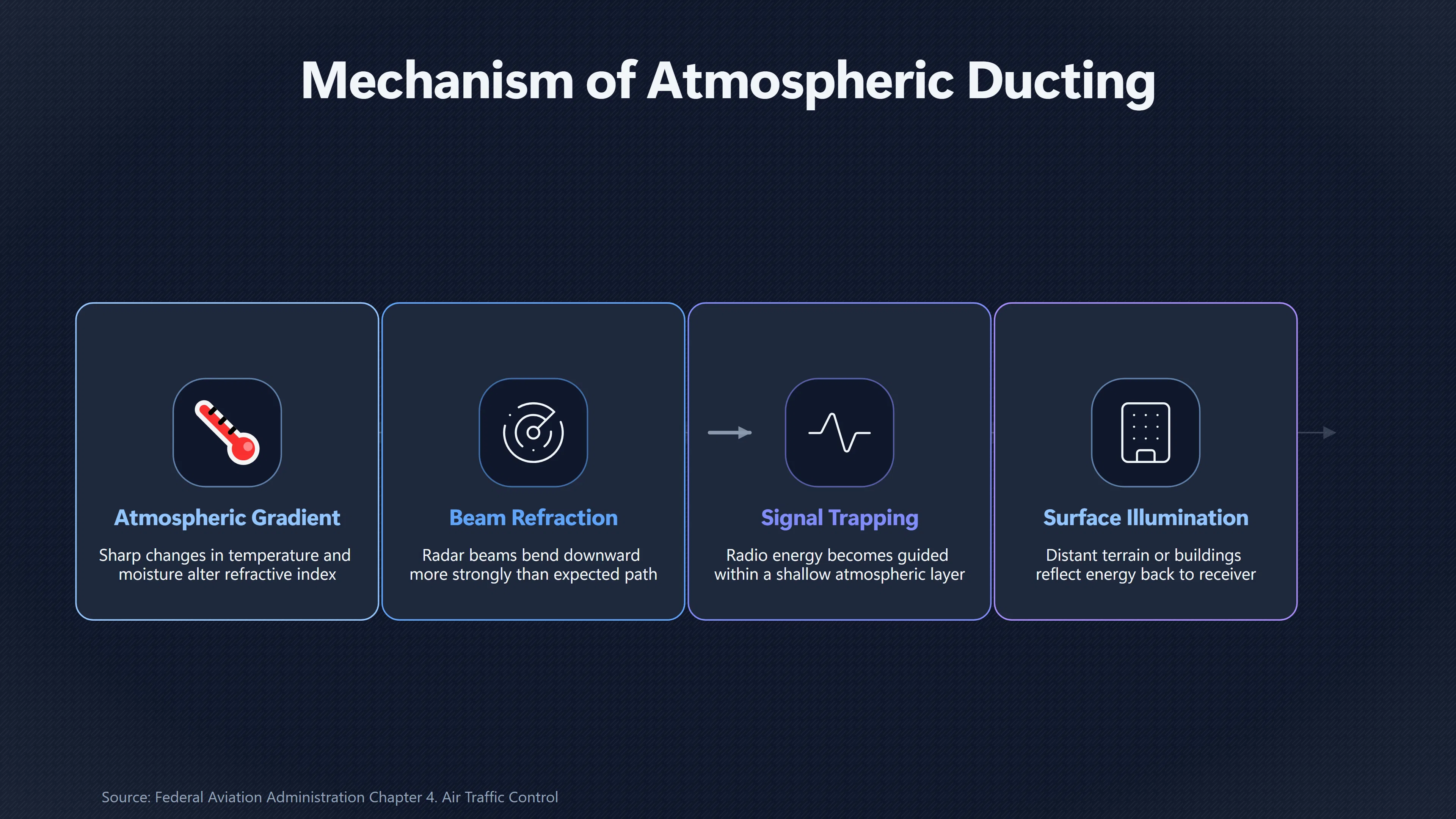
Atmospheric ducting is a well-established way for radar to produce convincing echoes from places where no aircraft is actually present. The mechanism begins with unusually sharp changes in temperature and moisture with height. These alter the atmosphere’s refractive index, bending a radar beam downwards more strongly than expected. In sufficiently strong conditions, part of the beam can become trapped in a shallow atmospheric layer and travel far beyond the normal radar horizon. It may then illuminate distant terrain, buildings, ships or other surface objects and carry their reflections back to the radar.[faa.gov]faa.govFederal Aviation Administration Chapter 4. Air Traffic ControlFederal Aviation Administration Chapter 4. Air Traffic Control
The resulting echoes are not imaginary signals: real radio energy has struck real reflectors. What is misleading is the assumed propagation path. A radar system that interprets the return as though its pulse followed the expected path can display unexplained blips or clutter in unexpected locations. The Federal Aviation Administration (FAA) explicitly warns that anomalous propagation, including ducting, can produce “many extraneous blips” on radar displays.[Federal Aviation Administration]faa.govFederal Aviation Administration Chapter 4. Air Traffic ControlFederal Aviation Administration Chapter 4. Air Traffic Control
For UFO and UAP reports involving radar, that distinction is crucial. An unexpected radar return establishes that the receiver detected energy; by itself, it does not establish that an aircraft or other discrete airborne object occupied the displayed position.
How atmospheric ducting bends radar beams
Radar propagation through the lower atmosphere depends on the refractive index of air, which in turn varies with temperature, atmospheric pressure and water vapour. Under ordinary conditions, radar engineers can model the beam as following a relatively predictable path that curves slightly towards the Earth’s surface. Strong vertical gradients can substantially change that curvature.[JCU Research Online]researchonline.jcu.edu.auJCU Research OnlineImplications of anomalous propagation in the evaporation duct for radars at X and Ku bandNovember 4, 2010…
A particularly important situation occurs when temperature rises with altitude through a layer — a temperature inversion — or when moisture decreases unusually rapidly with height. Either can create strong super-refraction, meaning that the beam bends towards the ground more sharply than normal. The US National Weather Service describes precisely this process: sufficiently abnormal downward refraction illuminates ground at ranges where ground targets would not normally be encountered.[National Weather Service]weather.govNational Weather Service NWS Weather RadarNational Weather Service NWS Weather Radar
The UK’s Met Office gives a useful visual analogy. Its radar guidance explains that during a low-level temperature inversion the beam can be refracted downwards, producing strong ground echoes in a process comparable to the optical refraction responsible for mirages. Such anomalous propagation is sufficiently familiar in operational meteorology to have the abbreviated name “anaprop”.[Met Office]metoffice.gov.ukMet Office RadarNational Meteorological Library and ArchiveSeptember 5, 2023…
Ducting is the more extreme end of this refraction problem. If the vertical refractivity gradient becomes sufficiently strong, radio energy can effectively become guided within a layer rather than simply continuing outwards along the expected path. The classic UK Met Office literature on radio ducting describes it as an atmospheric condition capable of severely changing radio detection and reception ranges.[Met Office Library]library.metoffice.gov.ukMet Office LibraryAn introduction to radio ducting…
Over the sea, a related form called an evaporation duct can form because humidity changes rapidly immediately above the water. Research on maritime radar propagation shows that such ducts can trap radio waves and alter detection ranges, although the strength of the effect depends on frequency, antenna height, antenna orientation and the structure of the duct itself.[JCU Research Online]researchonline.jcu.edu.auJCU Research OnlineImplications of anomalous propagation in the evaporation duct for radars at X and Ku bandNovember 4, 2010…
This is not merely a theoretical prediction. Experiments using shore-based navigation radar and atmospheric measurements have directly associated atmospheric ducts with over-the-horizon radar detection. One study found that particularly long-range detections in its experiments were associated with strong lower-atmospheric ducts rather than simply the near-surface evaporation duct.[MDPI]mdpi.comExperimental Analysis of Atmospheric Ducts and Navigation Radar Over-the-Horizon DetectionMay 27, 2022…
Why distant ground objects can appear airborne
The misleading-target problem arises because radar normally estimates an object’s position on assumptions about where its beam travelled. If those assumptions fail, the fact that the measured round-trip time is accurate does not necessarily mean that the inferred geometry is.
Consider a low-elevation surveillance beam that would normally rise above distant terrain because of the curvature of the Earth. Under strong super-refraction, the atmosphere bends that beam back towards the surface. A hill, building or other strong reflector beyond the ordinary radar horizon can suddenly be illuminated. Some of its reflected energy can then return through the same abnormal propagation environment. To the radar receiver, there is now an echo at a range where it ordinarily would not expect ground clutter.[National Weather Service]forecast.weather.govNational Weather Service NOAA's National Weather ServiceNational Weather ServiceNOAA's National Weather Service - Glossary…
This explains a feature that can make ducting particularly deceptive: the anomalous echo may be geographically distant from the radar rather than sitting obviously around the antenna as familiar local ground clutter. NOAA notes that super-refraction can cause the beam to encounter objects that would otherwise be outside its normal illumination pattern, while the FAA warns that downward bending can populate an operator’s display with extraneous returns.[NOAA]prod-01-alb-www-noaa.woc.noaa.govOpen source on noaa.gov.
The reflector itself can be entirely ordinary. Weather-radar training material notes that anomalous propagation may intercept particular hilltops or buildings rather than producing uniform ground clutter everywhere.[UCLA Atmospheric Research]research.atmos.ucla.eduAtmospheric Research Weather Radar FundamentalsUCLA Atmospheric ResearchWeather Radar Fundamentals… That matters when interpreting a radar display: scattered bright returns need not correspond to scattered objects in the sky. They can represent isolated strong surface reflectors that an abnormally curved beam happens to reach.
Atmospheric ducting can also extend radar coverage dramatically. Maritime experiments have demonstrated over-the-horizon detection during ducting, and evaporation-duct research describes both unexpectedly extended propagation and “radio black spots”. In other words, the same atmospheric structure can improve detection in one region while degrading it in another.[MDPI]mdpi.comExperimental Analysis of Atmospheric Ducts and Navigation Radar Over-the-Horizon DetectionMay 27, 2022…
That behaviour is one reason “the radar detected it” needs careful qualification in an unusual-target investigation. The radar can indeed have detected reflected energy while still giving a misleading impression of what produced it or where the relevant reflector lies.
Why the echoes can look convincing
Atmospheric ducting is sometimes described loosely as radar “malfunction”, but that wording obscures the mechanism. The radar may be operating normally. The unusual element is the medium through which its signal propagates.
This distinction has practical consequences. Ducting can suddenly expose the radar to strong reflectors that are normally hidden below its radio horizon. Their echoes can therefore appear and disappear as atmospheric conditions change, even though the buildings, terrain or other underlying reflectors have obviously not moved. NOAA describes anomalous propagation as transient and highly dependent on atmospheric conditions.[National Weather Service]weather.govNational Weather Service NWS Weather RadarNational Weather Service NWS Weather Radar
Operational experience shows that the problem can be serious enough to require dedicated suppression techniques. MIT Lincoln Laboratory documented anomalous-propagation ground-clutter contamination in Airport Surveillance Radar weather data and developed an editing algorithm using Doppler-spectrum characteristics to distinguish it. The work was tested against nine anomalous-propagation and weather episodes recorded around Orlando in 1991 and 1992.[Lincoln Laboratory]ll.mit.eduOpen source on mit.edu.
Similar difficulties occur in weather radar. Research on NEXRAD data describes ground-clutter contamination during anomalous propagation as an important limitation and discusses algorithms designed specifically to remove it. Later work has continued to treat identification and mitigation of both normal and anomalous-propagation ground clutter as an active radar-processing problem.[Lincoln Laboratory]ll.mit.eduOpen source on mit.edu.
This operational history is useful in the UAP context because it establishes the phenomenon independently of any particular UFO case. Radar engineers and meteorologists were developing ways to recognise and suppress anomalous-propagation echoes because they presented genuine practical problems in aviation and weather surveillance.
Clues that separate ducting from a real target
No single visual feature proves that an unexplained radar contact is caused by ducting. Investigators instead look for several mutually supporting clues.
Low elevation is an important warning sign. National Weather Service guidance says anomalous-propagation ground clutter is most common on the lowest radar elevation scans and may disappear on higher scans. That is what would be expected if a low beam were being refracted towards surface reflectors.[National Weather Service]weather.govNational Weather Service NWS Weather RadarNational Weather Service NWS Weather Radar
The weather should support abnormal refraction. A temperature inversion, sharp decrease in moisture with altitude, stable boundary layer or comparable refractivity gradient makes the explanation physically stronger. Research using radiosonde measurements has found relationships between anomalous clutter intensity and parameters including inversion layers and vertical refractivity gradients.[Mausam]mausamjournal.imd.gov.inOpen source on imd.gov.in.
The echoes often have little true radial velocity. Ground objects illuminated through anomalous propagation remain ground objects. Radar-meteorology research has therefore found near-zero Doppler velocity useful for identifying ground clutter and anomalous-propagation echoes. However, zero Doppler velocity is not an infallible discriminator because genuine weather can also have little radial motion relative to a particular radar.[Princeton University]collaborate.princeton.eduUniversity Anomalous propagation of radar signalsUniversity Anomalous propagation of radar signals
The pattern may remain geographically fixed while its strength changes. Training material from the COMET weather-radar programme notes that anomalous-propagation echoes often change little in position across successive frames, although individual echoes can disappear and reappear. That differs from a coherent airborne object steadily traversing the surveillance volume.[UCLA Atmospheric Research]research.atmos.ucla.eduAtmospheric Research Weather Radar FundamentalsUCLA Atmospheric ResearchWeather Radar Fundamentals…
Changes in atmospheric conditions can make the pattern vanish. The National Weather Service’s Melbourne, Florida, office notes that early-morning anomalous propagation associated with an inversion commonly filters out as daytime heating mixes or lifts the inversion. A suspicious radar pattern that appears during stable overnight conditions and fades as the boundary layer changes therefore has a plausible atmospheric signature.[National Weather Service]weather.govNational Weather Service NWS Weather RadarNational Weather Service NWS Weather Radar
Independent sensors matter. NOAA recommends checking neighbouring radars when deciding whether an apparent weather echo is anomalous propagation. The same logic applies more broadly to an unexplained radar target: independent radar geometry, visual or infrared observations, transponder information and atmospheric measurements can test whether the displayed contact corresponds to a physical object in the claimed location.[NOAA]prod-01-alb-www-noaa.woc.noaa.govOpen source on noaa.gov.
Modern filters reduce the problem but do not make it impossible. The FAA notes that moving-target indication and beacon radar can usually mitigate anomalous propagation in air-traffic surveillance, while radar research shows why clutter suppression is inherently a discrimination problem: aggressive filtering can also remove legitimate near-zero-velocity information.[Federal Aviation Administration]faa.govFederal Aviation Administration Chapter 4. Air Traffic ControlFederal Aviation Administration Chapter 4. Air Traffic Control

What ducting means for UFO and UAP radar reports
Atmospheric propagation has been part of the radar-UFO debate for decades. The 1968 University of Colorado study commissioned by the US Air Force — usually called the Condon Report — devoted an entire technical chapter to radar and UFOs and discussed super-refraction, trapping and atmospheric ducts in detail. Its radar analysis noted that sufficiently strong refractivity gradients can guide radar energy within a surface duct and produce exceptionally long propagation beyond the ordinary radar horizon.[NCAS Files]files.ncas.orgFiles Condon Report, Sec VI, Chapter 5 – Radar and UFOsFiles Condon Report, Sec VI, Chapter 5 – Radar and UFOs
Historical discussions sometimes went further and attributed moving UFO-like radar contacts directly to refracting atmospheric structures. Those older claims need caution. Modern operational sources provide especially strong support for ducting as a mechanism for illuminating distant surface targets and creating anomalous clutter; they do not justify treating every apparently fast or manoeuvring radar track as an atmospheric duct. Track processing, multipath, interference and other radar artefacts are separate mechanisms and need their own evidence.
The most defensible use of ducting in a UAP investigation is therefore as a testable hypothesis. Was there an inversion or sharp humidity gradient? Were the contacts concentrated at low elevation? Did they correspond to strong surface reflectors? Were their Doppler characteristics compatible with clutter? Did they persist geographically while their intensity fluctuated? Did the contacts weaken when atmospheric conditions changed? And did independent sensors actually confirm objects at the radar-derived positions?
A positive answer to several of those questions can turn an apparently mysterious radar episode into a conventional propagation event. A negative answer does not prove that the target was extraordinary; it simply means ducting has not adequately explained that particular observation.
That distinction captures the real value of atmospheric ducting to the study of UFO and UAP reports. It is not a universal explanation for unexplained radar contacts. It is a documented mechanism by which real radar echoes from ordinary distant objects can appear in places where normal propagation says they should not be visible. Understanding that mechanism prevents the radar display itself from being mistaken for an uncomplicated map of physical objects in the sky.
Amazon book picks
Further Reading
Books and field guides related to When the Atmosphere Makes Radar Targets Appear. Use these as the next step if you want deeper reading beyond the article.
Introduction to Radar Systems
Since the publication of the second edition of "Introduction to Radar Systems," there has been continual development of new radar capabil...
Radar Handbook
Publisher's Note: Products purchased from Third Party sellers are not guaranteed by the publisher for quality, authenticity, or access to...
Propagation of Radiowaves
Fully updated new edition of this successful book, providing a firm background to the theory and practice of radiowave propagation engine...
eBay marketplace picks
Marketplace Samples
Live-tested eBay searches with available results related to this page.
Selected fromUFO poster oneBay.co.uk.

Current eBay listing
VINTAGE UFO FLYING SAUCERS COMIC ADVERTISING A2 POSTER PRINT


Current eBay listing
I Want To Believe UFO Poster Giclée Fine Art Heavyweight Print

Endnotes
1.
Source: faa.gov
Title: Federal Aviation Administration Chapter 4. Air Traffic Control
Link:https://www.faa.gov/air_traffic/publications/atpubs/aim_html/chap4_section_5.html
2.
Source: forecast.weather.gov
Title: National Weather Service NOAA’s National Weather Service
Link:https://forecast.weather.gov/glossary.php?word=Propa
Source snippet
National Weather ServiceNOAA's National Weather Service - Glossary...
3.
Source: faa.gov
Title: Federal Aviation Administration ENR 1.1: General Rules
Link:https://www.faa.gov/air_traffic/publications/atpubs/aip_html/part2_enr_section_1.1.html
4.
Source: weather.gov
Title: National Weather Service NWS Weather Radar
Link:https://www.weather.gov/mlb/Doppler_Dual_Pol_Weather_Radar
5.
Source: mdpi.com
Link:https://www.mdpi.com/2072-4292/14/11/2588
Source snippet
Experimental Analysis of Atmospheric Ducts and Navigation Radar Over-the-Horizon DetectionMay 27, 2022...
Published: May 27, 2022
6.
Source: research.atmos.ucla.edu
Title: Atmospheric Research Weather Radar Fundamentals
Link:https://research.atmos.ucla.edu/weather/C110/Documents/tmp/basic_wxradar/navmenu.php_tab_1_page_5.1.2_type_text.htm
Source snippet
UCLA Atmospheric ResearchWeather Radar Fundamentals...
7.
Source: prod-01-alb-www-noaa.woc.noaa.gov
Link:https://prod-01-alb-www-noaa.woc.noaa.gov/jetstream/anomalous-propagation
8.
Source: ll.mit.edu
Link:https://www.ll.mit.edu/r-d/publications/anomalous-propagation-ground-clutter-suppression-airport-surveillance-radar-asr
9.
Source: ll.mit.edu
Link:https://www.ll.mit.edu/r-d/publications/performance-characteristics-algorithm-used-remove-anomolous-propagation-nexrad
10.
Source: collaborate.princeton.edu
Title: University Anomalous propagation of radar signals
Link:https://collaborate.princeton.edu/en/publications/anomalous-propagation-of-radar-signals-challenges-with-clutter/
11.
Source: files.ncas.org
Title: Files Condon Report, Sec VI, Chapter 5 – Radar and UFOs
Link:https://files.ncas.org/condon/text/s6chap05.htm
12.
Source: roc.noaa.gov
Title: build loaded
Link:https://www.roc.noaa.gov/build-loaded.php
13.
Source: mdpi.com
Link:https://www.mdpi.com/2072-4292/18/11/1808
14.
Source: mdpi.com
Link:https://www.mdpi.com/2073-4433/16/3/336
15.
Source: inside.nssl.noaa.gov
Title: bill lumbergh 5 7 2024 afternoon live
Link:https://inside.nssl.noaa.gov/ewp/2024/05/07/bill-lumbergh-5-7-2024-afternoon-live/
16.
Source: roc.noaa.gov
Title: unit designator ci matrix
Link:https://www.roc.noaa.gov/branches/program-branch/configuration-management/unit-designator-ci-matrix.php
17.
Source: mdpi.com
Link:https://www.mdpi.com/2072-4292/16/4/674
18.
Source: star.nesdis.noaa.gov
Link:https://www.star.nesdis.noaa.gov/socd/lsa/RADS.php
19.
Source: mdpi.com
Link:https://www.mdpi.com/2072-4292/15/12/2989
20.
Source: mdpi.com
Link:https://www.mdpi.com/2076-3417/12/17/8566
21.
Source: mdpi.com
Link:https://www.mdpi.com/2079-9292/11/14/2157
22.
Source: inside.nssl.noaa.gov
Title: false signals in areas of low power return ground clutter
Link:https://inside.nssl.noaa.gov/ewp/2021/05/19/false-signals-in-areas-of-low-power-return-ground-clutter/
23.
Source: mdpi.com
Link:https://www.mdpi.com/2073-4433/11/7/754
24.
Source: inside.nssl.noaa.gov
Title: azshear product a good tool to use with velocity data
Link:https://inside.nssl.noaa.gov/ewp/2019/06/03/azshear-product-a-good-tool-to-use-with-velocity-data/
25.
Source: inside.nssl.noaa.gov
Title: collaboration improves uk and us radar techniques to improve forecasts
Link:https://inside.nssl.noaa.gov/nsslnews/2017/04/collaboration-improves-uk-and-us-radar-techniques-to-improve-forecasts/
26.
Source: inside.nssl.noaa.gov
Title: gab at the lab david warde
Link:https://inside.nssl.noaa.gov/nsslnews/2015/10/gab-at-the-lab-david-warde/
27.
Source: faa.gov
Link:https://www.faa.gov/air_traffic/publications/atpubs/aim/aim0405.html
28.
Source: weather.gov
Title: Rare Sight- WSR-88D Sees Ships on the Lake
Link:https://www.weather.gov/dlh/shipsonradar
29.
Source: inside.nssl.noaa.gov
Title: cleaning up the clutter on radars
Link:https://inside.nssl.noaa.gov/nsslnews/2011/03/cleaning-up-the-clutter-on-radars/
30.
Source: preview.weather.gov
Link:https://preview.weather.gov/oun/spotterglossary
31.
Source: ll.mit.edu
Title: anomalous propagation associated thunderstorm outflows
Link:https://www.ll.mit.edu/r-d/publications/anomalous-propagation-associated-thunderstorm-outflows
32.
Source: files.ncas.org
Link:https://files.ncas.org/condon/text/s3chap05.htm
33.
Source: research.atmos.ucla.edu
Title: navmenu.php tab 1 page 5 1 2 type text
Link:https://research.atmos.ucla.edu/weather/C227/Documents/tmp/basic_wxradar/navmenu.php_tab_1_page_5_1_2_type_text.htm
34.
Source: research.atmos.ucla.edu
Link:https://research.atmos.ucla.edu/weather/C227/Documents/tmp/basic_wxradar/print.php.htm
35.
Source: research.atmos.ucla.edu
Title: navmenu.php tab 1 page 3 4 1 type text
Link:https://research.atmos.ucla.edu/weather/C227/Documents/tmp/basic_wxradar/navmenu.php_tab_1_page_3_4_1_type_text.htm
36.
Source: ncei.noaa.gov
Title: next generation weather radar
Link:https://www.ncei.noaa.gov/products/radar/next-generation-weather-radar
37.
Source: repository.library.noaa.gov
Link:https://repository.library.noaa.gov/view/noaa/25688
38.
Source: vlab.noaa.gov
Title: dual pol quality control
Link:https://vlab.noaa.gov/web/wdtd/-/dual-pol-quality-control?selectedFolder=668047
39.
Source: prod-01-alb-www-noaa.woc.noaa.gov
Title: how radar works
Link:https://prod-01-alb-www-noaa.woc.noaa.gov/jetstream/doppler/how-radar-works
40.
Source: prod-01-alb-www-noaa.woc.noaa.gov
Link:https://prod-01-alb-www-noaa.woc.noaa.gov/jetstream/velocity
41.
Source: prod-01-alb-www-noaa.woc.noaa.gov
Title: vcp max
Link:https://prod-01-alb-www-noaa.woc.noaa.gov/jetstream/vcp_max
42.
Source: prod-01-alb-www-noaa.woc.noaa.gov
Link:https://prod-01-alb-www-noaa.woc.noaa.gov/jetstream/reflectivity
43.
Source: nssl.noaa.gov
Link:https://www.nssl.noaa.gov/publications/dopplerguide/chapter1.php
44.
Source: repository.library.noaa.gov
Link:https://repository.library.noaa.gov/view/noaa/32473
45.
Source: repository.library.noaa.gov
Link:https://repository.library.noaa.gov/view/noaa/21918
46.
Source: nssl.noaa.gov
Link:https://www.nssl.noaa.gov/tools/radar/nexrad/
47.
Source: nssl.noaa.gov
Link:https://www.nssl.noaa.gov/about/events/review2015/publications/
48.
Source: nssl.noaa.gov
Link:https://www.nssl.noaa.gov/projects/mparsup/dsp.php
49.
Source: inside.nssl.noaa.gov
Link:https://inside.nssl.noaa.gov/nsslnews/2011/03/
50.
Source: inside.nssl.noaa.gov
Link:https://inside.nssl.noaa.gov/ewp/2024/04/page/5/
51.
Source: nssl.noaa.gov
Title: wsr88d reports
Link:https://www.nssl.noaa.gov/publications/wsr88d_reports/
52.
Source: roc.noaa.gov
Title: radar product improvement
Link:https://www.roc.noaa.gov/branches/engineering-branch/radar-product-improvement.php
53.
Source: roc.noaa.gov
Title: wf impact
Link:https://www.roc.noaa.gov/windfarms/wf-impact.php
54.
Source: roc.noaa.gov
Title: wsr88d hotline links info
Link:https://www.roc.noaa.gov/branches/operations-branch/wsr88d-hotline-links-info.php
55.
Source: test.roc.noaa.gov
Title: wsr88d hotline links info
Link:https://www.test.roc.noaa.gov/branches/operations-branch/wsr88d-hotline-links-info.php
56.
Source: roc.noaa.gov
Title: wf analysis
Link:https://www.roc.noaa.gov/windfarms/wf-analysis.php
57.
Source: roc.noaa.gov
Title: hardware engineering
Link:https://www.roc.noaa.gov/branches/engineering-branch/hardware-engineering.php
58.
Source: roc.noaa.gov
Title: software engineering
Link:https://www.roc.noaa.gov/branches/engineering-branch/software-engineering.php
59.
Source: roc.noaa.gov
Title: reports and conferences
Link:https://www.roc.noaa.gov/branches/field-requirements-branch/reports-and-conferences.php
60.
Source: roc.noaa.gov
Title: reports and conferences
Link:https://www.roc.noaa.gov/branches/operations-branch/field-requirements/reports-and-conferences.php
61.
Source: roc.noaa.gov
Link:https://www.roc.noaa.gov/radar-techniques/mpda.php
62.
Source: forecast.weather.gov
Link:https://forecast.weather.gov/glossary.php?word=propagation
63.
Source: weather.gov
Link:https://www.weather.gov/bmx/radar_aboutnwsradar_shortcomings
64.
Source: forecast.weather.gov
Link:https://forecast.weather.gov/glossary.php?letter=a
65.
Source: forecast.weather.gov
Link:https://forecast.weather.gov/glossary.php?word=AP
66.
Source: weather.gov
Link:https://www.weather.gov/iwx/wsr_88d
67.
Source: weather.gov
Link:https://www.weather.gov/bgm/researchRadarandBirds1997
68.
Source: preview.weather.gov
Title: pcpn methods
Link:https://preview.weather.gov/abrfc/pcpn_methods
69.
Source: forecast.weather.gov
Link:https://forecast.weather.gov/glossary.php?word=refraction
70.
Source: weather.gov
Link:https://www.weather.gov/jan/dualpolupgrade-about
71.
Source: weather.gov
Link:https://www.weather.gov/mkx/using-radar
72.
Source: forecast.weather.gov
Link:https://forecast.weather.gov/glossary.php?word=s
73.
Source: forecast.weather.gov
Link:https://forecast.weather.gov/glossary.php?word=r
74.
Source: forecast.weather.gov
Link:https://forecast.weather.gov/glossary.php?word=P
75.
Source: forecast.weather.gov
Link:https://forecast.weather.gov/glossary.php?word=n
76.
Source: forecast.weather.gov
Link:https://forecast.weather.gov/glossary.php?word=a
77.
Source: forecast.weather.gov
Link:https://forecast.weather.gov/glossary.php?word=T
78.
Source: library.metoffice.gov.uk
Link:https://library.metoffice.gov.uk/portal/Default/en-GB/RecordView/Index/398996
Source snippet
Met Office LibraryAn introduction to radio ducting...
79.
Source: researchonline.jcu.edu.au
Link:https://researchonline.jcu.edu.au/13769/
Source snippet
JCU Research OnlineImplications of anomalous propagation in the evaporation duct for radars at X and Ku bandNovember 4, 2010...
Published: November 4, 2010
80.
Source: metoffice.gov.uk
Title: Met Office Radar
Link:https://www.metoffice.gov.uk/binaries/content/assets/metofficegovuk/pdf/research/library-and-archive/library/publications/factsheets/factsheet_15-weather-radar-2020_2023.pdf
Source snippet
National Meteorological Library and ArchiveSeptember 5, 2023...
Published: September 5, 2023
81.
Source: researchonline.jcu.edu.au
Link:https://researchonline.jcu.edu.au/27121/
Source snippet
JCU Research OnlineObservations of anomalous over the horizon microwave radio propagation inside the tropical maritime evaporation duct i...
82.
Source: mausamjournal.imd.gov.in
Link:https://mausamjournal.imd.gov.in/index.php/MAUSAM/article/view/2
83.
Source: weather.metoffice.gov.uk
Title: metoffice.gov.uk U K rainfall radar map with accessible colours
Link:https://weather.metoffice.gov.uk/maps-and-charts/rainfall-radar-forecast-accessible-colours-map
84.
Source: weather.metoffice.gov.uk
Title: metoffice.gov.uk U K rainfall radar map
Link:https://weather.metoffice.gov.uk/maps-and-charts/rainfall-radar-forecast-map
85.
Source: metoffice.gov.uk
Title: Met Office Hadley Centre observations datasets
Link:https://www.metoffice.gov.uk/hadobs/hadsst4/HadSST.4.1.1.0_data/HadSST.4.1.1.0_download.html
86.
Source: melton.gov.uk
Title: Public Toilets – Melton Borough Council
Link:https://www.melton.gov.uk/business-licensing-and-investment/land-and-property/public-toilets/
87.
Source: metoffice.gov.uk
Link:https://www.metoffice.gov.uk/blog/2025/how-does-the-met-office-use-radar-for-weather-forecasts
88.
Source: journals.fugusau.edu.ng
Title: fugusau.edu.ng6+ Strange Weird Thing in the Sky: Explained!
Link:https://journals.fugusau.edu.ng/weird-thing-in-the-sky/
89.
Source: GOV.UK
Title: www.gov.uk Optimising the accuracy of radar products with dual polarisation
Link:https://www.gov.uk/flood-and-coastal-erosion-risk-management-research-reports/optimising-the-accuracy-of-radar-products-with-dual-polarisation
90.
Source: GOV.UK
Link:https://www.gov.uk/research-for-development-outputs/signal-processing-in-a-novel-radar-system-for-monitoring-insect-migration
91.
Source: trid.trb.org
Link:https://trid.trb.org/view/143781
92.
Source: sciencedirect.com
Title: Radar Beam
Link:https://www.sciencedirect.com/topics/physics-and-astronomy/radar-beam
93.
Source: metoffice.gov.uk
Title: New radar noise level estimator
Link:https://www.metoffice.gov.uk/research/news/2019/new-radar-noise-level-estimator
94.
Source: library.metoffice.gov.uk
Link:https://library.metoffice.gov.uk/portal/Default/en-GB/RecordView/Index/175654
95.
Source: metoffice.gov.uk
Title: Radar systems
Link:https://www.metoffice.gov.uk/research/weather/observations-research/radar-systems
96.
Source: library.metoffice.gov.uk
Title: Record View
Link:https://library.metoffice.gov.uk/portal/Default/en-GB/RecordView/Index/469109
97.
Source: weather.metoffice.gov.uk
Title: metoffice.gov.uk Kelvin-Helmholtz cloud
Link:https://weather.metoffice.gov.uk/learn-about/weather/types-of-weather/clouds/unusual-cloud-[formations
98.
Source: weather.metoffice.gov.uk
Title: metoffice.gov.uk U K rainfall radar map
Link:https://weather.metoffice.gov.uk/maps-and-charts/rainfall-radar-forecast-map?fs=e
99.
Source: metoffice.gov.uk
Title: Raindrops and radar
Link:https://www.metoffice.gov.uk/research/weather/observations-research/raindrops-and-radar
100.
Source: metoffice.gov.uk
Title: SESA R 3D Radar and Harmonised Turbulence Services
Link:https://www.metoffice.gov.uk/services/transport/aviation/regulated/international-aviation/sesar
101.
Source: library.metoffice.gov.uk
Link:https://library.metoffice.gov.uk/portal/Default/en-GB/RecordView/Index/88979
102.
Source: [bromsgrove]({{ ‘bromsgrove/’ | relative_url }}). gov.uk
Link:https://www.bromsgrove.gov.uk/things-to-do/parks-and-outdoors/public-toilets-and-conveniences/
103.
Source: emuseum.aberdeencity.gov.uk
Link:https://emuseum.aberdeencity.gov.uk/objects/144207/bonavista-nonia-852-853-piping-and-pumping-arrangements
104.
Source: emuseum.aberdeencity.gov.uk
Title: aberdeencity.gov.uk CORMOO R – Works – e Museum
Link:https://emuseum.aberdeencity.gov.uk/objects/101553/cormoor
Additional References
105.
Source: cia.gov
Link:https://www.cia.gov/readingroom/document/cia-rdp83-00418r005800140001-1
106.
Source: cia.gov
Link:https://www.cia.gov/readingroom/document/cia-rdp81r00560r000100070028-5
107.
Source: govinfo.gov
Link:https://www.govinfo.gov/app/details/GOVPUB-C13-b03b6715ba2ca6f63c5411b920ac95e0
108.
Source: clintonwhitehouse4.archives.gov
Link:https://clintonwhitehouse4.archives.gov/textonly/WH/EOP/OSTP/CTIformatted/chap4/4infocom.html
109.
Source: clintonwhitehouse3.archives.gov
Link:https://clintonwhitehouse3.archives.gov/WH/EOP/OSTP/CTIformatted/chap7/7matrls.html
110.
Source: clintonwhitehouse4.archives.gov
Link:https://clintonwhitehouse4.archives.gov/WH/EOP/OSTP/CTIformatted/chap8/8trans.html
111.
Source: cia.gov
Link:https://www.cia.gov/readingroom/document/cia-rdp90-00965r000402690023-9
112.
Source: youtube.com
Title: Module 5.6: Radar Brightband and Anomalous Propagation
Link:https://www.youtube.com/watch?v=Rq_ExHqg7TE
Source snippet
Radar & ARPA Explained | Basics of Marine Radar – Part 1...
113.
Source: cia.gov
Title: TECHNICA L DESCRIPTION OF THE RADAR K-1M A.250.000 TO | CIA FOIA (foia.cia.gov)
Link:https://www.cia.gov/readingroom/document/cia-rdp78-03066r000200160001-1
114.
Source: declassification.blogs.archives.gov
Title: the laser target recognition system ltrs a lesson in bleeding edge technology
Link:https://declassification.blogs.archives.gov/2018/10/10/the-laser-target-recognition-system-ltrs-a-lesson-in-bleeding-edge-technology/