Within Reconstruction
Can Multiple Witnesses Reveal a UFO's True Position?
Reports from observers in different places can constrain a UFO's direction and sometimes its distance far better than a crowd at one site.
On this page
- Why separated viewpoints matter
- How intersecting sight lines constrain location
- What shared viewing errors can still leave unresolved
Page outline Jump by section
Introduction
Yes — witnesses who are genuinely separated from one another can sometimes turn a vague UFO or UAP report into a geometrical problem. If two observers at known locations see the same object at the same time and can reconstruct reliable viewing directions, their sight lines can constrain where the object was. With favourable geometry, the intersection — or closest approach — of those lines can also provide an estimate of distance, altitude and subsequent motion.
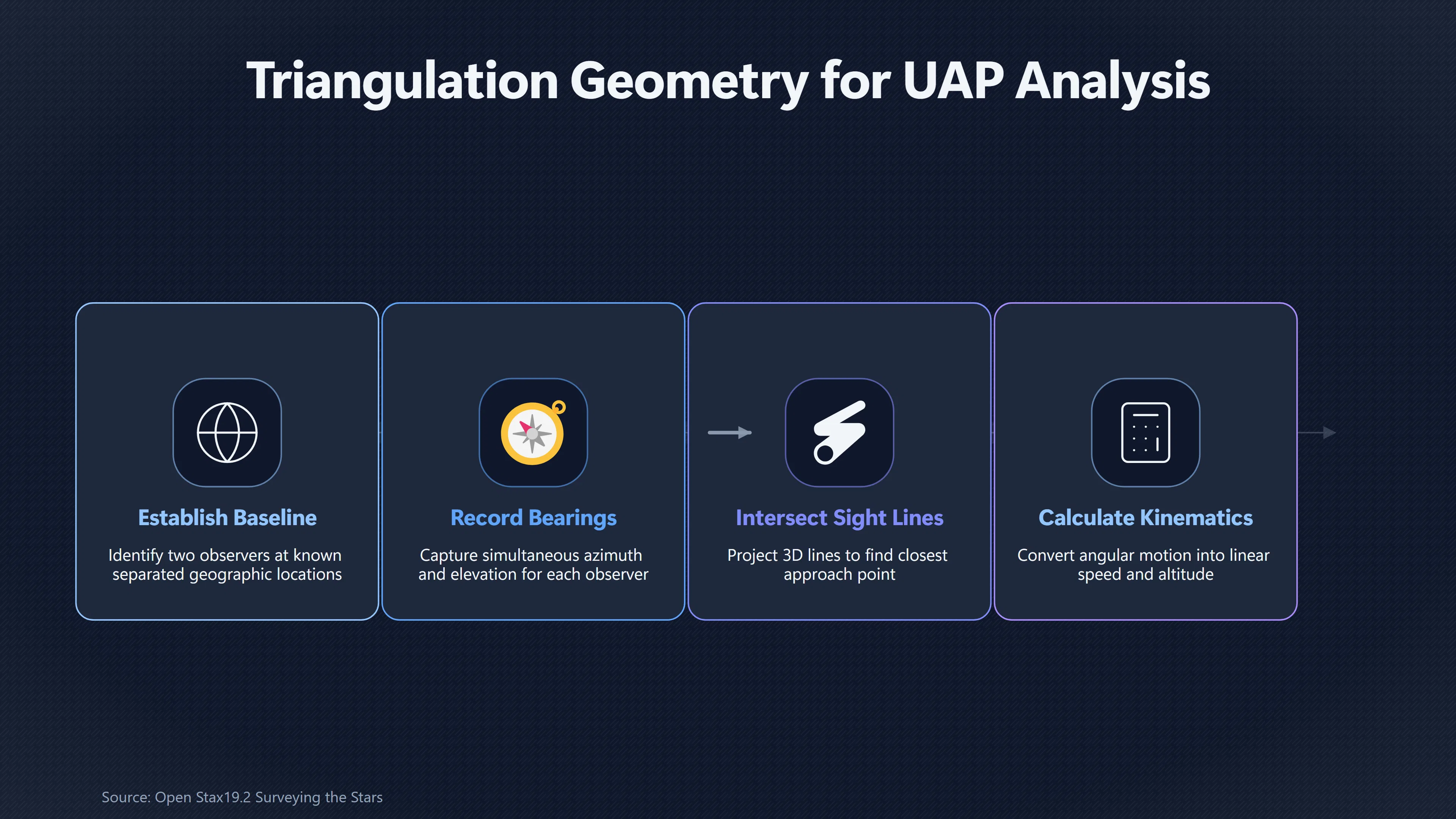
The crucial advantage is not simply having “more witnesses”. Ten people standing together essentially share one viewpoint. Two observers kilometres apart provide a baseline, allowing investigators to look for parallax: the change in an object’s apparent direction when viewed from different positions. This is the same basic principle used in surveying, astronomy and multi-station meteor tracking.[openstax.org]openstax.orgOpen Stax19.2 Surveying the Stars19.2 Surveying the Stars - Astronomy 2e | OpenStaxMarch 9, 2022…
For UFO investigation, that distinction can be decisive because distance is usually the missing quantity. Without it, apparent size and angular speed cannot safely be converted into physical size or true speed.
Why separated viewpoints matter
Imagine a bright light reported above a town. A group of witnesses in one car park may agree that it appeared about 20 degrees above the eastern horizon. Their agreement can strengthen confidence that a real visual stimulus was present, but it does little to establish how far away that stimulus was. A small object a kilometre away and a much larger object tens of kilometres away could occupy essentially the same direction in their sky.
Now add a second witness several kilometres to the north. If that person records the light towards the south-east rather than due east, investigators have gained something qualitatively different: a second line of sight from a substantially different location. Given sufficiently accurate positions, bearings and timing, the two lines can constrain the object’s position.
This is ordinary parallax geometry. Surveyors measure a known baseline between observing stations and determine the direction towards a target from each end. The apparent directional change supplies information about distance. The same principle allows simultaneous observations from separated sites to determine the range of an artificial satellite.[OpenStax]openstax.orgOpen Stax19.2 Surveying the Stars19.2 Surveying the Stars - Astronomy 2e | OpenStaxMarch 9, 2022…
The method is especially relevant to UFO reports because parallax is also one of the effects capable of making an ordinary object appear extraordinary. The US All-domain Anomaly Resolution Office (AARO) warns that forced perspective and parallax can produce exaggerated impressions of UAP size and speed. In its reconstruction of the Puerto Rico UAP video, AARO combined the observing aircraft’s position with sensor azimuth, elevation and other viewing geometry and concluded that apparent high speed resulted from motion parallax; the objects themselves were assessed as drifting at roughly wind speed.[AARO]aaro.milPuerto Rico UAP Case ResolutionAARO Puerto Rico UAP Case ResolutionMarch 19, 2025 — 20 Mar 2025 — Grey lines indicate the sensor's line-of-sight to the ground from…
Separated observations can attack the same ambiguity from the opposite direction. Rather than guessing distance from appearance, investigators try to measure geometry first.
How intersecting sight lines constrain location
The simplest reconstruction starts with two known observer positions, A and B, separated by a measured baseline. Each observer supplies a direction towards the phenomenon. In a simplified two-dimensional case, extending those directions across a map produces two lines that meet near the object’s horizontal position.
Real sightings are three-dimensional. Investigators ideally want both azimuth — the compass direction around the horizon — and elevation, the angle above it. Those measurements define a three-dimensional line of sight from each observer. Where independently derived sight lines intersect, or pass closest to one another after measurement uncertainty is allowed for, lies the candidate position of the observed object.
The underlying technique is not speculative UFO methodology. Multi-station meteor networks deliberately use separated cameras to reconstruct atmospheric trajectories. France’s FRIPON fireball network, for example, was designed with observatories roughly 80–100 kilometres apart specifically to permit triangulation. Modern meteor research fits trajectories to multiple line-of-sight measurements because the geometry can recover a three-dimensional path rather than merely a track across one camera’s sky.[International Meteor Organization]imo.net2015 56 colas finalInternational Meteor OrganizationFrench fireball network FRIPONby F Colas · Cited by 15 — To allow triangulation measurements of fireball…
A purpose-built UAP observing system would work on essentially the same principle. Researchers associated with the Galileo Project have proposed wide-field cameras at observing stations that can track aerial objects and derive position and kinematics through triangulation, alongside radar and other instruments. NASA’s independent UAP study likewise stressed the value of multiple, well-calibrated sensors because many historical UAP reports lack the measurements necessary for rigorous analysis.[arXiv]arxiv.orgThe Scientific Investigation of Unidentified Aerial Phenomena (UAP) Using Multimodal Ground-Based ObservatoriesMay 29, 2023…
The payoff is substantial. Once a reasonably constrained position or range exists, several quantities that witnesses commonly estimate by eye can instead become testable:
- Altitude: sight-line geometry can distinguish a nearby low object from something much farther away at high altitude.
- Physical size: an angular width becomes a meaningful size estimate only after distance is constrained.
- True speed: angular motion across the sky can be converted into linear motion when range and trajectory are known.
- Flight path: repeated simultaneous measurements can reconstruct movement through three-dimensional space.
- Candidate identification: the derived position and time can be compared much more tightly with aircraft, balloons, satellites, meteors or other known objects.
This is why “multiple witnesses” is not a single evidential category. Multiple observers at one location may provide useful corroboration of appearance and timing. Multiple observers at substantially different, accurately known locations can potentially provide spatial information.
A wide baseline is useful only with good measurements
Separation alone does not guarantee useful triangulation. The quality of the geometry matters.
A nearby object generally produces a larger parallax shift between two separated observing positions than a very distant one. This is the same reason astronomical parallax becomes progressively harder to measure as stellar distance increases: the apparent displacement shrinks.[European Space Agency]esa.intEuropean Space Agency ESAEuropean Space Agency ESA A long terrestrial baseline can therefore improve sensitivity, but only if both observers really saw the same event and their directions are known accurately enough.
The angle at which the sight lines meet also matters. If two observers are far apart but both look almost along the same direction, their lines may converge at a very shallow angle. Small bearing errors can then produce a large uncertainty in calculated distance. Meteor researchers explicitly recognise low convergence angles as a difficult case for trajectory reconstruction.[arXiv]arxiv.orgarXiv A Dynamic Trajectory Fit to Multi-Sensor Fireball ObservationsarXiv A Dynamic Trajectory Fit to Multi-Sensor Fireball Observations
Consider two reports whose reconstructed bearings cross at 15 kilometres. That figure may look impressively precise on a map. But if each witness’s direction is uncertain by several degrees, the true solution may be a broad region rather than a point. Extending slightly different permissible bearings over kilometres can move the intersection dramatically.
Investigators therefore need uncertainty ranges, not just a neat pair of crossing lines. A defensible result is more likely to say that an object was consistent with a particular volume of airspace, altitude range or trajectory corridor than to claim an exact coordinate unsupported by the observations.

Timing decides whether the geometry is real
Triangulation also depends on matching observations in time. If the phenomenon moves, a bearing recorded at 21:14:10 from one location cannot automatically be intersected with another witness’s direction at 21:14:40. Those sight lines may describe two different positions along the object’s trajectory.
For a slow or stationary light, modest timing uncertainty may be tolerable. For a meteor, aircraft or other rapidly moving target, seconds can matter. This is one reason instrumented multi-station observations are so much more powerful than retrospective eyewitness reconstruction: cameras can provide time-stamped sequences from which corresponding frames can be compared.
The problem becomes especially acute when reports contain only approximate statements such as “around nine o’clock” or “a few minutes later”. Those accounts may establish that several people probably witnessed the same broad event without supporting numerical triangulation.
Official UAP investigation practices reflect the wider importance of preserving these details. France’s CNES-linked GEIPAN service bases investigations on direct testimony gathered through a technical questionnaire, with photographs, videos, sketches and other material available to supplement the account.[Geipan]geipan.frOpen source on geipan.fr. A report becomes geometrically useful only when observer location, timing and viewing direction can be recovered with enough precision.

What shared viewing errors can still leave unresolved
Multiple witnesses are sometimes described as though they automatically eliminate perceptual error. They do not. Independence of location is different from independence of interpretation.
Two people kilometres apart can both mistake the same ordinary object for something unusual. In fact, a sufficiently distant astronomical or aerospace object can be visible across a very large region. Agreement that “a strange light was in the sky” therefore establishes much less than a successful reconstruction showing that independent bearings converge on a particular position.
Several failure modes remain important:
The directions may be reconstructed inaccurately. Witnesses asked later to point towards an object’s position can misremember its relationship to roads, buildings, stars or the horizon. A few degrees of error may be enough to ruin a long-range triangulation.
The witnesses may not have seen the same object. Two lights appearing at similar times can be separate aircraft, satellites or other phenomena. Intersecting their reported directions would create a fictitious location.
The accounts may not be independent. Witnesses who discuss the event before being interviewed can converge on descriptions, timings or directions. Agreement between accounts is therefore not equivalent to independently measured geometry.
The baseline may be too small. People hundreds of metres apart are technically separated, but a distant target may show too little parallax for ordinary eyewitness bearings to yield a useful range.
The convergence angle may be poor. Sight lines that nearly parallel one another can leave distance extremely uncertain even when both directions are reasonably well measured.
The target may be too distant for detectable parallax. If separated observers see essentially the same direction within their measurement errors, investigators may be able to infer that the phenomenon was not very close, but they may still be unable to determine how far away it actually was.
These limitations explain why sophisticated systems favour calibrated cameras and multiple sensors. NASA’s UAP study emphasised rigorous calibration and multi-sensor detection, while scientific proposals for dedicated UAP observatories combine optical triangulation with radar and other measurements rather than expecting eyewitness geometry to carry the entire analysis.[NASA Science]science.nasa.govNASA ScienceIndependent Study Team ReportThe importance of detecting UAP with multiple, well-calibrated sensors is paramount, and NASA sh…
When multiple witnesses really change a UFO case
The strongest configuration is therefore not simply “many people saw it”. It is something closer to independent observers, at substantially different known positions, observing the same event at synchronised times, with recoverable lines of sight. Photographs or videos containing stars, landmarks or calibrated pointing information can strengthen the reconstruction further.
That distinction matters when investigators assess reports of exceptional speed, altitude or size. A single viewpoint ordinarily supplies angular information: the object was this high above the horizon, this large in apparent diameter or moving this quickly across the field of view. Those observations do not by themselves establish physical distance.
A second well-separated viewpoint can supply the missing depth information. Once distance becomes measurable, apparently extraordinary performance may disappear — or, less commonly, remain after the geometry has been constrained. Either result is more informative than relying on visual impressions alone.
AARO’s recent case work illustrates the broader principle even when the second viewpoint comes from the movement and known geometry of a sensor platform rather than two human witnesses. In the Puerto Rico case, reconstructing sensor line of sight, aircraft position and changing viewing angle transformed apparently rapid, unusual motion into a much slower trajectory consistent with windborne objects.[AARO]aaro.milPuerto Rico UAP Case ResolutionAARO Puerto Rico UAP Case ResolutionMarch 19, 2025 — 20 Mar 2025 — Grey lines indicate the sensor's line-of-sight to the ground from…
Separated witnesses offer investigators another route to that essential quantity: perspective. Their real evidential value lies not in multiplying testimony, but in creating a baseline from which the sighting can potentially be measured.
Amazon book picks
Further Reading
Books and field guides related to Can Multiple Witnesses Reveal a UFO's True Position?. Use these as the next step if you want deeper reading beyond the article.
The UFO Experience: A Scientific Inquiry
The author belives that a number of UFO siting are still to be explained.
The UFO Handbook: A Guide to Investigating, Evaluating, and R...
An explanation of the usual reasons for confusing IFOs (identified flying objects) with UFOs and a survey of the tools used to investigat...
Elementary Surveying: An Introduction to Geomatics
Elementary Surveying, Fourteenth Edition, is ideal for Surveying courses offered in Civil Engineering departments and is a useful referen...
The Backyard Astronomer's Guide
Discusses the practical aspects of stargazing, including how to choose appropriate equipment, contending with light pollution, taking suc...
eBay marketplace picks
Marketplace Samples
Live-tested eBay searches with available results related to this page.
Selected fromUFO poster oneBay.co.uk.

Current eBay listing
VINTAGE UFO FLYING SAUCERS COMIC ADVERTISING A2 POSTER PRINT



Current eBay listing
I Want To Believe UFO Poster Giclée Fine Art Heavyweight Print
Endnotes
1.
Source: openstax.org
Title: Open Stax19.2 Surveying the Stars
Link:https://openstax.org/books/astronomy-2e/pages/19-2-surveying-the-stars
Source snippet
19.2 Surveying the Stars - Astronomy 2e | OpenStaxMarch 9, 2022...
Published: March 9, 2022
2.
Source: arxiv.org
Link:https://arxiv.org/abs/1504.00965
3.
Source: aaro.mil
Title: Puerto Rico UAP Case Resolution
Link:https://www.aaro.mil/Portals/136/PDFs/case_resolution_reports/AARO_Puerto_Rico_UAP_Case_Resolution.pdf
Source snippet
AARO Puerto Rico UAP Case ResolutionMarch 19, 2025 — 20 Mar 2025 — Grey lines indicate the sensor's line-of-sight to the ground from...
Published: March 19, 2025
4.
Source: aaro.mil
Title: UAP Records
Link:https://www.aaro.mil/UAP-Records/
Source snippet
UAP Records/Information Papers8 Jul 2026 — This informational paper provides an overview of these visual effects. Effect of Forced Pe...
5.
Source: arxiv.org
Title: arXiv A Dynamic Trajectory Fit to Multi-Sensor Fireball Observations
Link:https://arxiv.org/abs/1911.00816
6.
Source: arxiv.org
Link:https://arxiv.org/abs/2305.18566
Source snippet
The Scientific Investigation of Unidentified Aerial Phenomena (UAP) Using Multimodal Ground-Based ObservatoriesMay 29, 2023...
Published: May 29, 2023
7.
Source: science.nasa.gov
Link:https://science.nasa.gov/wp-content/uploads/2023/09/uap-independent-study-team-final-report.pdf?emrc=80696d
Source snippet
NASA ScienceIndependent Study Team ReportThe importance of detecting UAP with multiple, well-calibrated sensors is paramount, and NASA sh...
8.
Source: geipan.fr
Link:https://www.geipan.fr/en/what-did-i-see/step-1
9.
Source: geipan.fr
Link:https://www.geipan.fr/en/stats
10.
Source: aaro.mil
Link:https://www.aaro.mil/Next-AARO-Home-redesign/Next-Parent/Next-UAP-Report-Documents/
11.
Source: aaro.mil
Link:https://www.aaro.mil/Next-AARO-Home-redesign/Next-Parent/Next-AARO-UAP-Imagery-Acc-Table/
12.
Source: science.nasa.gov
Link:https://science.nasa.gov/uap/faqs/
13.
Source: aaro.mil
Link:https://www.aaro.mil/Next-AARO-Home-redesign/Next-Parent/Presidential-UAP-Transparency-Initiative/dvpmoduleid/77396/
14.
Source: geipan.fr
Link:https://www.geipan.fr/en/node/58786
15.
Source: pwg.gsfc.nasa.gov
Link:https://pwg.gsfc.nasa.gov/stargaze/Sparalax.htm
16.
Source: ntrs.nasa.gov
Link:https://ntrs.nasa.gov/citations/19740014365
18.
Source: geipan.fr
Link:https://www.geipan.fr/en/node/440
19.
Source: geipan.fr
Link:https://www.geipan.fr/en/node/58792
20.
Source: geipan.fr
Link:https://www.geipan.fr/en/node?page=0
21.
Source: geipan.fr
Link:https://geipan.fr/missions-methodes-et-resultats
22.
Source: geipan.fr
Link:https://geipan.fr/en/node/60361
23.
Source: geipan.fr
Title: detection louange 2
Link:https://geipan.fr/sites/default/files/detection_louange_2.pdf
24.
Source: aaro.mil
Link:https://www.aaro.mil/FAQ/
25.
Source: aaro.mil
Link:https://www.aaro.mil/Portals/136/PDFs/case_resolution_reports/Case_Resolution_of_Atmospheric_Wakes_508-02262024.pdf
26.
Source: aaro.mil
Title: Al Taqaddam Case Resolution Final
Link:https://www.aaro.mil/Portals/136/PDFs/case_resolution_reports/AARO_Al_Taqaddam_Case_Resolution_Final.pdf
27.
Source: aaro.mil
Title: AARO Historical Record Report Vol 1 2024
Link:https://www.aaro.mil/Portals/136/PDFs/AARO_Historical_Record_Report_Vol_1_2024.pdf
28.
Source: aaro.mil
Link:https://www.aaro.mil/Resources/
29.
Source: ntrs.nasa.gov
Link:https://ntrs.nasa.gov/api/citations/20020090931/downloads/20020090931.pdf
30.
Source: nasa.gov
Link:https://www.nasa.gov/wp-content/uploads/2024/01/presrep1973.pdf?emrc=67dc0ae18755a
31.
Source: ntrs.nasa.gov
Title: ITE FT6 TM Rev c
Link:https://ntrs.nasa.gov/api/citations/20205004052/downloads/ITE-FT6-TM%20Rev-c.pdf
32.
Source: ntrs.nasa.gov
Link:https://ntrs.nasa.gov/api/citations/19850012140/downloads/19850012140.pdf?attachment=true
33.
Source: ntrs.nasa.gov
Link:https://ntrs.nasa.gov/api/citations/20200002189/downloads/20200002189.pdf
34.
Source: ntrs.nasa.gov
Link:https://ntrs.nasa.gov/api/citations/19730024175/downloads/19730024175.pdf?attachment=true
35.
Source: ntrs.nasa.gov
Link:https://ntrs.nasa.gov/api/citations/19930004473/downloads/19930004473.pdf?attachment=true
36.
Source: ntrs.nasa.gov
Link:https://ntrs.nasa.gov/api/citations/19710017059/downloads/19710017059.pdf?attachment=true
37.
Source: ntrs.nasa.gov
Link:https://ntrs.nasa.gov/api/citations/19900006996/downloads/19900006996.pdf
38.
Source: ntrs.nasa.gov
Link:https://ntrs.nasa.gov/api/citations/19720026320/downloads/19720026320.pdf?attachment=true
39.
Source: ntrs.nasa.gov
Link:https://ntrs.nasa.gov/api/citations/19680027196/downloads/19680027196.pdf
40.
Source: ntrs.nasa.gov
Link:https://ntrs.nasa.gov/api/citations/19690020974/downloads/19690020974.pdf
41.
Source: ntrs.nasa.gov
Link:https://ntrs.nasa.gov/api/citations/19670095754/downloads/19670095754.pdf
42.
Source: ntrs.nasa.gov
Link:https://ntrs.nasa.gov/api/citations/19910022936/downloads/19910022936.pdf?attachment=true
43.
Source: ntrs.nasa.gov
Link:https://ntrs.nasa.gov/api/citations/20000011136/downloads/20000011136.pdf
44.
Source: arxiv.org
Link:https://arxiv.org/html/2502.06794v2
45.
Source: ufo.se
Link:https://ufo.se/index.php/om-ufo-sverige/verksamhetu/projekt/projekt-hessdalen
46.
Source: ufo.se
Title: 958 hessdalen project2
Link:https://www.ufo.se/index.php/fakta/lexikon/958-hessdalen-project2
47.
Source: imo.net
Title: 2015 56 colas final
Link:https://www.imo.net/imcs/imc2015/2015-56-colas-final.pdf
Source snippet
International Meteor OrganizationFrench fireball network FRIPONby F Colas · Cited by 15 — To allow triangulation measurements of fireball...
48.
Source: esa.int
Title: European Space Agency ESA
Link:https://www.esa.int/ESA_Multimedia/Images/2013/06/Measuring_stellar_distances_by_parallax
49.
Source: nuforc.org
Link:https://nuforc.org/sighting/?id=195722
50.
Source: nuforc.org
Link:https://nuforc.org/sighting/?id=135170
51.
Source: nuforc.org
Link:https://nuforc.org/sighting/?id=47626
52.
Source: imo.net
Link:https://www.imo.net/resources/software/qricht/
53.
Source: imo.net
Link:https://www.imo.net/observations/methods/radio-observation/practical/
54.
Source: imo.net
Title: imc2016 proceedings
Link:https://www.imo.net/files/imc2016/imc2016-proceedings.pdf
55.
Source: imc2017.imo.net
Title: imc2017 proceedings
Link:https://imc2017.imo.net/imc2017-proceedings.pdf
56.
Source: imc2018.imo.net
Title: IMC2018 Proceedings
Link:https://imc2018.imo.net/proceedings/Dfty56ghu52559aidDZZ897/IMC2018_Proceedings.pdf
57.
Source: imo.net
Link:https://www.imo.net/imcs/imc2014/2014-29-wray-final.pdf
58.
Source: web.hessdalen.org
Link:https://web.hessdalen.org/home/about
59.
Source: old.hessdalen.org
Link:https://old.hessdalen.org/observations/1981/
60.
Source: cnes-geipan.fr
Link:https://cnes-geipan.fr/en/node/58788
61.
Source: cnes-geipan.fr
Link:https://www.cnes-geipan.fr/en/node
62.
Source: esa.int
Link:https://www.esa.int/Science_Exploration/Space_Science/Gaia/Parallax
Additional References
63.
Source: defense.gov
Link:https://www.defense.gov/News/News-Stories/Article/Article/3965403/dod-examining-unidentified-anomalous-phenomena/
64.
Source: defense.gov
Link:https://www.defense.gov/News/News-Stories/Article/Article/3701297/dod-report-discounts-sightings-of-extraterrestrial-technology/
65.
Source: usgs.gov
Link:https://www.usgs.gov/publications/procedures-and-best-practices-trigonometric-leveling-us-geological-survey
66.
Source: cia.gov
Link:https://www.cia.gov/readingroom/document/cia-rdp81r00560r000100010001-0
67.
Source: academia.edu
Link:https://www.academia.edu/4321342/The_Beginning_of_the_Belgian_UFO_wave
68.
Source: academia.edu
Link:https://www.academia.edu/104742523/UFOs_Earthquakes_and_the_Straight_Line_Mystery_The_Answer_to_the_UFO_Enigma
69.
Source: instagram.com
Link:https://www.instagram.com/reel/DZae8w4FLAk/
70.
Source: ufopress.com
Link:https://www.ufopress.com/articles/aaro-releases-four-information-papers-on-uap-classification-satellite-flaring-se/
71.
Source: uap-archive.org
Link:https://uap-archive.org/uap/learn/aaro-case-resolution-reports-overview/
72.
Source: skepticalinquirer.org
Link:https://skepticalinquirer.org/2015/03/alien-lights-at-phoenix-stephenville-and-elsewhere-a-postmortem/