Within Following Lights
Why Distant Aircraft Lights Can Seem to Pace a Car
An aircraft far from the observer can show so little bearing change that its lights seem to hover or pace a car.
On this page
- Flight paths that produce little change in bearing
- Why darkness hides aircraft size and distance
- Clues that eventually reveal genuine aircraft motion
Page outline Jump by section
Introduction
At night, a distant aircraft can genuinely look as though it is hovering beside a road or pacing a moving car. The aircraft need not be hovering, matching the car’s speed or deliberately following it. If its flight path keeps it at nearly the same bearing from the observer, there may be remarkably little sideways movement to see. Meanwhile, darkness can hide the wings, fuselage and surrounding landscape, reducing the aircraft to one or a few bright points whose distance is difficult to judge. Aviation research confirms that reduced visual references at night can seriously weaken motion-parallax and distance judgements.[Federal Aviation Administration]faa.govFederal Aviation AdministrationOffice of Aerospace Medicine Technical Reports | Federal Aviation AdministrationMarch 1, 1978…
This combination matters in UFO and UAP reports because the description can sound more extraordinary than the underlying geometry: a light apparently “hovering” near a motorway, remaining beside a vehicle for several minutes, then suddenly moving or revealing multiple coloured lights. Conventional aircraft are among the objects that the US Department of Defense’s All-domain Anomaly Resolution Office (AARO) says can appear anomalous when seen from unusual angles or in poor viewing conditions.[AARO]aaro.milAARO Home…
Flight paths that barely change bearing
The crucial observation is not how fast the aircraft is actually travelling, but how quickly its direction from the observer changes. A distant aircraft can cover a substantial distance through the air while shifting only slightly across the driver’s field of view. If the car is also moving, the relative geometry can preserve that direction for surprisingly long periods.
The strongest version occurs when an aircraft is approaching roughly towards the observer. Its distance is decreasing primarily along the line of sight rather than across it, so its bearing changes little. Collision-perception research describes the corresponding geometry precisely: an approaching object on a collision trajectory expands while maintaining a constant bearing. Experiments have also found that observers use changes in bearing to help distinguish collision from non-collision trajectories, and that this judgement becomes less accurate when the observer is moving.[PubMed Central (PMC)]pmc.ncbi.nlm.nih.govPubMed Central (PMC)Temporal Characteristics in Detecting Imminent Collision Events on Linear Trajectories - PMCMay 1, 2011…
That does not mean a roadside aircraft that looks stationary is necessarily on a collision course with the car. Aircraft and car normally occupy completely different vertical planes and may be kilometres apart. The useful point is perceptual: substantial closing motion can coexist with very little apparent sideways motion. Research into aircraft-detection systems has explicitly had to address aircraft that appear stationary relative to the background, demonstrating that lack of obvious image motion is a recognised problem rather than evidence that the aircraft itself has stopped.[arXiv]arxiv.orgA Dataset of Stationary, Fixed-wing Aircraft on a Collision Course for Vision-Based Sense and AvoidDecember 6, 2021…
An oblique or approximately parallel flight path can produce a related effect. Military aviation training material warns of reversible perspective at night, in which another aircraft can even appear to be receding when it is actually approaching. US Naval Air Training Command guidance notes that this can occur when aircraft approach on parallel courses and advises pilots to use changes in light intensity and other cues to establish the true motion.[Chief of Naval Air Training]cnatra.navy.milChief of Naval Air TrainingNAVAL AIR TRAINING COMMANDAugust 21, 2024…
For a road observer, the result can be an especially persuasive “pacing” impression. A driver rounds bends and changes heading while an airliner follows an established arrival or departure route several miles away. The aircraft may repeatedly remain somewhere ahead or off one side of the vehicle. Because roadside objects sweep rapidly past while the distant aircraft changes direction only gradually, the light can seem attached to the journey rather than merely visible during it.
Why darkness hides the aircraft itself
In daylight, an aircraft normally supplies its own scale information: wings, fuselage, tail, orientation and movement against clouds or terrain. At sufficient distance after dark, most of that disappears. What remains may be a landing light, navigation lights, strobes or an anti-collision beacon. The observer is then trying to infer the movement of a three-dimensional aircraft from a few luminous points whose physical separation may not yet be resolvable.
This loss of visual structure is well established in aviation human-factors research. FAA experiments on simulated night approaches found that reduced visual cues can produce large perceptual errors and that relative motion parallax may become ineffective as a source of useful spatial information. Those studies concerned pilots judging runways rather than motorists identifying aircraft, but the underlying limitation is directly relevant: darkness removes precisely the contextual information normally used to interpret distance and movement.[Federal Aviation Administration]faa.govFederal Aviation AdministrationOffice of Aerospace Medicine Technical Reports | Federal Aviation AdministrationMarch 1, 1978…
The FAA’s current Airplane Flying Handbook devotes a section of its night-operations chapter to night vision and illusions, including autokinesis, in which an isolated light against a dark background can appear to move even when it is stationary. SKYbrary likewise describes autokinesis as an aviation hazard caused by staring at a distant stationary light at night. Autokinesis is not the principal explanation for an aircraft genuinely changing position, but it can add apparent wandering to an already ambiguous point of light.[Federal Aviation Administration]faa.govFederal Aviation AdministrationAirplane Flying Handbook | Federal Aviation AdministrationMarch 29, 2022…
Aircraft lighting can make the ambiguity stronger. FAA rules require position lights during night flight and generally require anti-collision lighting as well. Aircraft anti-collision systems may use red or white rotating beacons or strobes. SKYbrary describes the standard navigation-light arrangement as red on the left wing, green on the right and white at the tail.[Federal Aviation Administration]faa.govFederal Aviation Administration ENR 1.1: General RulesFederal Aviation Administration ENR 1.1: General Rules
Yet a distant observer does not necessarily see that neat pattern. Individual lamps may be too close together angularly to separate, may point less effectively towards the observer, or may be overwhelmed by a much brighter forward-facing light. An aircraft approaching nearly head-on can therefore present initially as a conspicuous white point rather than an obvious aeroplane.
That matters particularly around airports. Approach and landing lighting is deliberately designed for high visibility, and aviation lights can be visible over substantial distances at night. The FAA notes, for comparison, that some visual approach-slope lighting can be seen up to 20 miles or more at night. Although those are ground installations rather than aircraft lamps, they illustrate how strongly darkness can extend the apparent prominence of aviation lighting while leaving the physical object around the light invisible.[Federal Aviation Administration]faa.govOpen source on faa.gov.
Why the light can seem to stay beside the road
The moving car supplies a misleading visual comparison. Nearby barriers, lamp posts, trees and buildings cross the observer’s view quickly. More distant terrain shifts more slowly. An aircraft farther away still can show only a small angular displacement. This is motion parallax: relative image movement depends strongly on distance, and the FAA has specifically studied it as a depth cue in night aviation.[Federal Aviation Administration]faa.govFederal Aviation AdministrationOffice of Aerospace Medicine Technical Reports | Federal Aviation AdministrationMarch 1, 1978…
The impression can become stronger on a long, fairly straight road. Suppose an airliner is descending towards an airport several kilometres ahead and to the side. For a time, both the road vehicle and aircraft may be progressing through geometries that change their mutual bearing only slowly. The driver sees the same bright light through roughly the same part of the windscreen, while everything close to the road streams backwards. Perceptually, “the light is keeping up with us” can seem more natural than “we are moving through a geometry in which a remote object’s bearing barely changes”.
A change in the road can then create an apparent manoeuvre. When the car curves, enters a slip road or passes an obstruction, the light may abruptly shift relative to the windscreen and nearby scenery even though the aircraft has continued normally. Conversely, an aircraft turning onto final approach can transform from a nearly stationary bright point into an obviously moving set of lights. Neither transition requires sudden acceleration.
This is an important distinction when evaluating reports. “It remained beside us for ten minutes” is useful witness information, but it does not establish that the object physically maintained a fixed distance from the car. Bearing is not range. Without independent distance information, an observer cannot infer formation-like pacing simply because the light occupied approximately the same direction for an extended period.
The aircraft often reveals itself late
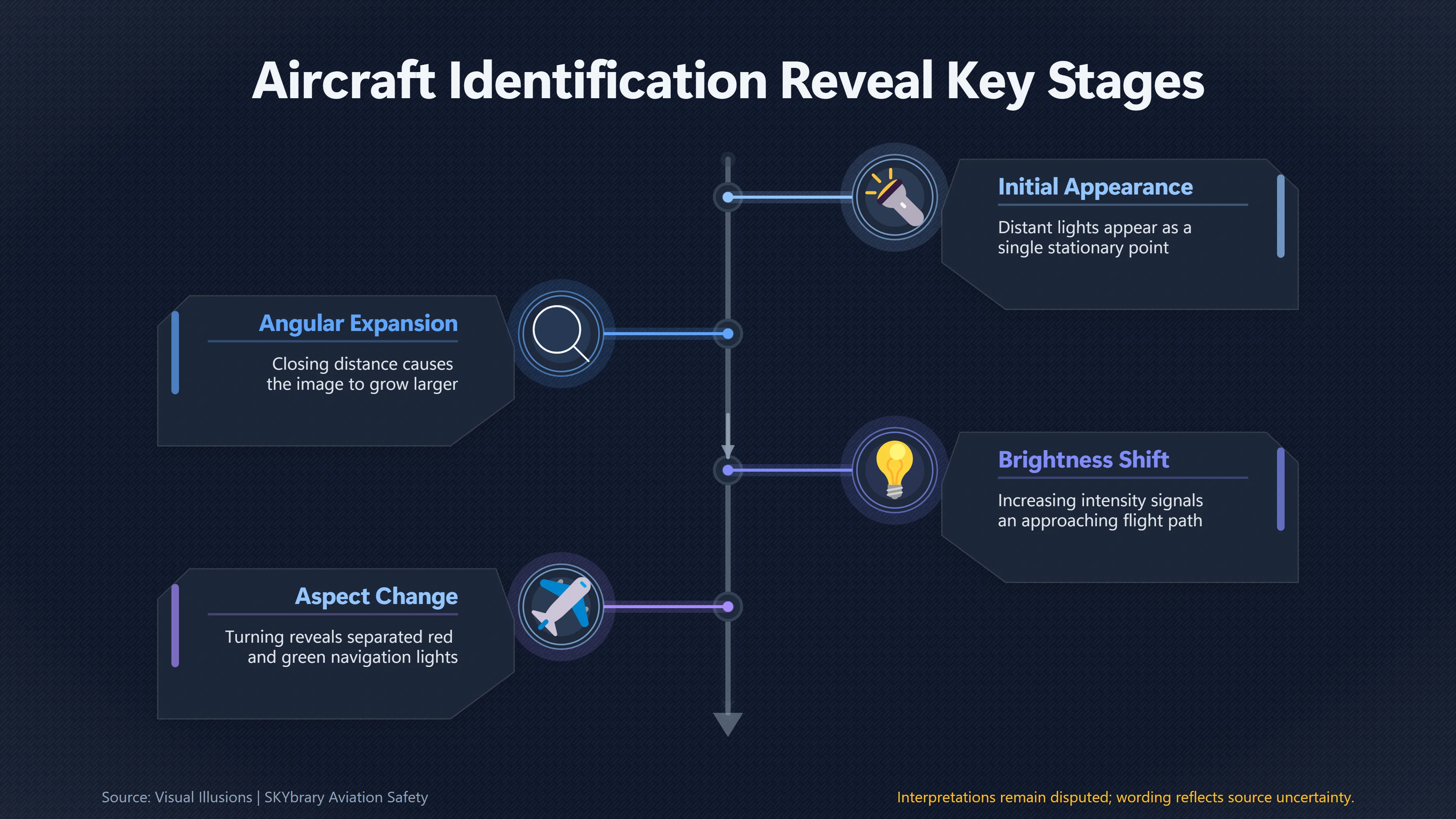
The apparent hovering usually becomes easier to interpret when the geometry changes enough to expose additional information. One particularly useful clue is angular expansion, or looming. A directly approaching object may initially show little lateral movement, but as it closes, its apparent size eventually increases. Vision research identifies this expanding image at approximately constant bearing as a fundamental cue to an approaching object.[nih.gov]pmc.ncbi.nlm.nih.govPubMed Central (PMC)Temporal Characteristics in Detecting Imminent Collision Events on Linear Trajectories - PMCMay 1, 2011…
For a distant night aircraft, however, the fuselage may remain below the observer’s visual-resolution threshold for much of the encounter. The first noticeable change may instead be increased brightness. Aviation guidance on reversible perspective specifically recommends watching whether another aircraft’s lights become brighter or dimmer: increasing intensity can indicate approach, while decreasing intensity can indicate recession.[Chief of Naval Air Training]cnatra.navy.milChief of Naval Air TrainingNAVAL AIR TRAINING COMMANDAugust 21, 2024…
A second reveal occurs when the aircraft turns. A nearly head-on aircraft may initially be dominated by bright forward lighting. As its aspect changes, separated navigation and anti-collision lights can become easier to distinguish. The appearance can therefore change from a single “orb” to a red, green and white arrangement without anything appearing or transforming in the sky; the observer is simply gaining a different view of an already-present aircraft lighting system.[Skybrary]skybrary.aeroExternal Lights | SKYbrary Aviation SafetyExternal Lights | SKYbrary Aviation Safety
The FAA’s lighting requirements provide useful checks but should not be treated as an infallible visual template. Anti-collision lights can differ in colour and configuration, supplementary strobes can be affected by operating conditions, and the visibility of any particular lamp depends on viewing direction and atmospheric conditions. Failure to see an expected red or green light at long range is therefore weak evidence against an aircraft identification.[Federal Aviation Administration]faa.govFederal Aviation Administration Chapter 4. Air Traffic ControlFederal Aviation Administration Chapter 4. Air Traffic Control
Sound can also arrive later than intuition suggests. A distant aircraft can be visually conspicuous before its engine noise becomes obvious, especially inside a moving vehicle with tyre, wind, ventilation and traffic noise. Consequently, “silent while it seemed to hover” is not by itself enough to exclude an aeroplane unless the object’s distance has been independently established.
A real identification requires more than “it hovered”
The most useful assessment separates what the witness actually observed from what was inferred. “A bright white light remained about 20 degrees to the left of the road for several minutes” is an observation. “It hovered beside the car” already assumes something about its distance and physical motion that the visual scene may not have established.
Several clues make a conventional aircraft explanation stronger when they occur together:
- the light lies along or near an airport arrival or departure direction;
- it remains at nearly constant bearing while slowly brightening;
- its apparent motion becomes obvious after either the aircraft or the road changes direction;
- separate red, green, white or flashing lights become visible as its viewing angle changes;
- an identifiable aircraft body eventually resolves around the lights;
- its movement settles into the smooth climb, descent or turn expected of ordinary air traffic.
None is conclusive alone. The important point is that they test the aircraft hypothesis against changes over time, rather than treating an initial impression of hovering as a measured fact. AARO explicitly lists commercial and military aircraft among common UAP causes, particularly when conventional aircraft are observed from unusual angles, in low visibility or through optical systems that make their normal characteristics harder to recognise.[AARO]aaro.milAARO Home…
Historical UFO investigation also provides a useful caution. When Britain’s formerly classified UFO files were released, contemporary reporting quoted former Ministry of Defence investigator Nick Pope identifying aircraft lights among the common sources of mistaken reports. One released example involved witnesses reporting red and green lights travelling towards Gatwick Airport — characteristics that strongly pointed to an ordinary commercial aircraft.[CBS News]cbsnews.comCBS News Secret UFO Files Made Public In BritainCBS News Secret UFO Files Made Public In Britain
The same principle appears in older investigative material: aircraft landing lights have repeatedly been considered when witnesses describe luminous objects or apparent beams, because a strongly illuminated aircraft viewed from the wrong aspect can look very different from the familiar side-on silhouette people expect.[UFO Transparency]ufotransparency.comOpen source on ufotransparency.com.
When the aircraft explanation becomes weaker
“Aircraft can look stationary” should not become a catch-all dismissal. A good identification has to explain the whole observation, not merely one convenient feature. If reliable evidence establishes large angular manoeuvres incompatible with the candidate aircraft’s track, a genuinely fixed position over known landmarks for a prolonged period, or a range and altitude that make ordinary flight impossible, the simple distant-aircraft explanation loses force.
Equally, apparent acceleration must be treated cautiously when it occurs at the same moment that the observer’s car turns, changes speed or passes foreground objects. Movement recorded against distant stars or a stable horizon is more informative than movement judged solely against a windscreen, roadside trees or rapidly shifting foreground scenery. The scientific reason is straightforward: observers in motion are less accurate at distinguishing collision and non-collision trajectories, while bearing-change information is central to that judgement.[PubMed Central (PMC)]pmc.ncbi.nlm.nih.govPubMed Central (PMC)Temporal Characteristics in Detecting Imminent Collision Events on Linear Trajectories - PMCMay 1, 2011…
A video can help, but only if it preserves useful context. A zoomed recording of an isolated point against black sky may contain less spatial information than the witness had with the naked eye. A wider sequence showing the horizon, road direction, foreground landmarks and the light continuously can make changes in bearing much easier to test. Exact time and location can then be compared with plausible aircraft traffic and airport approach routes.
What “hovering beside the car” really establishes
A night-time report of a light pacing a vehicle is therefore best treated as a geometry problem before a propulsion problem. The observation may be completely sincere and visually striking while still arising from ordinary flight. A distant aircraft can travel at normal speed yet remain at almost the same bearing; darkness can remove its recognisable body and depth cues; bright lighting can dominate what little remains visible; and movement of the car can make the resulting point of light seem tied to the road.
The decisive evidence usually appears when that geometry changes. Brightness increases or decreases, the light finally shifts against a stable background, separated aircraft lights become visible, the aircraft turns and exposes its shape, or its track becomes recognisable as an approach or departure. Those changes are more diagnostic than the initial impression that the light “hovered”. In the wider study of UFO and UAP reports, that distinction is crucial: apparent station-keeping is not the same thing as demonstrated station-keeping, and distant aircraft provide a well-understood way for the two to be confused.[navy.mil]cnatra.navy.milChief of Naval Air TrainingNAVAL AIR TRAINING COMMANDAugust 21, 2024…
Amazon book picks
Further Reading
Books and field guides related to Why Distant Aircraft Lights Can Seem to Pace a Car. Use these as the next step if you want deeper reading beyond the article.
Human Factors in Aviation
Since the 1950s, a number of specialized books dealing with human factors has been published, but very little in aviation. Human Factors...
Sensation and Perception
. Bruce Goldstein's SENSATION AND PERCEPTION, the best-seller which has helped over 150,000 students understand the ties between how we s...
The UFO Handbook: A Guide to Investigating, Evaluating, and R...
An explanation of the usual reasons for confusing IFOs (identified flying objects) with UFOs and a survey of the tools used to investigat...
eBay marketplace picks
Marketplace Samples
Live-tested eBay searches with available results related to this page.
Selected fromUFO patch oneBay.co.uk.

Endnotes
1.
Source: faa.gov
Link:https://www.faa.gov/data_research/research/med_humanfacs/oamtechreports/1970s/1978/197815
Source snippet
Federal Aviation AdministrationOffice of Aerospace Medicine Technical Reports | Federal Aviation AdministrationMarch 1, 1978...
Published: March 1, 1978
2.
Source: faa.gov
Link:https://www.faa.gov/data_research/research/med_humanfacs/oamtechreports/1970s/1977/197712
3.
Source: aaro.mil
Link:https://www.aaro.mil/
Source snippet
AARO Home...
4.
Source: arxiv.org
Link:https://arxiv.org/abs/2112.02735
Source snippet
A Dataset of Stationary, Fixed-wing Aircraft on a Collision Course for Vision-Based Sense and AvoidDecember 6, 2021...
Published: December 6, 2021
5.
Source: arxiv.org
Link:https://arxiv.org/abs/1903.03275
6.
Source: faa.gov
Link:https://www.faa.gov/regulations_policies/handbooks_manuals/aviation/airplane_handbook
Source snippet
Federal Aviation AdministrationAirplane Flying Handbook | Federal Aviation AdministrationMarch 29, 2022...
Published: March 29, 2022
7.
Source: skybrary.aero
Title: Visual Illusions | SKYbrary Aviation Safety
Link:https://skybrary.aero/index.php/articles/visual-illusions
8.
Source: faa.gov
Title: Federal Aviation Administration ENR 1.1: General Rules
Link:https://www.faa.gov/air_traffic/publications/atpubs/aip_html/part2_enr_section_1.1.html
9.
Source: faa.gov
Title: Federal Aviation Administration Chapter 4. Air Traffic Control
Link:https://www.faa.gov/Air_traffic/publications/atpubs/aim_html/chap4_section_3.html
10.
Source: skybrary.aero
Title: External Lights | SKYbrary Aviation Safety
Link:https://skybrary.aero/index.php/articles/external-lights
11.
Source: faa.gov
Link:https://www.faa.gov/Air_traffic/publications/atpubs/aim_html/chap2_section_1.html
12.
Source: faa.gov
Link:https://www.faa.gov/air_traffic/publications/atpubs/pcg_html/glossary-a.html
13.
Source: faa.gov
Title: Air Traffic Plans and Publications
Link:https://www.faa.gov/air_traffic/publications/
14.
Source: faa.gov
Title: Aviation Handbooks & Manuals | Federal Aviation Administration
Link:https://www.faa.gov/regulations_policies/handbooks_manuals/aviation
15.
Source: faa.gov
Title: Airfield Drivers Best Practices for Safety | Federal Aviation Administration
Link:https://www.faa.gov/airports/runway_safety/airfield_drivers/best_practices
16.
Source: faa.gov
Title: Pilots | Federal Aviation Administration
Link:https://www.faa.gov/pilots
17.
Source: faa.gov
Title: Aircraft Handbooks & Manuals | Federal Aviation Administration
Link:https://www.faa.gov/regulations_policies/handbooks_manuals/aircraft
18.
Source: aaro.mil
Link:https://www.aaro.mil/Next-AARO-Home-redesign/Next-Parent/Next-AARO-UAP-Imagery-Acc-Table/
19.
Source: aaro.mil
Link:https://www.aaro.mil/Next-AARO-Home-redesign/Next-Parent/Next-UAP-Report-Documents/
20.
Source: aaro.mil
Link:https://www.aaro.mil/Next-AARO-Home-redesign/Next-Parent/Next-UAP-Report-Documents/poster/
21.
Source: faa.gov
Title: faa h 8083 28b aviation weather handbook
Link:https://www.faa.gov/regulationspolicies/handbooksmanuals/aviation/faa-h-8083-28b-aviation-weather-handbook
22.
Source: aaro.mil
Link:https://www.aaro.mil/Next-AARO-Home-redesign/Next-Parent/Presidential-UAP-Transparency-Initiative/
23.
Source: faa.gov
Link:https://www.faa.gov/about/office_org/headquarters_offices/ato/service_units/techops/navservices/lsg/papi
24.
Source: faa.gov
Title: Examiner & Inspector Handbooks & Manuals | Federal Aviation Administration
Link:https://www.faa.gov/regulations_policies/handbooks_manuals/examiners_inspectors
25.
Source: faa.gov
Title: Runway Status Lights | Federal Aviation Administration
Link:https://www.faa.gov/air_traffic/technology/rwsl
26.
Source: faa.gov
Title: glider handbook
Link:https://www.faa.gov/regulations_policies/handbooks_manuals/aviation/glider_handbook
27.
Source: faa.gov
Title: Balloon Flying Handbook
Link:https://www.faa.gov/regulations_policies/handbooks_manuals/aviation/Balloon_Flying_Handbook
28.
Source: faa.gov
Title: FA I FSS
Link:https://www.faa.gov/about/office_org/headquarters_offices/ato/service_units/systemops/fs/alaskan/alaska/fai/pubs
29.
Source: aaro.mil
Link:https://www.aaro.mil/Next-AARO-Home-redesign/Next-Parent/Presidential-UAP-Transparency-Initiative/videoid/1006078/dvpcc/false/
30.
Source: faa.gov
Title: Runway Status Lights System Description
Link:https://www.faa.gov/air_traffic/technology/rwsl/description/index.cfm
31.
Source: faa.gov
Title: Pilot’s Handbook of Aeronautical Knowledge | Federal Aviation Administration
Link:https://www.faa.gov/regulations_policies/handbooks_manuals/aviation/phak
32.
Source: faa.gov
Title: Handbooks & Manuals | Federal Aviation Administration
Link:https://www.faa.gov/regulations_policies/handbooks_manuals
33.
Source: faa.gov
Link:https://www.faa.gov/about/office_org/headquarters_offices/ato/service_units/techops/navservices/lsg/reil
34.
Source: faa.gov
Title: Helicopter Flying Handbook | Federal Aviation Administration
Link:https://www.faa.gov/regulations_policies/handbooks_manuals/aviation/helicopter_flying_handbook
35.
Source: faa.gov
Title: Instrument Procedures Handbook (IPH) | Federal Aviation Administration
Link:https://www.faa.gov/regulations_policies/handbooks_manuals/aviation/instrument_procedures_handbook
36.
Source: faa.gov
Link:https://www.faa.gov/regulations_policies/handbooks_manuals/aviation/seaplane_handbook
37.
Source: faa.gov
Title: Aviation Handbooks and Manuals | Federal Aviation Administration
Link:https://www.faa.gov/regulations_policies/handbooks_manuals/aviation/pilot_risk
38.
Source: skybrary.aero
Title: b789 london gatwick uk 2018
Link:https://skybrary.aero/index.php/accidents-and-incidents/b789-london-gatwick-uk-2018
39.
Source: faa.gov
Title: pilots handbook aeronautical knowledge faa h 8083 25b
Link:https://www.faa.gov/aviation/phak/pilots-handbook-aeronautical-knowledge-faa-h-8083-25b
40.
Source: faa.gov
Title: Chapter 2. Aeronautical Lighting and Other Airport Visual Aids
Link:https://www.faa.gov/air_traffic/publications/atpubs/AIM/aim0201.html
41.
Source: faa.gov
Link:https://www.faa.gov/air_traffic/publications/ATpubs/AIM/aim0403.html
42.
Source: faa.gov
Title: Aeronautical Information Manual
Link:https://www.faa.gov/air_traffic/publications/atpubs/aim/index.htm
43.
Source: faa.gov
Link:https://www.faa.gov/air_traffic/publications/atpubs/FSS/fss1001.htm
44.
Source: faa.gov
Link:https://www.faa.gov/air_traffic/publications/ATpubs/ATC/atc0304.html
45.
Source: skybrary.aero
Title: b738 kingston jamaica 2009
Link:https://skybrary.aero/index.php/accidents-and-incidents/b738-kingston-jamaica-2009
46.
Source: skybrary.aero
Title: a343 b744 london heathrow uk 2007
Link:https://skybrary.aero/index.php/accidents-and-incidents/a343-b744-london-heathrow-uk-2007
47.
Source: skybrary.aero
Title: b732 london gatwick uk 1993
Link:https://skybrary.aero/index.php/accidents-and-incidents/b732-london-gatwick-uk-1993
48.
Source: faa.gov
Title: A C 20-30B
Link:https://www.faa.gov/airports/resources/advisory_circulars/index.cfm/go/document.information/documentNumber/20-30B
49.
Source: faa.gov
Title: Chapter 3. Airport Traffic Control
Link:https://www.faa.gov/air_traffic/publications/atpubs/atc_html/chap3_section_4.html
50.
Source: faa.gov
Link:https://www.faa.gov/air_traffic/publications/atpubs/fs_html/chap9_section_1.html
51.
Source: faa.gov
Link:https://www.faa.gov/air_traffic/publications/atpubs/aip_html/chap2_section_1.html
52.
Source: faa.gov
Link:https://www.faa.gov/air_traffic/publications/atpubs/aip_html/chap2_section_2.html
53.
Source: faa.gov
Link:https://www.faa.gov/air_traffic/publications/atpubs/aim_html/chap_2.html
54.
Source: faa.gov
Link:https://www.faa.gov/air_traffic/publications/atpubs/aip_html/part2_enr_section_1.12.html
55.
Source: faa.gov
Link:https://www.faa.gov/data_research/research/med_humanfacs/oamtechreports/1980s/1982/198206
56.
Source: faa.gov
Link:https://www.faa.gov/air_traffic/publications/atpubs/pcg_html/chap1_section_2.html
57.
Source: faa.gov
Title: glossary v
Link:https://www.faa.gov/air_traffic/publications/atpubs/pcg_html/glossary-v.html
58.
Source: faa.gov
Link:https://www.faa.gov/air_traffic/publications/atpubs/aip_html/part3_ad_1.1.html
59.
Source: faa.gov
Link:https://www.faa.gov/data_research/research/med_humanfacs/oamtechreports/1970s/1971/7132
60.
Source: skybrary.aero
Link:https://skybrary.aero/index.php/articles/night-visual-approaches
61.
Source: skybrary.aero
Link:https://skybrary.aero/index.php/articles/runway-visual-perspective
62.
Source: skybrary.aero
Title: Vision (OGHFA BN) | SKYbrary Aviation Safety VISION (OGHFA BN) 1
Link:https://skybrary.aero/index.php/articles/vision-oghfa-bn
63.
Source: skybrary.aero
Link:https://skybrary.aero/articles/transition-visual-flight-night-oghfa-se
64.
Source: skybrary.aero
Link:https://skybrary.aero/index.php/articles/visibility
65.
Source: skybrary.aero
Link:https://skybrary.aero/index.php/articles/general-aviation-night-flying-guidance
66.
Source: skybrary.aero
Link:https://skybrary.aero/index.php/articles/autokinetic-effect
67.
Source: skybrary.aero
Link:https://skybrary.aero/index.php/articles/somatogravic-and-somatogyral-illusions
68.
Source: skybrary.aero
Link:https://skybrary.aero/index.php/articles/lessening-effects-visual-illusions
69.
Source: skybrary.aero
Link:https://skybrary.aero/bookshelf/understanding-visual-illusions-and-disorientation
70.
Source: skybrary.aero
Link:https://skybrary.aero/index.php/articles/aerodrome-lighting
71.
Source: skybrary.aero
Link:https://skybrary.aero/index.php/articles/caution-and-warning-panel-cwp
72.
Source: skybrary.aero
Link:https://skybrary.aero/index.php/articles/light-and-pyrotechnic-signals
73.
Source: skybrary.aero
Link:https://skybrary.aero/index.php/articles/taxiway-lighting
74.
Source: skybrary.aero
Link:https://skybrary.aero/index.php/articles/visual-glidelope-indicators
75.
Source: skybrary.aero
Link:https://skybrary.aero/index.php/articles/runway-holding-point-lighting
76.
Source: skybrary.aero
Link:https://skybrary.aero/index.php/articles/pulse-light-approach-slope-indicator-plasi
77.
Source: skybrary.aero
Title: glf3 biggin hill uk 2014
Link:https://skybrary.aero/accidents-and-incidents/glf3-biggin-hill-uk-2014
78.
Source: aaro.mil
Link:https://www.aaro.mil/FAQ/
79.
Source: aaro.mil
Title: AAR O UAP Trends All-domain Anomaly Resolution Office UAP REPORTING TRENDS
Link:https://www.aaro.mil/UAP-Cases/UAP-Reporting-Trends/
80.
Source: aaro.mil
Link:https://www.aaro.mil/Next-AARO-Home-redesign/Next-Parent/Next-AARO-UAP-Trends/
81.
Source: aaro.mil
Link:https://www.aaro.mil/Next-AARO-Home-redesign/Next-Parent/Next-AARO-UAP-Imagery-Fixed-Table/
82.
Source: aaro.mil
Link:https://www.aaro.mil/UAP-Cases/Official-UAP-Imagery/4/
83.
Source: aaro.mil
Link:https://www.aaro.mil/Next-AARO-Home-redesign/Inactive-Parent/Next-UAP-Imagery-dup/
84.
Source: youtube.com
Title: Illusions In Flight Spaitial Disorientation Mzero A com
Link:https://www.youtube.com/watch?v=fIZpxEOsTg0
Source snippet
Motion Parallax - sensation and perception...
85.
Source: youtube.com
Title: Motion Parallax
Link:https://www.youtube.com/watch?v=RxO3HMCjfQs
Source snippet
Spatial Disorientation Explained: Deadly Flight Illusions Every Pilot Must Know...
86.
Source: pmc.ncbi.nlm.nih.gov
Link:https://pmc.ncbi.nlm.nih.gov/articles/PMC5393792/
Source snippet
PubMed Central (PMC)Temporal Characteristics in Detecting Imminent Collision Events on Linear Trajectories - PMCMay 1, 2011...
Published: May 1, 2011
87.
Source: cnatra.navy.mil
Link:https://www.cnatra.navy.mil/local/docs/pat-pubs/P-478.pdf
Source snippet
Chief of Naval Air TrainingNAVAL AIR TRAINING COMMANDAugust 21, 2024...
Published: August 21, 2024
88.
Source: pubmed.ncbi.nlm.nih.gov
Title: Pub Med Threat modulates perception of looming visual stimuli
Link:https://pubmed.ncbi.nlm.nih.gov/23058796/
89.
Source: pmc.ncbi.nlm.nih.gov
Link:https://pmc.ncbi.nlm.nih.gov/articles/PMC8849349/
90.
Source: cbsnews.com
Title: CBS News Secret UFO Files Made Public In Britain
Link:https://www.cbsnews.com/news/secret-ufo-files-made-public-in-britain/
91.
Source: ufotransparency.com
Link:https://ufotransparency.com/files/intl-uk-project-condign-volume-1-uap-vol1-pgs35to55-ch3a
92.
Source: casa.gov.au
Title: Approval to release an uncrewed free balloon | Civil Aviation Safety Authority
Link:https://www.casa.gov.au/aircraft/sport-aviation/approval-release-uncrewed-free-balloon
93.
Source: consultation.casa.gov.au
Title: casa.gov.au Relocation of The Oaks visual approach point
Link:https://consultation.casa.gov.au/stakeholder-engagement-group/relocation-oaks-vap/
94.
Source: pmc.ncbi.nlm.nih.gov
Link:https://pmc.ncbi.nlm.nih.gov/articles/PMC13205071/
95.
Source: consultation.casa.gov.au
Title: casa.gov.au Proposed RPAS operations over or near people
Link:https://consultation.casa.gov.au/regulatory-program/pp-2609us/
96.
Source: atsb.gov.au
Link:https://www.atsb.gov.au/taxonomy/term/294
97.
Source: casa.gov.au
Title: Sector threats, issues and hazards | Civil Aviation Safety Authority
Link:https://www.casa.gov.au/operations-safety-and-travel/safety-management-systems/sector-safety-risk-profiles/business-aviation-sector-safety-risk-profile/sector-threats-issues-and-hazards
98.
Source: pmc.ncbi.nlm.nih.gov
Link:https://pmc.ncbi.nlm.nih.gov/articles/PMC11852856/
99.
Source: atsb.gov.au
Title: ra2024 00142
Link:https://www.atsb.gov.au/repcon/2025/ra2024-00142
100.
Source: GOV.UK
Title: www.gov.uk Airspace modernisation
Link:https://www.gov.uk/government/publications/airspace-modernisation/airspace-modernisation
101.
Source: GOV.UK
Title: www.gov.uk Night flight dispensations
Link:https://www.gov.uk/government/publications/night-flight-dispensations/night-flight-dispensations
102.
Source: pmc.ncbi.nlm.nih.gov
Link:https://pmc.ncbi.nlm.nih.gov/articles/PMC10491236/
103.
Source: environment.data.gov.uk
Title: data.gov.uk Navigation Light | Data Requirements Library
Link:https://environment.data.gov.uk/data-requirements-library/revision/current/categories/AidsToNavigation/asset-types/Signal/elements/Signal-navigation-light
104.
Source: casa.gov.au
Title: Forms | Civil Aviation Safety Authority
Link:https://www.casa.gov.au/resources-and-education/publications/forms
105.
Source: GOV.UK
Title: www.gov.uk Sidelights on rescue boats: UK21/L005
Link:https://www.gov.uk/marine-equipment-approved-recommendations/sidelights-on-rescue-boats-uk21-slash-l005
106.
Source: atsb.gov.au
Link:https://www.atsb.gov.au/safety-issues/AO-2021-018-SI-01
107.
Source: environment.data.gov.uk
Title: data.gov.uk Navigation Light
Link:https://environment.data.gov.uk/asset-management/drl-app/revision/current/categories/AidsToNavigation/asset-types/Signal/elements/Signal-navigation-light
108.
Source: pmc.ncbi.nlm.nih.gov
Link:https://pmc.ncbi.nlm.nih.gov/articles/PMC10073940/
109.
Source: pubmed.ncbi.nlm.nih.gov
Link:https://pubmed.ncbi.nlm.nih.gov/37035005/
110.
Source: casa.gov.au
Title: Episode 28: Electronic flight bags | Civil Aviation Safety Authority
Link:https://www.casa.gov.au/resources-and-education/education-and-training/out-n-back/episode-28-electronic-flight-bags
111.
Source: GOV.UK
Title: www.gov.uk AAI B investigation to Reims Cessna F172M, G-MOFO
Link:https://www.gov.uk/aaib-reports/aaib-investigation-to-reims-cessna-f172m-g-mofo
112.
Source: casa.gov.au
Title: Flight planning | Civil Aviation Safety Authority
Link:https://www.casa.gov.au/resources-and-education/pilot-safety-hub/flight-planning
113.
Source: casa.gov.au
Link:https://www.casa.gov.au//operations-safety-and-travel/safety-advice/hazard-identification-and-management-aviation
114.
Source: consultation.casa.gov.au
Title: casa.gov.au Commissioning of aerodrome lighting systems – Draft AC 139.C-11 v1.0
Link:https://consultation.casa.gov.au/regulatory-program/ac-139-c-11-v1-0/
115.
Source: casa.gov.au
Title: Operational ratings and endorsements | Civil Aviation Safety Authority
Link:https://www.casa.gov.au/licences-and-certificates/pilots/ratings-reviews-and-endorsements/ratings-and-endorsements/operational-ratings-and-endorsements
116.
Source: atsb.gov.au
Link:https://www.atsb.gov.au/investigations/ao
117.
Source: GOV.UK
Title: regulatory article ra 3515 permanent fixed wing aerodrome lighting
Link:https://www.gov.uk/government/publications/regulatory-article-ra-3515-permanent-fixed-wing-aerodrome-lighting
118.
Source: pmc.ncbi.nlm.nih.gov
Link:https://pmc.ncbi.nlm.nih.gov/articles/PMC6126965/
119.
Source: atsb.gov.au
Link:https://www.atsb.gov.au/investigations/ao
120.
Source: consultation.casa.gov.au
Title: casa.gov.au Consultation draft
Link:https://consultation.casa.gov.au/regulatory-program/cd1619fs/consult_view/
121.
Source: pmc.ncbi.nlm.nih.gov
Link:https://pmc.ncbi.nlm.nih.gov/articles/PMC5364399/
122.
Source: atsb.gov.au
Link:https://www.atsb.gov.au/investigations/ao
123.
Source: pubmed.ncbi.nlm.nih.gov
Link:https://pubmed.ncbi.nlm.nih.gov/27994567/
124.
Source: pmc.ncbi.nlm.nih.gov
Link:https://pmc.ncbi.nlm.nih.gov/articles/4746292/
125.
Source: GOV.UK
Title: www.gov.uk The Highway Code
Link:https://www.gov.uk/guidance/the-highway-code/light-signals-controlling-traffic
126.
Source: pmc.ncbi.nlm.nih.gov
Link:https://pmc.ncbi.nlm.nih.gov/articles/PMC4582123/
127.
Source: atsb.gov.au
Title: which way is up
Link:https://www.atsb.gov.au/media/news-items/2015/which-way-is-up
128.
Source: atsb.gov.au
Title: wrong height wrong place
Link:https://www.atsb.gov.au/media/news-items/2015/wrong-height-wrong-place
129.
Source: GOV.UK
Title: bn2t islander g bswr 13 july 2011
Link:https://www.gov.uk/aaib-reports/bn2t-islander-g-bswr-13-july-2011
Published: july 2011
130.
Source: GOV.UK
Title: www.gov.uk Use of pilot controlled lighting at licensed aerodromes
Link:https://www.gov.uk/government/consultations/use-of-pilot-controlled-lighting-at-licensed-aerodromes
131.
Source: GOV.UK
Title: www.gov.uk MC A survey of lights and signalling equipment (MSIS 10)
Link:https://www.gov.uk/government/publications/mca-survey-of-lights-and-signalling-equipment-msis-10
132.
Source: atsb.gov.au
Title: Avoidable Accidents No. 7
Link:https://www.atsb.gov.au/publications/avoidable-accidents/2013/aviation/avoidable-accidents-no-7-visual-flight-night
133.
Source: pmc.ncbi.nlm.nih.gov
Link:https://pmc.ncbi.nlm.nih.gov/articles/PMC3710190/
134.
Source: GOV.UK
Link:https://www.gov.uk/government/news/leave-the-landing-light-on–2
135.
Source: pmc.ncbi.nlm.nih.gov
Link:https://pmc.ncbi.nlm.nih.gov/articles/PMC3081747/
136.
Source: pmc.ncbi.nlm.nih.gov
Link:https://pmc.ncbi.nlm.nih.gov/articles/PMC2680596/
137.
Source: pmc.ncbi.nlm.nih.gov
Link:https://pmc.ncbi.nlm.nih.gov/articles/PMC2650431/
138.
Source: atsb.gov.au
Link:https://www.atsb.gov.au/investigations/200003862
139.
Source: pubmed.ncbi.nlm.nih.gov
Link:https://pubmed.ncbi.nlm.nih.gov/697665/
140.
Source: trid.trb.org
Link:https://trid.trb.org/View/69988
141.
Source: ufotransparency.com
Title: intl au a703 580 1 1 part20 a703 580 1 1 part 20
Link:https://ufotransparency.com/files/intl-au-a703-580-1-1-part20-a703-580-1-1-part-20
142.
Source: atsb.gov.au
Link:https://www.atsb.gov.au/news/2022/nothing-see-night
143.
Source: atsb.gov.au
Link:https://www.atsb.gov.au/safetywatch/flying-with-reduced-visual-cues
144.
Source: atsb.gov.au
Link:https://www.atsb.gov.au/flying-reduced-visual-cues
145.
Source: atsb.gov.au
Title: Ambiguous runway lighting | ATSB* Rail statistics * Reporting * Mandatory
Link:https://www.atsb.gov.au/media/news-items/2021/ambiguous-runway-lighting
146.
Source: atsb.gov.au
Link:https://www.atsb.gov.au/taxonomy/term/360
147.
Source: sciencedirect.com
Title: Motion Parallax
Link:https://www.sciencedirect.com/topics/computer-science/motion-parallax
148.
Source: consultation.casa.gov.au
Title: casa.gov.au We Asked, You Said, We Did
Link:https://consultation.casa.gov.au/we_asked_you_said/
149.
Source: pubmed.ncbi.nlm.nih.gov
Link:https://pubmed.ncbi.nlm.nih.gov/14498362/
Additional References
150.
Source: youtube.com
Title: Spatial Disorientation Explained: Deadly Flight Illusions Every Pilot Must Know
Link:https://www.youtube.com/watch?v=6BD9fyyIJzY
Source snippet
Why airplane appears to hover illusion 3 Ways your BRAIN Tricks You into Thinking AIRPLANES HOVER...
151.
Source: rosap.ntl.bts.gov
Link:https://rosap.ntl.bts.gov/view/dot/21125
152.
Source: rosap.ntl.bts.gov
Link:https://rosap.ntl.bts.gov/view/dot/21105
153.
Source: archives.gov
Link:https://www.archives.gov/news/articles/[project-blue-book
154.
Source: archives.gov
Link:https://www.archives.gov/research/topics/uaps/faqs
155.
Source: ecfr.gov
Link:https://www.ecfr.gov/current/title-14/chapter-I/subchapter-G/part-121/subpart-R/section-121.493
156.
Source: ecfr.gov
Link:https://www.ecfr.gov/current/title-14/chapter-I/subchapter-D/part-61/subpart-G/section-61.167
157.
Source: ecfr.gov
Link:https://www.ecfr.gov/current/title-14/chapter-II/subchapter-A/part-296/subpart-B?toc=1
158.
Source: text-message.blogs.archives.gov
Link:https://text-message.blogs.archives.gov/2017/07/05/see-something-say-something-ufo-reporting-requirements-office-of-military-government-for-bavaria-germany-may-1948/
Published: may 1948
159.
Source: ecfr.gov
Link:https://www.ecfr.gov/current/title-14/chapter-II/subchapter-A/part-234?toc=1