Within Birds
Can Video Compression Make Wings Disappear?
Lossy video encoding can remove the few edge pixels that distinguish wings or a tail when a target is already tiny.
On this page
- Why tiny targets are unusually vulnerable to lost detail
- How frame to frame encoding can smooth changing outlines
- Where compression explanations become too speculative
Page outline Jump by section
Introduction
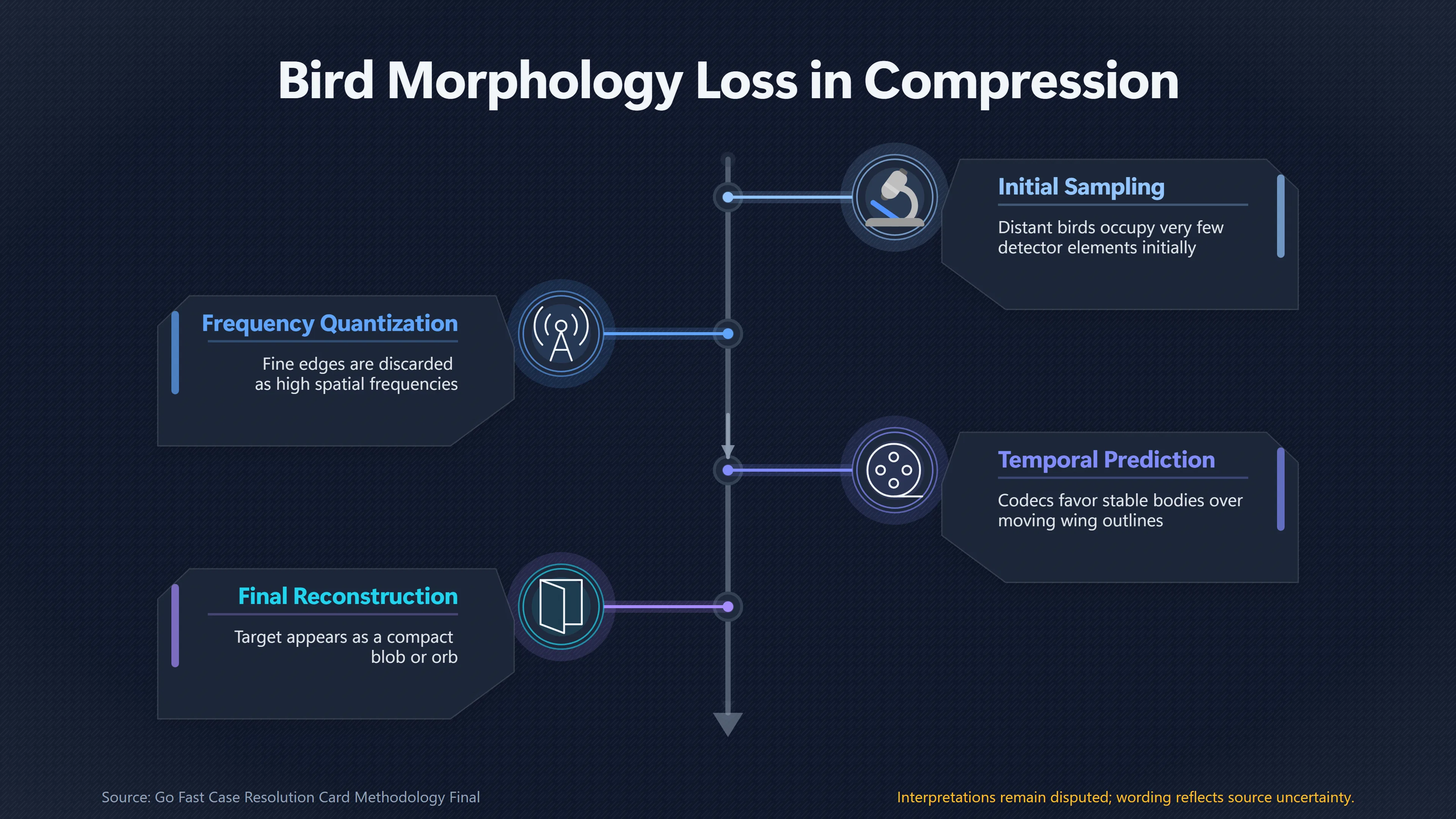
Yes. Lossy video compression can plausibly make the wings or tail of a distant bird disappear from infrared footage when those features are already represented by only a few weak edge pixels. Compression does not need to erase the bird itself: it need only preserve the strong central infrared contrast while discarding, averaging or mispredicting the much weaker variations around its outline. The reconstructed target can therefore become a compact blob or apparent “orb”.
That mechanism is technically well established, but it has an important limit. Compression cannot be invoked simply because an object looks featureless. The effect depends on the target’s pixel size, contrast, motion, codec, bitrate and processing history. Public military footage can also be a compressed derivative rather than the sensor’s richest data product. AARO explicitly warns that some publicly available military video contains compression artefacts, and it has documented a UAP case in which compression generated an apparently physical feature that was not actually present.[AARO]aaro.milGo Fast Case Resolution Card Methodology FinalUNCLASSIFIEDMay 10, 2026…
Why tiny targets lose identifying detail first
The crucial distinction is between preserving a target and preserving its shape. Suppose a distant bird is represented by a bright or dark central patch perhaps several pixels across, while each wing extends the silhouette by only one or two pixels. The central patch may be strongly different from the sky and therefore survive encoding. The wing pixels are a harder proposition: they may differ only modestly from neighbouring pixels, occur intermittently as the wings move, and account for very little of the frame’s overall visual information.
Infrared small-target research shows why that situation is unusually fragile. Modern research describes infrared targets as small as roughly one to four pixels and notes that their already limited information can be severely attenuated by image-processing operations. The underlying problem precedes compression: once a distant object occupies very few detector elements, there is little redundant shape information available to protect.[DOI]doi.orgA single-frame infrared small target detection method based on joint feature guidance | Complex & Intelligent Systems | Springer Natur…
Compression then introduces another opportunity to lose it. In conventional lossy image coding, spatial detail is transformed into frequency components and quantised: values judged insufficiently important are represented less precisely or rounded away. Fine edges and rapidly changing pixel patterns live disproportionately in higher spatial frequencies. A thin wing against the sky is therefore much closer to the sort of detail vulnerable to quantisation than a large, uniform central target.[ITU]itu.intS0 P2 SullivanOverview of International Video Coding Standards (…22 Jul 2005 — International Video Coding Standards (preceding H.264/AVC) Project…
This vulnerability has been measured specifically in thermal imagery. In a 2022 CVPR Workshops study, Neelanjan Bhowmik and colleagues applied progressively stronger JPEG compression to the FLIR thermal-imaging dataset and tested several object-detection systems. They found that tiny and small objects were more sensitive to compression than medium and large objects, with performance deteriorating particularly strongly under heavy compression. The experiment involved still-image JPEG rather than the exact military video pipeline relevant to UAP footage, so it does not prove that a particular bird’s wings vanished. It does demonstrate the underlying point directly in infrared data: information belonging to very small objects is disproportionately vulnerable to lossy encoding.[Open Access CVF]openaccess.thecvf.comOpen Access CVFCVPR 2022 Open Access Repository…
For a distant bird, that produces an important asymmetry. Compression may retain enough information to say “there is a compact infrared target here” while destroying precisely the few pixels needed to say “this target has wings”.
Frame-to-frame encoding can smooth a changing outline
Video compression adds a complication that still-image examples cannot show. Codecs such as H.264/AVC and H.265/HEVC exploit similarities between successive frames rather than encoding every frame independently at full fidelity. Modern hybrid video codecs combine spatial and temporal prediction, transform coding of the remaining prediction error, quantisation and entropy coding.[ITU]itu.intS JOURNAL ICTS.V3I1 2020 9 PDF ETHE VIDEO CODEC LANDSCAPE IN 2020June 8, 2020 — Advanced Video Coding (H.264/AVC) transformation of the prediction residual, quantizat…
In simplified terms, the encoder asks whether part of the current image can be predicted from information it has already encoded. Motion compensation allows blocks of an earlier or otherwise reference frame to be shifted to predict where imagery has moved. The difference between that prediction and the actual frame — the residual — is then encoded. Quantisation reduces the precision of that residual to save bits.[ITU]itu.intS JOURNAL ICTS.V3I1 2020 9 PDF ETHE VIDEO CODEC LANDSCAPE IN 2020June 8, 2020 — Advanced Video Coding (H.264/AVC) transformation of the prediction residual, quantizat…
That matters for flapping birds because the outline is not stable. A bird’s body may follow a comparatively smooth trajectory across the image while its wings repeatedly extend, retract and change angle. At sufficiently low resolution, the body may be the easy part to predict while the wing movement survives mainly as small residual changes around its edges.
If those changes are weak enough relative to the available bitrate and encoder decisions, they can be represented poorly. The result need not resemble a dramatic compression glitch. It can simply be a target whose centre remains persistent while its fine outline fluctuates, softens or disappears.
This also explains why examining one enlarged screenshot can be misleading. Enlarging the decoded frame does not restore information discarded during encoding. It merely makes the surviving pixels larger. A smooth-looking circular patch at 800 per cent magnification is not evidence that the original sensor recorded a smooth circular object.
There is also a temporal clue worth preserving. Even when compression and limited resolution prevent a viewer from seeing literal wing shapes, wing motion may still alter the infrared signal over time. AARO’s PR-016 case from Europe is useful here: the office assessed the objects as birds with greater than 95 per cent likelihood and cited, among other evidence, a pulsating infrared return at a frequency consistent with wing beats. In other words, recognisable anatomy is not the only avian information that can survive in low-detail infrared video.[AARO]aaro.milOpen source on aaro.mil.
Military UAP footage shows compression can create false morphology
There is unusually relevant official evidence that compression can materially change how a small object appears in military infrared footage. In the South Asia “atmospheric wake” case, an MQ-9 infrared sensor recorded an object apparently accompanied by a strange trailing feature. AARO ultimately assessed the object as likely to be a commercial aircraft and the apparent wake as a video-compression artefact.[AARO]aaro.milUAP ImageryUAP Imagery
AARO’s 2023 briefing described the proposed mechanism more specifically: the video-compression process used information from a previous frame and resolved differences in the greyscale infrared gradient, producing the apparent trail. The supposed wake therefore illustrates a broader warning relevant to tiny bird-like targets: a decoded video frame is not necessarily a straightforward pixel-for-pixel record of instantaneous scene geometry. Temporal encoding can affect apparent morphology.[AARO]aaro.milBrief to SASC-Department of Defense UAP MissionAARO Brief to SASC-Department of Defense UAP Mission April 19, 2023…
That case demonstrates creation of misleading structure rather than disappearance of wings, so the two effects should not be conflated. But they arise from the same general fact: lossy video encoding reconstructs frames from a limited representation rather than preserving every measured intensity value exactly. Small, moving features close to the codec’s effective information threshold are consequently poor candidates for precise morphological interpretation.
AARO has also acknowledged a broader problem with the public material used in UAP analysis. Its detailed methodology for the “Go Fast” case states that footage from military sensor platforms may not have been collected as a rigorous full-motion-video intelligence product and can contain compression artefacts or lack metadata needed for exhaustive analysis. In that case AARO itself had to extract measurements from publicly available video.[AARO]aaro.milGo Fast Case Resolution Card Methodology FinalUNCLASSIFIEDMay 10, 2026…
This distinction matters whenever somebody tries to infer anatomy from a public UAP clip. The useful question is not merely “How good is the military sensor?” It is “What generation of imagery are we actually examining?” A high-performance infrared sensor may initially acquire more information than survives recording, conversion, clipping, export or publication.
Why a compressed bird can look more like an orb
The rounded appearance follows naturally when the information losses are asymmetric. A distant bird’s warm body can contribute a relatively large, persistent infrared signal. Wings and tail are thinner, cover fewer pixels and continually change their contribution to the image.
Once fine outline information is weakened, several things can happen at once:
- The body survives while extremities do not. The strongest central pixels remain identifiable as the target.
- Edge contrast becomes less precise. Quantisation can suppress weak variations responsible for fine contours.
- Temporal prediction favours stable information. Rapidly changing wing-edge information may be harder to represent efficiently than the broadly translating body.
- Reconstruction and filtering can soften block boundaries and local detail. What remains can look smoother than the original sampled target.
- Later re-encoding can remove still more information. A copy uploaded, edited or converted for public release need not contain every detail present in an earlier version.
The important phrase is can look. Compression is not literally converting a detailed photograph of a bird into a geometrically perfect sphere. Usually the relevant target was poorly resolved to begin with. Compression is better understood as removing some of the remaining evidence against the blob interpretation.
This is why the mechanism is most persuasive for an object already close to the resolution limit. If the source imagery clearly resolves a bird across dozens of pixels and displays high-contrast wings, ordinary compression requires much more severe degradation before those large structures disappear completely. Conversely, if the body occupies only a small patch and the wing tips contribute perhaps a pixel or two, relatively modest information loss can change the viewer’s interpretation substantially. The thermal-compression experiments showing greater sensitivity among tiny and small objects support this scale-dependent expectation.[Open Access CVF]openaccess.thecvf.comOpen Access CVFCVPR 2022 Open Access Repository…
Where the compression explanation becomes too speculative
Compression is therefore a credible mechanism, but it is not a universal explanation for featureless UAP imagery. The strongest version of the claim — “there are no visible wings because compression removed them” — requires information about what wings should have looked like before compression.
That depends on distance, focal length, detector resolution, point-spread characteristics, target orientation, infrared contrast, atmospheric conditions, stabilisation and processing. Codec information matters too: the original encoding format, bitrate, quantisation settings, frame structure and whether the publicly released clip has been transcoded. Without those data, identifying the exact pixels that compression supposedly erased can become an exercise in reverse-engineering an unknown pipeline.
AARO’s Puerto Rico analysis provides an instructive counterexample to overusing the argument. The office considered a bird interpretation but concluded that, at its reconstructed viewing distances, birds should retain identifiable features such as wings or produce pulsation associated with wing beats. AARO therefore did not treat the mere possibility of poor infrared imagery as sufficient to rescue the bird hypothesis.[AARO]aaro.milPuerto Rico UAP Case ResolutionPuerto Rico UAP Case Resolution
That is the appropriate evidential standard. Compression should become more persuasive when several conditions coincide: the target is only a few pixels across; thin appendages would sit near the resolution limit; obvious block, ringing or temporal artefacts occur elsewhere; the available file is known to be a compressed derivative; or a better-quality version reveals structure absent from the public copy. It becomes less persuasive when the target is well resolved, the proposed missing features should span many high-contrast pixels, or high-quality source data show the same featureless morphology.
There is another trap: compression can both erase genuine details and introduce false ones. Sharpening, scaling, interpolation and repeated encoding can turn block boundaries or ringing into apparent protrusions just as compression can suppress genuine protrusions. A single frame therefore cannot safely answer whether a tiny projection is a wing, an artefact or noise.
What can actually be concluded from an “orb” video
For UFO and UAP analysis, the practical lesson is narrower than “blurry objects are birds”. A featureless infrared blob provides weak evidence about the object’s intrinsic shape when its image is close to the sensor and encoding pipeline’s spatial limits.
There is good evidence for each link needed to make compression a serious consideration. Infrared research shows that very small targets contain little spatial information and are particularly vulnerable to feature loss. Experiments on thermal imagery show that small and tiny objects suffer disproportionately under lossy compression. Modern video codecs deliberately exploit spatial and temporal redundancy and quantise prediction information. AARO, meanwhile, has documented compression artefacts in actual military infrared UAP footage and warns that public military clips can themselves contain such artefacts.[doi.org]doi.orgA single-frame infrared small target detection method based on joint feature guidance | Complex & Intelligent Systems | Springer Natur…
What those findings do not establish is that every apparently spherical military target was originally a bird with wings that compression erased. That conclusion has to be demonstrated case by case.
For birds that become “orbs” on military sensors, compression is best regarded as the last-mile loss of morphology. Distance, optics and detector sampling can first reduce a bird to a tiny infrared target; lossy encoding can then remove some of the few remaining edge and temporal details that might have disclosed its anatomy. By the time the resulting clip reaches a public webpage, the strongest surviving fact may simply be that something produced an infrared contrast signal. Its neat, compact outline may say considerably less about the shape of the original object than it appears to.
Amazon book picks
Further Reading
Books and field guides related to Can Video Compression Make Wings Disappear?. Use these as the next step if you want deeper reading beyond the article.
Digital Video and HD: Algorithms and Interfaces
Rapidly evolving computer and communications technologies have achieved data transmission rates and data storage capacities high enough f...
H.264 and MPEG-4 Video Compression
Following on from the successful MPEG-2 standard, MPEG-4 Visual is enabling a new wave of multimedia applications from Internet video str...
Digital Video Compression
CD-ROM contains compression tools, encoders and video clips.
An Introduction to Digital Video
First Published in 2001. Routledge is an imprint of Taylor & Francis, an informa company.
eBay marketplace picks
Marketplace Samples
Live-tested eBay searches with available results related to this page.
Selected fromUFO poster oneBay.co.uk.



Current eBay listing
VINTAGE UFO FLYING SAUCERS COMIC ADVERTISING A2 POSTER PRINT

Current eBay listing
I Want To Believe UFO Poster Giclée Fine Art Heavyweight Print
Endnotes
1.
Source: aaro.mil
Title: Go Fast Case Resolution Card Methodology Final
Link:https://www.aaro.mil/Portals/136/PDFs/case_resolution_reports/AARO_GoFast_Case_Resolution_Card_Methodology_Final.pdf?ver=qXvjrruO_0MgtnTsfYnCEQ%3D%3D
Source snippet
UNCLASSIFIEDMay 10, 2026...
Published: May 10, 2026
2.
Source: aaro.mil
Title: Brief to SASC-Department of Defense UAP Mission
Link:https://www.aaro.mil/Portals/136/PDFs/AARO_Brief_to_SASC-DoD_UAP_Mission-April_19_2023_508.pdf?ver=xIuFUzsYfa_M146q-q1pHg%3D%3D
Source snippet
AARO Brief to SASC-Department of Defense UAP Mission April 19, 2023...
Published: April 19, 2023
3.
Source: doi.org
Link:https://doi.org/10.1007/s40747-024-01410-6
Source snippet
A single-frame infrared small target detection method based on joint feature guidance | Complex & Intelligent Systems | Springer Natur...
4.
Source: itu.int
Title: S0 P2 Sullivan
Link:https://www.itu.int/ITU-T/worksem/vica/docs/presentations/S0_P2_Sullivan.pdf
Source snippet
Overview of International Video Coding Standards (...22 Jul 2005 — International Video Coding Standards (preceding H.264/AVC) Project...
5.
Source: itu.int
Title: S JOURNAL ICTS.V3I1 2020 9 PDF E
Link:https://www.itu.int/dms_pub/itu-s/opb/journal/S-JOURNAL-ICTS.V3I1-2020-9-PDF-E.pdf
Source snippet
THE VIDEO CODEC LANDSCAPE IN 2020June 8, 2020 — Advanced Video Coding (H.264/AVC) transformation of the prediction residual, quantizat...
Published: June 8, 2020
6.
Source: aaro.mil
Link:https://www.aaro.mil/Next-AARO-Home-redesign/Next-Parent/Presidential-UAP-Transparency-Initiative/videoid/988673/dvpcc/false/
7.
Source: aaro.mil
Title: UAP Imagery
Link:https://www.aaro.mil/UAP-Cases/Official-UAP-Imagery/4/
8.
Source: aaro.mil
Link:https://www.aaro.mil/Next-AARO-Home-redesign/Next-Parent/Next-AARO-UAP-Imagery-Acc-Table/
9.
Source: aaro.mil
Title: Puerto Rico UAP Case Resolution
Link:https://www.aaro.mil/Portals/136/PDFs/case_resolution_reports/AARO_Puerto_Rico_UAP_Case_Resolution.pdf
10.
Source: doi.org
Link:https://doi.org/10.1038/s41598-026-53189-w
11.
Source: doi.org
Link:https://doi.org/10.1109/tgrs.2026.3675680
12.
Source: aaro.mil
Link:https://www.aaro.mil/Next-AARO-Home-redesign/Next-Parent/Presidential-UAP-Transparency-Initiative/videoid/1014101/dvpcc/false/
13.
Source: aaro.mil
Link:https://www.aaro.mil/Next-AARO-Home-redesign/Next-Parent/Presidential-UAP-Transparency-Initiative/videoid/1007720/dvpcc/false/
14.
Source: aaro.mil
Link:https://www.aaro.mil/Next-AARO-Home-redesign/Next-Parent/Presidential-UAP-Transparency-Initiative/videoid/1014096/dvpcc/false/
15.
Source: aaro.mil
Link:https://www.aaro.mil/Next-AARO-Home-redesign/Next-Parent/Presidential-UAP-Transparency-Initiative/videoid/1007740/dvpcc/false/
16.
Source: aaro.mil
Link:https://www.aaro.mil/Next-AARO-Home-redesign/Next-Parent/Presidential-UAP-Transparency-Initiative/videoid/1007707/dvpcc/false/
17.
Source: doi.org
Title: Improving H.264 performances by quantization of motion vectors
Link:https://doi.org/10.1109/PCS.2009.5167401
18.
Source: itu.int
Title: CONTENT S
Link:https://www.itu.int/dms_pubrec/itu-t/rec/h/T-REC-H.264-200503-S%21%21TOC-HTM-E.htm
19.
Source: aaro.mil
Link:https://www.aaro.mil/UAP-Cases/Official-UAP-Imagery/ftag/MSF0951a18/
20.
Source: aaro.mil
Link:https://www.aaro.mil/UAP-Cases/Official-UAP-Imagery/
21.
Source: aaro.mil
Link:https://www.aaro.mil/Next-AARO-Home-redesign/Next-Parent/Next-AARO-UAP-Imagery-Fixed-Table/
22.
Source: aaro.mil
Title: UAP Imagery UAP Video
Link:https://www.aaro.mil/Next-AARO-Home-redesign/Inactive-Parent/Next-UAP-Imagery-dup/
23.
Source: aaro.mil
Link:https://www.aaro.mil/FAQ/
24.
Source: itu.int
Title: Table of Contents
Link:https://www.itu.int/dms_pubrec/itu-t/rec/h/T-REC-H.264-202108-S%21%21TOC-HTM-E.htm
25.
Source: itu.int
Title: TABL E DES MATIÈRES
Link:https://www.itu.int/dms_pubrec/itu-t/rec/h/T-REC-H.264-201304-S%21%21TOC-HTM-E.htm
26.
Source: itu.int
Title: CONTENT S
Link:https://www.itu.int/dms_pubrec/itu-t/rec/h/T-REC-H.264-201906-S%21%21TOC-HTM-E.htm
27.
Source: itu.int
Title: JCTVC A127 r2
Link:https://www.itu.int/wftp3/av-arch/jctvc-site/2010_04_A_Dresden/JCTVC-A127_r2.pdf
28.
Source: itu.int
Link:https://www.itu.int/dms_pub/itu-s/opb/journal/S-JOURNAL-ICTF.VOL3-2020-1-P12-PDF-E.pdf
29.
Source: itu.int
Title: JCTVC A112.doc
Link:https://www.itu.int/wftp3/av-arch/jctvc-site/2010_04_A_Dresden/JCTVC-A112.doc
30.
Source: itu.int
Title: dologin pub.asp
Link:https://www.itu.int/rec/dologin_pub.asp?id=T-REC-H.Sup21-202501-I%21%21PDF-E&lang=e&type=items
31.
Source: itu.int
Title: T13 SG16 151012 TD WP3 0215!R1 clean
Link:https://www.itu.int/en/ITU-T/studygroups/2013-2016/16/Documents/201510/T13-SG16-151012-TD-WP3-0215%21R1-clean.pdf
32.
Source: itu.int
Link:https://www.itu.int/wftp3/av-arch/jvt-site/2008_04_Geneva/AgendaWithNotes_AA_d1.doc
33.
Source: itu.int
Title: Keynote P2 Gary Sullivan
Link:https://www.itu.int/en/ITU-T/C-I/interop/13022015/Documents/Presentations/Keynote_P2-Gary-Sullivan.pdf
34.
Source: itu.int
Title: S3 P4 Gao
Link:https://www.itu.int/ITU-T/worksem/vica/docs/presentations/S3_P4_Gao.pdf
35.
Source: docs.flir.com
Link:https://docs.flir.com/T810413/en-US/latest/s12.html
36.
Source: support.flir.com
Link:https://support.flir.com/docdownload/assets/web/42vu/en-us/T506242.xml-ch12.html
37.
Source: flir.com
Title: quasar 1080p fixed
Link:https://www.flir.com/products/quasar-1080p-fixed?segment=solutions&vertical=security
38.
Source: flir.com
Title: quasar 1080p low profile
Link:https://www.flir.com/products/quasar-1080p-low-profile/
39.
Source: docs.flir.com
Link:https://docs.flir.com/T810413/en-US/latest/s23.html
40.
Source: flir.com
Link:https://www.flir.com/products/t865/?model=89202-0201-R
41.
Source: support.flir.com
Link:https://support.flir.com/docdownload/assets/web/qj4c/en-us/T506394.xml.html
42.
Source: flir.com
Link:https://www.flir.com/en-gb/products/t865/
43.
Source: openaccess.thecvf.com
Link:https://openaccess.thecvf.com/content/CVPR2022W/PBVS/html/Bhowmik_Lost_in_Compression_The_Impact_of_Lossy_Image_Compression_on_CVPRW_2022_paper.html
Source snippet
Open Access CVFCVPR 2022 Open Access Repository...
44.
Source: mpeg.chiariglione.org
Link:https://mpeg.chiariglione.org/standards/mpeg-4/video.html
45.
Source: onlinelibrary.wiley.com
Link:https://onlinelibrary.wiley.com/doi/10.1155/int/3744881
46.
Source: handwiki.org
Title: Motion compensation
Link:https://handwiki.org/wiki/Motion_compensation
47.
Source: solar.physics.montana.edu
Link:https://solar.physics.montana.edu/kobelski/jpeg/
48.
Source: sciencedirect.com
Title: Motion Compensation
Link:https://www.sciencedirect.com/topics/computer-science/motion-compensation
49.
Source: sciencedirect.com
Title: Motion Compensation
Link:https://www.sciencedirect.com/topics/engineering/motion-compensation
50.
Source: openaccess.thecvf.com
Link:https://openaccess.thecvf.com/content/CVPR2026/html/Yan_Target-Aware_Invertible_Encoder_with_Reconstruction_Guidance_for_Infrared_Small_Target_CVPR_2026_paper.html
51.
Source: openaccess.thecvf.com
Link:https://openaccess.thecvf.com/content/CVPR2023W/Anti-UAV/html/Yang_Video_Tiny-Object_Detection_Guided_by_the_Spatial-Temporal_Motion_Information_CVPRW_2023_paper.html
52.
Source: openaccess.thecvf.com
Link:https://openaccess.thecvf.com/CVPR2022_workshops/PBVS
53.
Source: openaccess.thecvf.com
Title: Abati ResQ Residual Quantization for Video Perception ICCV 2023 paper
Link:https://openaccess.thecvf.com/content/ICCV2023/html/Abati_ResQ_Residual_Quantization_for_Video_Perception_ICCV_2023_paper.html
54.
Source: openaccess.thecvf.com
Link:https://openaccess.thecvf.com/content/CVPR2026W/SVC/html/Shinde_Subtle-Aware_Mixed-Precision_Quantization_for_Efficient_Change_Detection_CVPRW_2026_paper.html
55.
Source: openaccess.thecvf.com
Link:https://openaccess.thecvf.com/content_CVPRW_2020/html/w7/Wu_End-to-End_Optimized_Video_Compression_With_MV-Residual_Prediction_CVPRW_2020_paper.html
56.
Source: openaccess.thecvf.com
Title: Yu Compressive Quantization for ICCV 2017 paper
Link:https://openaccess.thecvf.com/content_iccv_2017/html/Yu_Compressive_Quantization_for_ICCV_2017_paper.html
57.
Source: openaccess.thecvf.com
Title: Lee Interactive Multi Class Tiny Object Detection CVPR 2022 paper
Link:https://openaccess.thecvf.com/content/CVPR2022/html/Lee_Interactive_Multi-Class_Tiny-Object_Detection_CVPR_2022_paper.html
58.
Source: openaccess.thecvf.com
Title: Feng Learned Video Compression With Feature Level Residuals CVPRW 2020 paper
Link:https://openaccess.thecvf.com/content_CVPRW_2020/html/w7/Feng_Learned_Video_Compression_With_Feature-Level_Residuals_CVPRW_2020_paper.html
59.
Source: openaccess.thecvf.com
Link:https://openaccess.thecvf.com/content/ICCV2025/html/Chen_Event-based_Tiny_Object_Detection_A_Benchmark_Dataset_and_Baseline_ICCV_2025_paper.html
60.
Source: openaccess.thecvf.com
Title: Galteri Deep Generative Adversarial ICCV 2017 paper
Link:https://openaccess.thecvf.com/content_iccv_2017/html/Galteri_Deep_Generative_Adversarial_ICCV_2017_paper.html
61.
Source: openaccess.thecvf.com
Link:https://openaccess.thecvf.com/content/CVPR2022/html/Yang_QueryDet_Cascaded_Sparse_Query_for_Accelerating_High-Resolution_Small_Object_Detection_CVPR_2022_paper.html
62.
Source: openaccess.thecvf.com
Link:https://openaccess.thecvf.com/content/CVPR2025/html/Bian_Feature_Information_Driven_Position_Gaussian_Distribution_Estimation_for_Tiny_Object_CVPR_2025_paper.html
63.
Source: openaccess.thecvf.com
Title: Yongqiang Zhang SOD MTGAN Small Object ECCV 2018 paper
Link:https://openaccess.thecvf.com/content_ECCV_2018/html/Yongqiang_Zhang_SOD-MTGAN_Small_Object_ECCV_2018_paper.html
64.
Source: openaccess.thecvf.com
Link:https://openaccess.thecvf.com/content/CVPR2026/html/Duan_CHAL_Causal-guided_Hierarchical_Anomaly-aware_Learning_for_Moving_Infrared_Small_Target_CVPR_2026_paper.html
65.
Source: openaccess.thecvf.com
Title: Yu Scale Match for Tiny Person Detection WACV 2020 paper
Link:https://openaccess.thecvf.com/content_WACV_2020/html/Yu_Scale_Match_for_Tiny_Person_Detection_WACV_2020_paper.html
66.
Source: openaccess.thecvf.com
Title: Cannas Is JPEG AI going to change image forensics ICCVW 2025 paper
Link:https://openaccess.thecvf.com/content/ICCV2025W/APAI/html/Cannas_Is_JPEG_AI_going_to_change_image_forensics_ICCVW_2025_paper.html
67.
Source: openaccess.thecvf.com
Title: Soldan ResidualViT for Efficient Temporally Dense Video Encoding ICCV 2025 paper
Link:https://openaccess.thecvf.com/content/ICCV2025/html/Soldan_ResidualViT_for_Efficient_Temporally_Dense_Video_Encoding_ICCV_2025_paper.html
68.
Source: technav.ieee.org
Title: motion compensation
Link:https://technav.ieee.org/topic/motion-compensation/
Additional References
69.
Source: nature.com
Link:https://www.nature.com/articles/s41598-026-53189-w
Source snippet
TLCFormer: synergizing temporal motion and local contrast for robust infrared video small object detection | Scientific Reports...
70.
Source: arxiv.org
Link:https://arxiv.org/abs/2205.08002
71.
Source: arxiv.org
Link:https://arxiv.org/abs/2207.09729
72.
Source: youtube.com
Title: DECLASSIFIED VIDEO: UFO FILES
Link:https://www.youtube.com/watch?v=AdJvR5MmEAM
Source snippet
The SHOCKING Math Error Behind Viral UFO Videos | Mick West...
73.
Source: researchgate.net
Link:https://www.researchgate.net/publication/3327427_Combined_edge_crispiness_and_statistical_differencing_for_deblocking_JPEG_compressed_images
74.
Source: researchgate.net
Link:https://www.researchgate.net/publication/359517804_DNN-Driven_Compressive_Offloading_for_Edge-Assisted_Semantic_Video_Segmentation
75.
Source: researchgate.net
Link:https://www.researchgate.net/publication/343842362_Performance_Evaluation_of_Semantic_Video_Compression_using_Multi-cue_Object_Detection
76.
Source: researchsquare.com
Link:https://www.researchsquare.com/article/rs-3348658/v1.pdf
77.
Source: researchgate.net
Link:https://www.researchgate.net/publication/309370505_Classifying_objects_in_LWIR_imagery_via_CNNs
78.
Source: durham-repository.worktribe.com
Link:https://durham-repository.worktribe.com/output/1137238/lost-in-compression-the-impact-of-lossy-image-compression-on-variable-size-object-detection-within-infrared-imagery