Within False Horizons
The Airliner Collision That Shows False Horizons Matter
The 1965 Carmel collision shows how a sloping cloud background made another airliner appear dangerously close in altitude despite real vertical separation.
On this page
- What the crews saw before the collision
- How rising cloud tops distorted perceived altitude
- Why the case matters when evaluating airborne UAP reports
Page outline Jump by section
Introduction
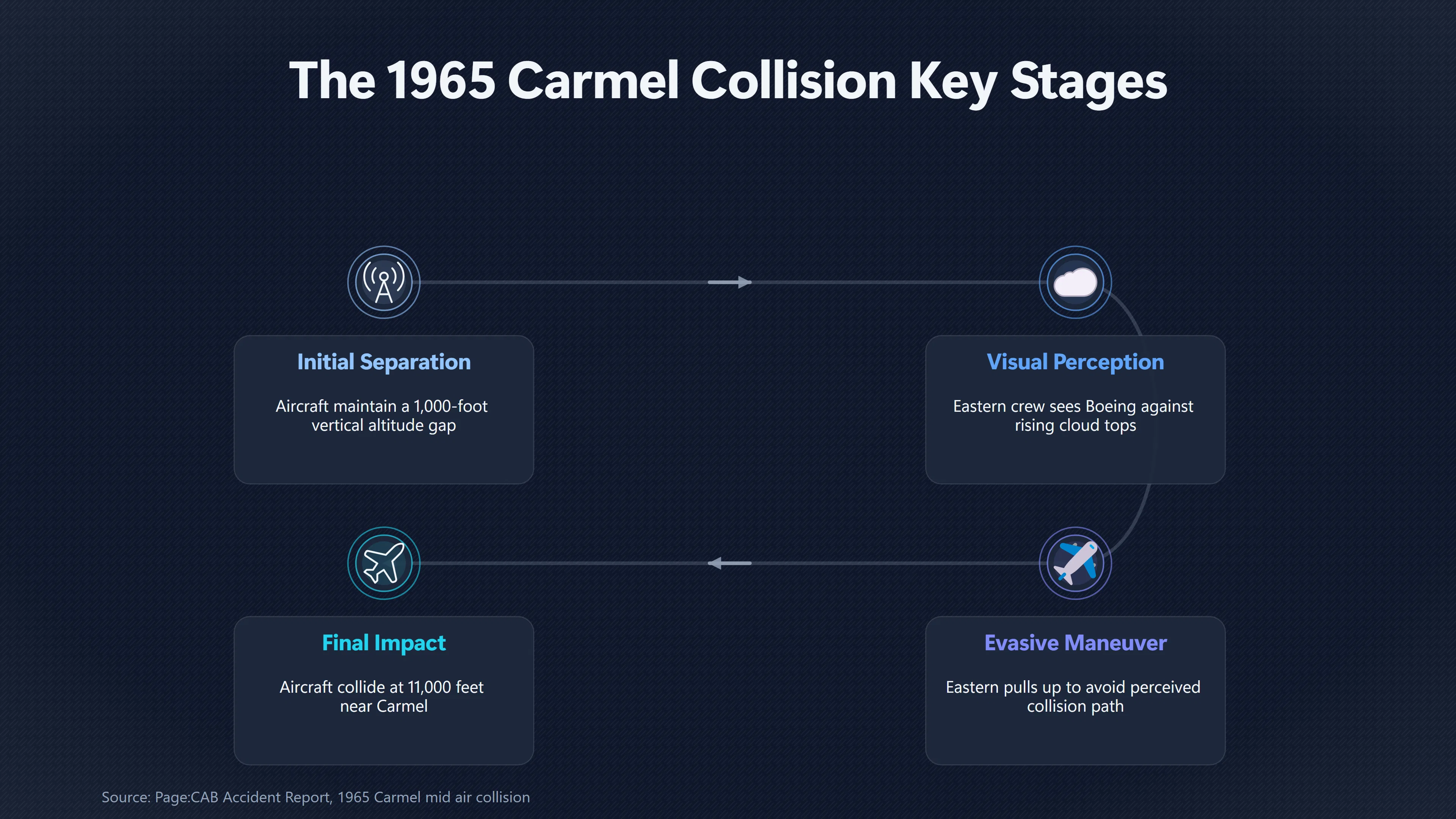
The 1965 Carmel mid-air collision is an unusually concrete warning about false horizons because the visual error did not merely make an aircraft seem slightly misplaced: investigators concluded that it helped turn a safe 1,000-foot assigned altitude separation into an actual collision. On 4 December, Eastern Air Lines Flight 853, a Lockheed Super Constellation assigned to 10,000 feet, encountered TWA Flight 42, a Boeing 707 assigned to 11,000 feet, near Carmel, New York. The Eastern crew saw the jet against cloud tops that rose towards the north and apparently judged it to be at roughly their own altitude. Their emergency climb, followed by the TWA crew’s reaction, brought the aircraft together at about 11,000 feet.[Wikisource]en.wikisource.orgPage:CAB Accident Report, 1965 Carmel mid air collisionPage:CAB Accident Report, 1965 Carmel mid-air collision.pdf/2 - Wikisource, the free online libraryDecember 13, 1965…
The Civil Aeronautics Board (CAB) attributed the crucial altitude misjudgement to an optical illusion created by the upslope of the cloud tops. That finding makes Carmel particularly relevant when assessing airborne UFO/UAP observations: an object’s apparent altitude and trajectory can be seriously wrong when the observer has adopted a misleading visual horizon.[Wikisource]en.wikisource.orgPage:CAB Accident Report, 1965 Carmel mid air collisionPage:CAB Accident Report, 1965 Carmel mid-air collision.pdf/15 - Wikisource, the free online library…
What the crews saw before the collision
The encounter occurred at about 16:19 Eastern Standard Time as both airliners approached the Carmel VORTAC, a radio-navigation facility north of New York City. TWA Flight 42 was arriving from San Francisco for John F. Kennedy International Airport and was flying under instrument flight rules at an assigned altitude of 11,000 feet. Eastern Flight 853, travelling from Boston towards Newark, had been assigned 10,000 feet. On paper, therefore, the flights had 1,000 feet of vertical separation before the emergency manoeuvres began.[Wikisource]en.wikisource.orgPage:CAB Accident Report, 1965 Carmel mid air collisionPage:CAB Accident Report, 1965 Carmel mid-air collision.pdf/2 - Wikisource, the free online libraryDecember 13, 1965…
The visual situation was less straightforward. TWA was flying in clear air above an overcast. Around Carmel, the tops of that cloud layer were generally a little above 10,000 feet, with scattered buildups protruding several hundred feet higher. Crucially, the cloud tops tended to become higher towards the north and north-west. To someone looking across them, they could therefore provide an apparent horizon that sloped upwards in the direction of the TWA aircraft.[Wikisource]en.wikisource.orgAviation Accident Report: 1965 Carmel mid air collisionAviation Accident Report: 1965 Carmel mid-air collision - Wikisource, the free online libraryDecember 20, 1966…
As Eastern approached Carmel on a south-westerly heading, its first officer saw the Boeing at approximately the two o’clock position. He believed it was at or very near Eastern’s altitude and on a collision course. He warned the captain and joined him in making a rapid pull-up. The CAB found that the Eastern crew’s response was not inexplicable or casual: given what they thought they were seeing and the very short time available, climbing appeared to them to be an emergency collision-avoidance manoeuvre.[Wikisource]en.wikisource.orgPage:CAB Accident Report, 1965 Carmel mid air collisionPage:CAB Accident Report, 1965 Carmel mid-air collision.pdf/2 - Wikisource, the free online libraryDecember 13, 1965…
The difficulty was that the Boeing was initially supposed to be about 1,000 feet higher. By climbing towards it, Eastern reduced the very separation its crew believed had already disappeared.
TWA’s crew then encountered its own rapidly developing visual emergency. The captain saw Eastern at roughly his ten o’clock position and believed it was on a collision course. He disengaged the autopilot, rolled sharply right and pulled back. When it became apparent that this would not provide clearance, the TWA pilots tried to reverse the manoeuvre, rolling left and pushing forwards. There was too little time. The aircraft collided at approximately 11,000 feet.[Wikisource]en.wikisource.orgAviation Accident Report: 1965 Carmel mid air collisionAviation Accident Report: 1965 Carmel mid-air collision - Wikisource, the free online libraryDecember 20, 1966…
The impact severely damaged both aircraft. TWA’s 707 nevertheless reached JFK and landed safely. Eastern’s Constellation lost effective elevator and rudder control after collision damage disrupted its control system; its crew eventually made a forced landing in the North Salem area. Four of the 54 people aboard Eastern were killed.[Wikisource]en.wikisource.orgPage:CAB Accident Report, 1965 Carmel mid air collisionPage:CAB Accident Report, 1965 Carmel mid-air collision.pdf/16 - Wikisource, the free online library…
How rising cloud tops distorted perceived altitude
The important feature of Carmel is not simply that clouds obstructed visibility. The CAB reconstructed a more specific visual mechanism.
Eastern was flying at or near the tops of the cloud layer. The first officer therefore had a conspicuous field of cloud beneath and beyond the approaching Boeing, but no useful true horizon against which to make a rapid altitude comparison. The cloud tops were relatively smooth overall, interrupted by higher buildups, and rose towards the north and north-west — behind TWA from Eastern’s viewing geometry.[Wikisource]en.wikisource.orgPage:CAB Accident Report, 1965 Carmel mid air collisionPage:CAB Accident Report, 1965 Carmel mid-air collision.pdf/15 - Wikisource, the free online library…
That arrangement could make the sloping cloud surface function perceptually as a horizon. Because TWA appeared against the higher clouds, the Boeing could look as though it were sitting on or close to that apparent horizon. The CAB’s analysis was explicit: with only a short interval in which to judge the encounter, the Eastern first officer lacked a visual aid for determining the true horizon, while the cloud buildup supplied a false one on which to judge separation.[Wikisource]en.wikisource.orgPage:CAB Accident Report, 1965 Carmel mid air collisionPage:CAB Accident Report, 1965 Carmel mid-air collision.pdf/15 - Wikisource, the free online library…
This distinction matters. The investigators did not conclude that Eastern simply failed to notice an obviously higher aircraft. Their reconstruction was that the outside scene itself supplied misleading information about the Boeing’s vertical position.
Modern aviation guidance recognises precisely this class of illusion. The US Federal Aviation Administration’s Aeronautical Information Manual warns that sloping cloud formations and an obscured natural horizon can produce a false horizon, causing pilots to perceive their orientation incorrectly.[Federal Aviation Administration]faa.govFederal Aviation Administration Chapter 8. Medical Facts for PilotsFederal Aviation AdministrationChapter 8. Medical Facts for PilotsJanuary 8, 2015… Experimental research has likewise treated sloping cloud as a false-horizon stimulus capable of producing spatial disorientation even among trained military pilots.[ResearchGate]researchgate.netOpen source on researchgate.net.
Carmel illustrates an especially important extension of that principle. A false horizon need not only mislead a pilot about their own aircraft’s attitude. It can also corrupt the apparent position of another aircraft.
That is exactly what made the encounter dangerous. Eastern’s crew had to infer the Boeing’s relative altitude from a fleeting angular view. Without a reliable earth–sky horizon, the visual system effectively had to locate the target within a reference frame supplied by the clouds. If that reference frame was tilted, the inference about relative altitude could be wrong even though the aircraft itself remained perfectly visible.
Why the evasive manoeuvre made sense from the cockpit
It is tempting in hindsight to ask why Eastern climbed when TWA was already above it. The investigation’s reconstruction shows why hindsight is misleading.
The crew did not know visually that TWA was safely above them. Their immediate perception was of a rapidly converging aircraft at approximately their own altitude. Moreover, the CAB noted another complication: pushing the Constellation downwards would have taken it into the solid overcast. If the approaching aircraft were also descending into cloud, Eastern’s pilots would lose the ability to watch it and make further visual corrections.[Wikisource]en.wikisource.orgPage:CAB Accident Report, 1965 Carmel mid air collisionPage:CAB Accident Report, 1965 Carmel mid-air collision.pdf/15 - Wikisource, the free online library…
The pull-up therefore illustrates the dangerous interaction between a perceptual error and an otherwise rational response. Once the false visual premise was accepted — that aircraft is at our altitude — urgent avoidance followed logically.
The TWA crew then had only an instantaneous view of Eastern and responded to the new geometry produced by its climb. The CAB concluded that the short period of visual contact gave the crews insufficient time for successful visual separation. Its analysis linked the cloud conditions, mistaken altitude judgement and successive evasive manoeuvres into one sequence rather than treating them as unrelated pilot mistakes.[Wikisource]en.wikisource.orgPage:CAB Accident Report, 1965 Carmel mid air collisionPage:CAB Accident Report, 1965 Carmel mid-air collision.pdf/16 - Wikisource, the free online library…
That is why the Board’s probable-cause finding is so useful in discussions of visual perception. It identified the initiating problem as Eastern’s misjudgement of altitude separation because of an optical illusion created by the upslope effect of cloud tops, which prompted Eastern’s evasive manoeuvre and TWA’s reaction.[Wikisource]en.wikisource.orgPage:CAB Accident Report, 1965 Carmel mid air collisionPage:CAB Accident Report, 1965 Carmel mid-air collision.pdf/17 - Wikisource, the free online library…
Why Carmel matters for airborne UAP reports
Carmel should not be used as a universal explanation for unusual observations from aircraft. It demonstrates something narrower and more useful: trained professional aircrew can make a large error in the apparent vertical position of another clearly visible aircraft when the background provides a deceptive horizon.
That distinction matters when evaluating an airborne UFO/UAP report in which a light or object appears to climb, descend, hold an improbable altitude or move abruptly relative to clouds. The observation may accurately report what the scene looked like while still being inaccurate about the object’s actual three-dimensional motion.
Carmel suggests several questions that are therefore worth asking before treating apparent aerial motion as physical motion:
- Was the true natural horizon actually visible, or was the observer looking across cloud tops?
- Did the cloud deck rise or fall across the direction in which the object was observed?
- Was the target seen against cloud buildups that could have provided a false altitude reference?
- Was the sighting brief enough that the observer had little opportunity to compare the visual impression with instruments or other references?
- Did the observer’s own aircraft manoeuvre during the sighting, further changing the target’s apparent position within the visual field?
These questions do not establish that any particular UAP was an aircraft or that every surprising manoeuvre is perceptual. They identify a documented failure mode that has to be excluded before unusual apparent motion can confidently be converted into claims about unusual actual motion.
The strength of the Carmel example is the independent information available afterwards. Investigators knew the flights’ assigned altitudes, reconstructed their tracks and manoeuvres, examined the weather and cloud geometry, inspected the damaged aircraft and had statements from surviving crews. Aviation Safety Network’s accident record likewise preserves the basic sequence: TWA at 11,000 feet, Eastern at 10,000 feet, the optical illusion, Eastern’s climb and the subsequent collision.[Aviation Safety Network]aviation-safety.netAviation Safety NetworkAccident Lockheed L-1049C Super Constellation N6218C, Saturday 4 December 1965…
In a typical UAP sighting, many of those constraints are missing. An observer may have only a brief visual encounter, uncertain range to the object and incomplete information about its true altitude. If a false horizon could cause professional pilots in the Carmel case to misjudge a large airliner’s vertical separation by enough to initiate a catastrophic manoeuvre, then apparent altitude and vertical motion in less constrained aerial observations deserve correspondingly careful treatment.

The false-horizon warning Carmel leaves behind
The most memorable fact about Carmel is that the illusion did not require an exotic atmospheric phenomenon or an untrained observer. The scene contained ordinary clouds, two ordinary airliners and experienced professional crews. The crucial visual cue was simply misleading: cloud tops rising towards one side of the scene provided an apparent horizon that did not represent true level.[Wikisource]en.wikisource.orgPage:CAB Accident Report, 1965 Carmel mid air collisionPage:CAB Accident Report, 1965 Carmel mid-air collision.pdf/15 - Wikisource, the free online library…
The accident also shows why witness confidence cannot by itself establish geometrical accuracy. Eastern’s pilots reacted decisively because the threat appeared immediate. Their perception was compelling enough to demand action, yet the CAB’s reconstruction found that the underlying altitude judgement was wrong. The collision then physically demonstrated how consequential that perceptual error had been.[Wikisource]en.wikisource.orgPage:CAB Accident Report, 1965 Carmel mid air collisionPage:CAB Accident Report, 1965 Carmel mid-air collision.pdf/2 - Wikisource, the free online libraryDecember 13, 1965…
For evaluating airborne UFO/UAP reports, Carmel therefore supplies a disciplined warning rather than a catch-all explanation. When an object’s extraordinary behaviour depends on estimates such as it suddenly climbed, it descended towards us, it was level with the aircraft or it changed altitude impossibly fast, the reliability of the observer’s horizon reference becomes part of the evidence. A sloping cloud background can alter the coordinate frame against which those judgements are made.
The Carmel collision is powerful precisely because this principle is not hypothetical. In December 1965, investigators concluded that an upslope in ordinary cloud tops made one airliner appear dangerously close in altitude to another despite their assigned 1,000-foot separation. The attempt to escape that apparent danger helped create the real one.[Wikisource]en.wikisource.orgPage:CAB Accident Report, 1965 Carmel mid air collisionPage:CAB Accident Report, 1965 Carmel mid-air collision.pdf/17 - Wikisource, the free online library…
Amazon book picks
Further Reading
Books and field guides related to The Airliner Collision That Shows False Horizons Matter. Use these as the next step if you want deeper reading beyond the article.
Human Factors in Aviation
Fully updated and expanded, the second edition of Human Factors in Aviation serves the needs of the widespread aviation community - stude...
Sensation and Perception
. Bruce Goldstein's SENSATION AND PERCEPTION, the best-seller which has helped over 150,000 students understand the ties between how we s...
The UFO Experience: A Scientific Inquiry
Cited by the New York Review of Books as "the best brief for visitation," this classic study presents an analysis of UFO reports and conc...
eBay marketplace picks
Marketplace Samples
Live-tested eBay searches with available results related to this page.
Selected fromBoeing 707 model oneBay.co.uk.
Endnotes
1.
Source: en.wikisource.org
Title: Page:CAB Accident Report, 1965 Carmel mid air collision
Link:https://en.wikisource.org/wiki/Page%3ACAB_Accident_Report%2C_1965_Carmel_mid-air_collision.pdf/2
Source snippet
Page:CAB Accident Report, 1965 Carmel mid-air collision.pdf/2 - Wikisource, the free online libraryDecember 13, 1965...
Published: December 13, 1965
2.
Source: en.wikisource.org
Title: Page:CAB Accident Report, 1965 Carmel mid air collision
Link:https://en.wikisource.org/wiki/Page%3ACAB_Accident_Report%2C_1965_Carmel_mid-air_collision.pdf/17
Source snippet
Page:CAB Accident Report, 1965 Carmel mid-air collision.pdf/17 - Wikisource, the free online library...
3.
Source: en.wikisource.org
Title: Page:CAB Accident Report, 1965 Carmel mid air collision
Link:https://en.wikisource.org/wiki/Page%3ACAB_Accident_Report%2C_1965_Carmel_mid-air_collision.pdf/15
Source snippet
Page:CAB Accident Report, 1965 Carmel mid-air collision.pdf/15 - Wikisource, the free online library...
4.
Source: en.wikisource.org
Title: Page:CAB Accident Report, 1965 Carmel mid air collision
Link:https://en.wikisource.org/wiki/Page%3ACAB_Accident_Report%2C_1965_Carmel_mid-air_collision.pdf/16
Source snippet
Page:CAB Accident Report, 1965 Carmel mid-air collision.pdf/16 - Wikisource, the free online library...
5.
Source: aviation-safety.net
Link:https://aviation-safety.net/wikibase/332496
Source snippet
Aviation Safety NetworkAccident Lockheed L-1049C Super Constellation N6218C, Saturday 4 December 1965...
Published: December 1965
6.
Source: en.wikisource.org
Title: Aviation Accident Report: 1965 Carmel mid air collision
Link:https://en.wikisource.org/wiki/Aviation_Accident_Report%3A_1965_Carmel_mid-air_collision
Source snippet
Aviation Accident Report: 1965 Carmel mid-air collision - Wikisource, the free online libraryDecember 20, 1966...
Published: December 20, 1966
7.
Source: researchgate.net
Link:https://www.researchgate.net/publication/335730548_The_influence_of_sloping_cloud_in_the_visual_field_on_the_cognitive_determinants_of_military_pilots%27_behavior
8.
Source: aviation-safety.net
Link:https://aviation-safety.net/wikibase/332497
Source snippet
Aviation Safety NetworkMid-air collision Accident Boeing 707-131B N748TW, Saturday 4 December 1965...
Published: December 1965
9.
Source: researchgate.net
Title: (PDF) Limitations of the See-and-Avoid Principle
Link:https://www.researchgate.net/publication/320617624_Limitations_of_the_See-and-Avoid_Principle
10.
Source: en.wikisource.org
Title: Page:CAB Accident Report, 1965 Carmel mid air collision
Link:https://en.wikisource.org/wiki/Page%3ACAB_Accident_Report%2C_1965_Carmel_mid-air_collision.pdf/7
11.
Source: en.wikisource.org
Title: Page:CAB Accident Report, 1965 Carmel mid air collision
Link:https://en.wikisource.org/wiki/Page%3ACAB_Accident_Report%2C_1965_Carmel_mid-air_collision.pdf/5
12.
Source: en.wikisource.org
Title: Page:CAB Accident Report, 1965 Carmel mid air collision
Link:https://en.wikisource.org/wiki/Page%3ACAB_Accident_Report%2C_1965_Carmel_mid-air_collision.pdf/3
13.
Source: en.wikisource.org
Title: Page:CAB Accident Report, 1965 Carmel mid air collision
Link:https://en.wikisource.org/wiki/Page%3ACAB_Accident_Report%2C_1965_Carmel_mid-air_collision.pdf/12
14.
Source: en.wikisource.org
Title: Page:CAB Accident Report, 1965 Carmel mid air collision
Link:https://en.wikisource.org/wiki/Page%3ACAB_Accident_Report%2C_1965_Carmel_mid-air_collision.pdf/14
15.
Source: en.wikisource.org
Link:https://en.wikisource.org/wiki/Commentary_and_critical_notes_on_the_Bible/Acts
16.
Source: en.wikisource.org
Link:https://en.wikisource.org/wiki/Commentary_and_critical_notes_on_the_Bible/Psalms
17.
Source: en.wikisource.org
Title: Page:CAB Accident Report, 1965 Carmel mid air collision
Link:https://en.wikisource.org/wiki/Page%3ACAB_Accident_Report%2C_1965_Carmel_mid-air_collision.pdf/9
18.
Source: researchgate.net
Link:https://www.researchgate.net/publication/263694508_Cognitive_Determinants_of_Pilots%27_Effectiveness_Under_a_False_Horizon_Illusion
19.
Source: en.wikisource.org
Title: Page:CAB Accident Report, 1965 Carmel mid air collision
Link:https://en.wikisource.org/wiki/Page%3ACAB_Accident_Report%2C_1965_Carmel_mid-air_collision.pdf/1
20.
Source: faa.gov
Title: Federal Aviation Administration Chapter 8. Medical Facts for Pilots
Link:https://www.faa.gov/air_traffic/publications/atpubs/aim/aim0801.html
Source snippet
Federal Aviation AdministrationChapter 8. Medical Facts for PilotsJanuary 8, 2015...
Published: January 8, 2015
21.
Source: faa.gov
Link:https://www.faa.gov/lessons_learned/transport_airplane/accidents/N533PS
22.
Source: faa.gov
Link:https://www.faa.gov/lessons_learned/transport_airplane/accidents/N6902C
23.
Source: baaa-acro.com
Title: new york
Link:https://www.baaa-acro.com/zone/new-york?page=16
24.
Source: www2.anac.gov.br
Link:https://www2.anac.gov.br/anacpedia/ing_por/tr4373.htm
25.
Source: www2.anac.gov.br
Link:https://www2.anac.gov.br/anacpedia/ing-por/tr4373.htm
26.
Source: faa.gov
Link:https://www.faa.gov/air_traffic/publications/atpubs/aip_html/chap7_section_6.html
27.
Source: kaweah.freedombox.rocks
Title: 1965 Carmel mid air collision
Link:https://kaweah.freedombox.rocks/kiwix/content/wikipedia_en_all_maxi_2023-10/A/1965_Carmel_mid-air_collision
28.
Source: baaa-acro.com
Title: Carmel | Bureau of Aircraft Accidents Archives
Link:https://www.baaa-acro.com/city/carmel
Additional References
29.
Source: youtube.com
Title: Spatial Disorientation Explained: Deadly Flight Illusions Every Pilot Must Know
Link:https://www.youtube.com/watch?v=6BD9fyyIJzY
Source snippet
Chapter 17 Aeromedical Factors | PHAK | AGPIAL Audio/Video Book...
30.
Source: science.gov
Link:https://www.science.gov/topicpages/c/calico%2Bhills%2Bformation
31.
Source: science.gov
Link:https://www.science.gov/topicpages/h/hill%2Bslope%2Bsediment
32.
Source: youtube.com
Title: Chapter 17 Aeromedical Factors | PHAK | AGPIAL Audio/Video Book
Link:https://www.youtube.com/watch?v=n1UYc615ZTQ
Source snippet
Night Illusions (Private Pilot Lesson 15d)...
33.
Source: youtube.com
Title: “Prepare For A CRASH LANDING!” | Carmel Mid-Air Collision
Link:https://www.youtube.com/watch?v=4M_HQrERAvs
Source snippet
PPGS Lesson 14.2 | Aeromedical: Illusions...
34.
Source: faraim.org
Link:https://www.faraim.org/faa/aim/chapter-8/section-8-1-5.html
35.
Source: flyaeroguard.com
Link:https://www.flyaeroguard.com/learning-center/visual-illusions/
36.
Source: manualzz.com
Link:https://manualzz.com/doc/35468370/faa-instrument-flying-handbook-handbook
37.
Source: meuslivros.de
Link:https://meuslivros.de/livros/66/
38.
Source: studylib.net
Link:https://studylib.net/doc/25850507/instrument-flying-handbook