Within Searchlights
Why Searchlights Matter to Aviation Safety
Aviation rules treat searchlights as serious directed-light displays because intense beams can distract or dazzle crews while producing striking sky effects.
On this page
- How directed lights can affect pilots
- Why temporary displays may require coordination
- What regulation reveals about real world searchlight use
Page outline Jump by section
Introduction
Aviation authorities regulate powerful searchlights because a ground-based light display can become an aviation hazard without ever touching an aircraft. A narrow, intense beam can distract or dazzle a pilot, interfere with night vision and, near an airport, resemble or compete with the lighting cues crews use during approach and landing. The UK Civil Aviation Authority (CAA) therefore treats searchlights as a form of directed-light display requiring aviation-safety consideration, alongside lasers.[Civil Aviation Authority]caa.co.ukOpen source on caa.co.uk.
That regulatory treatment is important when investigating apparent UFO or UAP sightings involving moving lights on clouds. Searchlights are not merely a hypothetical explanation: aviation rules assume that powerful commercial and event lights are used often enough, shine far enough into operational airspace and create effects conspicuous enough to pilots that displays sometimes need advance notification, coordination with air traffic control and warnings to aircrew.[Civil Aviation Authority]caa.co.ukCivil Aviation Authority CAP 736Civil Aviation AuthorityCAP 736 - Operation of Directed Light, Fireworks, Toy Balloons and Sky Lanterns within UK Airspace…
How directed lights can affect pilots
The central aviation concern is visual interference. The CAA describes lasers and searchlights as sources capable of producing intense, directional beams. Its guidance states that excessive artificial light can make vision less effective and that sudden, intense illumination can cause distraction and confusion, particularly when it is unexpected. The risk rises around aerodromes because take-off, final approach and landing are already high-workload phases in which pilots depend heavily on visual information.[Civil Aviation Authority]caa.co.ukCivil Aviation Authority CAP 736Civil Aviation AuthorityCAP 736 - Operation of Directed Light, Fireworks, Toy Balloons and Sky Lanterns within UK Airspace…
Searchlights do not need the eye-injury potential of a powerful laser to matter. CAP 736 specifically says that searchlights are frequently used as spectacular event backdrops and for displays lasting weeks or months, and identifies two aviation problems: they can distract aircrew, and they can appear similar in appearance and position to airfield lighting. Their placement and operation therefore have to be considered carefully.[Civil Aviation Authority]caa.co.ukCivil Aviation Authority CAP 736Civil Aviation AuthorityCAP 736 - Operation of Directed Light, Fireworks, Toy Balloons and Sky Lanterns within UK Airspace…
Night flying makes that concern particularly understandable. The US Federal Aviation Administration’s Airplane Flying Handbook warns that exposure of dark-adapted eyes to a bright source such as a searchlight for a second or more can temporarily impair night vision.[Federal Aviation Administration]faa.gov12 afh ch11Federal Aviation AdministrationAirplane Flying Handbook (FAA-H-8083-3C)May 8, 2026… European aviation guidance likewise notes that artificial illumination, including searchlights, can interfere with night-vision-goggle operations when the source lies near or within the pilot’s field of view, reducing useful visual cues.[EASA]easa.europa.euEASAEasy Access Rules for Air OperationsRevision 24, March 2026 | EASAMarch 27, 2026…
This is why aviation regulation is concerned with more than whether a beam can physically injure an eye. A light can be troublesome at lower levels simply because it arrives unexpectedly in a cockpit, competes with other visual information or temporarily degrades a pilot’s ability to see outside references. Aviation-safety literature describes a progression from distraction and startle through glare and disruption to temporary flash blindness for sufficiently intense laser illumination; bright-light interference is especially significant during night approaches and departures.[Skybrary]skybrary.aeroMisuse of LasersMisuse of Lasers - Illumination of Aircraft and ATC Towers | SKYbrary Aviation Safety…
There is also a navigation issue particular to airports. Aerodrome lighting is deliberately standardised so that pilots can recognise runways, approach paths and other operational features at night. An unrelated high-intensity display in the same visual field can therefore be more consequential near a runway than the identical display in an otherwise empty part of the sky. Current UK air-traffic guidance states plainly that light displays must never be directed at or towards aircraft or aerodromes.[Civil Aviation Authority]caa.co.ukCivil Aviation Authority Safety and Airspace Regulation GroupCivil Aviation Authority Safety and Airspace Regulation Group
Why temporary displays may require coordination
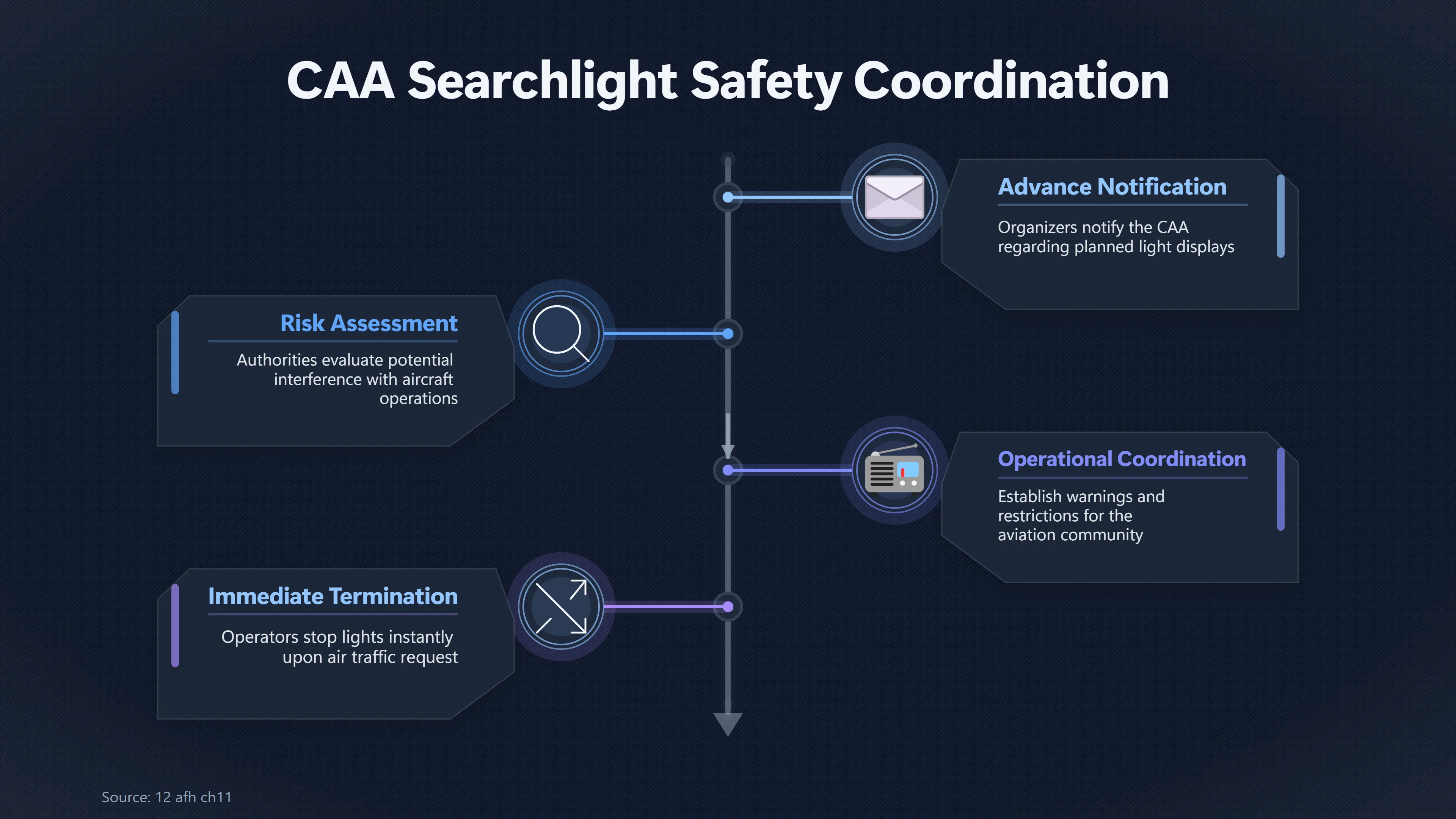
The UK approach shows how authorities turn those hazards into practical controls. CAA guidance covers outdoor events involving searchlights as well as lasers, fireworks and related activities, from small displays to major commercial or ceremonial events. The purpose is not simply to prohibit bright lights. It is to make a planned display compatible with aircraft operations through advance assessment, warning and, where necessary, operational restrictions.[Civil Aviation Authority]caa.co.ukOpen source on caa.co.uk.
CAP 736 sets out a particularly useful example. For temporary directed-light displays, organisers are asked to notify the CAA in advance. The authority can then deconflict or coordinate the activity, issue warnings to the aviation community and establish whatever control measures are considered necessary. The guidance identifies areas warranting particular attention: within three nautical miles of an aerodrome reference point, and along extended runway centrelines out to ten nautical miles, within a corridor extending 500 metres to either side.[Civil Aviation Authority]caa.co.ukCivil Aviation Authority CAP 736Civil Aviation AuthorityCAP 736 - Operation of Directed Light, Fireworks, Toy Balloons and Sky Lanterns within UK Airspace…
Those dimensions reveal the operational logic. An aircraft on an extended runway centreline may still be many miles from touchdown while already established on an approach. A searchlight positioned away from the airport boundary can therefore matter if its beam crosses the region through which arriving or departing aircraft are expected to fly.
The CAA’s preferred solution is to prevent illumination escaping towards the aerodrome or along the extended runway centreline. Where that cannot practicably be guaranteed, CAP 736 describes another safeguard: a direct telephone or radio link between the display operator and the relevant air traffic control authority, allowing the display to be stopped immediately if requested by an aircraft or affected aerodrome. The guidance is unusually clear about the consequence if that safeguard cannot be provided: the display may constitute a threat to flight safety and should not proceed.[Civil Aviation Authority]caa.co.ukCivil Aviation Authority CAP 736Civil Aviation AuthorityCAP 736 - Operation of Directed Light, Fireworks, Toy Balloons and Sky Lanterns within UK Airspace…
Current UK air-traffic procedures preserve the same operational principle. They specify that affected aircraft should be informed and that, if a pilot asks for the lights to be extinguished or air traffic control judges this necessary, action should be taken without delay.[Civil Aviation Authority]caa.co.ukCivil Aviation Authority Safety and Airspace Regulation GroupCivil Aviation Authority Safety and Airspace Regulation Group
This distinction between notification, coordination and prohibition matters. Regulation does not mean every skyward searchlight is inherently unsafe. It means that safety depends on circumstances such as location, beam direction, nearby flight paths and the ability to terminate the display. Even CAP 736 notes that a temporary display outside its specified aerodrome areas is unlikely to affect aerodrome flight operations, while still advising organisers to check whether other aviation activity might be affected.[Civil Aviation Authority]caa.co.ukCivil Aviation Authority CAP 736Civil Aviation AuthorityCAP 736 - Operation of Directed Light, Fireworks, Toy Balloons and Sky Lanterns within UK Airspace…
Permanent searchlights are an aviation-planning issue too
Aviation oversight is not confined to one-night concerts or promotional events. CAP 736 treats a laser or searchlight installation expected to remain in place for more than 30 days as a permanent site and says the CAA should be consulted during the initial planning process. The authority can assess whether the installation is likely to affect aircraft operations and, if so, identify measures needed to mitigate that effect.[Civil Aviation Authority]caa.co.ukCivil Aviation Authority CAP 736Civil Aviation AuthorityCAP 736 - Operation of Directed Light, Fireworks, Toy Balloons and Sky Lanterns within UK Airspace…
The CAA also says that known permanent sites capable of causing sufficient distraction or eye hazard, and intentionally emitting into airspace or capable of doing so through malfunction, may be recorded in the UK’s Aeronautical Information Publication.[Civil Aviation Authority]caa.co.ukOpen source on caa.co.uk. That is significant because the Aeronautical Information Publication is operational aviation information, not an entertainment-industry catalogue. A sufficiently consequential ground light effectively becomes a feature that aviation needs to know about.
Comparable procedures appear in other jurisdictions. The Isle of Man Civil Aviation Administration, for example, explicitly says that lasers and searchlights can dazzle pilots. For notified displays in its relevant area it can coordinate or deconflict the activity, promulgate warnings to aviation and establish control measures; permanent installations can also require aviation consultation during planning.[Isle of Man Government]gov.imOpen source on gov.im.
The United States provides a closely related regulatory model for outdoor lasers rather than conventional searchlights. The FAA’s active Advisory Circular 70-1B exists specifically for outdoor laser operations that may affect aircraft in the National Airspace System and establishes a notification and assessment process for proposed operations.[Federal Aviation Administration]faa.govFederal Aviation Administration AC 70-1BFederal Aviation Administration AC 70-1B Although laser hazards can be substantially more severe than those of ordinary searchlights, the underlying governance principle is similar: a powerful directed light projected into navigable airspace cannot be assessed solely as an activity taking place on the ground.
What regulation reveals about real-world searchlight use
For UFO and UAP investigation, perhaps the most useful point is not the safety rule itself but what the rule tells us about the underlying phenomenon. The CAA explicitly describes searchlights as being frequently used for spectacular event backdrops and for lighting displays associated with structures and special events, sometimes over periods of weeks or months.[Civil Aviation Authority]caa.co.ukCivil Aviation Authority CAP 736Civil Aviation AuthorityCAP 736 - Operation of Directed Light, Fireworks, Toy Balloons and Sky Lanterns within UK Airspace…
That gives searchlights a much firmer evidential footing as an explanation for some unusual-light reports. They are powerful, directional sources intentionally projected into the night sky; they can operate temporarily or from permanent installations; and their real-world prevalence is sufficient for aviation authorities to maintain dedicated notification and coordination procedures. In cloudy conditions, the same beam can illuminate the underside of cloud and produce the conspicuous moving patches discussed in the parent topic, while the projector itself may be distant or hidden from the observer.
The aviation system can even leave documentary traces of individual displays. Notices to Airmen, or NOTAMs, may warn crews about temporary activity. For example, UK NOTAM listings in 2026 included notices explicitly describing lasers and searchlights operating within defined areas, demonstrating that such displays are not merely an old regulatory concern but an activity that continues to enter operational aviation information.[NOTAM Info]notaminfo.comNOTAM Info Latest NOTAM Briefing | NOTAM InfoNOTAM Info Latest NOTAM Briefing | NOTAM Info
For an investigator examining a report of apparent objects moving across cloud, this suggests a useful distinction. Aviation regulation does not prove that a particular unexplained light was a searchlight. It does establish that sufficiently powerful skyward displays are a recognised, recurring real-world activity with known locations, operators, operating periods and sometimes aviation notifications. That makes event schedules, venue locations, aerodrome information and archived NOTAMs potentially valuable corroborating evidence when the observed motion and cloud conditions already point towards projected illumination.
The safety rules reinforce the mundane explanation
There is a useful irony in the relationship between searchlights and unusual aerial sightings. The very characteristics that can make a searchlight display look extraordinary from the ground — intensity, long reach, movement through the sky and conspicuous illumination of cloud — are among the characteristics that make aviation authorities take directed lights seriously.
CAA policy consequently treats searchlights neither as harmless decorative lamps nor as mysterious aerial phenomena. They are identifiable ground installations whose beams can extend into operational airspace, affect what pilots see and sometimes require coordination with aviation authorities.[Civil Aviation Authority]caa.co.ukOpen source on caa.co.uk.
That regulatory record strengthens, but does not by itself settle, a searchlight explanation for UFO or UAP reports involving apparent objects on clouds. It establishes the important underlying fact: powerful commercial and event searchlights really are projected into the sky often enough, and with enough operational significance, for aviation authorities to have developed formal procedures governing where, when and how they are used.
Amazon book picks
Further Reading
Books and field guides related to Why Searchlights Matter to Aviation Safety. Use these as the next step if you want deeper reading beyond the article.
Human Factors in Flight
The late Captain Frank H Hawkins FRAes, M Phil, was Human Factors Consultant to KLM, for whom he had flown for over 30 years as line capt...
The Killing Zone
This is not AI-generated content. The contents were written and verified by subject matter experts from Aviation Supplies & Academics, an...
Weather Flying
Weather Flying is regarded in the industry as the bible of weather flying. Robert Buck, a general aviation and commercial pilot with tens...
The UFO Handbook
An explanation of the usual reasons for confusing IFOs (identified flying objects) with UFOs and a survey of the tools used to investigat...
eBay marketplace picks
Marketplace Samples
Live-tested eBay searches with available results related to this page.
Selected fromaviation poster oneBay.co.uk.
Endnotes
1.
Source: faa.gov
Title: 12 afh ch11
Link:https://www.faa.gov/sites/faa.gov/files/regulations_policies/handbooks_manuals/aviation/airplane_handbook/12_afh_ch11.pdf
Source snippet
Federal Aviation AdministrationAirplane Flying Handbook (FAA-H-8083-3C)May 8, 2026...
Published: May 8, 2026
2.
Source: easa.europa.eu
Title: EASAEasy Access Rules for Air Operations
Link:https://www.easa.europa.eu/en/document-library/easy-access-rules/online-publications/easy-access-rules-air-operations?erules-id=ERULES-1963177438-21073
Source snippet
Revision 24, March 2026 | EASAMarch 27, 2026...
Published: March 27, 2026
3.
Source: skybrary.aero
Title: Misuse of Lasers
Link:https://skybrary.aero/index.php/articles/misuse-lasers-illumination-aircraft-and-atc-towers
Source snippet
Misuse of Lasers - Illumination of Aircraft and ATC Towers | SKYbrary Aviation Safety...
4.
Source: skybrary.aero
Title: Laser Interference in Aviation | SKYbrary Aviation Safety
Link:https://skybrary.aero/index.php/articles/laser-interference-aviation
Source snippet
Laser Interference in Aviation | SKYbrary Aviation Safety...
5.
Source: faa.gov
Title: Federal Aviation Administration AC 70-1B
Link:https://www.faa.gov/regulations_policies/advisory_circulars/index.cfm/go/document.information/documentID/1040741
6.
Source: faa.gov
Title: Federal Aviation Administration Advisory
Link:https://www.faa.gov/documentLibrary/media/Advisory_Circular/AC.70-1B_Outdoor.Laser.Operations.pdf
Source snippet
Circular U.S. Department of Transportat...
7.
Source: faa.gov
Title: Cert Alerts for Part 139 Airport Certification | Federal Aviation Administration
Link:https://www.faa.gov/airports/airport_safety/certalerts
8.
Source: faa.gov
Title: NOTAM S, TFRs, and Aircraft Safety Alerts | Federal Aviation Administration
Link:https://www.faa.gov/pilots/safety/notams_tfr
9.
Source: faa.gov
Title: What is a NOTAM? | Federal Aviation Administration
Link:https://www.faa.gov/about/initiatives/notam/what_is_a_notam
10.
Source: faa.gov
Title: Laser Education & News | Federal Aviation Administration
Link:https://www.faa.gov/about/initiatives/lasers/laser_education
11.
Source: faa.gov
Link:https://www.faa.gov/regulations_policies/advisory_circulars/index.cfm/go/document.current/documentNumber/70-1
12.
Source: faa.gov
Title: A C 70-2B
Link:https://www.faa.gov/regulations_policies/advisory_circulars/index.cfm/go/document.information/documentID/1037373
13.
Source: faa.gov
Link:https://www.faa.gov/regulations_policies/advisory_circulars/index.cfm/go/document.information/documentID/1037861
14.
Source: skybrary.aero
Title: Avi Ation LAser exposure se Lf-Assessment (ALes A) | SKYbrary Aviation Safety
Link:https://skybrary.aero/bookshelf/aviation-laser-exposure-self-assessment-alesa
15.
Source: faa.gov
Title: Chapter 29. Outdoor Laser Operations
Link:https://www.faa.gov/air_traffic/publications/atpubs/AIR/air2901.html
16.
Source: faa.gov
Title: Chapter 29. Outdoor Laser Operations
Link:https://www.faa.gov/air_traffic/publications/atpubs/AIR/air2904.html
17.
Source: faa.gov
Title: Chapter 19. Temporary Flight Restrictions
Link:https://www.faa.gov/air_traffic/publications/atpubs/fac/1907.html
18.
Source: faa.gov
Title: A C 70-1
Link:https://www.faa.gov/regulations_policies/advisory_circulars/index.cfm/go/document.information/documentID/23080
19.
Source: faa.gov
Link:https://www.faa.gov/regulations_policies/advisory_circulars/index.cfm/go/document.list/?appliedFacets=%7B%22topic%22%3A%22Airspace%22%7D&statusID=3
20.
Source: faa.gov
Link:https://www.faa.gov/regulations_policies/advisory_circulars/index.cfm/go/document.list/?appliedFacets=%7B%22subjectclass%22%3A%2270%22%7D&statusID=3
21.
Source: faa.gov
Link:https://www.faa.gov/regulations_policies/advisory_circulars/index.cfm/go/document.list/?appliedFacets=%7B%22subjectclass%22%3A%2270%22%7D&display=current&q=
22.
Source: faa.gov
Link:https://www.faa.gov/regulations_policies/advisory_circulars/index.cfm/go/document.list/?appliedFacets=%7B%22officenumber%22%3A%22AJV-P%22%7D&omni=AC-70C
23.
Source: faa.gov
Link:https://www.faa.gov/air_traffic/publications/atpubs/pham_html/chap29_section_1.html
24.
Source: faa.gov
Link:https://www.faa.gov/air_traffic/publications/atpubs/pham_html/chap29_section_4.html
25.
Source: faa.gov
Link:https://www.faa.gov/Air_traffic/publications/atpubs/aim_html/chap7_section_6.html
26.
Source: faa.gov
Link:https://www.faa.gov/air_traffic/publications/atpubs/foa_html/chap10_section_6.html
27.
Source: faa.gov
Link:https://www.faa.gov/air_traffic/publications/atpubs/notam_html/chap5_section_2.html
28.
Source: faa.gov
Link:https://www.faa.gov/air_traffic/publications/atpubs/foa_html/chap20_section_8.html
29.
Source: fly.faa.gov
Link:https://www.fly.faa.gov/fly/Products/Information/NOTAM/notam.html
30.
Source: faa.gov
Link:https://www.faa.gov/regulations_policies/advisory_circulars/index.cfm/go/document.list/?appliedFacets=%7B%22topic%22%3A%22Airport+Lighting%22%7D&statusID=2
31.
Source: faa.gov
Link:https://www.faa.gov/airports/resources/advisory_circulars/index.cfm/go/document.list/?appliedFacets=%7B%22subjectclass%22%3A%22150%2F5345%22%2C%22officenumber%22%3A%22AAS-100%22%2C%22topic%22%3A%22Airport+Improvement+Program+%28AIP%29%22%7D&display=current&parentTopicId=188%2C22%2C67%2C187%2C21%2C63%2C64%2C65%2C11%2C66%2C85%2C26%2C155%2C25%2C88%2C70&q=&startAt=0
32.
Source: faa.gov
Link:https://www.faa.gov/regulations_policies/advisory_circulars/index.cfm/go/document.list/topicID/63
33.
Source: faa.gov
Link:https://www.faa.gov/regulations_policies/advisory_circulars/index.cfm/go/document.list/?appliedFacets=%7B%22subjectclass%22%3A%22150%2F5345%22%2C%22topic%22%3A%22Airport+Improvement+Program+%28AIP%29%22%7D&o=
34.
Source: faa.gov
Link:https://www.faa.gov/regulations_policies/advisory_circulars/index.cfm/go/document.list/?appliedFacets=%7B%22subjectclass%22%3A%22150%2F5345%22%2C%22topic%22%3A%22Passenger+Facility+Charge+%28PFC%29%22%7D&display=current&q=
35.
Source: faa.gov
Link:https://www.faa.gov/regulations_policies/advisory_circulars/index.cfm/go/document.list/?appliedFacets=%7B%22subjectclass%22%3A%22150%2F5345%22%2C%22officenumber%22%3A%22AAS-100%22%2C%22topic%22%3A%22Airport+Improvement+Program+%28AIP%29%22%7D&omni=AC-70C
36.
Source: faa.gov
Link:https://www.faa.gov/regulations_policies/advisory_circulars/index.cfm/go/document.list/?appliedFacets=%7B%22topic%22%3A%22Airport+Lighting%22%7D
37.
Source: faa.gov
Link:https://www.faa.gov/regulations_policies/advisory_circulars/index.cfm/go/document.list/?appliedFacets=%7B%22officenumber%22%3A%22AAS-100%22%2C%22topic%22%3A%22Airport+Lighting%22%7D&parentTopicID=0&q=
38.
Source: faa.gov
Link:https://www.faa.gov/regulations_policies/advisory_circulars/index.cfm/go/document.list/?appliedFacets=%7B%22officenumber%22%3A%22AAS-100%22%2C%22topic%22%3A%22Airport+Lighting%22%7D&omni=ACs
39.
Source: faa.gov
Link:https://www.faa.gov/regulations_policies/advisory_circulars/index.cfm/go/document.list/?appliedFacets=%7B%22officenumber%22%3A%22AAS-100%22%2C%22topic%22%3A%22Airport+Lighting%22%7D&omni=AC-18
40.
Source: faa.gov
Link:https://www.faa.gov/airports/resources/advisory_circulars/index.cfm/go/document.list/?appliedFacets=%7B%22subjectclass%22%3A%22150%2F5345%22%2C%22topic%22%3A%22Passenger+Facility+Charge+%28PFC%29%22%7D&display=current&parentTopicId=139&startAt=0
41.
Source: faa.gov
Link:https://www.faa.gov/regulations_policies/advisory_circulars/index.cfm/go/document.list/?appliedFacets=%7B%22subjectclass%22%3A%22150%2F5345%22%2C%22topic%22%3A%22Federal+Aid+to+Airports%22%7D&wcmmode=disabled
42.
Source: skybrary.aero
Title: b738 vicinity porto portugal 2015
Link:https://skybrary.aero/index.php/accidents-and-incidents/b738-vicinity-porto-portugal-2015
43.
Source: skybrary.aero
Title: Low Level Go-around
Link:https://skybrary.aero/index.php/articles/low-level-go-around-atc-risk-management
44.
Source: skybrary.aero
Link:https://skybrary.aero/index.php/articles/response-laser-attacks
45.
Source: skybrary.aero
Link:https://skybrary.aero/index.php/articles/shallow-fog-guidance-flight-crews
46.
Source: skybrary.aero
Link:https://skybrary.aero/articles/vision-oghfa-bn
47.
Source: skybrary.aero
Link:https://skybrary.aero/articles/transition-visual-flight-night-oghfa-se
48.
Source: skybrary.aero
Link:https://skybrary.aero/index.php/articles/lessening-effects-visual-illusions
49.
Source: skybrary.aero
Link:https://skybrary.aero/index.php/articles/crew-incapacitation-guidance-controllers
50.
Source: skybrary.aero
Link:https://skybrary.aero/articles/flight-crew-expectation-bias
51.
Source: caa.co.uk
Link:https://www.caa.co.uk/Commercial-industry/Airspace/Event-and-obstacle-notification/Commercial-displays-and-events/Outdoor-laser-lights-and-fireworks/
52.
Source: caa.co.uk
Title: Civil Aviation Authority CAP 736
Link:https://www.caa.co.uk/publication/download/12600
Source snippet
Civil Aviation AuthorityCAP 736 - Operation of Directed Light, Fireworks, Toy Balloons and Sky Lanterns within UK Airspace...
53.
Source: caa.co.uk
Title: Civil Aviation Authority Safety and Airspace Regulation Group
Link:https://www.caa.co.uk/publication/download/20755
54.
Source: caa.co.uk
Link:https://www.caa.co.uk/air-passengers/displays-and-events/displays-and-events-guidance/
55.
Source: gov.im
Link:https://www.gov.im/categories/business-and-industries/civil-aviation-administration-caa/lights-fireworks-toy-balloons/
56.
Source: notaminfo.com
Title: NOTAM Info Latest NOTAM Briefing | NOTAM Info
Link:https://www.notaminfo.com/latest?country=UK+Channel+Isles
57.
Source: notaminfo.com
Title: NOTAM Info Latest NOTAM Briefing | NOTAM Info
Link:https://notaminfo.com/latest?country=UK%2F1000
58.
Source: notaminfo.massieweb.com
Link:https://notaminfo.massieweb.com/latest?country=UK
59.
Source: notaminfo.com
Title: List of NOTAMS for Your Area | NOTAM Info
Link:https://notaminfo.com/node/5
61.
Source: heritageportal.buckinghamshire.gov.uk
Link:https://heritageportal.buckinghamshire.gov.uk/Monument/MBC48863
62.
Source: heritageportal.buckinghamshire.gov.uk
Link:https://heritageportal.buckinghamshire.gov.uk/Monument/MBC48855
63.
Source: heritageportal.buckinghamshire.gov.uk
Link:https://heritageportal.buckinghamshire.gov.uk/Monument/MBC48869
64.
Source: heritageportal.buckinghamshire.gov.uk
Link:https://heritageportal.buckinghamshire.gov.uk/Monument/MBC48868
65.
Source: heritageportal.buckinghamshire.gov.uk
Link:https://heritageportal.buckinghamshire.gov.uk/Monument/MBC48839
66.
Source: caa.co.uk
Link:https://www.caa.co.uk/data-and-publications/publications/documents/content/dap1918/
67.
Source: caa.co.uk
Link:https://www.caa.co.uk/our-work/publications/documents/content/dap1918/
68.
Source: GOV.UK
Title: regulatory article ra 3236 clutter on situational displays
Link:https://www.gov.uk/government/publications/regulatory-article-ra-3236-clutter-on-situational-displays
69.
Source: GOV.UK
Title: www.gov.uk Aviation security screening approved equipment list
Link:https://www.gov.uk/government/collections/aviation-security-screening-approved-equipment-list
70.
Source: GOV.UK
Title: www.gov.uk Liquid explosive detection systems (LEDS) for aviation security
Link:https://www.gov.uk/government/publications/liquid-explosive-detection-systems-leds-for-aviation-security
71.
Source: GOV.UK
Title: www.gov.uk Screening liquids less than 100ml: equipment
Link:https://www.gov.uk/government/publications/approved-small-volume-liquid-explosive-detection-systems
72.
Source: GOV.UK
Title: www.gov.uk Explosive detection systems (EDS) for aviation security
Link:https://www.gov.uk/government/publications/approved-explosive-detection-systems
73.
Source: caa.co.uk
Link:https://www.caa.co.uk/Commercial-industry/Airspace/Event-and-obstacle-notification/Event-and-obstacle-notification/
74.
Source: caa.co.uk
Link:https://www.caa.co.uk/commercial-industry/airspace/event-and-obstacle-notification/other-notifications/explosives/
75.
Source: caa.co.uk
Link:https://www.caa.co.uk/commercial-industry/airspace/event-and-obstacle-notification/commercial-displays-and-events/
76.
Source: caa.co.uk
Link:https://www.caa.co.uk/safety-initiatives/how-we-regulate/safety-plan/mitigating-key-safety-risks/lasers/
77.
Source: caa.co.uk
Link:https://www.caa.co.uk/general-aviation/flying-displays-and-special-events/
78.
Source: caa.co.uk
Title: Flying displays | UK Civil Aviation Authority FLYING DISPLAYS Read our
Link:https://www.caa.co.uk/general-aviation/flying-displays-and-special-events/flying-displays/
79.
Source: caa.co.uk
Link:https://www.caa.co.uk/[drones
80.
Source: caa.co.uk
Title: general aviation forms
Link:https://www.caa.co.uk/data-and-publications/publications/form-categories/general-aviation-forms/
81.
Source: caa.co.uk
Title: airspace forms
Link:https://www.caa.co.uk/our-work/publications/form-categories/airspace-forms/
82.
Source: arun.gov.uk
Link:https://www.arun.gov.uk/balloon-sky-lantern-releases
83.
Source: heritage.suffolk.gov.uk
Link:https://heritage.suffolk.gov.uk/thesaurusterm/68826
Additional References
84.
Source: youtube.com
Title: Air 1 Locates Suspect in Aircraft Laser Strikes
Link:https://www.youtube.com/watch?v=nB59M1vNipY
Source snippet
This video from the FAA explains how high-powered ground-based directed light beams cause severe pilot distraction and glare, illustratin...
85.
Source: aviation.govt.nz
Link:https://www.aviation.govt.nz/airspace-and-aerodromes/airspace/airspace-hazards/
86.
Source: aviation.govt.nz
Link:https://www.aviation.govt.nz/licensing-and-certification/medical-certification/for-pilots-and-air-traffic-controllers/clinical-guidelines/colour-vision/
87.
Source: aviation.govt.nz
Link:https://www.aviation.govt.nz/safety/safety-education-and-advice/human-factors/non-technical-skills/decision-making/
88.
Source: flybrief.app
Link:https://flybrief.app/notams/about.html
89.
Source: eadaily.com
Link:https://eadaily.com/en/news/2026/01/02/for-the-first-time-i-see-geraniums-began-to-dazzle-the-anti-aircraft-drones-of-the-armed-forces-of-ukraine
90.
Source: scribd.com
Link:https://www.scribd.com/document/926732004/GYOFD-Red-Guidemmmmmmmmmmmmmmmmmmmmmmmmmmm
91.
Source: aviation.govt.nz
Link:https://www.aviation.govt.nz/safety/safety-education-and-advice/education/vector-magazine/vector-online/glass-vs-analogue/
92.
Source: doczz.net
Link:https://doczz.net/doc/8973621/hjel-draft-2-2-20sep
93.
Source: aviation.govt.nz
Link:https://www.aviation.govt.nz/safety/safety-education-and-advice/laser/