Within Launches
What Creates Giant Spirals in the Night Sky
A rotating or reorienting upper stage can spread vented material into a huge illuminated spiral that resembles a galaxy in the night sky.
On this page
- How vented material becomes a spiral
- Why sunlight makes the cloud visible
- How expansion and fading reveal a rocket origin
Page outline Jump by section
Introduction
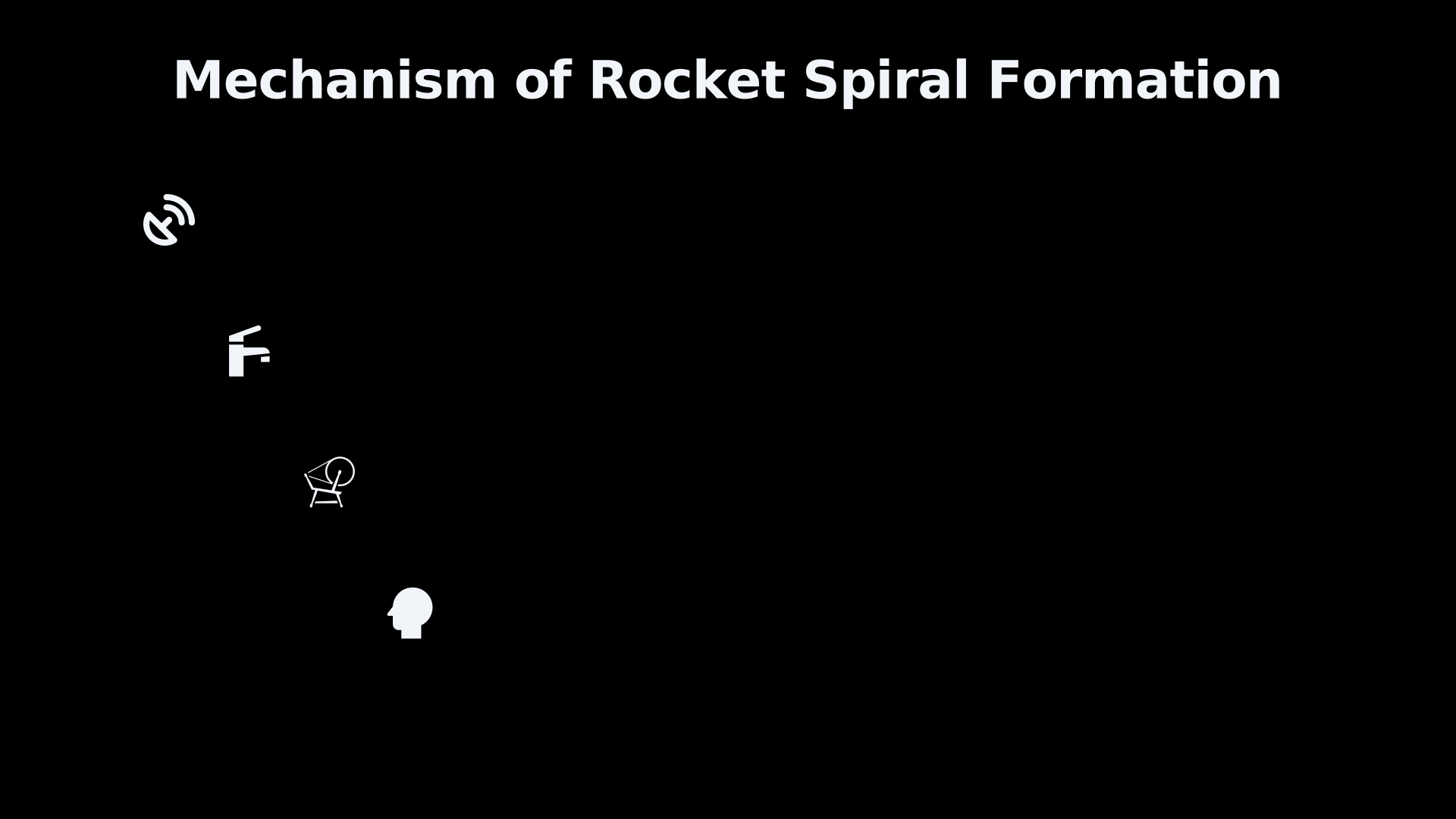
A giant luminous spiral in the night sky can look remarkably like a nearby galaxy, a rotating craft or an unexplained atmospheric vortex. In well-documented cases, however, the “spiral” is not a solid object at all. It is an expanding cloud released by a rocket’s upper stage. Residual propellant, pressurant or exhaust is expelled while the stage is rotating or changing attitude, so successive parcels of material leave in changing directions. As the cloud expands, those emissions trace a widening spiral or pinwheel around the stage’s path.
The effect becomes especially conspicuous when the upper stage and its plume remain in sunlight while observers below are already in darkness. NASA has described a Falcon 9 plume photographed from Iceland as a “galaxy-shaped rocket exhaust spiral”, while observatories and astronomers have linked similar displays over Hawaiʻi, New Zealand and Europe to upper-stage activity.[nasa.gov]apod.nasa.govAstronomy Picture of the DayMarch 12, 2024…
How vented material becomes a spiral
The essential ingredients are simple: a source of gas or particles, an upper stage whose orientation is changing, and enough time for the released material to spread.
After delivering a payload, an upper stage may still contain propellant and pressurised fluids. Space vehicles are commonly “passivated” at the end of their useful mission — meaning stored energy is removed so that the abandoned stage is less likely to rupture or explode later. NASA defines passivation as removing stored energy from spacecraft and launch-vehicle stages, including depletion of residual propellants and pressurants. ESA likewise notes that remaining fuel can be vented into space as part of this process.[nasa.gov]nodis3.gsfc.nasa.govdisplay All.cfmNPR 8715.6A NASA Procedural Requirements for Limiting Orbital Debris (w/ Change 1 - 5/14/09)May 14, 2009…
Venting is not merely theoretical or invisible housekeeping. ESA has published telescope imagery of an Ariane 5 upper stage venting propellant during passivation, producing brilliant clouds on opposite sides of the stage. The observation demonstrates directly that an apparently empty upper stage can release substantial, optically detectable material after its satellites have departed.[European Space Agency]esa.intEuropean Space Agency ESAEuropean Space AgencyESA - Galileos separated from Ariane upper stageNovember 18, 2016…
If such material emerged from a perfectly stationary nozzle pointing continuously in one direction, it would tend to form a plume extending along that direction. But upper stages do not necessarily maintain one fixed orientation. They have attitude-control systems and may rotate, roll, tumble or reorient during post-deployment and disposal operations. Falcon 9’s second stage, for example, has a gaseous-nitrogen attitude-control system for pointing and roll control.[Scribd]scribd.comFalcon Users Guide 042020Falcon 9 User's Guide Overview | PDF | Falcon 9 | Space XApril 1, 2020…
Rotation changes the geometry dramatically. Imagine a garden sprinkler turning while releasing water. Material emitted at one instant travels away along one direction; material emitted moments later starts from a slightly different angle. Because the earlier material has already travelled farther from the source, the result is a pattern whose radius increases with time. Seen from a suitable viewpoint, it becomes a spiral.
That is the mechanism astronomer J. D. Armstrong of the University of Hawaiʻi Institute for Astronomy invoked after a spectacular event above Maunakea on 17 April 2022. A Subaru Telescope camera recorded what observers described as a “flying whirlpool”. Armstrong identified it with the Falcon 9 upper stage and explained that the stage appeared to be rotating as material was expelled, creating a pattern comparable to a pinwheel firework.[University of Hawaii]hawaii.eduOpen source on hawaii.edu.
The precise post-flight process can vary between missions, so “fuel dump” should not be treated as a universal description of every rocket spiral. Some displays are associated with post-deorbit-burn venting, others with exhaust or the depletion of residual material. The robust identification is broader: an expanding cloud from an upper stage whose motion turns an otherwise ordinary release into a geometric pattern.[Live Science]livescience.comLive ScienceShimmering 'night spiral' captured above Hawaii is actually a dying SpaceX rocket | Live ScienceApril 18, 2022…
Why the spiral can become enormous
The visible spiral is vastly larger than the rocket producing it. This is one reason witnesses can reasonably fail to recognise it as a spacecraft effect.
At orbital or near-orbital altitudes, released gas is not confined in the way a low-altitude exhaust plume is. It expands into an extremely tenuous environment. Each successive turn of the rotating emission therefore spreads outwards, enlarging the apparent pinwheel while its material simultaneously becomes more diffuse.
Perspective adds to the effect. The stage itself may be only a small bright point or may not be individually noticeable, while its expanding cloud occupies a conspicuous patch of sky. A photograph can consequently resemble a luminous spiral galaxy with a bright central region even though the structure is nearby material spreading through space rather than an astronomical object. NASA’s Astronomy Picture of the Day highlighted precisely this resemblance in March 2024, describing a Falcon 9 exhaust plume photographed from Akureyri, Iceland, as looking like a strangely close galaxy.[Astronomy Picture of the Day]apod.nasa.govMarch 12, 2024…
The 19 June 2022 New Zealand event showed how geographically extensive the effect can be. A blue spiral was reported across widely separated parts of the country, including the South Island, and the New Plymouth Astronomical Society linked its timing to a Falcon 9 mission carrying Globalstar FM15. Contemporary reports described the likely source as a fuel dump or exhaust plume from the rocket.[channelnewsasia.com]channelnewsasia.comCNABlue light spiral in New Zealand night sky stuns stargazersCNABlue light spiral in New Zealand night sky stuns stargazers
The source rocket does not need to have launched anywhere near the observer. By the time an upper stage performs later manoeuvres or disposal operations, it may have travelled an enormous distance from its launch site. This helps explain a particularly counter-intuitive feature of rocket-spiral reports: witnesses may search for local launches and find none, even though the responsible stage originated on another continent or has already travelled much of the way around Earth.
That geographical disconnect was striking on 18 January 2023. A Falcon 9 carrying a US military GPS satellite launched from Florida, yet the Subaru-Asahi Star Camera on Maunakea later recorded a bright object opening into a spiral above Hawaiʻi. The observed location matched where the Falcon 9 second stage was expected to be. Time-lapse imagery showed the object expanding from a compact bright form into the recognisable spiral and then disappearing.[AP News]apnews.comAP News Camera captures night sky spiral after Space X rocket launchAP News Camera captures night sky spiral after Space X rocket launch
Why sunlight makes the cloud visible
The expelled material does not have to generate its own brilliant light. Illumination geometry can do much of the work.
A rocket stage hundreds or thousands of kilometres from an observer may still be exposed to sunlight even though the ground beneath the observer is dark. Material around the stage can therefore scatter sunlight towards Earth against a night-sky background. The resulting contrast can transform an otherwise inconspicuous cloud into a luminous blue-white structure.
This is why the phenomenon is strongly associated with favourable lighting rather than merely with the quantity of material released. A similar vent in poor illumination might pass unnoticed. When the stage is sunlit and the observer is in darkness, the same release can become spectacular.
The large spiral seen across Britain and parts of Europe on 24 March 2025 provided a particularly clear demonstration. The UK Met Office attributed reports of an illuminated swirl to a Falcon 9 launch and explained that its frozen exhaust plume was reflecting sunlight while appearing to spin. Photographs from locations including Suffolk, North Yorkshire, Windsor, Wigan and Crewe showed a remarkably coherent spiral despite the great distance from the rocket’s Florida launch site.[Sky at Night Magazine]skyatnightmagazine.comOpen source on skyatnightmagazine.com.
Descriptions of “frozen exhaust” or ice are physically plausible for material containing condensable substances released into the cold, low-pressure environment, but the crucial observational point is reflected or scattered sunlight. The cloud becomes visible because there are particles or droplets capable of redirecting solar illumination towards the observer. The spiral’s colour in photographs can also depend on illumination, atmospheric transmission, camera response and exposure rather than revealing an exotic light source.
This geometry also explains why a spiral can apparently materialise against an otherwise dark sky. Nothing necessarily switched on at the location where the witness first noticed it. The expanding material may simply have entered favourable illumination or become sufficiently large and bright to attract attention.
Expansion and fading are clues to a rocket origin
A useful clue is that a rocket spiral behaves more like an expanding cloud than a rigid craft.
The pattern may begin as a compact glow, develop curved arms or concentric-looking turns, grow rapidly and become increasingly transparent. Eventually the structure loses contrast and disappears. That evolution follows naturally from material moving away from the upper stage: the cloud’s volume grows while a finite quantity of material is distributed through an ever larger region.
The January 2023 Maunakea sequence is particularly informative because the Subaru camera captured the evolution rather than merely a single dramatic photograph. Contemporary reporting described a white orb spreading into a spiral as it crossed the sky and subsequently fading away. The position also corresponded to the expected location of the Falcon 9 second stage.[AP News]apnews.comAP News Camera captures night sky spiral after Space X rocket launchAP News Camera captures night sky spiral after Space X rocket launch
The April 2022 Maunakea observation supplied another independent example from the same astronomical site. The University of Hawaiʻi connected the event to a Falcon 9 launched from Vandenberg Space Force Base earlier that day, while satellite-tracking analysis identified the characteristic spiral with post-deorbit-burn upper-stage venting.[University of Hawaii]hawaii.eduOpen source on hawaii.edu.
Several features therefore reinforce one another when assessing a reported spiral:
- It expands rather than retaining a rigid outline. Older material has travelled farther from the stage, so the pattern opens out with time.
- Its arms become increasingly diffuse. The released material spreads through a growing volume rather than behaving like a solid rotating structure.
- A bright point may lie near the centre or leading part of the cloud. That can correspond to the stage or the densest region of recently released material.
- It fades over minutes. Expansion lowers the cloud’s optical density, while changing sunlight geometry can make it disappear even more quickly.
- Its timing and trajectory can coincide with an upper stage. Matching the observation against launch and orbital information can connect a display seen far from the launch site to the responsible vehicle.
None of these signs alone proves that every spiral photograph depicts a rocket. Their value comes from combination. When an expanding spiral occurs at the predicted time and position of a known upper stage, evolves like dispersing material and appears under suitable solar illumination, the rocket explanation becomes testable rather than merely a resemblance-based guess.

Why rocket spirals are persuasive UFO lookalikes
Rocket spirals are unusually effective at generating UFO or UAP reports because they violate everyday expectations about what rockets should look like. Most people picture a rocket as a bright point followed by a narrow flame or trail. They do not expect a launch conducted hours earlier and thousands of kilometres away to produce a galaxy-sized pinwheel above them.
The mechanism also produces several characteristics that sound strange when described without context: a glowing object appears suddenly, develops symmetrical arms, expands dramatically, moves across the stars and then vanishes. Those observations can all be substantially accurate while the interpretation of a structured flying object is mistaken.
Repeated observations make the mundane mechanism unusually well constrained. Spirals have been recorded by astronomical cameras, correlated with known rocket trajectories and observed after separate Falcon 9 missions in Hawaiʻi, New Zealand, Iceland and Europe. The individual displays differ in size, brightness and shape, but the recurring combination of upper-stage activity, rotation or changing attitude, expanding expelled material and favourable sunlight accounts for their characteristic appearance.[hawaii.edu]hawaii.eduOpen source on hawaii.edu.
The phenomenon is also not fundamentally unique to SpaceX. Passivation and residual-propellant disposal are established spacecraft and launch-vehicle practices. ESA has documented Ariane upper stages venting propellant, and NASA describes end-of-mission passivation as an important measure for reducing the risk of orbital break-ups. What determines whether that engineering operation becomes a spectacular sight from the ground is the combination of vent geometry, stage motion, viewing direction and sunlight.[esa.int]esa.intEuropean Space Agency ESAEuropean Space AgencyESA - Galileos separated from Ariane upper stageNovember 18, 2016…
For UFO identification, that leads to a useful distinction. A spiral’s extraordinary geometry is not evidence by itself that an extraordinary vehicle produced it. In this particular class of sightings, the geometry is precisely what ordinary orbital mechanics, rotating hardware and expanding material can create. The apparent “galaxy” is the visible history of material leaving a moving upper stage — each widening turn recording where the vent was pointing moments earlier.
Amazon book picks
Further Reading
Books and field guides related to What Creates Giant Spirals in the Night Sky. Use these as the next step if you want deeper reading beyond the article.
Reentry: SpaceX, Elon Musk, and the Reusable Rockets that Lau...
Featured in The Economist’s Best Books of 2024 USA Today Bestseller How did a shaky startup defy expectations and become the world’s lead...
Liftoff: Elon Musk and the Desperate Early Days That Launched...
The dramatic inside story of the first four historic flights that launched SpaceX-and Elon Musk-from a shaky startup into the world's lea...
Ignition!: An Informal History of Liquid Rocket Propellants
John Clark tells here, with irreverent and eyewitness immediacy, the story of the search for a power packaging which could be trusted to...
Rocket Propulsion Elements
Rating: 4.5/5 from 11 Google Books ratings
Aerospace Engineering/Mechanical Engineering The definitive text on rocket propulsion-now completely revised to reflect rapid advancement...
eBay marketplace picks
Marketplace Samples
Live-tested eBay searches with available results related to this page.
Selected fromUFO pin oneBay.co.uk.

Endnotes
1.
Source: apod.nasa.gov
Title: Astronomy Picture of the Day
Link:https://apod.nasa.gov/rjn/apod/ap240312.html
Source snippet
March 12, 2024...
Published: March 12, 2024
2.
Source: hawaii.edu
Link:https://www.hawaii.edu/news/2022/04/26/mysterious-swirl-maunakea-telescope/
3.
Source: channelnewsasia.com
Title: CNABlue light spiral in New Zealand night sky stuns stargazers
Link:https://www.channelnewsasia.com/world/blue-light-spiral-new-zealand-night-sky-stuns-stargazers-2757736
4.
Source: nodis3.gsfc.nasa.gov
Title: display All.cfm
Link:https://nodis3.gsfc.nasa.gov/displayAll.cfm?Internal_ID=N_PR_8715006A&page_name=all
Source snippet
NPR 8715.6A NASA Procedural Requirements for Limiting Orbital Debris (w/ Change 1 - 5/14/09)May 14, 2009...
Published: May 14, 2009
5.
Source: esa.int
Title: European Space Agency ESA
Link:https://www.esa.int/Enabling_Support/Operations/Space_debris_mitigation_the_case_for_a_code_of_conduct
Source snippet
European Space AgencyESA - Space debris mitigation: the case for a code of conduct...
6.
Source: ntrs.nasa.gov
Link:https://ntrs.nasa.gov/citations/20210019018
Source snippet
NASA Technical Reports ServerSpacecraft Passivation – An Overview of Requirements, Principles, and Practices - NASA Technical Reports Ser...
7.
Source: esa.int
Title: European Space Agency ESA
Link:https://www.esa.int/ESA_Multimedia/Images/2016/11/Galileos_separated_from_Ariane_upper_stage
Source snippet
European Space AgencyESA - Galileos separated from Ariane upper stageNovember 18, 2016...
Published: November 18, 2016
8.
Source: scribd.com
Title: Falcon Users Guide 042020
Link:https://www.scribd.com/document/494885606/Falcon-Users-Guide-042020
Source snippet
Falcon 9 User's Guide Overview | PDF | Falcon 9 | Space XApril 1, 2020...
Published: April 1, 2020
9.
Source: space.com
Title: Eerie blue spiral in night sky over Hawaii spawned by Space X rocket | Space
Link:https://www.space.com/spacex-gps-rocket-launch-spiral-hawaii
10.
Source: ntrs.nasa.gov
Title: Technical Reports Server End-of-Mission Passivation: Successes and Challenges
Link:https://ntrs.nasa.gov/citations/20130001570
11.
Source: esa.int
Link:https://www.esa.int/ESA_Multimedia/Images/2026/07/The_first_Ariane_6_rocket_soars
12.
Source: spacex.com
Title: Space X
Link:https://www.spacex.com/launches/starfalldemo
13.
Source: spacex.com
Title: Space X
Link:https://www.spacex.com/launches/bluebird8-10
14.
Source: spacex.com
Title: Space X
Link:https://www.spacex.com/launches/sl
15.
Source: spacex.com
Title: Space X
Link:https://www.spacex.com/launches/sl
16.
Source: spacex.com
Title: Space X
Link:https://www.spacex.com/launches/sl
17.
Source: spacex.com
Title: Space X
Link:https://www.spacex.com/launches/nrol172
18.
Source: spacex.com
Title: Space X
Link:https://www.spacex.com/launches/cas500-2
19.
Source: spacex.com
Title: Space X
Link:https://www.spacex.com/launches/sl
20.
Source: techport.nasa.gov
Link:https://techport.nasa.gov/projects/184147
21.
Source: esa.int
Link:https://www.esa.int/ESA_Multimedia/Images/2026/03/Smile_hoisting_Vega-C_fourth_stage_for_flight_VV29
22.
Source: esa.int
Link:https://www.esa.int/ESA_Multimedia/Images/2026/03/Smile_transporting_fourth_stage_to_the_Vega-C_launch_pad
23.
Source: spacex.com
Title: Space X
Link:https://www.spacex.com/launches/echostarxxv
24.
Source: esa.int
Link:https://www.esa.int/ESA_Multimedia/Images/2023/08/Ariane_6_project_logo
25.
Source: nasa.gov
Title: Crew-12: Max Q, Main Engine Cutoff, [Stage Separation]({{ ‘stage-separation/’ | relative_url }})
Link:https://www.nasa.gov/blogs/commercialcrew/2026/02/13/crew-12-max-q-main-engine-cutoff-stage-separation/
26.
Source: nasa.gov
Title: NAS A’s Space X Crew-12 Suit Up
Link:https://www.nasa.gov/blogs/commercialcrew/2026/02/13/nasas-spacex-crew-12-suit-up/
27.
Source: scribd.com
Title: BB C Sky at Night
Link:https://www.scribd.com/document/892112292/BBC-Sky-at-Night-June-2025-Freemagazines-Top
28.
Source: nasa.gov
Title: Image of the Day
Link:https://www.nasa.gov/image-of-the-day/page/81/?id=367712
29.
Source: nasa.gov
Title: Image of the Day
Link:https://www.nasa.gov/image-of-the-day/page/82/?id=355297
30.
Source: nasa.gov
Title: Image of the Day
Link:https://www.nasa.gov/image-of-the-day/page/19/?id=382688
31.
Source: nasa.gov
Title: Image of the Day
Link:https://www.nasa.gov/image-of-the-day/page/19/?id=350064
32.
Source: nasa.gov
Title: Image of the Day
Link:https://www.nasa.gov/image-of-the-day/page/19/?id=373323
33.
Source: nasa.gov
Title: Image of the Day
Link:https://www.nasa.gov/image-of-the-day/page/20/?id=341838
34.
Source: nasa.gov
Title: Image of the Day
Link:https://www.nasa.gov/image-of-the-day/page/19/?id=384482
35.
Source: space.com
Link:https://www.space.com/space-exploration/launches-spacecraft/mysterious-blue-spiral-spotted-over-european-skies-what-was-it-photos
36.
Source: esa.int
Link:https://www.esa.int/ESA_Multimedia/Images/2025/03/Ariane_6_VA263_soars_through_the_sky
37.
Source: spacex.com
Title: Space X
Link:https://www.spacex.com/launches/sl
38.
Source: nasa.gov
Title: images from 2024
Link:https://www.nasa.gov/gallery/images-from-2024/
39.
Source: esa.int
Link:https://www.esa.int/ESA_Multimedia/Images/2024/11/Acoustic_test_for_Ariane_6_upper_stage
40.
Source: spacex.com
Title: Space X
Link:https://www.spacex.com/launches/sl
41.
Source: esa.int
Link:https://www.esa.int/ESA_Multimedia/Images/2024/07/The_first_Ariane_6_rocket_soars_to_the_sky2
42.
Source: esa.int
Link:https://www.esa.int/ESA_Multimedia/Images/2024/06/SpaceCase_SCX-01_top
43.
Source: esa.int
Link:https://www.esa.int/ESA_Multimedia/Images/2024/05/Artist_s_view_of_the_Ariane_6_upper_stage_in_flight_on_first_mission
44.
Source: esa.int
Link:https://www.esa.int/ESA_Multimedia/Images/2024/02/Ariane_6_test_model_umbilicals
45.
Source: ntrs.nasa.gov
Link:https://ntrs.nasa.gov/citations/20230014779
46.
Source: ntrs.nasa.gov
Link:https://ntrs.nasa.gov/citations/20220015764
47.
Source: esa.int
Link:https://www.esa.int/Enabling_Support/Space_Transportation/Ariane/Ariane_5_payload_and_geography_open_super-efficient_path_to_GEO
48.
Source: space.com
Title: Wild blue spiral in New Zealand sky made by Space X rocket (photo) | Space
Link:https://www.space.com/spacex-rocket-launch-blue-spiral-photo
49.
Source: space.com
Link:https://www.space.com/night-spiral-over-hawaii
50.
Source: esa.int
Link:https://www.esa.int/ESA_Multimedia/Images/2021/02/Ariane_6_upper_stage_installed_for_tests5
51.
Source: esa.int
Link:https://www.esa.int/ESA_Multimedia/Images/2021/02/Ariane_6_upper_stage_installed_for_tests7
52.
Source: esa.int
Link:https://www.esa.int/ESA_Multimedia/Images/2021/02/Ariane_6_upper_stage_installed_for_tests2
53.
Source: ro.scribd.com
Title: Falcon Users Guide 042020
Link:https://ro.scribd.com/document/494885606/Falcon-Users-Guide-042020
54.
Source: id.scribd.com
Title: Falcon Users Guide 042020
Link:https://id.scribd.com/document/494885606/Falcon-Users-Guide-042020
55.
Source: esa.int
Link:https://www.esa.int/ESA_Multimedia/Images/2019/11/Vega-C_fairing_s_trial_by_sound
56.
Source: esa.int
Link:https://www.esa.int/ESA_Multimedia/Images/2019/02/Ariane_6_upper_stage_test_facility6
57.
Source: esa.int
Link:https://www.esa.int/ESA_Multimedia/Images/2019/02/Ariane_6_upper_stage_Test_cell
58.
Source: esa.int
Link:https://www.esa.int/ESA_Multimedia/Images/2019/02/Ariane_6_upper_stage_test_facility
59.
Source: space.com
Title: Strange Sky Spiral May Come from Secretive Space X Zuma Launch | Space
Link:https://www.space.com/39338-spacex-zuma-rocket-sky-spiral-photos.html
60.
Source: blogs.esa.int
Title: int SM A valves to prevent in-orbit explosions – The Clean Space blog
Link:https://blogs.esa.int/cleanspace/2017/07/21/sma-valves-to-prevent-in-orbit-explosions/
61.
Source: esa.int
Link:https://www.esa.int/ESA_Multimedia/Images/2016/11/Passivation_methods
62.
Source: esa.int
Link:https://www.esa.int/Space_Safety/Clean_Space/CleanSat_disposal_essential_for_swelling_satellite_population
63.
Source: ntrs.nasa.gov
Link:https://ntrs.nasa.gov/citations/20160000336
64.
Source: ntrs.nasa.gov
Link:https://ntrs.nasa.gov/search.jsp?R=20150016482
65.
Source: ntrs.nasa.gov
Link:https://ntrs.nasa.gov/citations/20140000623
66.
Source: ntrs.nasa.gov
Link:https://ntrs.nasa.gov/citations/20130013526
67.
Source: nodis3.gsfc.nasa.gov
Title: display CA.cfm
Link:https://nodis3.gsfc.nasa.gov/displayCA.cfm?Internal_ID=N_PR_87150006&page_name=AppendixA
68.
Source: nodis3.gsfc.nasa.gov
Title: display CA.cfm
Link:https://nodis3.gsfc.nasa.gov/displayCA.cfm?Internal_ID=N_PR_87150006&page_name=Chapter3
69.
Source: ntrs.nasa.gov
Link:https://ntrs.nasa.gov/citations/20060056240
70.
Source: ntrs.nasa.gov
Link:https://ntrs.nasa.gov/citations/20020050395
71.
Source: ntrs.nasa.gov
Link:https://ntrs.nasa.gov/citations/19990047911
72.
Source: ntrs.nasa.gov
Link:https://ntrs.nasa.gov/citations/19990106579
73.
Source: ntrs.nasa.gov
Link:https://ntrs.nasa.gov/citations/19900030960
74.
Source: spacex.com
Title: Space X
Link:https://www.spacex.com/vehicles/falcon-9/%20%20%20rel
75.
Source: apod.nasa.gov
Title: apod search
Link:https://apod.nasa.gov/cgi-bin/apod/apod_search?tquery=Milky+Way
76.
Source: apod.nasa.gov
Title: apod search
Link:https://apod.nasa.gov/cgi-bin/apod/apod_search?tquery=2026
77.
Source: esa.int
Link:https://www.esa.int/Space_Safety/Clean_Space/Zero_Debris_Technologies
78.
Source: livescience.com
Link:https://www.livescience.com/night-spiral-over-hawaii
Source snippet
Live ScienceShimmering 'night spiral' captured above Hawaii is actually a dying SpaceX rocket | Live ScienceApril 18, 2022...
Published: April 18, 2022
79.
Source: odt.co.nz
Link:https://www.odt.co.nz/news/national/spectacular-spiral-seen-south-island-skies
80.
Source: apnews.com
Title: AP News Camera captures night sky spiral after Space X rocket launch
Link:https://apnews.com/article/d0f19d48010a2ccc26ccba31387d47d5
81.
Source: skyatnightmagazine.com
Link:https://www.skyatnightmagazine.com/news/strange-spiral-cloud-in-the-sky
82.
Source: skyatnightmagazine.com
Title: 17 things commonly mistaken for UFOs | BBC Sky at Night Magazine
Link:https://www.skyatnightmagazine.com/space-science/things-mistaken-for-ufos
83.
Source: skyatnightmagazine.com
Link:https://www.skyatnightmagazine.com/advice/strange-flash-in-the-night-sky-explanation
84.
Source: sprite.phys.ncku.edu.tw
Link:https://sprite.phys.ncku.edu.tw/astrolab/mirrors/apod_e/ap240312.html
85.
Source: freerepublic.com
Title: Astronomy Picture of the Day
Link:https://freerepublic.com/focus/f-chat/4223767/posts
86.
Source: isro.gov.in
Title: LVM3M4 Re Entry Cryogenic Upper Stage
Link:https://www.isro.gov.in/ISRO_EN/LVM3M4_[ReEntry
Additional References
87.
Source: faa.gov
Link:https://www.faa.gov/taxonomy/term/13171
88.
Source: faa.gov
Link:https://www.faa.gov/taxonomy/term/2631
89.
Source: youtube.com
Title: What Is This Mysterious Spiral Anomaly in the Norwegian Sky?
Link:https://www.youtube.com/watch?v=FgWgsstTx-8
Source snippet
What the Flying Spiral Spotted Over Hawaii Actually Means...
90.
Source: youtube.com
Title: Strange blue spiral over Hawaii created by Space X rocket
Link:https://www.youtube.com/watch?v=T9Vyx6GGdds
Source snippet
What Is This Mysterious Spiral Anomaly in the Norwegian Sky?...
91.
Source: faa.gov
Link:https://www.faa.gov/space/stakeholder_engagement/SpaceX_Falcon_SLC_40_EA
92.
Source: faa.gov
Title: FA A Commercial Human Space Flight Recognition | Federal Aviation Administration
Link:https://www.faa.gov/space/human_spaceflight/recognition
93.
Source: faa.gov
Title: The Facts About FAA Commercial Space Oversight | Federal Aviation Administration
Link:https://www.faa.gov/blog/clearedfortakeoff/facts-about-faa-commercial-space-oversight
94.
Source: facebook.com
Link:https://www.facebook.com/groups/ElonMusk/posts/4169113176516520/
95.
Source: researchgate.net
Link:https://www.researchgate.net/publication/245433333_Jet-Damping_and_Misalignment_Effects_During_Solid-Rocket-_Motor_Burn
96.
Source: researchgate.net
Link:https://www.researchgate.net/publication/373981707_Spiral_Arm_Formation_of_Galaxies_Through_ROTASE_Mechanism_is_Perfectly_Demonstrated_by_Falling_Rockets_Venting_Fuel