Within UFO Identifications
When Radar Shows a Target That Misleads
Radar can register spurious or ambiguous returns that require context from other sensors before they can be treated as physical craft.
On this page
- How radar returns become ambiguous
- Why single sensor tracks need corroboration
- Cross checking radar with visual and flight data
Page outline Jump by section
Introduction
Radar can produce convincing targets that are not aircraft, and in some circumstances can display a target at the wrong position, range or velocity. That does not make radar unreliable. It means that a radar display is the end product of radio propagation, reflections, filtering and tracking software, all of which have known failure modes. The US Federal Aviation Administration (FAA), for example, explicitly warns that atmospheric ducting can create numerous extraneous blips, while aviation standards recognise a non-zero probability of false tracks even in operational surveillance systems.[Federal Aviation Administration]faa.govFederal Aviation Administrationwww.faa.govFederal Aviation Administrationwww.faa.gov
For UFO or UAP investigation, the practical consequence is important: a radar track is evidence of a radar detection, but it is not automatically proof of a discrete physical craft following the displayed trajectory. Investigators need to determine what generated the return, whether the displayed position and motion are trustworthy, and whether independent sensors observed the same event. US intelligence assessments have likewise stressed that sensor vantage point and simultaneous observation by multiple systems are important when deciding whether an apparent UAP actually displays unusual aerospace performance.[Archive DNI]archive.dni.govArchive DNI
How radar returns become ambiguous
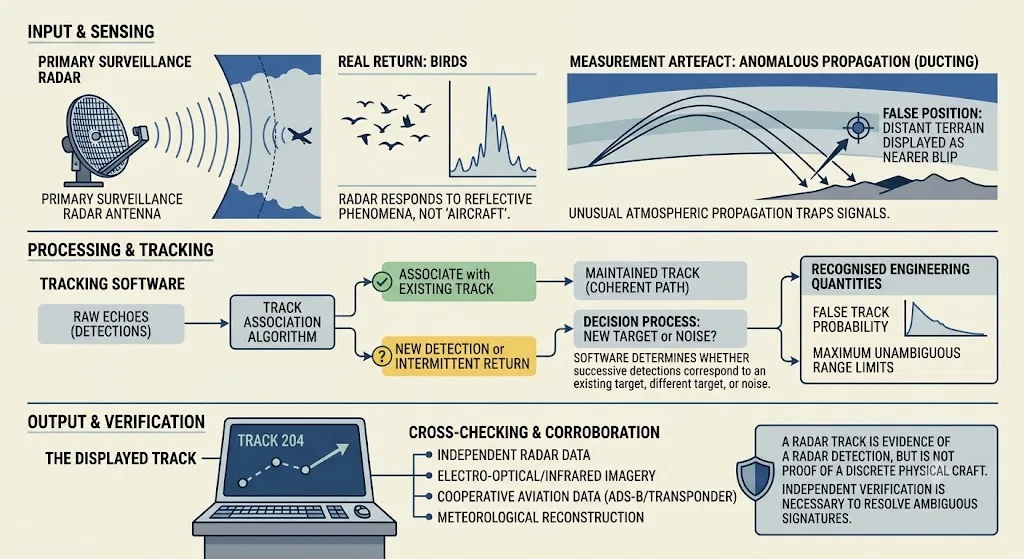
A primary surveillance radar transmits radio energy and measures energy reflected back towards its antenna. That basic principle creates an unavoidable identification problem: radar responds to reflective phenomena, not to the concept of an “aircraft”. Terrain, buildings, weather, birds, insects and other objects can all produce returns under suitable conditions. The FAA notes that dense objects and weather phenomena can reflect enough radar energy to appear on a scope or obscure aircraft returns, while the US National Weather Service (NWS) even uses the traditional term “angels” for echoes caused by birds, insects and localised variations in atmospheric refractive index.[Federal Aviation Administration]faa.govFederal Aviation Administrationwww.faa.govFederal Aviation Administrationwww.faa.gov
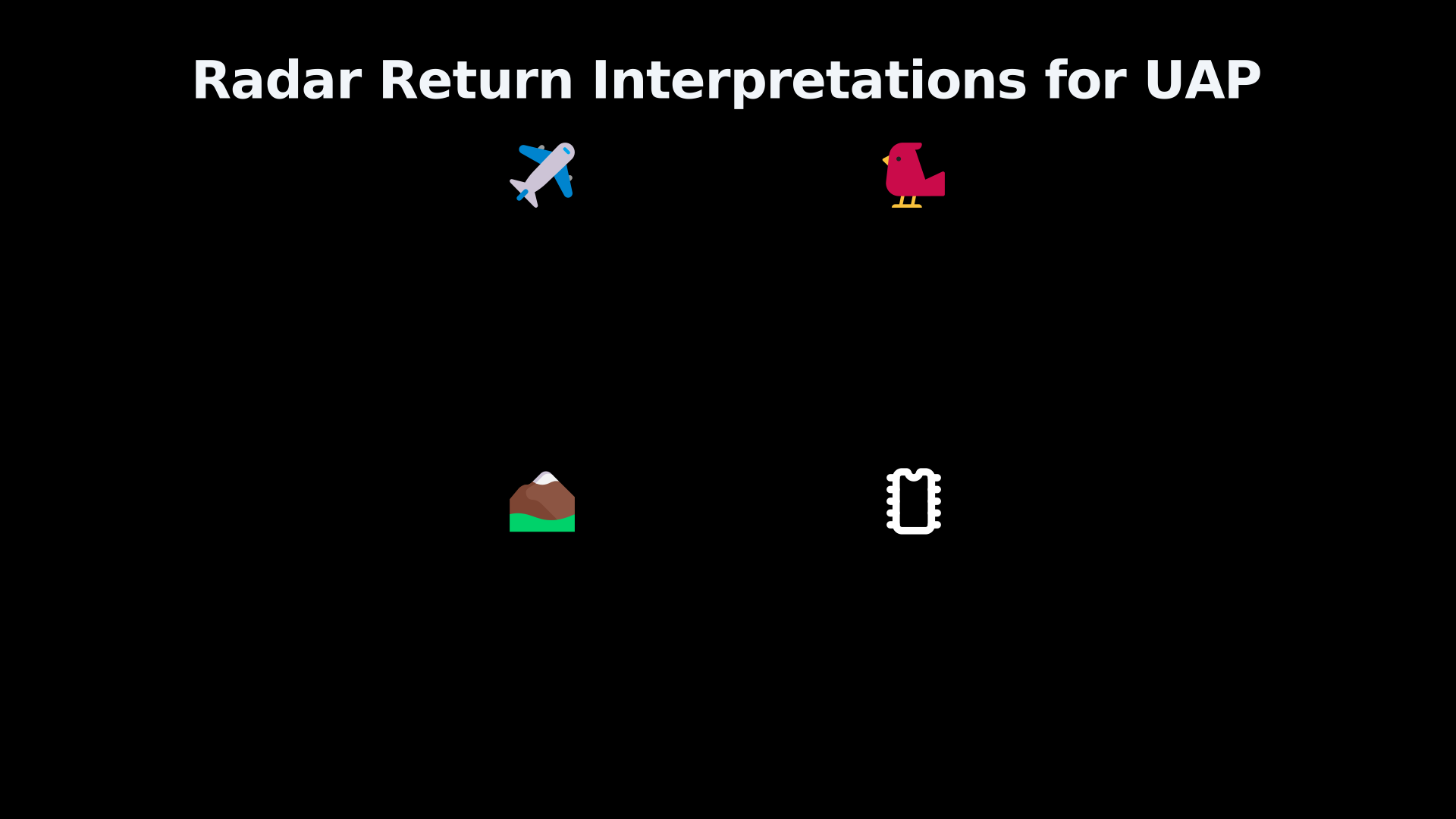
That creates two distinct kinds of misleading target which are easily conflated in discussions of UAP. One is a real return from the wrong kind of object: a flock of birds, for example, genuinely reflects radar energy but is not an unknown craft. The other is a measurement or processing artefact, in which the system assigns a return an incorrect position, range, speed or track. A third possibility lies between them: the radar is receiving real reflected energy, but unusual atmospheric propagation means the energy has followed a path the system was not designed to interpret normally.[Federal Aviation Administration]faa.govFederal Aviation Administrationwww.faa.govFederal Aviation Administrationwww.faa.gov
Atmospheric ducting can create targets where operators do not expect them
Ordinarily, a radar system interprets a return on the assumption that its beam has propagated through the atmosphere in a broadly predictable way. Temperature and humidity gradients can upset that assumption. Under strong super-refraction, the beam bends downwards more than usual; if the effect is sufficiently strong, the signal can become trapped in an atmospheric layer in a process called ducting. It may then strike distant terrain or structures that would normally lie below the radar horizon and return energy to the antenna.[National Weather Service]weather.govNational Weather Service NWS Radar: Short-Comings of the RadarNational Weather Service NWS Radar: Short-Comings of the Radar
The result can look like a collection of targets. The FAA’s Aeronautical Information Manual specifically says that anomalous propagation or ducting may cause “many extraneous blips” when radar pulses are bent towards the ground. Meteorologists encounter the same phenomenon routinely: the NWS describes anomalous propagation as a source of false echoes, often strongest at low antenna elevations and closely associated with temperature inversions or abrupt decreases in moisture with altitude.[Federal Aviation Administration]faa.govFederal Aviation Administrationwww.faa.govFederal Aviation Administrationwww.faa.gov
This matters for unusual-target reports because the apparent echo need not occur where the reflecting object actually is in straightforward three-dimensional space. The radar calculates location from the assumed travel path and timing of its signal. If propagation departs substantially from that model, an ordinary distant reflector can appear in an unexpected part of the display. Atmospheric conditions therefore have to be reconstructed before unusual range or position is treated as evidence of extraordinary motion.[National Weather Service]weather.govNational Weather Service NWS Radar: Short-Comings of the RadarNational Weather Service NWS Radar: Short-Comings of the Radar
One useful diagnostic is repeatability across elevation angles and neighbouring sensors. The NWS notes that anomalous-propagation clutter commonly appears on the lowest radar elevation and may disappear at higher elevations; it recommends checking adjacent radars and independent satellite imagery when deciding whether a suspicious weather-radar return is genuine. The same logic transfers directly to UAP analysis: an echo whose behaviour changes exactly as an expected propagation artefact should be treated differently from a coherent target independently detected from another geometry.[National Weather Service]weather.govNational Weather Service NWS Weather RadarNational Weather Service NWS Weather Radar
A displayed track is more than a raw echo
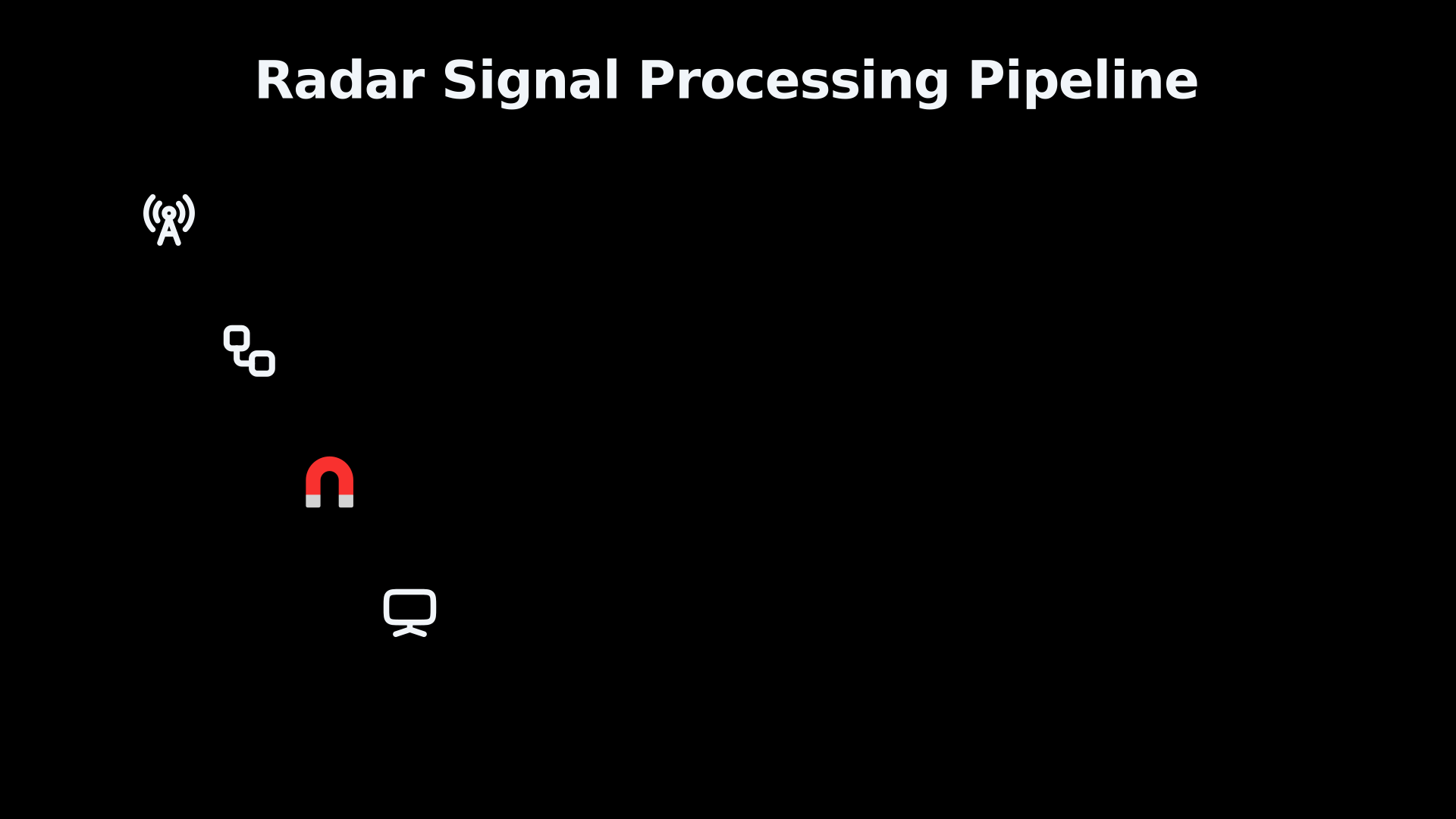
Modern radar displays generally do not consist simply of untouched reflections painted onto a screen. Processing attempts to suppress clutter, extract likely targets and associate successive detections into tracks. That improves usability enormously, but it introduces another distinction relevant to UAP reports: a track is an interpretation of detections over time.
Tracking software must decide whether a new return corresponds to an existing target, a different target or noise. It may predict where an established target ought to appear on the next scan and associate a new detection with that prediction. When returns are intermittent or ambiguous, systems can consequently produce phenomena such as false tracks, split tracks or incorrect associations. Such failures are recognised engineering quantities, not speculative explanations invented for UFO cases. Current US aeronautical material specifies maximum false-track probabilities for airborne collision-avoidance surveillance: less than 1.2 per cent for Mode A/C and less than 0.1 per cent for Mode S under the referenced specification.[Federal Aviation Administration]faa.govOpen source on faa.gov.
The important point is not that one per cent of every radar target is false; the figure applies to a particular surveillance requirement and should not be generalised to all radars. Its significance is that false-track probability is an explicitly measured characteristic of real aviation surveillance systems. Engineers design around it because no detection-and-tracking chain is perfectly immune to interference, garbled returns, target confusion or processing errors.[Federal Aviation Administration]faa.govOpen source on faa.gov.
Range itself can also become ambiguous in pulsed radar. The NWS explains a standard example known as the maximum unambiguous range problem: energy from an earlier pulse can return only after the radar has transmitted a subsequent pulse. If the system attributes the delayed echo to the wrong transmission, a distant reflector can be displayed at an incorrect, nearer range. Doppler radar has an analogous velocity ambiguity: motion faster than the system’s unambiguous velocity interval can be “folded” and displayed as another velocity.[National Weather Service]forecast.weather.govNational Weather Service NOAA's National Weather ServiceNational Weather ServiceNOAA's National Weather Service - Glossary…
Those mechanisms are especially relevant whenever a UAP claim depends on a derived number — extreme speed, sudden acceleration or an implausible change in range — rather than on a plainly resolved object. Before accepting the derived motion, an investigator needs to know which radar mode produced it, whether the value came from a raw detection or a maintained track, what ambiguity limits applied, and whether the underlying data are available for reconstruction.
Clutter can be physical without being a craft
Not every misleading radar target is an electronic phantom. Radar may accurately detect something in the air while giving the operator too little information to identify what it is. Birds and insects are a particularly useful demonstration because meteorological radars detect them routinely. The NWS classifies such biological detections alongside other non-weather returns, and its glossary explicitly identifies birds and insects as sources of radar echoes.[NWS Training Portal]training.weather.govNWS Training PortalDual-Pol Overview for Non-MeteorologistsOn the reflectivity image (at the left), click the echoes that best represent…
Ground clutter presents a related problem. Ordinary terrain, buildings and vegetation can return energy whenever they fall within the radar beam. Under anomalous propagation, features usually below the beam may suddenly become visible, producing a transient field of unfamiliar echoes. The NWS notes that normal ground clutter may come from terrain, trees and buildings, whereas atmospheric super-refraction can make additional ground returns appear temporarily.[National Weather Service]weather.govNational Weather Service NWS Weather RadarNational Weather Service NWS Weather Radar
Filtering these returns is itself imperfect. The FAA describes moving target indication, or MTI, as a way of electronically suppressing stationary and slow-moving targets, but also notes that the technique has a disadvantage: an aircraft whose motion coincides with an MTI “blind” speed may itself fail to appear. A processing measure intended to eliminate false or unwanted targets can therefore also remove a genuine one.[Federal Aviation Administration]faa.govFederal Aviation Administrationwww.faa.govFederal Aviation Administrationwww.faa.gov
This is why the phrase “radar contact” needs qualification. At minimum, investigators should ask whether the reported contact was a primary return, a transponder-based secondary-surveillance response, an automatically generated track, or a fused display drawing on several surveillance sources. These are not equivalent kinds of evidence.
Why single-sensor tracks need corroboration
Radar is often treated as inherently stronger evidence than a visual sighting because it can measure range and radial velocity rather than relying entirely on human perception. That advantage is real, but it does not remove ambiguity. The 2021 US intelligence assessment on UAP noted both that radar clutter is a longstanding technical challenge and that the number and vantage points of sensors observing an event substantially affect the ability to distinguish an unknown detection from a known object and to judge apparently exceptional performance. It also stressed that military sensors are generally designed for specific missions rather than specifically for identifying UAP.[Archive DNI]archive.dni.govArchive DNI
Multiple sensors are valuable only when they are genuinely independent. Two displays fed by the same radar or by the same upstream track processor do not constitute two independent observations. Nor does a pilot seeing a symbol on a cockpit display and an operator seeing the same network-generated track at a ground station. Corroboration becomes considerably stronger when different physical measurement chains agree — for example, an independent radar, optical or infrared imagery, verified transponder or ADS-B information, and contemporaneous aircraft or weather records.
A useful example of this method appears in the All-domain Anomaly Resolution Office’s published Western United States case. AARO reports that distant objects seen as small dots in imagery were compared with commercial flight information and radar tracks; the tracks aligned with three commercial aircraft, supporting the ordinary-aircraft identification. The significance of the example is methodological rather than dramatic: the radar was most useful when combined with an independent image and external flight data, not when treated as a self-interpreting target.[AARO]aaro.milUAP ImageryAARO UAP Imagery…
AARO’s unresolved imagery cases illustrate the reverse problem. In several published cases it says that, without corroborating telemetry or multi-modal sensor data, analysts could not decide whether an apparent signature represented a physical source or a sensor artefact. Those particular examples concern infrared imagery rather than radar, but they express the same evidential principle: a single sensor can record a real anomaly in its data without establishing what physical event produced it.[AARO]aaro.milUAP ImageryAARO UAP Imagery…
Cross-checking radar with visual and flight data
A strong radar-UAP investigation therefore works backwards from the display to the underlying measurement chain. The aim is not to dismiss the radar contact, but to determine how much of the reported behaviour is actually constrained by independent evidence.
The highest-value checks are usually:
- Compare independent radars. A target seen from substantially different sites is harder to explain as local ground clutter, ducting or a site-specific processing error. Atmospheric conditions still matter, so agreement in reconstructed position is more valuable than merely finding activity on two screens. The NWS similarly recommends adjacent-radar comparison when checking anomalous propagation.[National Weather Service]weather.govNational Weather Service NWS Weather RadarNational Weather Service NWS Weather Radar
- Check elevation dependence. Returns confined to a low radar elevation and disappearing at higher scans can be characteristic of anomalous propagation and ground clutter.[National Weather Service]weather.govNational Weather Service NWS Weather RadarNational Weather Service NWS Weather Radar
- Recover raw measurements where possible. A maintained track may contain predictions, correlations and filtered detections that are not evident from a screenshot or operator recollection. Claims of sudden acceleration are much easier to evaluate if the original range, azimuth, Doppler and scan-by-scan data survive.
- Compare cooperative aviation data. Transponder surveillance, ADS-B records, air-traffic-control logs and flight plans can identify conventional aircraft that looked anomalous on another sensor. AARO’s Western US analysis demonstrates the value of matching imagery against radar tracks and commercial flight information.[AARO]aaro.milUAP ImageryAARO UAP Imagery…
- Reconstruct the atmosphere. Temperature inversions, moisture gradients and other refractive conditions can establish whether ducting was plausible at the reported time and place. FAA and NWS guidance both identify anomalous propagation as a recognised cause of extraneous or false radar echoes.[Federal Aviation Administration]faa.govFederal Aviation Administrationwww.faa.govFederal Aviation Administrationwww.faa.gov
- Seek independent visual or electro-optical evidence. A geometrically consistent image of a target where radar places it is much stronger than a visual impression that merely occurred at roughly the same time. Conversely, absence of a visible object is not decisive by itself: range, cloud, illumination and sensor sensitivity may prevent optical detection.
The strongest cases are those in which separate systems constrain the same target’s position and motion closely enough that ordinary artefacts can be tested rather than merely proposed. The weakest are reconstructed from a remembered scope presentation, a verbal speed estimate or a track symbol without the underlying radar data.
What radar evidence can and cannot establish
Radar anomalies are therefore neither trivial nor self-validating. A coherent radar track can be important evidence, particularly when original data allow range and velocity to be reconstructed. But aviation and meteorological practice provide well-understood mechanisms capable of generating misleading displays: anomalous propagation can introduce unexpected ground returns; birds and insects can form genuine airborne echoes; range and velocity can be ambiguous; filters can suppress real targets; and tracking systems have recognised false-track failure modes.[faa.gov]faa.govFederal Aviation Administrationwww.faa.govFederal Aviation Administrationwww.faa.gov
For UFO and UAP reports, the key question is consequently not simply “Was it on radar?” It is “What precisely did the radar measure, how was that measurement processed, and which independent observations confirm the displayed target and its claimed motion?” That distinction preserves the evidential value of radar without assigning more certainty to a track than the sensor architecture can support. The broader US intelligence assessment reaches much the same operational conclusion: sensor limitations, vantage geometry and the number of concurrent observations materially affect whether an anomalous detection can be distinguished from a known object or judged to possess genuinely unusual performance.[Archive DNI]archive.dni.govArchive DNI
Amazon book picks
Further Reading
Books and field guides related to When Radar Shows a Target That Misleads. Use these as the next step if you want deeper reading beyond the article.
Introduction to Radar Systems
Since the publication of the second edition of "Introduction to Radar Systems," there has been continual development of new radar capabil...
Radar Handbook
Publisher's Note: Products purchased from Third Party sellers are not guaranteed by the publisher for quality, authenticity, or access to...

Fundamentals of Radar Signal Processing
Fully updated and expanded, Fundamentals of Radar Signal Processing, Second Edition, offers comprehensive coverage of the basic digital s...
eBay marketplace picks
Marketplace Samples
Live-tested eBay searches with available results related to this page.
Selected fromaviation radar poster oneBay.co.uk.

Endnotes
1.
Source: faa.gov
Title: Federal Aviation Administrationwww.faa.gov
Link:https://www.faa.gov/air_traffic/publications/atpubs/AIM/aim0405.html
2.
Source: faa.gov
Link:https://www.faa.gov/air_traffic/publications/atpubs/aip_html/part1_gen_section_1.7.html
3.
Source: archive.dni.gov
Title: Archive DNI
Link:https://archive.dni.gov/files/ODNI/documents/assessments/Prelimary-Assessment-UAP-20210625.pdf
4.
Source: forecast.weather.gov
Title: National Weather Service NOAA’s National Weather Service
Link:https://forecast.weather.gov/glossary.php?word=A
Source snippet
National Weather ServiceNOAA's National Weather Service - Glossary...
5.
Source: weather.gov
Title: National Weather Service NWS Weather Radar
Link:https://www.weather.gov/mlb/Doppler_Dual_Pol_Weather_Radar
6.
Source: weather.gov
Title: National Weather Service NWS Radar: Short-Comings of the Radar
Link:https://www.weather.gov/bmx/radar_aboutnwsradar_shortcomings
7.
Source: training.weather.gov
Link:https://training.weather.gov/wdtd/courses/dualpol/Outreach/non-mets-intro/presentation.html
Source snippet
NWS Training PortalDual-Pol Overview for Non-MeteorologistsOn the reflectivity image (at the left), click the echoes that best represent...
8.
Source: aaro.mil
Title: UAP Imagery
Link:https://www.aaro.mil/UAP-Cases/Official-UAP-Imagery/
Source snippet
AARO UAP Imagery...
9.
Source: faa.gov
Link:https://www.faa.gov/air_traffic/publications/atpubs/aim_html/chap4_section_5.html
10.
Source: faa.gov
Link:https://www.faa.gov/air_traffic/publications/atpubs/aip_html/part2_enr_section_1.1.html
11.
Source: faa.gov
Link:https://www.faa.gov/sites/faa.gov/files/media/airports/2016/march/TC-15-53_Deployment_and_Assessment_of_Avian_Radar_Systems_at_John_F__Ken.pdf
12.
Source: faa.gov
Link:https://www.faa.gov/documentLibrary/media/Order/6310.6.pdf
13.
Source: faa.gov
Title: 6050.32B with Changes 1 2 3
Link:https://www.faa.gov/documentLibrary/media/Order/6050.32B_with_Changes_1_2_3.pdf
14.
Source: faa.gov
Link:https://www.faa.gov/documentlibrary/media/order/nd/8200.1c.pdf
15.
Source: faa.gov
Link:https://www.faa.gov/air_traffic/publications/atpubs/cnt_html/chap2_section_2.html
16.
Source: faa.gov
Link:https://www.faa.gov/uas/programs_partnerships/UAS_BAA_Call_005_Final_Report_Sagetech_ND.pdf
17.
Source: faa.gov
Link:https://www.faa.gov/documentlibrary/media/advisory_circular/ac_20-151b.pdf
18.
Source: faa.gov
Title: AIP Amd 1 dtd 7 9 26 Update
Link:https://www.faa.gov/air_traffic/publications/media/AIP_Amd_1_dtd_7-9-26_Update.pdf
19.
Source: faa.gov
Title: aip amd 1 dtd 11 3 22
Link:https://www.faa.gov/sites/faa.gov/files/aip_amd_1_dtd_11-3-22.pdf
20.
Source: faa.gov
Title: AIP Basic w Amd 1 dtd 7 9 26
Link:https://www.faa.gov/air_traffic/publications/media/AIP_Basic_w_Amd_1_dtd_7-9-26.pdf
21.
Source: faa.gov
Title: AIP 2025 02 20 Amd 2 post
Link:https://www.faa.gov/air_traffic/publications/media/AIP_2025-02-20_Amd_2_post.pdf
22.
Source: faa.gov
Title: aip amd 2 dtd 6 17 21
Link:https://www.faa.gov/air_traffic/publications/media/aip_amd_2_dtd_6-17-21.pdf
23.
Source: faa.gov
Title: AIP Amd 3 dtd 8 7 25
Link:https://www.faa.gov/air_traffic/publications/media/AIP_Amd_3_dtd_8-7-25.pdf
24.
Source: weather.gov
Link:https://www.weather.gov/media/lsx/ACRandABBR.pdf
25.
Source: forecast.weather.gov
Link:https://forecast.weather.gov/glossary.php?word=AP
26.
Source: weather.gov
Link:https://www.weather.gov/oun/spotterglossary
27.
Source: weather.gov
Link:https://www.weather.gov/roc/WindFarms
28.
Source: weather.gov
Link:https://www.weather.gov/media/tbw/workouts/2022jan25_ww_radarSatellite.pdf
29.
Source: weather.gov
Link:https://www.weather.gov/mkx/using-radar
30.
Source: forecast.weather.gov
Link:https://forecast.weather.gov/glossary.php?word=P
31.
Source: training.weather.gov
Link:https://training.weather.gov/wdtd/scripts/Glossary/glossary.php
32.
Source: weather.gov
Link:https://www.weather.gov/spotterguide/glossary_a
33.
Source: weather.gov
Link:https://www.weather.gov/mrx/radarrainfallestimates
34.
Source: training.weather.gov
Title: rac25 interpretation
Link:https://training.weather.gov/wdtd/courses/rac/documentation/rac25-interpretation.pdf
35.
Source: training.weather.gov
Title: rac25 principles
Link:https://training.weather.gov/wdtd/courses/rac/documentation/rac25-principles.pdf
36.
Source: training.weather.gov
Title: Tang2020 MRMSQPEupdates
Link:https://training.weather.gov/wdtd/courses/MRMS/lessons/Hydro-products/hydro2-v12.2/presentation_content/external_files/Tang2020-MRMSQPEupdates.pdf
37.
Source: weather.gov
Title: ROC MOU FY2006 final
Link:https://www.weather.gov/media/owp/oh/hrl/docs/ROC_MOU_FY2006_final.pdf
38.
Source: weather.gov
Link:https://www.weather.gov/media/aly/stormbuster/Spring12SB.pdf
39.
Source: training.weather.gov
Link:https://training.weather.gov/wdtd/courses/rac/principles/rain-est-errors/story_content/external_files/f710efff6a6af195b7ed8c4d359a8313a7e7.pdf
40.
Source: weather.gov
Title: MRMS Deeper Dive
Link:https://www.weather.gov/media/ctp/Advanced%20Radar%20Class%20Material/MRMS%20Deeper%20Dive.pdf
41.
Source: weather.gov
Link:https://www.weather.gov/media/mtr/baybreezes/spotter_newsletter_winter09.pdf
42.
Source: weather.gov
Link:https://www.weather.gov/media/directives/050_pdfs/pd05011015curr.pdf
43.
Source: aaro.mil
Link:https://www.aaro.mil/UAP-Cases/UAP-Case-Resolution-Reports/
44.
Source: aaro.mil
Link:https://www.aaro.mil/
45.
Source: aaro.mil
Link:https://www.aaro.mil/Portals/136/PDFs/AARO_Mission_Brief_2025.pdf
46.
Source: aaro.mil
Title: AARO Brief to SASC DoD UAP Mission April 19 2023 508
Link:https://www.aaro.mil/Portals/136/PDFs/AARO_Brief_to_SASC-DoD_UAP_Mission-April_19_2023_508.pdf
47.
Source: aaro.mil
Link:https://www.aaro.mil/FAQ/
48.
Source: aaro.mil
Title: AARO Historical Record Report Vol 1 2024
Link:https://www.aaro.mil/Portals/136/PDFs/AARO_Historical_Record_Report_Vol_1_2024.pdf
49.
Source: intelligence.gov
Link:https://www.intelligence.gov/publics-daily-brief/publics-daily-brief-articles/unidentified-aerial-phenomena-preliminary-intelligence-assessment
50.
Source: Wikipedia
Link:https://en.wikipedia.org/wiki/Sensor
51.
Source: Wikipedia
Title: Anomalous propagation
Link:https://en.wikipedia.org/wiki/Anomalous_propagation
52.
Source: Wikipedia
Link:https://en.wikipedia.org/wiki/Radar
53.
Source: keyence.co.uk
Link:https://www.keyence.co.uk/products/sensor/
54.
Source: sal.net.au
Link:https://www.sal.net.au/products/smart-controls-and-electrical-accessories/sensors
55.
Source: techtarget.com
Link:https://www.techtarget.com/whatis/definition/sensor
56.
Source: uk.farnell.com
Link:https://uk.farnell.com/technical-resources/technology/sensors
Additional References
57.
Source: youtube.com
Link:https://www.youtube.com/watch?v=XFapyIIzX_8
Source snippet
Introduction to Radar Systems – Lecture 7 – Radar Clutter and Chaff; Part 2...
58.
Source: war.gov
Link:https://www.war.gov/ufo/
59.
Source: icao.int
Link:https://www.icao.int/sites/default/files/APAC/Meetings/2023/2023%20Mode%20S%20and%20DAPs%20WG6/4-Information%20Papers/IP08_CHN-AI.3-A-Case-Analysis-of-Maneuvering-Aircraft-Track-Missing.pdf
60.
Source: eurocontrol.int
Link:https://www.eurocontrol.int/sites/default/files/2019-05/final_report_rev-.pdf
61.
Source: icao.int
Link:https://www.icao.int/sites/default/files/sp-files/APAC/Documents/Meetings/2008/cnsmet_sg12rpt.pdf
62.
Source: icao.int
Link:https://www.icao.int/sites/default/files/sp-files/SAM/Documents/2016-CBT/10057_draft_en.pdf
63.
Source: researchgate.net
Link:https://www.researchgate.net/publication/398332620_Micro-Doppler_radar_deception_and_camouflage_of_airborne_targets
64.
Source: icao.int
Link:https://www.icao.int/sites/default/files/Meetings/AMC/MA/2005/ADSB_ADSB_TF3/ip15.pdf
65.
Source: merriam-webster.com
Link:https://www.merriam-webster.com/dictionary/sensor
66.
Source: sensors.co.uk
Link:https://www.sensors.co.uk/