Within Flares
Why Iridium Satellites Could Suddenly Outshine the Stars
Predictable Iridium reflections showed how an almost invisible satellite could brighten dramatically for only a few seconds.
On this page
- How Iridium antenna reflections produced brilliant flares
- Why flare times and locations could be predicted
- What Iridium taught investigators about sudden UFO like lights
Page outline Jump by section
Introduction
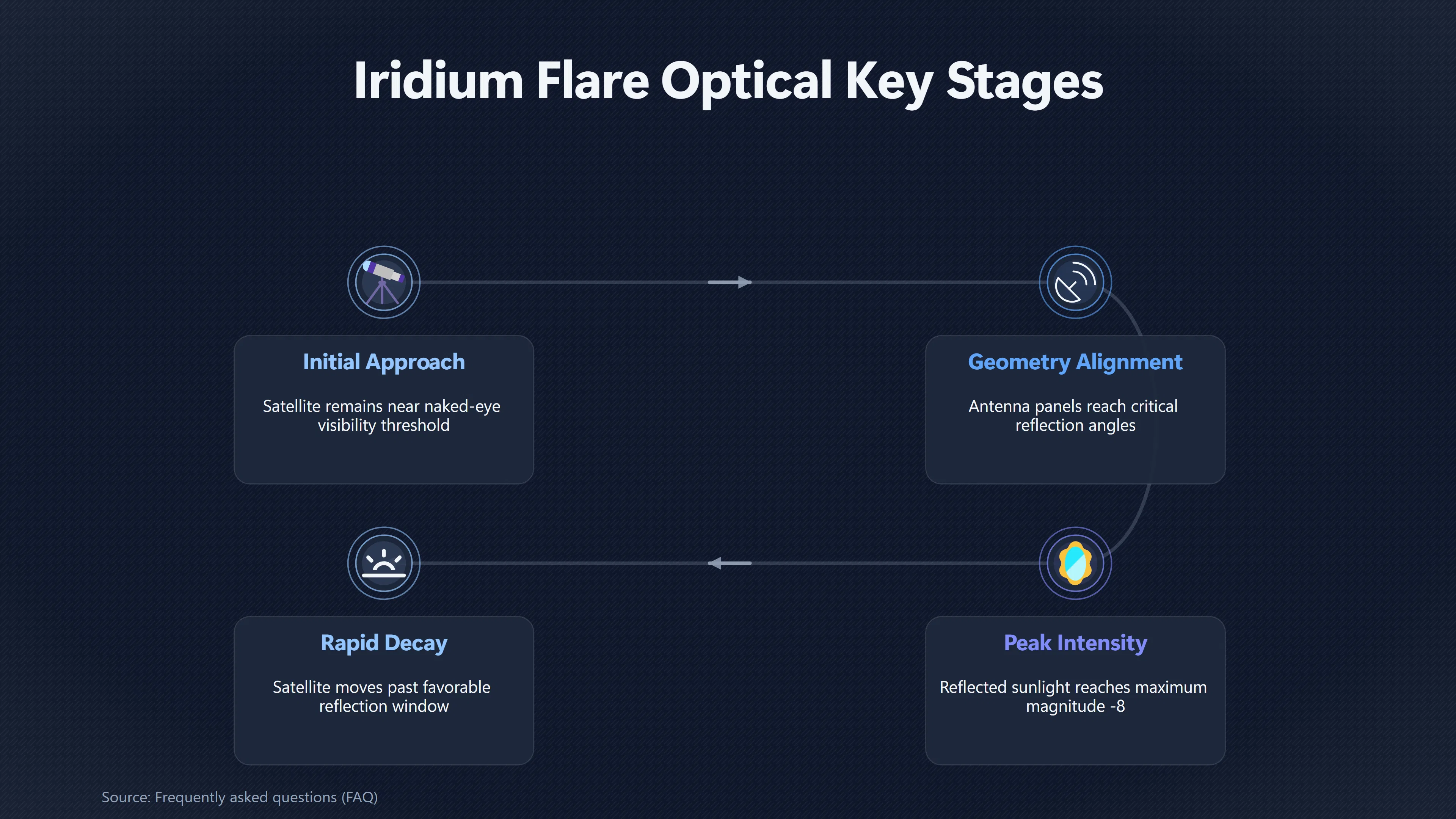
For roughly two decades, first-generation Iridium communications satellites provided an unusually clear demonstration of how an ordinary spacecraft could seem to erupt into brilliance without switching on any light of its own. A satellite that was normally near the limit of naked-eye visibility could brighten within seconds to around magnitude –8 — dramatically brighter than Venus — and then fade back towards invisibility. The cause was reflected sunlight from three large, flat main mission antennas whose orientation was precisely controlled.[Satellites Above]satobs.orgSatellites Above Iridium FlaresSatellites AboveIridium FlaresFebruary 7, 2007…
What made Iridium flares especially important for understanding UFO and UAP reports was not merely their brightness. They combined several potentially puzzling features: abrupt appearance, extraordinary intensity, short duration and apparent disappearance. Yet their timing and location could often be calculated beforehand. Iridium therefore became something close to a controlled experiment in how a perfectly conventional satellite could produce a startling, apparently spontaneous light in the night sky.[Heavens-Above]heavens-above.comFrequently asked questions (FAQFrequently asked questions (FAQ)…
How Iridium antennas produced brilliant flares
The original Iridium spacecraft carried three main mission antennas, commonly abbreviated MMAs. Each was a flat panel about 188 centimetres by 86 centimetres, with the three arranged 120 degrees apart around the spacecraft and angled about 40 degrees away from its body axis. The antenna surfaces were highly reflective, and operational satellites maintained a stable orientation relative to the Earth.[Satellites Above]satobs.orgSatellites Above Iridium FlaresSatellites AboveIridium FlaresFebruary 7, 2007…
That combination created an unusually effective celestial mirror. When sunlight struck one of the antennas at the appropriate angle, the panel could send a concentrated specular reflection towards a relatively restricted region on the Earth’s surface. An observer inside that region saw the reflected sunlight rather than any powered lamp aboard the spacecraft.[Heavens-Above]heavens-above.comFrequently asked questions (FAQFrequently asked questions (FAQ)…
This explains the characteristic Iridium-flare sequence. Away from the favourable reflection angle, an Iridium satellite was typically around magnitude, close to the naked-eye threshold under good conditions. As the satellite moved through the critical geometry, however, its brightness rapidly increased, reached a sharp maximum and then declined again. Historical observing material gives typical flare durations of roughly 5–20 seconds.[Satellites Above]satobs.orgSatellites Above Iridium FlaresSatellites AboveIridium FlaresFebruary 7, 2007…
The change could be enormous. Bright Iridium flares were commonly described as reaching magnitude –8. Because astronomical magnitudes are logarithmic, that is not merely a modest increase over the satellite’s normal appearance: it represents a brightness change of many hundreds of thousands of times between magnitude and –8. Sky & Telescope noted that the strongest events could momentarily outshine Venus, while contemporary satellite observers recorded and photographed magnitude –8 events.[Sky & Telescope]skyandtelescope.orgOpen source on skyandtelescope.org.
The effect was striking precisely because the spacecraft itself was comparatively inconspicuous. A person might therefore notice only the brightest portion of the event. Instead of seeing a faint satellite gradually approaching, flaring and then continuing onwards, an unprepared witness could perceive something closer to a brilliant light appearing in an apparently empty sky, shining for several seconds and disappearing.
That is the feature of Iridium flares most relevant to UFO and UAP identification. The suddenness belonged to the reflection, not to the object.
Why the flare could be predicted
Iridium flares were unusual among startling sky phenomena because the same characteristics that made them spectacular also made the operational satellites highly predictable. Investigators knew their orbits, the geometry of the reflective antennas and the fact that the spacecraft maintained controlled attitudes. With the observer’s position and the Sun’s position added to those data, software could calculate when the specular reflection would sweep across a particular location.[Satellites Above]satobs.orgSatellites Above Iridium FlaresSatellites AboveIridium FlaresFebruary 7, 2007…
Prediction software appeared remarkably early in the constellation’s history. Archived correspondence from the SeeSat-L satellite-observing community shows observers already exchanging computer-generated Iridium-flare predictions in November 1997. Programs including Rob Matson’s IRIDFLAR subsequently calculated the reflection geometry from orbital elements and the known spacecraft configuration.[Satellites Above]satobs.orgSatellites AboveSeeSat-L Nov-1997: Iridium flare observation theory, and a few obs.November 1, 1997…
Services such as Heavens-Above later made this accessible to ordinary skywatchers. A user could enter a location and receive the time, direction, altitude and predicted brightness of forthcoming events. The predictions were sufficiently location-sensitive that Heavens-Above recommended coordinates accurate to about one kilometre for Iridium flares, even though an error of about ten kilometres was considered acceptable for ordinary satellite observing.[Heavens-Above]heavens-above.comFrequently asked questions (FAQFrequently asked questions (FAQ)…
That geographical sensitivity reveals what was really happening. The observer was not simply watching a satellite that became equally bright for everyone beneath its orbit. A concentrated reflection was sweeping across the ground. Heavens-Above consequently distinguished between the direction of the satellite in the sky and the location of the flare centre on Earth, where the reflection was expected to appear brightest. Moving closer to that centre could make the same spacecraft substantially more conspicuous.[Heavens-Above]heavens-above.comFrequently asked questions (FAQFrequently asked questions (FAQ)…
Predictions were not perfectly deterministic. Heavens-Above cautioned that the spacecraft’s attitude-control system allowed small departures from its nominal orientation — about 0.1 degree according to its documentation — and that such a small angular difference could noticeably alter the observed brightness. Failed Iridium satellites presented another problem: once their orientation was no longer reliably controlled, they could still reflect sunlight but their flashes were much harder or impossible to forecast in the same way.[Heavens-Above]heavens-above.comFrequently asked questions (FAQFrequently asked questions (FAQ)…
That contrast is useful for investigators. Known orbit plus known orientation can make a specular flare highly predictable. Known orbit but uncertain orientation can leave the satellite’s position predictable while making the moment of its glint much less so. An unexpected flash is therefore not evidence that no satellite was present; it may instead mean that the spacecraft’s reflective geometry was not predictable from the available model.
A faint satellite could look like it had switched on
Iridium flares exposed an important weakness in unaided eyewitness interpretation: apparent brightness is easily mistaken for intrinsic activity.
Suppose an observer could not initially see a magnitude satellite. When the reflection strengthened, a point of light might suddenly become obvious. As it approached peak intensity, it could become brighter than every star and planet in the sky. Seconds later the reflection weakened and the satellite again fell below the observer’s visibility threshold.
The resulting testimony could quite reasonably be phrased as a light suddenly appeared, became extremely bright and then switched off. But none of those apparent transitions required the spacecraft to activate a light source. The observer was simply crossing two perceptual thresholds — first as the reflection became bright enough to notice, and again as it became too faint to follow.
The historical observations make the point unusually concrete. Satellite observers documented Iridium spacecraft going from roughly magnitude to flares around –8, with the bright phase lasting only seconds. Some exceptionally favourable reflections could even be seen in daylight if the observer knew precisely when and where to look.[Satellites Above]satobs.orgSatellites Above Iridium FlaresSatellites AboveIridium FlaresFebruary 7, 2007…
This also explains why a short sighting can provide a misleading impression of motion. If only the brightest few seconds are visible, there may be little time or angular displacement against reference stars for an observer to establish a reliable track. A faint satellite seen continuously for a minute is recognisably a satellite; the same spacecraft noticed only around the peak of a five- or ten-second reflection can present a much stranger visual problem.
Long-exposure photographs helped reveal what the eye could miss. Instead of recording an isolated luminous object, cameras frequently showed a satellite trail swelling smoothly towards a brilliant centre and narrowing again afterwards. Historical Iridium photographs collected by astronomers display exactly this symmetrical brightening-and-fading signature.[Sky & Telescope]skyandtelescope.orgSky & Telescope Iridium Flare | Mark HodgesSky & TelescopeIridium Flare | Mark Hodges - Sky & Telescope…
Iridium became a natural test case for UFO-like lights
The value of Iridium flares to UFO investigation is not that every isolated flash in the sky can be labelled an Iridium satellite. That would be wrong, particularly today. Their importance is methodological.
First-generation Iridium supplied a documented example in which several seemingly unusual observations had a single conventional cause:
- an object could be effectively invisible immediately before an observation;
- its brightness could increase enormously within seconds;
- it could become much brighter than familiar stars and planets;
- the brilliant phase could be extremely short;
- the light could apparently disappear again without the satellite itself disappearing;
- and the whole event could occur silently, at orbital altitude, without aircraft-style navigation lights.
Most importantly, the strongest version of the phenomenon was predictable before it happened. Skywatchers did not merely see a mysterious flash and retrospectively propose that a satellite might have caused it. They could obtain a forecast, go to a specified location, face a specified part of the sky at a specified time and watch the predicted brightening occur.[Sky & Telescope]skyandtelescope.orgOpen source on skyandtelescope.org.
That is unusually strong evidence for the broader principle behind satellite-flare explanations. A witness’s description of a light that suddenly “turned on” or “blazed up” does not by itself establish that the source emitted light, changed propulsion state or performed a manoeuvre. Reflection geometry can produce much the same visual sequence.
The distinction matters when reconstructing a UFO or UAP report. If a sighting consists mainly of a white point that brightens and fades while following an otherwise satellite-like path, investigators should preserve the exact date, time and observing location. Historical Iridium prediction systems themselves demonstrate why: flare visibility could change substantially over relatively short geographical distances, so a vague location can remove information needed to test the satellite hypothesis.[Heavens-Above]heavens-above.comFrequently asked questions (FAQFrequently asked questions (FAQ)…
The apparent behaviour should also be separated into what was actually observed and what was inferred. “The light disappeared” is an observation. “The object vanished” is an interpretation. Iridium flares showed experimentally why those two statements are not equivalent.
The predictable Iridium-flare era ended
Classic Iridium flares are now principally a historical example. The original constellation was replaced by the Iridium NEXT generation, whose different spacecraft design did not reproduce the old satellites’ dependable, brilliant antenna reflections. As replacement proceeded, the famous flare forecasts gradually disappeared.[The Guardian]theguardian.comThe Guardian Spacewatch: Swansong for Iridium flares | Space | The GuardianThe GuardianSpacewatch: Swansong for Iridium flares | Space | The GuardianSeptember 25, 2014…
By December 2019, Iridium described the planned deorbit of SV097, the lone remaining satellite from the original operational constellation, as the end of the Iridium-flare era. The company had completed its NEXT upgrade campaign earlier that year.[Iridium UAT]uat.iridium.comUATA Final #Flarewell | Iridium UATIridium UATA Final #Flarewell | Iridium UAT…
This means that an unexplained flash seen today should not automatically be called an “Iridium flare”. Other satellites and spacecraft surfaces can still produce glints and flares, but the famous predictable events from the operational first-generation Iridium constellation belong largely to the late 1990s and 2000s.
That historical distinction actually strengthens Iridium’s usefulness as a comparison case. The phenomenon was observed repeatedly, photographed, modelled and predicted while the relevant spacecraft were operating. Its physical cause was unusually well constrained: large reflective antennas on accurately oriented satellites directed sunlight towards observers for a few seconds.[Satellites Above]satobs.orgSatellites Above Iridium FlaresSatellites AboveIridium FlaresFebruary 7, 2007…
What Iridium taught investigators about sudden UFO-like lights
Iridium flares established a simple but powerful lesson for interpreting reports of sudden lights in the sky: visibility is not the same thing as physical presence. A spacecraft may be present before, during and after a sighting even if the observer sees it only during a brief interval of favourable illumination.
They also demonstrated why brightness alone is a poor guide to the nature or distance of an unidentified point source. An object hundreds of kilometres away could temporarily become far brighter than Venus because a relatively small reflective surface happened to send sunlight towards one observer. Conversely, once that narrow geometry passed, the same satellite could again become difficult or impossible to see.[Satellites Above]satobs.orgSatellites Above Iridium FlaresSatellites AboveIridium FlaresFebruary 7, 2007…
For UFO and UAP case analysis, the historical Iridium example therefore suggests several particularly useful checks: whether the object followed a straight satellite-like track; whether the brightness rose and fell rather than behaving like a repeating aircraft beacon; whether the event occurred while an orbiting object could still be sunlit; and, above all, whether precise time-and-location data allow the observation to be compared with satellite trajectories.
Iridium does not explain every satellite flare, much less every unidentified light. Its importance is narrower and more convincing. For years, observers could be told in advance that an almost invisible object would reach a particular point in the sky at a particular second and suddenly blaze brighter than the planets — and then they could go outside and watch it happen.[Heavens-Above]heavens-above.comFrequently asked questions (FAQFrequently asked questions (FAQ)…
That made Iridium flares a particularly vivid demonstration of how an apparently extraordinary transition — nothing visible, then a brilliant light, then nothing again — can arise from ordinary orbital motion and reflected sunlight alone.
Amazon book picks
Further Reading
Books and field guides related to Why Iridium Satellites Could Suddenly Outshine the Stars. Use these as the next step if you want deeper reading beyond the article.
Celestial Objects for Modern Telescopes
Based on field notes made by the author during his own career as an amateur astronomer, this unique guide covers both the traditional and...
Fundamentals of Astrodynamics
Rating: 4.5/5 from 12 Google Books ratings
Teaching text developed by U.S. Air Force Academy and designed as a first course emphasizes the universal variable formulation. Develops...
Satellite Orbits: Models, Methods and Applications
Satellite Orbits -Models, Methods, and Applications has been written as a compre hensive textbook that guides the reader through the theo...
NightWatch: A Practical Guide to Viewing the Universe
A practical guide to viewing the universe.
eBay marketplace picks
Marketplace Samples
Live-tested eBay searches with available results related to this page.
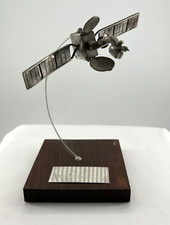
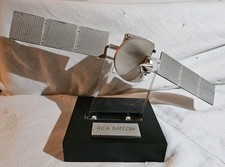
Selected fromcommunications satellite model oneBay.co.uk.
Endnotes
1.
Source: heavens-above.com
Title: Frequently asked questions (FAQ)
Link:https://www.heavens-above.com/FAQ.aspx?alt=0&cul=en&lat=0&lng=0&loc=Unspecified&tz=UCT
Source snippet
Frequently asked questions (FAQ)...
2.
Source: uat.iridium.com
Title: UATA Final #Flarewell | Iridium UAT
Link:https://uat.iridium.com/blog/a-final-flarewell/
Source snippet
Iridium UATA Final #Flarewell | Iridium UAT...
3.
Source: heavens-above.com
Title: IRIDIU M 141
Link:https://heavens-above.com/orbit.aspx?alt=345&cul=en&lat=49.3389&lng=17.9939&loc=Vsetin&satid=43077&tz=CET
4.
Source: heavens-above.com
Title: IRIDIU M 33 DEB
Link:https://www.heavens-above.com/orbit.aspx?alt=0&cul=en&lat=49.6899&lng=19.1328&loc=Sienna&satid=33775&tz=CET
5.
Source: investor.iridium.com
Title: 2022 09 08 Iridium Announces Ninth SpaceX Launch
Link:https://investor.iridium.com/2022-09-08-Iridium-Announces-Ninth-SpaceX-Launch
6.
Source: investor.iridium.com
Link:https://investor.iridium.com/2020-07-31-Iridium-[Launches
7.
Source: investor.iridium.com
Link:https://investor.iridium.com/2019-09-16-Iridium-Awarded-7-Year-738-5-Million-Contract-by-the-U-S-Department-of-Defense
8.
Source: uat.iridium.com
Title: dear iridium flare flarewell
Link:https://uat.iridium.com/blog/dear-iridium-flare-flarewell/
9.
Source: ifp.iridium.com
Title: dear iridium flare flarewell
Link:https://ifp.iridium.com/blog/dear-iridium-flare-flarewell/
10.
Source: investor.iridium.com
Link:https://investor.iridium.com/2019-02-06-Iridium-Declares-Victory-3-Billion-Satellite-Constellation-Upgrade-Complete
11.
Source: investor.iridium.com
Title: 2019 01 11 Iridium Completes Historic Satellite Launch Campaign
Link:https://investor.iridium.com/2019-01-11-Iridium-Completes-Historic-Satellite-Launch-Campaign
12.
Source: ifp.iridium.com
Title: flarewell catch the iridium flare
Link:https://ifp.iridium.com/blog/flarewell-catch-the-iridium-flare/
13.
Source: uat.iridium.com
Title: say flarewell to iridium flares
Link:https://uat.iridium.com/blog/say-flarewell-to-iridium-flares/
14.
Source: heavens-above.com
Title: The end of Iridium flares?
Link:https://heavens-above.com/IridiumDemise.aspx
15.
Source: ifp.iridium.com
Title: saying flarewell to iridiums deorbiting legacy satellite sv 40
Link:https://ifp.iridium.com/blog/saying-flarewell-to-iridiums-deorbiting-legacy-satellite-sv-40/
16.
Source: uat.iridium.com
Title: saying flarewell to iridiums deorbiting legacy satellite sv 40
Link:https://uat.iridium.com/blog/saying-flarewell-to-iridiums-deorbiting-legacy-satellite-sv-40/
17.
Source: investor.iridium.com
Link:https://investor.iridium.com/january-14-2017-iridium-announces-successful-first-launch-of-iridium-next-satellites
18.
Source: iridium.com
Link:https://www.iridium.com/products/solara-flare
19.
Source: iridium.com
Link:https://www.iridium.com/network/
20.
Source: iridium.com
Link:https://www.iridium.com/environmental-sustainability-policy-statement
21.
Source: heavens-above.com
Link:https://www.heavens-above.com/faq.aspx?alt=0&cul=en&lat=47.626766&lng=7.459314&loc=Brinckheim&tz=UCT
22.
Source: heavens-above.com
Link:https://www.heavens-above.com/glossary.aspx?Session=kebgfconbadlkacdpgdoanfg&term=magnitude
23.
Source: heavens-above.com
Link:https://www.heavens-above.com/overloading.aspx
24.
Source: heavens-above.com
Link:https://heavens-above.com/Mobile.aspx
25.
Source: heavens-above.com
Title: IRIDIU M 181
Link:https://www.heavens-above.com/orbit.aspx?alt=0&lat=0&lng=0&loc=Unspecified&satid=56726&tz=UCT
26.
Source: heavens-above.com
Title: IRIDIU M 106
Link:https://www.heavens-above.com/orbit.aspx?alt=0&cul=en&lat=39.948723&lng=-75.102394&loc=Ablett+Village&satid=41917&tz=UCT
27.
Source: heavens-above.com
Link:https://www.heavens-above.com/statsdaily.aspx?alt=14&cul=en&lat=36.343158&lng=-76.634967&loc=Mintonsville&tz=UCT
28.
Source: heavens-above.com
Link:https://heavens-above.com/statsdaily.aspx?alt=20&cul=en&lat=53.2402&lng=6.5367&loc=BlaauwSterrenwachtGron&tz=CET
29.
Source: youtube.com
Title: A Double Iridium Flare
Link:https://www.youtube.com/watch?v=-XE3LuD5htM
Source snippet
Iridium Flare...
30.
Source: youtube.com
Title: Iridium Flare
Link:https://www.youtube.com/watch?v=oBCwY34UBOU
Source snippet
(Iridium 60)...
31.
Source: satobs.org
Title: Satellites Above Iridium Flares
Link:https://www.satobs.org/iridium.html
Source snippet
Satellites AboveIridium FlaresFebruary 7, 2007...
Published: February 7, 2007
32.
Source: skyandtelescope.org
Link:https://skyandtelescope.org/stargazing-and-observing/celestial-objects-to-watch/observing-iridium-flares/
33.
Source: skyandtelescope.org
Title: Sky & Telescope Iridium Flare | Mark Hodges
Link:https://skyandtelescope.org/online-gallery/iridium-flare/
Source snippet
Sky & TelescopeIridium Flare | Mark Hodges - Sky & Telescope...
34.
Source: satobs.org
Link:https://www.satobs.org/seesat/Nov-1997/0001.html
Source snippet
Satellites AboveSeeSat-L Nov-1997: Iridium flare observation theory, and a few obs.November 1, 1997...
Published: November 1, 1997
35.
Source: theguardian.com
Title: The Guardian Spacewatch: Swansong for Iridium flares | Space | The Guardian
Link:https://www.theguardian.com/science/2014/sep/25/sss
Source snippet
The GuardianSpacewatch: Swansong for Iridium flares | Space | The GuardianSeptember 25, 2014...
Published: September 25, 2014
36.
Source: nuforc.org
Link:https://nuforc.org/sighting/?id=191392
37.
Source: imagine.gsfc.nasa.gov
Title: night sky
Link:https://imagine.gsfc.nasa.gov/ask_astro/night_sky.html
38.
Source: satobs.org
Link:https://www.satobs.org/seesat/Dec-2019/0016.html
39.
Source: imagine.gsfc.nasa.gov
Link:https://imagine.gsfc.nasa.gov/observatories/learning/swift/faq/
40.
Source: imagine.gsfc.nasa.gov
Link:https://imagine.gsfc.nasa.gov/educators/programs/swift/faq/
41.
Source: skyandtelescope.org
Title: Get Your Iridium Fix Before It’s Too Late!
Link:https://skyandtelescope.org/stargazing-and-observing/get-your-iridium-fix-before-its-too-late/
42.
Source: skyandtelescope.org
Link:https://skyandtelescope.org/online-gallery/fireball-over-banff-rundle-mountain/
43.
Source: skyandtelescope.org
Title: Predictive Prowess: See an Iridium Flare
Link:https://skyandtelescope.org/stargazing-and-observing/see-iridium-flare-071720143/
44.
Source: cloudynights.com
Title: Iridium flares
Link:https://www.cloudynights.com/forums/topic/214488-iridium-flares/
45.
Source: nuforc.org
Link:https://nuforc.org/sighting/?id=62856
46.
Source: forums.digitalspy.com
Link:https://forums.digitalspy.com/discussion/787641/ufo
47.
Source: skyandtelescope.org
Title: Another Cal SKY Success
Link:https://skyandtelescope.org/astronomy-blogs/another-calsky-success/
48.
Source: skyandtelescope.org
Title: Space Station Shadow
Link:https://skyandtelescope.org/astronomy-blogs/space-station-shadow
49.
Source: skyandtelescope.org
Title: Iridium: The Movie
Link:https://skyandtelescope.org/astronomy-blogs/iridium-the-movie/
50.
Source: skyandtelescope.org
Title: Astronomy Online
Link:https://skyandtelescope.org/astronomy-blogs/astronomy-online/
51.
Source: skyandtelescope.org
Title: Take a “Sat-seeing” Tour
Link:https://skyandtelescope.org/stargazing-and-observing/celestial-objects-to-watch/take-a-sat-seeing-tour/
52.
Source: nuforc.org
Link:https://nuforc.org/sighting/?id=50998
53.
Source: cloudynights.com
Title: Iridium Flare?
Link:https://www.cloudynights.com/forums/topic/3407-iridium-flare/
54.
Source: skyandtelescope.org
Title: Have You Been Flashed By Iridium?
Link:https://skyandtelescope.org/stargazing-and-observing/celestial-objects-to-watch/have-you-been-flashed-by-iridium/
55.
Source: satobs.org
Title: See Sat-L Mar-03: Simultaneous Iridium flares
Link:https://www.satobs.org/seesat/Mar-2003/0211.html
56.
Source: satobs.org
Title: See Sat-L Mar-03: Iridium flares as seen from orbit
Link:https://www.satobs.org/seesat/Mar-2003/0186.html
57.
Source: satobs.org
Link:https://www.satobs.org/seesat/Mar-2003/0073.html
58.
Source: nuforc.org
Link:https://nuforc.org/sighting/?id=17460
59.
Source: satobs.org
Title: See Sat-L Mar-00: First iridium flare?
Link:https://www.satobs.org/seesat/Mar-2000/0054.html
60.
Source: ocastronomers.org
Title: Iridium Flares
Link:https://www.ocastronomers.org/iridium-flares/
61.
Source: nuforc.org
Link:https://nuforc.org/sighting/?id=8479
62.
Source: satobs.org
Link:https://satobs.org/seesat/Jun-1998/0459.html
63.
Source: satobs.org
Title: See Sat-L Jun-98: Iridium flare predication software
Link:https://www.satobs.org/seesat/Jun-1998/0320.html
64.
Source: satobs.org
Title: See Sat-L May-98: Update on GSOC Iridium Flare Predictions
Link:https://satobs.org/seesat/May-1998/0195.html
65.
Source: satobs.org
Title: See Sat-L Mar-98 by subject
Link:https://satobs.org/seesat/Mar-1998/subject.html
66.
Source: satobs.org
Title: See Sat-L Mar-98: Iridium flare magnitude comments
Link:https://www.satobs.org/seesat/Mar-1998/0045.html
67.
Source: satobs.org
Title: See Sat-L Feb-98: Iridflar 1.52 released
Link:https://satobs.org/seesat/Feb-1998/0364.html
68.
Source: satobs.org
Link:https://satobs.org/seesat/Feb-1998/0329.html
69.
Source: satobs.org
Title: See Sat-L Feb-98: Re: Daytime Iridium Flares
Link:https://satobs.org/seesat/Feb-1998/0124.html
70.
Source: satobs.org
Title: See Sat-L Feb-98: Iridium Flare Info
Link:https://satobs.org/seesat/Feb-1998/0119.html
71.
Source: satobs.org
Title: See Sat-L Feb-98: RE: Iridium Flares ground projection (fwd)
Link:https://satobs.org/seesat/Feb-1998/0054.html
72.
Source: satobs.org
Title: See Sat-L Feb-98: Iridium Flare Geometry
Link:https://satobs.org/seesat/Feb-1998/0026.html
74.
Source: satobs.org
Link:https://satobs.org/seesat/Jan-1998/0142.html
75.
Source: satobs.org
Link:https://satobs.org/seesat/Jan-1998/0062.html
76.
Source: satobs.org
Link:https://www.satobs.org/seesat/Jan-1998/0040.html
77.
Source: satobs.org
Link:https://www.satobs.org/seesat/Jan-1998/0025.html
78.
Source: satobs.org
Link:https://www.satobs.org/seesat/Dec-1997/date.html
79.
Source: satobs.org
Title: See Sat-L Nov-97 by date
Link:https://www.satobs.org/seesat/Nov-1997/date.html
80.
Source: satobs.org
Title: See Sat-L Nov-97 by subject
Link:https://www.satobs.org/seesat/Nov-1997/subject.html
81.
Source: satobs.org
Title: See Sat-L Nov-97 by author
Link:https://www.satobs.org/seesat/Nov-1997/author.html
82.
Source: satobs.org
Title: See Sat-L Oct-97 by thread
Link:https://www.satobs.org/seesat/Oct-1997/index.html
83.
Source: satobs.org
Title: See Sat-L Oct-97 by date
Link:https://www.satobs.org/seesat/Oct-1997/date.html
84.
Source: satobs.org
Link:https://www.satobs.org/seesat/Oct-1997/0331.html
85.
Source: satobs.org
Title: See Sat-L Sep-97 by date
Link:https://satobs.org/seesat/Sep-1997/date.html
86.
Source: satobs.org
Title: See Sat-L Sep-97 by author
Link:https://satobs.org/seesat/Sep-1997/author.html
87.
Source: satobs.org
Title: See Sat-L Sep-97 by subject
Link:https://www.satobs.org/seesat/Sep-1997/subject.html
89.
Source: satobs.org
Title: See Sat-L Oct-97 by subject
Link:https://www.satobs.org/seesat/Oct-1997/subject.html
90.
Source: satobs.org
Title: See Sat-L Sep-97: more Iridium information
Link:https://www.satobs.org/seesat/Sep-1997/0375.html
91.
Source: satobs.org
Title: See Sat-L Aug-97 by thread
Link:https://satobs.org/seesat/Aug-1997/index.html
92.
Source: satobs.org
Title: Iridium Flare Photos-Part 2Image IRIDIUM FLARE PHOTOS
Link:https://satobs.org/iridpix2.html
93.
Source: astroverde.org
Title: iridium flares
Link:https://www.astroverde.org/iridium_flares.htm
94.
Source: cs.cmu.edu
Link:https://www.cs.cmu.edu/~zhuxj/astro/html/iridium.html
95.
Source: earthsky.org
Link:https://earthsky.org/?post_type=post&s=Iridium+flare
96.
Source: skyandtelescope.org
Title: Observing Guides to Celestial Objects
Link:https://skyandtelescope.org/celestial-objects-observe/
97.
Source: skyandtelescope.org
Link:https://skyandtelescope.org/stargazing-and-observing/celestial-objects-to-watch/space-satellites/
98.
Source: assa.org.au
Title: Iridium Flares
Link:https://www.assa.org.au/iridium
99.
Source: solipsys.co.uk
Link:https://www.solipsys.co.uk/new/HeavensAbove.html
100.
Source: ltpaobserverproject.com
Link:https://www.ltpaobserverproject.com/iridium.html
101.
Source: geoborders.com
Title: IRIDIU M
Link:https://geoborders.com/iridium/en/iridium.htm
Additional References
102.
Source: space.com
Title: Reflections from Space: Spot Iridium Flares | Space
Link:https://www.space.com/6898-reflections-space-spot-iridium-flares.html
Source snippet
Reflections from Space: Spot Iridium Flares | Space...
103.
Source: researchgate.net
Link:https://www.researchgate.net/publication/393956995_KDFE_Robust_KNN-Driven_Fusion_Estimator_for_LEO-SoOP_Under_Multi-Beam_Phased-Array_Dynamics
104.
Source: celestrak.org
Link:https://celestrak.org/columns/v02n02/
105.
Source: si.edu
Link:https://www.si.edu/object/communications-satellite-iridium%3Anasm_A19990005000
106.
Source: analytik.news
Link:https://analytik.news/en/press/2022/257.html
107.
Source: scribd.com
Link:https://www.scribd.com/document/365263824/199805036041
108.
Source: readkong.com
Link:https://www.readkong.com/page/impact-of-satellite-constellations-on-astronomical-7554527
109.
Source: apollosat.com
Link:https://apollosat.com/iridium-coverage-map/
110.
Source: geocities.ws
Link:https://www.geocities.ws/lemagicien_2000/astropage/flares.html
111.
Source: drivehq.com
Link:https://www.drivehq.com/web/FreeHostSpace/steveholmes/irr_pics.htm