Within Balloons
How a Balloon Cluster Became a Shapeshifting UAP
At Al Taqaddum, rotating balloons, dangling strings and partial inflation reproduced an object that seemed to change shape in flight.
On this page
- Why the object first appeared abnormally shaped
- How strings and overlapping balloons changed its silhouette
- Why wind speed and missing motor heat supported the balloon explanation
Page outline Jump by section
Introduction
The Al Taqaddum case is a particularly useful example of how a cluster of ordinary balloons can look like a single object that changes shape in flight. In October 2017, an infrared sensor aboard a force-protection aerostat over Al Taqaddum Air Base in Iraq tracked an irregular object for roughly 17½ minutes. It was initially described as “abnormally shaped”, but the US All-domain Anomaly Resolution Office (AARO) ultimately assessed with high confidence that it was a cluster of fully and partially inflated balloons.[AARO]aaro.milAl Taqaddam Case ResolutionAAROAl Taqaddam Case Resolution
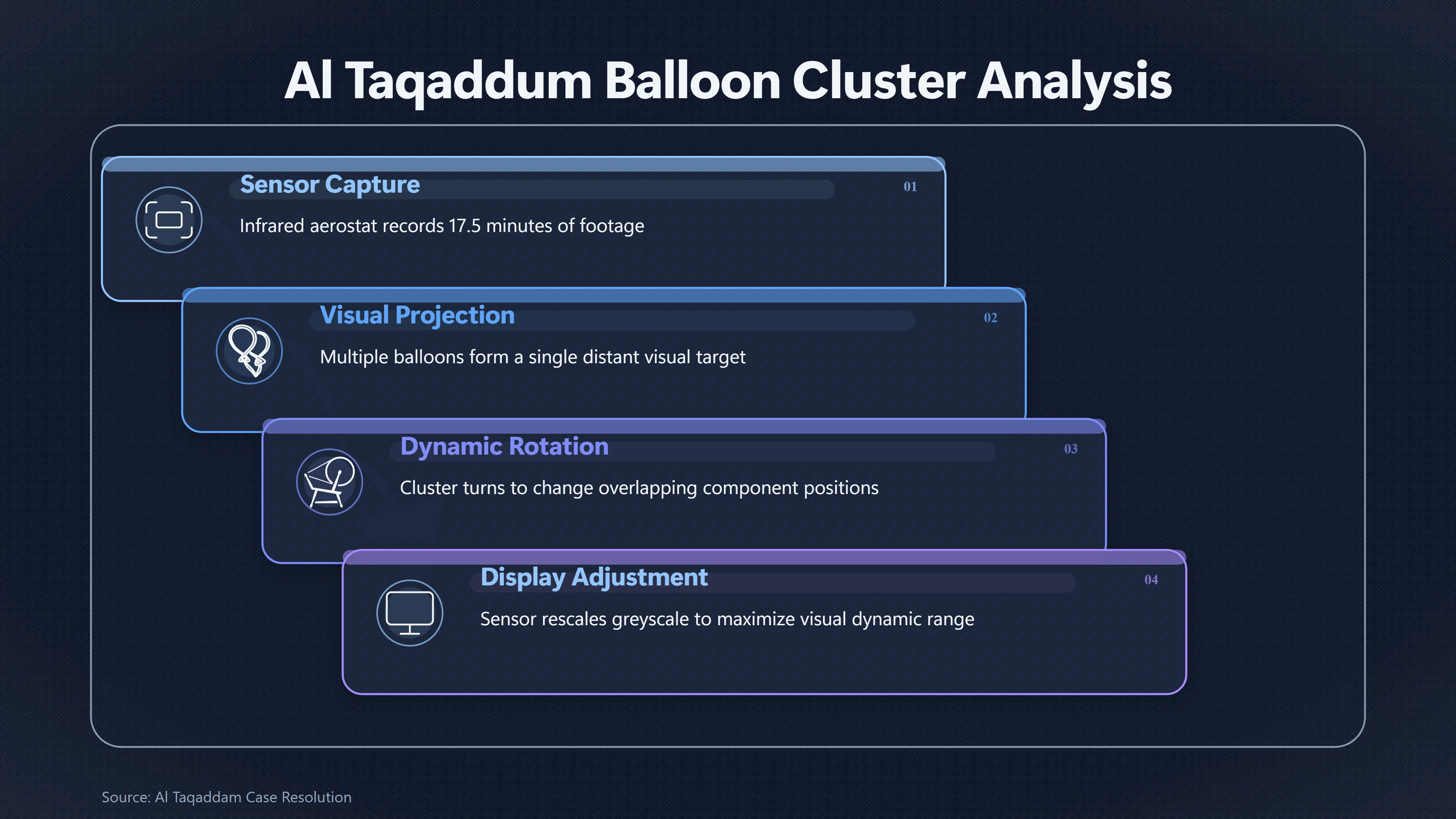
The important part of the explanation is not simply that balloons can drift. AARO found rounded balloon forms, partly deflated elements and dangling strings whose apparent number and arrangement changed as the cluster rotated relative to the camera. At the same time, the infrared system continually adjusted its greyscale display. Together, those effects could turn several mundane objects into an apparently coherent body with changing protrusions — the feature that made the Al Taqaddum object look so unusual in the first place.[AARO]aaro.milAl Taqaddam Case ResolutionAAROAl Taqaddam Case Resolution
Why the object first appeared abnormally shaped
The observation came from an infrared sensor aboard an aerostat — a tethered surveillance blimp — operating at about 2,700 feet above Al Taqaddum Air Base. AARO’s September 2025 case-resolution report dates the event to 23 October 2017 and describes 17 minutes and 30 seconds of footage in which the unidentified object appeared to float above the ground. The publicly released video hosted by the US Defense Visual Information Distribution Service is 17 minutes and 27 seconds long.[AARO]aaro.milAl Taqaddam Case ResolutionAAROAl Taqaddam Case Resolution
The case synopsis captures the identification problem neatly. The reported shape was “abnormally shaped”, whereas AARO’s eventual assessment was “balloon shaped”. That difference did not result from finding one clean frame that suddenly revealed an unmistakable party balloon. Instead, investigators treated the changing appearance across the full sequence as evidence about the object’s construction.[AARO]aaro.milAl Taqaddam Case ResolutionAAROAl Taqaddam Case Resolution
A loose balloon cluster is fundamentally different from a rigid aircraft. Its individual components can move relative to one another. Some balloons can remain rounded while others lose pressure and become elongated or folded. Strings can trail underneath, bunch together or separate. The resulting silhouette depends on which components overlap along the camera’s line of sight.
That matters because the Al Taqaddum footage was infrared rather than an ordinary close-range colour photograph. A distant, low-detail target does not necessarily preserve the visual cues that would immediately identify latex, foil, knots or string. AARO also notes that the recording becomes increasingly grainy towards its end, probably because the object was getting farther from the sensor.[AARO]aaro.milAl Taqaddam Case ResolutionAAROAl Taqaddam Case Resolution
The result is a useful reversal of the initial impression. What looks problematic under a single-object hypothesis — an object apparently growing, losing or rearranging appendages — becomes expected under a cluster hypothesis, because there is no fixed outer hull whose silhouette must remain constant.
How strings and overlapping balloons changed the silhouette
AARO’s strongest shape-specific observation concerns the hanging material beneath the main mass. Investigators reported that fully and partly inflated balloon shapes and dangling strings could be distinguished at several points in the footage. More importantly, the apparent shape and number of the strings changed. AARO interpreted that variation as consistent with balloons changing their positions relative to the sensor’s point of view.[AARO]aaro.milAl Taqaddam Case ResolutionAAROAl Taqaddam Case Resolution
This provides a straightforward mechanism for the apparent shapeshifting.
Imagine several balloons tied together but not held rigidly in place. From one viewing direction, three rounded envelopes may overlap so closely that the camera records something resembling one lumpy body. A partly deflated balloon hanging behind the group can disappear into that silhouette. A turn of the cluster can then expose it at the edge. Meanwhile, several strings that were superimposed along nearly the same line of sight can separate visually and appear to multiply.
Nothing has actually grown out of the object. The projected outline has changed because the viewing geometry has changed.
AARO’s published figure makes the proposed interpretation explicit: it identifies bulbous, rounded portions as balloons and points to strings and deflated balloons hanging beneath them. The agency says the object’s appearance was also consistent with other observations it had identified as balloon clusters.[AARO]aaro.milAl Taqaddam Case ResolutionAAROAl Taqaddam Case Resolution
The partial inflation is especially important. A group of uniformly spherical balloons would produce a relatively simple bunch-of-grapes outline. A mixed cluster containing both taut and deflated envelopes can produce something much less familiar. Rounded sections remain at the top or sides while softer envelopes and cords sag below, creating the impression of legs, tendrils or irregular structural components.
The infrared display introduced another source of apparent change. AARO says the object’s fluctuating infrared return resulted from the sensor continually adjusting the greyscale assigned to pixels in order to maximise visual dynamic range as the background changed.[AARO]aaro.milAl Taqaddam Case ResolutionAAROAl Taqaddam Case Resolution
That distinction matters. A target becoming lighter or darker in processed infrared imagery does not by itself demonstrate that its physical temperature is undergoing an equally dramatic change. In this case, AARO attributed the visible fluctuations to the sensor’s display behaviour rather than an exotic thermal process. Earlier public discussion of the footage included disagreement over whether its changing infrared appearance represented genuine temperature changes, illustrating how easily sensor presentation can become part of the perceived anomaly.[Reddit]reddit.comGreenstreet reports a different version of the "jellyfish ufo footage" story that instead actually took place in 2017, with differi…
Taken together, rotation, overlap, dangling material and changing image contrast provide a coherent explanation for the video’s most memorable feature: an outline that does not behave like the silhouette of a conventional rigid aircraft.
Why the object’s motion also fitted balloons
The balloon explanation did not rest on resemblance alone. AARO combined the full-motion video with its metadata, line-of-sight analysis, scenario reconstruction and weather information. That allowed investigators to test whether the object’s movement was compatible with something being carried passively by the atmosphere.[AARO]aaro.milAl Taqaddam Case ResolutionAAROAl Taqaddam Case Resolution
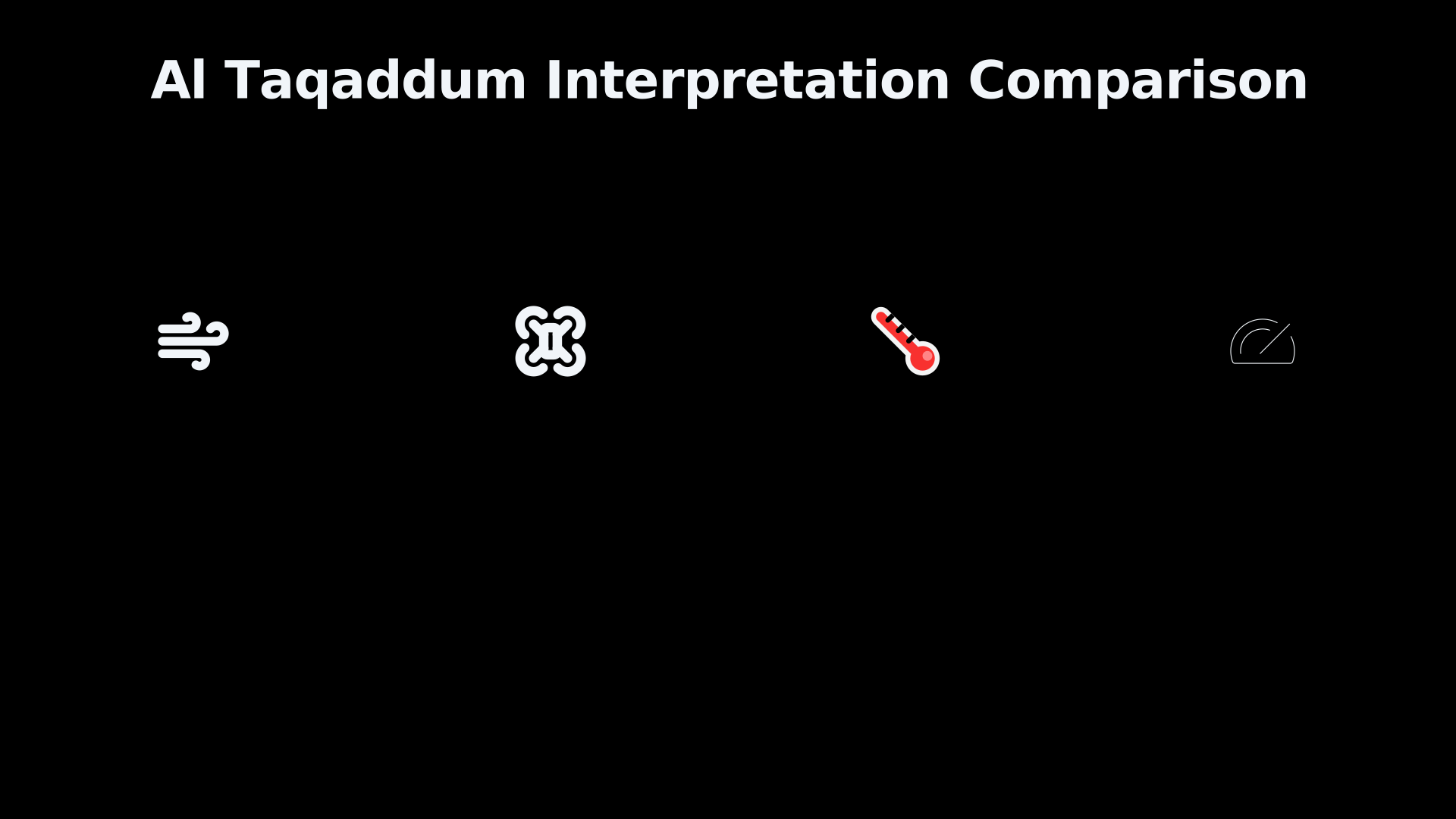
AARO estimated the target’s altitude at approximately 850–2,200 feet and its speed at about 4–14 mph. The agency assigned only moderate confidence to those numerical ranges because of variability in historical and real-time wind information, but it reached high confidence that the object was moving east to west at a speed within the relevant wind range, using positional information from the observing aerostat.[AARO]aaro.milAl Taqaddam Case ResolutionAAROAl Taqaddam Case Resolution
That is significant because the changing silhouette and the trajectory support the same explanation independently. If the imagery had resembled balloons while the target repeatedly accelerated against the wind, held an obviously powered course or performed abrupt manoeuvres, resemblance alone would have been weak evidence. Instead, AARO found the object behaving as a freely drifting target should.
The agency therefore assessed that the object showed no anomalous speed or other performance beyond known capabilities. Its official imagery catalogue similarly states that geolocation data from the aerostat was used to assess the object’s speed and direction and that the observation showed no anomalous performance characteristics.[AARO]aaro.milAl Taqaddam Case ResolutionAAROAl Taqaddam Case Resolution
This is what makes the Al Taqaddum case more instructive than a simple visual match. The proposed identity explains two different aspects of the observation at once: why the object looked irregular and why it moved as it did.
Why a concealed quadrotor was less convincing
Investigators did consider a more technological alternative. According to the resolution report, one of AARO’s partners proposed that the object might have been a quadrotor unmanned aerial system covered with camouflage netting. Such an arrangement could, at least superficially, account for an irregular body and material hanging from it.[AARO]aaro.milAl Taqaddam Case ResolutionAAROAl Taqaddam Case Resolution
AARO rejected that explanation on two specific grounds.
First was the flight behaviour. A powered quadrotor would not normally be expected simply to drift with the wind in the way reconstructed for the Al Taqaddum target. The measured motion instead strengthened the passive-object interpretation.[AARO]aaro.milAl Taqaddam Case ResolutionAAROAl Taqaddam Case Resolution
Second was infrared evidence. Electric motors and associated powered components should generate detectable heat under suitable observing conditions, yet AARO reported no corresponding motor heat sources in the imagery. The absence of those signatures was consistent with its broader finding that the target lacked the thermal characteristics expected from the proposed drone.[AARO]aaro.milAl Taqaddam Case ResolutionAAROAl Taqaddam Case Resolution
Neither point, considered alone, proves that every strangely shaped drifting object must be balloons. In this particular case, however, the balloon hypothesis required fewer additional assumptions: rounded and deflated forms were visible, strings changed their projected arrangement, the whole assembly travelled with the wind and no powered propulsion signature emerged.

What the Al Taqaddum case demonstrates about changing-shape UAPs
Al Taqaddum shows why “changing shape” is not necessarily evidence that an observed object is itself transforming. What a camera records is a two-dimensional projection. If the target is a loose three-dimensional assembly, its projection can change substantially even though every component remains completely ordinary.
The sequence can be understood as a chain of ordinary effects:
- Several balloons formed one distant visual target. Limited resolution made the cluster easier to perceive as a single object than as separate envelopes.
- Some balloons were only partly inflated. Their irregular shapes produced hanging or elongated portions unlike the familiar silhouette of a fully inflated party balloon.
- Strings and deflated material hung below the cluster. Those features produced the apparent appendages.
- The cluster changed orientation. Overlapping balloons and strings moved into and out of alignment, altering the projected outline and apparent number of dangling features.
- The infrared sensor adjusted its display. Greyscale changes made the target’s visual appearance fluctuate further.
- The entire assembly drifted with the atmosphere. Its reconstructed speed and east-to-west motion remained within the wind range rather than revealing independent propulsion. AARO
There is one documentary wrinkle worth keeping separate from the physical analysis. AARO’s final resolution identifies 23 October 2017 as the observation date, while the DVIDS video record labels the footage 1 October 2017. The official sources therefore contain a metadata discrepancy over the precise day, although both place the event at Al Taqaddum in October 2017 and describe the same roughly 17½-minute infrared observation. AARO
That discrepancy does not change the central shape analysis. AARO’s conclusion is based on the recorded morphology, sensor behaviour, reconstructed trajectory and weather comparison rather than merely on calling an irregular object balloon-like. The case was resolved with high confidence because those separate lines of evidence converged on the same mundane mechanism. AARO
For the broader problem of balloons being mistaken for extraordinary flying objects, Al Taqaddum supplies an unusually concrete lesson: a balloon cluster need not look recognisably like balloons in every frame. In fact, its instability is part of what can make it look extraordinary. The “appendages” can be strings and deflated envelopes; apparent structural changes can be changing overlap; brightness changes can partly come from the infrared display; and apparently purposeful movement can reduce to ordinary wind drift. What initially looked like a shapeshifting object was, on AARO’s reconstruction, unusual mainly in projection rather than in physics. AARO
Amazon book picks
Further Reading
Books and field guides related to How a Balloon Cluster Became a Shapeshifting UAP. Use these as the next step if you want deeper reading beyond the article.
Remote Sensing and Image Interpretation
From recent developments in digital image processing to the next generation of satellite systems, this book provides a comprehensive intr...
Atmospheric Science: An Introductory Survey
Atmospheric Science, Second Edition, is the long-awaited update of the classic atmospheric science text, which helped define the field ne...
eBay marketplace picks
Marketplace Samples
Live-tested eBay searches with available results related to this page.
Selected fromUFO poster oneBay.co.uk.

Current eBay listing
I Want To Believe UFO Poster Giclée Fine Art Heavyweight Print


Current eBay listing
VINTAGE UFO FLYING SAUCERS COMIC ADVERTISING A2 POSTER PRINT

Endnotes
2.
Source: aaro.mil
Link:https://www.aaro.mil/Next-AARO-Home-redesign/Next-Parent/Next-AARO-UAP-Imagery-Acc-Table/
Source snippet
Next - AARO UAP Imagery Acc Table...
3.
Source: reddit.com
Link:https://www.reddit.com/r/UFOs/comments/193ejfc/greenstreet_reports_a_different_version_of_the/
Source snippet
Greenstreet reports a different version of the "jellyfish ufo footage" story that instead actually took place in 2017, with differi...
4.
Source: aaro.mil
Title: UAP Case Resolution DT
Link:https://www.aaro.mil/Next-AARO-Home-redesign/Next-Parent/AARO-UAP-Case-Resolution-DT/
Source snippet
AARO UAP Case Resolution DT...
5.
Source: aaro.mil
Link:https://www.aaro.mil/Next-AARO-Home-redesign/Next-Parent/Next-UAP-Case-RR-Data-Table/
6.
Source: aaro.mil
Link:https://www.aaro.mil/UAP-Cases/Official-UAP-Imagery/4/
7.
Source: aaro.mil
Link:https://www.aaro.mil/UAP-Cases/Official-UAP-Imagery/ftag/MSF0951a18/
8.
Source: aaro.mil
Title: UAP Imagery* Al Taqaddum Object UAP Video
Link:https://www.aaro.mil/Next-AARO-Home-redesign/Inactive-Parent/Next-UAP-Imagery-dup/
9.
Source: aaro.mil
Link:https://www.aaro.mil/Next-AARO-Home-redesign/Next-Parent/Next-AARO-UAP-Imagery-Fixed-Table/
10.
Source: aaro.mil
Link:https://www.aaro.mil/Next-AARO-Home-redesign/Next-Parent/AARO-UAP-Case-DT/
11.
Source: taqaddum.com
Link:https://www.taqaddum.com/services/immigration/
12.
Source: dvidshub.net
Link:https://www.dvidshub.net/video/960331/al-taqaddum-object
Source snippet
Video - Al Taqaddum Object...
13.
Source: disclosdex.com
Title: Al Taqaddum Object | Disclosdex
Link:https://disclosdex.com/events/2017-al-taqaddum-object
14.
Source: t.co
Link:https://t.co/4M3L5Trglk
15.
Source: military-history.fandom.com
Title: Al Taqaddum Air Base
Link:https://military-history.fandom.com/wiki/Al-Taqaddum_Air_Base
16.
Source: salattimes.net
Title: Al Taqaddum
Link:https://www.salattimes.net/Yearly.php?cityID=40355
Additional References
17.
Source: ufotransparency.com
Link:https://ufotransparency.com/files/decade-2020s-aaro-case-resolution-reports-2023-2025-aaro-al-taqaddam-case-resolution-final
Source snippet
UFO TransparencyAARO Resolves Al Taqaddum 'Jellyfish' as Balloons, DoD / All-domain Anomaly Resolution Office (AARO) · 2023 · UFO Transpa...
18.
Source: aatip.com
Title: UAP Case Files & Official Reports | AATIP.com
Link:https://www.aatip.com/inpage/case-files/
Source snippet
Shape alone is weak evidence when range is large, resolution is low and an infrared system continually rescales contrast. RESOLVED AL TAQ...
19.
Source: wikidisc.org
Title: Jellyfish UFO video | Wiki Disc
Link:https://www.wikidisc.org/wiki/Jellyfish_UFO_video
Source snippet
Jellyfish UFO video | WikiDiscJuly 1, 2026 — JELLYFISH UFO VIDEO Case Information Explained - Conventional Location & Time --- Date | 201...
Published: July 1, 2026
20.
Source: youtube.com
Title: Al Taqaddum Object: Unresolved Case
Link:https://www.youtube.com/watch?v=20dApmxF6kk
Source snippet
Dead Air | Aliens Among Us? | w/ Marc D'Antonio...
21.
Source: youtube.com
Title: Top Declassified UFO Videos Released by the Pentagon
Link:https://www.youtube.com/watch?v=oER70vPK1aU
Source snippet
Al Taqaddum Object: Unresolved Case - Declassified Footage of Unidentified Anomalous Phenomena...
22.
Source: youtube.com
Title: Full Uncut [Tracking]({{ ‘tracking/’ | relative_url }}) Video of the Infamous ‘Jellyfish’ UAP over Iraq
Link:https://www.youtube.com/watch?v=nb45rXZX6Yw
Source snippet
Top Declassified UFO Videos Released by the Pentagon...
23.
Source: bigorre.org
Link:https://www.bigorre.org/aero/meteo/orni/en
Source snippet
Al Najaf International airport (Irak) aviation weather and informations ORNI NJFJuly 22, 2026 — * Al Taqaddum Air Base airport at 104 mi...
Published: July 22, 2026
24.
Source: singularfortean.com
Link:https://www.singularfortean.com/news/2024/1/9/jellyfish-ufo-reportedly-recorded-over-united-states-joint-operations-base-in-iraq
25.
Source: researchgate.net
Link:https://www.researchgate.net/publication/349964168_Concept_of_Qillat-I-Darqiyat_Hypothyroidism_in_Unani_System_of_Medicine_A_Systemic_Review
26.
Source: ufotransparency.com
Link:https://ufotransparency.com/topics/aaro-case-resolutions