Within Tracking
Why Go Fast's Reconstructed Speed Is a Range
GoFast's exact speed cannot be reduced to one number because aircraft heading and wind assumptions materially change the reconstructed result.
On this page
- Which missing inputs prevent a single exact speed
- How heading assumptions change reconstructed motion
- Why wind broadens the plausible velocity range
Page outline Jump by section
Introduction
GoFast does not support one exact reconstructed speed from the public video. The key reason is not simply that the footage is blurry: the recording lacks the F/A-18F’s absolute heading and georeferenced position, while wind changes the aircraft’s motion over the ground. Those missing inputs alter the reconstructed geometry and therefore the target velocity derived from it. The All-domain Anomaly Resolution Office (AARO) consequently modelled a range of aircraft headings rather than reporting a unique solution.[AARO]aaro.milOpen source on aaro.mil.
That distinction matters when assessing the striking impression of rapid movement in the 2015 infrared recording. Geometry strongly constrains the more dramatic interpretation: both NASA and AARO place the object at roughly 13,000 feet rather than immediately above the sea, making motion parallax from the fast-moving sensor platform an important part of the apparent speed. But constraining an extraordinary interpretation is not the same as knowing the object’s exact velocity. NASA’s simplified calculation produced about 40 mph while explicitly acknowledging that it neglected wind effects on the aircraft; AARO’s later wind-aware reconstruction produced a much wider set of possible velocities.[NASA Science]nasa.govOpen source on nasa.gov.
Which missing inputs prevent a single exact speed?
The GoFast display contains unusually useful information for a short UAP video. It shows target range, sensor azimuth and elevation, aircraft altitude, airspeed and bank angle. From the range, elevation angle and aircraft altitude, investigators can estimate the target’s altitude with comparatively little dependence on the disputed horizontal geometry. This is why the approximately 13,000-foot altitude result is substantially firmer than a single claimed speed. AARO describes the altitude estimate as high confidence because it depends principally on sensor pointing angles and range rather than the aircraft’s absolute position or the wind.[AARO]aaro.milOpen source on aaro.mil.
The speed calculation has a different problem. AARO says the only GoFast material available to it was the compressed public Windows Media Video file; the original file and accompanying metadata were no longer available. In particular, the surviving metadata does not provide the aircraft’s georeferenced position or compass heading. Those values matter because reconstructing the target’s movement requires first reconstructing where the observing aircraft travelled during the measurement interval.[AARO]aaro.milOpen source on aaro.mil.
There is also limited numerical precision in the imagery itself. AARO notes that most relevant values displayed by the sensor are integers, while target range and sensor angles have limited displayed precision. Its calculations therefore carry measurement uncertainty even before the larger uncertainty about absolute heading is considered. AARO also sought but was unable to obtain accounts from the F/A-18F aircrew for its published resolution.[AARO]aaro.milOpen source on aaro.mil.
This creates an important hierarchy of conclusions:
- Target altitude is comparatively well constrained. The roughly 13,000-foot estimate does not require investigators to know which compass direction the fighter was travelling.
- Absolute target speed is less constrained. It depends on the reconstructed horizontal motion of both aircraft and target.
- Speed relative to the surrounding air adds another layer. Wind must be separated from the target’s movement if the question is whether it was drifting with the air mass or moving through it under its own power.
NASA’s 2023 treatment illustrates the difference. Using display information and a roughly 22-second interval, the NASA independent study team estimated that the object travelled about 390 metres, corresponding to an average speed of about 40 mph. Crucially, the report immediately cautioned that this calculation neglected wind effects on the aircraft and therefore contained uncertainty. NASA presented the exercise primarily to demonstrate that the video did not require an extraordinary velocity, not as a definitive kinematic reconstruction.[NASA Science]nasa.govOpen source on nasa.gov.
How heading assumptions change reconstructed motion
Aircraft airspeed is motion through the surrounding air; ground speed is motion relative to Earth. Wind is the vector connecting the two. That distinction becomes critical in GoFast because investigators are trying to reconstruct positions relative to the Earth while much of the surviving flight information describes the aircraft relative to the air.
A strong headwind makes the aircraft advance over the ocean more slowly than the same indicated airspeed would suggest. A tailwind makes it advance more quickly. A crosswind shifts its path sideways. Because the target’s calculated position is built from the moving aircraft’s position plus the sensor’s range and pointing direction, changing that aircraft track also changes the reconstructed target track.
This is why an unknown compass heading cannot simply be treated as an irrelevant rotation of the whole diagram. If there were no wind, rotating an otherwise identical reconstruction around the compass could leave much of the relative geometry unchanged. Once a real wind vector is introduced, however, orientation matters: rotating the aircraft relative to that wind changes its ground-velocity vector and hence where the sensor should be at successive moments.
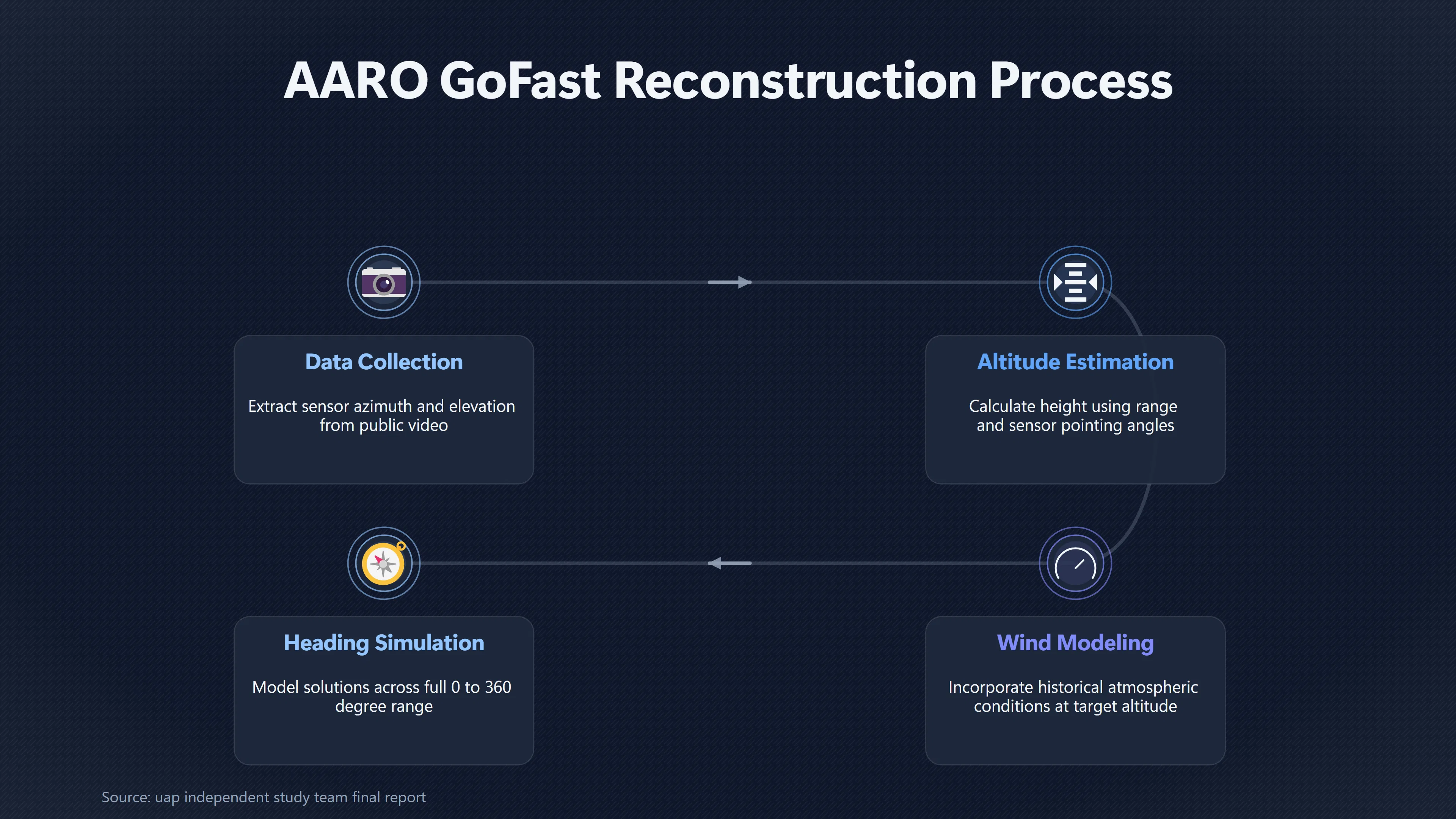
AARO dealt with the missing heading by calculating solutions over the complete 0°–360° range rather than choosing one undocumented aircraft course. Its published methodology says explicitly that it could not calculate a single target speed and heading because the fighter’s flight path depends on its exact heading and the target’s calculated location depends on the fighter’s location.[AARO]aaro.milOpen source on aaro.mil.
That approach produces materially different solutions. AARO’s illustrative cases gave wind-compensated target speeds of approximately 5 mph above the wind for the headwind configuration, 59 mph for a left crosswind, 92 mph for the tailwind configuration and 62 mph for a right crosswind. The associated target direction relative to the wind also changed substantially. These are not four observations of the object changing speed; they are examples of how different permissible assumptions about the missing geometry lead to different reconstructed velocities from the same recording.[AARO]aaro.milOpen source on aaro.mil.
The 92 mph figure therefore should not be read as AARO discovering that GoFast was definitely travelling 92 mph through the air. Nor should the 5 mph case be presented as its uniquely established speed. They mark different points in a solution space created in part by information that is absent from the surviving video.
Why wind broadens the plausible velocity range
AARO’s later analysis went further than NASA’s illustrative 40 mph calculation by incorporating historical atmospheric conditions near the event. It used winds of about 30.9 metres per second — 69 mph — from 265° at the target’s estimated 13,000-foot altitude and about 52 metres per second — 116 mph — from 255° at the F/A-18F’s roughly 25,000-foot altitude.[AARO]aaro.milOpen source on aaro.mil.
Those two wind values perform different jobs in the reconstruction. Wind at aircraft altitude affects how the fighter’s airspeed translates into movement over the Earth. Wind at target altitude provides the reference against which investigators can ask whether the target was largely travelling with the air mass or moving substantially through it. Conflating those questions can make apparently contradictory speed estimates look more contradictory than they really are.
AARO consequently reports two useful forms of velocity. Depending on the assumed heading relative to the wind, its reconstructed ground speed for the target ranged from about 32 to 72 m/s, or roughly 72 to 161 mph. After subtracting the contribution of the wind at target altitude, its estimated intrinsic speed — movement relative to the surrounding air — ranged from about 2 to 41.3 m/s, approximately 5 to 92 mph.[AARO]aaro.milOpen source on aaro.mil.
That distinction is especially important for hypotheses involving a wind-borne object. An object travelling at 69 mph over the ground in a 69 mph air mass could have essentially zero air-relative horizontal speed. Conversely, an object travelling in a different direction could require substantial motion through that same air mass. A ground-speed number alone therefore cannot establish whether GoFast was simply drifting or was self-propelled.
The historical winds themselves should not be treated as perfect measurements at the exact position of both objects throughout the recording. AARO’s technical appendix warns that uncertainty in wind direction and speed, together with other reconstruction uncertainties, means its detailed quantitative values should not be used literally; they are more appropriate for qualitative evaluation of the object’s performance.[UFO Transparency]ufotransparency.comOpen source on ufotransparency.com.
Independent technical discussion before AARO’s final report had already identified this sensitivity. Analyses using historical meteorological data found that introducing strong upper-level winds could materially alter the reconstructed F/A-18 ground track and hence the target velocity. Those discussions also stressed that atmospheric reanalysis represents reconstructed weather conditions rather than an instrument measuring the wind beside the target itself. Such work is useful for testing plausible geometries, but it cannot manufacture the missing aircraft heading or exact local wind measurement.[Metabunk]metabunk.orgOpen source on metabunk.org.

What the speed range actually establishes
The strongest conclusion from GoFast is narrower than either “it was travelling at 40 mph” or “it was travelling at 92 mph”. The public recording provides enough geometric information to challenge the visual impression that a low-flying object was tearing across the ocean at extraordinary speed, but not enough information to collapse the object’s ordinary-speed possibilities into one precise value.
NASA’s analysis showed why the visual impression is unreliable: the estimated target altitude is about 13,000 feet, leaving several kilometres between the object and the ocean visible behind it, while the observing aircraft itself is travelling rapidly. That geometry creates substantial parallax. NASA therefore concluded that extraordinary target speed is unnecessary to reproduce the basic observation, while expressly acknowledging the uncertainty introduced by its omission of wind effects.[NASA Science]nasa.govOpen source on nasa.gov.
AARO’s more elaborate reconstruction strengthens the first part of that conclusion while making the second part more explicit. It assessed with high confidence that the object did not display anomalous speed, but its own published result is a range rather than a point estimate. Across the heading assumptions it tested, AARO found approximately 72–161 mph of ground motion and about 5–92 mph of wind-compensated motion. The object’s reconstructed direction deviated by as much as roughly 32° from the wind direction, although AARO says most simulations produced smaller differences and none showed the object moving against the wind.[AARO]aaro.milOpen source on aaro.mil.
There is therefore no inconsistency in saying both that GoFast’s extraordinary apparent speed is largely a tracking-and-parallax effect and that its exact physical speed remains uncertain. The first proposition depends mainly on the robust altitude and viewing geometry; the second reflects missing heading, location, original metadata and exact atmospheric information.
That is the useful lesson for interpreting tracked UAP footage. Geometry can sometimes exclude a sensational performance claim without supplying a unique mundane explanation. In GoFast, the surviving data are sufficient to move the case away from an apparent near-surface, extremely fast object, but the missing aircraft heading and imperfect knowledge of the wind leave a meaningful range of conventional velocities. Treating any single reconstructed number as the speed of GoFast claims more precision than the available evidence supports.[AARO]aaro.milOpen source on aaro.mil.
Amazon book picks
Further Reading
Books and field guides related to Why Go Fast's Reconstructed Speed Is a Range. Use these as the next step if you want deeper reading beyond the article.
Optics
For courses in Optics A Contemporary Approach to Optics with Practical Applications and New Focused Pedagogy Hecht Optics balances theory...
Introduction to Modern Photogrammetry
This text is designed to give students a strong grounding in the mathematical basis of photogrammetry while introducing them to related f...
Applied Photographic Optics
Selected by the American Library Association's 'Choice' magazine as "best technical book", the first edition of this book soon establishe...
eBay marketplace picks
Marketplace Samples
Live-tested eBay searches with available results related to this page.
Selected fromUFO poster oneBay.co.uk.


Current eBay listing
VINTAGE UFO FLYING SAUCERS COMIC ADVERTISING A2 POSTER PRINT


Current eBay listing
I Want To Believe UFO Poster Giclée Fine Art Heavyweight Print
Endnotes
1.
Source: science.nasa.gov
Title: uap independent study team final report
Link:https://science.nasa.gov/wp-content/uploads/2023/09/uap-independent-study-team-final-report.pdf?emrc=80696d
2.
Source: aaro.mil
Link:https://www.aaro.mil/Portals/136/PDFs/case_resolution_reports/AARO_Puerto_Rico_UAP_Case_Resolution.pdf
Additional References
3.
Source: youtube.com
Title: Explained: ‘[Go Fast]({{ ‘go-fast/’ | relative_url }})’ UFO Video
Link:https://www.youtube.com/watch?v=PLyEO0jNt6M
Source snippet
GOFAST UFO Analysis (yeah no, probably just a balloon)...
4.
Source: youtube.com
Title: Unidentified Anomalous Phenomena Independent Study Report
Link:https://www.youtube.com/watch?v=TQcqOW39ksk
Source snippet
Quantum physicists analyze pentagon US navy UFO video footage...
5.
Source: youtube.com
Title: The SHOCKING Math Error Behind Viral UFO Videos | Mick West
Link:https://www.youtube.com/watch?v=ypfbhfEXnBo
Source snippet
Unidentified Anomalous Phenomena Independent Study Report...
6.
Source: youtube.com
Title: GOFAST UFO Analysis (yeah no, probably just a balloon)
Link:https://www.youtube.com/watch?v=-3NYowlCoDc
Source snippet
The SHOCKING Math Error Behind Viral UFO Videos | Mick West...
7.
Source: youtube.com
Title: Quantum physicists analyze pentagon US navy UFO video footage
Link:https://www.youtube.com/watch?v=cwACSrLEPeM