Within UFO Identifications
What Project Blue Book Actually Identified
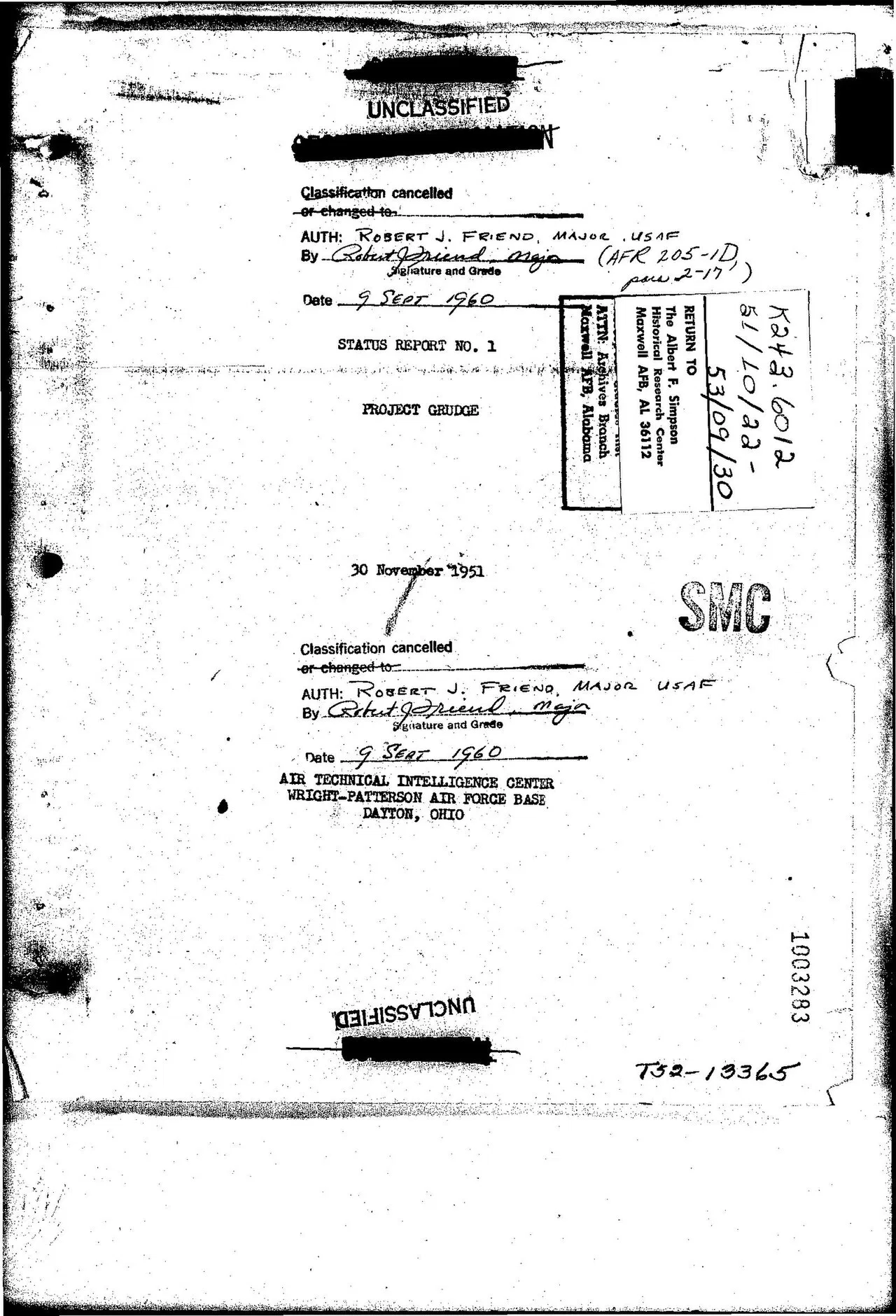
Project Blue Book documented how astronomical objects, aircraft, balloons, satellites and many other ordinary causes entered UFO reports.
On this page
- The major identification categories
- What the unresolved total did and did not mean
- How Cold War explanations compare with today's
Page outline Jump by section
Introduction
Project Blue Book did not treat every UFO report as the same kind of mystery. Its investigators repeatedly found that reports began with ordinary things seen under difficult or unfamiliar conditions: bright planets, meteors, aircraft, balloons, satellites, reflections, searchlights, birds, flares and other commonplace objects or phenomena. The Air Force ultimately recorded 12,618 sightings in the Blue Book-era files, of which 701 remained classified as unidentified.[Air Force]af.milAir ForceUnidentified Flying Objects and Air Force Project Blue BookOf a total of 12,618 sightings reported to Project Blue Book, 701 rem…

That headline figure can obscure the more useful lesson in the archive. Blue Book developed explicit identification categories because different mundane causes produced different kinds of UFO reports. Astronomical objects could seem to hover or manoeuvre; distant aircraft could lose their recognisable shape; balloons could appear stationary or move at surprising speeds; and the arrival of artificial satellites created an entirely new class of unfamiliar lights. Blue Book’s categories therefore amount to an early taxonomy of what are now often called UAP false positives.[ESD]esd.whs.milproj b1proj b1
The major identification categories
Blue Book’s later public description divided evaluations first into three broad outcomes: identified, insufficient data and unidentified. An identified report contained enough specific information for a positive identification or explanation. An insufficient-data report lacked something essential — for example, precise time, location, duration, weather information or direction of observation. An unidentified report was supposed to contain the pertinent information needed to test explanations, yet still resist correlation with a known object or phenomenon.[ESD]esd.whs.milproj b1proj b1
Within the identified group, several causes recurred so often that they received recognisable categories of their own.
Astronomical sightings. Blue Book listed bright stars, planets, comets, fireballs, meteors, auroral streamers and other celestial bodies. Venus, Jupiter and Mars were specifically noted as sources of reports when haze, thin fog, moving clouds or other viewing conditions altered their appearance. Stellar mirages also appeared among the project’s explanations.[AARO]aaro.milAARO Historical Record Report VolAARO_Historical_Record_Repor…6 Mar 2024 — • Balloons: These included weather balloons, radiosondes, and large research balloons…
This category matters because astronomical objects can produce descriptions that sound much more dynamic than the object really is. Without a reliable visual reference for distance, a bright point in a dark sky offers few cues to its scale or motion. Blue Book therefore checked astronomical information as part of its casework rather than simply deciding that a witness had seen a star because the report involved a light. Its statistical study described the use of astronomical almanacs alongside flight plans, balloon-release records and weather data when attempting identifications.[Internet Archive]archive.orgInternet Archive Full text of "Project Blue Book Special Report #14Internet Archive Full text of "Project Blue Book Special Report #14
Aircraft. Conventional aircraft were another major source. Blue Book’s own guidance emphasised that an aeroplane seen at high altitude and long range could look disc- or rocket-shaped when sunlight reflected from a bright surface. Jet condensation trails illuminated by low sunlight could appear fiery red or orange, while afterburners could remain conspicuous after the aircraft itself had become too distant or dark to distinguish.[ESD]esd.whs.milproj b1proj b1
The category was broader than ordinary scheduled airliners. Blue Book investigators could check military training flights, aerial refuelling operations and commercial traffic, while the CIA’s retrospective account lists propeller aircraft, jets, helicopters, advertising aircraft, photographic aircraft and refuelling missions among the kinds of aviation that entered the files.[ESD]esd.whs.milproj b1proj b1
Balloons. Weather balloons, radiosondes and large research balloons were sufficiently common that Blue Book treated them as a major explanation rather than an exotic edge case. AARO’s later review of the Blue Book material says some research balloons reached diameters of roughly 300 feet and that balloons accounted for several thousand reports across the programme. Sunlight near dawn or sunset could produce striking reflections, while high-altitude winds could move large balloons at more than 100 miles per hour.[AARO]aaro.milAARO Historical Record Report VolAARO_Historical_Record_Repor…6 Mar 2024 — • Balloons: These included weather balloons, radiosondes, and large research balloons…
That combination — an unfamiliar shape, great altitude, changing illumination and movement governed by winds invisible to an observer on the ground — made balloons particularly effective UFO generators. It also explains why investigators wanted actual launch records rather than relying only on visual resemblance. The Special Report No. 14 methodology explicitly describes checking balloon releases against reported sightings.[Internet Archive]archive.orgInternet Archive Full text of "Project Blue Book Special Report #14Internet Archive Full text of "Project Blue Book Special Report #14
Satellites. Artificial satellites became important later in Blue Book’s life. A 1966 Air Force description called them a major source of UFO reports and linked the increase partly to growing public interest and partly to the increasing number of objects in orbit. Investigators could consult tracking information from the North American Air Defense Command’s space-tracking system, NASA Goddard Space Flight Center and Smithsonian-associated tracking work to determine whether a visible object corresponded to a known satellite.[ESD]esd.whs.milproj b1proj b1
This is an important historical shift. Satellites did not merely add another item to a static list; they showed how the mix of UFO causes changes when new technology enters an observer’s sky. A phenomenon that was unavailable as an explanation in the late 1940s could become commonplace by the 1960s.
Other. Blue Book needed a catch-all category because many perfectly ordinary causes were individually too uncommon to justify their own large statistical group. The project’s records and later summaries place missiles, kites, fireworks, flares, contrails, reflections, searchlights, birds, radar artefacts and some hoaxes in this wider family. Its earlier statistical scheme also separated unusual optical effects — mirages, sun dogs, inversion-layer images and distortions caused by airborne ice — as a distinct light phenomenon category.[Internet Archive]archive.orgInternet Archive Full text of "Project Blue Book Special Report #14Internet Archive Full text of "Project Blue Book Special Report #14
This miscellaneous group is useful precisely because it prevents a misleading assumption that Blue Book’s identifications consisted only of three stock answers — “weather balloon”, “aircraft” or “Venus”. The files reflected a much broader aerial environment.
Special Report No. 14 shows how the categories worked
The most detailed statistical picture came from the Air Technical Intelligence Center’s Project Blue Book Special Report No. 14, produced with scientific support from Battelle Memorial Institute. Rather than simply counting whatever label happened to be written on an existing case file, the study established a standardised evaluation procedure, converted reports into punched-card data and attempted to consolidate duplicated accounts of the same event.[U.S. Department of War]media.defense.govU.S. Department of War(https://media.defense.gov/2024/Mar/08/2003409233/-1/-1/0/DOPSR-2024-0263-AARO-HISTORICAL-RECORD-REPORT-VOLUME-1-2024.PDF)
Its coding system listed ten final identification categories: balloon; astronomical; aircraft; light phenomenon; birds; clouds or dust; insufficient information; psychological manifestations; unknown; and other. The “other” group included such things as kites, fireworks, flares, rockets, contrails and small tornado-like meteorological effects.[Internet Archive]archive.orgInternet Archive Full text of "Project Blue Book Special Report #14Internet Archive Full text of "Project Blue Book Special Report #14
The report is also a warning against quoting a single percentage without saying what was being counted. It distinguished all sightings, unit sightings and object sightings. “All sightings” represented individual accepted reports; “unit sightings” reduced multiple reports of one sighting to a representative case; “object sightings” attempted to consolidate reports that appeared to describe the same underlying phenomenon. The study recorded 3,201 all-sighting reports, 2,554 unit sightings and 2,199 object sightings.[Internet Archive]archive.orgInternet Archive Full text of "Project Blue Book Special Report #14Internet Archive Full text of "Project Blue Book Special Report #14
For the 2,199 “object sightings” — the sample the report regarded as the best approximation of separate phenomena — the surviving graphical data show 479 astronomical identifications, 474 aircraft identifications, 339 balloons, 240 insufficient-information cases and 434 unknowns, with the balance placed in other identified categories. In other words, the three familiar families of astronomical objects, aircraft and balloons together accounted for well over half of this object-sighting sample before the smaller categories were added.[Internet Archive]archive.orgInternet Archive Full text of "Project Blue Book Special Report #14Internet Archive Full text of "Project Blue Book Special Report #14
Special Report No. 14 did not pretend that every identification had equal certainty. Except for “insufficient information” and “unknown”, proposed identifications could be classed as certain or doubtful. The report described a certain identification as one thought, by its rule-of-thumb standard, to have a better than 95 per cent chance of being correct; a doubtful identification meant investigators still believed the proposed explanation was more likely than not.[Internet Archive]archive.orgInternet Archive Full text of "Project Blue Book Special Report #14Internet Archive Full text of "Project Blue Book Special Report #14
That distinction is easy to lose in retellings. “Identified” in the historical database can therefore mean either a very strong correlation or a best-supported conventional explanation, depending on the particular case and period. The categories are evidence of investigative attribution, not laboratory proof that every labelled case was reconstructed beyond any possibility of error.
What the unresolved total did and did not mean
The famous figure of 701 unidentified cases out of 12,618 is real, but its meaning is narrower than “701 objects that defied conventional science”. The Air Force’s own definition required only that an adequately described report could not be correlated with a known object or phenomenon. It did not assign an origin to whatever had been reported.[Air Force]af.milAir ForceUnidentified Flying Objects and Air Force Project Blue BookOf a total of 12,618 sightings reported to Project Blue Book, 701 rem…
Equally important, Blue Book kept insufficient data separate from unidentified. The distinction was deliberate. In Special Report No. 14, insufficient information was intended for reports missing an essential fact or containing data too uncertain to justify a firm identification; the report explicitly said it was not supposed to function as a bin for “poor unknowns”. “Unknown”, by contrast, meant the reported description could not be fitted to the pattern of a known object or phenomenon.[Internet Archive]archive.orgInternet Archive Full text of "Project Blue Book Special Report #14Internet Archive Full text of "Project Blue Book Special Report #14
This is why an unresolved count should not automatically be read as a measure of anomalous technology. A residual case can remain unidentified because the evidence permits no satisfactory attribution while also containing no positive evidence for any particular extraordinary hypothesis. At Blue Book’s closure, the Air Force stated that it had found no evidence that its unidentified cases represented technological principles beyond contemporary scientific knowledge or extraterrestrial vehicles.[National Archives]archives.govNational Archives Project BLUE BOOKNational ArchivesProject BLUE BOOK - Unidentified Flying Objects | National Archives…
There is nevertheless a legitimate historical caution about treating the entire Blue Book database as one homogeneous scientific experiment. Procedures, personnel and investigative standards changed across more than two decades. Special Report No. 14 was a particularly formal statistical exercise: its evaluators rated the quality of witnesses and reports, correlated cases against external records and required group review for proposed unknowns. The 12,618-case final programme total encompasses a much broader span of administrative practice.[Internet Archive]archive.orgInternet Archive Full text of "Project Blue Book Special Report #14Internet Archive Full text of "Project Blue Book Special Report #14
The cleanest reading is therefore neither “Blue Book explained everything” nor “701 cases proved something extraordinary”. It is that the programme identified a large, repeatable population of ordinary causes, while retaining a smaller residue for which it did not establish a satisfactory identification.
Secret technology complicates the historical categories
Blue Book’s ordinary categories also have a distinctly Cold War wrinkle: sometimes the “ordinary” object was ordinary only to people cleared to know about it.
The CIA’s retrospective history says reconnaissance aircraft including the U-2, A-12 and SR-71 generated substantial UFO reporting during the late 1950s and 1960s. High-altitude aircraft could be illuminated by sunlight when observers below were already in darkness, placing a bright moving object in a part of the sky where conventional aircraft were not expected. The secrecy surrounding reconnaissance programmes also limited what could be publicly disclosed when sightings occurred.[CIA]cia.govHow To Investigate a Flying SaucerHow To Investigate a Flying Saucer - CIA…
AARO’s 2024 historical review makes the broader point cautiously: the Cold War brought rapid development of advanced aircraft, rockets, missiles and space systems, much of it classified, and AARO assesses that some portion of historical misidentifications almost certainly resulted from observers encountering unfamiliar new technology. Its review of the Blue Book era places those reports alongside the project’s established categories of aircraft, balloons, satellites and other conventional causes.[AARO]aaro.milAARO Historical Record Report VolAARO_Historical_Record_Repor…6 Mar 2024 — • Balloons: These included weather balloons, radiosondes, and large research balloons…
That does not mean every Blue Book unknown was a secret US aircraft. It means the historical dataset contained an additional identification problem that investigators and witnesses could not always solve openly: a real human-made object might be unknown to the observer and inaccessible to an investigator lacking the right information.
How Cold War explanations compare with today’s
The striking feature of Blue Book’s identification categories is not how antiquated they look, but how familiar they remain. Modern UAP investigation still resolves reports as balloons, conventional aircraft, birds, satellites and other mundane objects. In AARO’s fiscal year 2025 report, 370 cases were resolved during the reporting period; the office attributed them to prosaic sources including balloons, satellites, birds, aircraft and unmanned aerial systems, with single cases attributed to a commercial rocket launch and a manned jet pack.[AARO]aaro.milFY25 Consolidated Annual Report on UAPAARO FY25 Consolidated Annual Report on UAP…
The biggest change is technological. Blue Book had satellites but not today’s dense satellite constellations; it had aircraft but not ubiquitous small drones. AARO now reports satellite flaring as a major identification problem and says a new three-dimensional modelling capability enabled analysts to resolve 238 reports as satellite flares. It describes such flares as bright apparent orbs produced when sunlight reflects towards an observer from satellite surfaces.[AARO]aaro.milFY25 Consolidated Annual Report on UAPAARO FY25 Consolidated Annual Report on UAP…
The analytical logic, however, is recognisably Blue Book’s. Start with a report that is unidentified to the observer. Compare its time, direction, motion, appearance and environmental conditions against known candidates. Check external records. Separate cases that can be attributed from cases that lack enough information. Retain the remainder for further analysis rather than treating “unidentified” as an explanation in itself. Blue Book used flight plans, weather information, balloon records, astronomical almanacs and satellite tracking; contemporary investigators can add digital sensor data, orbital databases and three-dimensional modelling.[Internet Archive]archive.orgInternet Archive Full text of "Project Blue Book Special Report #14Internet Archive Full text of "Project Blue Book Special Report #14
The continuity is the central lesson of Blue Book’s categories. UFO reports are not generated by one recurring object. They are generated by an identification environment containing many different objects and phenomena whose appearance changes with illumination, distance, weather, viewing geometry, technology and the information available to the observer. Project Blue Book’s lasting value for the study of IFOs lies less in its final unexplained tally than in documenting, case after case, how surprisingly many ordinary things can first enter the record as UFOs.
Amazon book picks
Further Reading
Books and field guides related to What Project Blue Book Actually Identified. Use these as the next step if you want deeper reading beyond the article.
The UFO Experience: A Scientific Inquiry
Cited by the New York Review of Books as "the best brief for visitation," this classic study presents an analysis of UFO reports and conc...
The Report on Unidentified Flying Objects
Edward J. Ruppelt's "The Report on Unidentified Flying Objects" serves as a pivotal text in the study of UFO phenomena, blending personal...
UFO: The Inside Story of the US Government's Search for Alien...
"The full story of our national obsession with UFOs--and the covert, decades-long search by scientists, the United States military, and t...
UFOs and Government: A Historical Inquiry
Governments around the world have had to deal with the UFO phenomenon for a good part of a century. How and why they did so is the subjec...
eBay marketplace picks
Marketplace Samples
Live-tested eBay searches with available results related to this page.
Selected fromUFO poster oneBay.co.uk.



Current eBay listing
I Want To Believe UFO Poster Giclée Fine Art Heavyweight Print
Current eBay listing
VINTAGE UFO FLYING SAUCERS COMIC ADVERTISING A2 POSTER PRINT
Endnotes
1.
Source: archives.gov
Title: National Archives Project BLUE BOOK
Link:https://www.archives.gov/research/military/air-force/ufos
Source snippet
National ArchivesProject BLUE BOOK - Unidentified Flying Objects | National Archives...
2.
Source: esd.whs.mil
Title: proj b1
Link:https://www.esd.whs.mil/Portals/54/Documents/FOID/Reading%20Room/UFOsandUAPs/proj_b1.pdf?ver=2017-05-22-113513-837
3.
Source: aaro.mil
Title: AARO Historical Record Report Vol 1 2024
Link:https://www.aaro.mil/Portals/136/PDFs/AARO_Historical_Record_Report_Vol_1_2024.pdf
Source snippet
AARO_Historical_Record_Repor...6 Mar 2024 — • Balloons: These included weather balloons, radiosondes, and large research balloons...
4.
Source: cia.gov
Title: How To Investigate a Flying Saucer
Link:https://www.cia.gov/stories/story/how-to-investigate-a-flying-saucer/
Source snippet
How To Investigate a Flying Saucer - CIA...
5.
Source: archive.org
Title: Internet Archive Full text of “Project Blue Book Special Report #14”
Link:https://archive.org/stream/ProjectBlueBookSpecialReport14/pbbsr14_djvu.txt
6.
Source: media.defense.gov
Title: U.S. Department of War
Link:https://media.defense.gov/2024/Mar/08/2003409233/-1/-1/0/DOPSR-2024-0263-AARO-HISTORICAL-RECORD-REPORT-VOLUME-1-2024.PDF
7.
Source: aaro.mil
Title: FY25 Consolidated Annual Report on UAP
Link:https://www.aaro.mil/Portals/136/PDFs/FY25%20UAP%20Annual%20Report/AARO_FY2025_Consolidated_Annual_Report_on_UAP.pdf
Source snippet
AARO FY25 Consolidated Annual Report on UAP...
8.
Source: archives.gov
Title: Citizen Archivist Missions | National Archives
Link:https://www.archives.gov/citizen-archivist/missions
9.
Source: aaro.mil
Link:https://www.aaro.mil/Next-AARO-Home-redesign/Next-Parent/Next-AARO-UAP-Imagery-Acc-Table/
10.
Source: aaro.mil
Title: AAR O UAP Records
Link:https://www.aaro.mil/UAP-Records/fbclid/IwZXh0bgNhZW0CMTEAAR0F9nbI4TTQyu8d96BuOtBb1uVQuvapZEvLug7mWxQC4ZqlNDrM5_ejMt4_aem_q0czZMebJdVWJ-6XDLdWAA/
11.
Source: archives.gov
Link:https://www.archives.gov/research/topics/uaps/presidential-libraries
12.
Source: archives.gov
Link:https://www.archives.gov/research/topics/uaps/rg-collections
13.
Source: archives.gov
Link:https://www.archives.gov/research/catalog/catalog-bulk-downloads/uap-bulk-download
14.
Source: archives.gov
Link:https://www.archives.gov/research/topics/uaps/publications
15.
Source: archives.gov
Link:https://www.archives.gov/research/topics/uaps/textual-and-microfilm
16.
Source: aaro.mil
Link:https://www.aaro.mil/Next-AARO-Home-redesign/Next-Parent/Presidential-UAP-Transparency-Initiative/videoid/1010276/dvpcc/false/
17.
Source: aaro.mil
Link:https://www.aaro.mil/Next-AARO-Home-redesign/Next-Parent/Presidential-UAP-Transparency-Initiative/videoid/1006094/dvpcc/false/
18.
Source: archives.gov
Link:https://www.archives.gov/news/articles/project-blue-book-50th-anniversary
19.
Source: archives.gov
Title: Do Records Show Proof of UFOs? | National Archives
Link:https://www.archives.gov/news/articles/do-records-show-proof-of-ufos
20.
Source: cia.gov
Title: VEHICLE S FOR OVERHEAD RECONNAISSANCE | CIA FOIA (foia.cia.gov)
Link:https://www.cia.gov/readingroom/document/cia-rdp74j00828r000100200016-2
21.
Source: cia.gov
Title: PROJEC T USEFUL | CIA FOIA (foia.cia.gov)
Link:https://www.cia.gov/readingroom/document/cia-rdp78-05795a000500010001-0
22.
Source: archives.gov
Title: Project BLUE BOOK
Link:https://www.archives.gov/foia/ufos.html
23.
Source: archives.gov
Title: Intrinsic Value in Archival Material | National Archives
Link:https://www.archives.gov/research/alic/reference/archives-resources/archival-material-intrinsic-value.html
24.
Source: cia.gov
Title: The U-2 Program: A Russian Officer Remembers
Link:https://www.cia.gov/resources/csi/studies-in-intelligence/archives/vol-42-no-5/the-u-2-program-a-russian-officer-remembers/
25.
Source: aaro.mil
Link:https://www.aaro.mil/Next-AARO-Home-redesign/Next-Parent/Next-Submit-a-Report-dup/
26.
Source: aaro.mil
Title: Congressional Tab DT
Link:https://www.aaro.mil/Next-AARO-Home-redesign/Next-Parent/AARO-Congressional-Tab-DT/
27.
Source: aaro.mil
Title: Congressional Press Products
Link:https://www.aaro.mil/Congressional-Press-Products/
28.
Source: aaro.mil
Link:https://www.aaro.mil/Next-AARO-Home-redesign/Bruce-working/Next-AARO-UAP-Trends-Charts/
29.
Source: aaro.mil
Link:https://www.aaro.mil/Next-AARO-Home-redesign/Inactive-Parent/Next-Congressional-Press-Products/
30.
Source: aaro.mil
Title: AAR O UAP Trends All-domain Anomaly Resolution Office UAP REPORTING TRENDS
Link:https://www.aaro.mil/UAP-Cases/UAP-Reporting-Trends/quot/
31.
Source: aaro.mil
Link:https://www.aaro.mil/Next-AARO-Home-redesign/Next-Parent/Presidential-UAP-Transparency-Initiative/dvpmoduleid/77396/dvpsearch/searchstring/
32.
Source: aaro.mil
Title: AAR O UAP Trends All-domain Anomaly Resolution Office UAP REPORTING TRENDS
Link:https://www.aaro.mil/UAP-Cases/UAP-Reporting-Trends/
33.
Source: aaro.mil
Link:https://www.aaro.mil/
34.
Source: obamawhitehouse.archives.gov
Title: bioecon (# 023SUPP) NSF NBIC
Link:https://obamawhitehouse.archives.gov/sites/default/files/microsites/ostp/bioecon-%28%23%20023SUPP%29%20NSF-NBIC.pdf
35.
Source: obamawhitehouse.archives.gov
Link:https://obamawhitehouse.archives.gov/sites/default/files/microsites/ostp/ocp2009.pdf
36.
Source: archives.gov
Link:https://www.archives.gov/files/declassification/iscap/pdf/2014-004-doc01.pdf
37.
Source: archives.gov
Link:https://www.archives.gov/files/declassification/ndc/military-entries-that-are-potential-iod-candidates-as-of-5-16-2024.xlsx
38.
Source: archives.gov
Link:https://www.archives.gov/files/research/military/army/civil-works-correspondence-classification.pdf
39.
Source: archives.gov
Title: pi 170 intl boundaries
Link:https://www.archives.gov/files/research/cartographic/pi-170-intl-boundaries.pdf
40.
Source: archives.gov
Link:https://www.archives.gov/files/federal-register/the-federal-register/2008-annual2.txt
41.
Source: archives.gov
Title: 2003 annual report
Link:https://www.archives.gov/files/about/history/sources/reports/2003-annual-report.pdf
42.
Source: archives.gov
Title: rg 472 hes command manual
Link:https://www.archives.gov/files/research/military/vietnam-war/rg-472-hes-command-manual.pdf
43.
Source: georgewbush-whitehouse.archives.gov
Title: gov1. Instructions
Link:https://georgewbush-whitehouse.archives.gov/omb/procurement/fair/2004fair_spreadsheet.xls
44.
Source: archives.gov
Title: 2010 annual3.txt
Link:https://www.archives.gov/files/federal-register/the-federal-register/2010-annual3.txt
45.
Source: archives.gov
Link:https://www.archives.gov/research/guide-fed-records/groups/341.html
46.
Source: defense.gov
Title: dod examining unidentified anomalous phenomena
Link:https://www.defense.gov/News/News-Stories/Article/article/3965403/dod-examining-unidentified-anomalous-phenomena/
47.
Source: defense.gov
Title: dr jon kosloski director aaro media roundtable on the fy24 consolidated annual
Link:https://www.defense.gov/News/Transcripts/Transcript/Article/3965734/dr-jon-kosloski-director-aaro-media-roundtable-on-the-fy24-consolidated-annual/
48.
Source: defense.gov
Title: deputy pentagon press secretary sabrina singh holds a press briefing
Link:https://www.defense.gov/News/Transcripts/Transcript/Article/3965597/deputy-pentagon-press-secretary-sabrina-singh-holds-a-press-briefing/
49.
Source: cia.gov
Link:https://www.cia.gov/readingroom/docs/CIA-RDP81R00560R000100060001-5.pdf
50.
Source: cia.gov
Link:https://www.cia.gov/readingroom/docs/CIA-RDP81R00560R000100010012-8.pdf
51.
Source: cia.gov
Link:https://www.cia.gov/readingroom/document/cia-rdp81r00560r000100060001-5
52.
Source: cia.gov
Link:https://www.cia.gov/readingroom/document/cia-rdp81r00560r000100010001-0
53.
Source: cia.gov
Title: CORON A: America’s First Imaging Satellite Program
Link:https://www.cia.gov/legacy/museum/exhibit/corona-americas-first-imaging-satellite-program/
54.
Source: cia.gov
Title: U-2 Pressure Suit and Helmet
Link:https://www.cia.gov/legacy/museum/artifact/u-2-pressure-suit-and-helmet/
55.
Source: cia.gov
Title: the cia and the u 2 program 1954 1974
Link:https://www.cia.gov/resources/csi/books-monographs/the-cia-and-the-u-2-program-1954-1974/
56.
Source: cia.gov
Title: U-2 Film Canister
Link:https://www.cia.gov/legacy/museum/artifact/u-2-film-canister/
57.
Source: cia.gov
Title: ASSESSMEN T OF THE PRESENT AND FUTURE(SANITIZED) | CIA FOIA (foia.cia.gov)
Link:https://www.cia.gov/readingroom/document/cia-rdp75b00159r000400100068-3
58.
Source: cia.gov
Title: U-2 PROCUREMENT AND LOSSES | CIA FOIA (foia.cia.gov)
Link:https://www.cia.gov/readingroom/document/cia-rdp75b00285r000200020047-7
59.
Source: cia.gov
Title: U-2 AIRCRAFT CARRIER OPERATION | CIA FOIA (foia.cia.gov)
Link:https://www.cia.gov/readingroom/document/cia-rdp80t01137a000400080001-8
60.
Source: cia.gov
Title: SA C PROPOSALS FOR EUROPEAN PERIPHERAL PHOTO FLIGHTS
Link:https://www.cia.gov/readingroom/document/cia-rdp63-00313a000600030034-6
61.
Source: youtube.com
Title: Project Blue Book: America’s Obsession with UFOs
Link:https://www.youtube.com/watch?v=Xu4oTBBI5UE
Source snippet
Project Blue Book...
62.
Source: youtube.com
Title: Project Blue Book
Link:https://www.youtube.com/watch?v=jjinS2lZAsY
Source snippet
Exposed (2020)...
63.
Source: af.mil
Link:https://www.af.mil/About-Us/Fact-Sheets/Display/Article/104590/unidentified-flying-objects-and-air-force-project-blue-book/
Source snippet
Air ForceUnidentified Flying Objects and Air Force Project Blue BookOf a total of 12,618 sightings reported to Project Blue Book, 701 rem...
64.
Source: af.mil
Link:https://www.af.mil/About-Us/Fact-Sheets/Indextitle/U/
65.
Source: af.mil
Title: Fact Sheets
Link:https://www.af.mil/About-Us/Fact-Sheets/?Page=2&Search=National+OR+Museum+OR+United+OR+States+OR+Air+OR+Force&Sort=Rank
66.
Source: af.mil
Title: Fact Sheets
Link:https://www.af.mil/About-Us/Fact-Sheets/?Page=10&Sort=rank
67.
Source: af.mil
Title: Fact Sheets
Link:https://www.af.mil/About-Us/Fact-Sheets/?Page=10
68.
Source: af.mil
Link:https://www.af.mil/Portals/1/documents/2021SAF/03_Mar/Constituent_Response_Guide_117th_Congress.pdf
69.
Source: af.mil
Link:https://www.af.mil/Portals/1/documents/2025SAF/DAF_CRG.pdf
70.
Source: af.mil
Title: AFD 160208 042
Link:https://www.af.mil/Portals/1/documents/Secretariat%20of%20the%20AF/SAF-FM/Budget%20-%202017/AFD-160208-042.pdf?ver=fzydaC4P2izA1lMF5UQLng%3D%3D
71.
Source: af.mil
Link:https://www.af.mil/Portals/1/documents/2024SAF/DAF_CRG.pdf
72.
Source: esd.whs.mil
Link:https://www.esd.whs.mil/Portals/54/Documents/FOID/Reading%20Room/DARPA/22-F-0430_Doc_2_DARPA_1958-1989.pdf
73.
Source: esd.whs.mil
Title: 12 F 0344 Millennium Challenge 2002 Experiment Report
Link:https://www.esd.whs.mil/Portals/54/Documents/FOID/Reading%20Room/Joint_Staff/12-F-0344-Millennium-Challenge-2002-Experiment-Report.pdf
74.
Source: esd.whs.mil
Title: 13 F 1391 DOC 27 Early Bird 05 23 2012
Link:https://www.esd.whs.mil/Portals/54/Documents/FOID/Reading%20Room/Public_Affairs/13-F-1391_DOC_27_Early_Bird_05-23-2012.pdf
75.
Source: Wikipedia
Title: Project Blue Book
Link:https://en.wikipedia.org/wiki/Project_Blue_Book
Additional References
76.
Source: youtube.com
Title: Project Blue Book’s J. Allen Hynek’s Son Paul On His Famous Father
Link:https://www.youtube.com/watch?v=7LYqfZ70yGY
Source snippet
This collection of videos provides historical context on Project Blue Book's UFO investigations and how the U.S. Air Force analyzed and c...
77.
Source: arxiv.org
Link:https://arxiv.org/html/2502.06794v2
78.
Source: nro.gov
Link:https://www.nro.gov/About-NRO/history/index.html
79.
Source: govinfo.gov
Link:https://www.govinfo.gov/content/pkg/GOVPUB-PR32_5200-8824535e28ae245ee6870a187f480de3/html/GOVPUB-PR32_5200-8824535e28ae245ee6870a187f480de3.htm
80.
Source: govinfo.gov
Link:https://www.govinfo.gov/content/pkg/GOVPUB-D301-PURL-gpo111110/pdf/GOVPUB-D301-PURL-gpo111110.pdf
81.
Source: govinfo.gov
Link:https://www.govinfo.gov/content/pkg/CPRT-87HPRT89774/pdf/CPRT-87HPRT89774.pdf
82.
Source: govinfo.gov
Link:https://www.govinfo.gov/content/pkg/CHRG-89hhrg50066O/pdf/CHRG-89hhrg50066O.pdf
83.
Source: youtube.com
Title: UFO Project Blue Book at National Archives Museum
Link:https://www.youtube.com/watch?v=JHeZjJgO9Ns
Source snippet
Project Blue Book's J. Allen Hynek's Son Paul On His Famous Father...
84.
Source: nro.gov
Title: The story of the Manned Orbiting Laboratory – part one > NRO > News Article
Link:https://www.nro.gov/news-media-featured-stories/news-media-archive/News-Article/Article/3208288/the-story-of-the-manned-orbiting-laboratory-part-one/
85.
Source: tonylutz.net
Link:https://tonylutz.net/images/ebooks/star-children/2/Flying-Saucers-and-Science.pdf