Within Flares
Why Satellite Trackers Can Miss the Brightest Flash
A pass calculator may predict a satellite as too faint to see while a short-lived reflection still makes it briefly obvious.
On this page
- What ordinary pass predictions can and cannot estimate
- Why attitude and surface shape control flare brightness
- How investigators should treat a tracker that shows a faint pass
Page outline Jump by section
Introduction
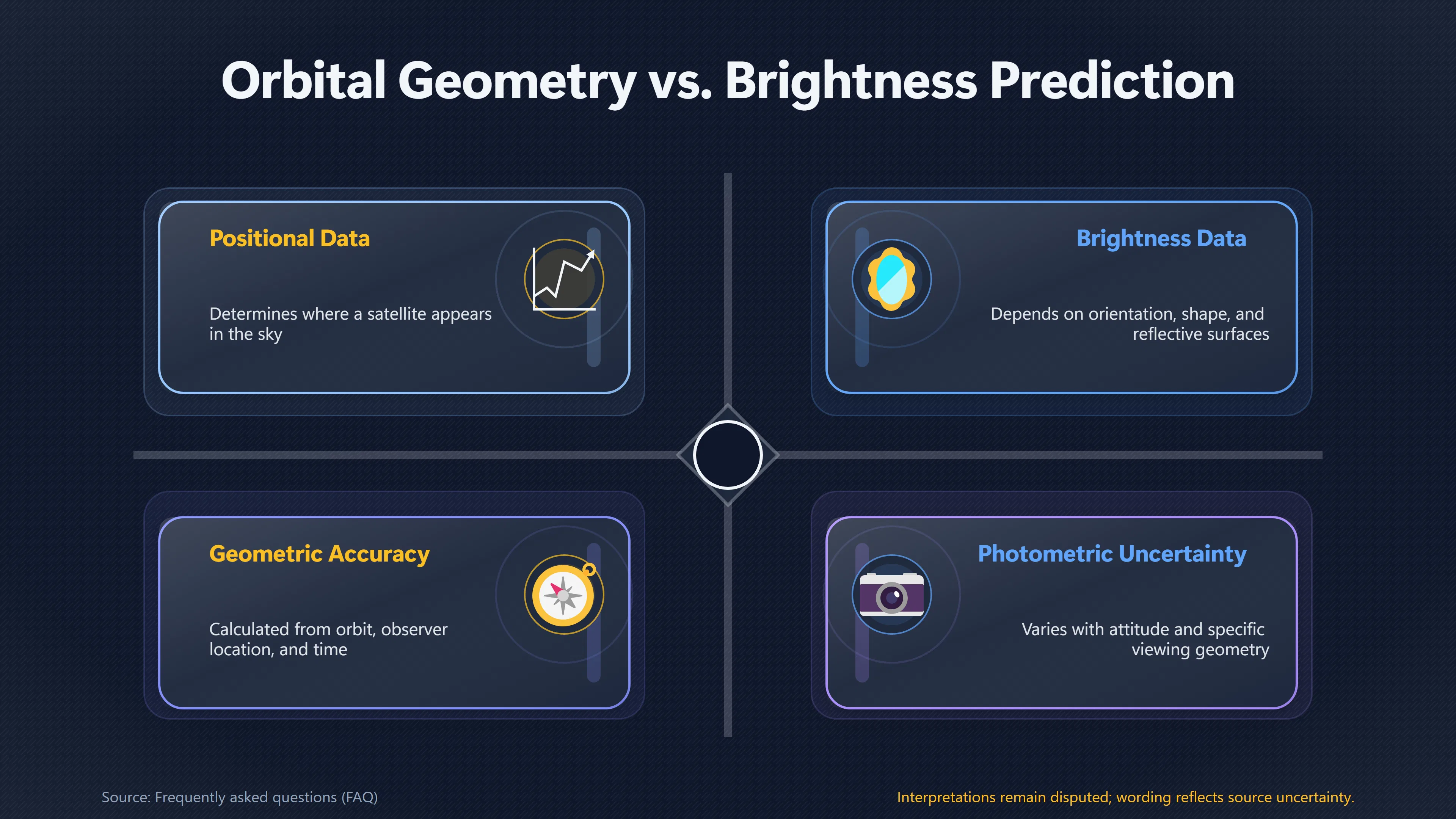
A satellite tracker can put a spacecraft in the right patch of sky at the right time and still badly underestimate what an observer will see. The reason is that orbit prediction and brightness prediction are different problems. Orbital data can determine where a satellite should be with considerable accuracy, while its apparent brightness also depends on its orientation, shape and reflective surfaces. A brief mirror-like, or specular, reflection can therefore make an otherwise faint satellite flash conspicuously for seconds.[Heavens-Above]heavens-above.comFrequently asked questions (FAQFrequently asked questions (FAQ)…

This distinction matters when investigating UFO or UAP reports. If a pass calculator says a satellite was only magnitude 6, 7 or fainter, that number should not automatically exclude the satellite when the reported event was a short flash. Ordinary magnitude estimates are often approximate; the very reflection that made the object noticeable may be the part of its behaviour that the prediction did not model.[Heavens-Above]heavens-above.comFrequently asked questions (FAQFrequently asked questions (FAQ)…
What ordinary pass predictions can and cannot estimate
A satellite pass prediction is strongest when answering geometrical questions: Was the satellite there? Where in the sky should it have appeared? Was it illuminated by the Sun? In which direction was it moving? These quantities can be calculated from orbital information together with the observer’s location and time.
Brightness is harder. Heavens-Above, one of the longstanding public satellite-prediction services, explicitly describes the visual magnitude in its pass tables as only a “rough indication” of apparent brightness. Its FAQ explains why: size, surface reflectivity, distance and the Sun-satellite-observer angle all affect brightness, but spacecraft orientation — its attitude — is often unknown and may change rapidly. Consequently, Heavens-Above warns that its magnitude estimates should be treated as a rough guide and that a satellite may actually be considerably brighter or fainter.[Heavens-Above]heavens-above.comExplanatory NotesExplanatory Notes…
That produces an important asymmetry for sighting investigations. A positional match can be meaningful even when a magnitude prediction looks poor. If a tracker places a sunlit spacecraft close to the reported line of sight at the correct time, a displayed faint magnitude does not necessarily mean that spacecraft was incapable of producing a short bright event.
Modern research illustrates why. Predicting satellite brightness more rigorously requires knowledge of how different spacecraft surfaces scatter light in different directions. Researchers describe this with a bidirectional reflectance distribution function (BRDF) — essentially a mathematical description of how strongly a surface reflects incoming light towards a particular viewing direction. Fankhauser, Tyson and Askari’s satellite-brightness modelling integrates the reflective behaviour of spacecraft components and viewing geometry, demonstrating that considerably more information is required for good photometric predictions than for simply propagating an orbit across the sky.[arXiv]arxiv.orgarXiv Satellite Optical BrightnessarXiv Satellite Optical Brightness
In practical terms, a simple pass calculator can get this sequence right:
21:14:30 — satellite at this azimuth and elevation
while getting this much less reliably:
21:14:30 — satellite will be magnitude 6.2
The first result is predominantly orbital geometry. The second additionally depends on what the spacecraft is presenting to the Sun and observer.
Why attitude and surface shape control flare brightness
A spacecraft is not a uniformly glowing point. It can contain solar arrays, antenna surfaces, chassis panels, thermal materials and other components with very different reflective properties. Their orientation determines where reflected sunlight goes.
This becomes especially important near the specular direction. Instead of scattering light broadly, a sufficiently smooth surface can concentrate much more sunlight into a narrow range of directions. An observer outside that favourable geometry sees an unremarkable satellite; an observer momentarily crossed by the reflected light sees a flare. The principle is well established in optical remote sensing: NASA describes sun glint as specular reflection and notes that small changes in viewing geometry can determine whether a narrowly concentrated glint is detected at all.[EPIC]epic.gsfc.nasa.govEPICAbout ProductEPICAbout Product
For satellite prediction, that means tiny orientation differences can produce large brightness differences. The historical Iridium constellation demonstrated the effect particularly clearly because its reflective antennas and controlled attitude made many flares predictable. Even then, Heavens-Above warned that the spacecraft attitude was maintained only to within roughly 0.1° of nominal and that this unpredictable difference could make a flare substantially brighter or fainter than forecast. Temporary non-nominal attitudes could cause predicted flares to disappear altogether.[Heavens-Above]heavens-above.comFrequently asked questions (FAQFrequently asked questions (FAQ)…
Most satellites do not offer such a convenient combination of known reflective geometry and tightly predictable orientation. Rocket bodies and failed spacecraft may tumble. Operational satellites can adopt different attitude modes. Solar arrays can change orientation. A reflection may also originate from a component that a simplified brightness model does not represent adequately.
The result is exactly the failure mode relevant to an apparently spontaneous UFO or UAP sighting: the satellite’s track may be predictable while the flash is not.
A faint pass can therefore contain a very short excursion to much greater brightness. Photometric work on Starlink has specifically characterised flares lasting only a few seconds, while large observational datasets show that spacecraft brightness depends strongly on illumination geometry rather than behaving as a constant property of the object.[arXiv]arxiv.orgOpen source on arxiv.org.
Starlink shows how large the prediction error can become
Starlink provides a modern example because its satellites are numerous, regularly observed and sufficiently complex for their brightness to depend strongly on viewing geometry.
Research by Anthony Mallama and Richard Cole found that Starlink spacecraft can become extremely bright when sunlight is reflected specularly towards an observer. Their model attributes these extreme events to the reflective behaviour of the spacecraft chassis and applies the mechanism directly to an incident reported as UAP by commercial pilots.[arXiv]arxiv.orgarXiv Extreme Flaring of Starlink SatellitesExtreme Flaring of Starlink SatellitesMay 21, 2024…
Observations reported in Sky & Telescope provide a useful sense of scale. Cole developed a numerical brightness model predicting that, in suitable geometry, the Earth-facing Starlink chassis could produce a mirror-like solar reflection. Mallama subsequently observed Starlink satellites flaring to approximately magnitude –2, while analysis indicated that observers aboard high-altitude aircraft could encounter still brighter reflections. Under favourable conditions the flares can approach the brightness of Venus.[Sky & Telescope]skyandtelescope.orgSky & Telescope Starlink Flares Can Fool Anyone — Even Airline PilotsSky & TelescopeStarlink Flares Can Fool Anyone — Even Airline Pilots - Sky & TelescopeJune 10, 2024…
That is not a small correction to an ordinary brightness estimate. Astronomical magnitude is logarithmic: a difference of five magnitudes corresponds to a factor of 100 in brightness. A spacecraft that is normally difficult or impossible to notice can therefore become, briefly, one of the most conspicuous point-like objects in its part of the sky.
The crucial lesson is not that every faint predicted Starlink pass will flare. Most will not produce an extreme reflection for a particular observer. It is that a predicted baseline brightness is not necessarily an upper limit. A narrow specular component can sit on top of the more ordinary brightness behaviour represented by a simpler model.
Better models can reduce this uncertainty. Detailed BRDF-based calculations incorporate spacecraft surfaces, solar geometry and empirical observations, and research has demonstrated improved agreement between calculated and observed Starlink brightness. But this improvement itself underlines the limitation of simpler predictions: accurate flare forecasting requires substantially more than knowing the orbit.[arXiv]arxiv.orgarXiv Satellite Optical BrightnessarXiv Satellite Optical Brightness
Why a correct track can accompany a wrong brightness
This apparent contradiction disappears once the two calculations are separated.
Suppose a witness reports a bright point that appeared for four seconds, moved a short distance and faded. A satellite database subsequently shows a spacecraft crossing that position at almost exactly the reported time, but the pass table assigns it magnitude 7. It is tempting to conclude that the satellite was too faint and eliminate it.
That conclusion is stronger than the prediction warrants.
The orbit establishes where the satellite’s centre of mass should have been. A flare prediction additionally requires enough knowledge to determine how sunlight interacted with its surfaces at that moment. For a detailed calculation, investigators may need to know or model:
- the spacecraft’s attitude;
- the orientation of solar arrays and other reflective components;
- the optical properties of those surfaces;
- the precise Sun-spacecraft-observer geometry;
- whether the satellite was manoeuvring, tumbling or operating in a different attitude mode;
- and the observer’s exact location, because a narrow specular reflection can be geographically sensitive.
The sensitivity to location was obvious with Iridium flares. Heavens-Above recommends observer coordinates accurate to roughly 1 km for those predictions, compared with about 10 km being adequate for ordinary satellite observing, because flare geometry is much more sensitive to where the observer stands.[Heavens-Above]heavens-above.comFrequently asked questions (FAQFrequently asked questions (FAQ)…
Thus, “the satellite was predicted to be faint” and “the satellite was in the right place” should not be treated as equally strong statements. The positional prediction may rest on much firmer information than the photometric one.
A real UAP case demonstrates the distinction
The practical relevance is not hypothetical. Douglas Buettner and colleagues examined an August 2022 incident in which five pilots aboard two commercial aircraft over the Pacific reported an unidentified phenomenon. The event included photographs and video. Using supplemental orbital elements for recently launched Starlink satellites and aircraft position data, the researchers reconstructed the geometry and matched the apparent motion of the reported object to the satellite train.[arXiv]arxiv.orgEnhancing Space Situational Awareness to Mitigate Risk: A Single-Case Study in the Misidentification of a Recently-Launched Starlink…
Brightness was a separate part of the problem. Sky & Telescope reports that analysis of the pilots’ photographs put the elongated object at about magnitude –4, comparable to Venus. Subsequent modelling of Starlink’s specular behaviour showed that the geometry of the Sun, spacecraft and aircraft could account for unusually intense reflections.[Sky & Telescope]skyandtelescope.orgSky & Telescope Starlink Flares Can Fool Anyone — Even Airline PilotsSky & TelescopeStarlink Flares Can Fool Anyone — Even Airline Pilots - Sky & TelescopeJune 10, 2024…
The case is valuable because it shows why merely asking whether a generic tracker listed an obviously bright object can be insufficient. Satellite identification can require combining orbital coincidence with illumination geometry, rather than demanding that a simplified pass-table magnitude reproduce the observation exactly.
It also exposes a broader investigative risk. Buettner and colleagues argue that changing specular-reflection angles, deployment configurations and spacecraft attitudes create gaps in space situational awareness. Their proposed remedy involves simulations capable of representing unusual illumination configurations, rather than relying solely on conventional knowledge of where satellites are located.[arXiv]arxiv.orgEnhancing Space Situational Awareness to Mitigate Risk: A Single-Case Study in the Misidentification of a Recently-Launched Starlink…
How investigators should treat a tracker that shows a faint pass
A faint magnitude prediction is evidence, but it should be weighted according to how that magnitude was calculated. It is not automatically a physical ceiling on the satellite’s possible brightness.
For a short-lived flash, a useful investigation separates three questions:
- Does the orbit match? Check whether a satellite occupied the reported line of sight at the relevant time and whether its direction and angular motion are compatible with the observation.
- Was illumination possible? Establish whether the spacecraft was sunlit rather than deep in Earth’s shadow and whether the solar geometry makes reflected light plausible.
- How trustworthy is the magnitude estimate? Determine whether the tracker uses a generic or average brightness model, or whether it actually models the spacecraft’s attitude, shape and directional reflectance closely enough to predict a specular event.
The third question is where false exclusions can occur. Heavens-Above itself cautions that unknown attitude means actual satellite brightness may differ considerably from its estimate. Research-grade models can do better by representing spacecraft surfaces and BRDFs, but those inputs are not automatically available for every object or every operational attitude.[Heavens-Above]heavens-above.comFrequently asked questions (FAQFrequently asked questions (FAQ)…
This does not justify declaring any unmatched flash to be a satellite. A credible identification still needs temporal and positional agreement, suitable illumination and behaviour consistent with orbital motion. A satellite hundreds of kilometres from the reported line of sight cannot be rescued merely by invoking a flare.
The narrower lesson is about exclusion: brightness alone is often the weakest reason to reject an otherwise strong satellite match when the reported phenomenon was a brief flash.

The useful distinction: “not predicted bright” is not “could not flare”
For UFO and UAP analysis, wording matters. “The tracker predicted this satellite at magnitude 7” is a defensible statement about a model. “Therefore this satellite could not have produced the bright flash” is a much stronger physical claim and may be unjustified unless the prediction genuinely incorporates the spacecraft’s instantaneous attitude and reflective behaviour.
Specular reflections are inherently geometry-sensitive. Modern Starlink observations demonstrate that spacecraft can undergo short, intense brightness surges, while established satellite-prediction services openly caution that orientation uncertainty limits ordinary magnitude forecasts.[arXiv]arxiv.orgarXiv Extreme Flaring of Starlink SatellitesExtreme Flaring of Starlink SatellitesMay 21, 2024…
That explains one of the more counter-intuitive ways a satellite flare can appear to come from nowhere. The tracker may not have missed the satellite at all. It may have correctly predicted a faint spacecraft moving through precisely that part of the sky while missing the few seconds in which one reflective surface happened to send an exceptional amount of sunlight towards the observer.
Amazon book picks
Further Reading
Books and field guides related to Why Satellite Trackers Can Miss the Brightest Flash. Use these as the next step if you want deeper reading beyond the article.
Fundamentals of Astrodynamics
Rating: 4.5/5 from 12 Google Books ratings
Teaching text developed by U.S. Air Force Academy and designed as a first course emphasizes the universal variable formulation. Develops...
Satellite Orbits: Models, Methods, and Applications
This modern presentation guides readers through the theory and practice of satellite orbit prediction and determination. Starting from th...
Orbital Mechanics for Engineering Students
Orbital Mechanics for Engineering Students, Second Edition, provides an introduction to the basic concepts of space mechanics. These incl...
eBay marketplace picks
Marketplace Samples
Live-tested eBay searches with available results related to this page.
Selected fromsatellite model oneBay.co.uk.

Endnotes
1.
Source: heavens-above.com
Title: Frequently asked questions (FAQ)
Link:https://www.heavens-above.com/FAQ.aspx?alt=0&cul=en&lat=0&lng=0&loc=Unspecified&tz=UCT
Source snippet
Frequently asked questions (FAQ)...
2.
Source: arxiv.org
Title: arXiv Satellite Optical Brightness
Link:https://arxiv.org/abs/2305.11123
3.
Source: arxiv.org
Link:https://arxiv.org/abs/2111.09735
4.
Source: heavens-above.com
Title: Explanatory Notes
Link:https://www.heavens-above.com/explain.aspx
Source snippet
Explanatory Notes...
5.
Source: epic.gsfc.nasa.gov
Title: EPICAbout Product
Link:https://epic.gsfc.nasa.gov/science/products/glint
6.
Source: ntrs.nasa.gov
Title: Technical Reports Server Analysis of Glint During the Artemis I Mission
Link:https://ntrs.nasa.gov/citations/20240003767
Source snippet
NASA Technical Reports ServerAnalysis of Glint During the Artemis I Mission - NASA Technical Reports Server (NTRS)...
7.
Source: arxiv.org
Title: arXiv Extreme Flaring of Starlink Satellites
Link:https://arxiv.org/abs/2405.13091
Source snippet
Extreme Flaring of Starlink SatellitesMay 21, 2024...
Published: May 21, 2024
8.
Source: arxiv.org
Link:https://arxiv.org/abs/2403.08155
Source snippet
Enhancing Space Situational Awareness to Mitigate Risk: A Single-Case Study in the Misidentification of a Recently-Launched Starlink...
9.
Source: ntrs.nasa.gov
Link:https://ntrs.nasa.gov/search?q=%22Artemis+I%22
10.
Source: data.nasa.gov
Link:https://data.nasa.gov/dataset/dscovr-epic-level-2-glint-7313a
11.
Source: science.nasa.gov
Title: the subtleties of sunglint 151456
Link:https://science.nasa.gov/earth/earth-observatory/the-subtleties-of-sunglint-151456/
12.
Source: ntrs.nasa.gov
Link:https://ntrs.nasa.gov/citations/20210016802
13.
Source: science.nasa.gov
Title: specular spectacular
Link:https://science.nasa.gov/resource/specular-spectacular/
14.
Source: jpl.nasa.gov
Title: pia18432 specular spectacular
Link:https://www.jpl.nasa.gov/images/pia18432-specular-spectacular/
15.
Source: science.nasa.gov
Title: the science of sunglint 84333
Link:https://science.nasa.gov/earth/earth-observatory/the-science-of-sunglint-84333/
16.
Source: jpl.nasa.gov
Title: pia12481 reflection of sunlight off titan lake
Link:https://www.jpl.nasa.gov/images/pia12481-reflection-of-sunlight-off-titan-lake/
17.
Source: science.nasa.gov
Title: sun glint from solar electric generating stations 4517
Link:https://science.nasa.gov/earth/earth-observatory/sun-glint-from-solar-electric-generating-stations-4517/
18.
Source: science.nasa.gov
Title: sun glint from solar electric generating stations
Link:https://science.nasa.gov/photojournal/sun-glint-from-solar-electric-generating-stations/
19.
Source: heavens-above.com
Title: All Sats.aspx
Link:https://www.heavens-above.com/AllSats.aspx?lat=31.8943056&lng=-109.0399444
20.
Source: heavens-above.com
Title: All Sats.aspx
Link:https://www.heavens-above.com/AllSats.aspx?lat=27.4245347&lng=-97.2993546
21.
Source: heavens-above.com
Link:https://heavens-above.com/Mobile.aspx
22.
Source: heavens-above.com
Title: All Sats.aspx
Link:https://heavens-above.com/AllSats.aspx
23.
Source: heavens-above.com
Title: All Sats.aspx
Link:https://heavens-above.com/AllSats.aspx?alt=304.0&cul=en&lat=42.85275&lng=-83.4076166667&loc=Heavens+View+Observatory&tz=EST
24.
Source: heavens-above.com
Title: All Sats.aspx
Link:https://heavens-above.com/AllSats.aspx?alt=1593.0&cul=en&lat=37.3749&lng=-117.9802&loc=Deep+Springs+Observatory&tz=PST
25.
Source: heavens-above.com
Link:https://heavens-above.com/?alt=0&cul=en&lat=0&lng=1&loc=unspecified
26.
Source: heavens-above.com
Link:https://www.heavens-above.com/faq.aspx?alt=0&cul=en&lat=47.626766&lng=7.459314&loc=Brinckheim&tz=UCT
27.
Source: jpl.nasa.gov
Link:https://www.jpl.nasa.gov/news/press_kits/sentinel-6/mission/spacecraft/
28.
Source: skyandtelescope.org
Title: Sky & Telescope Starlink Flares Can Fool Anyone — Even Airline Pilots
Link:https://skyandtelescope.org/astronomy-news/starlink-flares-can-fool-anyone-even-airline-pilots/
Source snippet
Sky & TelescopeStarlink Flares Can Fool Anyone — Even Airline Pilots - Sky & TelescopeJune 10, 2024...
Published: June 10, 2024
29.
Source: celestrak.org
Link:https://celestrak.org/norad/elements/table.php?FORMAT=tle&GROUP=iridium-NEXT
30.
Source: skyandtelescope.org
Title: Satellite or Meteor? Dissecting Light Trails in Your Sky Photos
Link:https://skyandtelescope.org/astronomy-news/satellite-or-meteor-dissecting-light-trails-in-your-sky-photos/
31.
Source: astronomy.com
Title: march 13 1989 quebec goes dark
Link:https://www.astronomy.com/today-in-the-history-of-astronomy/march-13-1989-quebec-goes-dark/
32.
Source: astronomy.com
Title: feb 14 1980 solarmax [launches]({{ ‘launches/’ | relative_url }})
Link:https://www.astronomy.com/https%3A/feb-14-1980-solarmax-launches/
33.
Source: astronomy.com
Title: Satellite megaconstellations: Not just a problem from Earth anymore
Link:https://www.astronomy.com/space-exploration/satellite-megaconstellations-not-just-a-problem-from-earth-anymore/
34.
Source: jglobal.jst.go.jp
Link:https://jglobal.jst.go.jp/en/public/202402221356811440
35.
Source: astronomy.com
Link:https://www.astronomy.com/observing/astronomers-develop-new-method-for-predicting-explosive-solar-flares/
36.
Source: astronomy.com
Title: Satellite ‘fake out’
Link:https://www.astronomy.com/science/satellite-fake-out/
37.
Source: skyandtelescope.org
Title: Get Your Iridium Fix Before It’s Too Late!
Link:https://skyandtelescope.org/stargazing-and-observing/get-your-iridium-fix-before-its-too-late/
38.
Source: astronomy.com
Title: NAS A missions measure solar flare from 2 spots in space | Astronomy.com
Link:https://www.astronomy.com/observing/nasa-missions-measure-solar-flare-from-2-spots-in-space/
39.
Source: skyandtelescope.org
Title: How to Spot the USAF’s ‘Mini-Shuttle’
Link:https://skyandtelescope.org/astronomy-news/observing-news/how-to-spot-the-usafs-mini-shuttle-x-37b-2010201522/
40.
Source: meetings.aps.org
Link:https://meetings.aps.org/Meeting/4CF15/Event/258589
41.
Source: skyandtelescope.org
Title: Predictive Prowess: See an Iridium Flare
Link:https://skyandtelescope.org/stargazing-and-observing/see-iridium-flare-071720143/
42.
Source: astronomy.com
Title: NAS A spacecraft spots a late phase in solar flares | Astronomy.com
Link:https://www.astronomy.com/science/nasa-spacecraft-spots-a-late-phase-in-solar-flares/
43.
Source: astronomy.com
Title: Sun unleashes X6.9 class flare | Astronomy.com
Link:https://www.astronomy.com/science/sun-unleashes-x6-9-class-flare/
44.
Source: astronomy.com
Title: The aurora | Astronomy.com
Link:https://www.astronomy.com/science/the-aurora/
45.
Source: skyandtelescope.org
Title: Another Cal SKY Success
Link:https://skyandtelescope.org/astronomy-blogs/another-calsky-success/
46.
Source: satobs.org
Title: Iridium Flares
Link:https://www.satobs.org/iridium.html
47.
Source: skyandtelescope.org
Title: Iridium: The Movie
Link:https://skyandtelescope.org/astronomy-blogs/iridium-the-movie/
48.
Source: skyandtelescope.org
Title: Iridium Flare Watch: How to Observe Iridium Flares | Sky & Telescope
Link:https://skyandtelescope.org/stargazing-and-observing/celestial-objects-to-watch/observing-iridium-flares/
49.
Source: skyandtelescope.org
Title: Take a “Sat-seeing” Tour
Link:https://skyandtelescope.org/stargazing-and-observing/celestial-objects-to-watch/take-a-sat-seeing-tour/
50.
Source: astronomy.com
Title: Aurorae on the way? | Astronomy.com
Link:https://www.astronomy.com/science/aurorae-on-the-way/
51.
Source: astronomy.com
Title: a glimpse of supernova 1006
Link:https://www.astronomy.com/science/a-glimpse-of-supernova-1006/
52.
Source: skyandtelescope.org
Title: Have You Been Flashed By Iridium?
Link:https://skyandtelescope.org/stargazing-and-observing/celestial-objects-to-watch/have-you-been-flashed-by-iridium/
53.
Source: skyandtelescope.org
Title: Martian Flare Watch
Link:https://skyandtelescope.org/astronomy-news/observing-news/martian-flare-watch/
54.
Source: skyandtelescope.org
Title: Observing Guides to Celestial Objects
Link:https://skyandtelescope.org/celestial-objects-observe/
55.
Source: skyandtelescope.org
Link:https://skyandtelescope.org/stargazing-and-observing/celestial-objects-to-watch/space-satellites/
56.
Source: skyandtelescope.org
Link:https://skyandtelescope.org/astronomy-news/page/31/
57.
Source: skyandtelescope.org
Title: Astronomy News & Astronomical Events | Sky & Telescope By: Monica Young
Link:https://skyandtelescope.org/astronomy-news/page/33/
58.
Source: skyandtelescope.org
Title: Astronomy in the News | The Impact of Astronomy on Society By: Arwen Rimmer
Link:https://skyandtelescope.org/astronomy-news/astronomy-and-society/page/2/
59.
Source: skyandtelescope.org
Link:https://skyandtelescope.org/author/tmallamaskyandtelescope-com/
60.
Source: skyandtelescope.org
Link:https://skyandtelescope.org/astronomy-news/page/28/?c=y&id=123828866
61.
Source: cosmosage.online
Link:https://cosmosage.online/arxiv/?pid=2603.07631&rank=pid
62.
Source: astronomy.com
Link:https://www.astronomy.com/page/1354/?lang=all&w=milky-way
Additional References
63.
Source: hjkc.de
Title: CENAPRaumfahrt+Astronomie-Blog von CENAP
Link:https://www.hjkc.de/_blog/22917-ufo-forschung-enhancing-space-situational-awareness-to-mitigate-risk-a-case-study-in-the-misidentifi/
Source snippet
Blog: UFO-Forschung - ENHANCING SPACE SITUATIONAL AWARENESS TO MITIGATE RISK: A CASE STUDY IN THE MISIDENTIFICATION OF STARLINK SATELLITE...
64.
Source: youtube.com
Title: Curious Pilot: N661LF Oregon UAP / UFO sighting explained,
Link:https://www.youtube.com/watch?v=GyXRO7MR75c
Source snippet
Tutorial - how to use online satellite calculator - Heavens Above...
Published: December 7, 2024
65.
Source: chinarxiv.org
Link:https://chinarxiv.org/items/chinaxiv-202604.00180
66.
Source: usgs.gov
Link:https://www.usgs.gov/publications/across-track-tilt-concept-sun-glint-mitigation-future-earth-observing-missions
67.
Source: usgs.gov
Link:https://www.usgs.gov/publications/across-track-tilt-concept-sun-glint-mitigation-uture-earth-observing-missions
68.
Source: nature.com
Title: Satellite megaconstellations will threaten space-based astronomy | Nature
Link:https://www.nature.com/articles/s41586-025-09759-5
69.
Source: nature.com
Title: The high optical brightness of the Blue Walker 3 satellite | Nature
Link:https://www.nature.com/articles/s41586-023-06672-7
70.
Source: youtube.com
Title: These UFOs are Starlink Flares, 100%
Link:https://www.youtube.com/watch?v=Ea8BCl2yVU0
Source snippet
Curious Pilot: N661LF Oregon UAP / UFO sighting explained, December 7, 2024...
Published: December 7, 2024
71.
Source: aas.org
Link:https://aas.org/form/aas-survey-on-satellite-constell
72.
Source: researchgate.net
Link:https://www.researchgate.net/scientific-contributions/Anthony-Mallama-72546103/publications/2