Within Following Lights
Why Venus Can Seem to Follow Your Car
Venus can stay in nearly the same direction for kilometres, making a bright celestial light seem to pace a vehicle.
On this page
- Why road travel barely changes Venus's bearing
- How passing scenery strengthens the pursuit impression
- Conditions that make Venus easier to mistake for a UFO
Page outline Jump by section
Introduction
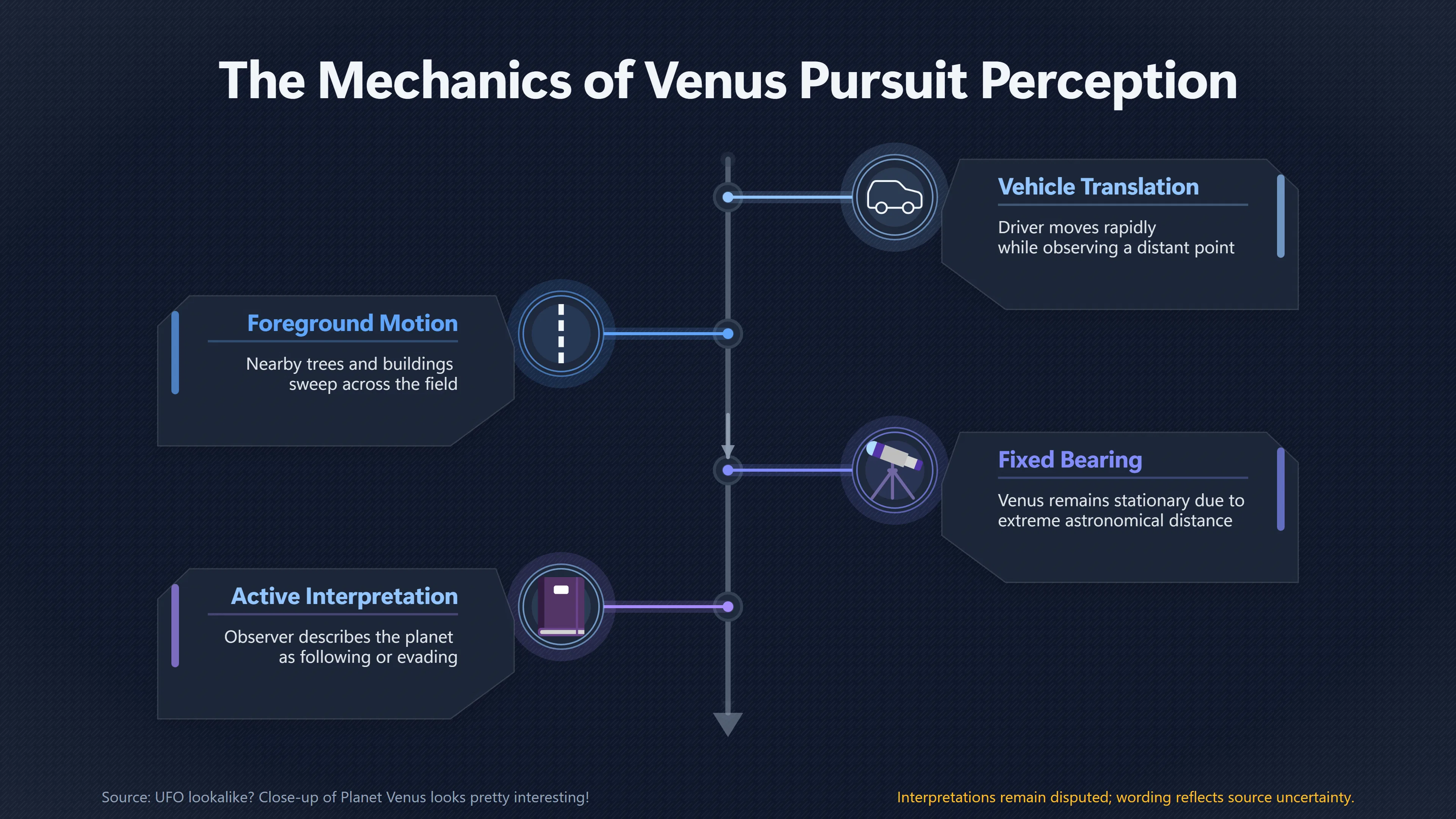
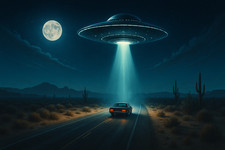
Venus really can seem to follow a moving car. The effect does not require the planet to move with the vehicle: it arises because Venus is so extraordinarily distant that driving even many kilometres changes the observer’s viewing direction towards it by an imperceptibly small amount. Meanwhile, trees, buildings, lamp posts and hills sweep across the view. Against that moving foreground, the bright planet can appear to hold its position beside the car, retreat when pursued or reappear after bends in the road.
This matters in UFO/UAP reports because Venus is unusually conspicuous. NASA identifies it as the brightest planet seen from Earth and the brightest night-sky object after the Moon.[NASA Science]nasa.govOpen source on nasa.gov. Historical UFO investigations contain striking examples in which observers described bright lights as pacing or evading vehicles, only for investigators to identify Venus as an important part of the sighting.[NCAS Files]ncas.orgOpen source on ncas.org.
Why road travel barely changes Venus’s bearing
The essential point is scale. A roadside object may be tens or hundreds of metres away; Venus is separated from Earth by tens of millions of kilometres even during comparatively close approaches. NASA notes that Venus orbits the Sun at an average distance of about 108 million kilometres, while its distance from Earth varies enormously as the planets move around their respective orbits.[NASA Science]nasa.govOpen source on nasa.gov.
Suppose, simply for illustration, that Venus were 40 million kilometres away and a car travelled 10 kilometres sideways relative to the line of sight. For a small angle, the resulting change in direction would be roughly:
θ≈40,000,00010
That is about 0.000014 degrees, or roughly 0.05 arcseconds. The precise number changes with Venus’s distance and the direction in which the car travels, but the practical conclusion does not: ordinary road journeys produce far too little parallax for a person to notice Venus sliding across the distant sky because of the car’s translation alone.
A nearby lamp behaves completely differently. Travel a few hundred metres and its bearing may swing dramatically. Venus therefore creates an unusual visual contrast: the observer knows the car is moving rapidly, everything nearby confirms that movement, yet the brilliant point in the distance stubbornly remains in almost the same direction.
This is an extreme-distance example of the geometry underlying motion parallax. Vision research describes motion parallax as the relative image motion produced when an observer translates through an environment; those differences in motion provide the visual system with powerful information about three-dimensional structure and relative depth.[PubMed]nih.govOpen source on nih.gov. Normally the mechanism helps us. With an astronomical point of light whose distance is not visually obvious, however, the same visual situation can support a misleading impression of pursuit.
Importantly, a nearly constant bearing does not establish that a light is travelling alongside the observer. Direction and distance are different measurements. Without reliable range information, a remote stationary-looking light and a much nearer object genuinely pacing a vehicle can initially produce superficially similar impressions.
How passing scenery strengthens the pursuit impression
From inside a moving vehicle, Venus is not perceived against an empty coordinate grid. The view is continually reorganised by nearby scenery. A hedge rushes backwards. Lamp posts cross the window one after another. Houses disappear behind the passenger. Distant hills drift much more slowly. Venus, vastly farther away than all of them, appears essentially fixed.
That hierarchy of apparent motion is exactly the sort of information motion parallax normally supplies to the visual system: retinal motion varies with depth as the observer moves.[OUP Academic]oup.comOpen source on oup.com. The unusual part of the Venus experience is that the planet supplies almost no everyday cues to its immense distance. To the unaided eye it is simply an exceptionally bright point.
The road can then turn geometry into an apparent interaction. Imagine Venus lying ahead and to the left. On one stretch it is visible through the windscreen; after a bend it may sit beside the driver’s window. Trees temporarily hide it and then it reappears through another gap. A further bend may place it ahead again. Because the driver experiences these changes while accelerating, turning and passing landmarks, it is easy to describe the sequence in active language: it kept up with us, it stayed beside the car, it disappeared and came back, or every time we turned, it followed.
The vehicle is actually doing most of the manoeuvring.
There is another useful diagnostic. If a supposed pursuer remains at approximately the same celestial position while the road repeatedly changes direction, that behaviour can favour a distant astronomical source over a nearby craft maintaining formation. The test is stronger when the observation can be reconstructed using the exact date, time, location and viewing direction, rather than relying on remembered impressions of where the light seemed to be.
Why Venus is especially convincing
Not every star creates the same degree of surprise. Venus combines several properties that make it unusually effective as an apparent UFO.
First, it is exceptionally bright. NASA describes Venus as the brightest planet in Earth’s sky; only the Sun and Moon normally surpass it among natural celestial objects visible from Earth.[NASA Science]nasa.govOpen source on nasa.gov. A person unfamiliar with the sky can therefore underestimate how bright a perfectly ordinary planet can look and assume that such an intense light must be comparatively close.
Second, Venus is encountered around morning or evening rather than roaming the sky throughout the night. Because its orbit lies inside Earth’s, Venus always appears relatively close to the Sun in our sky. It consequently becomes the familiar “morning star” or “evening star”.[NASA Science]nasa.govOpen source on nasa.gov. Those observing periods overlap naturally with road travel in twilight and darkness, when fewer environmental depth cues are available.
Third, Venus can be conspicuous at relatively low elevation. A brilliant isolated light near the horizon is particularly easy to associate with terrestrial terrain: an observer may judge it as being “above those trees”, “over that ridge” or “a few miles down the road”, even though the foreground supplies no genuine measurement of the planet’s range.
Low elevation can add atmospheric effects as well. The World Meteorological Organization explains that fluctuations in atmospheric refractive index can produce variations in the apparent brilliance, colour and position of celestial lights, with scintillation becoming more pronounced towards the horizon because the light traverses a longer atmospheric path.[International Cloud Atlas]wmo.intOpen source on wmo.int. Thus a low bright object need not always look like the calm, textbook image of a planet. Under some conditions its apparent brightness, colour or position can fluctuate enough to make the observation feel more dynamic.
The Colorado UFO study explicitly encountered this problem. Its discussion of field investigations noted that light diffusion and scintillation contributed to early-morning UFO observations and singled out Venus as a frequent source of misidentification.[NCAS Files]ncas.orgOpen source on ncas.org.

A historical pursuit that turned out to involve Venus
One of the clearest historical demonstrations comes from Case 37 of the University of Colorado’s UFO study in the late 1960s. It is especially relevant because the reports went considerably beyond somebody merely mistaking a stationary star for a UFO.
Law-enforcement officers in several communities reported unidentified bright objects over four successive mornings. Accounts included objects being chased by police and apparently chasing them back. One patrolman reportedly pursued a ball of light along a road; when the officers turned back, they believed the object turned and followed them, eventually catching up before climbing into the sky. A light aircraft was also sent up in pursuit of an object that its pilot could not catch.[NCAS Files]ncas.orgOpen source on ncas.org.
At first sight, descriptions such as “it fled when we chased it” seem difficult to reconcile with a planet. But the investigation found that the apparently extraordinary behaviour was precisely where observer motion and uncertain distance mattered. The light remained visible after some of the supposed manoeuvres, and observers described it eventually assuming a stable position in the sky. Investigators compared those positions with the known locations of Venus and Jupiter. They also showed police observers Venus during daylight; according to the case report, the officers agreed that it matched the appearance of their UFO once the object had settled into its later position.[NCAS Files]ncas.orgOpen source on ncas.org.
The investigators concluded that the excitement had been caused primarily by Venus, with Jupiter contributing to some reports. Significantly for vehicle sightings, the report explicitly highlighted “the appearance of motion of a stationary distant object, particularly that caused by the motion of the observer”, alongside horizon haze and scintillation.[NCAS Files]ncas.orgOpen source on ncas.org.
The case should not be treated as proof that every reported vehicle pursuit is Venus. Its value is narrower and stronger: it demonstrates from a documented investigation that sincere observers can interpret a planet as a light that reacts to pursuit, retreats from vehicles and later appears to chase them.
When Venus reports become more elaborate
Historical records also show why identifying the underlying light can become harder once an observer has interpreted it as nearby.
In another Colorado-project case, an observer repeatedly reported an evening object that appeared enormous, changed shape and seemed to land several times a week. He even described apparent windows and jets through binoculars. When an investigator visited, the observer pointed to the object in question: Venus and Saturn were close together in that part of the western sky, with Venus much brighter. The reported repeated “landings” corresponded to the object’s gradual descent towards the western horizon.[Project 1947]project1947.comOpen source on project1947.com.
That example illustrates an important caution for apparent-pursuit reports. Once a point of light is mentally assigned a nearby distance, subsequent impressions of speed and size inherit that assumption. A light believed to be a few hundred metres away must seem to travel rapidly to remain beside a fast car. The identical angular behaviour attributed to an astronomical object requires no such movement at all.
This is why witness descriptions such as “it matched our speed” are not measurements of velocity unless the object’s distance has independently been established. A driver travelling at 80 km/h can truthfully report that Venus remained beside the vehicle for kilometre after kilometre. What cannot be inferred from that observation alone is that Venus — or whatever the unidentified light was — was itself travelling at 80 km/h.
Conditions that make Venus easier to mistake for a UFO
A Venus pursuit interpretation becomes particularly plausible when several clues occur together rather than when “Venus” is invoked simply because a sighting involves a bright light.
The strongest pattern is a very bright, largely featureless light seen towards the morning or evening sky that retains approximately the same celestial direction while the vehicle covers substantial distance. Venus becomes still more plausible if its apparent changes correlate with bends, hills, foreground obstructions or the observer changing position rather than with independently observed motion against the stars.
Atmospheric conditions can complicate the appearance. Haze can spread a bright point into a larger glow, while low-altitude scintillation can produce fluctuations in brightness, colour and apparent position.[International Cloud Atlas]wmo.intOpen source on wmo.int. Those effects are especially relevant because a witness who already judges the light to be nearby may interpret optical changes as changes in a craft’s lights or manoeuvres rather than as effects along a long atmospheric sightline.
Venus is also more convincing when relatively few stars are visible. Twilight, urban lighting, thin cloud or haze can suppress fainter reference stars while leaving Venus conspicuous. The observer then loses precisely the celestial reference points that would make the planet’s fixed astronomical position easier to recognise.
Conversely, “it followed the car” should not automatically be labelled Venus. A useful identification requires checking whether Venus was actually above the horizon in the reported direction at the stated date and time. Reports containing independently verified large angular movements against the star field, reliable range measurements or behaviour incompatible with Venus’s calculated position need another explanation. Historical UFO investigations are most persuasive when they reconstruct those details rather than treating Venus as a generic answer.
Why the effect matters in UFO/UAP assessment
Venus occupies an important place in UFO history because it exposes a fundamental weakness in judging aerial motion by eye: angular behaviour is not the same thing as physical trajectory. Project Blue Book’s surviving records, now held by the US National Archives, document a much broader history of attempts to separate unidentified reports from astronomical, atmospheric and human-made causes.[National Archives]archives.govOpen source on archives.gov. Contemporary summaries of Blue Book likewise note that stars, planets, meteors and other astronomical objects accounted for a meaningful share of investigated reports.[Air & Space Forces Magazine]airandspaceforces.comOpen source on airandspaceforces.com.
The moving-car version makes that problem particularly intuitive. The observer has excellent evidence that something relative to the vehicle is changing because the entire landscape is streaming past. Yet the distant planet barely changes direction. That mismatch can make Venus feel less stationary, not more: it seems uniquely attached to the observer while everything else is left behind.
A report that “the light followed us for 20 kilometres” can therefore be completely sincere and observationally accurate in one limited sense — the light really did remain visible in nearly the same direction for 20 kilometres. The interpretive step is concluding that it travelled those kilometres alongside the vehicle.
For Venus, no such pursuit is necessary. Its immense distance keeps its bearing almost unchanged; the road supplies the motion; passing scenery supplies the contrast; and Venus’s exceptional brightness supplies a compelling object for the eye to track. Together, those ordinary ingredients can produce one of the most memorable apparent-pursuit effects in UFO/UAP reporting.
Amazon book picks
Further Reading
Books and field guides related to Why Venus Can Seem to Follow Your Car. Use these as the next step if you want deeper reading beyond the article.
NightWatch: A Practical Guide to Viewing the Universe
A practical guide to viewing the universe.
The Backyard Astronomer's Guide
Discusses the practical aspects of stargazing, including how to choose appropriate equipment, contending with light pollution, taking suc...
Turn Left at Orion
With over 100,000 copies sold since first publication, this is one of the most popular astronomy books of all time. It is a unique guideb...
eBay marketplace picks
Marketplace Samples
Live-tested eBay searches with available results related to this page.
Selected fromUFO poster oneBay.co.uk.


Current eBay listing
VINTAGE UFO FLYING SAUCERS COMIC ADVERTISING A2 POSTER PRINT
Current eBay listing
I Want To Believe UFO Poster Giclée Fine Art Heavyweight Print
Endnotes
1.
Source: pmc.ncbi.nlm.nih.gov
Link:https://pmc.ncbi.nlm.nih.gov/articles/PMC3349336/
2.
Source: ntrs.nasa.gov
Link:https://ntrs.nasa.gov/api/citations/19980019496/downloads/19980019496.pdf
3.
Source: pmc.ncbi.nlm.nih.gov
Link:https://pmc.ncbi.nlm.nih.gov/articles/PMC6740481/
4.
Source: youtube.com
Title: UFO lookalike? Close-up of Planet Venus looks pretty interesting!
Link:https://www.youtube.com/watch?v=2ABJtikyCN4
Source snippet
Venus - the Morning Star and Evening Star...
5.
Source: youtube.com
Link:https://www.youtube.com/watch?v=Ov3fYgGwy60
Source snippet
Depth Perception (Intro Psych Tutorial #57)...
Additional References
6.
Source: youtube.com
Title: Depth Perception (Intro Psych Tutorial #57)
Link:https://www.youtube.com/watch?v=Qr_yBDMd1Z8
Source snippet
Roadside Wonders - The Motion Parallax Effect...
7.
Source: earthsky.org
Link:https://earthsky.org/astronomy-essentials/moon-and-stars-distance-appearance/
8.
Source: youtube.com
Title: Transit of Venus Intro to Parallax
Link:https://www.youtube.com/watch?v=2o2otqL3Uc4