Within Starlink
Why New Starlink Launches Look Like UFO Formations
Newly deployed Starlink satellites can appear as a remarkably orderly chain before orbit raising spreads the group apart.
On this page
- How deployment creates a compact satellite train
- Why the spacing looks unusually regular
- How the formation changes over the following days
Page outline Jump by section
Introduction
A freshly launched Starlink batch can produce one of the most artificial-looking sights in the modern night sky: a tightly packed procession of nearly identical lights travelling along the same track. The effect is strongest soon after deployment, when the satellites have only just been released into low Earth orbit and have not yet spread into their eventual positions. The US All-domain Anomaly Resolution Office (AARO) says that, immediately after launch and for several days afterwards, dozens of Starlink satellites can form a distinctive line of bright objects.[AARO]aaro.milCorrelations of Starlink Satellite Flaring with UAP ObservationsCorrelations of Starlink Satellite Flaring with UAP ObservationsJanuary 24, 2025…
Recent launches show that this is still an active source of unusual-looking sky displays rather than merely a feature of Starlink’s early years. Falcon 9 missions in 2026 have commonly released batches of roughly two dozen to 29 satellites at once. More unusually, footage from a May 2026 deployment showed the process from the satellites’ own perspective: the spacecraft began close together and slowly separated before starting their main orbit-raising phase.[SpaceX]spacex.comSpace XSpace XSpaceX - Starlink MissionMay 25, 2026…
For UFO and UAP identification, that short post-launch interval matters. It is when an ordinary satellite deployment can most closely resemble a deliberately organised formation of luminous objects.
How deployment creates a compact satellite train
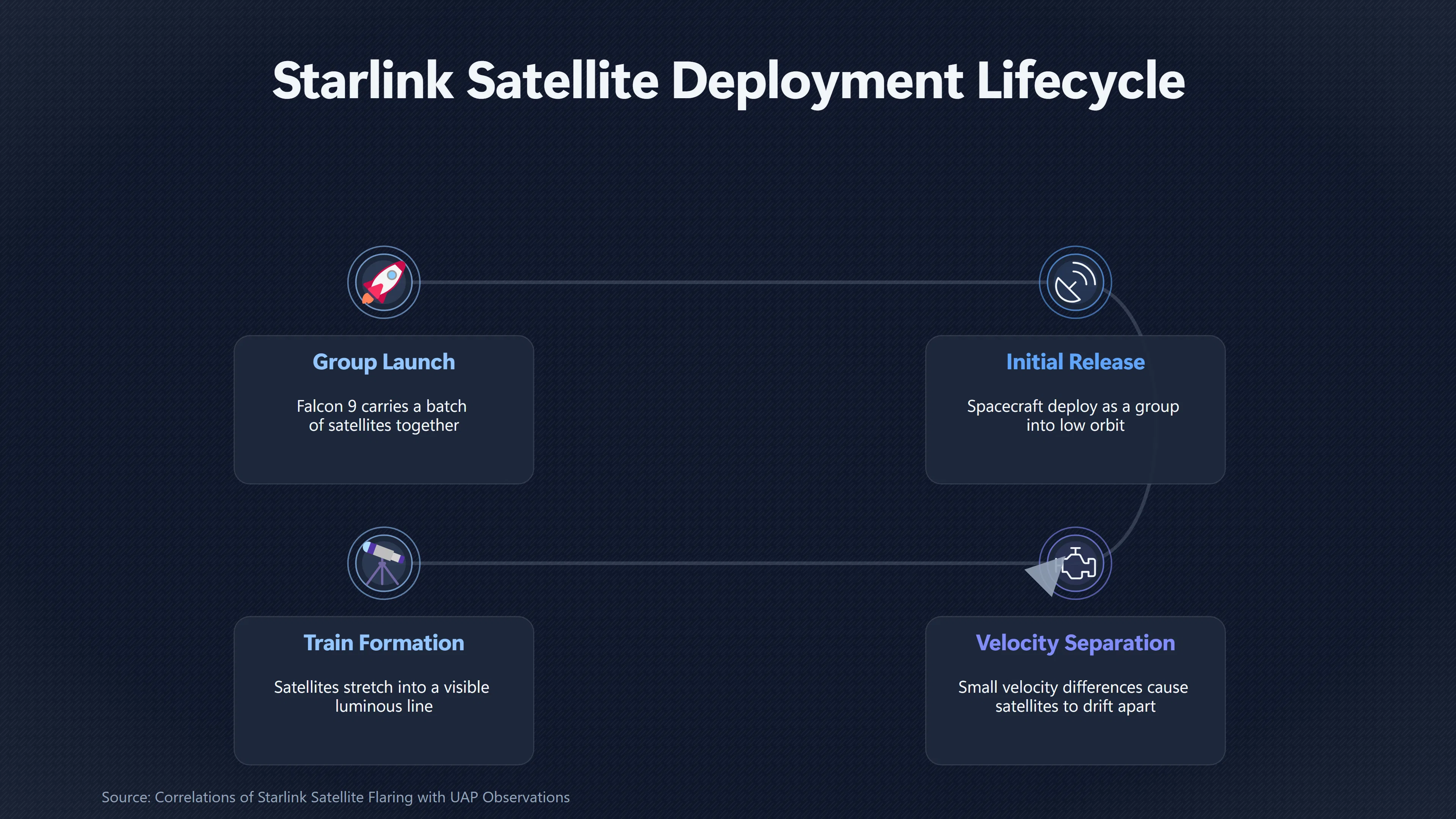
The train begins with the way a Starlink mission carries and releases its payload. A Falcon 9 does not normally put each Starlink spacecraft separately into its final operational position. It carries a batch together, reaches an initial low-Earth-orbit deployment trajectory and releases the spacecraft as a group. AARO describes this as the transition from the launch phase, when many satellites are carried together with their solar panels folded, into the initial orbital phase in which they separate and deploy their arrays.[AARO]aaro.milCorrelations of Starlink Satellite Flaring with UAP ObservationsCorrelations of Starlink Satellite Flaring with UAP ObservationsJanuary 24, 2025…
Current missions make the scale and timing concrete. SpaceX’s Starlink 10-47 mission on 25 May 2026 carried 29 satellites. Falcon 9’s second stage performed a short second burn just after T minutes, and the Starlink satellites deployed at about T hour 1 minute. Another 29-satellite mission, Starlink 10-43 on 4 June, followed almost the same pattern, deploying its payload roughly an hour after liftoff.[SpaceX]spacex.comSpace XSpace XSpaceX - Starlink MissionMay 25, 2026…
That deployment does not instantly turn the payload into 29 widely separated satellites. A particularly useful demonstration came from Starlink Group 10-38, launched on 1 May 2026. SpaceX’s mission record confirms that Falcon 9 carried 29 Starlink spacecraft and deployed them at approximately T hour. A few days later, footage recorded from one of those satellites showed other members of the batch during their first orbit after release. They were still close enough for several spacecraft to appear together in the camera’s field of view.[SpaceX]spacex.comSpace XSpace XSpaceX - Starlink MissionMay 1, 2026…
Michael Nicolls, SpaceX’s senior Starlink engineering executive, explained the separation mechanism accompanying that footage: the satellites are carried stacked much like a deck of cards, while the dispensing process imparts small differences in velocity so that the spacecraft move safely apart. The important point for a ground observer is the scale of those differences. They are sufficient to separate neighbouring satellites safely, but they do not immediately scatter the batch across the sky. Instead, the satellites begin their independent flight in closely related trajectories and gradually stretch into a line.[Space]space.comShared on May 4, 2026, by Michael Nicolls, SpaceX's Vice President of Starlink Engineering, the 3.5-minute video records the journey of o…
The result is the familiar Starlink train: many independent spacecraft that can nevertheless look like a single coordinated formation because they share almost the same orbital path and deployment history.
Why the spacing looks unusually regular
The orderly appearance is one reason a new Starlink train can generate UFO reports. Random objects in the sky are not expected to arrange themselves into a neat procession, yet regularity is exactly what a controlled multi-satellite deployment can produce.
Each spacecraft begins from essentially the same place in space, within the same deployment sequence, with only small differences in its motion relative to neighbouring satellites. As those differences accumulate, the batch stretches primarily along its orbital path. To someone on the ground, the geometry can therefore appear less like unrelated satellites and more like points placed along an invisible line.
The May 2026 onboard footage is particularly revealing because it shows that this visual organisation is not an illusion created solely by viewing the satellites from Earth. Space.com reported that the satellites could be seen gradually separating during an entire orbit through sunrise and sunset, completing their initial deployment sequence before beginning orbit raising.[Space]space.comShared on May 4, 2026, by Michael Nicolls, SpaceX's Vice President of Starlink Engineering, the 3.5-minute video records the journey of o…
Orbital mechanics then help preserve the procession while changing its scale. Small differences in altitude and velocity produce gradual changes in the satellites’ positions along the orbit. SpaceX can subsequently manoeuvre individual spacecraft as the constellation is populated. A large observational analysis of Starlink’s 2019–25 orbital data describes the constellation as highly dynamic, with satellites making altitude adjustments, relocations and other manoeuvres rather than remaining in a permanently fixed geometry.[arXiv]arxiv.orgarXiv Starlink Constellation: Deployment, Configuration, and DynamicsStarlink Constellation: Deployment, Configuration, and DynamicsMarch 26, 2026…
From the ground, however, the early phase can look remarkably simple: one light, another behind it, then another, all moving at nearly the same apparent speed. When enough remain close together, the formation can resemble a luminous dotted line or a “string of pearls”. Current observing guidance notes that Starlink satellites are generally easiest to see a day or two after deployment and become progressively harder to spot as they climb and disperse.[Space]space.comStarlink satellites: Facts, tracking and impact on astronomyDesigned to provide global low-cost internet, especially in remote areas, Starlink aims to eventually grow to 42,000 satellites. The netw…
This also explains why eyewitness descriptions can vary. A very compact train may look almost like one elongated or segmented object, particularly at low angular resolution or when photographed with a phone. A somewhat older train is more readily resolved into individual points. Later still, the satellites may be separated by such large angles that a casual observer no longer recognises them as belonging to the same launch.
The first days are the key UFO-identification window
AARO’s assessment gives the most useful practical timescale: immediately after launch and for several days afterwards, a newly deployed batch can remain recognisable as a distinctive line before the satellites ascend and the appearance changes.[AARO]aaro.milCorrelations of Starlink Satellite Flaring with UAP ObservationsCorrelations of Starlink Satellite Flaring with UAP ObservationsJanuary 24, 2025…
This is not simply because the spacecraft are close together. Visibility also depends on illumination. Starlink satellites shine primarily by reflecting sunlight, so a train may be conspicuous when the observer is in darkness while the spacecraft hundreds of kilometres above remain sunlit. As geometry changes along the pass, individual objects can brighten or fade rather than maintaining the constant appearance expected of lights physically attached to a single craft.[Space]space.comStarlink satellite train: how to see and track it in the night skyAs of July 30, 2026, there are 10,876 Starlink satellites in orbit, with 10,860 functioning. The constellation could eventually reach up…
The orbit-raising phase can itself be relatively bright. Photometric research on Starlink V2 Mini satellites found a substantial change in brightness during orbit raising: spacecraft observed below a roughly 357-kilometre threshold had a mean apparent magnitude of 2.68 in the study’s sample, compared with 6.46 above it. After correcting for distance, the researchers concluded that a change in spacecraft configuration used for brightness mitigation reduced brightness by about 93 per cent. They also noted that orbit-raising Starlinks attract considerable public attention and have been reported as UAP by airline pilots.[arXiv]arxiv.orgarXiv The Brightness of Starlink Mini Satellites During Orbit-RaisingarXiv The Brightness of Starlink Mini Satellites During Orbit-Raising
This means that “recently launched” is more than a descriptive detail when assessing a UFO report. It is a useful diagnostic clue. A sighting of numerous regularly spaced lights should be checked against launches in the preceding hours and days because that is precisely when the constellation architecture temporarily creates its most conspicuous formation.
The relationship has already been demonstrated in a detailed aviation case. Researchers examining reports from five pilots aboard two commercial aircraft over the Pacific on 10 August 2022 used orbital elements for Starlink satellites launched that same day, together with aircraft ADS-B tracking data, to reconstruct what the pilots should have seen. Their modelling reproduced the reported phenomenon and identified the recently launched Starlink train as the source.[arXiv]arxiv.orgOpen source on arxiv.org.
That case is especially relevant because the witnesses were professional aviators rather than inexperienced skywatchers. A compact satellite group seen under unfamiliar illumination can create an appearance that is genuinely difficult to interpret from visual impressions alone.
How the formation changes over the following days
The most useful way to understand a Starlink train is as a short-lived phase of deployment rather than a permanent structure. Three things evolve together after release: separation, altitude and spacecraft orientation.
First, the train lengthens. The small velocity differences established during deployment cause neighbouring spacecraft to drift apart. The May 2026 onboard imagery directly recorded that initial separation over the course of an orbit. As the process continues, a batch that initially fits into a compact patch of sky stretches across an increasingly long arc.[Space]space.comShared on May 4, 2026, by Michael Nicolls, SpaceX's Vice President of Starlink Engineering, the 3.5-minute video records the journey of o…
Second, satellites begin changing their orbits. Starlink spacecraft do not remain indefinitely on their deployment trajectories. The network is continuously being populated and reconfigured through altitude changes and orbital relocations. As members of a launch group progress through this process, the simple geometry inherited from their common deployment becomes less visually obvious.[arXiv]arxiv.orgarXiv Starlink Constellation: Deployment, Configuration, and DynamicsStarlink Constellation: Deployment, Configuration, and DynamicsMarch 26, 2026…
Third, their apparent brightness changes. Distance is part of the reason, but spacecraft orientation and brightness-control measures are also important. Research has found large changes in Starlink brightness associated with attitude adjustments during parking and orbit raising, while measurements of V2 Mini spacecraft similarly show a sharp reduction after a configuration change during ascent.[arXiv]arxiv.orgarXiv Roll Angle Adjustment Dims Starlink SatellitesarXiv Roll Angle Adjustment Dims Starlink Satellites
The historical record shows the transformation clearly. After SpaceX’s first 60-satellite deployment in May 2019, observers initially saw an extraordinarily compact stream. Sky & Telescope reported that as the satellites gained altitude they became considerably fainter and spread out; a procession that had initially crossed an observer’s view within minutes eventually extended so far around the orbit that the passage of the group took much longer.[Sky & Telescope]skyandtelescope.orgSky & Telescope Space X Launches First Volley of Starlink SatellitesSky & Telescope Space X Launches First Volley of Starlink Satellites
A modern train therefore has a recognisable visual life cycle. In the earliest stage it can be dense enough to suggest a structured luminous object or closely controlled fleet. As the satellites separate, the “object” resolves into a procession of points. Later, the procession stretches until the satellites no longer present an obvious naked-eye formation.
Recent launch cadence keeps creating new trains
What makes Starlink particularly relevant to contemporary UFO reports is repetition. The mechanism is not rare or hypothetical: new batches continue to enter orbit at a high rate.
For example, SpaceX launched 29 Starlink satellites on 1 May 2026, 24 on 5 May, 29 on 25 May, 24 on 30 May and another 29 on 4 June.[SpaceX]spacex.comSpace XSpace XSpaceX - Starlink MissionMay 1, 2026… The Group 10-38 deployment on 1 May was especially informative because the subsequent onboard video captured the batch actually undergoing the compact-to-dispersed transition.[Space]space.comShared on May 4, 2026, by Michael Nicolls, SpaceX's Vice President of Starlink Engineering, the 3.5-minute video records the journey of o…
Launches continued at high frequency through the year. By 30 July 2026, published tracking figures put the Starlink population at 10,876 spacecraft in orbit, while observing guidance continued to emphasise that newly launched satellites are easiest to see before they disperse and climb.[Space]space.comStarlink satellites: Facts, tracking and impact on astronomyDesigned to provide global low-cost internet, especially in remote areas, Starlink aims to eventually grow to 42,000 satellites. The netw…
That cadence changes the practical interpretation of UFO sightings. A line of evenly spaced lights no longer needs an unusual atmospheric phenomenon or an unknown aircraft formation to explain its organisation. There is a routinely occurring spaceflight event specifically capable of producing that geometry.
Why launch timing is such a strong identification test
The temporary nature of the train makes Starlink unusually testable compared with many proposed explanations for unidentified sightings. A recent launch produces a known batch of spacecraft, at a known time, entering a calculable orbital trajectory. If a witness reports a compact line of lights shortly afterwards, investigators can compare several independent facts.
The strongest match combines the launch date, satellite orbital data, the observer’s position, the reported direction and time of travel, and whether sunlight could illuminate the spacecraft from that viewing geometry. The 2022 Pacific aviation reconstruction demonstrated the power of that approach by combining Starlink orbital elements with precise aircraft tracking information rather than relying on a superficial resemblance between a UFO photograph and a satellite-train photograph.[arXiv]arxiv.orgOpen source on arxiv.org.
Timing also provides a useful negative test. A report of a tightly packed train is more persuasive as a fresh Starlink identification if a suitable batch was recently deployed and its predicted track crossed the witness’s sky. Conversely, merely labelling every row of lights “Starlink” without checking the relevant launch and orbit would be weak analysis. The formation’s distinctive appearance narrows the possibilities; orbital reconstruction is what can establish the match.
For the broader problem of identified objects behind UFO and UAP reports, fresh Starlink launches are therefore significant for an unusually concrete reason. The same process that makes the sight look engineered — dozens of lights released together, sharing a trajectory and initially maintaining strikingly orderly spacing — also leaves a detailed, predictable orbital trail by which the apparent UFO formation can often be identified.
Amazon book picks
Further Reading
Books and field guides related to Why New Starlink Launches Look Like UFO Formations. Use these as the next step if you want deeper reading beyond the article.
NightWatch: A Practical Guide to Viewing the Universe
A practical guide to viewing the universe.
Celestial Objects for Modern Telescopes
Based on field notes made by the author during his own career as an amateur astronomer, this unique guide covers both the traditional and...
Liftoff: Elon Musk and the Desperate Early Days That Launched...
The dramatic inside story of the first four historic flights that launched SpaceX-and Elon Musk-from a shaky startup into the world's lea...
The Space Barons
A "pacy, smartly reported" (Financial Times) account of the historic quest to rekindle the human exploration and colonization of space le...
eBay marketplace picks
Marketplace Samples
Live-tested eBay searches with available results related to this page.
Selected fromStarlink satellite model oneBay.co.uk.

Endnotes
1.
Source: aaro.mil
Title: Correlations of Starlink Satellite Flaring with UAP Observations
Link:https://www.aaro.mil/Portals/136/PDFs/Information%20Papers/AARO_Satellite_Flaring_Paper.pdf
Source snippet
Correlations of Starlink Satellite Flaring with UAP ObservationsJanuary 24, 2025...
Published: January 24, 2025
2.
Source: spacex.com
Title: Space XSpace X
Link:https://www.spacex.com/launches/sl
Source snippet
SpaceX - Starlink MissionMay 25, 2026...
Published: May 25, 2026
3.
Source: spacex.com
Title: Space XSpace X
Link:https://www.spacex.com/launches/sl
Source snippet
SpaceX - Starlink Mission...
4.
Source: space.com
Link:https://www.space.com/space-exploration/launches-spacecraft/watch-spacex-starlink-train-circle-earth-in-amazing-satellite-video
Source snippet
Shared on May 4, 2026, by Michael Nicolls, SpaceX's Vice President of Starlink Engineering, the 3.5-minute video records the journey of o...
Published: May 4, 2026
5.
Source: spacex.com
Title: Space XSpace X
Link:https://www.spacex.com/launches/sl
Source snippet
SpaceX - Starlink MissionMay 1, 2026...
Published: May 1, 2026
6.
Source: arxiv.org
Title: arXiv Starlink Constellation: Deployment, Configuration, and Dynamics
Link:https://arxiv.org/abs/2603.25835
Source snippet
Starlink Constellation: Deployment, Configuration, and DynamicsMarch 26, 2026...
Published: March 26, 2026
7.
Source: space.com
Title: Starlink satellites: Facts, tracking and impact on astronomy
Link:https://www.space.com/spacex-starlink-satellites.html
Source snippet
Designed to provide global low-cost internet, especially in remote areas, Starlink aims to eventually grow to 42,000 satellites. The netw...
8.
Source: space.com
Title: Starlink satellite train: how to see and track it in the night sky
Link:https://www.space.com/starlink-satellite-train-how-to-see-and-track-it
Source snippet
As of July 30, 2026, there are 10,876 Starlink satellites in orbit, with 10,860 functioning. The constellation could eventually reach up...
Published: July 30, 2026
9.
Source: arxiv.org
Title: arXiv The Brightness of Starlink Mini Satellites During Orbit-Raising
Link:https://arxiv.org/abs/2405.12007
10.
Source: arxiv.org
Link:https://arxiv.org/abs/2403.08155
11.
Source: arxiv.org
Link:https://arxiv.org/pdf/2403.08155
12.
Source: arxiv.org
Title: arXiv Roll Angle Adjustment Dims Starlink Satellites
Link:https://arxiv.org/abs/2303.01431
13.
Source: spacex.com
Title: Space XSpace X
Link:https://www.spacex.com/launches/sl
14.
Source: spacex.com
Title: Space XSpace X
Link:https://www.spacex.com/launches/sl
15.
Source: space.com
Title: X wants to launch 100,000 Starlink satellites to orbit | Space
Link:https://www.space.com/space-exploration/satellites/spacex-wants-to-launch-100-000-starlink-satellites-to-orbit
16.
Source: spacex.com
Title: Space X
Link:https://www.spacex.com/launches/sl
17.
Source: spacex.com
Title: Space X
Link:https://www.spacex.com/launches/sl
18.
Source: spacex.com
Title: Space X
Link:https://www.spacex.com/launches/sl
19.
Source: spacex.com
Title: Space X
Link:https://www.spacex.com/launches/sl
20.
Source: starlink.com
Link:https://starlink.com/mh/updates
21.
Source: starlink.com
Link:https://starlink.com/as/updates
22.
Source: spacex.com
Title: Space X
Link:https://www.spacex.com/launches/sl
23.
Source: aaro.mil
Link:https://www.aaro.mil/Next-AARO-Home-redesign/Next-Parent/Next-UAP-Report-Documents/poster/dividLink/
24.
Source: aaro.mil
Link:https://www.aaro.mil/Next-AARO-Home-redesign/Next-Parent/Next-AARO-UAP-Imagery-Acc-Table/
25.
Source: spacex.com
Title: Space X
Link:https://www.spacex.com/launches/sl
26.
Source: starlink.com
Link:https://starlink.com/si/updates
27.
Source: space.com
Title: spacex starlink 6 88 b1101 ccsfs jrti
Link:https://www.space.com/space-exploration/launches-spacecraft/spacex-starlink-6-88-b1101-ccsfs-jrti
28.
Source: space.com
Title: X lowering orbits of 4,400 Starlink satellites for safety’s sake | Space
Link:https://www.space.com/space-exploration/satellites/spacex-lowering-orbits-of-4-400-starlink-satellites-for-safetys-sake
29.
Source: aaro.mil
Link:https://www.aaro.mil/Next-AARO-Home-redesign/Next-Parent/Presidential-UAP-Transparency-Initiative/dvpmoduleid/77396/
30.
Source: spacex.com
Title: Space X
Link:https://www.spacex.com/launches/sl
31.
Source: aaro.mil
Link:https://www.aaro.mil/Next-AARO-Home-redesign/Next-Parent/Presidential-UAP-Transparency-Initiative/videoid/1014101/dvpcc/false/
32.
Source: spacex.com
Title: Space X
Link:https://www.spacex.com/launches/sl
33.
Source: space.com
Title: weather can make it hard to predict satellite trajectories | Space
Link:https://www.space.com/space-weather-unreliable-satellite-trajectory-predictions
34.
Source: aaro.mil
Link:https://www.aaro.mil/Next-AARO-Home-redesign/Next-Parent/Presidential-UAP-Transparency-Initiative/videoid/1006105/dvpmoduleid/77396/
35.
Source: space.com
Title: Contact Lost With Three Starlink Satellites, Other 57 Healthy | Space
Link:https://www.space.com/spacex-loses-contact-with-3-starlink-satellites.html
36.
Source: spacex.com
Title: Space X
Link:https://www.spacex.com/updates
37.
Source: spacex.com
Link:https://www.spacex.com/assets/media/falcon-users-guide-2025-05-09.pdf
38.
Source: spacex.com
Title: Space X
Link:https://www.spacex.com/vehicles/starship
39.
Source: space-safety.starlink.com
Title: constellation altitudes
Link:https://space-safety.starlink.com/docs/space-safety-articles/constellation_altitudes/
40.
Source: starlink.com
Link:https://starlink.com/2025
41.
Source: starlink.com
Link:https://starlink.com/progress/
42.
Source: starlink.com
Link:https://starlink.com/ws/progress
43.
Source: starlink.com
Link:https://starlink.com/updates/starlink-version-3-satellites
44.
Source: starlink.com
Title: Obstructions Explained
Link:https://starlink.com/as/support/article/d79d6c7f-b871-78fb-8083-a11f41b45eeb
45.
Source: starlink.com
Link:https://www.starlink.com/bt/technology
46.
Source: starlink.com
Link:https://starlink.com/bb/updates/stargaze
47.
Source: starlink.com
Link:https://starlink.com/to/updates/stargaze
48.
Source: starlink.com
Link:https://starlink.com/gb/emergency-response
49.
Source: starlink.com
Link:https://starlink.com/technology?referral=RC-126124-18248-6
50.
Source: starlink.com
Link:https://starlink.com/technology?referral=RC-2161473-15040-49
51.
Source: starlink.com
Link:https://starlink.com/us/emergency-response
52.
Source: starlink.com
Link:https://starlink.com/gh/updates
53.
Source: starlink.com
Link:https://starlink.com/updates?srsltid=AfmBOopbA-jT2U-pCNZzN5H0pVV1xRgHLICziIFymBfoEqU_-O3Xb5eJ
54.
Source: starlink.com
Link:https://starlink.com/business/mobility?srsltid=AfmBOorn8Tz9FI90g7MyWGtVlR87T_fLiLM_D9TmJAR0Kl3tGkdTzABN
55.
Source: space.com
Title: x launches 26 starlink satellites to orbit from california video
Link:https://www.space.com/space-exploration/launches-spacecraft/spacex-launches-26-starlink-satellites-to-orbit-from-california-video
56.
Source: space.com
Link:https://www.space.com/space-exploration/satellites/a-spacex-starlink-satellite-is-tumbling-and-falling-out-of-space-after-partial-breakup-in-orbit
57.
Source: space.com
Title: x starlink satellite launch group 12 3
Link:https://www.space.com/space-exploration/launches-spacecraft/spacex-starlink-satellite-launch-group
58.
Source: space.com
Title: x launches 28 starlink satellites to orbit from florida
Link:https://www.space.com/space-exploration/launches-spacecraft/spacex-launches-28-starlink-satellites-to-orbit-from-florida
59.
Source: space.com
Title: x starlink satellites spotted night sky video
Link:https://www.space.com/spacex-starlink-satellites-spotted-night-sky-video.html
60.
Source: aaro.mil
Link:https://www.aaro.mil/Resources/Historical-Record-Reports/Volume-II/
61.
Source: aaro.mil
Link:https://www.aaro.mil/Next-AARO-Home-redesign/Inactive-Parent/AARO-Records-Tabs/
62.
Source: aaro.mil
Link:https://www.aaro.mil/UAP-Records/-1/
63.
Source: aaro.mil
Title: AAR O UAP Trends All-domain Anomaly Resolution Office UAP REPORTING TRENDS
Link:https://www.aaro.mil/UAP-Cases/UAP-Reporting-Trends/
64.
Source: aaro.mil
Link:https://www.aaro.mil/Next-AARO-Home-redesign/Next-Parent/Next-AARO-UAP-Trends/
65.
Source: aaro.mil
Link:https://www.aaro.mil/Next-AARO-Home-redesign/Bruce-working/Next-AARO-UAP-Trends-Charts/
66.
Source: aaro.mil
Link:https://www.aaro.mil/FAQ/
67.
Source: skyandtelescope.org
Title: Sky & Telescope Space X Launches First Volley of Starlink Satellites
Link:https://skyandtelescope.org/astronomy-news/observing-news/spacex-launches-starlink-satellites/
68.
Source: ar15.com
Link:https://www.ar15.com/forums/t_1_5/2178003_SpaceX-assembling-superheavy-test-rocket-in-Texas-Now-Official-Starship-Thread.html%26page%3D590
69.
Source: spaceflightnow.com
Link:https://spaceflightnow.com/2026/01/04/live-coverage-spacex-to-launch-first-starlink-deployment-mission-since-problem-strikes-satellite/
70.
Source: arstechnica.com
Title: Space X begins “significant reconfiguration” of Starlink satellite constellation
Link:https://arstechnica.com/space/2026/01/spacex-begins-significant-reconfiguration-of-starlink-satellite-constellation/
71.
Source: space.stackexchange.com
Title: how are starlink satellites deployed
Link:https://space.stackexchange.com/questions/64136/how-are-starlink-satellites-deployed
72.
Source: baas.aas.org
Link:https://baas.aas.org/pub/9pjfovjp/release/1
73.
Source: techcrunch.com
Link:https://techcrunch.com/2020/10/27/spacex-and-leolabs-partner-up-for-tracking-of-starlink-satellite-deployments/
74.
Source: forbes.com
Link:https://www.forbes.com/sites/jonathanocallaghan/2020/03/27/spacex-rival-oneweb-to-file-for-bankruptcy-as-soon-as-today-with-74-satellites-still-in-orbit/
75.
Source: linkedin.com
Link:https://www.linkedin.com/posts/rogierbeld_spacex-starlink-falcon9-activity-7457351359210717184-unOH
76.
Source: spacejournal.cn
Link:https://www.spacejournal.cn/yhxb/article/doi/10.3873/j.issn.1000-1328.2026.03.006
77.
Source: orbitalfocus.uk
Link:https://www.orbitalfocus.uk/Diaries/Launches/Launches.php?year=2024
78.
Source: spaceatlas.tech
Link:https://www.spaceatlas.tech/see-starlink
Additional References
79.
Source: tech.yahoo.com
Title: Tech Watch Space X Starlink train circle Earth in amazing satellite video
Link:https://tech.yahoo.com/science/articles/watch-spacex-starlink-train-circle-200000031.html
Source snippet
Yahoo TechWatch SpaceX Starlink train circle Earth in amazing satellite video...
80.
Source: youtube.com
Title: Watch Space X deploy 52 Starlink satellites in stunning view from space
Link:https://www.youtube.com/watch?v=zCM8eJ3YOkM
Source snippet
Starlink satellite train night sky deployment SpaceX SpaceX Starlink Satellite Train 9/25/2022...
81.
Source: youtube.com
Title: Watch Space X deploy Starlink satellites in glorious view from space
Link:https://www.youtube.com/watch?v=rFLoGka4abk
Source snippet
Watch SpaceX deploy 52 Starlink satellites in stunning view from space...
82.
Source: linkedin.com
Link:https://www.linkedin.com/posts/navarino-technology_navarinonews-starlink-satelliteconnectivity-activity-7453089317607944192-rPQ1
83.
Source: ion.org
Link:https://www.ion.org/publications/abstract.cfm?articleID=18669
84.
Source: pats-blog.com
Link:https://pats-blog.com/daily/
85.
Source: keneci.com
Link:https://www.keneci.com/hotfeed-9
86.
Source: sciencedirect.com
Link:https://www.sciencedirect.com/science/article/pii/S009457652600041X
87.
Source: sciencedirect.com
Link:https://www.sciencedirect.com/science/article/pii/S0273117726003881
88.
Source: orbitalnodes.ai
Link:https://orbitalnodes.ai/launches/