Within Blue Book
Why Bright Planets Could Become UFO Reports
Blue Book used astronomical data to test whether bright planets, stars, meteors and related sky phenomena matched reported UFO sightings.
On this page
- Which celestial objects Blue Book identified
- How haze and darkness changed appearances
- How almanacs helped investigators test sightings
Page outline Jump by section
Introduction
Bright planets and stars were a routine but surprisingly persuasive source of UFO reports during the Project Blue Book era. The US Air Force placed them in its astronomical identification category, alongside comets, fireballs, meteors, auroral streamers and other celestial phenomena. Venus was particularly important: because it can be exceptionally bright and conspicuous near the horizon, it could be perceived as a luminous object hovering in the atmosphere rather than as a distant planet. Blue Book also specifically named Jupiter and Mars among planets reported as UFOs under unusual viewing conditions.[CIA]cia.govHow To Investigate a Flying SaucerHow To Investigate a Flying Saucer - CIAJanuary 21, 2016…
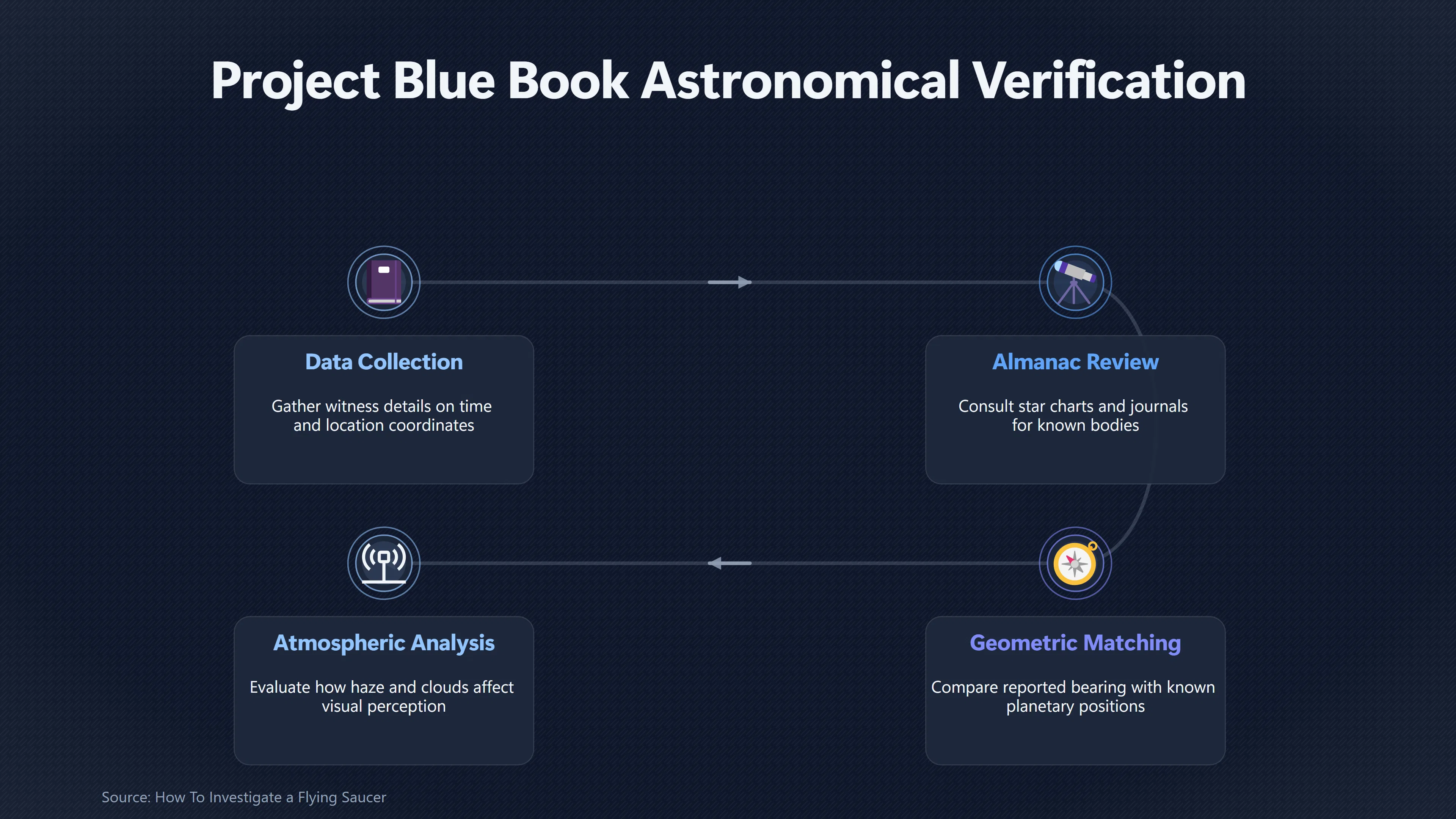
The important point was not simply that witnesses failed to recognise something in the sky. Darkness removed many of the visual cues needed to judge distance and motion, while haze, thin cloud and atmospheric disturbance could change a point of light’s apparent colour, brightness and position. Blue Book therefore tried to test astronomical explanations against the reported time, direction and location rather than treating every unexplained light as inherently mysterious. Its investigators consulted astronomical almanacs, star charts, journals and observatory data to determine whether a known celestial object occupied the right part of the sky.[Wikisource]en.wikisource.orgThe Report on Unidentified Flying Objects/Chapter 11The Report on Unidentified Flying Objects/Chapter 11 - Wikisource, the free online library…
Which celestial objects Blue Book identified
Project Blue Book’s astronomical category was broader than stars and planets. Its published descriptions included bright stars, planets, comets, fireballs, meteors, auroral streamers and other celestial bodies. Modern historical reviews of the programme preserve essentially the same classification.[CIA]cia.govHow To Investigate a Flying SaucerHow To Investigate a Flying Saucer - CIAJanuary 21, 2016…
For the particular problem of apparently persistent UFO lights, however, planets and stars were especially useful candidates. A meteor normally crosses the sky quickly; a planet can remain conspicuous for minutes or hours. That persistence makes a planet capable of matching reports in which an object supposedly hovered, remained at approximately the same bearing or slowly approached the horizon.
Venus was the standout example. Project Blue Book Status Report No. 11 provides an unusually clear snapshot. Of 59 reports received during March 1953, the report attributed 21 — about 35 per cent — to known astronomical phenomena. Venus alone was identified as the cause of 16 UFO reports. Four of those reports had come from experienced military pilots, demonstrating that professional aviation experience did not automatically prevent an astronomical misidentification.[Wikisource]en.wikisource.orgPage:Project Blue Book, complete status reports.pdf/332Page:Project Blue Book, complete status reports.pdf/332 - Wikisource, the free online library…
That episode also shows why the astronomical category deserves more attention than the cliché that someone had merely “seen a star”. Blue Book’s own report noted that Venus was unusually bright and low on the horizon and could appear to change colour or make erratic movements when observed through thin clouds or ground haze. The resulting observation could therefore contain genuine visual effects even though the underlying object was completely ordinary.[Wikisource]en.wikisource.orgPage:Project Blue Book, complete status reports.pdf/332Page:Project Blue Book, complete status reports.pdf/332 - Wikisource, the free online library…
Why a stationary planet could appear to manoeuvre
A planet does not need actually to move like an aircraft for a witness to perceive movement. Blue Book repeatedly emphasised the role of viewing conditions. Its descriptions stated that Venus, Jupiter and Mars had been reported as UFOs when seen through haze, light fog, moving clouds or other unusual conditions, and also recognised stellar mirages as a source of reports.[Wikisource]en.wikisource.orgPage:AARO Historical Record Report VolumePage:AARO Historical Record Report Volume 1 2024.pdf/18 - Wikisource, the free online library…
Several effects could combine.
Moving clouds could reverse the apparent relationship between object and background. A bright planet shining through breaks in moving cloud provides a stable light against an unstable reference frame. To an observer concentrating on the light rather than the clouds, the light itself can appear to drift or manoeuvre.
Haze could make a point source look larger or less sharply defined. Near the horizon, the observer is looking through considerably more atmosphere than when looking overhead. Blue Book records consequently describe planets as apparently changing colour or behaving strangely under hazy conditions rather than always appearing as clean, recognisable points.
Colour changes could strengthen the impression of an artificial object. The March 1953 Blue Book report specifically associated Venus with apparent colour changes and erratic motion through thin cloud or ground haze. A witness expecting a planet to look like a steady white point could reasonably regard a red, orange or fluctuating light as something quite different.[Wikisource]en.wikisource.orgPage:Project Blue Book, complete status reports.pdf/332Page:Project Blue Book, complete status reports.pdf/332 - Wikisource, the free online library…
Darkness removed distance cues. A bright point against an otherwise featureless sky carries little information about its actual range. If its astronomical identity is not recognised, there is no obvious visual indication that it is millions of kilometres away rather than a relatively nearby airborne light. Descriptions such as “hovering” therefore did not necessarily imply that witnesses had observed the outline of a stationary craft; sometimes they were interpretations of an isolated light whose distance could not be established.
This is why Blue Book’s astronomical identification was a mechanism, not merely a label. Investigators were trying to determine whether the reported behaviour could arise from the interaction between a fixed or predictably moving celestial source, the atmosphere and an observer without reliable visual references.
A Venus report at Kent Hill
A Blue Book case from Kent Hill, Maine, on 7 March 1953 illustrates the process unusually well. Ten students and three instructors reported a large, round, red “ball of fire” at about 10.02 pm. It made no sound and showed no aerodynamic features. The observers watched it for approximately 12 minutes and thought it appeared to travel away before disappearing below the horizon.[Wikisource]en.wikisource.orgPage:Project Blue Book, complete status reports.pdf/346Page:Project Blue Book, complete status reports.pdf/346 - Wikisource, the free online libraryMarch 7, 1953…
That description could sound much more dramatic than “planet” when read without the astronomical context. But the investigating intelligence officer checked what was actually visible in that direction and found Venus in the western sky. The report noted that several similar sightings had recently been received and described how Venus could appear large, shift between red, white and orange, and seem to manoeuvre because of cloud and haze. Near the horizon it could apparently drop from view or seem to switch off.[Wikisource]en.wikisource.orgPage:Project Blue Book, complete status reports.pdf/346Page:Project Blue Book, complete status reports.pdf/346 - Wikisource, the free online libraryMarch 7, 1953…
Blue Book consequently recorded the Kent Hill case as astronomical — Venus. The case is valuable because the identification did not depend solely on the fact that the witnesses reported a bright light. The candidate object also had to fit the direction, time and observed disappearance.
The episode also illustrates a recurring trap in interpreting historical UFO reports. A witness’s statement that an object “went away”, “descended” or “went out” records an appearance, not necessarily a measured trajectory. A celestial object approaching the horizon, passing behind cloud or becoming obscured by haze can generate essentially the same observational language.
How almanacs helped investigators test sightings
Blue Book’s strongest astronomical identifications depended on correlation rather than resemblance alone. Captain Edward J. Ruppelt, who directed Blue Book during its formative period, later described the project’s procedure in unusually practical terms. Astronomical almanacs and journals, star charts and information supplied by observatories were used to find celestial objects that might account for UFO reports. Ruppelt wrote that investigations in this category were also checked by an astronomer associated with Project Bear, the Battelle Memorial Institute study supporting Blue Book.[Wikisource]en.wikisource.orgThe Report on Unidentified Flying Objects/Chapter 11The Report on Unidentified Flying Objects/Chapter 11 - Wikisource, the free online library…
That approach allowed investigators to ask a sequence of testable questions. Was a bright planet or star above the horizon at the reported time? Was it in approximately the reported direction? Did its elevation correspond to the witness’s description? Would it have been unusually conspicuous? Could its setting, rising or obstruction by cloud account for the reported appearance or disappearance?
The reporting system was therefore important. Blue Book questionnaires sought details such as the date, time, location, position in the sky, duration, weather conditions and manner in which an object appeared or disappeared. Without those particulars, an astronomical explanation could be little more than a guess; with them, investigators could compare the observation with a predictable sky.[CIA]cia.govHow To Investigate a Flying SaucerHow To Investigate a Flying Saucer - CIAJanuary 21, 2016…
This distinction also explains why an astronomical candidate merely being somewhere in the sky was not sufficient evidence by itself. A convincing identification required geometrical and temporal agreement. Historical controversy over particular Blue Book explanations often arose precisely when critics believed that this standard had not been met.
When a planet explanation did not fit
The astronomical category was useful, but Blue Book’s history also demonstrates the danger of applying it too quickly. The Mantell incident of January 1948, which preceded Blue Book but formed part of the Air Force’s continuing UFO investigations, became an instructive example. Astronomer J. Allen Hynek initially considered Venus as an explanation for the object reported before Kentucky Air National Guard pilot Thomas Mantell’s fatal crash. He later rejected that interpretation because the planet’s expected visibility and the atmospheric conditions did not adequately fit the observation. A later Air Force explanation centred instead on a high-altitude balloon.[Wikipedia]WikipediaMantell UFO incidentMantell UFO incident
That reversal captures an important methodological point. Finding a bright planet in roughly the appropriate region of the sky establishes a candidate, not automatically an identification. Brightness, visibility, bearing, elevation, weather and the reported behaviour still have to agree.
This became especially significant because Project Blue Book’s explanations were themselves contested. Hynek, its long-serving astronomical consultant, eventually became highly critical of aspects of the programme’s scientific practice and argued that inadequate information and limited investigative resources weakened some case assessments.[Wikipedia]WikipediaProject Blue BookProject Blue Book
The existence of disputed explanations does not undermine the broader astronomical mechanism. Blue Book’s March 1953 records provide direct evidence that Venus generated clusters of reports, including reports by experienced pilots. Rather, the disputes show why a proper astronomical identification must be demonstrated case by case instead of being assigned because “Venus was visible”.
What the astronomical category reveals about UFO reports
Bright planets and stars occupied a useful place in Project Blue Book’s taxonomy because they showed how a UFO report could be sincere, detailed and visually striking without requiring an unusual object in the atmosphere. Ruppelt recalled that Blue Book learned early that roughly 60 per cent of reports were attributable collectively to balloons, aircraft or astronomical bodies seen under unusual conditions, prompting the project to build procedures for filtering such cases before concentrating on reports that resisted identification.[Wikisource]en.wikisource.orgThe Report on Unidentified Flying Objects/Chapter 11The Report on Unidentified Flying Objects/Chapter 11 - Wikisource, the free online library…
The astronomical cases also expose a distinction that remains important when reading historical UFO testimony: perceived motion is not necessarily physical motion. An observer may accurately report that a light seemed to change colour, dart, descend or disappear while being mistaken about what produced those appearances. Clouds, haze, the horizon and the lack of distance references can change the apparent behaviour without changing the identity of the source.
Blue Book’s response was therefore fundamentally comparative. A reported light became an astronomical identification when its time and position could be reconciled with a known object and the viewing circumstances could plausibly explain the more unusual parts of the description. Venus was especially productive because its exceptional brightness made it conspicuous enough to attract attention while atmospheric effects could make it look much less like the steady “planet” an observer expected.
That is the lasting value of this category within the broader causes of UFO and UAP reports. It demonstrates that identification depends not simply on asking what was in the sky, but on reconstructing what that object would have looked like to that particular observer, from that particular place, through those particular atmospheric conditions. Project Blue Book’s use of almanacs, star charts, weather information and precise sighting details was an early systematic attempt to make that distinction.[Wikisource]en.wikisource.orgPage:Ruppelt - The Report on Unidentified Flying Objects.djvu/193 - Wikisource, the free online library…
Amazon book picks
Further Reading
Books and field guides related to Why Bright Planets Could Become UFO Reports. Use these as the next step if you want deeper reading beyond the article.
The UFO Experience: A Scientific Inquiry
Cited by the New York Review of Books as "the best brief for visitation," this classic study presents an analysis of UFO reports and conc...
The Backyard Astronomer's Guide
Discusses the practical aspects of stargazing, including how to choose appropriate equipment, contending with light pollution, taking suc...
Turn Left at Orion
With over 100,000 copies sold since first publication, this is one of the most popular astronomy books of all time. It is a unique guideb...
NightWatch: A Practical Guide to Viewing the Universe
A practical guide to viewing the universe.
eBay marketplace picks
Marketplace Samples
Live-tested eBay searches with available results related to this page.
Selected fromplanet poster oneBay.co.uk.




Endnotes
1.
Source: cia.gov
Title: How To Investigate a Flying Saucer
Link:https://www.cia.gov/stories/story/how-to-investigate-a-flying-saucer/
Source snippet
How To Investigate a Flying Saucer - CIAJanuary 21, 2016...
Published: January 21, 2016
2.
Source: en.wikisource.org
Title: Page:AARO Historical Record Report Volume 1 2024
Link:https://en.wikisource.org/wiki/Page%3AAARO_Historical_Record_Report_Volume_1_2024.pdf/18
Source snippet
Page:AARO Historical Record Report Volume 1 2024.pdf/18 - Wikisource, the free online library...
3.
Source: en.wikisource.org
Title: The Report on Unidentified Flying Objects/Chapter 11
Link:https://en.wikisource.org/wiki/The_Report_on_Unidentified_Flying_Objects/Chapter_11
Source snippet
The Report on Unidentified Flying Objects/Chapter 11 - Wikisource, the free online library...
4.
Source: en.wikisource.org
Link:https://en.wikisource.org/wiki/Page%3ARuppelt_-_The_Report_on_Unidentified_Flying_Objects.djvu/193
Source snippet
Page:Ruppelt - The Report on Unidentified Flying Objects.djvu/193 - Wikisource, the free online library...
5.
Source: en.wikisource.org
Link:https://en.wikisource.org/wiki/Report_on_the_Historical_Record_of_U.S._Government_Involvement_with_Unidentified_Anomalous_Phenomena/Volume_1/Section_4
Source snippet
Report on the Historical Record of U.S. Government Involvement with Unidentified Anomalous Phenomena/Volume 1/Section 4 - Wikis...
6.
Source: en.wikisource.org
Title: Page:Project Blue Book, complete status reports.pdf/332
Link:https://en.wikisource.org/wiki/Page%3AProject_Blue_Book%2C_complete_status_reports.pdf/332
Source snippet
Page:Project Blue Book, complete status reports.pdf/332 - Wikisource, the free online library...
7.
Source: en.wikisource.org
Title: Page:Project Blue Book, complete status reports.pdf/346
Link:https://en.wikisource.org/wiki/Page%3AProject_Blue_Book%2C_complete_status_reports.pdf/346
Source snippet
Page:Project Blue Book, complete status reports.pdf/346 - Wikisource, the free online libraryMarch 7, 1953...
Published: March 7, 1953
8.
Source: Wikipedia
Title: Mantell UFO incident
Link:https://en.wikipedia.org/wiki/Mantell_UFO_incident
9.
Source: Wikipedia
Title: Project Blue Book
Link:https://en.wikipedia.org/wiki/Project_Blue_Book
10.
Source: en.wikisource.org
Title: Chapter 12
Link:https://en.wikisource.org/wiki/The_Report_on_Unidentified_Flying_Objects/Chapter_12
11.
Source: history.com
Title: j allen hynek ufos project blue book
Link:https://www.history.com/articles/j-allen-hynek-ufos-project-blue-book
12.
Source: history.com
Title: ufos green fireballs nuclear facilities new mexico
Link:https://www.history.com/articles/ufos-green-fireballs-nuclear-facilities-new-mexico
13.
Source: history.com
Title: of UFOs
Link:https://www.history.com/articles/history-of-ufos
14.
Source: en.wikisource.org
Title: Chapter 3
Link:https://en.wikisource.org/wiki/The_Report_on_Unidentified_Flying_Objects/Chapter_3
15.
Source: ufo.se
Link:https://www.ufo.se/index.php/26-fakta?start=505
16.
Source: en.wikisource.org
Title: Air Force Regulation 200 2, Unidentified Flying Objects Reporting
Link:https://en.wikisource.org/wiki/Air_Force_Regulation_200-2%2C_Unidentified_Flying_Objects_Reporting
17.
Source: en.wikisource.org
Title: en:Index:AFR 200 2, Aug 12, 1954
Link:https://en.wikisource.org/wiki/en%3AIndex%3AAFR_200-2%2C_Aug_12%2C_1954.pdf
18.
Source: en.ikwipedia.org
Title: Project Blue Book
Link:https://en.ikwipedia.org/wiki/Project_Blue_Book
19.
Source: nuforc.org
Link:https://nuforc.org/sighting/?id=179919
20.
Source: forums.sufficientvelocity.com
Title: page 3
Link:https://forums.sufficientvelocity.com/threads/more-than-meets-the-spy-spy-x-family-transformers.106676/page-3
21.
Source: nuforc.org
Link:https://nuforc.org/sighting/?id=141739
22.
Source: pt.scribd.com
Link:https://pt.scribd.com/document/427182434/Ufo
23.
Source: wikizero.net
Title: Project Blue Book
Link:https://www.wikizero.net/wiki/en/Project_Blue_Book
24.
Source: cufos.org
Title: Project Blue Book
Link:https://cufos.org/resources/project-blue-book/
25.
Source: military-history.fandom.com
Title: Project Blue Book
Link:https://military-history.fandom.com/wiki/Project_Blue_Book
26.
Source: mysteriousworld.fandom.com
Title: Project Blue Book
Link:https://mysteriousworld.fandom.com/wiki/Project_Blue_Book
27.
Source: internationalflyingsaucerbureau.com
Title: Project Blue Book
Link:https://www.internationalflyingsaucerbureau.com/project-blue-book/
28.
Source: satyori.com
Title: project blue book
Link:https://satyori.com/suppressed-history/project-blue-book/
29.
Source: magazine.northeast.aaa.com
Link:https://magazine.northeast.aaa.com/page/82/?V_ID=51&p=video_ind.cfm
30.
Source: scribd.com
Link:https://www.scribd.com/document/467530805/CIA-Fact-Sheet-Air-Force-UFO-Report-July
31.
Source: biblio.com
Link:https://www.biblio.com/details.php?aid=vialibri&dcx=1723408030
Additional References
32.
Source: theblackvault.com
Link:https://www.theblackvault.com/documents/ufos/bluebook/bluebook.pdf
Source snippet
The Black VaultTHIS FILE IS MADE AVAILABLE THROUGH THE DECLASSIFICATION EFFORTS AND RESEARCH OF:THE BLACK VAULTTHE BLACK VAULT IS THE LAR...
33.
Source: popularmechanics.com
Link:https://www.popularmechanics.com/military/a70995826/j-allen-hynek-project-blue-book-ufo-investigation-truth/
Source snippet
After Project Blue Book's closure in 1969, Hynek continued independently promoting "ufology," emphasizing scientific rigor, and creating...
34.
Source: youtube.com
Title: UFO lookalike? Close-up of Planet Venus looks pretty interesting!
Link:https://www.youtube.com/watch?v=2ABJtikyCN4
Source snippet
The Object That Appeared On Venus And Why We Ignored It...
35.
Source: nature.com
Link:https://www.nature.com/articles/s41598-023-49527-x
36.
Source: upload.wikimedia.org
Title: Commons This PDF format document was produced by
Link:https://upload.wikimedia.org/wikipedia/commons/2/21/Project_Blue_Book%2C_BBA-PBSR11-300.pdf
Source snippet
Wikimedia CommonsThis PDF format document was produced by...
37.
Source: youtube.com
Title: The Object That Appeared On Venus And Why We Ignored It
Link:https://www.youtube.com/watch?v=H8vlCp6WaFM
Source snippet
How Venus Became a Planetary Hell | Naked Science 611...
38.
Source: youtube.com
Title: Venus -the Morning Star and Evening Star
Link:https://www.youtube.com/watch?v=Ov3fYgGwy60
Source snippet
UFO lookalike? Close-up of Planet Venus looks pretty interesting! - 1080P HD...
39.
Source: hd123movies.com
Link:https://www.hd123movies.com/
40.
Source: uap-archive.org
Link:https://uap-archive.org/uap/records/aaro-historical-record-report-vol1/
41.
Source: encyclopedia.com
Link:https://www.encyclopedia.com/science/encyclopedias-almanacs-transcripts-and-maps/aerial-phenomena-research-organization-apro