Within Planets
Why a Stationary Planet Can Seem to Move
A bright planet watched against a dark featureless sky can appear to wander even when its true position is essentially fixed.
On this page
- What autokinesis looks like in darkness
- Why bright isolated planets trigger the illusion
- Clues that separate apparent motion from real travel
Page outline Jump by section
Introduction
A bright planet can appear to manoeuvre even when it is following its ordinary, predictable path across the sky. The relevant visual illusion is autokinesis: when an observer stares at an isolated point of light against a dark, largely featureless background, that stationary or nearly stationary light can seem to drift, wobble, dart or change direction. The Federal Aviation Administration (FAA) treats the effect as a genuine night-vision hazard, warning pilots that a fixed light or star can appear to move after sustained viewing.[Federal Aviation Administration]faa.govFederal Aviation AdministrationAirplane Flying Handbook (3C) Chapter 11September 24, 2021 — Various atmospheric and water conditions can…
This matters for UFO and UAP reports because Venus, Jupiter and other bright celestial objects can supply almost ideal stimuli for the illusion. A witness may therefore identify a real light correctly enough — there genuinely is something bright in the sky — while misperceiving its motion. Autokinesis is consequently useful for explaining reports in which an apparently hovering astronomical light begins making movements that are difficult to reconcile with its actual celestial position.[Skeptical Inquirer]skepticalinquirer.orgSkeptical InquirerUFO Identification ProcessNovember 1, 2018 — This can be caused by the natural, involuntary jerking movements of the hu…
What autokinesis looks like in darkness
Autokinesis is not simply blurred eyesight. In experimental conditions, observers looking at a small fixed light in darkness can have a convincing perception that the light itself has moved. Modern research describes it as apparent motion arising when the visual system has unusually little information with which to distinguish real object movement from changes associated with the observer’s own visual system.[PubMed]pubmed.ncbi.nlm.nih.govPub Med Autokinesis Reveals a Threshold for Perception of Visual MotionAutokinesis Reveals a Threshold for Perception of Visual Motion - PubMedApril 5, 2024…
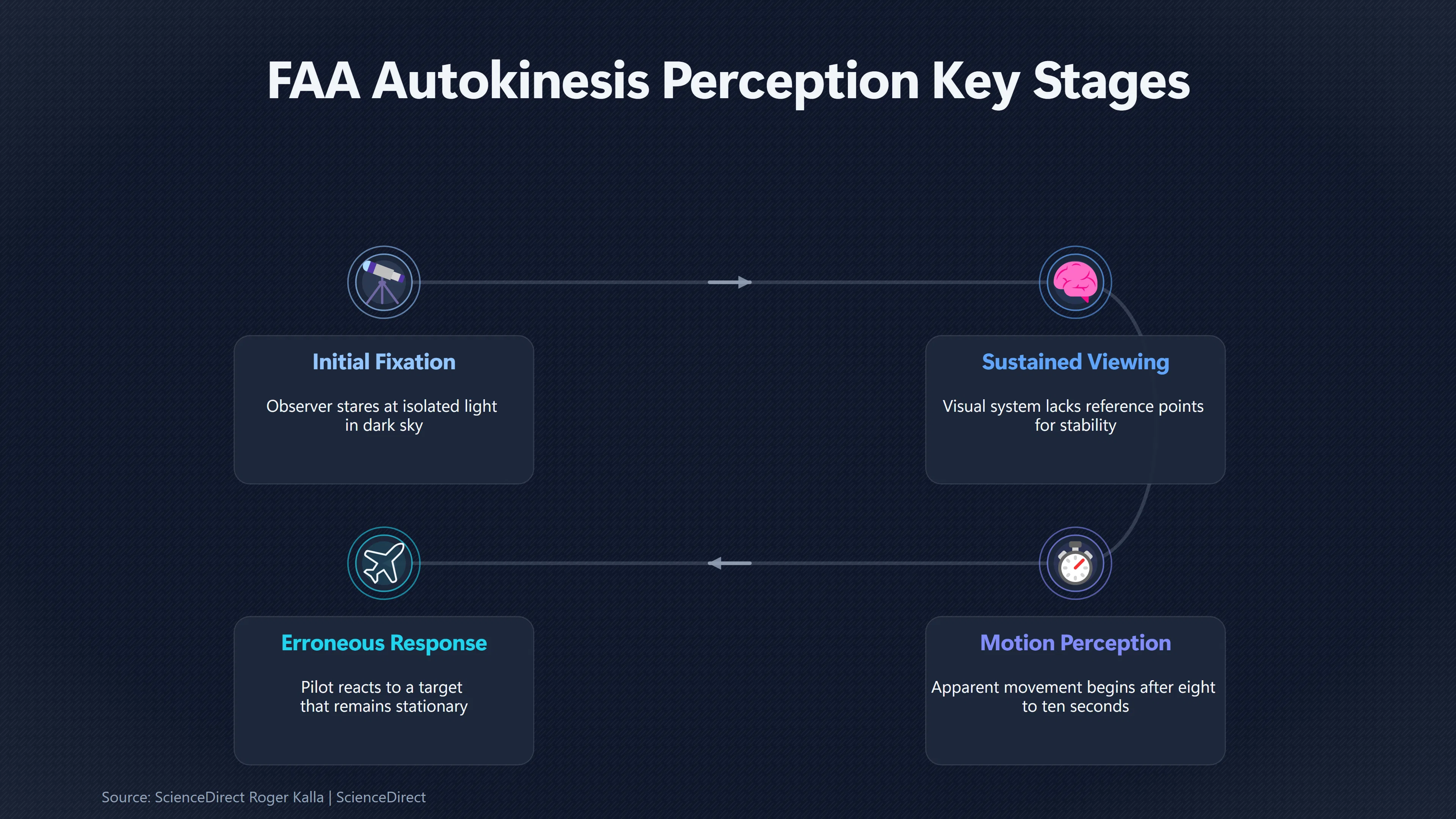
The experience can therefore be more persuasive than the word “illusion” might suggest. FAA guidance says that staring at a stationary light in darkness for many seconds can make it appear to move, while current FAA helicopter-training material says apparent movement may begin after roughly eight to ten seconds under suitable conditions. Aviation authorities take the phenomenon seriously because a pilot who accepts the apparent movement as real can respond to a target that has not actually changed position.[Federal Aviation Administration]faa.govFederal Aviation AdministrationAirplane Flying Handbook (3C) Chapter 11September 24, 2021 — Various atmospheric and water conditions can…
The perceived trajectory need not resemble the slow, smooth apparent movement expected from a planet as Earth rotates. Research describes autokinetic movement as variable and capable of appearing in different directions. Experiments have also found that the illusion tends to become stronger with prolonged fixation. In a brain-imaging experiment in which subjects stared at the same stationary dim light for 35 seconds, perceived autokinesis was more pronounced during the latter half of the viewing period even though the physical stimulus had not changed.[ScienceDirect]sciencedirect.comScienceDirect Roger Kalla | ScienceDirectScienceDirect Roger Kalla | ScienceDirect
That distinction is particularly important in a UFO account. A witness might truthfully report something like: the light hovered, began drifting, reversed direction and then wandered again. Such a description does not by itself establish that an external object executed those movements. Autokinesis provides a demonstrated mechanism through which movement can enter the observation at the perceptual stage.
Why an isolated planet is such a strong trigger
Normal vision has abundant reference information. Buildings, trees, the horizon and neighbouring objects help the brain determine whether an object has shifted relative to its surroundings. The night sky can remove much of that information. If only one conspicuous point remains obvious, there may be no nearby visual framework against which the observer can judge tiny positional changes reliably.
Research on visual stability helps explain the problem. Our eyes are not mechanically fixed even when we believe we are staring steadily; small eye movements continue during fixation. Under ordinary illuminated conditions, the visual system combines retinal information with other signals to maintain a stable perception of the world. Experiments in complete darkness show that this discrimination becomes less reliable: observers can perceive movement in a stationary stimulus and become worse at distinguishing real from apparent low-speed motion.[PubMed Central (PMC)]pmc.ncbi.nlm.nih.govPub Med Central (PMC)Stability of the Visual World during Eye DriftPubMed Central (PMC)Stability of the Visual World during Eye Drift - PMC…
The exact mechanism should not be reduced to the popular claim that “your eyes twitch, so the planet looks as though it twitches”. Eye movements clearly matter, but research indicates that autokinesis involves the brain’s broader solution to an ambiguous visual scene. One experiment found that the apparent movement could be manipulated through compensatory eye movements, supporting an ocular contribution. Later experiments, however, found phenomena that a simple eye-movement account could not readily explain, suggesting that higher-level perceptual processing also contributes.[Sage Journals]journals.sagepub.comSage Journals Eye Movements and the Visual Autokinetic PhenomenonSage Journals Eye Movements and the Visual Autokinetic Phenomenon
That makes the lack of reference points central. A 2024 experimental study found that in darkness the perceived direction of very slow movement was more strongly influenced by autokinesis, whereas actual motion became more accurately represented at higher speeds or under illuminated conditions. In other words, the illusion is particularly relevant precisely where a distant celestial light creates ambiguity: little environmental structure, no useful distance cue and little or no obvious physical displacement against nearby objects.[PubMed]pubmed.ncbi.nlm.nih.govPub Med Autokinesis Reveals a Threshold for Perception of Visual MotionAutokinesis Reveals a Threshold for Perception of Visual Motion - PubMedApril 5, 2024…
Venus or another bright planet need not be literally motionless for this explanation to apply. Celestial objects change apparent position gradually as the sky turns, but over a short observation their ordinary astronomical movement can be far smaller and smoother than the rapid wandering or reversals a witness reports. In this context, “stationary planet” means a planet whose genuine short-term displacement is insufficient to account for the reported manoeuvres.

Why staring can make the report more dramatic
An unusual-looking light naturally attracts prolonged attention, yet sustained fixation is exactly the condition that encourages autokinesis. This creates a useful paradox for understanding some UFO reports: the harder someone stares at an isolated light in an attempt to determine what it is, the more unstable its apparent position may become.
The FAA explicitly advises against prolonged fixation as a defence against the illusion. Its current helicopter instructor guidance recommends visual scanning and notes that increasing the number of visible lights or otherwise restoring reference information can reduce autokinesis.[Federal Aviation Administration]faa.govFederal Aviation AdministrationFAA-H-8083-4Helicopter Instructor's…
Experimental evidence points in the same direction. When researchers supplied observers with additional information about a target’s location, autokinesis began later, was smaller and lasted for less time. That result supports the broader principle that apparent wandering thrives when positional information is impoverished and weakens as reliable reference information is restored.[ScienceDirect]sciencedirect.comOpen source on sciencedirect.com.
This also explains why a witness can be sincerely certain that movement occurred. The illusion is a perceptual experience, not necessarily a careless inference made afterwards. Autokinesis has long been sufficiently reliable in controlled settings that psychologists have deliberately used a physically stationary light to create ambiguous apparent movement in experiments.[UR Scholarship Repository]scholarship.richmond.eduUR Scholarship Repository Autokinetic EffectUR Scholarship Repository Autokinetic Effect
For UFO investigation, sincerity and physical motion therefore have to be treated as separate questions. A witness can accurately describe what the light looked like it was doing without that description providing an equally accurate record of the light’s trajectory through space.

Clues that separate apparent motion from real travel
Autokinesis should be treated as a testable candidate explanation rather than a universal label for unexplained movement. It is strongest when the reported circumstances resemble the conditions known to produce the illusion: a small or unresolved light, darkness, few surrounding reference points, sustained observation and movement described mainly by the naked-eye witness. FAA material specifically associates the illusion with a single fixed light, including a star, against a dark and featureless background.[Federal Aviation Administration]faa.govFederal Aviation AdministrationSpatial Disorientation: Visual IllusionsThe Autokinetic Illusion gives you the impression that a stationar…
Several observations can make the distinction much clearer:
- Compare the light with fixed landmarks. A roofline, tree, mast or other stable reference can reveal whether the object’s angular position is genuinely changing.
- Break prolonged fixation. Looking elsewhere and scanning the surrounding scene restores visual information and is an established aviation countermeasure for autokinesis.[Federal Aviation Administration]faa.govFederal Aviation AdministrationFAA-H-8083-4Helicopter Instructor's…
- Check the astronomical position. If the bright light occupies the calculated position of Venus, Jupiter or another celestial object at the stated time and location, that supplies independent evidence for what the underlying light actually was.
- Use fixed-camera evidence carefully. If a witness perceives dramatic zigzags while a stable recording shows the light retaining essentially the same position relative to fixed scenery or stars, the mismatch strongly favours apparent rather than physical motion.
- Look for independent positional evidence. Genuine travel should normally produce consistent angular displacement against reference points. A purely perceptual excursion need not appear identically to another observer or to an independently stabilised recording.
The reverse is equally important. Autokinesis becomes a weak explanation if independently recorded imagery shows the object traversing the same path reported by the observer, especially when that displacement can be measured against fixed references. It also cannot by itself explain every other feature of a complex sighting. Autokinesis addresses perceived movement of a light; identifying the source of the light remains a separate step.
A manoeuvring light does not necessarily mean a manoeuvring object
The practical value of autokinesis in Venus and bright-planet cases is that it breaks an otherwise tempting inference: if the light changed direction, it cannot have been a planet. Under dark, reference-poor viewing conditions, that inference is unsafe. Aviation authorities explicitly recognise that stationary lights can appear to move, and laboratory research confirms that human observers can perceive motion where none exists.[Federal Aviation Administration]faa.govFederal Aviation AdministrationSpatial Disorientation: Visual IllusionsThe Autokinetic Illusion gives you the impression that a stationar…
Nor does recognising the effect mean dismissing eyewitnesses. The more useful distinction is between the external stimulus and the experienced motion. A bright planet can provide the genuine external stimulus while autokinesis supplies part of the apparent behaviour attributed to it. UFO investigators have consequently discussed the effect specifically in connection with lights reported as darting, wobbling or zigzagging against the night sky.[Skeptical Inquirer]skepticalinquirer.orgSkeptical InquirerUFO Identification ProcessNovember 1, 2018 — This can be caused by the natural, involuntary jerking movements of the hu…
The strongest planet identification still requires more than invoking perception. Investigators should establish that the candidate planet was actually in the reported direction and elevation at the relevant time, then compare the witness’s claimed motion with independent references or recordings. If the astronomical position matches, the light remains fixed relative to suitable reference points, and the extraordinary manoeuvres occur only during sustained naked-eye viewing, autokinesis provides a well-established mechanism for understanding how a stationary-looking planet could nevertheless seem vividly alive in the sky.
Amazon book picks
Further Reading
Books and field guides related to Why a Stationary Planet Can Seem to Move. Use these as the next step if you want deeper reading beyond the article.
Sensation and Perception
. Bruce Goldstein's SENSATION AND PERCEPTION, the best-seller which has helped over 150,000 students understand the ties between how we s...
The UFO Handbook: A Guide to Investigating, Evaluating, and R...
An explanation of the usual reasons for confusing IFOs (identified flying objects) with UFOs and a survey of the tools used to investigat...
NightWatch: A Practical Guide to Viewing the Universe
A practical guide to viewing the universe.
The UFO Experience: A Scientific Inquiry
The author belives that a number of UFO siting are still to be explained.
eBay marketplace picks
Marketplace Samples
Live-tested eBay searches with available results related to this page.
Selected fromplanet poster oneBay.co.uk.


Endnotes
1.
Source: faa.gov
Link:https://www.faa.gov/sites/faa.gov/files/regulations_policies/handbooks_manuals/aviation/airplane_handbook/12_afh_ch11.pdf
Source snippet
Federal Aviation AdministrationAirplane Flying Handbook (3C) Chapter 11September 24, 2021 — Various atmospheric and water conditions can...
Published: September 24, 2021
2.
Source: faa.gov
Link:https://www.faa.gov/pilots/safety/pilotsafetybrochures/media/spatiald_visillus.pdf
Source snippet
Federal Aviation AdministrationSpatial Disorientation: Visual IllusionsThe Autokinetic Illusion gives you the impression that a stationar...
3.
Source: skepticalinquirer.org
Link:https://skepticalinquirer.org/2018/11/ufo-identification-process/
Source snippet
Skeptical InquirerUFO Identification ProcessNovember 1, 2018 — This can be caused by the natural, involuntary jerking movements of the hu...
Published: November 1, 2018
4.
Source: faa.gov
Link:https://www.faa.gov/sites/faa.gov/files/regulations_policies/handbooks_manuals/aviation/FAA-H-8083-4.pdf
Source snippet
Federal Aviation AdministrationFAA-H-8083-4Helicopter Instructor's...
5.
Source: sciencedirect.com
Title: ScienceDirect Roger Kalla | ScienceDirect
Link:https://www.sciencedirect.com/author/16222741500/roger-kalla
6.
Source: sciencedirect.com
Link:https://www.sciencedirect.com/science/article/pii/0042698977901584
7.
Source: faa.gov
Link:https://www.faa.gov/sites/faa.gov/files/2022-01/Spatial%20Disorientation.pdf
8.
Source: sciencedirect.com
Title: Autokinesis Reveals a Threshold for Perception of Visual Motion
Link:https://www.sciencedirect.com/science/article/pii/S0306452224000514
9.
Source: faa.gov
Title: Robinson R44 | Federal Aviation Administration
Link:https://www.faa.gov/lessons_learned/rotorcraft/accidents/N474FA
10.
Source: faa.gov
Title: Chapter 8. Medical Facts for Pilots
Link:https://www.faa.gov/air_traffic/publications/atpubs/aim/aim0801.html
11.
Source: faa.gov
Link:https://www.faa.gov/data_research/research/med_humanfacs/oamtechreports/2000s/2006/200623
12.
Source: sciencedirect.com
Title: Imaging the visual autokinetic illusion with f MRI
Link:https://www.sciencedirect.com/science/article/pii/S1053811905002168
13.
Source: faa.gov
Title: Office of Aerospace Medicine Technical Reports | Federal Aviation Administration
Link:https://www.faa.gov/data_research/research/med_humanfacs/oamtechreports/1970s/1971/7134
14.
Source: sciencedirect.com
Title: Eye Muscle
Link:https://www.sciencedirect.com/topics/engineering/eye-muscle
15.
Source: sciencedirect.com
Title: Proprioceptive information about target location suppresses autokinesis
Link:https://www.sciencedirect.com/science/article/abs/pii/0042698977901584
16.
Source: sciencedirect.com
Link:https://www.sciencedirect.com/author/35068364800/amir-kheradmand
17.
Source: sciencedirect.com
Title: mehran armand
Link:https://www.sciencedirect.com/author/35236429300/mehran-armand
18.
Source: faa.gov
Link:https://www.faa.gov/Air_traffic/publications/atpubs/aim_html/chap8_section_1.html
19.
Source: faa.gov
Link:https://www.faa.gov/data_research/research/med_humanfacs/oamtechreports/1960s/1969/196923
20.
Source: faa.gov
Link:https://www.faa.gov/data_research/research/med_humanfacs/oamtechreports/1970s/1979/197926
21.
Source: faa.gov
Link:https://www.faa.gov/data_research/research/med_humanfacs/oamtechreports/1980s/1982/198206
22.
Source: faa.gov
Link:https://www.faa.gov/data_research/research/med_humanfacs/oamtechreports/2000s/2006/200628
23.
Source: faa.gov
Link:https://www.faa.gov/data_research/research/med_humanfacs/oamtechreports/1970s/1970/7009
24.
Source: faa.gov
Link:https://www.faa.gov/data_research/research/med_humanfacs/oamtechreports/1960s/1967/196719
25.
Source: faa.gov
Link:https://www.faa.gov/data_research/research/med_humanfacs/oamtechreports/1970s/1970/7002
26.
Source: faa.gov
Link:https://www.faa.gov/sites/faa.gov/files/about/office_org/headquarters_offices/avs/MP-086-21.pdf
27.
Source: faa.gov
Title: FA A Safety Briefing
Link:https://www.faa.gov/sites/faa.gov/files/2022-01/SepOct2015.pdf
28.
Source: faa.gov
Title: AM70 09
Link:https://www.faa.gov/sites/faa.gov/files/data_research/research/med_humanfacs/oamtechreports/AM70-09.pdf
29.
Source: faa.gov
Link:https://www.faa.gov/data_research/research/med_humanfacs/oamtechreports/media/AM63-30pt04.pdf
30.
Source: pubmed.ncbi.nlm.nih.gov
Title: Pub Med Autokinesis Reveals a Threshold for Perception of Visual Motion
Link:https://pubmed.ncbi.nlm.nih.gov/38432549/
Source snippet
Autokinesis Reveals a Threshold for Perception of Visual Motion - PubMedApril 5, 2024...
Published: April 5, 2024
31.
Source: pmc.ncbi.nlm.nih.gov
Title: Pub Med Central (PMC)Stability of the Visual World during Eye Drift
Link:https://pmc.ncbi.nlm.nih.gov/articles/PMC2931276/
Source snippet
PubMed Central (PMC)Stability of the Visual World during Eye Drift - PMC...
32.
Source: pmc.ncbi.nlm.nih.gov
Link:https://pmc.ncbi.nlm.nih.gov/articles/PMC5777566/
Source snippet
PubMed Central (PMC)Effect of Grouping, Segmentation, and Vestibular Stimulation on the Autokinetic Effect - PMC...
33.
Source: journals.sagepub.com
Title: Sage Journals Eye Movements and the Visual Autokinetic Phenomenon
Link:https://journals.sagepub.com/doi/10.2466/pms.1966.22.1.319
34.
Source: pmc.ncbi.nlm.nih.gov
Link:https://pmc.ncbi.nlm.nih.gov/articles/PMC10965040/
35.
Source: scholarship.richmond.edu
Title: UR Scholarship Repository Autokinetic Effect
Link:https://scholarship.richmond.edu/jepson-faculty-publications/162/
36.
Source: encyclopedia.arabpsychology.com
Link:https://encyclopedia.arabpsychology.com/autokinesis/
37.
Source: journals.sagepub.com
Link:https://journals.sagepub.com/doi/10.1177/2041669517752716
38.
Source: pubmed.ncbi.nlm.nih.gov
Link:https://pubmed.ncbi.nlm.nih.gov/24820290/
39.
Source: pmc.ncbi.nlm.nih.gov
Link:https://pmc.ncbi.nlm.nih.gov/articles/PMC3485812/
40.
Source: pubmed.ncbi.nlm.nih.gov
Link:https://pubmed.ncbi.nlm.nih.gov/21702846/
41.
Source: pubmed.ncbi.nlm.nih.gov
Link:https://pubmed.ncbi.nlm.nih.gov/15878673/
42.
Source: pubmed.ncbi.nlm.nih.gov
Link:https://pubmed.ncbi.nlm.nih.gov/1236562/
43.
Source: pubmed.ncbi.nlm.nih.gov
Link:https://pubmed.ncbi.nlm.nih.gov/2587187/
44.
Source: pubmed.ncbi.nlm.nih.gov
Link:https://pubmed.ncbi.nlm.nih.gov/2216323/
45.
Source: pubmed.ncbi.nlm.nih.gov
Link:https://pubmed.ncbi.nlm.nih.gov/422957/
46.
Source: pubmed.ncbi.nlm.nih.gov
Link:https://pubmed.ncbi.nlm.nih.gov/7941413/
47.
Source: pubmed.ncbi.nlm.nih.gov
Link:https://pubmed.ncbi.nlm.nih.gov/2251081/
48.
Source: pubmed.ncbi.nlm.nih.gov
Link:https://pubmed.ncbi.nlm.nih.gov/980671/
49.
Source: pubmed.ncbi.nlm.nih.gov
Link:https://pubmed.ncbi.nlm.nih.gov/432077/
50.
Source: pubmed.ncbi.nlm.nih.gov
Link:https://pubmed.ncbi.nlm.nih.gov/15069868/
51.
Source: pubmed.ncbi.nlm.nih.gov
Link:https://pubmed.ncbi.nlm.nih.gov/4736468/
52.
Source: pubmed.ncbi.nlm.nih.gov
Link:https://pubmed.ncbi.nlm.nih.gov/595387/
53.
Source: pubmed.ncbi.nlm.nih.gov
Link:https://pubmed.ncbi.nlm.nih.gov/20720121/
54.
Source: pmc.ncbi.nlm.nih.gov
Link:https://pmc.ncbi.nlm.nih.gov/articles/PMC4905637/
55.
Source: pmc.ncbi.nlm.nih.gov
Link:https://pmc.ncbi.nlm.nih.gov/articles/PMC4117078/
56.
Source: pmc.ncbi.nlm.nih.gov
Link:https://pmc.ncbi.nlm.nih.gov/articles/PMC7150283/
57.
Source: pmc.ncbi.nlm.nih.gov
Link:https://pmc.ncbi.nlm.nih.gov/articles/PMC5105064/
58.
Source: pmc.ncbi.nlm.nih.gov
Link:https://pmc.ncbi.nlm.nih.gov/articles/PMC4914563/
59.
Source: pmc.ncbi.nlm.nih.gov
Link:https://pmc.ncbi.nlm.nih.gov/articles/PMC6473325/
60.
Source: pmc.ncbi.nlm.nih.gov
Link:https://pmc.ncbi.nlm.nih.gov/articles/PMC3637548/
61.
Source: pubmed.ncbi.nlm.nih.gov
Link:https://pubmed.ncbi.nlm.nih.gov/1454474/
62.
Source: pubmed.ncbi.nlm.nih.gov
Link:https://pubmed.ncbi.nlm.nih.gov/1852560/
63.
Source: journals.sagepub.com
Link:https://journals.sagepub.com/doi/10.2466/pms.1963.17.1.299
64.
Source: journals.sagepub.com
Link:https://journals.sagepub.com/doi/10.2466/pms.1968.26.2.417
65.
Source: journals.sagepub.com
Link:https://journals.sagepub.com/doi/abs/10.2466/pms.1973.36.3.979
66.
Source: pubmed.ncbi.nlm.nih.gov
Link:https://pubmed.ncbi.nlm.nih.gov/5778046/
67.
Source: pubmed.ncbi.nlm.nih.gov
Link:https://pubmed.ncbi.nlm.nih.gov/14075726/
68.
Source: journals.sagepub.com
Link:https://journals.sagepub.com/doi/10.1080/17470216308416334
Additional References
69.
Source: planetary.org
Title: are ufos or uaps real
Link:https://www.planetary.org/articles/are-ufos-or-uaps-real
Source snippet
The Planetary SocietyAre UFOs or UAPs real?20 Mar 2025 — They end up being [meteors]({{ 'meteors/' | relative_url }}), bright [planets]({{ 'planets/' | relative_url }}) in the night sky, lighthouse...
70.
Source: youtube.com
Title: Chapter 17 Aeromedical Factors | PHAK | AGPIAL Audio/Video Book
Link:https://www.youtube.com/watch?v=n1UYc615ZTQ
Source snippet
PPGS Lesson 14.2 | Aeromedical: Illusions...
71.
Source: researchgate.net
Link:https://www.researchgate.net/publication/400385806_Physiology_in_Aviation_Hearing_Vision_Spatial_Disorientation_and_Visual_Illusions
72.
Source: researchgate.net
Link:https://www.researchgate.net/publication/400386255_Physiology_in_Aviation_Hearing_Vision_Spatial_Disorientation_and_Visual_Illusions
73.
Source: aaro.mil
Link:https://www.aaro.mil/Next-AARO-Home-redesign/Inactive-Parent/FAQ-Datatable/
74.
Source: skybrary.aero
Link:https://skybrary.aero/sites/default/files/bookshelf/6021.pdf
75.
Source: encyclopedia.com
Link:https://www.encyclopedia.com/social-sciences/applied-and-social-sciences-magazines/autokinetic-effect
76.
Source: skybrary.aero
Link:https://skybrary.aero/index.php/articles/autokinetic-effect
77.
Source: skybrary.aero
Link:https://skybrary.aero/articles/autokinetic-effect
78.
Source: psychology-lexicon.com
Link:https://www.psychology-lexicon.com/cms/glossary/34-glossary-a/3023-autokinetic-effect.html