Within Helicopters
Why a Fixed Helicopter Light Can Seem to Dart
A stationary light in darkness can appear to wander, making a hovering helicopter seem to perform small unexplained movements.
On this page
- What the autokinetic effect does to isolated lights
- Why dark skies make false motion easier to perceive
- Separating perceived darts from measured changes in bearing
Page outline Jump by section
Introduction
A hovering helicopter can be physically steady while its light appears to make small, unexplained movements. The reason is autokinesis, a well-established visual illusion in which a stationary point of light seen against a dark, featureless background appears to wander. Aviation authorities specifically warn that prolonged fixation on a single light can create an impression of motion even when the source itself is not moving.[Federal Aviation Administration]faa.govFederal Aviation AdministrationSpatial Disorientation: Visual IllusionsThe Autokinetic Illusion gives you the impression that a stationar…
For UFO or UAP reports, this matters most when a witness describes a light that mostly hovers but occasionally “darts”, “jumps”, “slides” or makes short excursions without a clearly visible aircraft body. Those movements may feel completely real to the observer, yet they should not automatically be treated as measured changes in the helicopter’s flight path. The critical distinction is between apparent motion in an isolated light and motion demonstrated relative to stable visual references.
What the autokinetic effect does to isolated lights
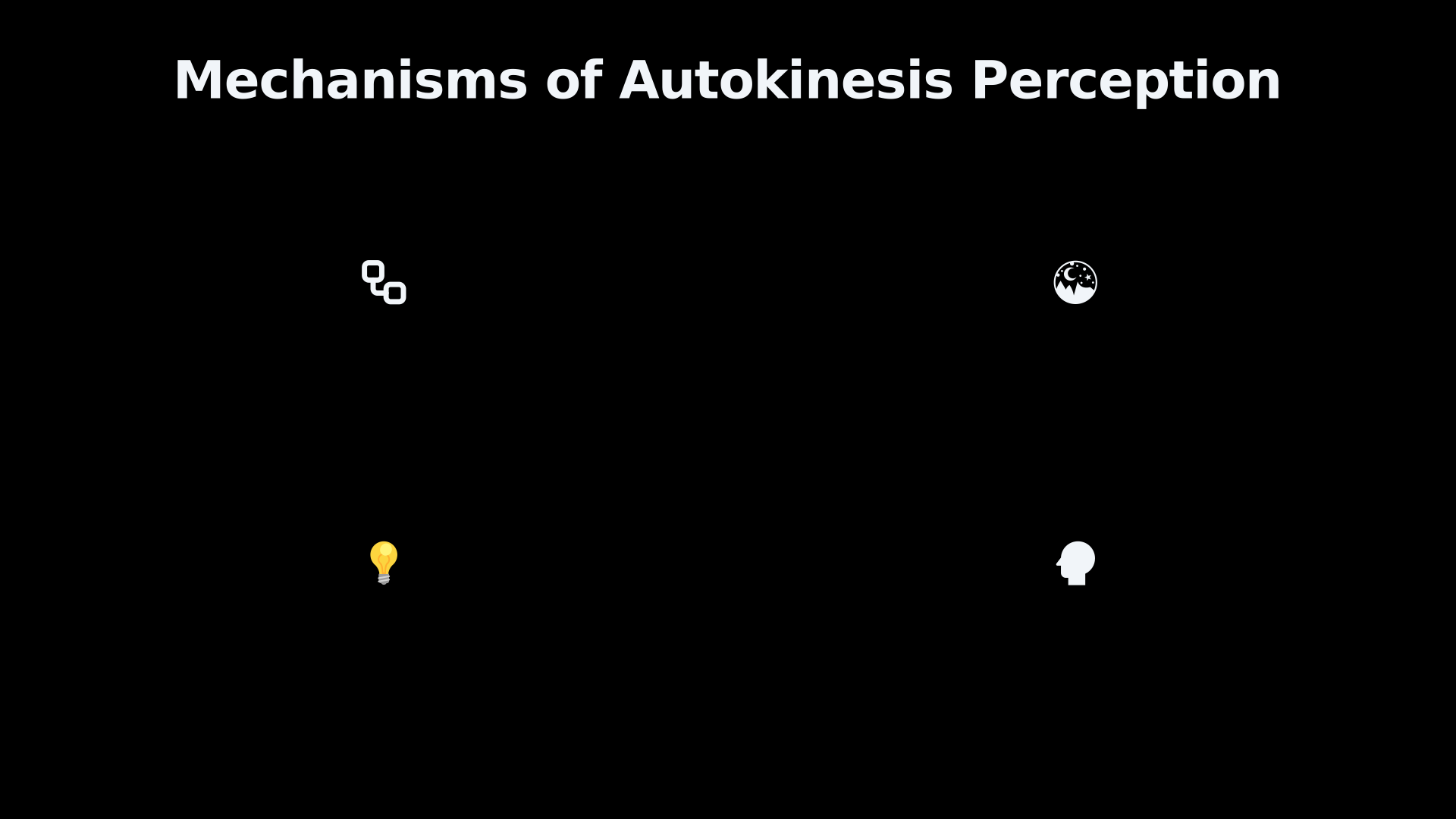
Autokinesis occurs when a small stationary light is viewed in darkness with few surrounding references. The Federal Aviation Administration describes the effect directly: a person staring at a fixed single light in a dark, featureless background can gain the impression that the stationary object is moving. The FAA treats the illusion seriously because pilots may respond to this false movement as though another aircraft were actually changing position.[NTSB Data]data.ntsb.govNTSB Data…
Transport Canada’s aviation medical guidance makes the same point in especially relevant terms. It warns that small night-time sources such as stars or distant ground lights can appear to move when watched intently and may consequently be mistaken for aircraft. It also notes that the illusion is less common when the source is bright or visually large, reinforcing the importance of a small, isolated target.[Transport Canada]tc.canada.caWhen watched intently they will appear to moveTransport CanadaHandbook for Civil Aviation Medical Examiners - TP 13312Autokinesis There is a special problem at night with small light…
A distant helicopter can fit those conditions unusually well. The machine itself may be too dark or too small to resolve, while one conspicuous light remains visible. If the aircraft is hovering, its true angular position may change very little. The observer is therefore left staring at something close to the classic autokinetic stimulus: a luminous point with weak positional context.
The apparent movement is not necessarily a smooth drift. Aviation accounts describe stationary lights as appearing to move after sustained fixation, and observational descriptions of autokinesis include wandering or apparently random changes in direction.[Federal Aviation Administration]faa.govThe disoriented pilot could lose control of the aircraftFederal Aviation AdministrationAirplane Flying Handbook (3C) Chapter 11Autokinesis In the dark, a stationary light will appear to move ab… In a UFO report, this can translate into language such as “it shifted left”, “jumped upwards”, “wobbled”, or “darted and came back”.
That does not mean every such description is autokinesis. It means that small unmeasured excursions by a point-like night light are weak evidence for extraordinary manoeuvring unless some external reference confirms them.
Why dark skies make false motion easier to perceive
The visual system normally judges motion by comparing an object with its surroundings. Buildings, trees, the horizon, other lights and textured ground provide reference points that help establish whether the target has moved or whether changes on the retina arose from movements of the eyes or head.
A dark sky removes much of that information. SKYbrary, an aviation-safety reference, describes autokinesis specifically as the apparent movement of a small stationary point of light against a dark or featureless background. Its practical advice is to avoid prolonged fixation and to use other visual references where possible.[Skybrary]skybrary.aeroOpen source on skybrary.aero.
Older aerospace research likewise characterises autokinesis as apparent random movement when a light is viewed without an adequate visual frame of reference.[NASA Technical Reports Server]ntrs.nasa.govTechnical Reports Server I IMIIIN 'o0T INASA Technical Reports ServerI IMIIIN 'o0T I - ~ESEARICICAand DE-qELOIV£ENTLIFE30 Jul 1971 — The autokinetic effect consists of the appar… That lack of reference is the key reason a helicopter light can become deceptive. In daylight, the observer might see the aircraft body, its relationship to the horizon and its movement against terrain. At night, all three can disappear.
Sustained staring makes the situation worse. The Aircraft Owners and Pilots Association notes that a dim stationary light can begin to appear mobile after roughly six to twelve seconds of fixation.[AOPA]aopa.orgTricked by IllusionsTricked by Illusions FAA material similarly warns that staring at a single light for several seconds on a dark night can produce apparent movement and recommends scanning rather than allowing vision to become fixed on one source.[NTSB Data]data.ntsb.govdoc BLOBNTSB DataAirplane Flying Handbook (FAA-H-8083-3B) Chapter 10Visual autokinesis can occur when staring at a single light source for severa…
That creates a counter-intuitive problem for witnesses. Concentrating harder on an ambiguous hovering light does not necessarily improve the observation. Under the right conditions, prolonged fixation can actually increase the chance that false motion will be perceived.
A modern experiment shows why slow movement is especially tricky
Recent research has added an important qualification: autokinesis can affect the perception not only of stationary lights, but also of lights that are genuinely moving slowly.
A 2024 study in Neuroscience investigated how autokinesis interacts with real target motion. Participants reported the apparent movement of visual targets while researchers varied the targets’ actual motion. At lower physical speeds, perceived direction was more strongly aligned with each observer’s autokinetic tendency; at higher speeds, or when stronger visual references were available, perception tracked the real direction more accurately.[nih.gov]pmc.ncbi.nlm.nih.govOpen source on nih.gov.
That finding is particularly relevant to a hovering helicopter because “hovering” is rarely a guarantee of perfect geometric immobility. A helicopter may make small station-keeping corrections, drift slowly or change its bearing by a modest amount. The witness may therefore be seeing real slow motion overlaid with illusory motion.
This helps explain why reconstructing a precise flight path from phrases such as “it zigzagged a little” can be unreliable. Some part of the perceived movement might correspond to genuine aircraft movement, while its magnitude or direction may be distorted by the absence of visual references.
The study also provides a useful limit on the explanation. As actual motion became more pronounced, observers’ reports became better aligned with that physical movement.[PubMed Central (PMC)]pmc.ncbi.nlm.nih.govOpen source on nih.gov. Autokinesis is therefore most relevant to small, uncertain excursions, not as a blanket explanation for any large or independently verified displacement.

The illusion is not simply “your eyes twitching”
A common explanation says that tiny involuntary eye movements make the light seem to move. That is directionally useful but incomplete.
Human eyes are never perfectly stationary during fixation, and modern vision research shows that the brain normally compensates for small eye movements to keep the visual world stable. Research on eye drift has found that failures or limitations in this stabilising process can contribute to motion illusions including autokinesis.[PubMed Central (PMC)]pmc.ncbi.nlm.nih.govPub Med Central (PMC)Stability of the Visual World during Eye DriftPub Med Central (PMC)Stability of the Visual World during Eye Drift
The 2024 autokinesis study describes the phenomenon in terms of how retinal information and signals about eye position or movement are integrated by the visual system, rather than reducing it to a simple one-to-one relationship between an eye twitch and apparent target motion.[PubMed Central (PMC)]pmc.ncbi.nlm.nih.govOpen source on nih.gov.
That distinction matters for evaluating UFO testimony. The phenomenon is not best understood as a witness consciously mistaking an obvious eye movement for aircraft motion. It is a perceptual failure of spatial stability under impoverished viewing conditions. The observer’s experience can be vivid and convincing even though the corresponding target movement did not occur.
Small darts are weaker evidence than large referenced movements
Autokinesis has a specific evidential range. It is strongest as an explanation when four features coincide: the target is point-like, the background is dark or visually sparse, the observer fixes attention on the light, and the claimed movements are relatively small or poorly referenced.[skybrary.aero]skybrary.aeroOpen source on skybrary.aero.
It becomes much less persuasive when the claimed movement is anchored to stable external features. If a light moves from one side of a chimney to the other, crosses a known ridgeline, shifts clearly relative to identifiable stars in a stable recording, or changes measured bearing, there is evidence of actual angular displacement that autokinesis alone cannot explain.
This is the main critique risk when examining UFO or UAP reports involving hovering lights: treating the felt certainty of motion as equivalent to a measured trajectory. The two are not the same.
A useful assessment therefore separates three possibilities:
- a stationary helicopter light that only appears to move;
- a helicopter making small real movements whose direction or scale is distorted by autokinesis;
- a target whose displacement is independently recorded and therefore cannot be attributed to autokinesis alone.
The first two are particularly plausible under the viewing conditions aviation authorities associate with the illusion.[NTSB Data]data.ntsb.govNTSB Data…
Separating perceived darts from measured changes in bearing
The best way to test an apparent dart is to compare the light with something that does not move. A witness description such as “it shot sideways” records a perception; a change in bearing relative to a fixed landmark records something closer to physical motion.
Useful evidence includes repeated compass bearings, the light’s position relative to a roofline or mast, a stationary-camera recording, or another independent positional record. The value of these methods comes from restoring the reference information that darkness removes.
A video can help, but only if the frame itself is stable enough to preserve that reference. A handheld camera that follows the target may reproduce the witness’s uncertainty rather than resolve it. Camera shake, zoom changes or continual re-centring can make a light appear to shift dramatically within the image even when little can be inferred about its true angular path. That is a separate measurement problem and should not be confused with autokinesis itself.
The most informative recording is therefore one in which the target and fixed scene features remain visible simultaneously. If a witness sees the light dart but the recording shows it holding essentially the same position relative to those features, a perceptual explanation becomes stronger. If the target alone clearly changes its position against a stable reference, the movement is physical at least in angular terms.
This logic is consistent with the research literature: autokinesis is strongest when reference information is poor, while stronger visual context improves motion discrimination.[PubMed Central (PMC)]pmc.ncbi.nlm.nih.govOpen source on nih.gov.

Why this matters for helicopter-related UFO reports
A night-time helicopter can create a particularly convincing combination of real and illusory cues. The aircraft can genuinely hover; darkness can conceal its familiar body; and a remaining light can appear to wander because the observer lacks the references needed to judge its position reliably.
The resulting account can sound paradoxical: “It stayed in one place for minutes, but every so often it made a sudden little dart.” That description is not automatically inconsistent with a hovering helicopter. In fact, it closely matches the circumstances in which autokinesis becomes relevant: a persistent isolated light, sustained observation and small apparent deviations.[faa.gov]faa.govFederal Aviation AdministrationChapter 17: Aeromedical FactorsAutokinesis When flying in the dark, a stationary light may appear to move…
The mechanism should nevertheless be used carefully. It explains a risk of misperceiving small motion, not every dramatic manoeuvre reported at night. Large displacements confirmed against stable landmarks, multiple independent instruments or clear recordings require separate explanation.
For this narrow class of UFO/UAP report, the decisive question is therefore not simply whether the witness saw the light move. It is whether anything independent of the witness’s visual impression shows that the light’s bearing actually changed. Without that distinction, a hovering helicopter’s ordinary light can acquire a trajectory that existed only in perception.
Amazon book picks
Further Reading
Books and field guides related to Why a Fixed Helicopter Light Can Seem to Dart. Use these as the next step if you want deeper reading beyond the article.
Pilot's Handbook of Aeronautical Knowledge
Pilot's Handbook of Aeronautical Knowledge, created by the Federal Aviation Administration, is the official reference manual for pilots a...
Human Factors in Flight
The late Captain Frank H Hawkins FRAes, M Phil, was Human Factors Consultant to KLM, for whom he had flown for over 30 years as line capt...
The Invisible Gorilla: How Our Intuitions Deceive Us
NEW YORK TIMES BESTSELLER • Our minds don’t work the way we think they do. Two renowned psychologists explain how and why our intuitions...
Helicopter Flying Handbook
Compiled by the Federal Aviation Administration, this handbook is the ultimate technical manual for anyone who flies or wants to learn to...
eBay marketplace picks
Marketplace Samples
Live-tested eBay searches with available results related to this page.
Selected fromUFO patch oneBay.co.uk.


Endnotes
1.
Source: faa.gov
Link:https://www.faa.gov/pilots/safety/pilotsafetybrochures/media/spatiald_visillus.pdf
Source snippet
Federal Aviation AdministrationSpatial Disorientation: Visual IllusionsThe Autokinetic Illusion gives you the impression that a stationar...
2.
Source: faa.gov
Link:https://www.faa.gov/sites/faa.gov/files/regulations_policies/handbooks_manuals/aviation/phak/19_phak_ch17.pdf
Source snippet
Federal Aviation AdministrationChapter 17: Aeromedical FactorsAutokinesis When flying in the dark, a stationary light may appear to move...
3.
Source: tc.canada.ca
Title: When watched intently they will appear to move
Link:https://tc.canada.ca/en/aviation/publications/handbook-civil-aviation-medical-examiners-tp-13312
Source snippet
Transport CanadaHandbook for Civil Aviation Medical Examiners - TP 13312Autokinesis There is a special problem at night with small light...
4.
Source: data.ntsb.gov
Link:https://data.ntsb.gov/Docket/Document/docBLOB?FileExtension=pdf&FileName=FAA+General+Aviation+Joint+Steering+Committee+Safety+Enhancement+Topic+%28SE%29-Rel.pdf&ID=19762867
Source snippet
NTSB Data...
5.
Source: data.ntsb.gov
Title: doc BLOB
Link:https://data.ntsb.gov/Docket/Document/docBLOB?FileExtension=.PDF&FileName=Pages+from+Airplane+Flying+Handbook+%28FAA-H-8083-3B%29+Chapter-Master.PDF&ID=40484326
Source snippet
NTSB DataAirplane Flying Handbook (FAA-H-8083-3B) Chapter 10Visual autokinesis can occur when staring at a single light source for severa...
6.
Source: faa.gov
Title: The disoriented pilot could lose control of the aircraft
Link:https://www.faa.gov/sites/faa.gov/files/regulations_policies/handbooks_manuals/aviation/airplane_handbook/12_afh_ch11.pdf
Source snippet
Federal Aviation AdministrationAirplane Flying Handbook (3C) Chapter 11Autokinesis In the dark, a stationary light will appear to move ab...
7.
Source: ntrs.nasa.gov
Title: Technical Reports Server I IMIIIN ‘o0T I
Link:https://ntrs.nasa.gov/api/citations/19710024584/downloads/19710024584.pdf?attachment=true
Source snippet
NASA Technical Reports ServerI IMIIIN 'o0T I - ~ESEARICICAand DE-qELOIV£ENTLIFE30 Jul 1971 — The autokinetic effect consists of the appar...
8.
Source: skybrary.aero
Link:https://skybrary.aero/articles/autokinetic-effect
9.
Source: aopa.org
Title: Tricked by Illusions
Link:https://www.aopa.org/training-and-safety/online-learning/safety-spotlights/spatial-disorientation/tricked-by-illusions
10.
Source: tc.canada.ca
Title: ca Hazards Associated with Flying at Night
Link:https://tc.canada.ca/en/aviation/publications/system-safety-summer-briefing-kit-tp-14112/hazards-associated-flying-night-powerpoint-presentation
11.
Source: tc.canada.ca
Title: ca T P 185E
Link:https://tc.canada.ca/sites/default/files/migrated/tp185e_1_2006.pdf
12.
Source: tc.canada.ca
Link:https://tc.canada.ca/sites/default/files/migrated/tp185e_3_2011.pdf
13.
Source: ntrs.nasa.gov
Link:https://ntrs.nasa.gov/api/citations/19690013275/downloads/19690013275.pdf
14.
Source: rotorcraft.arc.nasa.gov
Link:https://rotorcraft.arc.nasa.gov/faa-h-8083-21.pdf
15.
Source: ntrs.nasa.gov
Link:https://ntrs.nasa.gov/api/citations/19620004691/downloads/19620004691.pdf?attachment=true
16.
Source: ntrs.nasa.gov
Link:https://ntrs.nasa.gov/api/citations/19660006146/downloads/19660006146.pdf
17.
Source: nasa.gov
Link:https://www.nasa.gov/wp-content/uploads/2026/01/ma07-tec.pdf?emrc=26a1b7
18.
Source: asrs.arc.nasa.gov
Title: cb 193
Link:https://asrs.arc.nasa.gov/publications/callback/cb_193.htm
19.
Source: ntrs.nasa.gov
Link:https://ntrs.nasa.gov/api/citations/19670008816/downloads/19670008816.pdf
20.
Source: nasa.gov
Title: i POSTLAUNCH MEMORANDUM REPORTPilot’s Impressions of the Flight. Pilot Training
Link:https://www.nasa.gov/wp-content/uploads/2026/01/ma07-te2.pdf?emrc=e61f8d
21.
Source: ntrs.nasa.gov
Link:https://ntrs.nasa.gov/api/citations/19670013567/downloads/19670013567.pdf?attachment=true
22.
Source: ntrs.nasa.gov
Link:https://ntrs.nasa.gov/api/citations/19680000713/downloads/19680000713.pdf?attachment=true
23.
Source: ntrs.nasa.gov
Link:https://ntrs.nasa.gov/api/citations/19920012102/downloads/19920012102.pdf
24.
Source: ntrs.nasa.gov
Link:https://ntrs.nasa.gov/api/citations/19670001428/downloads/19670001428.pdf?attachment=true
25.
Source: ntrs.nasa.gov
Link:https://ntrs.nasa.gov/api/citations/19650024024/downloads/19650024024.pdf?attachment=true
26.
Source: ntrs.nasa.gov
Link:https://ntrs.nasa.gov/api/citations/19880019247/downloads/19880019247.pdf
27.
Source: ntrs.nasa.gov
Link:https://ntrs.nasa.gov/api/citations/19720004399/downloads/19720004399.pdf
28.
Source: ntrs.nasa.gov
Link:https://ntrs.nasa.gov/api/citations/19700020600/downloads/19700020600.pdf
29.
Source: ntrs.nasa.gov
Link:https://ntrs.nasa.gov/api/citations/19650009670/downloads/19650009670.pdf
30.
Source: ntrs.nasa.gov
Link:https://ntrs.nasa.gov/api/citations/19680012833/downloads/19680012833.pdf?attachment=true
31.
Source: ntrs.nasa.gov
Link:https://ntrs.nasa.gov/api/citations/19750007236/downloads/19750007236.pdf?attachment=true
32.
Source: skybrary.aero
Link:https://skybrary.aero/sites/default/files/bookshelf/4078.pdf
33.
Source: data.ntsb.gov
Link:https://data.ntsb.gov/carol-repgen/api/Aviation/ReportMain/GenerateNewestReport/46975/pdf
34.
Source: data.ntsb.gov
Title: doc BLOB
Link:https://data.ntsb.gov/Docket/Document/docBLOB?FileExtension=.PDF&FileName=FAA-H-8083-3+Excerpt-Master.PDF&ID=40159907
35.
Source: data.ntsb.gov
Title: doc BLOB
Link:https://data.ntsb.gov/Docket/Document/docBLOB?FileExtension=.PDF&FileName=Sikorsky+Submission-Master.PDF&ID=40470574
36.
Source: faa.gov
Link:https://www.faa.gov/sites/faa.gov/files/2022-01/Spatial%20Disorientation.pdf
37.
Source: faa.gov
Link:https://www.faa.gov/sites/faa.gov/files/2022-01/NovDec2015.pdf
38.
Source: faa.gov
Link:https://www.faa.gov/sites/faa.gov/files/about/office_org/headquarters_offices/avs/MP-086-20.pdf
39.
Source: faa.gov
Link:https://www.faa.gov/sites/faa.gov/files/MayJun2024.pdf
40.
Source: faa.gov
Link:https://www.faa.gov/sites/faa.gov/files/21_phak_glossary.pdf
41.
Source: faa.gov
Title: pilot handbook
Link:https://www.faa.gov/sites/faa.gov/files/pilots/pilot_handbook.pdf
42.
Source: faa.gov
Link:https://www.faa.gov/data_research/research/med_humanfacs/oamtechreports/media/AM63-30pt04.pdf
43.
Source: faa.gov
Link:https://www.faa.gov/lessons_learned/rotorcraft/accidents/N474FA
44.
Source: faa.gov
Link:https://www.faa.gov/sites/faa.gov/files/about/office_org/headquarters_offices/avs/MP-086-21.pdf
45.
Source: pmc.ncbi.nlm.nih.gov
Link:https://pmc.ncbi.nlm.nih.gov/articles/PMC10965040/
46.
Source: pubmed.ncbi.nlm.nih.gov
Link:https://pubmed.ncbi.nlm.nih.gov/38432549/
47.
Source: pmc.ncbi.nlm.nih.gov
Title: Pub Med Central (PMC)Stability of the Visual World during Eye Drift
Link:https://pmc.ncbi.nlm.nih.gov/articles/PMC2931276/
48.
Source: pmc.ncbi.nlm.nih.gov
Link:https://pmc.ncbi.nlm.nih.gov/articles/PMC3710190/
49.
Source: pmc.ncbi.nlm.nih.gov
Link:https://pmc.ncbi.nlm.nih.gov/articles/PMC1559950/
50.
Source: pmc.ncbi.nlm.nih.gov
Link:https://pmc.ncbi.nlm.nih.gov/articles/PMC6969921/
51.
Source: pmc.ncbi.nlm.nih.gov
Link:https://pmc.ncbi.nlm.nih.gov/articles/PMC4887493/
52.
Source: pmc.ncbi.nlm.nih.gov
Link:https://pmc.ncbi.nlm.nih.gov/articles/PMC4319382/
53.
Source: pmc.ncbi.nlm.nih.gov
Link:https://pmc.ncbi.nlm.nih.gov/articles/PMC3621588/
54.
Source: pmc.ncbi.nlm.nih.gov
Link:https://pmc.ncbi.nlm.nih.gov/articles/PMC5009211/
55.
Source: pmc.ncbi.nlm.nih.gov
Link:https://pmc.ncbi.nlm.nih.gov/articles/PMC11512565/
56.
Source: pmc.ncbi.nlm.nih.gov
Link:https://pmc.ncbi.nlm.nih.gov/articles/PMC4731397/
57.
Source: pmc.ncbi.nlm.nih.gov
Link:https://pmc.ncbi.nlm.nih.gov/articles/PMC1692628/
58.
Source: Wikipedia
Title: Autokinetic effect
Link:https://en.wikipedia.org/wiki/Autokinetic_effect
59.
Source: jstor.org
Link:https://www.jstor.org/stable/1421669
Additional References
60.
Source: researchgate.net
Link:https://www.researchgate.net/publication/378706437_Autokinesis_reveals_a_threshold_for_perception_of_visual_motion
61.
Source: researchgate.net
Link:https://www.researchgate.net/publication/18156658_Autokinesis_and_Eye_Movement_Control-System_Stabilization_Pilot_Study_on_Effect_of_Brief_Hand_Viewing
62.
Source: oxfordreference.com
Link:https://www.oxfordreference.com/display/10.1093/oi/authority.20110803095436220?d=%2F10.1093%2Foi%2Fauthority.20110803095436220&p=emailAMVNoKe9wTMxk
63.
Source: semanticscholar.org
Link:https://www.semanticscholar.org/paper/The-Origin-of-the-Autokinetic-Effect-Gregory-Zangwill/ddcfc8559d5cbd5855035779838b7b9902d4cf59
64.
Source: autokinetic.bandcamp.com
Link:https://autokinetic.bandcamp.com/
65.
Source: youtube.com
Title: Visual Illusions Every Pilot Should Know
Link:http://www.youtube.com/watch?v=4gG9RlbPb5Q
Source snippet
Spatial Disorientation Explained: Deadly Flight Illusions...
66.
Source: youtube.com
Title: Night Illusions (Private Pilot Lesson 15d)
Link:http://www.youtube.com/watch?v=y_HvgmQ3NJs
Source snippet
Illusions In Flight Spatial Disorientation...
67.
Source: youtube.com
Title: PPGS Lesson 14.2 | Aeromedical: Illusions
Link:http://www.youtube.com/watch?v=ZBPmFaqECdM
Source snippet
Night Illusions (Private Pilot Lesson 15d)...
68.
Source: youtube.com
Title: Illusions In Flight Spatial Disorientation
Link:http://www.youtube.com/watch?v=fIZpxEOsTg0
Source snippet
Visual Illusions Every Pilot Should Know...
69.
Source: youtube.com
Link:https://www.youtube.com/shorts/b_MmOKiZrP0