Within Following Lights
How a Following Light Illusion Can Last for Kilometres
A sufficiently remote light may change bearing so slowly that the impression of following can survive a long stretch of road.
On this page
- How distance limits angular change
- Why several kilometres of travel may still be too little
- When route geometry finally makes the light shift
Page outline Jump by section
Introduction
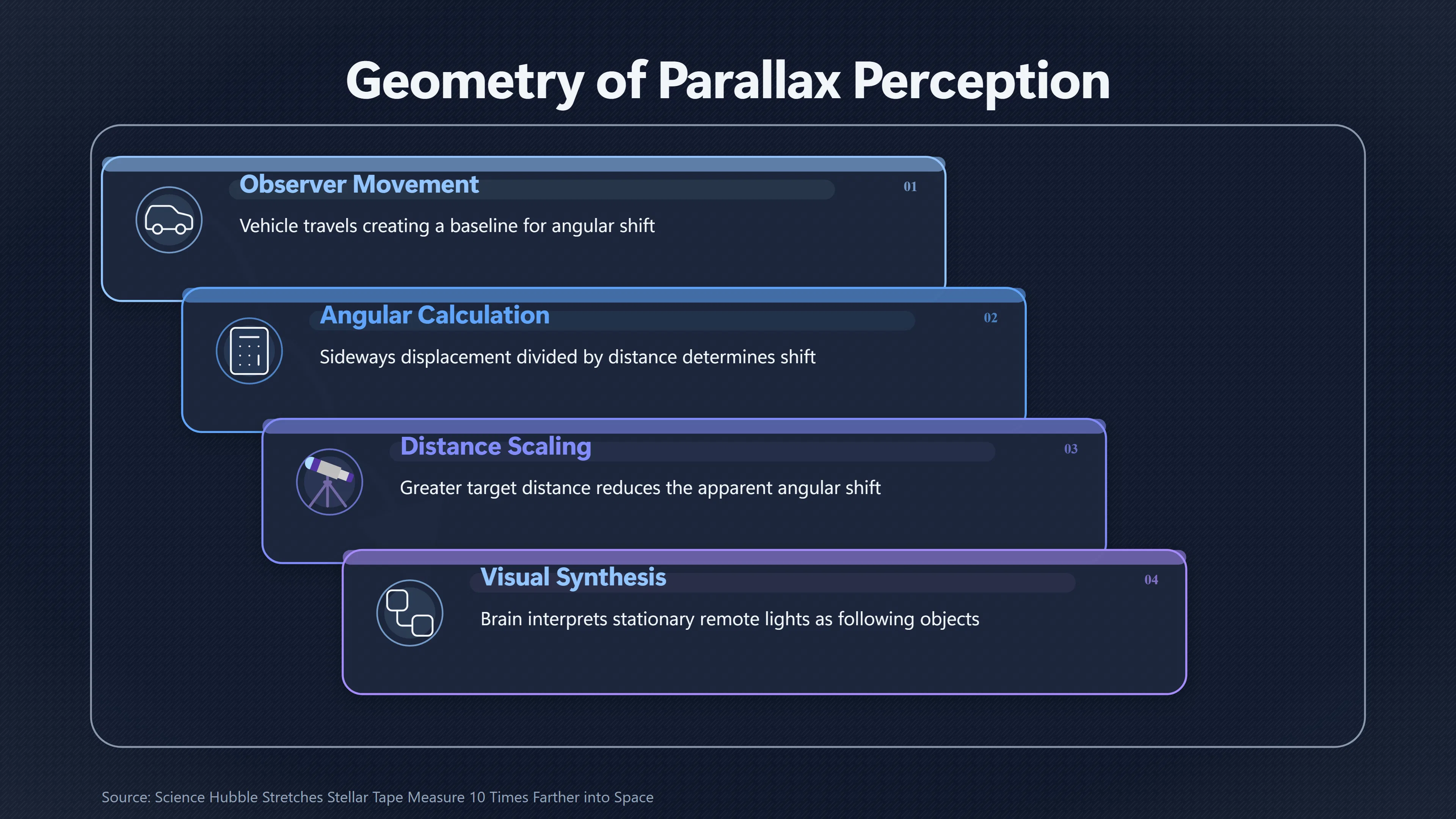
A light does not have to physically pace a moving vehicle to seem as though it has followed it for several kilometres. If the source is sufficiently far away, the vehicle’s journey is a small baseline compared with the source’s distance, so the direction from observer to light changes only slightly. Nearby trees, buildings and road signs meanwhile sweep past, reinforcing the impression that the light is keeping station with the car. This is the geometry of parallax and motion parallax: increasing the observer’s displacement increases the angular shift, but increasing the object’s distance reduces it.[nasa.gov]pwg.gsfc.nasa.govNASA PWGParallax–Lesson Plan #14December 17, 2001…
That matters when assessing UFO/UAP reports described as a light that “followed” a car for miles. Duration or distance travelled can sound like evidence of sustained pursuit, yet for a remote light those kilometres may still be far too short a baseline to reveal much change in bearing. The decisive question is not simply how long the experience lasted, but how large an angular change the journey should have produced at the light’s actual distance.
How distance limits angular change
Parallax is the apparent change in an object’s direction when the observer changes position. NASA’s explanations of the principle emphasise two linked facts: a larger observing baseline produces a larger parallax, while greater target distance produces a smaller apparent shift. Astronomers exploit precisely this relationship when they measure stellar distances, using an enormous baseline provided by Earth’s orbit because the shifts of distant objects are otherwise extremely small.[NASA PWG]pwg.gsfc.nasa.govNASA PWGParallax–Lesson Plan #14December 17, 2001…
The same geometry works on an ordinary road, just at a very different scale. For a simple case in which a vehicle’s displacement is approximately sideways relative to the line of sight, the small angular change can be approximated by:
angular change in radians ≈ sideways displacement ÷ distance to the light
The useful point is the ratio, rather than the equation itself. Suppose the effective sideways change of viewpoint is 1 kilometre. A stationary light 1 kilometre away would shift by a very large angle. At 10 kilometres, the shift is roughly 5.7°. At 100 kilometres, it is only about 0.57°. At astronomical distances, a road journey of a few kilometres produces an angular change effectively invisible to unaided observation.
These are simplified geometrical examples, not estimates of the range of any particular UFO report. They show why “it stayed in almost the same direction” cannot establish that an object maintained the same physical position relative to a car. Direction and distance are different quantities. A remote fixed source can preserve approximately the same viewing direction even as the separation between observer and source remains enormous.
This inverse relationship between apparent motion and distance is also fundamental to motion parallax. Experiments have long shown that the changing retinal positions produced by observer movement provide powerful information about relative depth, and modern vision research describes observer translation as producing different image velocities for objects at different distances.[nih.gov]pubmed.ncbi.nlm.nih.govPub Med Motion parallax as an independent cue for depth perceptionMotion parallax as an independent cue for depth perception - PubMed…
Why several kilometres may still be too little
The phrase “it followed us for ten kilometres” sounds much stronger than “we watched it for ten minutes”, because kilometres suggest a measurable pursuit. Geometrically, however, the distance recorded on the vehicle’s odometer is not necessarily the relevant baseline. What changes the viewing direction most efficiently is movement across the line of sight to the object.
Consider a driver travelling towards a bright light low in the eastern sky. The car might cover 10 kilometres while moving largely towards that light. Much of the journey then changes range rather than bearing. The light can remain almost straight ahead even if it is completely stationary. A long, fairly straight road aimed approximately towards or away from a remote source is therefore particularly capable of sustaining the impression that the source is accompanying the vehicle.
Even when the road is not aligned with the light, range still matters. If a source is 100 kilometres away, a 5-kilometre effective sideways baseline corresponds, in a simple right-angle approximation, to only about 2.9° of change. At 500 kilometres, the same baseline gives roughly 0.57°. If the source is the Moon, a planet or a star, terrestrial driving distances are negligible by comparison. NASA notes that even stellar parallax requires astronomers to use Earth’s orbital motion as a baseline; for more distant stars, the resulting angular displacement becomes extraordinarily small.[NASA Science]science.nasa.govScience Hubble Stretches Stellar Tape Measure 10 Times Farther into SpaceNASA ScienceHubble Stretches Stellar Tape Measure 10 Times Farther into Space - NASA Science…
The familiar Moon-following-a-car experience is the everyday extreme of this effect. A distant source hardly alters direction while foreground scenery changes continuously. The result is perceptually striking precisely because the observer is moving: the roadside world advertises that movement while the remote object apparently refuses to participate in it. Research on motion parallax confirms that the visual system uses these distance-dependent differences in retinal motion to infer three-dimensional layout.[Sage Journals]journals.sagepub.comSage Journals Motion Parallax as an Independent Cue for Depth PerceptionSage JournalsMotion Parallax as an Independent Cue for Depth Perception - Brian Rogers, Maureen Graham, 1979…
For UFO/UAP assessment, this means that kilometres travelled are useful evidence only when combined with route geometry. A report that a light remained “off the driver’s right” for 15 kilometres does not by itself show that the source travelled 15 kilometres beside the car. Investigators need to know which way the road ran, where and how sharply it turned, whether the reported bearing changed, and whether there were stationary landmarks against which that bearing could be reconstructed.

A pursuit can feel more convincing as the journey continues
There is a perceptual irony here. A long observation may increase the witness’s confidence in pursuit even when distance is exactly what permits the illusion to persist. Each additional kilometre during which the light remains in roughly the same region of the windscreen can seem like another piece of evidence that it is matching the vehicle.
Yet the observation may instead be repeatedly demonstrating the same fact: the source has very little parallax.
This is particularly relevant to bright point-like sources whose distance cannot be judged directly. NASA’s guidance on identifying UFOs and UAPs specifically notes that Venus is frequently mistaken for an unidentified object, especially when low on the horizon; Jupiter, Sirius and Mercury can also generate reports.[NASA Science]science.nasa.govScience Identifying UFOs and UAPsNASA ScienceIdentifying UFOs and UAPs - NASA ScienceDecember 1, 2013… A bright celestial object supplies essentially no road-scale parallax, so a driver’s changing position cannot make it sweep across the landscape in the manner expected of a nearby lamp, drone or aircraft.
Historical UFO investigation provides unusually vivid examples of how convincing this can become. In Case 37 of the University of Colorado’s Condon investigation, law-enforcement officers in several communities reported bright objects that appeared to flee from or pursue police vehicles. The investigation concluded that the principal pursued object was Venus, with Jupiter involved in some reports. The case included claims of pursuit at road speeds and contradictory apparent directions from different locations, illustrating how an astronomical source could acquire an apparently dynamic relationship with moving observers.[NCAS Files]files.ncas.orgFiles Condon Report, Case 37: Planets Venus & JupiterFiles Condon Report, Case 37: Planets Venus & Jupiter
The importance of such cases is not that every prolonged vehicle sighting is Venus. NASA lists many other potential sources of unidentified lights, including aircraft, satellites, meteors, balloons and unusual atmospheric phenomena.[NASA Science]science.nasa.govScience Identifying UFOs and UAPsNASA ScienceIdentifying UFOs and UAPs - NASA ScienceDecember 1, 2013… Rather, the cases demonstrate that prolonged apparent pursuit is not sufficient on its own to establish prolonged physical pursuit. An observer can sincerely experience a remote source as keeping pace while its actual position bears no such relationship to the vehicle.
When route geometry finally makes the light shift
A following-light interpretation becomes more testable when the vehicle makes a substantial change of direction. On a long straight road, the geometry can remain ambiguous: the source may simply sit ahead, behind or to one side with little apparent change. A significant bend or turn changes the observer’s trajectory relative to the line of sight.
This creates an important distinction. If a driver turns 90° and a very distant fixed light remains fixed against the astronomical background, its location relative to the car should change. Something that had appeared through the windscreen may move towards a side window simply because the vehicle has rotated. If instead a genuinely nearby object manoeuvres so as to restore the same relative position beside the car, that behaviour requires a different geometrical explanation.
But even turns have to be reconstructed carefully. Rotation of the vehicle immediately changes where a fixed object appears relative to the windscreen, whereas translation along the new road changes its actual bearing more gradually. These two effects can easily be conflated in memory. Vision accounts distinguish rotational and translational components of optic flow: translation produces distance-dependent parallax, while rotation moves the visual field without providing the same distance relationship.[CIS RIT]cis.rit.eduCIS RITPhenomenology of MotionCIS RITPhenomenology of Motion
This is why a sequence such as “the road curved and the light stayed with us” is less diagnostic than it first appears. A gentle bend may continually alter the vehicle’s heading without supplying a large sideways baseline relative to a remote source. Hills, trees and buildings can also hide and reveal the light, breaking continuous observation and making its subsequent reappearance seem like renewed pursuit.
A stronger reconstruction records the road itself. Investigators can plot successive witness positions, headings and reported directions to the light. If those sight-lines intersect reasonably closely, they can constrain a terrestrial source’s location. If the lines remain nearly parallel, the observations instead imply either a very distant source or insufficient angular precision to determine range. That is simply triangulation in reverse: NASA’s parallax material explains that distant targets require increasingly large baselines because their sight-lines differ by increasingly small angles.[NASA PWG]pwg.gsfc.nasa.govNASA PWGParallax–Lesson Plan #14December 17, 2001…

What kilometres of “following” actually establish
A prolonged sighting is still valuable evidence. It can provide multiple viewing locations, turns in the road, changes in elevation, interruptions by terrain and opportunities to compare the light with known landmarks. In principle, that makes a kilometres-long observation more useful than a fleeting glimpse. But the value comes from those changing geometrical constraints, not from the distance travelled by itself.
For a vehicle-related UFO/UAP report, several details therefore matter more than the statement that the light followed for a long distance:
- Bearing changes: Did its direction relative to north or identifiable landmarks actually change?
- Route shape: Was the vehicle travelling straight towards the source, sideways to it, or through substantial turns?
- Foreground crossings: Did the light pass demonstrably in front of or behind known terrain, structures or clouds?
- Independent viewpoints: Did separated observers obtain sufficiently different bearings to constrain distance?
- Behaviour when stationary: Did the reported “matching” behaviour persist after the vehicle stopped, or did the light simply remain in the sky?
- Astronomical alignment: Was a conspicuous planet, star or the Moon in the reported direction and elevation?
The underlying lesson is narrow but important. A following-light illusion does not have a natural limit of a few hundred metres. If the source is remote enough, several kilometres — or far more — may still constitute a very small observing baseline. The same mathematical relationship that allows astronomers to estimate distance from parallax also explains why distant objects show so little parallax in the first place.[NASA PWG]pwg.gsfc.nasa.govNASA PWGParallax…
Consequently, the length of a reported UFO/UAP “chase” should not be treated as a proxy for the object’s ability to match a vehicle’s speed. A much stronger test is whether the accumulated journey produced angular changes that are inconsistent with a distant stationary or independently moving source. Until range, bearing and route geometry are tied together, kilometres of apparent pursuit can remain kilometres of compelling — but geometrically ordinary — illusion.
Amazon book picks
Further Reading
Books and field guides related to How a Following Light Illusion Can Last for Kilometres. Use these as the next step if you want deeper reading beyond the article.
Sensation and Perception
. Bruce Goldstein's SENSATION AND PERCEPTION, the best-seller which has helped over 150,000 students understand the ties between how we s...
Visual Intelligence: How We Create What We See
A unique, illustrated popular study reveals the way the human eye acts on the visual world not just to represent but to create the things...
The UFO Handbook: A Guide to Investigating, Evaluating, and R...
An explanation of the usual reasons for confusing IFOs (identified flying objects) with UFOs and a survey of the tools used to investigat...
eBay marketplace picks
Marketplace Samples
Live-tested eBay searches with available results related to this page.
Selected fromUFO poster oneBay.co.uk.

Current eBay listing
VINTAGE UFO FLYING SAUCERS COMIC ADVERTISING A2 POSTER PRINT
Current eBay listing
I Want To Believe UFO Poster Giclée Fine Art Heavyweight Print

Endnotes
1.
Source: pwg.gsfc.nasa.gov
Link:https://pwg.gsfc.nasa.gov/stargaze/ILparalax.htm
Source snippet
NASA PWGParallax--Lesson Plan #14December 17, 2001...
Published: December 17, 2001
2.
Source: pwg.gsfc.nasa.gov
Link:https://pwg.gsfc.nasa.gov/stargaze/Sparalax.htm
Source snippet
NASA PWGParallax...
3.
Source: science.nasa.gov
Title: Science Hubble Stretches Stellar Tape Measure 10 Times Farther into Space
Link:https://science.nasa.gov/missions/hubble/hubble-stretches-stellar-tape-measure-10-times-farther-into-space/
Source snippet
NASA ScienceHubble Stretches Stellar Tape Measure 10 Times Farther into Space - NASA Science...
4.
Source: nature.com
Title: Scene-relative object motion biases depth percepts | Scientific Reports
Link:https://www.nature.com/articles/s41598-022-23219-4
Source snippet
Scene-relative object motion biases depth percepts | Scientific Reports...
5.
Source: nature.com
Link:https://www.nature.com/articles/nature06814
Source snippet
A neural representation of depth from motion parallax in macaque visual cortex | Nature...
6.
Source: starchild.gsfc.nasa.gov
Title: Star Child Parallax
Link:https://starchild.gsfc.nasa.gov/docs/StarChild/questions/parallax.html
7.
Source: science.nasa.gov
Title: Science Identifying UFOs and UAPs
Link:https://science.nasa.gov/solar-system/skywatching/night-sky-network/identifying-ufos-and-uaps/
Source snippet
NASA ScienceIdentifying UFOs and UAPs - NASA ScienceDecember 1, 2013...
Published: December 1, 2013
8.
Source: files.ncas.org
Title: Files Condon Report, Case 37: [Planets]({{ ‘planets/’ | relative_url }}) Venus & Jupiter
Link:https://files.ncas.org/condon/text/case37.htm
9.
Source: cis.rit.edu
Title: CIS RITPhenomenology of Motion
Link:https://www.cis.rit.edu/people/faculty/montag/vandplite/pages/chap_13/ch13p2.html
10.
Source: imagine.gsfc.nasa.gov
Link:https://imagine.gsfc.nasa.gov/features/cosmic/solar_system_info.html
11.
Source: science.nasa.gov
Title: Science Stellar Parallax
Link:https://science.nasa.gov/asset/hubble/stellar-parallax/
12.
Source: science.nasa.gov
Title: hubble glossary
Link:https://science.nasa.gov/mission/hubble/multimedia/hubble-glossary/
13.
Source: science.nasa.gov
Title: hubble constant and tension
Link:https://science.nasa.gov/mission/hubble/science/science-behind-the-discoveries/hubble-constant-and-tension/
14.
Source: imagine.gsfc.nasa.gov
Link:https://imagine.gsfc.nasa.gov/descriptions/parallax.html
15.
Source: science.nasa.gov
Title: 10jul supermoons
Link:https://science.nasa.gov/science-research/planetary-science/10jul_supermoons/
16.
Source: science.nasa.gov
Title: depth perception in space
Link:https://science.nasa.gov/resource/depth-perception-in-space/
17.
Source: ntrs.nasa.gov
Link:https://ntrs.nasa.gov/citations/19980019496
18.
Source: spacemath.gsfc.nasa.gov
Link:https://spacemath.gsfc.nasa.gov/transits/TRACEmerc.html
19.
Source: spacemath.gsfc.nasa.gov
Link:https://spacemath.gsfc.nasa.gov/transits/TRACEvenus.html
20.
Source: files.ncas.org
Link:https://files.ncas.org/condon/text/s3chap05.htm
21.
Source: files.ncas.org
Link:https://files.ncas.org/condon/text/case51.htm
22.
Source: pubmed.ncbi.nlm.nih.gov
Title: Pub Med Motion parallax as an independent cue for depth perception
Link:https://pubmed.ncbi.nlm.nih.gov/471676/
Source snippet
Motion parallax as an independent cue for depth perception - PubMed...
23.
Source: pmc.ncbi.nlm.nih.gov
Title: Pub Med Central (PMC)Visual Depth from Motion Parallax and Eye Pursuit
Link:https://pmc.ncbi.nlm.nih.gov/articles/PMC3348271/
Source snippet
PubMed Central (PMC)Visual Depth from Motion Parallax and Eye Pursuit - PMC...
24.
Source: journals.sagepub.com
Title: Sage Journals Motion Parallax as an Independent Cue for Depth Perception
Link:https://journals.sagepub.com/doi/10.1068/p080125
Source snippet
Sage JournalsMotion Parallax as an Independent Cue for Depth Perception - Brian Rogers, Maureen Graham, 1979...
25.
Source: letstalk.cornwall.gov.uk
Title: cornwall.gov.uk St Ives Town Deal Low Carbon Transport | Let’s Talk Cornwall
Link:https://letstalk.cornwall.gov.uk/st-ives-town-deal-low-carbon-transport?tool=news_feed
26.
Source: nuforc.org
Link:https://nuforc.org/sighting/?id=198036
27.
Source: media.nationalarchives.gov.uk
Title: nationalarchives.gov.uk The Cold War and UFOs | The National Archives
Link:https://media.nationalarchives.gov.uk/index.php/cold-war-ufos/
28.
Source: maidstone.gov.uk
Title: Your Councillors
Link:https://maidstone.gov.uk/home/primary-services/council-and-democracy/primary-areas/your-councillors?sq_content_src=%2BdXJsPWh0dHBzJTNBJTJGJTJGbWVldGluZ3MubWFpZHN0b25lLmdvdi51ayUyRmRvY3VtZW50cyUyRnM2NDI0MCUyRkNvYnRyZWUlMjBFc3RhdGUlMjBVcGRhdGUuaHRtbCUzRkNUJTNEMiZhbGw9MQ%3D%3D
29.
Source: nuforc.org
Link:https://nuforc.org/sighting/?id=142766
30.
Source: nuforc.org
Link:https://nuforc.org/sighting/?id=132274
31.
Source: pmc.ncbi.nlm.nih.gov
Link:https://pmc.ncbi.nlm.nih.gov/articles/PMC4901450/
32.
Source: maidstone.gov.uk
Title: Contact your Parish Council
Link:https://maidstone.gov.uk/home/primary-services/council-and-democracy/additional-areas/contact-your-parish-council?sq_content_src=%2BdXJsPWh0dHBzJTNBJTJGJTJGbWVldGluZ3MubWFpZHN0b25lLmdvdi51ayUyRmRvY3VtZW50cyUyRnM0MTA4NCUyRkVjb25vbWljJTIwYW5kJTIwQ29tbWVyY2lhbCUyMERldmVsb3BtZW50JTIwT1NDJTIwVHdpbGlnaHQlMjBFY29ub215JTIwUmV2aWV3Lmh0bWwlM0ZDVCUzRDImYWxsPTE%3D
33.
Source: moderngov.rotherham.gov.uk
Title: ie List Documents.aspx
Link:https://moderngov.rotherham.gov.uk/ieListDocuments.aspx?CId=491&MID=13018
34.
Source: GOV.UK
Title: www.gov.uk[Withdrawn] Venus Express gets ready to take the plunge
Link:https://www.gov.uk/government/news/venus-express-gets-ready-to-take-the-plunge
35.
Source: maidstone.gov.uk
Title: What’s new
Link:https://maidstone.gov.uk/home/primary-services/council-and-democracy/primary-areas/meetings%2C-minutes-And-agendas/tier-3-primary-areas/whats-new?sq_content_src=%2BdXJsPWh0dHBzJTNBJTJGJTJGbWVldGluZ3MubWFpZHN0b25lLmdvdi51ayUyRmRvY3VtZW50cyUyRnMyNzMyOSUyRlJlcG9ydCUyMGZvciUyME1BJTIwMTElMjAxOTQ0Lmh0bWwlM0ZDVCUzRDImYWxsPTE%3D
36.
Source: maidstone.gov.uk
Title: Agendas and meetings
Link:https://maidstone.gov.uk/home/primary-services/council-and-democracy/primary-areas/meetings%2C-minutes-And-agendas/tier-3-primary-areas/agendas-and-meetings?sq_content_src=%2BdXJsPWh0dHBzJTNBJTJGJTJGbWVldGluZ3MubWFpZHN0b25lLmdvdi51ayUyRmRvY3VtZW50cyUyRnMyMjQ5NSUyRlJlcG9ydCUyMGZvciUyME1BJTIwMTIlMjAwMTE2Lmh0bWwlM0ZDVCUzRDImYWxsPTE%3D
37.
Source: pubmed.ncbi.nlm.nih.gov
Link:https://pubmed.ncbi.nlm.nih.gov/21695531/
38.
Source: nuforc.org
Link:https://nuforc.org/sighting/?id=68433
39.
Source: nuforc.org
Link:https://nuforc.org/sighting/?id=26326
40.
Source: nuforc.org
Link:https://nuforc.org/sighting/?id=9445
41.
Source: journals.sagepub.com
Link:https://journals.sagepub.com/doi/pdf/10.1068/p080125
42.
Source: pubmed.ncbi.nlm.nih.gov
Link:https://pubmed.ncbi.nlm.nih.gov/11540630/
43.
Source: sciencedirect.com
Title: Motion Parallax
Link:https://www.sciencedirect.com/topics/computer-science/motion-parallax
44.
Source: astro.unl.edu
Link:https://astro.unl.edu/naap/distance/parallax.html
45.
Source: itu.physics.uiowa.edu
Link:https://itu.physics.uiowa.edu/labs/foundational/parallax
46.
Source: itu.physics.uiowa.edu
Title: stellar parallax
Link:https://itu.physics.uiowa.edu/glossary/stellar-parallax
47.
Source: brent.gov.uk
Link:https://www.brent.gov.uk/nuisance-crime-and-community-safety/noise-and-nuisance
48.
Source: moderngov.rotherham.gov.uk
Link:https://moderngov.rotherham.gov.uk/mgDelegatedDecisions.aspx?DM=13197PPL&DR=28%2F10%2F2025-11%2F11%2F2025&DS=2&HD=0&K=0&META=mgofficerdecisions&Next=true&RP=0&V=1
49.
Source: lingwood-burlinghamparishcouncil.gov.uk
Link:https://lingwood-burlinghamparishcouncil.gov.uk/notices/
50.
Source: lisburncastlereagh.gov.uk
Title: annual employment industry monitor report 2023 2024 duplicate
Link:https://www.lisburncastlereagh.gov.uk/w/annual-employment-industry-monitor-report-2023-2024-duplicate
Additional References
51.
Source: discovermagazine.com
Link:https://www.discovermagazine.com/the-sciences/aliens-yes-ufos-no
52.
Source: ufouap.net
Link:https://www.ufouap.net/en/explainers/common-ufo-misidentifications
53.
Source: explainingwhy.com
Link:https://www.explainingwhy.com/natural-sciences/astronomy/explain-why-the-moon-appears-to-follow-our-car-when-we-drive/
54.
Source: purdue.edu
Link:https://www.purdue.edu/freeform/me274/chapter-3-discussion/homework-h3-b-9/
55.
Source: gutenberg.org
Link:https://www.gutenberg.org/files/66639/66639-h/66639-h.htm
56.
Source: tipsmake.com
Link:https://tipsmake.com/this-is-why-we-always-see-the-moon-always-following-us
57.
Source: ourcuriousworld.com
Link:https://www.ourcuriousworld.com/UFOIdentification.htm
58.
Source: astronomyufo.com
Link:https://www.astronomyufo.com/UFO/Venusufo.htm
59.
Source: vedantu.com
Link:https://www.vedantu.com/question-answer/moving-in-a-car-the-trees-and-buildings-appear-class-11-physics-cbse-604907338554fc1e3c46ae77
60.
Source: universalium.en-academic.com
Link:https://universalium.en-academic.com/291504/unidentified_flying_object