Within Balloons
Can Wind Make a Balloon Seem Piloted?
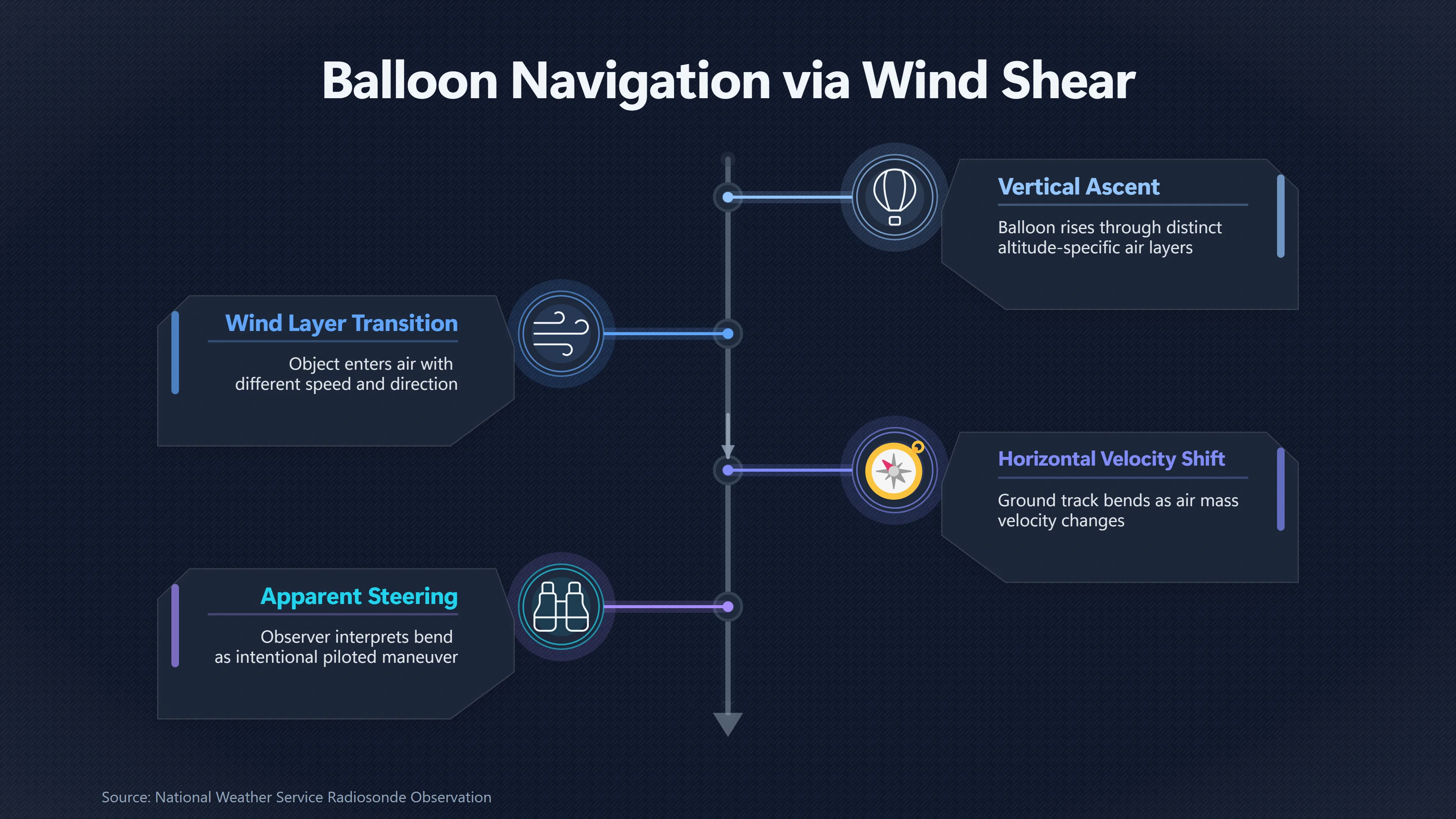
A balloon rising or descending through different wind layers can turn sharply without propulsion or deliberate control.
On this page
- How wind direction changes with altitude
- Why climbing and descending balloons change course
- When apparent turns do not imply propulsion
Page outline Jump by section
Introduction
A balloon can appear to make a purposeful turn without possessing any horizontal propulsion at all. The key mechanism is vertical wind shear: wind speed and wind direction change with altitude. When a rising or descending balloon passes from one wind layer into another, its horizontal velocity changes with the surrounding air. To an observer who cannot see the balloon’s vertical movement or the invisible layers of atmosphere, the resulting bend in its ground track can resemble steering, acceleration or an intentional change of heading.
This is not merely a theoretical explanation for UFO or UAP reports. Meteorologists routinely measure winds aloft by tracking ascending balloons, while high-altitude balloon engineers deliberately exploit different wind layers to obtain limited navigation through altitude changes. Recent US All-domain Anomaly Resolution Office (AARO) case work likewise uses agreement between an object’s motion and altitude-specific winds as evidence when resolving UAP reports as balloons.[weather.gov]weather.govNational Weather Service Radiosonde ObservationNational Weather Service Radiosonde Observation
The important diagnostic question is therefore not simply whether an object turned. It is whether it moved in a way that the surrounding wind field, including changes of wind with height, could not plausibly produce.
How wind direction changes with altitude
Wind is a velocity: it has both speed and direction. Neither has to remain constant as altitude changes. The US National Weather Service defines vertical wind shear as a change in wind direction and speed with height. It distinguishes directional shear, where direction changes with altitude, from speed shear, where wind speed changes; the atmosphere can exhibit either or both simultaneously.[National Weather Service]forecast.weather.govNational Weather Service NOAA's National Weather ServiceNational Weather ServiceNOAA's National Weather Service - Glossary…
A simple example shows why this matters for a balloon. Imagine that at 3,000 metres the wind carries a balloon towards the east at 20 km/h. At 4,000 metres, the air might instead be travelling north-east at 40 km/h. If the balloon climbs through those levels, its horizontal motion will progressively change from the first wind vector towards the second. On a map, its track bends. If the difference between the layers is large and the transition is relatively shallow, that bend can look conspicuous.
Meteorological balloons demonstrate the mechanism every day. National Weather Service radiosondes rise at roughly 300 metres per minute while transmitting their GPS positions. Meteorologists derive wind speed and direction aloft by tracking that motion. A typical NWS sounding can climb above 35 kilometres, remain airborne for more than two hours and drift more than 300 kilometres from its launch point; in a strong jet stream, a radiosonde can exceed 400 km/h horizontally.[National Weather Service]weather.govNational Weather Service Radiosonde ObservationNational Weather Service Radiosonde Observation
That practice is especially revealing for the UAP question. The balloon is not merely being used to measure temperature or pressure while somebody independently measures the wind. The balloon’s displacement is itself evidence of the air’s motion. NOAA explains that GPS tracking of a radiosonde’s position provides measurements of wind speed and direction aloft.[NOAA]prod-01-alb-www-noaa.woc.noaa.govRadiosondes | National Oceanic and Atmospheric AdministrationRadiosondes | National Oceanic and Atmospheric Administration…
NOAA’s Integrated Global Radiosonde Archive makes the vertical structure explicit. It contains radiosonde and pilot-balloon observations from more than 2,800 stations and includes wind direction and speed at standard pressure levels, variable pressure levels and height-based wind levels.[NCEI]ncei.noaa.govFebruary 8, 2018… The existence of these vertical wind profiles is important when analysing an unidentified object: a surface weather report cannot establish what air was doing kilometres above the observer.
Why climbing balloons change course
An ordinary free balloon has very little ability to choose its horizontal velocity relative to the surrounding atmosphere. Once it has adjusted to a wind layer, it tends to travel with that air mass. But a balloon is simultaneously moving vertically during ascent, so the wind carrying it can change continuously.
The resulting ground track need not be straight.
Suppose an ascending weather balloon spends several minutes in south-westerly winds and is consequently carried north-east. It then reaches a layer where the wind comes from the north-west and is carried south-east. The balloon has effectively changed heading even though no motor has fired and no pilot has commanded a turn. From sufficiently far away, an observer may see only the horizontal component and interpret the change as a conventional aerial manoeuvre.
This is one reason meteorological sounding systems record complete trajectories rather than assuming one wind for an entire flight. National Weather Service upper-air stations produce plots of wind speed, wind direction and balloon trajectory as the radiosonde climbs.[National Weather Service]weather.govNational Weather Service NWS Nashville Upper Air InformationNational Weather Service NWS Nashville Upper Air Information NOAA similarly describes weather-balloon observations as vertical profiles of wind speed and direction, alongside temperature, humidity, pressure and geopotential height.[NCEI]ncei.noaa.govNCEIWeather Balloon | National Centers for Environmental Information (NCEINCEIWeather Balloon | National Centers for Environmental Information (NCEI
The balloon’s vertical speed also establishes a useful timescale. At the NWS’s typical ascent rate of about 300 metres per minute, a balloon traverses a 300-metre-deep layer in roughly one minute and a kilometre of altitude in a little over three minutes.[National Weather Service]weather.govNational Weather Service Radiosonde ObservationNational Weather Service Radiosonde Observation Therefore, if a substantial directional change is concentrated into a relatively shallow altitude interval, the resulting change in ground track need not take hours. It can become evident during a short observation.
That does not mean a balloon instantaneously snaps onto the new wind vector. Its inertia and aerodynamic response matter, and real wind fields are not perfectly uniform slabs. The useful point for UAP analysis is narrower: an apparently significant course change over minutes is not automatically evidence of propulsion if the object is also changing altitude through a sheared atmosphere.
Descending balloons can turn as well
The mechanism works in reverse during descent. A balloon that loses buoyancy, is commanded to descend, bursts and releases a payload, or otherwise changes altitude can encounter different winds below it. Its horizontal track can consequently bend one or more times on the way down.
This creates a potentially deceptive observational sequence. An object might drift eastward at high altitude, begin descending, move south-east in an intermediate layer and then turn towards the south in lower-level winds. An observer who cannot determine altitude precisely may perceive three horizontal flight legs separated by two “turns”. In three dimensions, however, the path may simply record the object’s passage through three different moving layers of air.
Descent can introduce additional complications because balloon systems frequently include payloads and parachutes. National Weather Service balloons typically burst at high altitude and their radiosondes descend beneath parachutes; the horizontal distance travelled varies with winds aloft.[National Weather Service]weather.govNational Weather Service Upper AirNational Weather Service Upper Air The visual object seen before and after a burst may therefore differ, but the underlying point remains: once a lightweight balloon component or parachuting payload enters a different air layer, its ground track can change.
Vertical movement itself can also be difficult to judge against an empty sky. Unless an observer has reliable ranging, radar or stereoscopic information, a distant object becoming slightly higher or lower may produce much less obvious visual change than its sideways displacement. The hidden altitude change can therefore be the missing variable that makes an apparent horizontal manoeuvre seem mysterious.
Some balloons deliberately exploit wind shear
There is an important distinction between a balloon being passively redirected by wind shear and a balloon system deliberately changing altitude to exploit it. The second case can look even more like piloted flight, yet it still does not require conventional horizontal propulsion.
High-altitude balloon research explicitly treats altitude as a navigation control. A 2024 Scientific Reports study explains that such balloon systems rely on changes in wind direction with altitude: changing height changes the direction of horizontal motion, allowing an altitude-control system to move the balloon into a more favourable wind layer. The researchers modelled potential trajectories using ERA5 atmospheric wind data and found that the ability to remain near a target varies substantially by geography and season.[Nature]nature.comSeasonal and geographic viability of high altitude balloon navigation | Scientific Reports…
Other aerospace research describes the same principle as “riding” the natural wind field. A 2019 study in Aerospace Science and Technology modelled station-keeping by changing altitude to use winds with different speeds and directions. Another analysis states directly that, because wind direction varies with altitude, a balloon can reverse or alter its cruise direction by moving to a layer containing the desired wind.[ScienceDirect]sciencedirect.comOpen source on sciencedirect.com.
This distinction matters when the word steerable is applied to a balloon. It can misleadingly suggest an aircraft-like vehicle pointing its nose and generating thrust towards a chosen bearing. Altitude-controlled balloons instead have an indirect form of horizontal navigation: they select, where atmospheric conditions permit, from the currents available above or below them.
The technique also has limitations. The 2024 Scientific Reports analysis found that station-keeping is not universally possible; favourable directional diversity depends on season and latitude, with mid-latitude conditions generally more challenging than lower latitudes in the simulations.[Nature]nature.comSeasonal and geographic viability of high altitude balloon navigation | Scientific Reports… A balloon therefore cannot necessarily choose any heading it wants. Its apparent freedom of movement remains constrained by the atmospheric wind field.
For UAP interpretation, however, even limited control can matter. A balloon that ascends, changes horizontal direction, later descends and changes direction again can superficially resemble a vehicle making navigational decisions. The actual control input may have been only up or down.
Large scientific balloons show how strongly wind controls the track
NASA’s scientific balloon programme provides concrete examples of wind-dominated flight on a much larger scale than ordinary weather balloons. NASA states that a super-pressure balloon’s flight path is determined by wind speed and direction at its float altitude. Its New Zealand super-pressure balloons typically operate around 33.5 kilometres, or 110,000 feet.[NASA]nasa.govSuper Pressure Balloons Return to New Zealand for Test FlightsSuper Pressure Balloons Return to New Zealand for Test Flights
Launch planning illustrates how consequential relatively subtle atmospheric differences can become. In April 2017, NASA postponed a super-pressure balloon launch from Wanaka because stratospheric winds around the intended 33.5-kilometre float altitude would have produced an unacceptable trajectory. NASA was monitoring not only ground and low-level winds but also the stratospheric flow at the actual operating altitude.[NASA Science]science.nasa.govScience NASA Postpones Super Pressure Balloon LaunchScience NASA Postpones Super Pressure Balloon Launch
Another NASA super-pressure mission reached approximately 33.5 kilometres after two hours and eight minutes of ascent. Its initial trajectory carried it westward through southern Australia before it entered an eastward-flowing winter stratospheric circulation. NASA expected the balloon subsequently to circumnavigate the Southern Hemisphere according to stratospheric wind speeds.[NASA]nasa.govSuper Pressure Balloon Begins Globetrotting JourneySuper Pressure Balloon Begins Globetrotting Journey
That is a particularly clear real-world demonstration of the mechanism relevant to apparent UAP manoeuvres. The balloon did not need an aircraft-style propulsion system to transition from one broad direction of travel to another. The atmosphere supplied the horizontal motion.
NASA’s launch-location information also shows how strongly expected balloon trajectories depend on the wind regime. Different launch sites are associated with eastward, westward or “turnaround” trajectories, with stated float-wind ranges extending to 120 knots for some operations.[NASA]nasa.govBalloon Launch LocationsBalloon Launch Locations Balloon motion that appears dramatic in ground coordinates can therefore remain completely ordinary relative to the moving air.
A turn may also come with apparent acceleration
Directional shear changes heading; speed shear changes how quickly the balloon moves across the ground. When both occur together, an object can appear to turn and accelerate at approximately the same time.
The National Weather Service gives a straightforward example of speed shear: south-westerly winds might increase from 20 mph at 10,000 feet to 50 mph at 20,000 feet.[National Weather Service]forecast.weather.govNational Weather Service NOAA's National Weather ServiceNational Weather ServiceNOAA's National Weather Service - Glossary… A balloon ascending through such an environment would progressively acquire a greater horizontal velocity even without producing thrust.
Combine that with directional shear and the visual effect becomes more striking. Imagine lower winds carrying a balloon north at 20 mph and upper winds carrying it east-north-east at 50 mph. As the balloon crosses the transition, an observer could see the object curve onto a new heading while its angular rate across the sky increases.
This is precisely why claims of extraordinary acceleration require more information than a visual track alone. One must know, or estimate, the object’s range, altitude, vertical motion and the wind field through which it travelled. A course change measured against the ground is not equivalent to an acceleration generated relative to the surrounding air.
There is also a viewing-geometry complication. A distant balloon’s angular speed depends on its distance and its direction of motion relative to the observer. A change in track can increase its motion across the observer’s line of sight even without a comparable increase in true speed. Wind shear can therefore alter the actual velocity while geometry simultaneously alters how dramatic that velocity appears. Those are separate mechanisms, but in a real sighting they can operate together.
UAP investigations use wind matching as a diagnostic
AARO’s published case material shows why wind data are valuable when deciding whether an unusual-looking object is behaving like a balloon.
In the January 2023 Eglin UAP case, a military pilot encountered an object at about 16,000 feet and described it as moving very slowly or potentially remaining stationary. AARO ultimately assessed with moderate confidence that the object was very likely a lighter-than-air object. Crucially for its behaviour, the office reported that the object’s direction and slow speed were consistent with wind direction and speed at the time and altitude of the observation.[AARO]aaro.milEglin UAP Case ResolutionEglin UAP Case Resolution
The case is useful because AARO did not rely solely on resemblance to a balloon. Its assessment incorporated the object’s reported behaviour, reconstructed flight geometry and other information. AARO stated that no anomalous flight characteristics were confirmed.[AARO]aaro.milEglin UAP Case ResolutionEglin UAP Case Resolution That illustrates the proper role of wind analysis: not as a blanket assertion that “the wind could do it”, but as a comparison between an observed trajectory and the atmospheric conditions relevant to that trajectory.
AARO’s newer public imagery catalogue provides multiple additional examples. PR-004, PR-005, PR-006, PR-009 and PR-010 — all reports from Europe in 2022 — are assessed with high confidence as almost certainly balloons. For each, AARO specifically cites performance characteristics associated with lighter-than-air objects, including drifting at wind speed and direction.[AARO]aaro.milUAP ImageryAARO UAP Imagery…
The Middle East Red Balloon case from 2024 is even more explicit. AARO assessed the slow-moving spheroidal object as almost certainly a consumer-grade reflective foil balloon, citing both its morphology and its behavioural correlation with recorded wind speed and direction during the event.[AARO]aaro.milUAP ImageryAARO UAP Imagery…
These examples do not establish that every object matching the wind is a balloon. Birds, airborne debris and other objects can also be carried or influenced by atmospheric flow. They demonstrate something more limited and useful: matching an object’s measured motion against the appropriate wind is a meaningful test of the balloon hypothesis.
Surface wind is not enough
One common analytical mistake is to compare a reported object’s direction with the wind measured at a nearby airport or weather station at ground level and then accept or reject a balloon explanation from that comparison.
Vertical wind shear makes that unreliable.[faa.gov]faa.govSource details in endnotes.
An observer might feel a westerly breeze while a balloon several kilometres above is travelling south because the upper wind is completely different. Conversely, an object moving against the surface wind is not necessarily moving against the air surrounding it. The relevant quantity is the wind vector at or near the object’s altitude.
Radiosonde observations exist precisely because surface observations cannot describe the entire atmospheric column. NOAA’s archive records wind at multiple vertical levels, and NWS radiosondes derive these winds continuously as they ascend.[NCEI]ncei.noaa.govFebruary 8, 2018…
For a historical UAP case, the strongest wind-shear analysis would therefore combine the sighting time and location with the best available altitude estimate, radiosonde soundings, meteorological reanalysis or other upper-air observations. If the object changed altitude during the event, the analysis should reconstruct a vertical wind profile, not choose one convenient altitude.
Timing matters as well. The atmosphere evolves, so a sounding taken many hours away or hundreds of kilometres from the observation introduces uncertainty. Local thunderstorms can produce winds very different from the surrounding environment; the NWS even uses such differences as examples when discussing unusual upper-air profiles.[National Weather Service]weather.govNational Weather Service Identifying Erroneous Data in Upper-air SoundingsNational Weather Service Identifying Erroneous Data in Upper-air Soundings A good balloon assessment should acknowledge those uncertainties rather than treating a coarse weather model as an exact measurement at the object’s position.
When does an apparent turn support a balloon explanation?
Wind shear is strongest as an explanation when several independent pieces of evidence converge.
First, the object’s direction and speed should be broadly compatible with measured or reconstructed winds at its estimated altitude. Second, a reported course change should correspond plausibly to a vertical transition into a layer with a different wind vector. Third, the timing should make physical sense given the object’s estimated climb or descent rate. Finally, other evidence — shape, reflectivity, altitude, lack of exhaust, slow air-relative motion or known balloon activity — should independently support the hypothesis.
The hypothesis becomes weaker when good telemetry shows something fundamentally different. For example, if accurate three-dimensional tracking demonstrated that an object remained at a fixed altitude while repeatedly making large, rapid horizontal velocity changes inconsistent with the wind and ordinary aerodynamic forces, vertical wind shear would not explain those manoeuvres. Likewise, invoking unspecified “different winds” without checking actual upper-air conditions would be speculation rather than analysis.
Altitude-controlled balloons require an additional nuance. A sequence of turns that correlates with deliberate climbs and descents may indicate genuine navigation, but it still need not indicate horizontal propulsion. Research on station-keeping shows that changing altitude can intentionally select favourable wind layers.[Nature]nature.comSeasonal and geographic viability of high altitude balloon navigation | Scientific Reports… Thus, “the balloon was navigating” and “the balloon was being carried by the wind” are not mutually exclusive descriptions.
A curved ground track is not automatically a powered manoeuvre
The central distinction is between motion relative to the ground and motion relative to the surrounding air.
A balloon may trace a curved path over the Earth because the air carrying it changes velocity with altitude. An observer sees the ground-relative trajectory but generally cannot see the atmospheric reference frame. If the balloon is also rising or descending, the observer may not even recognise that it has crossed from one wind regime into another.
This is why weather balloons make such a useful physical demonstration. Their GPS tracks are routinely used to derive winds precisely because their horizontal displacement responds to atmospheric motion.[National Weather Service]weather.govNational Weather Service Radiosonde ObservationNational Weather Service Radiosonde Observation Scientific balloons likewise travel according to winds at their operating altitude, while specialised high-altitude systems can exploit wind differences by deliberately changing height.[NASA]nasa.govSuper Pressure Balloons Return to New Zealand for Test FlightsSuper Pressure Balloons Return to New Zealand for Test Flights
For reports of balloons mistaken for extraordinary flying objects, therefore, the mere observation that an object “turned”, “changed direction” or “seemed to steer” has limited diagnostic value. The stronger question is whether the observed velocity change requires the object to have accelerated independently of the atmosphere.
Sometimes it will. But when a lightweight object is climbing or descending through a vertically sheared wind field, a seemingly deliberate manoeuvre can have a much simpler explanation. The balloon changes altitude; the surrounding air changes speed or direction; and the visible track changes with it. What appears from a distance to be a piloted turn may be the geometry of an unpowered object moving through an atmosphere that is itself moving differently at different heights.
Amazon book picks
Further Reading
Books and field guides related to Can Wind Make a Balloon Seem Piloted?. Use these as the next step if you want deeper reading beyond the article.
Atmospheric Science: An Introductory Survey
Atmospheric Science, Second Edition, is the long-awaited update of the classic atmospheric science text, which helped define the field ne...
An Introduction to Dynamic Meteorology
During the past decade, the science of dynamic meteorology has continued its rapid advance. The scope of dynamic meteorology has broadene...
Weather: A Concise Introduction
The second edition of this concise, affordable textbook is ideal for curious undergraduate majors and non-majors taking a first course in...
eBay marketplace picks
Marketplace Samples
Live-tested eBay searches with available results related to this page.
Selected fromUFO poster oneBay.co.uk.

Current eBay listing
I Want To Believe UFO Poster Giclée Fine Art Heavyweight Print



Current eBay listing
VINTAGE UFO FLYING SAUCERS COMIC ADVERTISING A2 POSTER PRINT
Endnotes
1.
Source: weather.gov
Title: National Weather Service Radiosonde Observation
Link:https://www.weather.gov/upperair/factsheet
2.
Source: nature.com
Link:https://www.nature.com/articles/s41598-024-71445-9
Source snippet
Seasonal and geographic viability of high altitude balloon navigation | Scientific Reports...
3.
Source: aaro.mil
Title: UAP Imagery
Link:https://www.aaro.mil/UAP-Cases/Official-UAP-Imagery/4/
Source snippet
AARO UAP Imagery...
4.
Source: forecast.weather.gov
Title: National Weather Service NOAA’s National Weather Service
Link:https://forecast.weather.gov/glossary.php?word=speed+shear
Source snippet
National Weather ServiceNOAA's National Weather Service - Glossary...
5.
Source: forecast.weather.gov
Title: National Weather Service NOAA’s National Weather Service
Link:https://forecast.weather.gov/glossary.php?word=directional+shear
Source snippet
National Weather ServiceNOAA's National Weather Service - Glossary...
6.
Source: forecast.weather.gov
Title: National Weather Service NOAA’s National Weather Service
Link:https://forecast.weather.gov/glossary.php?word=vertical+wind+shear
Source snippet
National Weather ServiceNOAA's National Weather Service - Glossary...
7.
Source: prod-01-alb-www-noaa.woc.noaa.gov
Title: Radiosondes | National Oceanic and Atmospheric Administration
Link:https://prod-01-alb-www-noaa.woc.noaa.gov/jetstream/upperair/radiosondes
Source snippet
Radiosondes | National Oceanic and Atmospheric Administration...
8.
Source: aoml.noaa.gov
Title: AOMLUpper Air Observations: How Weather Balloons Improve Forecasts
Link:https://www.aoml.noaa.gov/upper-air-observations/
Source snippet
NOAA/AOML...
9.
Source: ncei.noaa.gov
Link:https://www.ncei.noaa.gov/products/weather-balloon/integrated-global-radiosonde-archive
Source snippet
February 8, 2018...
Published: February 8, 2018
10.
Source: weather.gov
Title: National Weather Service NWS Nashville Upper Air Information
Link:https://www.weather.gov/ohx/upperair3
11.
Source: weather.gov
Title: National Weather Service NWS Amarillo Upper Air Tour – Post-Launch
Link:https://www.weather.gov/ama/upperair3
12.
Source: ncei.noaa.gov
Title: NCEIWeather Balloon | National Centers for Environmental Information (NCEI)
Link:https://www.ncei.noaa.gov/products/weather-balloon
13.
Source: weather.gov
Title: National Weather Service Upper Air
Link:https://www.weather.gov/epz/upperair
14.
Source: sciencedirect.com
Link:https://www.sciencedirect.com/science/article/pii/S1270963819318164
15.
Source: sciencedirect.com
Link:https://www.sciencedirect.com/science/article/pii/S1270963819312271
16.
Source: nasa.gov
Title: Super Pressure Balloons Return to New Zealand for Test Flights
Link:https://www.nasa.gov/missions/scientific-balloons/nasa-super-pressure-balloons-return-to-new-zealand-for-test-flights/
17.
Source: science.nasa.gov
Title: Science NASA Postpones Super Pressure Balloon Launch
Link:https://science.nasa.gov/blogs/super-pressure-balloon/2017/04/07/nasa-postpones-super-pressure-balloon-launch/
18.
Source: nasa.gov
Title: Super Pressure Balloon Begins Globetrotting Journey
Link:https://www.nasa.gov/centers-and-facilities/wallops/nasa-super-pressure-balloon-begins-globetrotting-journey/
19.
Source: nasa.gov
Title: Balloon Launch Locations
Link:https://www.nasa.gov/scientificballoons/balloon-launch-locations/
20.
Source: aaro.mil
Title: Eglin UAP Case Resolution
Link:https://www.aaro.mil/Portals/136/PDFs/case_resolution_reports/Case_Resolution_of_Eglin_UAP_2508.pdf
21.
Source: weather.gov
Title: National Weather Service Identifying Erroneous Data in Upper-air Soundings
Link:https://www.weather.gov/upperair/Study2
22.
Source: aaro.mil
Link:https://www.aaro.mil/Next-AARO-Home-redesign/Next-Parent/Next-AARO-UAP-Imagery-Acc-Table/
23.
Source: aaro.mil
Link:https://www.aaro.mil/Next-AARO-Home-redesign/Next-Parent/Next-UAP-Report-Documents/poster/dividLink/
24.
Source: aaro.mil
Title: AAR O UAP Records
Link:https://www.aaro.mil/UAP-Records/fbclid/IwZXh0bgNhZW0CMTEAAR0F9nbI4TTQyu8d96BuOtBb1uVQuvapZEvLug7mWxQC4ZqlNDrM5_ejMt4_aem_q0czZMebJdVWJ-6XDLdWAA/
25.
Source: nature.com
Link:https://www.nature.com/articles/s43247-025-02526-4
26.
Source: nasa.gov
Title: Scientific Balloon FAQs
Link:https://www.nasa.gov/scientificballoons/faqs/
27.
Source: nasa.gov
Title: NAS A Balloon at Float, Begins Southern Hemisphere Journey
Link:https://www.nasa.gov/blogs/wallops/2025/04/16/nasa-balloon-at-float-begins-southern-hemisphere-journey/
28.
Source: ncei.noaa.gov
Link:https://www.ncei.noaa.gov/archive/archive-management-system/OAS/bin/prd/jquery/insttype/details/269/1
29.
Source: aaro.mil
Link:https://www.aaro.mil/Next-AARO-Home-redesign/Next-Parent/Presidential-UAP-Transparency-Initiative/videoid/988676/dvpcc/false/
30.
Source: nasa.gov
Title: Lift off! NASA’s Super Pressure Balloon Takes Flight from New Zealand
Link:https://www.nasa.gov/centers-and-facilities/wallops/lift-off-nasas-super-pressure-balloon-takes-flight-from-new-zealand/
31.
Source: aaro.mil
Link:https://www.aaro.mil/Next-AARO-Home-redesign/Next-Parent/Presidential-UAP-Transparency-Initiative/videoid/988673/dvpcc/false/
32.
Source: nature.com
Link:https://www.nature.com/articles/s41586
33.
Source: vlab.noaa.gov
Title: out of thin air the history and evolution of upper air observations
Link:https://vlab.noaa.gov/web/nws-heritage/-/out-of-thin-air-the-history-and-evolution-of-upper-air-observations
34.
Source: prod-01-alb-www-noaa.woc.noaa.gov
Title: adopts technology to automate weather balloon [launches]({{ ‘launches/’ | relative_url }})
Link:https://prod-01-alb-www-noaa.woc.noaa.gov/media-release/noaa-adopts-technology-to-automate-weather-balloon-launches
35.
Source: nasa.gov
Title: NAS A Completes Balloon Technology Test Flight
Link:https://www.nasa.gov/centers-and-facilities/wallops/nasa-completes-balloon-technology-test-flight/
36.
Source: madis.ncep.noaa.gov
Title: upperair notes.shtml
Link:https://madis.ncep.noaa.gov/upperair_notes.shtml
37.
Source: ncei.noaa.gov
Title: climate data kites
Link:https://www.ncei.noaa.gov/news/climate-data-kites
38.
Source: science.nasa.gov
Link:https://science.nasa.gov/blogs/super-pressure-balloon/2017/03/29/balloon-weather-when-conditions-align-on-the-ground-lower-levels-and-in-the-stratosphere/
39.
Source: madis.ncep.noaa.gov
Title: madis raob.shtml
Link:https://madis.ncep.noaa.gov/madis_raob.shtml
40.
Source: science.nasa.gov
Title: forecasting from the ground up to the edge of space
Link:https://science.nasa.gov/blogs/super-pressure-balloon/2016/04/03/forecasting-from-the-ground-up-to-the-edge-of-space/
41.
Source: pmel.noaa.gov
Title: view rsond info
Link:https://www.pmel.noaa.gov/acg/data/view_rsond_info.php?cruise=CALNEX
42.
Source: nasa.gov
Title: Great Moments in GRIStory
Link:https://www.nasa.gov/missions/scientific-balloons/great-moments-in-gristory/
43.
Source: nature.com
Title: Antarctic topography from balloons | Nature
Link:https://www.nature.com/articles/268514a0
44.
Source: weather.gov
Link:https://www.weather.gov/rah/virtualtourballoon
45.
Source: weather.gov
Link:https://www.weather.gov/okx/Tour_Weather_Balloon
46.
Source: weather.gov
Title: NW S Amarillo Upper Air Tour – Balloon Preparation & Launch Image
Link:https://www.weather.gov/ama/upperair2
47.
Source: weather.gov
Link:https://www.weather.gov/rev/upperair
48.
Source: weather.gov
Link:https://www.weather.gov/about/observation-equipment
49.
Source: forecast.weather.gov
Link:https://forecast.weather.gov/glossary.php?word=shear
50.
Source: weather.gov
Link:https://www.weather.gov/lch/uahome
51.
Source: weather.gov
Link:https://www.weather.gov/hnx/upperair
52.
Source: weather.gov
Link:https://www.weather.gov/chs/upperair
53.
Source: weather.gov
Link:https://www.weather.gov/upperair
54.
Source: weather.gov
Title: NW S Sterling, VA
Link:https://www.weather.gov/lwx/onlinetour_uprair1
55.
Source: weather.gov
Link:https://www.weather.gov/upperair/FAQ-QC
56.
Source: forecast.weather.gov
Link:https://forecast.weather.gov/glossary.php?word=WIND
57.
Source: forecast.weather.gov
Link:https://forecast.weather.gov/glossary.php?word=a
58.
Source: forecast.weather.gov
Link:https://forecast.weather.gov/glossary.php?word=s
59.
Source: forecast.weather.gov
Link:https://forecast.weather.gov/glossary.php?word=T
60.
Source: forecast.weather.gov
Link:https://forecast.weather.gov/glossary.php?word=D
61.
Source: forecast.weather.gov
Link:https://forecast.weather.gov/glossary.php?word=EC
62.
Source: forecast.weather.gov
Link:https://forecast.weather.gov/glossary.php?letter=d
63.
Source: weather.gov
Link:https://www.weather.gov/ggw/GlossaryW
64.
Source: forecast.weather.gov
Link:https://forecast.weather.gov/glossary.php?word=n
65.
Source: atmos.jpl.nasa.gov
Link:https://atmos.jpl.nasa.gov/balloon.htm
66.
Source: ncei.noaa.gov
Title: integrated global radiosonde archive
Link:https://www.ncei.noaa.gov/index.php/products/weather-balloon/integrated-global-radiosonde-archive
67.
Source: pmel.noaa.gov
Title: view rsond info
Link:https://www.pmel.noaa.gov/acg/data/view_rsond_info.php?cruise=ACE1
68.
Source: ncei.noaa.gov
Link:https://www.ncei.noaa.gov/access/metadata/landing-page/bin/iso?id=gov.noaa.ncdc%3AC00616
69.
Source: csl.noaa.gov
Link:https://www.csl.noaa.gov/projects/b2sap/instruments.html
70.
Source: nssl.noaa.gov
Link:https://www.nssl.noaa.gov/projects/pecan/instruments/
71.
Source: prod-01-alb-www-noaa.woc.noaa.gov
Title: skew t plots
Link:https://prod-01-alb-www-noaa.woc.noaa.gov/jetstream/upperair/skew-t-plots
72.
Source: repository.library.noaa.gov
Link:https://repository.library.noaa.gov/view/noaa/67507
73.
Source: vlab.noaa.gov
Title: class of 2022
Link:https://vlab.noaa.gov/web/lapenta-internship-program/class-of-2022?displayStyle=card
74.
Source: nature.com
Link:https://www.nature.com/commsenv/articles?page=58&searchType=journalSearch&sort=PubDate&type=article
75.
Source: nature.com
Link:https://www.nature.com/commsenv/articles?page=63&searchType=journalSearch&sort=PubDate
76.
Source: nature.com
Link:https://www.nature.com/commsenv/research-articles?page=27&searchType=journalSearch&sort=PubDate&type=article&year=2025
77.
Source: aaro.mil
Link:https://www.aaro.mil/Next-AARO-Home-redesign/Next-Parent/Next-UAP-Case-RR-Data-Table/
78.
Source: aaro.mil
Link:https://www.aaro.mil/Next-AARO-Home-redesign/Next-Parent/AARO-UAP-Case-Resolution-DT/
79.
Source: aaro.mil
Link:https://www.aaro.mil/UAP-Cases/Official-UAP-Imagery/ftag/MSF0951a18/
80.
Source: aaro.mil
Title: AAR O UAP Trends All-domain Anomaly Resolution Office UAP REPORTING TRENDS
Link:https://www.aaro.mil/UAP-Cases/UAP-Reporting-Trends/
81.
Source: aaro.mil
Link:https://www.aaro.mil/Next-AARO-Home-redesign/Next-Parent/Next-AARO-UAP-Imagery-Fixed-Table/
82.
Source: aaro.mil
Link:https://www.aaro.mil/Next-AARO-Home-redesign/Next-Parent/Next-AARO-UAP-Trends/
83.
Source: aaro.mil
Title: Next UAP Imagery dup
Link:https://www.aaro.mil/Next-AARO-Home-redesign/Inactive-Parent/Next-UAP-Imagery-dup/
84.
Source: aaro.mil
Link:https://www.aaro.mil/Next-AARO-Home-redesign/Bruce-working/Next-AARO-UAP-Trends-Charts/
85.
Source: aaro.mil
Title: AAR O UAP Trends All-domain Anomaly Resolution Office UAP REPORTING TRENDS
Link:https://www.aaro.mil/UAP-Cases/UAP-Reporting-Trends/quot/
86.
Source: aaro.mil
Link:https://www.aaro.mil/Next-AARO-Home-redesign/Next-Parent/Next-Index/
87.
Source: aaro.mil
Link:https://www.aaro.mil/Resources/Historical-Record-Reports/Volume-II/
88.
Source: aaro.mil
Link:https://www.aaro.mil/Next-AARO-Home-redesign/Inactive-Parent/AARO-Records-Tabs/
89.
Source: nature.com
Title: The Upper Air During Föhn | Nature
Link:https://www.nature.com/articles/091282b0
90.
Source: nature.com
Title: Aëronautics 1 | Nature
Link:https://www.nature.com/articles/083204a0
91.
Source: nature.com
Title: The Isothermal Layer of the Atmosphere | Nature
Link:https://www.nature.com/articles/079308b0
92.
Source: nature.com
Title: Balloons and Kites in the Service of Meteorology | Nature
Link:https://www.nature.com/articles/074035a0
93.
Source: nature.com
Title: TH E INCREASE IN THE VELOCITY OF THE WIND WITH THE ALTITUDE | Nature
Link:https://www.nature.com/articles/027243b0
94.
Source: metoffice.gov.uk
Title: Turbulent flights and the climate connection
Link:https://www.metoffice.gov.uk/blog/2025/turbulent-flights-and-the-climate-connection
95.
Source: metoffice.gov.uk
Title: Hurricanes, typhoons and tornadoes: What’s the difference?
Link:https://www.metoffice.gov.uk/blog/2025/hurricanes-typhoons-and-tornadoes-whats-the-difference
96.
Source: metoffice.gov.uk
Title: What is wind and how do we measure it?
Link:https://www.metoffice.gov.uk/blog/2025/what-is-wind-and-how-do-we-measure-it
97.
Source: ro.scribd.com
Title: Case Resolution of Eglin UAP 2 508
Link:https://ro.scribd.com/document/727241939/Case-Resolution-of-Eglin-UAP
98.
Source: weather.metoffice.gov.uk
Title: metoffice.gov.uk How we measure wind
Link:https://weather.metoffice.gov.uk/guides/observations/how-we-measure-wind
99.
Source: weather.metoffice.gov.uk
Title: metoffice.gov.uk Coriolis effect
Link:https://weather.metoffice.gov.uk/learn-about/weather/how-weather-works/coriolis-effect
100.
Source: weather.metoffice.gov.uk
Title: metoffice.gov.uk Wind flow
Link:https://weather.metoffice.gov.uk/learn-about/weather/how-weather-works/high-and-low-pressure/wind-flow
101.
Source: weather.metoffice.gov.uk
Title: metoffice.gov.uk Understanding weather
Link:https://weather.metoffice.gov.uk/learn-about/met-office-for-schools/other-content/other-resources/understanding-weather
102.
Source: weather.metoffice.gov.uk
Title: metoffice.gov.uk Beach forecast and tide times explained
Link:https://weather.metoffice.gov.uk/guides/coast-and-sea/beach-and-tide-times
103.
Source: metoffice.gov.uk
Link:https://www.metoffice.gov.uk/research/weather/tropical-cyclones/hurricane
104.
Source: weather.metoffice.gov.uk
Title: metoffice.gov.uk Guide to marine forecasts
Link:https://weather.metoffice.gov.uk/guides/coast-and-sea
105.
Source: weather.metoffice.gov.uk
Title: metoffice.gov.uk Kelvin-Helmholtz cloud
Link:https://weather.metoffice.gov.uk/learn-about/weather/types-of-weather/clouds/unusual-cloud-[formations
106.
Source: weather.metoffice.gov.uk
Title: metoffice.gov.uk Asperitas clouds
Link:https://weather.metoffice.gov.uk/learn-about/weather/types-of-weather/clouds/unusual-cloud-formations/asperitas
107.
Source: ufotransparency.com
Link:https://ufotransparency.com/takeaways/all
Additional References
108.
Source: youtube.com
Title: Balloon Flying
Link:https://www.youtube.com/watch?v=S21EyzQPiDU
Source snippet
These videos explain how directional wind shear at different altitudes affects high-altitude balloons and aircraft, providing relevant te...
109.
Source: faa.gov
Link:https://www.faa.gov/air_traffic/publications/atpubs/fs_html/chap5_section_2.html
110.
Source: faa.gov
Link:https://www.faa.gov/air_traffic/publications/atpubs/aim_html/chap7_section_1.html
111.
Source: faa.gov
Link:https://www.faa.gov/air_traffic/publications/atpubs/fs_html/chap8_section_1.html
112.
Source: faa.gov
Link:https://www.faa.gov/air_traffic/publications/atpubs/atc_html/chap9_section_6.html
113.
Source: faa.gov
Link:https://www.faa.gov/air_traffic/publications/atpubs/aip_html/part2_enr_section_5.3.html
114.
Source: faa.gov
Link:https://www.faa.gov/air_traffic/publications/atpubs/aip_html/chap7_section_1.html
115.
Source: pmc.ncbi.nlm.nih.gov
Link:https://pmc.ncbi.nlm.nih.gov/articles/PMC11413015/
116.
Source: youtube.com
Title: Bold Balloons: Providing High-Flying Internet with Project Loon
Link:https://www.youtube.com/watch?v=KucfFBxGm7Y
Source snippet
What was Project Loon? Google's High-Flying Internet...
117.
Source: ufotransparency.com
Link:https://ufotransparency.com/files/2024-02-26-aaro-western-united-states-uap-case-resolution-aaro-western-us-case-resolution