Within Following Lights
Can a Winding Road Make a Light Seem to Turn With You?
Changes in the vehicle's heading can make a remote light repeatedly reappear beside the road, creating an impression of coordinated turning.
On this page
- How vehicle heading changes alter the viewing frame
- Why a remote light can reappear in the same side window
- Separating road geometry from an object's actual manoeuvre
Page outline Jump by section
Introduction
Yes. A winding road can make a distant light seem to turn with a vehicle even when the light itself has not changed course. The key distinction is between the light’s direction in the outside world and its position in the driver’s moving visual frame. When the car turns, that frame turns too: the windscreen, side windows, bonnet, road centreline and nearby landscape all rotate relative to the distant source.
For a sufficiently remote light — a planet is the clearest example — the car may change direction far more than the true line of sight to the source changes. The result can be surprisingly lifelike. A light may disappear behind trees, return through the same side of the windscreen, seem to swing across the road during a bend, or appear to “come after” the vehicle following a turn. Research on optic flow confirms that rotation complicates human judgements of heading, while historical UFO investigations contain striking examples of observers attributing such relative motion to the light itself.[PubMed Central (PMC)]pmc.ncbi.nlm.nih.govPubMed Central (PMC)Heading perception depends on time-varying evolution of optic flow - PMCDecember 29, 2020…
How a road turn changes the viewing frame
On a straight road, it is comparatively easy to imagine the geometry. A very distant light changes its bearing only slightly as a car travels a modest distance, whereas nearby trees, signs and buildings move rapidly across the view. That familiar disparity is why the Moon can appear to follow a car: terrestrial scenery streams past while the Moon remains at almost the same direction in the sky.[EarthSky]earthsky.orgEarth Sky Why does the moon seem to follow me when I’m in a car?Why does the moon seem to follow me when I’m in a car?April 19, 2024…
A bend adds something important: rotation of the observer. Suppose a distant bright light is approximately east of the vehicle. The road initially runs north-east, then curves east, then bends south-east. The light has not had to perform either turn. Instead, the vehicle’s forward direction has rotated towards and then away from the fixed eastern direction.
This matters because a driver does not normally keep a mental compass bearing on an unidentified light. The natural references are vehicle-centred and road-centred: “ahead”, “above the right-hand verge”, “through the passenger window”, or “just to the left of the windscreen pillar”. Those references rotate every time the car changes heading.
Vision research describes the larger phenomenon through optic flow, the pattern of apparent movement produced as an observer moves through an environment. Optic flow can arise from translation, rotation or combinations of the two. Experimental work on heading perception specifically notes that when angular rotation accompanies translation — including movement along a curved path — the resulting visual pattern creates what researchers call a “rotation problem” for estimating heading from instantaneous optic flow.[PubMed Central (PMC)]pmc.ncbi.nlm.nih.govPub Med Central (PMC)Optic Flow: Perceiving and Acting in a 3-D WorldPubMed Central (PMC)Optic Flow: Perceiving and Acting in a 3-D World - PMCFebruary 3, 2021…
That does not mean drivers are generally unable to negotiate bends. In an ordinary daylight scene, abundant information from the road, horizon, landscape and the vehicle’s own motion allows the visual system to make good sense of what is happening. The difficulty relevant to UFO reports arises when an isolated point of light has little information attached to it about distance, size or independent motion.
Why the same light can keep coming back
A winding road can produce a particularly persuasive sequence because visibility itself is intermittent. Trees, buildings, hills, embankments and the edges of the vehicle can repeatedly hide and reveal the same remote source.
Imagine a bright planet low in the eastern sky. On one stretch of road it is visible through the front-right portion of the windscreen. The road curves north and the light moves towards the side of the vehicle, perhaps disappearing behind woodland. A later bend points the vehicle eastwards again and the same light reappears ahead or beside the road.
From a map-and-compass perspective, nothing mysterious has happened: the road has changed direction relative to a nearly fixed celestial bearing. From inside the car, however, the sequence can feel very different:
- the light was beside the road;
- the car turned and the light disappeared;
- another bend followed;
- the light returned on a conspicuous part of the windscreen or side window;
- further bends produced further apparent repositioning.
The recurrence can suggest agency because it resembles something a genuinely pursuing object might do — continually adjusting its position as the vehicle changes course. Yet the critical variable may be the car’s heading rather than the source’s trajectory.
This is an extension of the familiar “following Moon” effect. Physics explanations of that effect emphasise how little the Moon’s angular position changes during ordinary car travel compared with nearby objects. A nearby roadside object rapidly shifts from ahead to alongside and behind; an extremely remote source does not.[WIRED]wired.comWhy does the Moon follow me? | WIREDWhy does the Moon follow me? | WIRED…
A bend therefore does not necessarily destroy an apparent-pursuit illusion. It can make the experience more complicated and, in some circumstances, more convincing by repeatedly changing where the nearly fixed external bearing falls within the rotating vehicle.
When “it turned when we turned” is not enough
This distinction becomes especially important when evaluating reports that describe apparently responsive motion. Statements such as “it turned with us”, “it came back when we turned round” or “it followed us after we changed direction” sound like evidence of an independently manoeuvring object. Sometimes they could be. But the observation alone does not establish that conclusion.
A historical example appears in Case 37 of the University of Colorado UFO study, commonly associated with the Condon Report. During a series of pre-dawn sightings in 1967, police officers and other observers reported bright objects that appeared to flee from or pursue vehicles. One officer described following a bright object for miles before losing sight of it and later seeing it behind the police car. Another patrol account described a light that seemed to reverse roles after the officers turned back towards town: they reported that the object then followed them.[NCAS Files]files.ncas.orgFiles Condon Report, Case 37: Planets Venus & JupiterNCAS FilesCondon Report, Case 37: Planets Venus & Jupiter…
The investigation ultimately attributed the principal objects to Venus and Jupiter. Several details supported that conclusion: the phenomena repeatedly appeared during the appropriate early-morning period, eventually occupied positions matching the planets, and remained visible after the supposed pursuit behaviour had ended. The investigators explicitly identified “the appearance of motion of a stationary distant object, particularly that caused by the motion of the observer” as one of the lessons of the case.[NCAS Files]files.ncas.orgFiles Condon Report, Case 37: Planets Venus & JupiterNCAS FilesCondon Report, Case 37: Planets Venus & Jupiter…
The case should not be treated as proof that every vehicle-associated UFO report has the same explanation. Its value here is narrower and stronger: it demonstrates that observers can sincerely describe a remote astronomical light in language of pursuit, retreat and responsive movement when their own changing motion is part of the geometry.
The same investigation recorded an aircraft pilot saying that the object moved away while he pursued it and returned when he turned back. Investigators found the description compatible with pursuit of a planet; when the Venus explanation and its unusual appearance were discussed with the pilot, he accepted that it might have been what he had seen.[NCAS Files]files.ncas.orgFiles Condon Report, Case 37: Planets Venus & JupiterNCAS FilesCondon Report, Case 37: Planets Venus & Jupiter…
Road geometry versus an object’s actual manoeuvre
The most useful question is therefore not simply “Did the light appear to turn when the road turned?” It is “Did its bearing in the outside world change in a way that cannot be explained by the observer’s own change of heading?”
Those are different measurements.
Suppose a driver says a light stayed ten degrees to the right of the car’s direction while the road turned through 40 degrees. If those figures were accurately measured, the light’s geographic bearing would also have had to change substantially. That would be evidence of real relative motion rather than a fixed astronomical source. But an unaided recollection that the light “stayed on my right” provides much less information, especially when the road is winding and observations are broken by trees or other obstructions.
Conversely, a light can move dramatically across the windscreen while remaining essentially fixed on a compass bearing. Turn the car through 60 degrees and a distant source can shift through roughly the corresponding angle relative to the vehicle without performing any comparable manoeuvre itself. This is why vehicle-relative descriptions need to be reconstructed against road direction before they are treated as object motion.
NASA’s UAP study makes the broader measurement problem explicit. It notes that many reports lack the calibrated observations and metadata needed to constrain an object’s size and motion, and that apparent anomalous behaviour can sometimes be explained by motion of the observing platform. It also cautions that eyewitness observations alone generally cannot resolve errors involving perceived distance or speed.[NASA Science]smd-cms.nasa.govScience NASAUNIDENTIFIED ANOMALOUS PHENOMENA…
For a road sighting, several details are consequently much more diagnostic than the bare statement that a light “turned with the car”:
Compass direction matters. If the light remained near the same azimuth — the same direction measured against north — while its position relative to the vehicle changed, road geometry is a strong explanation.
The sequence of road headings matters. A map can reveal that apparent “turns” of the light coincided with bends, junctions or reversals made by the observer.
Stops are valuable. Once the vehicle stops, the rapid changes generated by its translation and steering cease. A light that then settles into an apparently stationary position deserves to be compared with planets, stars, distant towers and other fixed sources. In the 1967 Case 37 investigation, objects that had previously been described as actively manoeuvring eventually appeared star-like and remained in positions corresponding to Venus and Jupiter.[NCAS Files]files.ncas.orgFiles Condon Report, Case 37: Planets Venus & JupiterNCAS FilesCondon Report, Case 37: Planets Venus & Jupiter…
Independent viewpoints are much stronger than vehicle-relative impressions. Two geographically separated observers who record the light at the same time can provide constraints that one moving witness cannot. Likewise, timestamped video combined with the vehicle’s route and known camera direction may allow the sightline to be reconstructed.
Why the illusion can feel coordinated
The striking feature of a winding-road sighting is not merely that the light appears to move. It is the apparent relationship between its movement and the driver’s actions.
A bend is a deliberate action from the observer’s perspective: the steering wheel turns, the road swings, the car changes heading and then the light seems to change position. If the light reappears in a conspicuous place immediately afterwards, it is natural to connect those events. A succession of bends can create a narrative in which the light appears repeatedly to respond to the vehicle.
Yet the physical sequence may run in the opposite causal direction. The road determines the vehicle’s heading; the vehicle’s heading determines the orientation of the observer’s viewing frame; that changing frame determines where a distant fixed bearing falls relative to the windscreen and road. No response by the light is required.
Research into heading perception reinforces why rotation deserves separate attention rather than being treated as just another form of straight-line motion. Experimental studies find that adding rotation to translation complicates the instantaneous optic-flow information available for judging heading; the visual system benefits from the way that flow evolves over time.[PubMed Central (PMC)]pmc.ncbi.nlm.nih.govPubMed Central (PMC)Heading perception depends on time-varying evolution of optic flow - PMCDecember 29, 2020…
Night driving can remove some of the contextual information that normally makes such relationships obvious. Aviation guidance provides an analogous warning about isolated lights: the US Federal Aviation Administration recognises several night visual illusions, including autokinesis, in which a stationary light viewed against darkness can appear to move. Autokinesis is a different mechanism from the road-turn geometry discussed here, but it illustrates the wider problem: an isolated light without a well-defined spatial framework is a poor basis for confident judgements about movement.[Federal Aviation Administration]faa.govFederal Aviation Administration Chapter 8. Medical Facts for PilotsFederal Aviation AdministrationChapter 8. Medical Facts for PilotsJanuary 8, 2015…
Reconstructing a reported turn
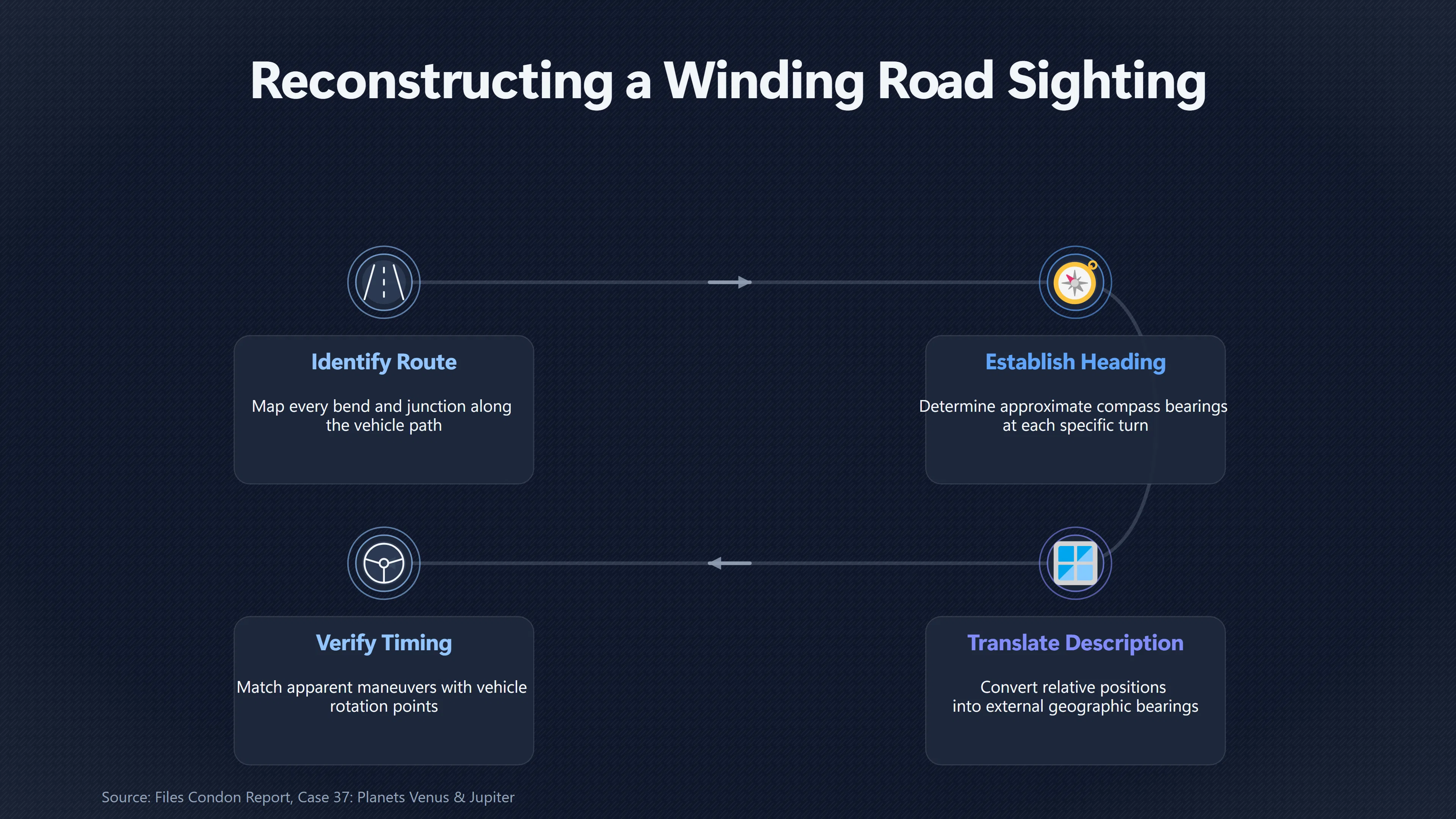
For UFO/UAP analysis, the practical way to test this explanation is to reconstruct the sighting in an Earth-fixed frame, not merely repeat the witness’s vehicle-relative description.
Start with the route and identify each substantial bend, junction, U-turn and stop. Establish the vehicle’s approximate compass heading at those points. Then translate descriptions such as “front-left”, “over the passenger side”, “behind us” or “above the road” into approximate external bearings where the information permits.
Next, compare the timing. If every dramatic apparent manoeuvre occurs when the car changes heading, while straight stretches produce relatively stable behaviour, observer motion becomes an important candidate explanation. If the light repeatedly disappears and reappears, the investigator should also check whether intervening terrain, woodland, buildings or the vehicle’s own roof pillars account for those interruptions.
Finally, compare the reconstructed bearings with plausible distant sources at the reported date and time. Planets are especially relevant because Venus can be exceptionally conspicuous and has a long history of generating UFO reports. In Case 37, Venus was about magnitude −4.2 during the reported period, and investigators found that the eventual positions of the supposed objects matched Venus and Jupiter.[NCAS Files]files.ncas.orgFiles Condon Report, Case 37: Planets Venus & JupiterNCAS FilesCondon Report, Case 37: Planets Venus & Jupiter…
None of these checks should be used backwards to force an identification. A genuinely moving aircraft, drone or other object can of course turn while a car turns. The point is evidential: a manoeuvre should be attributed to the observed object only after the observer’s own translation and rotation have been accounted for.
That standard also fits the modern scientific approach to UAP. NASA stresses the importance of calibrated measurements, multiple observations and adequate contextual metadata because apparent motion by itself may not reveal an object’s actual trajectory.[NASA]nasa.govUPDATE: NASA Shares UAP Independent Study Report; Names DirectorUPDATE: NASA Shares UAP Independent Study Report; Names Director - NASASeptember 14, 2023…
The key distinction
A distant light and a winding vehicle can produce two very different stories from exactly the same geometry. In road-centred terms, the light may seem to swing around, disappear, return, cross from one window to another and repeatedly reposition itself after turns. In Earth-centred terms, the source may have remained close to one compass direction while the vehicle did most of the turning.
That is why “it turned when we turned” is an important observation but not, on its own, evidence of coordinated pursuit. The decisive question is whether the source’s external bearing or independently measured trajectory changed, rather than merely its position relative to a car whose own heading was continually changing.
For UFO/UAP reports made from moving vehicles, reconstructing the road is therefore part of reconstructing the sighting. A curve on the map can sometimes account for a curve apparently traced by the light — and a sequence that felt like intelligent manoeuvring from behind the windscreen may resolve into a distant source viewed from a reference frame that was turning all along.
Amazon book picks
Further Reading
Books and field guides related to Can a Winding Road Make a Light Seem to Turn With You?. Use these as the next step if you want deeper reading beyond the article.
Sensation and Perception
. Bruce Goldstein's SENSATION AND PERCEPTION, the best-seller which has helped over 150,000 students understand the ties between how we s...
The Cambridge Handbook of Visuospatial Thinking
Visuospatial thinking encompasses a wide range of thinking processes concerning space, whether it be navigating across town, understandin...
The UFO Handbook: A Guide to Investigating, Evaluating, and R...
An explanation of the usual reasons for confusing IFOs (identified flying objects) with UFOs and a survey of the tools used to investigat...
eBay marketplace picks
Marketplace Samples
Live-tested eBay searches with available results related to this page.
Selected fromUFO poster oneBay.co.uk.



Current eBay listing
VINTAGE UFO FLYING SAUCERS COMIC ADVERTISING A2 POSTER PRINT
Current eBay listing
I Want To Believe UFO Poster Giclée Fine Art Heavyweight Print
Endnotes
1.
Source: files.ncas.org
Title: Files Condon Report, Case 37: Planets Venus & Jupiter
Link:https://files.ncas.org/condon/text/case37.htm
Source snippet
NCAS FilesCondon Report, Case 37: Planets Venus & Jupiter...
2.
Source: earthsky.org
Title: Earth Sky Why does the moon seem to follow me when I’m in a car?
Link:https://earthsky.org/astronomy-essentials/moon-and-stars-distance-appearance/
Source snippet
Why does the moon seem to follow me when I’m in a car?April 19, 2024...
Published: April 19, 2024
3.
Source: wired.com
Title: Why does the Moon follow me? | WIRED
Link:https://www.wired.com/2010/09/why-does-the-moon-follow-me/
Source snippet
Why does the Moon follow me? | WIRED...
4.
Source: smd-cms.nasa.gov
Title: Science NASA
Link:https://smd-cms.nasa.gov/wp-content/uploads/2023/09/uap-independent-study-team-final-report.pdf
Source snippet
UNIDENTIFIED ANOMALOUS PHENOMENA...
5.
Source: nasa.gov
Title: uap independent study team final report 0
Link:https://www.nasa.gov/wp-content/uploads/2023/09/uap-independent-study-team-final-report-0.pdf?emrc=683c39f732e62
Source snippet
UNIDENTIFIED ANOMALOUS PHENOMENA Independent...
6.
Source: nasa.gov
Title: UPDATE: NASA Shares UAP Independent Study Report; Names Director
Link:https://www.nasa.gov/news-release/update-nasa-shares-uap-independent-study-report-names-director/
Source snippet
UPDATE: NASA Shares UAP Independent Study Report; Names Director - NASASeptember 14, 2023...
Published: September 14, 2023
7.
Source: science.nasa.gov
Title: tidal locking
Link:https://science.nasa.gov/moon/tidal-locking/
8.
Source: science.nasa.gov
Link:https://science.nasa.gov/uap/faqs/
9.
Source: science.nasa.gov
Link:https://science.nasa.gov/uap/
10.
Source: svs.gsfc.nasa.gov
Link:https://svs.gsfc.nasa.gov/5320/
11.
Source: ntrs.nasa.gov
Link:https://ntrs.nasa.gov/citations/20240007669
12.
Source: ntrs.nasa.gov
Link:https://ntrs.nasa.gov/citations/20230017968
13.
Source: nasa.gov
Title: NAS A to Release, Discuss Unidentified Anomalous Phenomena Report
Link:https://www.nasa.gov/news-release/nasa-to-release-discuss-unidentified-anomalous-phenomena-report/
14.
Source: nasa.gov
Title: NAS A Provides Coverage of Unidentified Anomalous Phenomena Meeting
Link:https://www.nasa.gov/news-release/nasa-provides-coverage-of-unidentified-anomalous-phenomena-meeting/
15.
Source: science.nasa.gov
Title: the moon illusion why does the moon look so big sometimes
Link:https://science.nasa.gov/solar-system/moon/the-moon-illusion-why-does-the-moon-look-so-big-sometimes/
16.
Source: moon.nasa.gov
Title: the moons orbit and rotation
Link:https://moon.nasa.gov/resources/429/the-moons-orbit-and-rotation/
17.
Source: moon.nasa.gov
Title: the moons orbit
Link:https://moon.nasa.gov/resources/429/the-moons-orbit/
18.
Source: nasa.gov
Title: NAS A Announces Unidentified Aerial Phenomena Study Team Members
Link:https://www.nasa.gov/general/nasa-announces-unidentified-aerial-phenomena-study-team-members/
19.
Source: science.nasa.gov
Title: dancing the lunar transit
Link:https://science.nasa.gov/blogs/the-sun-spot/2019/03/20/dancing-the-lunar-transit/
20.
Source: ntrs.nasa.gov
Link:https://ntrs.nasa.gov/citations/20160001934
21.
Source: ntrs.nasa.gov
Link:https://ntrs.nasa.gov/citations/20050153369
22.
Source: ntrs.nasa.gov
Link:https://ntrs.nasa.gov/citations/20040088137
23.
Source: ntrs.nasa.gov
Link:https://ntrs.nasa.gov/citations/20040172625
24.
Source: ntrs.nasa.gov
Link:https://ntrs.nasa.gov/citations/20040173009
25.
Source: ntrs.nasa.gov
Link:https://ntrs.nasa.gov/citations/20020052443
26.
Source: ntrs.nasa.gov
Link:https://ntrs.nasa.gov/citations/20020038807
27.
Source: ntrs.nasa.gov
Link:https://ntrs.nasa.gov/citations/19980019496
28.
Source: ntrs.nasa.gov
Link:https://ntrs.nasa.gov/citations/20020034916
29.
Source: ntrs.nasa.gov
Link:https://ntrs.nasa.gov/citations/20020015986
30.
Source: ntrs.nasa.gov
Link:https://ntrs.nasa.gov/citations/20050000897
31.
Source: ntrs.nasa.gov
Link:https://ntrs.nasa.gov/citations/19900013604
32.
Source: ntrs.nasa.gov
Link:https://ntrs.nasa.gov/citations/19880033050
33.
Source: ntrs.nasa.gov
Link:https://ntrs.nasa.gov/citations/19780050772
34.
Source: ntrs.nasa.gov
Link:https://ntrs.nasa.gov/citations/19760044009
35.
Source: ntrs.nasa.gov
Link:https://ntrs.nasa.gov/citations/19730030448
36.
Source: files.ncas.org
Link:https://files.ncas.org/condon/text/s4chap02.htm
37.
Source: files.ncas.org
Link:https://files.ncas.org/condon/text/s3chap01.htm
38.
Source: files.ncas.org
Link:https://files.ncas.org/condon/text/s3chap05.htm
39.
Source: files.ncas.org
Link:https://files.ncas.org/condon/text/case12.htm
40.
Source: files.ncas.org
Link:https://files.ncas.org/condon/text/case27.htm
41.
Source: files.ncas.org
Link:https://files.ncas.org/condon/text/case26.htm
42.
Source: files.ncas.org
Title: sec ii
Link:https://files.ncas.org/condon/text/sec-ii.htm
43.
Source: files.ncas.org
Link:https://files.ncas.org/condon/text/case17.htm
44.
Source: files.ncas.org
Link:https://files.ncas.org/condon/text/s6chap07.htm
45.
Source: files.ncas.org
Link:https://files.ncas.org/condon/text/s5chap02.htm
46.
Source: files.ncas.org
Link:https://files.ncas.org/condon/text/case51.htm
47.
Source: pmc.ncbi.nlm.nih.gov
Link:https://pmc.ncbi.nlm.nih.gov/articles/PMC7776640/
Source snippet
PubMed Central (PMC)Heading perception depends on time-varying evolution of optic flow - PMCDecember 29, 2020...
Published: December 29, 2020
48.
Source: pmc.ncbi.nlm.nih.gov
Title: Pub Med Central (PMC)Optic Flow: Perceiving and Acting in a 3-D World
Link:https://pmc.ncbi.nlm.nih.gov/articles/PMC7869175/
Source snippet
PubMed Central (PMC)Optic Flow: Perceiving and Acting in a 3-D World - PMCFebruary 3, 2021...
Published: February 3, 2021
49.
Source: faa.gov
Title: Federal Aviation Administration Chapter 8. Medical Facts for Pilots
Link:https://www.faa.gov/air_traffic/publications/atpubs/aim/aim0801.html
Source snippet
Federal Aviation AdministrationChapter 8. Medical Facts for PilotsJanuary 8, 2015...
Published: January 8, 2015
50.
Source: devonandcornwall-pcc.gov.uk
Title: Excellence in Policing Awards highlights incredible achievements
Link:https://devonandcornwall-pcc.gov.uk/excellence-in-policing-awards-highlights-incredible-achievements
51.
Source: aaro.mil
Link:https://www.aaro.mil/Next-AARO-Home-redesign/Next-Parent/Next-AARO-UAP-Imagery-Acc-Table/
52.
Source: aaro.mil
Link:https://www.aaro.mil/Next-AARO-Home-redesign/Next-Parent/Next-UAP-Report-Documents/poster/
53.
Source: aaro.mil
Link:https://www.aaro.mil/Next-AARO-Home-redesign/Next-Parent/Next-UAP-Report-Documents/
54.
Source: aaro.mil
Link:https://www.aaro.mil/Next-AARO-Home-redesign/Next-Parent/Next-UAP-Report-Documents/poster/dividLink/
55.
Source: policeconduct.gov.uk
Link:https://www.policeconduct.gov.uk/our-work/learning/investigation-report-officer-engaged-sexual-activity-member-public-while-duty
56.
Source: devonandcornwall-pcc.gov.uk
Title: Unsung heroes with accredited powers keep our communities safe
Link:https://devonandcornwall-pcc.gov.uk/the-unsung-heroes-with-accredited-powers-to-keep-our-communities-safe
57.
Source: nuforc.org
Link:https://nuforc.org/sighting/?id=194961
58.
Source: aaro.mil
Link:https://www.aaro.mil/Next-AARO-Home-redesign/Next-Parent/Presidential-UAP-Transparency-Initiative/
59.
Source: devonandcornwall-pcc.gov.uk
Link:https://devonandcornwall-pcc.gov.uk/hidden-devon-and-cornwall-history-gem-believed-to-be-the-largest-collection-of-policing-memorabilia-in-the-uk
60.
Source: policeconduct.gov.uk
Link:https://www.policeconduct.gov.uk/news/investigation-conduct-allegations-against-devon-and-cornwall-deputy-chief-constable-concluded
61.
Source: pmc.ncbi.nlm.nih.gov
Link:https://pmc.ncbi.nlm.nih.gov/articles/PMC11863211/
62.
Source: aaro.mil
Link:https://www.aaro.mil/Next-AARO-Home-redesign/Next-Parent/Presidential-UAP-Transparency-Initiative/videoid/1014101/dvpcc/false/
63.
Source: faa.gov
Title: Airman Education Programs | Federal Aviation Administration
Link:https://www.faa.gov/pilots/training/airman_education/topics_of_interest/spatial_disorientation
64.
Source: aaro.mil
Link:https://www.aaro.mil/Next-AARO-Home-redesign/Next-Parent/Presidential-UAP-Transparency-Initiative/videoid/1006078/dvpcc/false/
65.
Source: faa.gov
Title: Pilot’s Handbook of Aeronautical Knowledge | Federal Aviation Administration
Link:https://www.faa.gov/regulations_policies/handbooks_manuals/aviation/phak
66.
Source: pmc.ncbi.nlm.nih.gov
Link:https://pmc.ncbi.nlm.nih.gov/articles/PMC9932552/
67.
Source: faa.gov
Title: Airplane Flying Handbook | Federal Aviation Administration
Link:https://www.faa.gov/regulations_policies/handbooks_manuals/aviation/airplane_handbook
68.
Source: faa.gov
Title: Helicopter Flying Handbook | Federal Aviation Administration
Link:https://www.faa.gov/regulations_policies/handbooks_manuals/aviation/helicopter_flying_handbook
69.
Source: pmc.ncbi.nlm.nih.gov
Link:https://pmc.ncbi.nlm.nih.gov/articles/PMC8607907/
70.
Source: policeconduct.gov.uk
Link:https://www.policeconduct.gov.uk/our-work/learning/recommendations-devon-and-cornwall-police-december-2020
71.
Source: pmc.ncbi.nlm.nih.gov
Link:https://pmc.ncbi.nlm.nih.gov/articles/PMC7545086/
72.
Source: media.nationalarchives.gov.uk
Title: nationalarchives.gov.uk The Cold War and UFOs | The National Archives
Link:https://media.nationalarchives.gov.uk/index.php/cold-war-ufos/
73.
Source: pmc.ncbi.nlm.nih.gov
Link:https://pmc.ncbi.nlm.nih.gov/articles/PMC6500172/
74.
Source: media.nationalarchives.gov.uk
Link:https://media.nationalarchives.gov.uk/index.php/ufo-files-national-archives/
75.
Source: pmc.ncbi.nlm.nih.gov
Link:https://pmc.ncbi.nlm.nih.gov/articles/PMC4760467/
76.
Source: pmc.ncbi.nlm.nih.gov
Link:https://pmc.ncbi.nlm.nih.gov/articles/PMC4337725/
77.
Source: pmc.ncbi.nlm.nih.gov
Link:https://pmc.ncbi.nlm.nih.gov/articles/PMC3930491/
78.
Source: pmc.ncbi.nlm.nih.gov
Link:https://pmc.ncbi.nlm.nih.gov/articles/PMC3689323/
79.
Source: faa.gov
Title: Bell 206B-3 Jet Ranger III | Federal Aviation Administration
Link:https://www.faa.gov/lessons_learned/rotorcraft/accidents/N828AC
80.
Source: pmc.ncbi.nlm.nih.gov
Link:https://pmc.ncbi.nlm.nih.gov/articles/PMC3826327/
81.
Source: pmc.ncbi.nlm.nih.gov
Link:https://pmc.ncbi.nlm.nih.gov/articles/PMC2735858/
82.
Source: astronomy.com
Title: Does the Moon follow the same path across the sky as the Sun? | Astronomy.com
Link:https://www.astronomy.com/observing/does-the-moon-follow-the-same-path-across-the-sky-as-the-sun/
83.
Source: nuforc.org
Link:https://nuforc.org/sighting/?id=12153
84.
Source: faa.gov
Title: Office of Aerospace Medicine Technical Reports | Federal Aviation Administration
Link:https://www.faa.gov/data_research/research/med_humanfacs/oamtechreports/1970s/1978/197815
85.
Source: pubmed.ncbi.nlm.nih.gov
Link:https://pubmed.ncbi.nlm.nih.gov/11540630/
86.
Source: pubmed.ncbi.nlm.nih.gov
Link:https://pubmed.ncbi.nlm.nih.gov/11090678/
87.
Source: pubmed.ncbi.nlm.nih.gov
Link:https://pubmed.ncbi.nlm.nih.gov/26762278/
88.
Source: pubmed.ncbi.nlm.nih.gov
Link:https://pubmed.ncbi.nlm.nih.gov/2299447/
89.
Source: aaro.mil
Link:https://www.aaro.mil/Next-AARO-Home-redesign/Next-Parent/Next-AARO-UAP-Trends/
90.
Source: faa.gov
Link:https://www.faa.gov/Air_traffic/publications/atpubs/aim_html/chap8_section_1.html
91.
Source: faa.gov
Link:https://www.faa.gov/air_traffic/publications/atpubs/aim_html/chap7_section_6.html
92.
Source: faa.gov
Link:https://www.faa.gov/air_traffic/publications/atpubs/aip_html/part2_enr_section_5.3.html
93.
Source: faa.gov
Link:https://www.faa.gov/air_traffic/publications/atpubs/aip_html/chap7_section_6.html
94.
Source: faa.gov
Link:https://www.faa.gov/data_research/research/med_humanfacs/oamtechreports/1980s/1982/198206
95.
Source: nationalarchives.gov.uk
Title: UF O reports
Link:https://www.nationalarchives.gov.uk/explore-the-collection/explore-by-time-period/postwar/ufo-reports/
96.
Source: nationalarchives.gov.uk
Link:https://www.nationalarchives.gov.uk/help-with-your-research/research-guides/ufos/
97.
Source: skybrary.aero
Link:https://skybrary.aero/index.php/articles/visual-illusions
98.
Source: devonandcornwall-pcc.gov.uk
Link:https://devonandcornwall-pcc.gov.uk/contact-us/faqs
99.
Source: devonandcornwall-pcc.gov.uk
Title: Independent Panel Members
Link:https://devonandcornwall-pcc.gov.uk/work-for-us/independent-panel-members
100.
Source: austroads.gov.au
Link:https://austroads.gov.au/publications/road-design/agrd03
Additional References
101.
Source: youtube.com
Title: Quantum physicists analyze pentagon US navy UFO video footage
Link:https://www.youtube.com/watch?v=cwACSrLEPeM
Source snippet
These videos illustrate how changes in an observer's orientation and motion [parallax]({{ 'parallax/' | relative_url }}) create optical illusions where distant celestial bod...
102.
Source: nature.com
Link:https://www.nature.com/articles/s41467-025-67857-4
103.
Source: archives.gov
Link:https://www.archives.gov/research/catalog/catalog-bulk-downloads/uap-bulk-download
104.
Source: cia.gov
Link:https://www.cia.gov/readingroom/document/cia-rdp81r00560r000100010002-9
105.
Source: cia.gov
Link:https://www.cia.gov/readingroom/docs/CIA-RDP81R00560R000100010002-9.pdf
106.
Source: archives.gov
Link:https://www.archives.gov/research/topics/uaps/moving-images-and-sound
107.
Source: archives.gov
Link:https://www.archives.gov/research/topics/uaps/presidential-libraries
108.
Source: archives.gov
Link:https://www.archives.gov/research/topics/uaps/rg-collections
109.
Source: cia.gov
Link:https://www.cia.gov/readingroom/docs/CIA-RDP69B00369R000200240055-8.pdf
110.
Source: cia.gov
Link:https://www.cia.gov/readingroom/document/cia-rdp81r00560r000100010001-0