Within Bright Stars
Was That UFO Actually a Star? How to Check
A sighting's time, location and bearing can be compared with the reconstructed sky to test whether a bright star actually fits the report.
On this page
- The sighting details needed for a meaningful identification
- Matching direction and altitude against the historical sky
- Why a poor positional match should rule out a star explanation
Page outline Jump by section
Introduction
A suspected star explanation for a UFO or UAP report can be tested rather than guessed. Stars occupy predictable positions in the sky, so if a report preserves a reasonably accurate place, date, time and viewing direction, an investigator can reconstruct the historical sky and ask a straightforward question: was the proposed star actually where the witness said the unexplained light was?
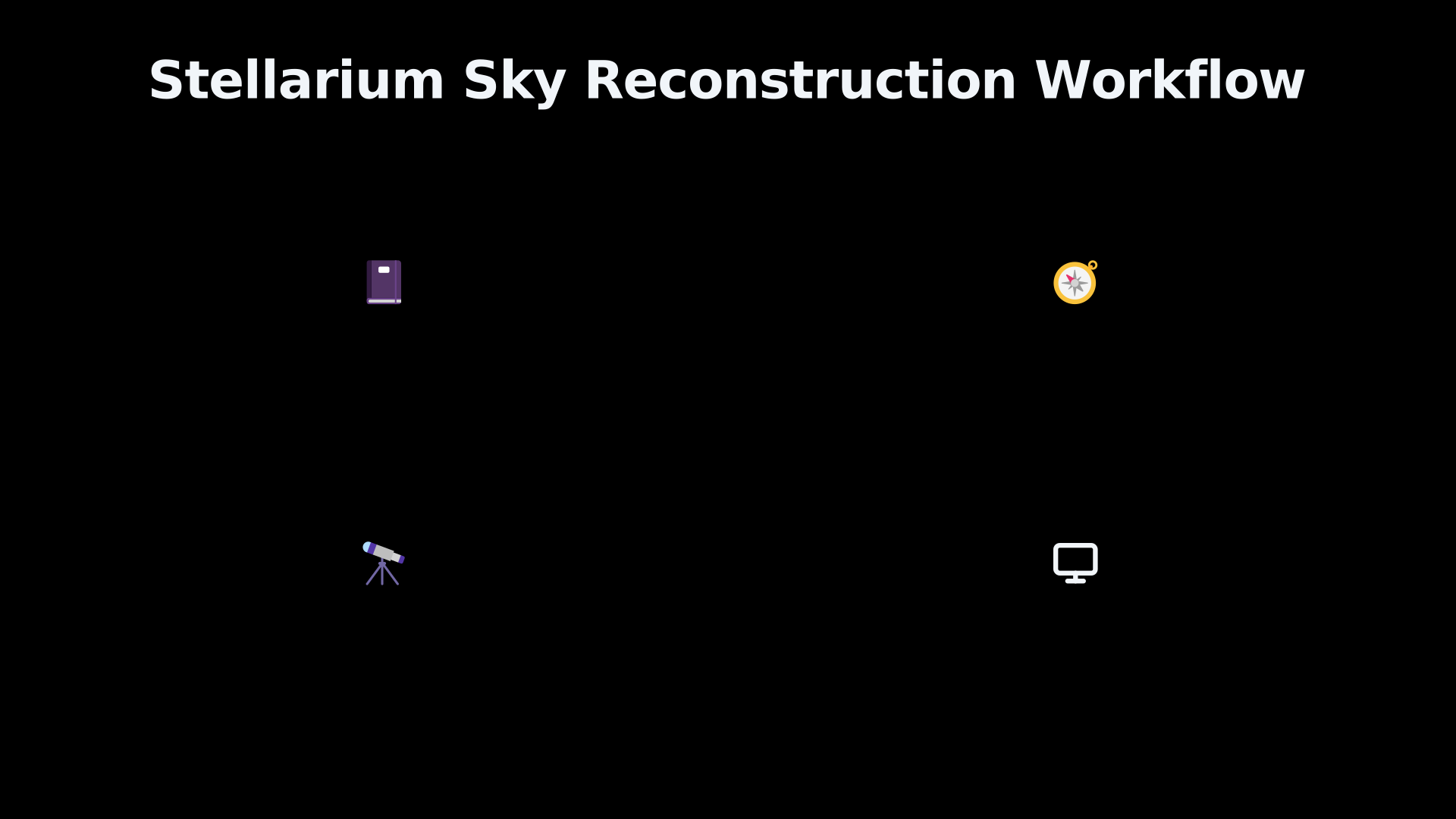
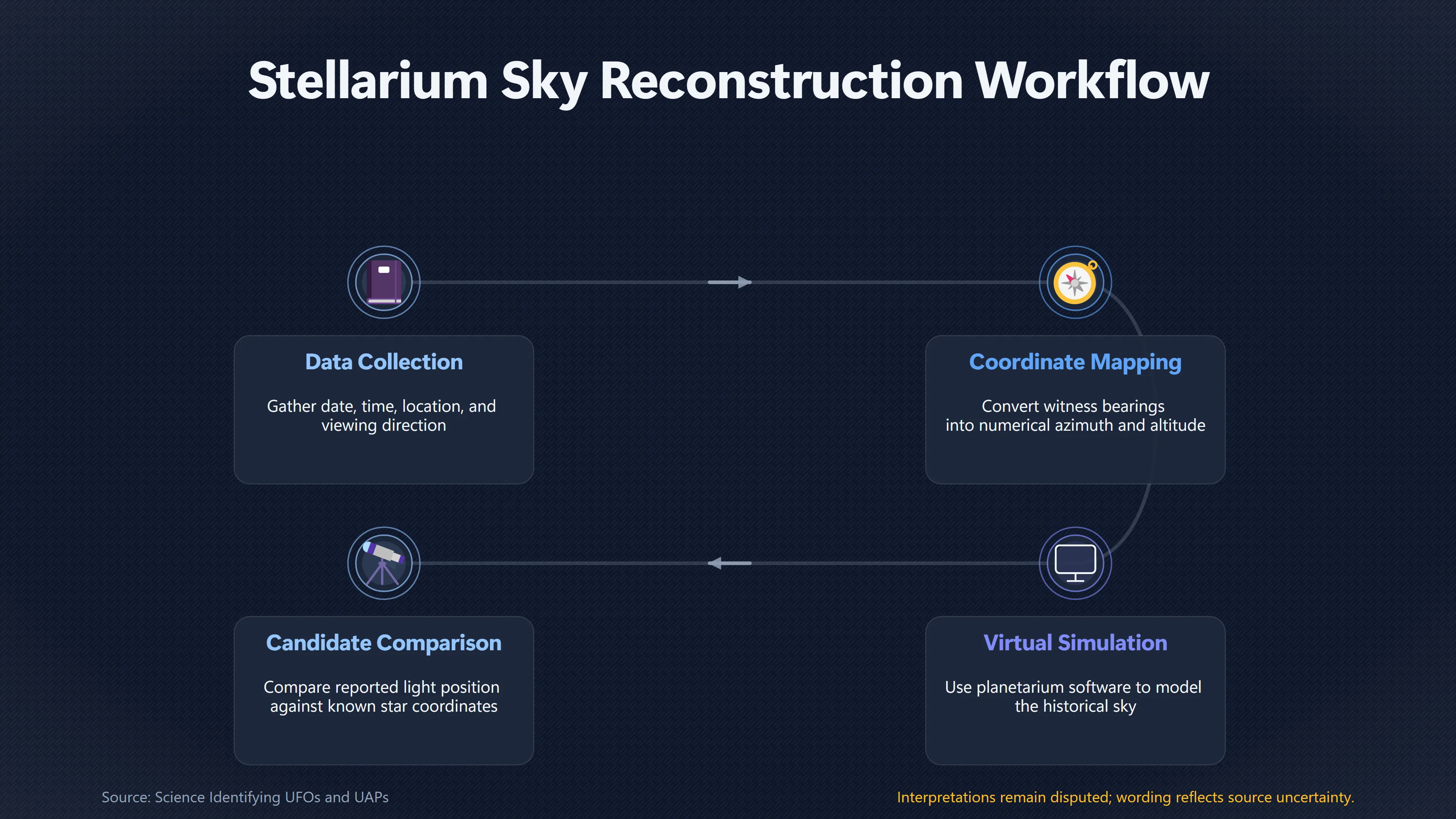
This is especially useful for reports of bright, apparently hovering lights. NASA’s skywatching guidance specifically recommends planetarium software such as Stellarium when the date, time and description of a sighting are known. Stellarium calculates the sky for a chosen observer location and time, while astronomical calculations can independently provide a candidate star’s azimuth—its compass direction—and altitude, its angle above the horizon.[nasa.gov]science.nasa.govScience Identifying UFOs and UAPsNASA ScienceIdentifying UFOs and UAPs - NASA ScienceDecember 1, 2013…
The method has an important safeguard built into it: reconstruction can support a star identification, but it can also falsify one. If the proposed star was nowhere near the reported line of sight, investigators should reject that particular explanation rather than stretching the witness account until it fits.
What details does a useful sky check require?
A reconstruction is only as good as the sighting information put into it. The minimum useful record is not simply “a bright light was seen last night”. NASA recommends obtaining the date and time, observing location, duration, apparent drift or direction of travel, and information about brightness. For positional testing, the witness’s viewing direction is crucial as well.[NASA Science]science.nasa.govScience Identifying UFOs and UAPsNASA ScienceIdentifying UFOs and UAPs - NASA ScienceDecember 1, 2013…
Four inputs matter most:
- Observer location. Latitude and longitude determine which part of the celestial sphere was above the local horizon and at what angle.
- Date and clock time. The sky changes continuously as the Earth rotates, while the seasonal night sky changes as the Earth orbits the Sun. The time should ideally include the applicable time zone and any daylight-saving adjustment.
- Bearing or azimuth. “South-east” is useful; “towards the church tower, which is 118° from the observation point” is much better. Astronomical azimuth normally runs clockwise from north: north is 0°, east 90°, south 180° and west 270°.[Astropy]docs.astropy.orgcoordinates.Alt AzAltAz — Astropy v8.0.1July 5, 2026…
- Altitude above the horizon. A report that places a light 10° above the eastern horizon is much more discriminating than one that merely says “in the east”. Altitude runs from 0° at the astronomical horizon to 90° directly overhead.[US Naval Observatory]aa.usno.navy.milOpen source on navy.mil.
This explains why contemporary notes, photographs of the viewing location and identifiable landmarks can be more valuable than elaborate later descriptions of the object’s shape. A church spire, roofline, hill, road direction or window edge may allow a reported line of sight to be reconstructed years later.
The University of Colorado UFO study—the Condon investigation—made essentially this point after examining historical cases. Its radar-visual analysis recommended “extremely careful efforts” to determine the correct azimuth and elevation of reported objects, including post-sighting reconstruction when necessary, and judged those angular positions more useful for analysis than descriptions of an object’s appearance.[NCAS Files]files.ncas.orgFiles Condon Report, Sec III, Chapter 5: Optical & Radar AnalysisNCAS FilesCondon Report, Sec III, Chapter 5: Optical & Radar Analysis…
Reconstructing the historical sky
Once the observation point and time are established, the investigator can reproduce the celestial scene. A virtual planetarium such as[Stellarium]stellarium.orgOpen source on stellarium.org. calculates the positions of stars, planets, the Sun and Moon for an observer at a selected location and time. Its documentation explicitly describes the program as drawing the sky according to both observer location and time.[Stellarium]stellarium.orgStellarium…
For a more numerical check, the same problem can be solved using astronomical coordinates. Star catalogues normally specify a star using right ascension and declination, coordinates tied to the celestial sphere. Given those coordinates, the observer’s latitude and longitude, and the relevant sidereal time, they can be transformed into the local horizon coordinates that correspond directly to a UFO report: altitude and azimuth. The US Naval Observatory publishes the calculation and also provides a celestial-navigation service that computes altitude and azimuth for celestial bodies from a specified place and Universal Time.[US Naval Observatory]aa.usno.navy.milOpen source on navy.mil.
The practical comparison is therefore simple. Suppose a witness reports a brilliant stationary light at approximately 22:15, low in the east-south-east. Reconstruction shows Sirius at 15° altitude and 115° azimuth. That would make Sirius a serious candidate. If Sirius instead lay below the horizon, or 80° away in azimuth, it would not.
A convincing identification becomes stronger when several independent features agree simultaneously. The candidate should be above the horizon, in approximately the reported direction and at a plausible elevation. Its brightness should be capable of attracting attention, and its predicted movement over the observation period should not contradict the report.
This is not merely a modern desktop-software technique. Historical UFO investigators used astronomical almanacs and positional calculations for the same purpose. Modern software simply makes the reconstruction quicker and easier to visualise.
Direction and altitude can turn a possibility into a test
One case in the Condon Report illustrates how strong a positional match can be. In Case 6, witnesses repeatedly placed the principal bright object in the same west-north-western part of the sky. Investigators consulted the nautical almanac and found Jupiter about 20°–30° above the horizon and 23° north of west during the observation. The report concluded that this position matched the principal reported light, with scintillation and apparent motion providing explanations for other aspects of the observation.[NCAS Files]files.ncas.orgFiles Condon Report, Case 6: UFO Sighting Over a SchoolNCAS FilesCondon Report, Case 6: UFO Sighting Over a School…
The significance of that reasoning lies less in Jupiter itself than in the procedure. “It looked like a planet” would have been weak evidence. Showing that a conspicuously bright planet occupied the reported patch of sky at the relevant time was a substantially stronger test.
The same logic appears elsewhere in the Condon material. In its analysis of radar-visual cases, investigators compared reported directions with calculated celestial positions. At one point the report gives Capella at 40° azimuth and 15° elevation at 00:11, rising to 53° azimuth and 30° elevation by 02:00, and notes that these calculated positions agreed with the witness positions. Other reported lights were compared with the predicted locations of Jupiter and Betelgeuse.[NCAS Files]files.ncas.orgFiles Condon Report, Sec III, Chapter 5: Optical & Radar AnalysisNCAS FilesCondon Report, Sec III, Chapter 5: Optical & Radar Analysis…
That time sequence provides an especially useful test. A star does not remain fixed relative to a terrestrial horizon. As the Earth rotates, its altitude and azimuth change predictably. If a report lasts long enough and contains several usable directional observations, investigators can compare the track of the reported light with the candidate star rather than relying on a single positional coincidence.
A match at one instant can occur by chance. Agreement at several times is considerably more discriminating.
Nearby stars can provide a celestial fingerprint
Video and photography can make the test stronger still when the camera records more than the principal bright light. Faint surrounding stars form a recognisable geometric pattern. Instead of asking only whether a bright candidate occupied approximately the right compass direction, an investigator can compare the entire recorded star field with the reconstructed sky.
That is effectively a celestial fingerprint. If the bright point lies in the same position relative to several neighbouring stars as Sirius, Capella or another candidate does in a calculated sky map, the identification no longer depends mainly on a witness’s memory of compass direction.
This principle is closely related to ordinary astronomical astrometry—the measurement of positions in the sky. Modern astronomical tools transform celestial coordinates into an observer’s altitude-azimuth frame using both observation time and Earth location. Astropy, for example, defines its AltAz frame specifically with an observation time and terrestrial location and measures azimuth eastwards from north.[Astropy]docs.astropy.orgcoordinates.Alt AzAltAz — Astropy v8.0.1July 5, 2026…
For historical UFO photographs, however, camera geometry introduces additional work. A cropped or zoomed image may conceal where the camera was pointing; digital stabilisation may alter apparent motion; and an unidentified horizon can make orientation difficult. Recovering several stars in the same frame can therefore be much more useful than magnifying the bright object itself. The surrounding field supplies reference points against which the camera’s direction and rotation can be checked.

The reconstruction should include uncertainty
Sky positions can be calculated with great precision, but eyewitness directions usually cannot. It would therefore be misleading to compare a mathematically exact star coordinate with a vaguely remembered bearing as though both had equal accuracy.
A report such as “roughly south-west” should be treated as an angular region, not an exact azimuth. Likewise, “about two hand-widths above the horizon” carries substantial uncertainty. A witness who later revisits the observation point and aligns the original sightline with permanent landmarks may narrow that uncertainty considerably.
Time uncertainty also matters. An investigator should distinguish between “22:17 according to a timestamped photograph” and “about ten o’clock, as remembered twenty years later”. Because the celestial sphere appears to rotate approximately 15° per hour, a large timing error can noticeably alter a candidate’s calculated position.
For old cases, stellar motion itself is usually a much smaller issue than uncertainties in witness time and direction. Stars do have proper motion, meaning that their celestial coordinates slowly change. The European Space Agency notes that even Barnard’s Star, which has exceptionally high proper motion, shifts only 10.3 arcseconds per year; ordinary bright stars generally move much less.[European Space Agency]esa.intEuropean Space Agency ESAEuropean Space AgencyESA - Proper motion… Modern astronomical software and catalogues can nevertheless account for epoch and coordinate transformations where precision requires it.
Near the horizon, another complication appears: atmospheric refraction. The atmosphere shifts the apparent altitude of celestial objects, with the problem becoming increasingly sensitive close to the horizon. Astropy’s documentation warns that its standard refraction model becomes inaccurate below about 5° altitude. A claim requiring an extraordinarily precise match to a star sitting almost on the horizon therefore deserves more caution than a match involving a star well above it.[Astropy]docs.astropy.orgcoordinates.Alt AzAltAz — Astropy v8.0.1July 5, 2026…
A bad positional match should rule the star out
Sky reconstruction is valuable partly because it prevents “star” from becoming an unfalsifiable explanation for any stationary nocturnal light. A bright candidate must actually occupy the relevant part of the sky.
The Condon Report contains a particularly instructive counterexample. In a 7 February 1953 case at Nemuro, Hokkaido, a visual object was measured near 91° azimuth, with an initial elevation estimated at about 15°. The Project Blue Book file had suggested Deneb or Regulus as possible explanations. The later Condon analysis checked the celestial geometry and found their positions “far away from the sighted object”. It therefore did not accept either star identification.[NCAS Files]files.ncas.orgFiles Condon Report, Sec III, Chapter 5: Optical & Radar AnalysisNCAS FilesCondon Report, Sec III, Chapter 5: Optical & Radar Analysis…
That is exactly how reconstruction should work. The calculation is not supposed to prove that every puzzling light was astronomical. It is supposed to discriminate between candidates.
A useful rule is:
A strong match can make a star explanation plausible or compelling; a strong mismatch makes that particular star explanation untenable.
Investigators should consequently be wary of explanations based only on superficial resemblance: “it flashed colours, so it was Sirius”, for example. Sirius may indeed scintillate conspicuously, but if it was below the horizon or in the opposite direction at the reported time, the resemblance is irrelevant. The geometry takes priority.
Conversely, failure of one candidate does not establish that the object was extraordinary. It means only that the tested candidate failed. Another star, planet, aircraft or other source might still fit, or the available data may simply be insufficient to identify the observation.
When the data are too weak for a meaningful identification
Some historical reports cannot support a reliable sky reconstruction. A date without a time may leave many possible celestial configurations. A time without a location can be equally problematic. “Over there” without a bearing or recognisable landmark may prevent meaningful comparison altogether.
Project Blue Book’s archival structure reflects this broader investigative problem: cases were not all forced into either identified or unexplained categories. The Air Force also used an Insufficient Data category, as described by the US National Archives.[Pieces of History]prologue.blogs.archives.govPieces of History UFOs: Natural Explanations – Pieces of HistoryPieces of HistoryUFOs: Natural Explanations – Pieces of HistoryApril 16, 2018… That distinction remains useful when evaluating proposed astronomical identifications.
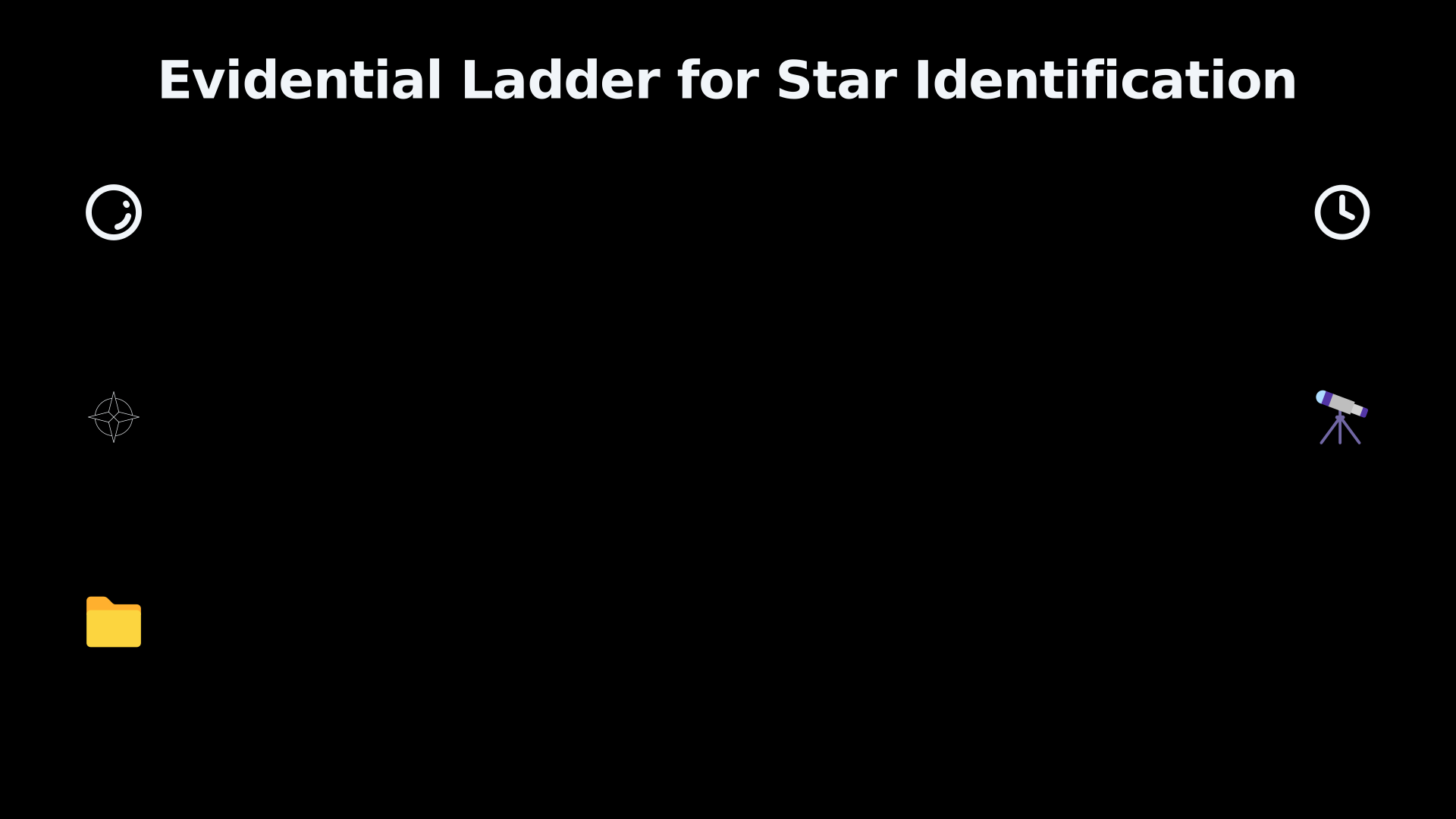
A star hypothesis should therefore be graded according to the quality of the match and the quality of the underlying report. In practice, the evidential ladder runs from weak to strong: a bright star merely being visible that night; the star occupying the general reported quadrant; agreement in both azimuth and altitude; agreement across several reported times; and, strongest of all, correspondence between the candidate and a recorded pattern of neighbouring stars.
The absence of adequate positional information should not be quietly converted into evidence for either side. If nobody recorded where the witness was standing, exactly when the observation occurred or where the light appeared, modern planetarium software cannot recover those missing facts.
The best sky check is one that could fail
Reconstructing the historical sky turns one of the most common proposed explanations for hovering UFOs into a testable hypothesis. Record the observation point and time, establish the sightline as accurately as the evidence permits, calculate the historical sky, and compare the candidate star’s altitude, azimuth and movement with the report. NASA explicitly recommends this kind of planetarium check for unidentified sky observations, while historical UFO investigators likewise regarded accurate azimuth and elevation as unusually valuable evidence.[NASA Science]science.nasa.govScience Identifying UFOs and UAPsNASA ScienceIdentifying UFOs and UAPs - NASA ScienceDecember 1, 2013…
The crucial standard is not whether an investigator can find some bright star somewhere in the sky. It is whether a specific astronomical object was in the right place at the right time and behaved consistently with the observation.
That distinction protects the analysis in both directions. A close positional and temporal match can turn an initially strange hovering light into a well-supported astronomical identification. A substantial mismatch can eliminate an attractive but incorrect star explanation. And where the original sighting lacks enough positional information to distinguish between those outcomes, the scientifically useful conclusion is simply that the sky reconstruction is inconclusive.
Amazon book picks
Further Reading
Books and field guides related to Was That UFO Actually a Star? How to Check. Use these as the next step if you want deeper reading beyond the article.
Turn Left at Orion
With over 100,000 copies sold since first publication, this is one of the most popular astronomy books of all time. It is a unique guideb...
NightWatch: A Practical Guide to Viewing the Universe
A practical guide to viewing the universe.
The Backyard Astronomer's Guide
Discusses the practical aspects of stargazing, including how to choose appropriate equipment, contending with light pollution, taking suc...
The Stars: A New Way to See Them
Written with the primary purpose of enabling everyone to gain more pleasure from stargazing.
eBay marketplace picks
Marketplace Samples
Live-tested eBay searches with available results related to this page.
Selected fromstar map print oneBay.co.uk.

References
Endnotes
1.
Source: science.nasa.gov
Title: Science Identifying UFOs and UAPs
Link:https://science.nasa.gov/solar-system/skywatching/night-sky-network/identifying-ufos-and-uaps/
Source snippet
NASA ScienceIdentifying UFOs and UAPs - NASA ScienceDecember 1, 2013...
Published: December 1, 2013
2.
Source: stellarium.org
Link:https://stellarium.org/guide/
Source snippet
Stellarium...
3.
Source: docs.astropy.org
Title: coordinates.Alt Az
Link:https://docs.astropy.org/en/stable/api/astropy.coordinates.AltAz.html
Source snippet
AltAz — Astropy v8.0.1July 5, 2026...
Published: July 5, 2026
4.
Source: files.ncas.org
Title: Files Condon Report, Sec III, Chapter 5: Optical & Radar Analysis
Link:https://files.ncas.org/condon/text/s3chap05.htm
Source snippet
NCAS FilesCondon Report, Sec III, Chapter 5: Optical & Radar Analysis...
5.
Source: files.ncas.org
Title: Files Condon Report, Case 6: UFO Sighting Over a School
Link:https://files.ncas.org/condon/text/case06.htm
Source snippet
NCAS FilesCondon Report, Case 6: UFO Sighting Over a School...
6.
Source: prologue.blogs.archives.gov
Title: Pieces of History UFOs: Natural Explanations – Pieces of History
Link:https://prologue.blogs.archives.gov/2018/04/16/ufos-natural-explanations/
Source snippet
Pieces of HistoryUFOs: Natural Explanations – Pieces of HistoryApril 16, 2018...
Published: April 16, 2018
7.
Source: docs.astropy.org
Title: coordinates.ITR S
Link:https://docs.astropy.org/en/latest/api/astropy.coordinates.ITRS.html
Source snippet
Astropy v8.1.0.dev396+ga888e4d3eJuly 29, 2026 — ITRS# class astropy.coordinates.ITRS(*args, copy=True, representation_type=None, differ...
Published: July 29, 2026
8.
Source: docs.astropy.org
Title: common errors
Link:https://docs.astropy.org/en/latest/coordinates/common_errors.html
9.
Source: docs.astropy.org
Link:https://docs.astropy.org/en/latest/coordinates/frames.html
10.
Source: docs.astropy.org
Link:https://docs.astropy.org/en/latest/coordinates/index.html
11.
Source: docs.astropy.org
Link:https://docs.astropy.org/en/latest/_modules/astropy/coordinates/builtin_frames/altaz.html
12.
Source: docs.astropy.org
Title: coordinates.HA Dec
Link:https://docs.astropy.org/en/stable/api/astropy.coordinates.HADec.html
13.
Source: docs.astropy.org
Link:https://docs.astropy.org/en/stable/coordinates/index.html
14.
Source: docs.astropy.org
Link:https://docs.astropy.org/en/stable/_modules/astropy/coordinates/builtin_frames/hadec.html
15.
Source: docs.astropy.org
Link:https://docs.astropy.org/en/stable/_modules/astropy/coordinates/builtin_frames/itrs.html
16.
Source: docs.astropy.org
Link:https://docs.astropy.org/en/stable/coordinates/[satellites
17.
Source: docs.astropy.org
Link:https://docs.astropy.org/en/stable/coordinates/velocities.html
18.
Source: stellarium.org
Title: Skybright Class Reference
Link:https://stellarium.org/doc/head/classSkybright.html
19.
Source: stellarium.org
Title: Stel Location Class Reference
Link:https://stellarium.org/doc/26.0/classStelLocation.html
20.
Source: stellarium.org
Title: Archaeo Lines Plug-in
Link:https://stellarium.org/doc/head/group__archaeoLines.html
21.
Source: stellarium.org
Title: Historical Supernovae Plug-in
Link:https://stellarium.org/doc/26.0/group__historicalSupernovae.html
22.
Source: stellarium.org
Title: Stel Core Class Reference
Link:https://stellarium.org/doc/head/classStelCore.html
23.
Source: stellarium.org
Title: Stel Object Class Reference
Link:https://stellarium.org/doc/head/classStelObject.html
24.
Source: stellarium.org
Title: Landscape Old Style Class Reference
Link:https://stellarium.org/doc/head/classLandscapeOldStyle.html
25.
Source: in-the-sky.org
Title: Capella (Star)
Link:https://in-the-sky.org/data/object.php?id=HIP24608
26.
Source: in-the-sky.org
Title: Capella (Star)
Link:https://in-the-sky.org/data/object.php?id=34646
27.
Source: stellarium.org
Title: Stel Location Class Reference
Link:https://stellarium.org/doc/25.0/classStelLocation.html
28.
Source: stellarium.org
Title: Landscape Class Reference
Link:https://stellarium.org/doc/25.0/classLandscape.html
29.
Source: archives.gov
Link:https://www.archives.gov/research/topics/uaps/rg-collections
30.
Source: archives.gov
Link:https://www.archives.gov/research/catalog/catalog-bulk-downloads/uap-bulk-download
31.
Source: archives.gov
Link:https://www.archives.gov/research/topics/uaps/publications
32.
Source: archives.gov
Link:https://www.archives.gov/research/topics/uaps/textual-and-microfilm
33.
Source: archives.gov
Link:https://www.archives.gov/research/topics/uaps/photographs
34.
Source: stellarium.org
Title: Historical Supernovae Plug-in
Link:https://stellarium.org/doc/24.0/group__historicalSupernovae.html
35.
Source: archives.gov
Title: Project BLUE BOOK
Link:https://www.archives.gov/research/military/air-force/ufos
36.
Source: stellarium.org
Title: Skybright Class Reference
Link:https://stellarium.org/doc/23.0/classSkybright.html
37.
Source: stellarium.org
Title: Stel Core Class Reference
Link:https://stellarium.org/doc/23.0/classStelCore.html
38.
Source: science.nasa.gov
Title: webb looks for fomalhauts asteroid belt and finds much more
Link:https://science.nasa.gov/missions/webb/webb-looks-for-fomalhauts-asteroid-belt-and-finds-much-more/
39.
Source: stellarium.org
Title: Stel Core Class Reference
Link:https://stellarium.org/doc/1.x/classStelCore.html
40.
Source: stellarium.org
Title: Stel Core Class Reference
Link:https://stellarium.org/doc/0.19/classStelCore.html
41.
Source: archives.gov
Link:https://www.archives.gov/news/articles/project-blue-book-50th-anniversary
42.
Source: visit.archives.gov
Title: gov50 Years Ago: Government Stops Investigating UFOs | National Archives Museum
Link:https://visit.archives.gov/whats-on/explore-exhibits/50-years-ago-government-stops-investigating-ufos
43.
Source: archives.gov
Title: 50 Years Ago: Government stops investigating UFOs | National Archives
Link:https://www.archives.gov/press/press-releases/2020/nr20-19
44.
Source: stellarium.org
Title: Archaeo Lines Plug-in
Link:https://stellarium.org/doc/0.18/group__archaeoLines.html
45.
Source: stellarium.org
Title: Stel Object Class Reference
Link:https://stellarium.org/doc/0.18/classStelObject.html
46.
Source: archives.gov
Title: Do Records Show Proof of UFOs? | National Archives
Link:https://www.archives.gov/news/articles/do-records-show-proof-of-ufos
47.
Source: stellarium.org
Title: 0.15.2 has been released
Link:https://stellarium.org/release/2017/03/21/stellarium-0.15.2-has-been-released.html
48.
Source: stellarium.org
Link:https://stellarium.org/doc/0.15/StelMainScriptAPI_8hpp_source.html
49.
Source: archives.gov
Title: Project BLUE BOOK
Link:https://www.archives.gov/foia/ufos.html
50.
Source: stellarium.org
Title: Angle Measure plug-in
Link:https://stellarium.org/doc-plugins/0.14/group__angleMeasure.html
51.
Source: stellarium.org
Title: Landscape Old Style Class Reference
Link:https://stellarium.org/doc/0.13/classLandscapeOldStyle.html
52.
Source: space.com
Title: Capella: The Goat Star | Space
Link:https://www.space.com/21989-capella-star.html
53.
Source: nasa.gov
Title: New Study Brings a Doubted Exoplanet ‘Back from the Dead’
Link:https://www.nasa.gov/universe/new-study-brings-a-doubted-exoplanet-back-from-the-dead/
54.
Source: svs.gsfc.nasa.gov
Link:https://svs.gsfc.nasa.gov/11116
55.
Source: stellarium.org
Title: Extinction Class Reference
Link:https://stellarium.org/doc/0.11/classExtinction.html
56.
Source: space.com
Title: How to See Capella: A Star to Get Your Goat | Space
Link:https://www.space.com/13044-skywatching-capella-goat-star-auriga-constellation.html
57.
Source: science.nasa.gov
Title: hubble directly observes a planet orbiting another star 2
Link:https://science.nasa.gov/missions/hubble/hubble-directly-observes-a-planet-orbiting-another-star-2/
58.
Source: science.nasa.gov
Title: hubble directly observes planet orbiting fomalhaut
Link:https://science.nasa.gov/universe/exoplanets/hubble-directly-observes-planet-orbiting-fomalhaut/
59.
Source: science.nasa.gov
Title: hubble directly observes a planet orbiting another star
Link:https://science.nasa.gov/missions/hubble/hubble-directly-observes-a-planet-orbiting-another-star
60.
Source: jpl.nasa.gov
Title: hubble directly observes a planet orbiting another star
Link:https://www.jpl.nasa.gov/news/hubble-directly-observes-a-planet-orbiting-another-star/
61.
Source: science.nasa.gov
Title: hubble proves existence of a planet orbiting another star
Link:https://science.nasa.gov/asset/hubble/hubble-proves-existence-of-a-planet-orbiting-another-star/
62.
Source: science.nasa.gov
Title: astronomers use hubble to weigh dog stars companion
Link:https://science.nasa.gov/missions/hubble/astronomers-use-hubble-to-weigh-dog-stars-companion/
63.
Source: science.nasa.gov
Title: the dog star sirius and its tiny companion
Link:https://science.nasa.gov/asset/hubble/the-dog-star-sirius-and-its-tiny-companion/
64.
Source: science.nasa.gov
Title: elusive planet reshapes a ring around neighboring star
Link:https://science.nasa.gov/missions/hubble/elusive-planet-reshapes-a-ring-around-neighboring-star/
65.
Source: science.nasa.gov
Title: circumstellar disk around fomalhaut
Link:https://science.nasa.gov/photojournal/circumstellar-disk-around-fomalhaut/
66.
Source: astronomical.org
Title: Beyond the Event Horizon, Black Hols
Link:https://www.astronomical.org/astbook/blkhole.html
67.
Source: jpl.nasa.gov
Title: stars found with excessive infrared emission
Link:https://www.jpl.nasa.gov/news/stars-found-with-excessive-infrared-emission/
68.
Source: jpl.nasa.gov
Title: iras data reveals 2nd star
Link:https://www.jpl.nasa.gov/news/iras-data-reveals-2nd-star/
69.
Source: files.ncas.org
Link:https://files.ncas.org/condon/text/case09.htm
70.
Source: files.ncas.org
Link:https://files.ncas.org/condon/text/sec-i.htm
71.
Source: files.ncas.org
Link:https://files.ncas.org/condon/text/case38.htm
72.
Source: files.ncas.org
Link:https://files.ncas.org/condon/text/s4chap02.htm
73.
Source: files.ncas.org
Link:https://files.ncas.org/condon/text/case37.htm
74.
Source: files.ncas.org
Link:https://files.ncas.org/condon/text/case01.htm
75.
Source: files.ncas.org
Link:https://files.ncas.org/condon/text/case27.htm
76.
Source: files.ncas.org
Title: sec iv
Link:https://files.ncas.org/condon/text/sec-iv.htm
77.
Source: files.ncas.org
Title: sec ii
Link:https://files.ncas.org/condon/text/sec-ii.htm
78.
Source: files.ncas.org
Link:https://files.ncas.org/condon/text/s6chap09.htm
79.
Source: files.ncas.org
Link:https://files.ncas.org/condon/text/s4chap01.htm
80.
Source: files.ncas.org
Link:https://files.ncas.org/condon/text/case35.htm
81.
Source: files.ncas.org
Link:https://files.ncas.org/condon/text/case17.htm
82.
Source: files.ncas.org
Link:https://files.ncas.org/condon/text/contents.htm
83.
Source: condon.ncas.org
Link:https://condon.ncas.org/text/intro.htm
84.
Source: files.ncas.org
Link:https://files.ncas.org/condon/text/case07.htm
85.
Source: learn.astropy.org
Title: 2 Coordinates Transforms
Link:https://learn.astropy.org/tutorials/2_Coordinates-Transforms.html
86.
Source: stellarium.org
Link:https://stellarium.org/doc/24.0/classStelMainScriptAPI.html
87.
Source: astronomical.org
Link:https://www.astronomical.org/constellationsCopy/cma.html
88.
Source: astronomical.org
Link:https://www.astronomical.org/constellationsCopy/aps.html
89.
Source: astronomical.org
Link:https://www.astronomical.org/constellations/ser.html
90.
Source: astronomical.org
Link:https://www.astronomical.org/constellationsCopy/ret.html
91.
Source: astronomical.org
Link:https://astronomical.org/constellations/sco.html
92.
Source: astronomical.org
Link:https://www.astronomical.org/astbook/binary.html
93.
Source: astronomical.org
Link:https://www.astronomical.org/constellationsCopy/vul.html
94.
Source: astronomical.org
Link:https://www.astronomical.org/constellationsCopy/pup.html
95.
Source: astronomical.org
Link:https://www.astronomical.org/constellations/umi.html
96.
Source: astronomical.org
Link:https://www.astronomical.org/astbook/form.html
97.
Source: astronomical.org
Link:https://www.astronomical.org/astbook/planning.htm
98.
Source: files.ncas.org
Title: appndx b
Link:https://files.ncas.org/condon/text/appndx-b.htm
99.
Source: files.ncas.org
Link:https://files.ncas.org/condon/text/case54.htm
100.
Source: files.ncas.org
Link:https://files.ncas.org/condon/text/case52.htm
101.
Source: files.ncas.org
Link:https://files.ncas.org/condon/text/case51.htm
102.
Source: files.ncas.org
Link:https://files.ncas.org/condon/text/case49.htm
103.
Source: files.ncas.org
Link:https://files.ncas.org/condon/text/case46.htm
104.
Source: youtube.com
Title: Why “Racetrack” UFOs are mostly Starlink Flares
Link:https://www.youtube.com/watch?v=_VmrRGln1XA
Source snippet
Stellarium a Great Free App to Study the Night Sky. UFO? Use this app to discover what you saw...
105.
Source: youtube.com
Link:https://www.youtube.com/watch?v=QUX13lA1Dbg
Source snippet
Interview: Mick West, Identifying UFOs...
106.
Source: youtube.com
Title: Interview: Mick West, Identifying UFOs
Link:https://www.youtube.com/watch?v=lsMomLDKIz4
Source snippet
Stellarium UFO investigation planet star Astro at Home: Moons and Exomoons...
107.
Source: aa.usno.navy.mil
Link:https://aa.usno.navy.mil/faq/alt_az
108.
Source: aa.usno.navy.mil
Title: US Naval Observatory Celestial Navigation Data for Assumed Position and Time
Link:https://aa.usno.navy.mil/data/celnav
109.
Source: esa.int
Title: European Space Agency ESA
Link:https://www.esa.int/Science_Exploration/Space_Science/Gaia/Proper_motion
Source snippet
European Space AgencyESA - Proper motion...
110.
Source: nuforc.org
Link:https://nuforc.org/sighting/?id=197095
111.
Source: aa.usno.navy.mil
Title: mil Celestial Navigation Data for Assumed Position and Time
Link:https://aa.usno.navy.mil/calculated/celnav?ID=AA&date=2025-05-04&label=&lat=-36.3352&lon=121.7511&submit=Get+Data&time=13%3A00%3A00.000
112.
Source: aa.usno.navy.mil
Title: mil Celestial Navigation Data for Assumed Position and Time
Link:https://aa.usno.navy.mil/calculated/celnav?ID=AA&date=2023-02-17&lat=30&lon=-130&submit=Get+Data&time=04%3A00%3A00.000
113.
Source: cosmos.esa.int
Title: int COSMO S Where do the stars go or come from?
Link:https://www.cosmos.esa.int/web/gaia/dr3-where-do-the-stars-go-or-come-from
114.
Source: cosmos.esa.int
Title: int COSMO S Gaia Data Release 3 contents
Link:https://www.cosmos.esa.int/web/gaia/dr3
115.
Source: cosmos.esa.int
Title: int COSMO S Gaia EDR3
Link:https://www.cosmos.esa.int/web/gaia/edr3-startrails
116.
Source: esa.int
Link:https://www.esa.int/ESA_Multimedia/Videos/2020/12/Gaia_s_stellar_motion_for_the_next_1.6_million_years
117.
Source: aa.usno.navy.mil
Title: mil Celestial Navigation Data for Assumed Position and Time
Link:https://aa.usno.navy.mil/calculated/celnav?ID=AA&date=2018-09-30&lat=-27.5&lon=143.2&submit=Get+Data&time=07%3A16%3A50.000
118.
Source: sci.esa.int
Title: int ES A Science & Technology
Link:https://sci.esa.int/web/gaia/-/60237-[parallax
119.
Source: sci.esa.int
Title: int ES A Science & Technology
Link:https://sci.esa.int/s/wV6OGjw
120.
Source: esa.int
Link:https://www.esa.int/Science_Exploration/Space_Science/Gaia/Gaia_s_first_year_of_scientific_observations
121.
Source: manualzz.com
Title: Stellarium User Guide | Manualzz
Link:https://manualzz.com/doc/4196587/stellarium-software-user-guide
122.
Source: manualzilla.com
Title: Stellarium User Guide
Link:https://manualzilla.com/doc/6869898/stellarium-user-guide—physics-and-astronomy
123.
Source: aa.usno.navy.mil
Link:https://aa.usno.navy.mil/data/
124.
Source: aa.usno.navy.mil
Link:https://aa.usno.navy.mil/data/AltAz
125.
Source: aa.usno.navy.mil
Link:https://aa.usno.navy.mil/data/api
126.
Source: aa.usno.navy.mil
Link:https://aa.usno.navy.mil/faq/celnav
127.
Source: aa.usno.navy.mil
Link:https://aa.usno.navy.mil/data/mrst
128.
Source: aa.usno.navy.mil
Link:https://aa.usno.navy.mil/publications/na
129.
Source: aa.usno.navy.mil
Link:https://aa.usno.navy.mil/publications/aira
130.
Source: esa.int
Link:https://www.esa.int/Science_Exploration/Space_Science/Gaia
131.
Source: esa.int
Link:https://www.esa.int/Science_Exploration/Space_Science/Gaia/How_does_Gaia_study_the_Milky_Way
132.
Source: cosmos.esa.int
Title: int COSMO S Gaia FAQ
Link:https://www.cosmos.esa.int/web/gaia/faqs
133.
Source: esdcdoi.esac.esa.int
Link:https://esdcdoi.esac.esa.int/doi/html/data/astronomy/gaia/DR1.html
134.
Source: theskylive.com
Link:https://theskylive.com/sky/stars/capella-alpha-aurigae-star
135.
Source: aa.usno.navy.mil
Title: mil Celestial Navigation Data for Assumed Position and Time
Link:https://aa.usno.navy.mil/calculated/celnav?ID=AA&date=1860-04-04&lat=-25.1333&lon=139.9000&submit=Get+Data&time=14%3A00%3A10.000
136.
Source: aa.usno.navy.mil
Title: mil Celestial Navigation Data for Assumed Position and Time
Link:https://aa.usno.navy.mil/calculated/celnav?ID=AA&date=1860-04-04&lat=-25.1333&lon=139.9000&submit=Get+Data&time=14%3A11%3A30.000
Additional References
137.
Source: bufora.org.uk
Link:https://www.bufora.org.uk/sightings/analysis-of-ufo-photographs
138.
Source: sky-tonight.com
Link:https://sky-tonight.com/object/star/Capella
139.
Source: iau.org
Link:https://iau.org/CommissionA2/CommissionA2/Home.aspx
140.
Source: ufouap.net
Link:https://www.ufouap.net/en/explainers/common-ufo-misidentifications
141.
Source: airmass.org
Link:https://airmass.org/notes
142.
Source: amnh.org
Link:https://www.amnh.org/learn-teach/curriculum-collections/cosmic-horizons-book/friedrich-bessel-sirius-b
143.
Source: iau.org
Link:https://iau.org/IAU/IAU/Science/Past-scientific-groups.aspx?hkey=b927dee0-cd5b-4638-bae9-7b92ba208cb8
144.
Source: mdpi.com
Link:https://www.mdpi.com/1424-8220/25/6/1871
145.
Source: skyandtelescope.org
Link:https://www.skyandtelescope.org/wp-content/plugins/observing-tools/satellite/custom.html
146.
Source: iau.org
Link:https://iau.org/Copy_of_CommissionA3/Scientific-Objectives.aspx?WebsiteKey=a756ff73-3047-4561-b407-3f73042a670b