Within Autokinesis
Why Can a Fixed Light Seem to Drift?
A stationary point of light can appear to wander when darkness removes the visual references needed to judge its position reliably.
On this page
- How darkness removes positional reference points
- Why prolonged fixation encourages apparent wandering
- What perceived drift can and cannot prove
Page outline Jump by section
Introduction
A fixed light can seem to drift at night because darkness removes the visual landmarks that normally tell the brain where an object is and whether its position is changing. When a small light is isolated against a dark or nearly featureless sky, its retinal image cannot easily be compared with a horizon, terrain, buildings or other stable features. After sustained viewing, the observer may therefore perceive wandering even though the source itself remains stationary. This is the autokinetic effect, or autokinesis.[PubMed Central (PMC)]pmc.ncbi.nlm.nih.govPubMed Central (PMC)Autokinesis reveals a threshold for perception of visual motion - PMCApril 5, 2024…
The effect is especially relevant to UFO and UAP reports involving a distant unresolved light that initially appears stationary and then seems to drift, sway or change direction. Crucially, the experience can be vivid without being imaginary in the everyday sense: experiments deliberately produce apparent motion from physically stationary lights. Autokinesis therefore provides a mechanism for sincere reports of movement, but it does not prove that any particular reported light was stationary.[PubMed]pubmed.ncbi.nlm.nih.govPub Med Imaging the visual autokinetic illusion with f MRIImaging the visual autokinetic illusion with fMRI - PubMedAugust 1, 2005…
How darkness removes positional reference points
Seeing whether something moves is normally a relational judgement. A light travelling across a city skyline changes position relative to buildings. An aircraft passing clouds changes position relative to their edges. Even a distant object above the countryside can often be judged against the horizon, trees or stars. Those surrounding features form a visual reference frame.
An isolated night light is different. If most of the visual field is black, the observer may have little external information against which to measure its position. SKYbrary’s aviation guidance describes autokinesis in essentially these terms: motion perception ordinarily depends on reference points, while a small light in darkness or a featureless environment lacks a sufficiently defined reference.[Skybrary]skybrary.aeroAutokinetic Effect | SKYbrary Aviation SafetyAutokinetic Effect | SKYbrary Aviation Safety…
This matters because the eyes, head and body are never perfectly motionless. The visual system ordinarily combines information from the changing retinal image with information about eye and body movement to maintain the remarkably stable world we experience in everyday vision. In a well-structured scene, there is abundant evidence that a wall, lamp post or distant building has not suddenly moved whenever the observer’s gaze shifts slightly. An isolated light against darkness supplies far less information with which to make that correction.[PubMed Central (PMC)]pmc.ncbi.nlm.nih.govPubMed Central (PMC)Autokinesis reveals a threshold for perception of visual motion - PMCApril 5, 2024…
It is tempting to reduce autokinesis to the simple claim that involuntary eye movements directly make the light appear to move. The research suggests a more complicated process. The visual system uses both retinal signals and extraretinal signals — information associated with eye position and the motor commands controlling eye movement — to distinguish changes caused by the observer from changes in the outside world. Studies have not found a straightforward correspondence between measured eye movement and the direction of perceived autokinetic motion.[PubMed Central (PMC)]pmc.ncbi.nlm.nih.govPubMed Central (PMC)Autokinesis reveals a threshold for perception of visual motion - PMCApril 5, 2024…
The important ingredient, then, is not merely that the eyes move. It is that the visual system has unusually poor evidence for deciding what those small changes mean. Darkness turns a normally well-constrained judgement into an ambiguous one.
Why staring makes the light wander
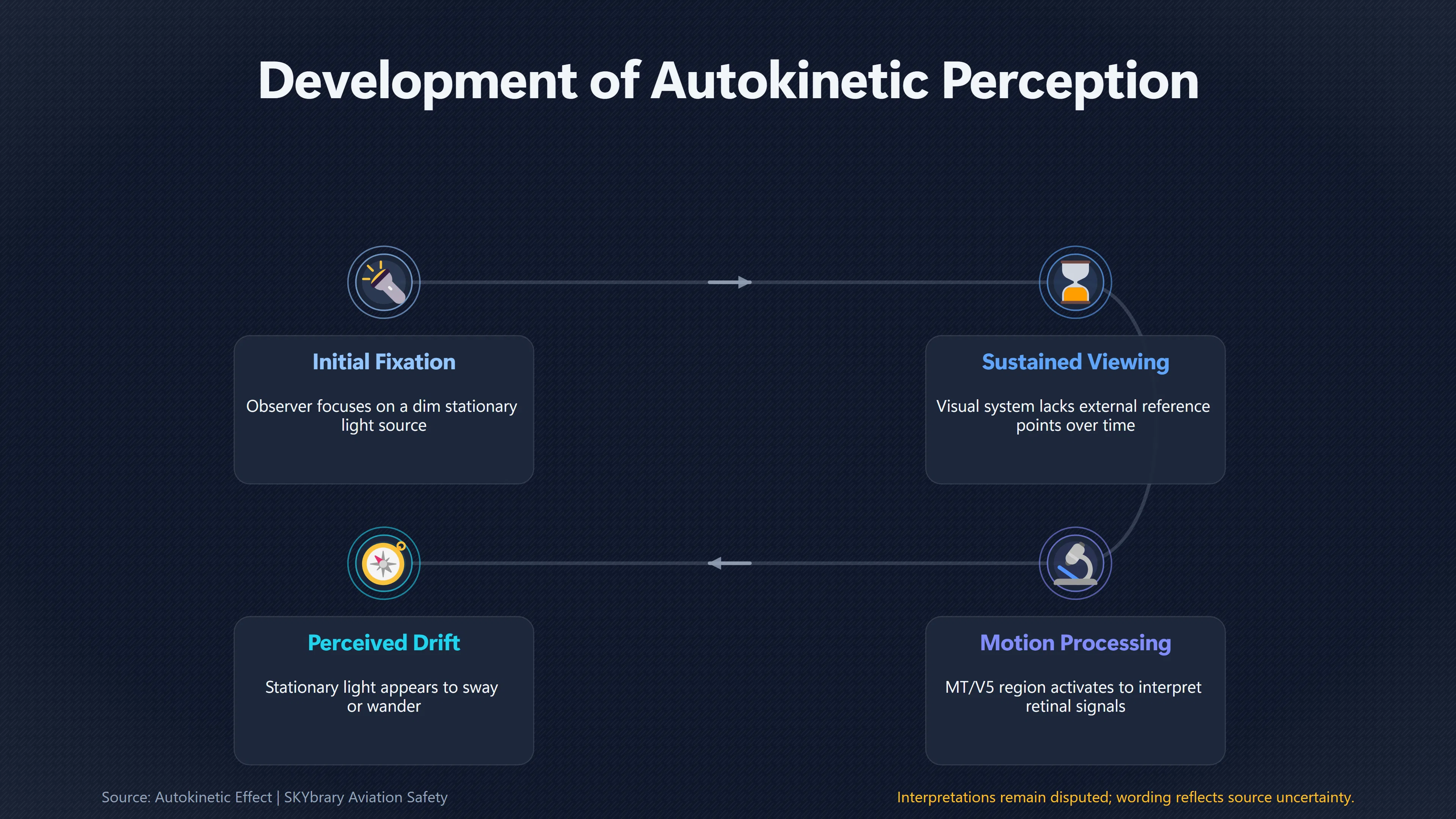
Autokinesis often develops with time rather than appearing instantly. The US Federal Aviation Administration warns that a static light in darkness can appear to move when stared at for many seconds. Aviation safety material consequently advises pilots not to fixate continuously on a single night light.[Federal Aviation Administration]faa.govFederal Aviation Administration Chapter 8. Medical Facts for PilotsFederal Aviation Administration Chapter 8. Medical Facts for Pilots
Laboratory evidence supports that time course. In a 2005 functional magnetic resonance imaging study, 11 healthy participants fixated a stationary dim light-emitting diode in complete darkness for 35 seconds. The stimulus itself remained unchanged, but autokinetic perception became stronger during the latter half of the viewing period. The stronger illusion was accompanied by increased activity in MT/V5, a part of the visual system strongly associated with motion processing.[PubMed]pubmed.ncbi.nlm.nih.govPub Med Imaging the visual autokinetic illusion with f MRIImaging the visual autokinetic illusion with fMRI - PubMedAugust 1, 2005…
That result is important for interpreting a common observation: the light was still at first, and then it began moving. Such a sequence does not by itself demonstrate that an object switched from hovering to physical motion. Under suitable viewing conditions, the delay before apparent movement is exactly what autokinesis can produce.
Aviation descriptions give a practical sense of the timescale. The Aircraft Owners and Pilots Association says a stationary dim light may appear to move after roughly six to twelve seconds of fixation. The FAA’s broader guidance avoids relying on one precise threshold and describes the effect as occurring after staring for many seconds, which is appropriate because susceptibility and viewing conditions vary.[AOPA]aopa.orgTricked by IllusionsTricked by Illusions - AOPA…
Prolonged attention can therefore make an initially convincing fixed reference progressively less trustworthy. The observer is concentrating harder precisely when the impoverished visual scene provides too little independent information to stabilise the judgement.
The apparent path need not resemble real motion
Autokinesis is not restricted to the impression that a light merely trembles by a tiny amount. Experimental observers can perceive recognisable paths and directions even though the stimulus has not moved.
A 2024 Neuroscience study at Johns Hopkins University asked 12 participants to report the perceived paths of lights under controlled conditions. All participants experienced autokinesis while viewing a static dot for five minutes in darkness. Within individuals, the distributions of perceived directions were significantly reproducible between repeated trials, while changes in measured eye position showed no clear association with the reported direction of motion.[PubMed Central (PMC)]pmc.ncbi.nlm.nih.govPubMed Central (PMC)Autokinesis reveals a threshold for perception of visual motion - PMCApril 5, 2024…
The same experiment produced an especially useful result for night-light observations. Researchers also presented lights that really were moving. When the physical motion was slow and the scene dark, participants’ perceived directions were poorly aligned with the light’s actual direction and were more strongly influenced by autokinesis. As physical speed increased, their judgements increasingly followed the genuine movement. When visual cues were restored by turning on the light, directional accuracy for the slow-moving target improved sharply.[PubMed Central (PMC)]pmc.ncbi.nlm.nih.govPubMed Central (PMC)Autokinesis reveals a threshold for perception of visual motion - PMCApril 5, 2024…
This means that darkness creates more than a binary problem of deciding whether a light is “moving” or “stationary”. It can also make very slow real movement difficult to separate from illusory movement. A distant light might be physically fixed, moving slowly, or undergoing ordinary celestial apparent motion while the observer simultaneously experiences autokinetic drift. The visual impression alone may not cleanly disentangle those possibilities.
That is particularly significant for UFO reports in which unusual manoeuvring is inferred from small angular excursions. Without reliable reference points, apparent sideways motion, wavering or reversal cannot automatically be translated into an object’s physical trajectory, speed or acceleration.
Why distant night lights are particularly ambiguous
A point-like light contains remarkably little information about the object producing it. Unless its source or surroundings are identifiable, the observer may not know its physical size or distance. Those missing quantities also make estimates of movement difficult.
Suppose an observer perceives a light shifting through a small angle. If the light were relatively close, that angle could represent a modest sideways displacement. If it were many kilometres away, the same apparent angular shift would imply much greater physical travel. If the displacement were autokinetic, there would be no corresponding physical travel at all. The eye alone cannot solve that geometry when range and reference structure are unknown.
Historical aviation research demonstrates how compelling such errors can become outside the laboratory. A NASA review of visual and vestibular disorientation described isolated lights as appearing to wander randomly and noted reports of pilots attempting to join formations with lights that were actually stars, buoys, bridge lights or street lights. Adding visual structure generally reduced the illusion: additional lights, a horizontal illuminated bar and even a faint horizon could provide useful reference information, although some experiments found that the illusion was not always eliminated completely.[NASA Technical Reports Server]ntrs.nasa.govNASA Technical Reports ServerNASA CR-1309March 23, 2012…
Modern FAA guidance continues to classify autokinesis as an operational visual illusion. That continuity is useful in the UFO/UAP context because it shows that apparent movement of isolated night lights is not merely an explanation devised retrospectively for unusual sightings. It is a recognised perceptual problem in a field where mistaking a fixed light for a moving object can have immediate practical consequences.[Federal Aviation Administration]faa.govFederal Aviation Administration Chapter 8. Medical Facts for PilotsFederal Aviation Administration Chapter 8. Medical Facts for Pilots
What perceived drift can and cannot prove
Autokinesis changes what can safely be inferred from eyewitness language. If a report says that a point of light “wandered”, “swayed”, “started moving after I watched it”, or made relatively small changes of direction against a dark background, apparent motion should be considered alongside physical motion. The classic Condon study of UFO reports specifically included the autokinetic effect among perceptual distortions relevant to the misidentification of real stimuli, citing experimental work in which stationary lights appeared to move in darkness.[NCAS PDF Directory]files.ncas.orgNCAS PDF DirectoryCondon Report, Sec VI, Chap 3: Psychological Aspects of UFO Reports…
But autokinesis should not become a catch-all explanation for every moving light. The mechanism is most persuasive when the observation has its characteristic ingredients: a small or unresolved light, sparse visual references, darkness and sustained fixation. Evidence showing displacement against a stable external reference changes the assessment.
For example, if a light repeatedly changes position relative to a clearly visible building, mountain ridge or star field, the observer has information that an isolated-light autokinetic situation lacks. Similarly, independent instrumental evidence of changing position can establish real angular movement regardless of whether the witness simultaneously experiences perceptual effects.
Breaking fixation is also informative. Aviation guidance recommends maintaining a visual scan rather than staring continuously at one point, and SKYbrary advises shifting attention among objects at different distances. Restoring surrounding reference structure gives the visual system more information with which to judge whether the target itself is moving.[Skybrary]skybrary.aeroAutokinetic Effect | SKYbrary Aviation SafetyAutokinetic Effect | SKYbrary Aviation Safety…
The distinction is therefore evidential rather than dismissive. A witness can accurately report that a light appeared to move while the available observation remains insufficient to establish that the source physically followed the perceived path. Autokinesis explains why those two propositions can both be true.

Why this matters when assessing UFO and UAP lights
For an isolated night light, apparent manoeuvring is strongest as evidence when its motion can be demonstrated relative to something independent of the observer’s gaze. Conversely, movement described only against an essentially black sky is intrinsically harder to interpret.
The most useful questions are consequently concrete ones: Was a horizon visible? Could the light’s position be compared continuously with stars, buildings, terrain or other fixed lights? Did the apparent wandering begin after sustained staring? Did it diminish when the observer looked away and reacquired the target? Was the same displacement recorded relative to stable features?
None of those questions predetermines what the source was. They establish how much confidence can be placed in the reported trajectory. The 2024 experimental evidence makes the reason particularly clear: when motion signals become sufficiently weak and the visual scene sufficiently impoverished, perceived direction can follow the observer’s autokinetic experience more closely than the target’s actual motion.[PubMed Central (PMC)]pmc.ncbi.nlm.nih.govPubMed Central (PMC)Autokinesis reveals a threshold for perception of visual motion - PMCApril 5, 2024…
That is the central lesson of apparent drift. Human vision normally provides an impressively stable representation of the world, but it achieves that stability by combining multiple sources of information. Remove most of those sources, leave one bright point suspended in darkness and stare at it, and position becomes surprisingly uncertain. A fixed night light can then seem convincingly mobile — not because the witness necessarily fabricated or carelessly described the observation, but because under those particular conditions perceived movement is not the same thing as measured movement.[PubMed]pubmed.ncbi.nlm.nih.govPub Med Imaging the visual autokinetic illusion with f MRIImaging the visual autokinetic illusion with fMRI - PubMedAugust 1, 2005…
Amazon book picks
Further Reading
Books and field guides related to Why Can a Fixed Light Seem to Drift?. Use these as the next step if you want deeper reading beyond the article.
Sensation and Perception
. Bruce Goldstein's SENSATION AND PERCEPTION, the best-seller which has helped over 150,000 students understand the ties between how we s...
Visual Perception: Physiology, Psychology, and Ecology
This edition contains over 460 additional references and the treatment of visual psychology in the early chapters has been extensively re...
Vision Science: Photons to Phenomenology
This textbook on vision reflects the integrated computational approach of modern research scientists, combining psychological, computatio...
Seeing Motion: A History of Visual Perception in Art and Science
The central focus of this publication is the synthesis of science and art in the field of visual perception, in particular how early 19th...
eBay marketplace picks
Marketplace Samples
Live-tested eBay searches with available results related to this page.
Selected fromUFO art print oneBay.co.uk.


Endnotes
1.
Source: skybrary.aero
Title: Autokinetic Effect | SKYbrary Aviation Safety
Link:https://skybrary.aero/index.php/articles/autokinetic-effect
Source snippet
Autokinetic Effect | SKYbrary Aviation Safety...
2.
Source: files.ncas.org
Link:https://files.ncas.org/condon/text/s6chap03.htm
Source snippet
NCAS PDF DirectoryCondon Report, Sec VI, Chap 3: Psychological Aspects of UFO Reports...
3.
Source: skybrary.aero
Title: Visual Illusions | SKYbrary Aviation Safety
Link:https://skybrary.aero/index.php/articles/visual-illusions
Source snippet
Visual Illusions | SKYbrary Aviation Safety...
4.
Source: faa.gov
Title: Federal Aviation Administration Chapter 8. Medical Facts for Pilots
Link:https://www.faa.gov/Air_traffic/publications/atpubs/aim_html/chap8_section_1.html
5.
Source: faasafety.gov
Title: Your Senses In The Shadows
Link:https://www.faasafety.gov/files/events/SO/SO15/2024/SO15134204/YourSensesInTheShadows.pdf
Source snippet
Your Senses in the Shadows. Nighttime Visual Illusions and Spatial… | by FAA Safety Briefing Magazine | Jan, 2025 | Medium...
6.
Source: aopa.org
Title: Tricked by Illusions
Link:https://aopa.org/training-and-safety/online-learning/safety-spotlights/spatial-disorientation/tricked-by-illusions
Source snippet
Tricked by Illusions - AOPA...
7.
Source: ntrs.nasa.gov
Link:https://ntrs.nasa.gov/api/citations/19690013275/downloads/19690013275.pdf
Source snippet
NASA Technical Reports ServerNASA CR-1309March 23, 2012...
Published: March 23, 2012
8.
Source: faa.gov
Title: Chapter 8. Medical Facts for Pilots
Link:https://www.faa.gov/air_traffic/publications/atpubs/aim/aim0801.html
9.
Source: faa.gov
Title: Bell 206B-3 Jet Ranger III | Federal Aviation Administration
Link:https://www.faa.gov/lessons_learned/rotorcraft/accidents/N828AC
10.
Source: faa.gov
Link:https://www.faa.gov/air_traffic/publications/atpubs/aim_html/chap11_section_8.html
11.
Source: faa.gov
Link:https://www.faa.gov/data_research/research/med_humanfacs/oamtechreports/1970s/1977/197702
12.
Source: faa.gov
Link:https://www.faa.gov/air_traffic/publications/atpubs/aip_html/part2_enr_section_1.1.html
13.
Source: faa.gov
Link:https://www.faa.gov/Air_traffic/publications/atpubs/aim_html/chap4_section_3.html
14.
Source: faa.gov
Link:https://www.faa.gov/data_research/research/med_humanfacs/oamtechreports/1970s/1971/7142
15.
Source: faa.gov
Title: EN R 1.15: Medical Facts for Pilots7.. JUDGMENT ASPECTS OF COLLISION AVOIDANCE 1
Link:https://www.faa.gov/air_traffic/publications/atpubs/aip_html/part2_enr_section_1.15.html
16.
Source: faa.gov
Link:https://www.faa.gov/data_research/research/med_humanfacs/oamtechreports/1960s/1966/196639
17.
Source: files.ncas.org
Link:https://files.ncas.org/condon/text/s6chap01.htm
18.
Source: skybrary.aero
Link:https://skybrary.aero/index.php/articles/general-aviation-night-flying-guidance
19.
Source: skybrary.aero
Link:https://skybrary.aero/index.php/articles/empty-field-myopia
20.
Source: skybrary.aero
Link:https://skybrary.aero/articles/transition-visual-flight-night-oghfa-se
21.
Source: skybrary.aero
Link:https://skybrary.aero/index.php/Startle_Effect
22.
Source: skybrary.aero
Link:https://skybrary.aero/index.php/articles/startle-reflex
23.
Source: skybrary.aero
Link:https://skybrary.aero/index.php/articles/impaired-judgment-decision-making-and-flying-skills-due-fatigue-oghfa-se
24.
Source: skybrary.aero
Link:https://skybrary.aero/articles/vision-oghfa-bn
25.
Source: skybrary.aero
Title: c550 vicinity cagliari sardinia italy 2004
Link:https://skybrary.aero/accidents-and-incidents/c550-vicinity-cagliari-sardinia-italy-2004
26.
Source: skybrary.aero
Link:https://skybrary.aero/index.php/articles/instantaneous-self-assessment-isa
27.
Source: skybrary.aero
Link:https://skybrary.aero/index.php/articles/somatogravic-and-somatogyral-illusions
28.
Source: aopa.org
Title: Night Flying
Link:https://www.aopa.org/training-and-safety/students/crosscountry/skills/night-flying
29.
Source: ufo.se
Link:https://www.ufo.se/index.php/a
30.
Source: faa.gov
Title: Aerospace Medicine Technical Reports | Federal Aviation Administration
Link:https://www.faa.gov/data_research/research/med_humanfacs/oamtechreports/1960s/1967/196724
31.
Source: pmc.ncbi.nlm.nih.gov
Link:https://pmc.ncbi.nlm.nih.gov/articles/PMC10965040/
Source snippet
PubMed Central (PMC)Autokinesis reveals a threshold for perception of visual motion - PMCApril 5, 2024...
Published: April 5, 2024
32.
Source: pubmed.ncbi.nlm.nih.gov
Title: Pub Med Imaging the visual autokinetic illusion with f MRI
Link:https://pubmed.ncbi.nlm.nih.gov/15878673/
Source snippet
Imaging the visual autokinetic illusion with fMRI - PubMedAugust 1, 2005...
Published: August 1, 2005
33.
Source: encyclopedia.arabpsychology.com
Link:https://encyclopedia.arabpsychology.com/autokinesis/
34.
Source: pubmed.ncbi.nlm.nih.gov
Link:https://pubmed.ncbi.nlm.nih.gov/39292248/
35.
Source: pubmed.ncbi.nlm.nih.gov
Link:https://pubmed.ncbi.nlm.nih.gov/38432549/
36.
Source: pubmed.ncbi.nlm.nih.gov
Link:https://pubmed.ncbi.nlm.nih.gov/30271942/
37.
Source: pmc.ncbi.nlm.nih.gov
Link:https://pmc.ncbi.nlm.nih.gov/articles/PMC5777566/
38.
Source: pmc.ncbi.nlm.nih.gov
Link:https://pmc.ncbi.nlm.nih.gov/articles/PMC2931276/
39.
Source: pubmed.ncbi.nlm.nih.gov
Link:https://pubmed.ncbi.nlm.nih.gov/20720121/
40.
Source: pmc.ncbi.nlm.nih.gov
Link:https://pmc.ncbi.nlm.nih.gov/articles/PMC1559950/
41.
Source: optical-illusions.fandom.com
Title: Autokinetic Effect
Link:https://optical-illusions.fandom.com/wiki/Autokinetic_Effect
42.
Source: newworldencyclopedia.org
Link:https://www.newworldencyclopedia.org/entry/Autokinesis
43.
Source: pubmed.ncbi.nlm.nih.gov
Link:https://pubmed.ncbi.nlm.nih.gov/15069868/
44.
Source: pubmed.ncbi.nlm.nih.gov
Link:https://pubmed.ncbi.nlm.nih.gov/1236562/
45.
Source: pubmed.ncbi.nlm.nih.gov
Link:https://pubmed.ncbi.nlm.nih.gov/550593/
46.
Source: pubmed.ncbi.nlm.nih.gov
Link:https://pubmed.ncbi.nlm.nih.gov/5972897/
47.
Source: pubmed.ncbi.nlm.nih.gov
Link:https://pubmed.ncbi.nlm.nih.gov/2251081/
48.
Source: pubmed.ncbi.nlm.nih.gov
Link:https://pubmed.ncbi.nlm.nih.gov/12854056/
49.
Source: pubmed.ncbi.nlm.nih.gov
Link:https://pubmed.ncbi.nlm.nih.gov/7339574/
50.
Source: pubmed.ncbi.nlm.nih.gov
Link:https://pubmed.ncbi.nlm.nih.gov/23094461/
51.
Source: pubmed.ncbi.nlm.nih.gov
Link:https://pubmed.ncbi.nlm.nih.gov/9282225/
52.
Source: pubmed.ncbi.nlm.nih.gov
Link:https://pubmed.ncbi.nlm.nih.gov/948048/
53.
Source: pubmed.ncbi.nlm.nih.gov
Link:https://pubmed.ncbi.nlm.nih.gov/11140182/
54.
Source: ufos.wiki
Title: Autokinetic effect
Link:https://ufos.wiki/investigation/autokinetic-effect/
55.
Source: pubmed.ncbi.nlm.nih.gov
Link:https://pubmed.ncbi.nlm.nih.gov/5778046/
56.
Source: pubmed.ncbi.nlm.nih.gov
Link:https://pubmed.ncbi.nlm.nih.gov/14075726/
Additional References
57.
Source: sciencedirect.com
Title: ScienceDirect Autokinesis Reveals a Threshold for Perception of Visual Motion
Link:https://www.sciencedirect.com/science/article/pii/S0306452224000514
Source snippet
Autokinesis Reveals a Threshold for Perception of Visual Motion - ScienceDirect...
58.
Source: youtube.com
Title: Conformity Research: Sherif’s Autokinetic Effect Experiment
Link:https://www.youtube.com/watch?v=1-pbW6kc7q0
Source snippet
Private Pilot Ground School Lesson on Aeromedical Illusions is relevant because it directly explains autokinesis—the visual illusion wher...
59.
Source: nature.com
Link:https://www.nature.com/articles/s41598-024-52069-5
60.
Source: youtube.com
Title: Sherif’s Autokinetic Effect Study
Link:https://www.youtube.com/watch?v=CTb4Rs9ZcsM
Source snippet
Conformity Research: Sherif's Autokinetic Effect Experiment...
61.
Source: nature.com
Link:https://www.nature.com/articles/199099b0
62.
Source: quotev.com
Link:https://www.quotev.com/story/17335275/Researching-the-Skeptics-Dictionary/12
63.
Source: anagrammer.com
Link:https://www.anagrammer.com/scrabble/autokineses
64.
Source: researchgate.net
Link:https://www.researchgate.net/publication/18156658_Autokinesis_and_Eye_Movement_Control-System_Stabilization_Pilot_Study_on_Effect_of_Brief_Hand_Viewing
65.
Source: researchgate.net
Link:https://www.researchgate.net/publication/18598794_Autokinetic_illusion_A_systematic_review_of_theories_measures_and_independent_variables
66.
Source: project1947.com
Link:https://www.project1947.com/shg/condon/s6chap03.html