Within UFO Identifications
Why Unresolved Does Not Mean Inexplicable
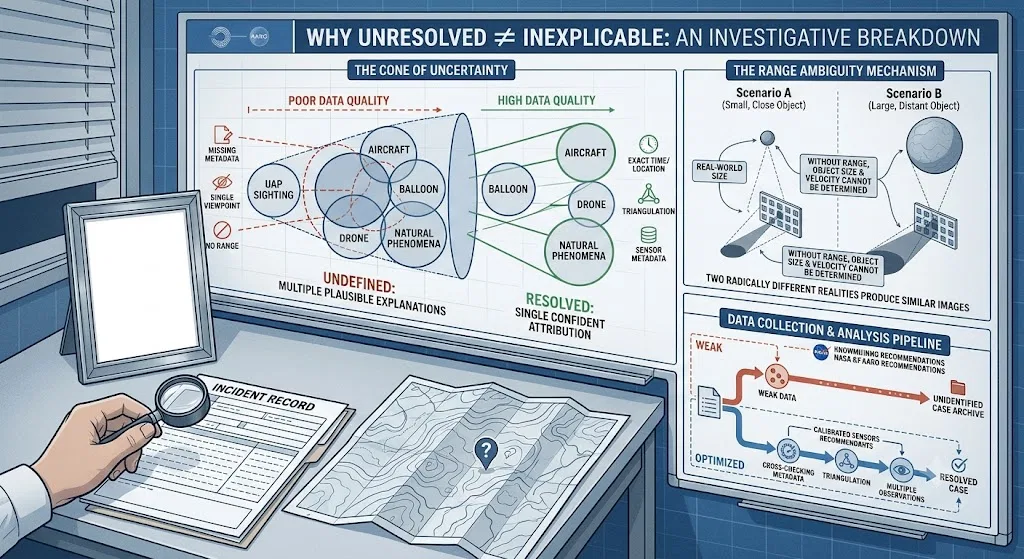
A case may remain unidentified simply because investigators lack range, timing, imagery or sensor data needed to test ordinary explanations.
On this page
- The difference between unidentified and inexplicable
- Which missing measurements matter most
- Why weak cases often resist both proof and debunking
Page outline Jump by section
Introduction
A UFO or UAP case can remain unresolved for a simple reason: investigators do not have enough information to determine what was observed. A photograph may show a bright dot without revealing its distance; a video may record apparent motion without the range needed to calculate true speed; an infrared image may lack the sensor settings needed to distinguish a real heat source from an artefact. Without precise timing, location, viewing direction or corroborating observations, ordinary explanations such as aircraft, balloons, satellites and birds may be impossible to confirm or exclude. NASA’s UAP study identified poor calibration, missing metadata, lack of multiple measurements and inadequate baseline data as major obstacles to analysis.[NASA Science]science.nasa.govNASA Science…
That makes unidentified a statement about the available evidence, not a synonym for inexplicable. The distinction is central to understanding why a residue of UFO cases survives investigation.
Unidentified is not the same as inexplicable
A case becomes unidentified when the available observations fail to support a sufficiently confident attribution. That is a much lower bar than demonstrating that every conventional explanation has been ruled out. An investigator may know that a video contains a physical object yet still be unable to say whether it is a balloon, aircraft, bird or something else.
The scale of this problem is visible in the latest annual data from the US All-domain Anomaly Resolution Office (AARO). Of 319 UAP reports covered by its FY2025 reporting period, AARO resolved 114 as ordinary objects or events, including balloons, birds, satellites, aircraft, unmanned aircraft, a rocket launch and a jet pack. Nine warranted additional specialist analysis. But 191 were moved into an “active archive” because there was insufficient information to determine whether their apparent performance was consistent with natural phenomena or known technology. Those cases remain available for reconsideration if corroborating information later appears or improved analytical techniques make more of the existing evidence usable.[AARO]aaro.milFY25 Consolidated Annual Report on UAPAARO FY25 Consolidated Annual Report on UAP…
That distinction matters because otherwise the unresolved category can be misread as a collection of objects known to possess extraordinary properties. It is not. In the same FY2025 dataset, 77 of the 319 reports contained too little information even to reach an analytical conclusion about the phenomenon’s morphology — what basic shape or visual form it had. Some reports describing apparently exceptional performance near sensitive locations arrived without accompanying technical data at all.[AARO]aaro.milFY25 Consolidated Annual Report on UAPAARO FY25 Consolidated Annual Report on UAP…
AARO’s released imagery demonstrates the issue case by case. In PR-017, recorded in Europe in 2024, investigators had only 30 seconds of mobile-phone video and judged the footage insufficient to determine what it showed. Other released cases go one stage further: PR-018 contains more than ten minutes of infrared footage, and AARO says it is highly confident that a physical object is present, yet the object’s ordinary-looking characteristics do not permit a more specific attribution with the information available.[AARO]aaro.milUAP ImageryAARO UAP Imagery…
Duration alone, therefore, does not make an observation scientifically decisive. Ten minutes of poorly constrained imagery can answer less than a short observation accompanied by reliable range, platform position, sensor parameters and independent tracking.
Which missing measurements matter most?
The central difficulty is that a camera records an image, not automatically an object’s physical dimensions, distance, trajectory or speed. Those quantities have to be derived from other measurements. When those measurements are absent, radically different real-world situations can produce similar pictures.
Range is especially important. A small nearby object and a much larger distant object can subtend the same angle in a camera image. The same ambiguity affects velocity: angular movement across the field of view cannot by itself tell investigators how fast an object is travelling in metres per second. Its distance and the movement of the observing platform have to be known or constrained. AARO has specifically noted that motion parallax — the apparent movement produced by an observer moving relative to a target and background — can make stationary or slow objects appear much faster.[AARO]aaro.milEffect of Forced Perspective and Parallax View on UAP…the effects of forced perspective and parallax can frequently explain excess…
This makes several categories of information disproportionately valuable:
- Exact time and position. These allow investigators to compare a sighting against aircraft traffic, satellite passes, launches, astronomical objects and weather conditions.
- Range or a way to derive it. Radar returns, laser ranging, stereoscopic observations or geometry from a moving calibrated platform can turn angular motion into meaningful estimates of actual speed and altitude.
- Sensor metadata. Zoom level, field of view, azimuth, elevation, exposure, observing mode and other settings are often essential for reconstructing what the instrument was actually seeing.
- Original imagery. Compression, cropping and re-encoding can remove information or introduce visual structures not present in the source data.
- Platform motion and orientation. If the camera is mounted on an aircraft or drone, investigators need to separate target motion from movement of the observer and sensor.
- Environmental measurements. Wind direction and speed are particularly useful when testing balloons, drifting objects or airborne material; temperature, clouds and atmospheric conditions matter for infrared and optical observations.
- A second independent observation. Another camera, radar or sensor can establish that a feature exists outside one instrument and may provide triangulation or another physical measurement.
NASA’s independent study placed particular emphasis on calibration and metadata such as time, location and observing mode. It also stressed the value of collecting UAP with multiple, well-calibrated sensors, because cross-checking different instruments helps distinguish genuine target characteristics from instrument-specific effects.[NASA Science]science.nasa.govNASA Science…
Calibration matters because cameras and infrared systems are measuring devices with limitations, not neutral windows onto a scene. Detector noise, automatic image processing, compression and changes in thermal contrast can alter how an object appears. NASA noted that some apparent anomalies have turned out to be sensor artefacts once suitable calibration information and metadata were considered.[NASA Science]science.nasa.govNASA Science…
One AARO release, PR-008 from Europe in 2022, illustrates the ambiguity particularly well. The infrared footage contains an apparent heat signature, but the available information does not establish whether it represents thermal emission from a physical object, reflected heat, an environmental temperature difference or a sensor-display error. Without enough data to discriminate among those possibilities, AARO says the phenomenon’s performance characteristics cannot be evaluated.[AARO]aaro.milUAP ImageryAARO UAP Imagery…
In other words, the missing information is not merely preventing investigators from naming the object. It can prevent them from determining whether the dramatic-looking property that made the case interesting — apparent heat, extreme speed or unusual movement — existed in the first place.
What changes when the necessary data are available?
Resolved cases provide a useful comparison because they show what additional measurements allow investigators to do.
The 2013 Aguadilla, Puerto Rico, video is a strong example. At first glance, infrared footage appeared to show an object moving rapidly, dividing into two and possibly entering the sea. AARO later reconstructed the aircraft’s trajectory and the sensor’s viewing direction using platform position and sensor parameters. That reconstruction indicated that two objects had been travelling together throughout the encounter and that they remained over land rather than entering the water. Their calculated movement was about 8 mph, close to the measured wind speed, with the original impression of high velocity largely produced by motion parallax.[AARO]aaro.milPuerto Rico UAP Case ResolutionAARO Puerto Rico UAP Case Resolution…
The video itself was imperfect: distance from the objects increased substantially, clouds partly obscured them and declining infrared contrast made them appear to disappear against the background. Yet enough contextual and sensor information survived to reconstruct the geometry. AARO consequently judged the encounter resolved with high confidence as showing no anomalous flight behaviour, while giving only moderate confidence to the more specific hypothesis that the objects were sky lanterns.[AARO]aaro.milPuerto Rico UAP Case ResolutionAARO Puerto Rico UAP Case Resolution…
That difference in confidence is instructive. Investigators do not always need to identify an object down to its exact make or model to answer the more important physical question. A case can establish with high confidence that the supposed extreme speed or transmedium behaviour was an observational effect even when the precise identity remains less certain.
The 2017 Al Taqaddum case in Iraq shows another combination of useful evidence. An aerostat recorded an object for 17½ minutes in infrared. Investigators had the full-motion video, metadata, the aerostat’s location, line-of-sight information and weather data. They were able to estimate the object’s altitude and speed, compare its motion with prevailing winds, examine its changing shape and test an alternative drone hypothesis. AARO concluded with high confidence that the object was consistent with a cluster of fully or partly inflated balloons.[AARO]aaro.milAl Taqaddam Case ResolutionAl Taqaddam Case ResolutionSeptember 18, 2025 — 8 Sept 2025 — AARO assesses that the visual and sensor data associated with the objec…
Other released resolutions follow the same logic. For a set of Western US observations, combining full-motion infrared video with commercial flight data allowed AARO to associate three distant points with conventional aircraft. In another case, additional longer-focal-length footage and commercial flight information helped identify an apparent object with a strange “wake” as probably an aircraft, while the wake itself was attributed to video-compression effects.[AARO]aaro.milUAP ImageryAARO UAP Imagery…
These examples expose the dividing line between a striking clip and an analysable event. The decisive evidence is often not a sharper image of the object but the otherwise mundane information surrounding it: where the camera was, which way it was pointing, when the recording occurred, how the sensor behaved, what the atmosphere was doing and what other objects occupied that patch of sky.

Why weak cases resist both proof and debunking
Poor data create a problem in both directions. They make extraordinary interpretations difficult to demonstrate, but they can also make specific ordinary explanations impossible to prove.
Suppose a witness records a featureless light for 15 seconds without exact coordinates or an accurate clock. Investigators might consider a satellite, aircraft, balloon or astronomical source plausible, but without time and position they may be unable to test those possibilities against independent records. If the object’s range is unknown, its apparent movement cannot establish extraordinary speed either. The result is not evidence for either side. It is an underdetermined case: several explanations remain compatible with what little is known.
AARO’s public case catalogue contains numerous examples of precisely this intermediate state. Some infrared recordings establish with high confidence that something physical was present, but show only unremarkable behaviour and lack enough information for attribution. Others cannot determine whether an apparent thermal feature was an object at all. AARO keeps such reports unresolved while explicitly stating that additional information could permit a more conclusive answer.[AARO]aaro.milUAP ImageryAARO UAP Imagery…
This explains why demanding that every UFO report be conclusively “debunked” sets an evidential standard that incomplete observations cannot always meet. To establish that a particular dot was, say, Flight ABC123, investigators need enough information to match it to that aircraft. If those data disappeared with the moment of observation, the ordinary hypothesis may remain plausible but unprovable.
The reverse inference is equally weak. Failure to prove that the light was an aircraft does not establish that it was something extraordinary. Missing range does not become evidence for extreme velocity; absent radar data do not demonstrate stealth; an unresolved infrared signature does not prove an unconventional heat source. Those conclusions require positive measurements.
This is why NASA described the broader UAP problem principally as a problem of data quality and systematic collection. Its study found current analysis hampered by poor sensor calibration, missing metadata, lack of multiple observations and insufficient baseline information. It recommended better-curated datasets and coordinated observations rather than attempting to extract certainty from inherently inadequate records.[NASA Science]science.nasa.govNASA Science…
Better collection changes the unresolved category
Investigators cannot recover measurements that were never made, so the most effective way to reduce the unresolved fraction is to improve data collection before and during future events. NASA has recommended multiple calibrated sensors, consistent metadata, rapid sharing of transient-event information and better curation of observations. Research groups developing purpose-built UAP observatories likewise emphasise triangulation, multispectral cameras, radar-derived range and velocity, environmental measurements and cross-sensor confirmation.[arXiv]arxiv.orgOpen source on arxiv.org.
The goal is not simply to collect more photographs. It is to transform sightings into datasets from which physical quantities can be measured. Two calibrated viewpoints can constrain range. Range plus angular movement can constrain velocity. Platform position and sensor orientation can reconstruct a trajectory. Weather data can test whether it drifted with the wind. Radar or independent imagery can establish whether an optical feature corresponds to an external object.
That approach is already visible in the changing UAP record. AARO says improved three-dimensional modelling has allowed it to resolve increasing numbers of reports involving satellite flares, while its FY2025 report distinguishes cases suitable for further specialist analysis from the much larger group whose principal limitation is insufficient data.[AARO]aaro.milFY25 Consolidated Annual Report on UAPAARO FY25 Consolidated Annual Report on UAP…
An unresolved UFO case therefore carries a narrower meaning than the word unexplained often suggests. Sometimes investigators genuinely encounter an observation worthy of additional analysis. But many cases reach no firm conclusion because the information needed to choose among competing explanations was never recorded, cannot be recovered or is too poor to support reliable measurement. In those circumstances, preserving “unidentified” as the answer is not an admission that ordinary explanations have failed. It is the scientifically appropriate recognition that the evidence does not yet discriminate among them.
Amazon book picks
Further Reading
Books and field guides related to Why Unresolved Does Not Mean Inexplicable. Use these as the next step if you want deeper reading beyond the article.
The UFO Experience: A Scientific Inquiry
The author belives that a number of UFO siting are still to be explained.
The UFO Handbook: A Guide to Investigating, Evaluating, and R...
An explanation of the usual reasons for confusing IFOs (identified flying objects) with UFOs and a survey of the tools used to investigat...
The Demon-Haunted World: Science as a Candle in the Dark
NEW YORK TIMES BESTSELLER • From the renowned astronomer and author of Cosmos comes a “powerful [and] stirring defense of informed ration...

How to Think About Weird Things: Critical Thinking for a New Age
First published 1994. Subjects: Critical thinking, Curiosities and wonders, Mind, body, spirit: disciplines & techniques, Parapsychology,...
eBay marketplace picks
Marketplace Samples
Live-tested eBay searches with available results related to this page.
Selected fromUFO poster oneBay.co.uk.


Current eBay listing
VINTAGE UFO FLYING SAUCERS COMIC ADVERTISING A2 POSTER PRINT


Current eBay listing
I Want To Believe UFO Poster Giclée Fine Art Heavyweight Print
Endnotes
1.
Source: science.nasa.gov
Link:https://science.nasa.gov/wp-content/uploads/2023/09/uap-independent-study-team-final-report.pdf
Source snippet
NASA Science...
2.
Source: aaro.mil
Title: FY25 Consolidated Annual Report on UAP
Link:https://www.aaro.mil/Portals/136/PDFs/FY25%20UAP%20Annual%20Report/AARO_FY2025_Consolidated_Annual_Report_on_UAP.pdf
Source snippet
AARO FY25 Consolidated Annual Report on UAP...
3.
Source: aaro.mil
Title: UAP Imagery
Link:https://www.aaro.mil/UAP-Cases/Official-UAP-Imagery/
Source snippet
AARO UAP Imagery...
4.
Source: aaro.mil
Link:https://www.aaro.mil/Portals/136/PDFs/Information%20Papers/AARO_Effect_of_Forced_Perspective_and_Parallax_View_on_UAP_Observations_2024.pdf
Source snippet
Effect of Forced Perspective and Parallax View on UAP...the effects of forced perspective and parallax can frequently explain excess...
5.
Source: aaro.mil
Link:https://www.aaro.mil/FAQ/
Source snippet
AARO FAQOptical phenomena, such as motion parallax, can explain how a stationary or slow-moving object can appear to be moving rapidl...
6.
Source: aaro.mil
Title: Puerto Rico UAP Case Resolution
Link:https://www.aaro.mil/Portals/136/PDFs/case_resolution_reports/AARO_Puerto_Rico_UAP_Case_Resolution.pdf
Source snippet
AARO Puerto Rico UAP Case Resolution...
7.
Source: aaro.mil
Title: Al Taqaddam Case Resolution
Link:https://www.aaro.mil/Portals/136/PDFs/case_resolution_reports/AARO_Al_Taqaddam_Case_Resolution_Final.pdf
Source snippet
Al Taqaddam Case ResolutionSeptember 18, 2025 — 8 Sept 2025 — AARO assesses that the visual and sensor data associated with the objec...
Published: September 18, 2025
8.
Source: arxiv.org
Link:https://arxiv.org/abs/2305.18566
9.
Source: arxiv.org
Title: arXiv Galileo Project Observatory Class System Architecture
Link:https://arxiv.org/abs/2506.00125
10.
Source: aaro.mil
Title: Congressional Press Products
Link:https://www.aaro.mil/Congressional-Press-Products/
11.
Source: aaro.mil
Title: AARO Historical Record Report Vol 1 2024
Link:https://www.aaro.mil/Portals/136/PDFs/AARO_Historical_Record_Report_Vol_1_2024.pdf
12.
Source: aaro.mil
Link:https://www.aaro.mil/
13.
Source: aaro.mil
Title: UAP Records
Link:https://www.aaro.mil/UAP-Records/
14.
Source: aaro.mil
Link:https://www.aaro.mil/UAP-Cases/UAP-Case-Resolution-Reports/
15.
Source: aaro.mil
Link:https://www.aaro.mil/Portals/136/PDFs/FOIA/2023%20FOIAs/23-F-0922_3.pdf
16.
Source: aaro.mil
Link:https://www.aaro.mil/Portals/136/PDFs/UAP_RECORDS_RESEARCH/History_and_Origin_of_KONA_BLUE_FINAL_508.pdf
17.
Source: aaro.mil
Link:https://www.aaro.mil/Portals/136/PDFs/FOIA/2023%20FOIAs/23-F-0010.pdf
18.
Source: nasa.gov
Title: update nasa shares uap independent study report names director
Link:https://www.nasa.gov/news-release/update-nasa-shares-uap-independent-study-report-names-director/
19.
Source: nasa.gov
Title: announces unidentified aerial phenomena study team members
Link:https://www.nasa.gov/general/nasa-announces-unidentified-aerial-phenomena-study-team-members/
20.
Source: science.nasa.gov
Link:https://science.nasa.gov/uap/
21.
Source: science.nasa.gov
Link:https://science.nasa.gov/uap/faqs/
22.
Source: nasa.gov
Link:https://www.nasa.gov/wp-content/uploads/2025/08/2024-agency-foia-log.xlsx?emrc=646ac0
23.
Source: mls.jpl.nasa.gov
Link:https://mls.jpl.nasa.gov/publications/
24.
Source: nasa.gov
Title: to release discuss unidentified anomalous phenomena report
Link:https://www.nasa.gov/news-release/nasa-to-release-discuss-unidentified-anomalous-phenomena-report/
25.
Source: nasa.gov
Link:https://www.nasa.gov/wp-content/uploads/2025/08/2022-agency-foia-log.xlsx?emrc=93a4ff
26.
Source: nasa.gov
Link:https://www.nasa.gov/wp-content/uploads/2025/08/fy-2025-q2-foia-log.xlsx?emrc=7b3b98
27.
Source: nasa.gov
Link:https://www.nasa.gov/sbir_sttr/
28.
Source: nasa.gov
Title: fy 2026 q1 foia log.xlsx
Link:https://www.nasa.gov/wp-content/uploads/2026/01/fy-2026-q1-foia-log.xlsx?emrc=2566e7
29.
Source: nasa.gov
Title: provides coverage of unidentified anomalous phenomena meeting
Link:https://www.nasa.gov/news-release/nasa-provides-coverage-of-unidentified-anomalous-phenomena-meeting/
30.
Source: nasa.gov
Link:https://www.nasa.gov/wp-content/uploads/2025/11/fy-2025-q4-foia-log.xlsx?emrc=75e66d
31.
Source: nasa.gov
Link:https://www.nasa.gov/
32.
Source: science.nasa.gov
Title: grant solicitations
Link:https://science.nasa.gov/researchers/sara/grant-solicitations/
33.
Source: arxiv.org
Link:https://arxiv.org/html/2506.00125v1
34.
Source: arxiv.org
Link:https://arxiv.org/html/2312.00558v3
35.
Source: case.org
Link:https://www.case.org/
36.
Source: GOV.UK
Title: ufo reports in the uk
Link:https://www.gov.uk/government/publications/ufo-reports-in-the-uk
37.
Source: nationalarchives.gov.uk
Link:https://www.nationalarchives.gov.uk/explore-the-collection/explore-by-time-period/postwar/ufo-reports/
38.
Source: cdn.nationalarchives.gov.uk
Link:https://cdn.nationalarchives.gov.uk/documents/podcast-transcript.pdf
39.
Source: cdn.nationalarchives.gov.uk
Link:https://cdn.nationalarchives.gov.uk/documents/ufo-files-reveal-behind-the-scenes-of-the-ufo-desk.pdf
40.
Source: nationalarchives.gov.uk
Link:https://www.nationalarchives.gov.uk/help-with-your-research/research-guides/ufos/
41.
Source: cdn.nationalarchives.gov.uk
Link:https://cdn.nationalarchives.gov.uk/documents/aug-2009-research-guide.pdf
42.
Source: ons.gov.uk
Link:https://www.ons.gov.uk/aboutus/transparencyandgovernance/freedomofinformationfoi/witnessesofunidentifiedaerialphenomena
43.
Source: uapcompany.com
Link:https://www.uapcompany.com/about
44.
Source: assets.publishing.service.gov.uk
Title: 20140624 FOI 01746 Rendlesham UFO Incident1980
Link:https://assets.publishing.service.gov.uk/media/5a7e4e1de5274a2e8ab47283/20140624_FOI_01746_Rendlesham_UFO_Incident1980.pdf
45.
Source: assets.publishing.service.gov.uk
Title: FOI UFO DMC publishing
Link:https://assets.publishing.service.gov.uk/media/5a7e3ea940f0b6230268a198/FOI_UFO_DMC_publishing.pdf
46.
Source: assets.publishing.service.gov.uk
Link:https://assets.publishing.service.gov.uk/media/5c1b71ee40f0b60bb17f6ec6/12790.pdf
Additional References
47.
Source: youtube.com
Title: Replay! NASA’s Release of the Unidentified Anomalous Phenomena Report
Link:https://www.youtube.com/watch?v=nuBMnluJfs0
Source snippet
Breaking Down UAP Footage with the Head of The Pentagon’s UAP Taskforce, Dr. Jon Kosloski...
48.
Source: youtube.com
Title: Public Meeting on Unidentified Anomalous Phenomena (Official NASA Broadcast)
Link:https://www.youtube.com/watch?v=bQo08JRY0iM
Source snippet
Replay! NASA's Release of the Unidentified Anomalous Phenomena Report...
49.
Source: dni.gov
Link:https://www.dni.gov/files/ODNI/documents/assessments/ATA-2025-Unclassified-Report.pdf
50.
Source: dni.gov
Link:https://www.dni.gov/index.php/newsroom/press-releases/press-releases-2023/3668-odni-releases-annual-report-on-unidentified-aerial-phenomena
51.
Source: dni.gov
Link:https://www.dni.gov/
52.
Source: war.gov
Link:https://www.war.gov/ufo/
53.
Source: youtube.com
Link:https://www.youtube.com/watch?v=mvsU4p0Gsas
Source snippet
The Government's Unresolved UAP Reports...
54.
Source: casece.com
Link:https://www.casece.com/
55.
Source: nps.edu
Link:https://nps.edu/documents/110773463/165192597/CTX-EAG-Special-Issue-2026.pdf
56.
Source: dni.gov
Title: 3667 2022 annual report on unidentified aerial phenomena
Link:https://www.dni.gov/index.php/newsroom/reports-publications/reports-publications-2023/3667-2022-annual-report-on-unidentified-aerial-phenomena