Within False Horizons
Can City Lights Create a False Horizon?
Roads, coastlines and aligned town lights can form a false level line that distorts where an airborne light seems to be moving.
On this page
- How roads and settlements form persuasive visual lines
- Why stars and ground lights become hard to separate
- How the wrong light boundary alters apparent aerial motion
Page outline Jump by section
Introduction
Yes. City lights, roads, coastlines and other organised patterns of illumination can create a convincing false nighttime horizon when the real earth–sky boundary is weak or invisible. The Federal Aviation Administration (FAA) explicitly warns that a dark scene containing ground lights and stars, as well as certain geometric patterns of ground lighting, can give pilots inaccurate visual information about the true horizon.[Federal Aviation Administration]faa.govFederal Aviation Administration Chapter 8. Medical Facts for PilotsFederal Aviation Administration Chapter 8. Medical Facts for Pilots
This matters when assessing UFO or UAP reports from aircraft because the apparent motion of a distant light is judged against the observer’s visual frame. If a line of streetlights, a shoreline settlement or a chain of lights across sloping terrain is unconsciously accepted as level, an airborne light can appear to climb, descend or move on an unexpected diagonal even when its actual trajectory is much less remarkable. The mechanism does not require poor eyesight or an obviously confused observer: aviation medicine treats false horizons as genuine perceptual hazards precisely because plausible visual structure can override an inadequate natural horizon.[PubMed Central (PMC)]pmc.ncbi.nlm.nih.govPub Med Central (PMC)Orientation and disorientation in aviationPubMed Central (PMC)Orientation and disorientation in aviation - PMCJanuary 3, 2013…
How roads and settlements form persuasive visual lines
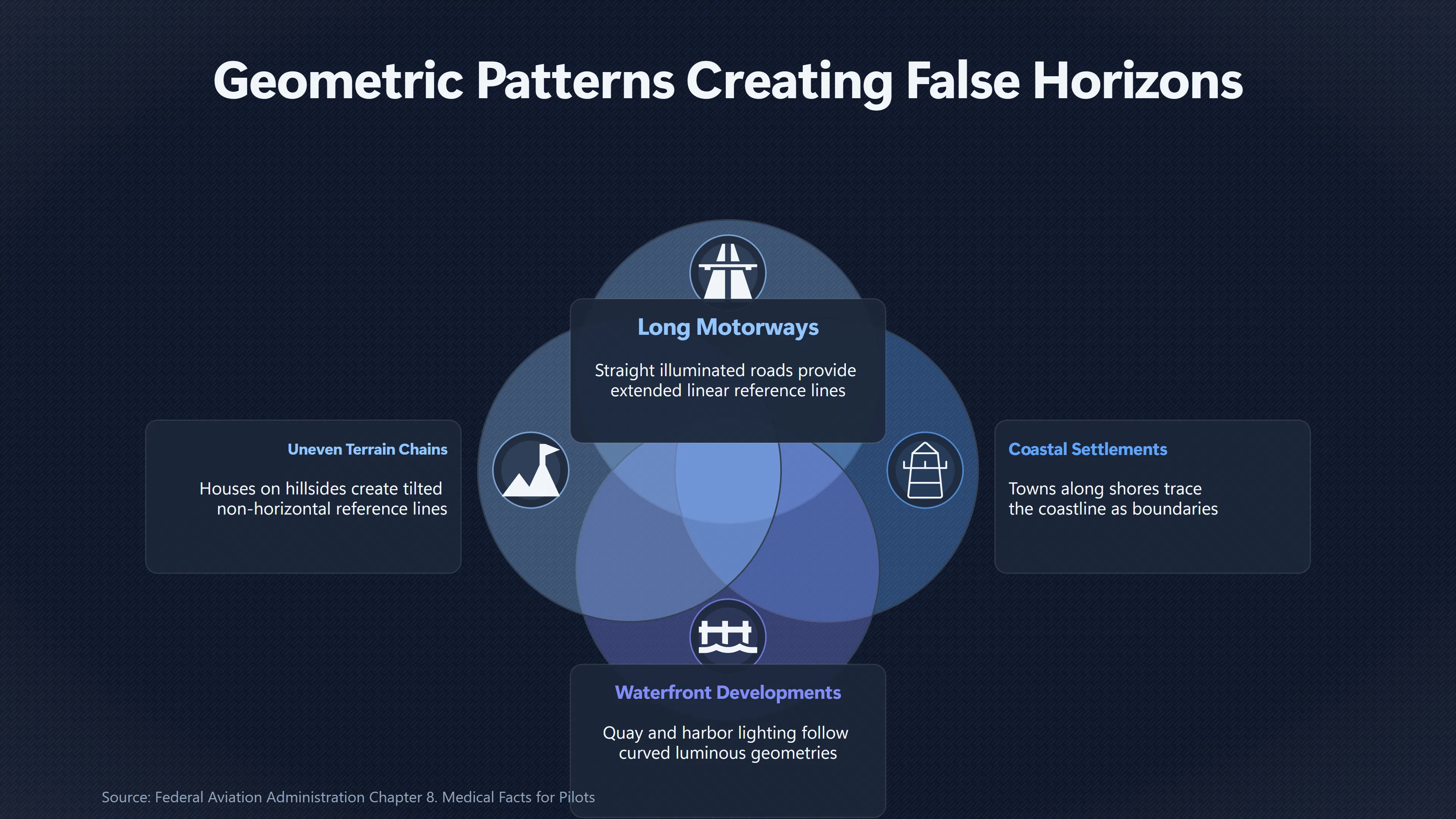
The important feature is not simply that lights are present. It is their geometry. A scattered collection of lights supplies points in the darkness; a road, waterfront or elongated settlement supplies something more powerful — an extended line that can be interpreted as a boundary or reference for level.
The FAA’s Aeronautical Information Manual specifically identifies “certain geometric patterns of ground light” as capable of producing false-horizon illusions.[Federal Aviation Administration]faa.govFederal Aviation Administration Chapter 8. Medical Facts for PilotsFederal Aviation Administration Chapter 8. Medical Facts for Pilots SKYbrary, drawing on aviation-safety material, gives more concrete examples: at night or in poor visibility, pilots may mistake a set of streetlights or a shoreline for the horizon.[Skybrary]skybrary.aeroVisual Illusions | SKYbrary Aviation SafetyVisual Illusions | SKYbrary Aviation Safety… A medical review of aviation spatial disorientation similarly notes that lines of streetlights and waterfront lighting can constitute convincing false horizons.[PubMed Central (PMC)]pmc.ncbi.nlm.nih.govPub Med Central (PMC)Orientation and disorientation in aviationPubMed Central (PMC)Orientation and disorientation in aviation - PMCJanuary 3, 2013…
Several configurations are therefore particularly troublesome:
- Long roads and motorways. A sufficiently straight illuminated road produces an extended line with a clear direction. Military night-flying guidance separately warns that lights along a straight road can even be mistaken for runway or approach lighting, illustrating how readily organised ground illumination can acquire an incorrect spatial meaning.[Chief of Naval Air Training]cnatra.navy.milChief of Naval Air TrainingNAVAL AIR TRAINING COMMANDAugust 29, 2024…
- Coastal settlements. Towns concentrated along a shore naturally trace the coastline. If the sea beyond is almost completely black, the illuminated strip may become the strongest apparent boundary in the scene.
- Waterfronts and harbour developments. Lighting can follow quays, bays and shore roads for kilometres. From altitude, the observer may see the luminous geometry while losing the dark land or water that explains it.
- Settlements on uneven terrain. A chain of houses or roads following a hillside may produce a conspicuous line that is not horizontal. If that line is treated as level, the observer’s reference frame is tilted.
- Sparse linear development. Even widely separated lights can imply a continuous line when the intervening terrain cannot be seen. The visual system does not need a brightly illuminated strip; a sequence of points may be sufficient to establish apparent structure.
A first-hand account published by the Aircraft Owners and Pilots Association describes the effect vividly. During a moonless flight off Long Island, the pilot encountered fishing-boat lights spread across dark water beneath a star-filled sky. Sea and sky appeared to merge, producing a powerful sensation of being steeply banked. The same account warns that rows of lights along highways, shorelines and mountainsides can create false horizons.[AOPA]aopa.orgInto The DarknessInto The Darkness - AOPANovember 5, 1999… The account is anecdotal rather than experimental evidence, but it closely matches the hazard described independently in FAA and aviation-medicine guidance.[Federal Aviation Administration]faa.govFederal Aviation Administration Chapter 8. Medical Facts for PilotsFederal Aviation Administration Chapter 8. Medical Facts for Pilots
The resulting false horizon need not correspond to any physically meaningful boundary. A road running diagonally across the landscape is not an earth–sky boundary at all. Yet in a largely black visual field, its length, regularity and continuity can make it more useful to perception than the true horizon, which may be only faintly detectable.
Why stars and ground lights become hard to separate
Night removes many of the cues that normally tell an observer whether a light is on the ground, in the atmosphere or at astronomical distance. Daylight provides visible terrain, surface texture, haze gradients, shadows and a recognisable earth–sky boundary. Darkness can reduce the same scene to isolated luminous points against blackness.
US Navy training material describes this problem as confusion with ground lights, or cultural lighting. It warns that pilots can mistake ground lights for stars and consequently place an aircraft in an unusual attitude while trying to keep the supposed stars above them. It also notes that, under overcast conditions, unlit terrain can blend into the dark sky so thoroughly that the terrain itself appears to belong to the sky.[Chief of Naval Air Training]cnatra.navy.milChief of Naval Air TrainingNAVAL AIR TRAINING COMMANDAugust 21, 2024… Historical US military spatial-disorientation material records the same phenomenon: ground lights may be confused with stars and with the horizon at night.[NTSB Data]data.ntsb.govData Other Pertinent Forms and ReportsNTSB DataOther Pertinent Forms and Reports - Spatial Disorientation Reference MaterialJuly 8, 2001…
Coastlines are especially revealing because dark water can erase the normal separation between illuminated land and sky. SKYbrary’s night-flying guidance explains that when approaching the shore of an ocean or large lake, darkness over the water can make shoreline lights appear to be stars.[Skybrary]skybrary.aeroGeneral Aviation Night Flying Guidance | SKYbrary Aviation SafetyGeneral Aviation Night Flying Guidance | SKYbrary Aviation Safety The apparent location of the earth–sky boundary can therefore migrate towards whatever distribution of lights provides the most persuasive structure.
That produces two related but distinct errors. In one, individual ground lights are categorised as celestial or airborne lights. In the other, a whole arrangement of ground lights becomes the apparent horizon. They can occur together. A pilot may perceive some lights as stars while simultaneously using another luminous line as level, creating a coherent-looking but geometrically incorrect picture of the outside world.
This is why the phrase “clear night” can be misleading in witness assessment. Clear meteorological conditions do not guarantee a strong visual horizon. A peer-reviewed review of aviation orientation notes that night flight involves a profound reduction in visual information even under apparently clear conditions, with stars and ground lights becoming confusable and waterfront or street lighting capable of defining false horizons.[PubMed Central (PMC)]pmc.ncbi.nlm.nih.govPub Med Central (PMC)Orientation and disorientation in aviationPubMed Central (PMC)Orientation and disorientation in aviation - PMCJanuary 3, 2013…

How the wrong light boundary alters apparent aerial motion
For a UFO or UAP report, the crucial consequence is not necessarily that the observer thinks the aircraft itself is tilted. It is that the coordinate system against which another light is being judged may be wrong.
Consider a distant light that moves slowly from left to right while maintaining roughly constant elevation relative to the true horizon. If the observer instead adopts a line of ground lights that slopes upwards from left to right, the target’s track no longer looks level relative to that reference. It can appear to descend towards one end of the scene. Reverse the slope of the false horizon and the same physical track can appear to climb.
The effect can become stronger if the observer’s own aircraft changes attitude. Aviation medicine explains that a pilot inadvertently entering a gentle bank may not receive a compelling bodily sensation that the aircraft is tilted; after the turn stabilises, it can continue to feel effectively “wings level”.[PubMed Central (PMC)]pmc.ncbi.nlm.nih.govPub Med Central (PMC)Orientation and disorientation in aviationPubMed Central (PMC)Orientation and disorientation in aviation - PMCJanuary 3, 2013… If an external light is being watched during that process, several reference frames are now changing at once: the target’s actual line of sight, the aircraft’s attitude and the falsely perceived horizon.
That distinction is important in UAP analysis. A witness can accurately report the appearance of a light rising, dipping or travelling diagonally without that description uniquely establishing equivalent motion through three-dimensional space. Apparent angular movement is what the eye directly observes; speed, altitude and trajectory are interpretations that require reliable reference geometry and, ideally, independent measurements.
The All-domain Anomaly Resolution Office (AARO) makes the broader point that familiar objects can appear anomalous under difficult viewing conditions. Its public guidance notes that conventional aircraft can be misidentified when viewed under unusual angles or low visibility, while celestial objects can appear to hover or manoeuvre because of perceptual and relative-motion effects.[AARO]aaro.milOpen source on aaro.mil. A false ground-light horizon is one specific mechanism by which such relative-motion judgements can be distorted; it should not be treated as a universal explanation for unexplained reports.
What makes this explanation credible — and what does not
False-horizon interpretation is strongest when the geometry of the reported scene actually supports it. Simply saying that an observation occurred at night is insufficient. The hypothesis becomes more persuasive when several conditions coincide: the natural horizon was weak or absent; the view contained a long road, shoreline, waterfront or organised settlement lighting; the proposed false line was noticeably tilted relative to the true horizon; and the reported anomaly consisted primarily of unexpected angular movement relative to that line.
It is especially useful to reconstruct the scene geographically. A map can establish whether an illuminated motorway, coast or elongated settlement lay in the witness’s viewing direction. Aircraft attitude and heading data, where available, can establish the orientation of the cockpit relative to those features. Weather records can show whether haze, cloud or darkness over water would have weakened the natural horizon. A photograph or video with identifiable stars can be even more useful because astronomical positions provide an external reference independent of the ground-light pattern.
Conversely, the explanation weakens when the true horizon is plainly and continuously visible, the ground-light geometry does not match the alleged false line, or independent sensor data demonstrate target motion that cannot be produced by changing visual reference alone. False-horizon effects also do not automatically explain a light’s colour, flashing pattern, disappearance or physical identity. Those require separate analysis.
This restraint matters because aviation literature establishes the existence and plausibility of the illusion, not that any particular UAP sighting was caused by it. FAA guidance says geometric ground-light patterns can provide inaccurate attitude information; SKYbrary identifies streetlights and shorelines as examples; aviation medicine describes waterfront and street lighting as convincing false horizons.[faa.gov]faa.govFederal Aviation Administration Chapter 8. Medical Facts for PilotsFederal Aviation Administration Chapter 8. Medical Facts for Pilots Those sources justify testing the mechanism. They do not justify applying it to a case without reconstructing the actual viewing geometry.
The key clue is the reference frame
Ground-light false horizons are most useful in UAP investigation when a report centres on motion that seemed extraordinary because of where the witness believed “level” to be. Roads, coastal towns and waterfront lighting can form long visual lines; dark terrain or water can erase the contextual information showing that those lines belong to the ground; and stars may become difficult to distinguish from terrestrial illumination. The observer can consequently inherit a coherent but incorrect nighttime landscape.
That mechanism helps explain why a light need not perform a genuinely dramatic manoeuvre to generate a dramatic description. A modest track viewed against a tilted false horizon can acquire an apparent climb or descent, while banking or turning of the observer’s own aircraft can further change the light’s position within the visual field. FAA and military guidance treat the underlying illusion seriously because the same perceptual mistake can cause pilots themselves to adopt inappropriate aircraft attitudes.[Federal Aviation Administration]faa.govFederal Aviation Administration Chapter 8. Medical Facts for PilotsFederal Aviation Administration Chapter 8. Medical Facts for Pilots
For UFO/UAP assessment, the practical lesson is therefore narrower than “night observations are unreliable”. Night observations can be perfectly useful, but a reported trajectory is only as trustworthy as the spatial references used to derive it. Where an airborne sighting occurred above dark water, featureless terrain or an illuminated road-and-settlement pattern, reconstructing the true horizon and the geometry of the ground lights can materially change what the reported aerial motion means.
Amazon book picks
Further Reading
Books and field guides related to Can City Lights Create a False Horizon?. Use these as the next step if you want deeper reading beyond the article.
Human Factors in Flight
The late Captain Frank H Hawkins FRAes, M Phil, was Human Factors Consultant to KLM, for whom he had flown for over 30 years as line capt...
The Pilot's Manual: Flight School
Time is money in an airplane and with an instructor. Effective for both preflight learning and post-flight briefings, Flight School will...

Stick and Rudder
First published 1972. Subjects: Aerodynamics, Flight, Piloting, Airplanes, Airplanes, piloting.
eBay marketplace picks
Marketplace Samples
Live-tested eBay searches with available results related to this page.
Selected fromUFO poster oneBay.co.uk.

Current eBay listing
VINTAGE UFO FLYING SAUCERS COMIC ADVERTISING A2 POSTER PRINT
Current eBay listing
I Want To Believe UFO Poster Giclée Fine Art Heavyweight Print
Endnotes
1.
Source: faa.gov
Title: Federal Aviation Administration Chapter 8. Medical Facts for Pilots
Link:https://www.faa.gov/Air_traffic/publications/atpubs/aim_html/chap8_section_1.html
2.
Source: faa.gov
Link:https://www.faa.gov/lessons_learned/rotorcraft/accidents/N828AC
3.
Source: skybrary.aero
Title: Visual Illusions | SKYbrary Aviation Safety
Link:https://skybrary.aero/index.php/articles/visual-illusions
Source snippet
Visual Illusions | SKYbrary Aviation Safety...
4.
Source: cnatra.navy.mil
Link:https://www.cnatra.navy.mil/local/docs/pat-pubs/P-457.pdf
Source snippet
Chief of Naval Air TrainingNAVAL AIR TRAINING COMMANDAugust 29, 2024...
Published: August 29, 2024
5.
Source: aopa.org
Title: Into The Darkness
Link:https://www.aopa.org/news-and-media/all-news/1999/november/flight-training-magazine/into-the-darkness
Source snippet
Into The Darkness - AOPANovember 5, 1999...
Published: November 5, 1999
6.
Source: cnatra.navy.mil
Link:https://www.cnatra.navy.mil/local/docs/pat-pubs/P-478.pdf
Source snippet
Chief of Naval Air TrainingNAVAL AIR TRAINING COMMANDAugust 21, 2024...
Published: August 21, 2024
7.
Source: data.ntsb.gov
Title: Data Other Pertinent Forms and Reports
Link:https://data.ntsb.gov/Docket/Document/docBLOB?FileExtension=.PDF&FileName=Other+Pertinent+Forms+and+Reports+-+Spatial+Disorientation+Reference+Material-Master.PDF&ID=40075592
Source snippet
NTSB DataOther Pertinent Forms and Reports - Spatial Disorientation Reference MaterialJuly 8, 2001...
Published: July 8, 2001
8.
Source: skybrary.aero
Title: General Aviation Night Flying Guidance | SKYbrary Aviation Safety
Link:https://skybrary.aero/index.php/articles/general-aviation-night-flying-guidance
9.
Source: aaro.mil
Link:https://www.aaro.mil/
10.
Source: aaro.mil
Link:https://www.aaro.mil/Next-AARO-Home-redesign/Next-Parent/Next-UAP-Report-Documents/poster/dividLink/
11.
Source: history.navy.mil
Title: mil U-2s, UFOs, and Operation Blue Book
Link:https://www.history.navy.mil/content/history/nhhc/browse-by-topic/disasters-and-phenomena/u2s-ufos-and-operation-blue-book.html
12.
Source: pilot-protection-services.aopa.org
Title: everything is different at night
Link:https://pilot-protection-services.aopa.org/news/2022/december/01/everything-is-different-at-night?_gac=1.250269556.1737746367.CjwKCAiAkc28BhB0EiwAM001TTIe7rWVLYBB82vnLLonbzOK-4V54gMS8LhPQGwMFS335GkZxDrjJhoCNs8QAvD_BwE
13.
Source: faa.gov
Title: Chapter 8. Medical Facts for Pilots
Link:https://www.faa.gov/air_traffic/publications/atpubs/aim/aim0801.html
14.
Source: faa.gov
Link:https://www.faa.gov/air_traffic/publications/atpubs/aim/aim1002.html
15.
Source: faa.gov
Title: Chapter 2. Aeronautical Lighting and Other Airport Visual Aids
Link:https://www.faa.gov/air_traffic/publications/atpubs/AIM/aim0201.html
16.
Source: aopa.org
Title: AS F Safety Spotlight
Link:https://www.aopa.org/news-and-media/all-news/2009/february/flight-training-magazine/asf-safety-spotlight
17.
Source: aopa.org
Title: Proficient Pilot
Link:https://www.aopa.org/news-and-media/all-news/2007/october/pilot/proficient-pilot-%2810%29
18.
Source: aopa.org
Title: Learning Experiences
Link:https://www.aopa.org/news-and-media/all-news/1998/july/flight-training-magazine/learning-experiences
19.
Source: faa.gov
Link:https://www.faa.gov/Air_traffic/publications/atpubs/aim_html/chap7_section_6.html
20.
Source: faa.gov
Link:https://www.faa.gov/air_traffic/publications/atpubs/aip_html/chap7_section_6.html
21.
Source: aaro.mil
Link:https://www.aaro.mil/UAP-Cases/Official-UAP-Imagery/4/
22.
Source: aaro.mil
Link:https://www.aaro.mil/FAQ/
23.
Source: aaro.mil
Title: AAR O UAP Trends All-domain Anomaly Resolution Office UAP REPORTING TRENDS
Link:https://www.aaro.mil/UAP-Cases/UAP-Reporting-Trends/
24.
Source: aaro.mil
Link:https://www.aaro.mil/Next-AARO-Home-redesign/Next-Parent/Next-AARO-UAP-Trends/
25.
Source: aopa.org
Title: Tricked by Illusions
Link:https://www.aopa.org/training-and-safety/online-learning/safety-spotlights/spatial-disorientation/tricked-by-illusions
26.
Source: aopa.org
Title: Night Flying
Link:https://www.aopa.org/training-and-safety/students/crosscountry/skills/night-flying
28.
Source: pmc.ncbi.nlm.nih.gov
Title: Pub Med Central (PMC)Orientation and disorientation in aviation
Link:https://pmc.ncbi.nlm.nih.gov/articles/PMC3710190/
Source snippet
PubMed Central (PMC)Orientation and disorientation in aviation - PMCJanuary 3, 2013...
Published: January 3, 2013
29.
Source: ncbi.nlm.nih.gov
Title: NCBIPhysiology Of Spatial Orientation
Link:https://www.ncbi.nlm.nih.gov/sites/books/NBK518976/
Source snippet
StatPearls - NCBI Bookshelf...
30.
Source: pmc.ncbi.nlm.nih.gov
Link:https://pmc.ncbi.nlm.nih.gov/articles/PMC12420934/
31.
Source: ncbi.nlm.nih.gov
Link:https://www.ncbi.nlm.nih.gov/books/NBK518976/?report=printable
32.
Source: pubmed.ncbi.nlm.nih.gov
Link:https://pubmed.ncbi.nlm.nih.gov/29557053/
33.
Source: verticalmag.com
Title: False Horizon
Link:https://verticalmag.com/features/falsehorizon/
34.
Source: manuals.plus
Title: Aeronautical Information Manual
Link:https://manuals.plus/m/61b1a4dfdca89a6b1c154da80f647becfc238469032fe813b9d0c6360231f1b9
35.
Source: pmc.ncbi.nlm.nih.gov
Link:https://pmc.ncbi.nlm.nih.gov/articles/PMC7150324/
36.
Source: ncbi.nlm.nih.gov
Link:https://www.ncbi.nlm.nih.gov/books/NBK621360/
37.
Source: nationalarchives.gov.uk
Title: UF O reports
Link:https://www.nationalarchives.gov.uk/explore-the-collection/explore-by-time-period/postwar/ufo-reports/
38.
Source: www2.anac.gov.br
Link:https://www2.anac.gov.br/anacpedia/ing-por/tr4373.htm
39.
Source: www2.anac.gov.br
Link:https://www2.anac.gov.br/anacpedia/ing_por/tr4373.htm
Additional References
40.
Source: youtube.com
Title: ICEFLAGS: Unmasking the In-Flight Illusions
Link:https://www.youtube.com/watch?v=uRZO1LRLQ4I
Source snippet
This selection of videos explains night flying visual illusions, detailing how ground-light patterns, star alignment, and featureless ter...
41.
Source: defense.gov
Link:https://www.defense.gov/News/News-Stories/Article/Article/3701297/dod-report-discounts-sightings-of-extraterrestrial-technology/
42.
Source: bassoft.com
Link:https://www.bassoft.com/book
43.
Source: shutterstock.com
Link:https://www.shutterstock.com/search/coastline-night
44.
Source: disclosdex.com
Link:https://disclosdex.com/documents/2026-pursue-release-03-063-nasa-uap-d017-preliminary-gemini-4-crew-debriefing-part-ii-1965
45.
Source: faatest.com
Link:https://www.faatest.com/books/ifrh/6.htm
46.
Source: shutterstock.com
Link:https://www.shutterstock.com/search/plane-flying-night
47.
Source: faraim.org
Link:https://www.faraim.org/faa/aim/chapter-8/section-8-1-5.html
48.
Source: scribd.com
Link:https://www.scribd.com/document/766646406/AVIATION-SAFETY-BULLETIN-issue-3
49.
Source: studylib.net
Link:https://studylib.net/doc/25531099/pilot-s-handbook-of-aeronautical-knowledge—aeromedical-